



Abstract
Generation Z (Gen Z), the ‘sustainability generation’, drives higher education institutions (HEIs) to adapt to evolving environmental values. Understanding (Gen Z) sustainable consumption behaviours provides insights for HEIs aiming to embed sustainability in their values, policies and communications. This study uses configurational theorizing and fuzzy-set qualitative comparative analysis (fsQCA) with data from 117 Thai undergraduates to identify pathways linked to high and low sustainability behavioural intentions. Results show that individual and contextual factors shape these intentions. The findings offer theoretical, empirical and practical guidance for HEIs and policymakers to effectively promote sustainability and align with Gen Z’s expectations.
Introduction
For-profit organizations have long recognized the value of integrating sustainability into business processes and operational decisions. Porter and Kramer (2011) contended that sustainability aligns with, rather than contradicts, a for-profit mission, as firms can create economic value while addressing social and environmental challenges through shared value. Accordingly, over the past three decades, companies have moved beyond viewing sustainability as a compliance requirement and have increasingly embedded it within their core philosophies and strategies (Dyllick & Hockerts, 2002; Lee et al., 2025). This emphasis on sustainability has also gained momentum in higher education institutions (HEIs). Like corporations, HEIs have shown growing interest in incorporating sustainable practices into curricula, operations and community engagement, often through the establishment of sustainability institutes that integrate educational and operational goals.
Scholars argue that, given their mission and organizational structures, HEIs have a moral and social responsibility to equip graduates with the knowledge and skills needed to engage in sustainable practices in their personal and professional lives as future business leaders (Baker-Shelley, 2016). Ragazzi and Ghidini (2017) noted that universities can significantly influence environmental outcomes through sustainability-focused curricula and campus operations, while also fostering a broader culture of sustainability by educating future generations. Guided by the 2030 Global Sustainable Development Goals (SDGs), HEIs in the USA and globally have increasingly introduced courses and research initiatives that promote sustainability across diverse curricula. Business faculty, in particular, have expanded the integration of sustainability topics into their teaching and scholarship (Kara & Min, 2024), alongside a growing emphasis on interdisciplinary and transdisciplinary approaches (Agbedahin, 2019).
Beyond the moral and economic rationale for sustainability initiatives, HEIs are responding to increasing demand from students, particularly Generation Z (Gen Z), who place high value on corporate social responsibility (CSR; Phan & Nguyen, 2025a), exhibits strong aspirations for sustainable consumption and actively engages in sustainable practices both on and off campus (Kim et al., 2020). As the primary student demographic, Gen Z exerts significant influence on HEIs; their sustainability-oriented values and environmental concerns compel institutions to adapt in order to remain relevant (Grunwald et al., 2025b). Accordingly, HEIs must align their missions and operations with the SDGs and clearly communicate their sustainability commitments to stakeholders. Therefore, HEIs’ sustainability initiatives should emphasize fostering cultural and mindset shifts, clearly define targeted behaviours, address underlying drivers and implement focused interventions to promote durable and meaningful change (Quoquab & Mohammad, 2020; Wang et al., 2019).
However, HEIs are complex organizations involving multiple influential stakeholders, including faculty, students, governments and industry, all of whom shape institutional operations and strategic directions. Sustainability concept further complicates this process, as stakeholders often hold divergent or conflicting expectations about it. Moreover, the effects of sustainability initiatives are typically not immediate but emerge over time. Sustainability-related actions are also prone to social desirability bias, and prior research highlights the presence of a value–action gap (VAG), whereby stakeholders’ stated intentions may diverge from their actual behaviours (Grunwald et al., 2025a). Finally, literature emphasizes that sustainability research is complicated by uncertainty, evolving expectations, limited knowledge, VAG, market volatility, behavioural barriers, conflicting stakeholder signals, statistical asymmetry, hypocrisy and social desirability bias. These factors hinder precise identification of causal relationships underlying sustainability behaviours.
Complexity theory suggests that conventional quantitative approaches assuming linear relationships may be inadequate for capturing such dynamics. Prior research has largely adopted variable-centred explanations focused on single determinants (e.g., Lidgren et al., 2006) or segment-based targeting derived from student clustering and profiling (Bask et al., 2020; Lambrechts et al., 2018). Consequently, configurational methods such as fuzzy-set qualitative comparative analysis (fsQCA) offer a more suitable approach, as they accommodate multiple interacting conditions and reveal equifinal causal pathways. fsQCA (Ragin, 2008) is an asymmetric analytical technique that integrates qualitative reasoning with quantitative analysis, enabling the examination of large samples with enhanced explanatory power (Pappas & Woodside, 2021; Woodside, 2013; Wu et al., 2014). Despite its growing application, fsQCA remains underutilized in studying the interplay between sustainability expectations, behavioural intentions and their determinants in HEIs’ sustainability transformations (Grunwald et al., 2025b), particularly across diverse cultural contexts such as Thailand. Hence, to address research gaps, this study draws on the theory of planned behaviour (TPB) and applies fsQCA to answer the following research question:
Research question: In what ways do individual-level collectivist values, perceived incentives, interest in sustainability and sense of social responsibility among Gen Z consumers combine across different configurational pathways to shape their intentions to engage in sustainable behaviours?
By uncovering the combinatorial complexity and asymmetric relationships among factors shaping Gen Z’s sustainability behaviours, this study makes several contributions to the literature (Farrell & Phungsoonthorn, 2020; Phan & Nguyen, 2025a). First, it is among the earliest empirical studies to apply the fsQCA method to examine determinants of Gen Z’s sustainability behaviours in an Asian context (Kolodinsky et al., 2010; Phan & Nguyen, 2025b). Beyond identifying statistical significance, fsQCA captures configurational causality and provides deeper qualitative insights, enabling more nuanced interpretation and shifting managerial attention beyond surface-level metrics (Brush et al., 2024; Chen et al., 2025; Chen & Chen, 2025; Patrício & Ferreira, 2023).
Second, this study focuses on undergraduate business students, a Gen Z cohort that exhibits strong concern for CSR (Phan & Nguyen, 2025a) but is frequently criticized for being shaped by business education that prioritizes shareholder value over environmental and social impacts, stakeholder relationships and ethical leadership (Charlebois & Foti, 2017; García-Feijoo et al., 2020). Prior research emphasizes the need to reorient business education from a shareholder-centric to a stakeholder-focused approach (Saunders et al., 2022). Accordingly, firms increasingly expect business graduates to possess sustainability knowledge, adopt sustainability-oriented mindsets and implement innovative solutions, skills essential for creating shared value (Chiang & Chen, 2022; Sroufe, 2020; Uddin & Khan, 2016).
Finally, this study provides empirical evidence from a newly industrialized country characterized by distinct cultural and contextual factors. These insights contribute to a broader understanding of regional similarities and differences in sustainability perspectives within higher education. Overall, the study advances research on sustainability transformation and informs the design of sustainability interventions for HEIs to foster sustainable innovation (Baroudi & ElSayary, 2024) and enhance understanding of sustainable consumption behaviours among Thailand’s Gen Z cohort.
Literature Review and Theoretical Framework
Research on Gen Z’s sustainable consumption intentions in Thailand remains limited, with prior studies largely relying on variance-based quantitative methods. Tangwanichagapong et al. (2017) showed that waste management initiatives in HEIs positively shaped Gen Z students’ environmental attitudes. Similarly, Wonglorsaichon (2025) found that environmental concern, environmental knowledge and social influence enhanced green attitudes (Mishra & Farooqi, 2024) and purchase intentions, while Rosdiana et al. (2025) reported that environmental orientation and knowledge increased Gen Z’s willingness to reduce plastic waste in Indonesia and Thailand. Although these studies offer valuable insights, they adopt a net-effects logic that emphasizes the independent influence of individual factors, potentially overlooking combinations of conditions that jointly produce sustainable consumption intentions. A configurational approach, such as fsQCA, addresses this limitation by examining how environmental, cognitive and social factors interact to yield similar outcomes in the Thai context. To the authors’ knowledge, configurational research on Gen Z’s sustainable consumption intentions in Thailand remains scarce.
Thailand Country Context
Although Thailand is classified as an upper-middle-income economy, its economic and fiscal conditions remain constrained by a slow post-COVID-19 recovery, high household debt, fiscal deficits and political instability (World Bank Group, 2025). While Thailand demonstrates a strong commitment to the UN SDGs, ranking first among the Association of Southeast Asian Nations (ASEAN) countries and 43rd globally in the 2025 SDG index (Nation Thailand, 2025), the role of Thai HEIs in advancing SDG 4 (quality education and lifelong learning) remains inadequately documented in global sustainability reporting.
Thailand has 138 HEIs, with sustainability reporting concentrated in larger institutions. In 2019, 37 HEIs joined UI GreenMetric and 19 the Times Higher Education (THE) Impact Rankings, with large HEIs comprising 56.8% and 79% of participants, respectively (Tabucanon, 2021). Institutional policy and strategic vision drive sustainability performance, with large HEIs more active in ‘green university’ initiatives. Smaller or newer HEIs are advised to adopt clear sustainability strategies, focusing on waste management, safety and well-being and experiential learning such as project-based learning (PBL; Oludoye & Supakata, 2024). Understanding student engagement in sustainability practices is therefore both theoretically and practically important. Supporting this view, Janmaimool and Chontanawat (2021) found that Thai university students’ sustainable energy behaviours are primarily driven by cognitive factors, including climate change awareness, perceived self-efficacy and self-interest.
Complexity Theory
Complexity theory examines systems with nonlinear, dynamic interactions (Cartwright, 1991). It emphasizes analyzing interdependent components, rather than isolating variables (Pappas, 2019), as linear approaches fail in contexts with diverse actors and nonlinear decision-making (Farmaki et al., 2021). Concepts such as equifinality and causal asymmetry show how different factors can yield divergent outcomes depending on context (Wu et al., 2014). Sustainability research reflects these complexities, shaped by evolving concepts, diverse stakeholder expectations and substantial upfront investments (Grunwald et al., 2025b; Khizar et al., 2024). Hence, complexity theory aids understanding by examining interactions among social, economic and environmental factors. Methods like fsQCA better capture multiple causal pathways, nonlinear relationships and dynamic influences.
TPB
Understanding sustainable consumer behaviour is often grounded in rational decision-making models, particularly the TPB (Ajzen, 1985), which has been widely applied in sustainability contexts (Chanda et al., 2025; Dhir et al., 2021; Ferdous, 2010; Jain, 2018). TPB posits that behavioural intentions are shaped by attitudes, subjective norms and perceived behavioural control. Although these constructs effectively explain intention formation, favourable intentions do not always translate into action due to contextual barriers such as limited resources, institutional constraints or insufficient skills and motivation. This intention–behaviour gap underscores the need to consider broader contextual and value-based factors.
Building on this, Phan and Nguyen (2025a) integrated attribution theory with TPB to examine how consumers interpret corporate environmental claims. They highlighted that perceived authenticity of corporate practices critically shapes consumer responses: practices seen as genuine foster trust, while those perceived as opportunistic generate scepticism and reduce willingness to pay (WTP). This is particularly relevant in the context of greenwashing, where misleading environmental claims can erode consumer trust. Expanding this perspective, Phan and Nguyen (2025b) examined the impact of CSR initiatives across Carroll’s (1991) four dimensions (economic, legal, ethical and philanthropic) on Vietnamese Gen Z consumers’ purchasing decisions. Their study emphasizes the growing importance of addressing multiple societal expectations, especially for Gen Z, who evaluate firms based on comprehensive social responsibility.
A key strength of TPB lies in its conceptual openness to incorporating additional variables (Ajzen, 1985). As a result, scholars have extended the model by introducing factors such as moral norms, habits, self-identity, affective beliefs and self-efficacy (Mannetti et al., 2004). However, these extensions often increase model complexity while yielding diminishing improvements in explanatory power, thereby limiting practical applicability (Jackson, 2005). Hence, TPB has been integrated with complementary frameworks, including attitude–behaviour–context (ABC) theory (Guagnano et al., 1995; Stern, 2000), social identity theory and norm activation theory (Fielding et al., 2008; Schwartz, 1977). ABC theory is particularly relevant, as it emphasizes that behaviour results from interactions between internal dispositions (e.g., attitudes and values) and external conditions (e.g., institutional constraints and incentives), with attitudes exerting greater influence when contextual barriers are weak. Given the challenges of observing actual sustainability behaviours in HEIs, this study focuses on students’ sustainability intentions, which reliably reflect emerging values and commitments.
Cultural values, though absent from the TPB, are key antecedents of attitudes and normative expectations (Bask et al., 2020). As guiding principles shaping behavioural priorities (Schwartz, 2011), values strongly influence sustainability engagement in HEIs. Altruistic and prosocial values promote pro-environmental behaviour, whereas self-enhancement values may hinder it (de Groot & Thogersen, 2012). Students with collectivist or universalistic orientations tend to exhibit more favourable sustainability attitudes, reflecting broader cultural prosocial tendencies (Adams et al., 2018; Hofstede, 1984). While TPB assumes linear causality, complexity theory highlights that sustainability intentions arise from interdependent factors. Attitudes, values, norms, perceived behavioural control and contextual conditions interact dynamically, creating multiple pathways to similar outcomes. This perspective underpins the use of fsQCA in the present study. Building on prior research linking Gen Z students’ sustainability intentions to social responsibility, collectivism and external incentives (Kara & Min, 2024), fsQCA is applied to identify alternative combinations of conditions driving sustainability intentions in HEIs. This approach recognizes that relationships among variables are not strictly linear and that multiple causal pathways can lead to higher or lower sustainability intentions (Figure 1).
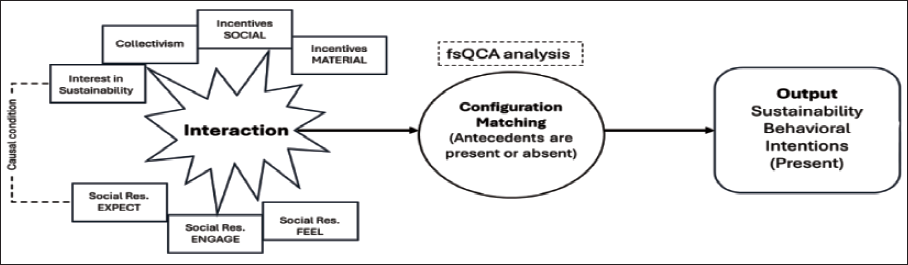
Social responsibility refers to the social and ethical impacts of business activities, including respect for human rights, fair compensation, health and safety and prevention of unethical behaviour (Slovick, 2008). Beyond corporate responsibility, consumer social responsibility, deliberate consumption guided by moral and personal values, is increasingly recognized as shaping decision-making (Devinney et al., 2006; Schlaile et al., 2018). However, consumers often lack awareness of the broader social and environmental consequences of their choices (Simpson & Radford, 2012). Research shows that socially responsible consumption is strongly linked to ethical values, moral beliefs and sustainability-oriented behaviours (Soni et al., 2021). In higher education, students’ perceptions of social responsibility significantly influence engagement in sustainable campus practices such as recycling, waste reduction and minimizing environmental impact (Imbrisca & Toma, 2020).
External Incentives
Social and financial incentives are widely used to promote environmentally responsible behaviour by increasing awareness and participation (Geller, 1989). However, behaviour changes driven by material rewards are often temporary and may undermine intrinsic motivation (Ryan & Deci, 2000). While sustainability awareness has been shown to positively influence sustainable behaviour, this relationship varies by behaviour type (Cogut et al., 2019). Overall, the literature suggests that sustained environmentally responsible behaviour is best supported through a combination of intrinsic and extrinsic motivators.
Cultural Values—Collectivism
Cultural orientations, particularly collectivism, are closely associated with sustainable consumption behaviours (Cho et al., 2013; Grunwald et al., 2025c). Collectivist values emphasize group welfare, social harmony and shared responsibility, which can enhance concern for the environment and future generations (Kim & Choi, 2005). Studies suggest that individuals with collectivist orientations are more willing to sacrifice personal interests for collective benefits, thereby supporting sustainable behaviours (Rahman et al., 2021). Research on Gen Z in Thailand indicates strong collectivist values combined with uncertainty avoidance, reinforcing group-oriented decision-making and shared responsibility (Farrell & Phungsoonthorn, 2020; McCann et al., 2010).
Sustainability Interest
Greater knowledge and understanding of sustainability issues increase the likelihood of environmentally responsible behaviour (Hines et al., 1987). Individuals are more inclined to engage in sustainable actions when they feel competent and understand how their behaviour contributes to solutions (De Young, 2000). Both awareness of environmental issues and perceived ability to address them are critical drivers of behaviour change (Ramsey & Rickson, 1977).
Sustainability Behaviour
Drawing from the literature and sustainability initiatives commonly promoted on college campuses, this study examines students’ self-reported intentions to engage in behaviours such as recycling, using reusable water bottles, conserving energy, carpooling, attending sustainability events, cycling and participating in e-waste recycling programmes. Accordingly, we offer the following two general propositions:
Proposition 1: There is no single configuration of conditions that universally leads to Thai students’ high or low sustainability behaviours at HEIs; rather, multiple distinct combinations of causal factors can produce the same outcome.
Proposition 2: Individual causal conditions may be either present or absent in configurations that lead to Thai students’ high or low sustainability intentions at HEIs, depending on how they interact with other contributing factors.
Methodology
Measures
All measurement scales used in this study were adapted from the extant literature (Kara & Min, 2024) and are considered to possess adequate content validity and reliability. Consumer social responsibility is widely recognized as a vital element in the complex decision-making process underlying sustainable consumption. It is generally assumed that consumers base their consumption choices on personal values and moral beliefs (Devinney et al., 2006, p. 32). Imbrisca and Toma (2020) pointed out that sustainability and social responsibility have become key focuses in higher education, noting that students’ beliefs and attitudes about social responsibility greatly impact their participation in sustainability-related actions. Building on their study, we adopted the consumer social responsibility scale developed by Imbrisca and Toma (2020).
The literature indicates that consumers’ cultural orientations, particularly collectivism, are closely linked to sustainability behaviours. This association reflects the notion that achieving global SDGs requires collective action, with multiple stakeholders cooperating to generate meaningful impact. Prioritizing group interests over individual desires is thought to foster a willingness to forgo personal gains for collective benefit. Consequently, individuals with stronger collectivist values are more likely to hold positive attitudes toward sustainability and demonstrate greater engagement in sustainable behaviours. To measure students’ individual collectivist values, we used a five-item scale adapted from Hofstede’s (1984) original collectivism measure, as modified by Yoo and Donthu (2002).
Previous research highlights the pivotal role of consumer interest in sustainability in promoting environmentally responsible behaviours. Hines et al. (1987) found that individuals are more likely to engage in pro-environmental actions when they possess a thorough understanding of environmental issues and potential solutions. Similarly, De Young (2000) emphasized that a sense of competence, together with knowledge of effective actions, drives environmentally responsible decision-making. Ramsey and Rickson (1977) also argued that both awareness of environmental issues and the capacity to address them are essential for meaningful behaviour change. Building on these insights, the present study measured students’ interest in sustainability using a four-item scale.
Both internal and external motivators play a crucial role in initiating and sustaining environmentally and socially responsible consumption behaviours. Incentives and rewards have been shown to reinforce desirable behaviours, effectively encouraging specific consumption choices over time. To assess the influence of incentives on students’ sustainability engagement, this study employed eight items adapted from Levy and Marans (2012). Drawing on prior literature and campus-based sustainable practices, students’ sustainable behaviours were measured through statements capturing their participation in sustainability-related activities, also rated on a five-point Likert scale. Table 1 presents descriptive statistics, reliability coefficients and the measurement items for all constructs used in the study. All scales were measured by using a five-point Likert scale, ranging from 1 (strongly disagree) to 5 (strongly agree).
Constructs Used in the Study (Thailand).
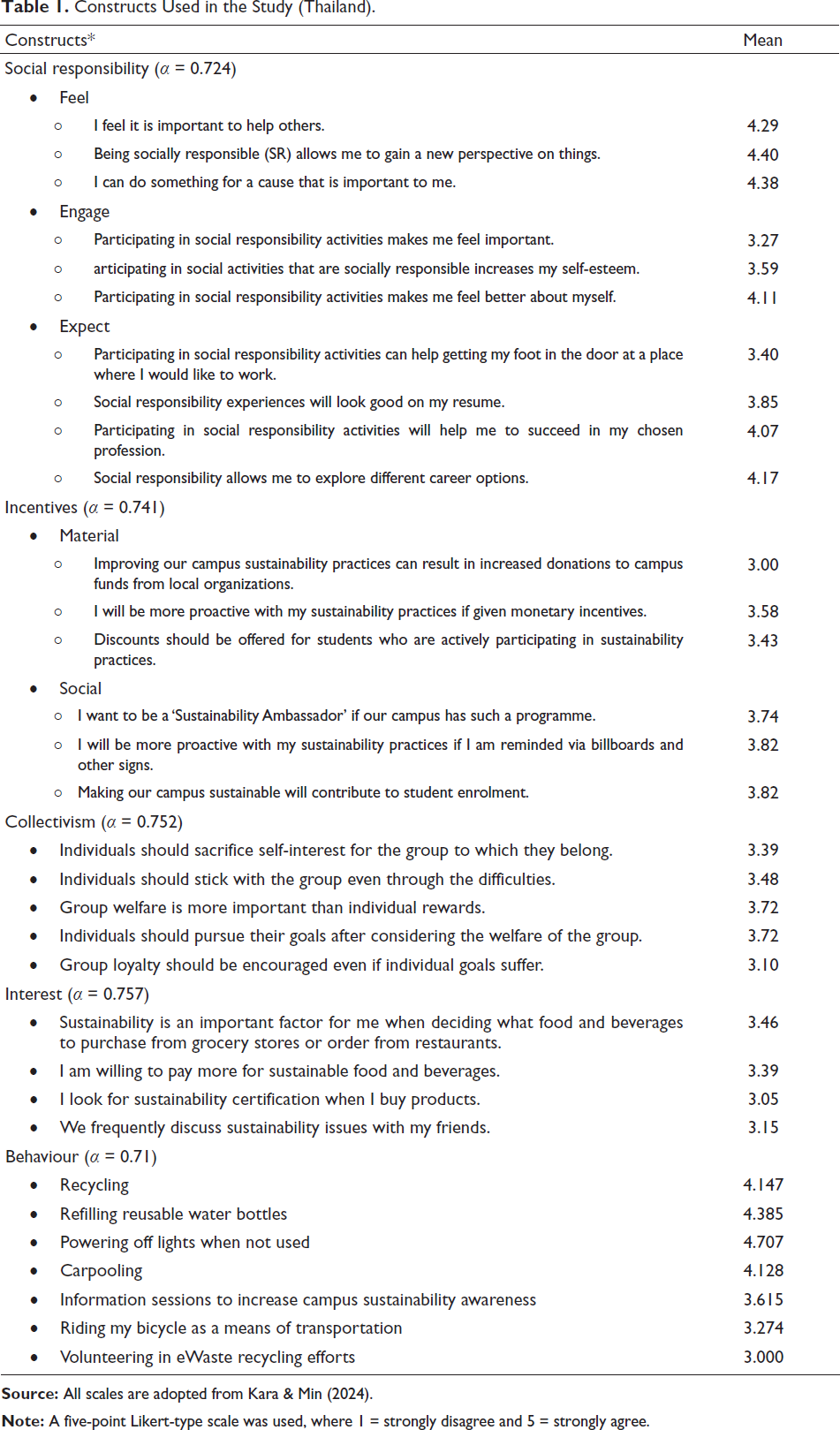
Constructs Used in the Study (Thailand).
Using the measures identified in the conceptual model to examine students’ sustainability behaviours, data for this study were collected between May and September 2024. In addition to the measurement constructs, the questionnaire included demographic items to capture a basic profile of participants. Although convenience sampling of students has been critiqued in the literature, it is often regarded as acceptable when the sample is appropriate, externally valid, and the topic is relevant to participants. In this study, student participants were deemed suitable. While limitations such as reduced generalizability and potential sampling bias are acknowledged, convenience sampling remains a valid approach, particularly in exploratory research where constraints of time, cost or resources exist and the primary objective is to examine specific populations rather than generalize findings broadly.
Participants were recruited via convenience sampling, primarily targeting undergraduates at Thammasat Business School, Thailand. The survey was distributed electronically to students enrolled in online courses, with invitations sent via university mailing lists. Efforts were made to include students from diverse academic years and demographic backgrounds. In-line with institutional review boards (IRB) guidelines, implied consent was obtained, and participation was voluntary and confidential. Extra course credit was offered to encourage participation. Participants were broadly representative of the business student population regarding academic interests, exposure to business issues and socio-demographic characteristics, supporting the relevance of the findings. A total of 117 surveys were completed. Descriptive analysis indicated that 59% of participants were female, all were under 30 and nearly 60% reported an annual income below $35,000.
Data Analysis
Confirmatory Factor Analysis
Confirmatory factor analysis (CFA) showed that social responsibility can be viewed as a three sub-dimensional construct (feeling, engagement and expectations) as conceptualized in Kara and Min’s (2024) study. CFA results showed sufficient or good model fit indices (Chi-square = 61.32, Parsimonious Chi-square/degrees of freedom (PCMIN/DF) = 1.97, Goodness of Fit Index (GFI) = 0.91, Comparative Fit Index (CFI) = 0.90). Similarly, CFA results showed that external incentives can be viewed as a two sub-dimensional construct (material and social incentives) with sufficient or good model fit indices (Chi-square = 13.12, PCMIN/DF = 1.64, GFI = 0.97, CFI = 0.96).
Construct Reliability
Before we analyzed various configurations present in the dataset, we first assessed construct reliability for all constructs used in the study. Table 1 shows that all reliability scores meet the levels suggested cutoffs (0.70) in the literature. Considering the high reliability scores along with the previous use of these scales by other researchers, we believe that it is justifiable to use an average score of the scale items to represent each construct.
fsQCA
We used fsQCA (Ragin, 2007) to examine the effects of conceptualized drivers on students’ sustainability intentions at HEIs in Thailand. fsQCA has gained popularity in business and management research for its ability to capture complex, conjunctural relationships among variables (Fiss, 2011; Lewellyn & Muller-Kahle, 2024; Pappas & Woodside, 2021). It is particularly suitable for small samples (fewer than 50 cases) and allows conditions to influence outcomes only in combination with others (Schneider & Wagemann, 2010). Unlike regression models, which isolate individual effects, fsQCA analyses configurations of causal factors, offering a more context-sensitive understanding of antecedents and outcomes. This study thus considers that the same factors may be present (or be absent) in different configurations that drive Thai students’ sustainability behaviours in HEIs.
Calibration
Prior to conducting fsQCA, construct scores were calibrated to a binary scale (0, 1). Although Ragin (2008) did not prescribe specific calibration rules, studies commonly use anchor points for full non-membership (0.0), the crossover point (0.5) and full membership (1.0). Following this convention, we employed the software’s calibration tool, using the maximum, mean and minimum values of each construct to define the full membership, crossover and non-membership thresholds. Table 2 reports the calibration values for all constructs.
Calibration Rules.
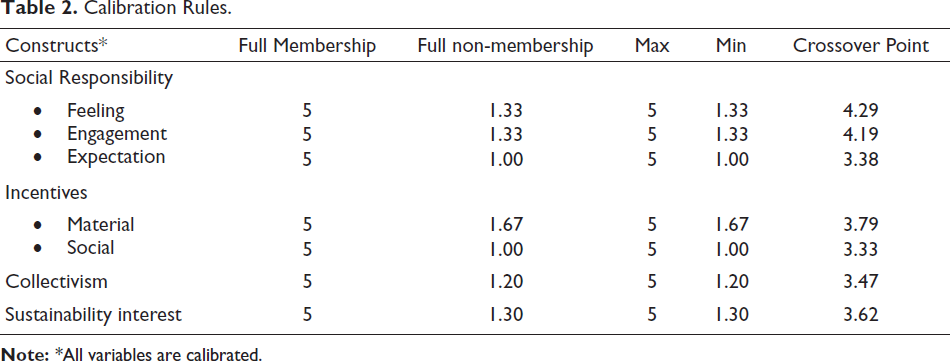
Calibration Rules.
Following calibration, the analysis was conducted using the default settings of the software. The frequency threshold, which is the minimum number of cases for a causal combination, was set to 2. The outcome variable was coded as 1 (high sustainability behaviour) for configurations with a consistency score ≥0.80. Table 3 presents the resulting truth tables for both datasets.
Truth Table.
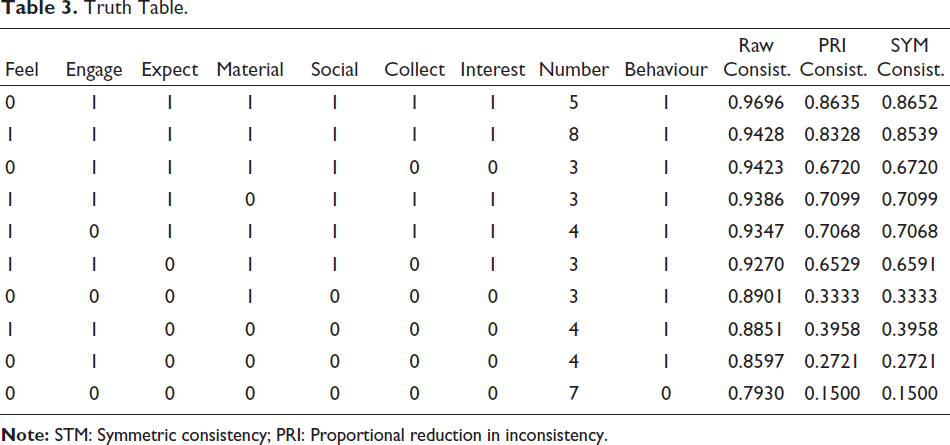
Finally, we conducted a necessary condition analysis to complement the identification of sufficient configurations from the truth tables. A condition is considered necessary if it is present in all or nearly all instances of the outcome, with a consistency value >0.90 indicating near-necessity (Ragin, 2008). Table 4 presents the results generated using the software’s built-in tool. While some conditions, such as social responsibility, approached this threshold, none met the minimum consistency criterion to be deemed necessary.
Necessary Condition.
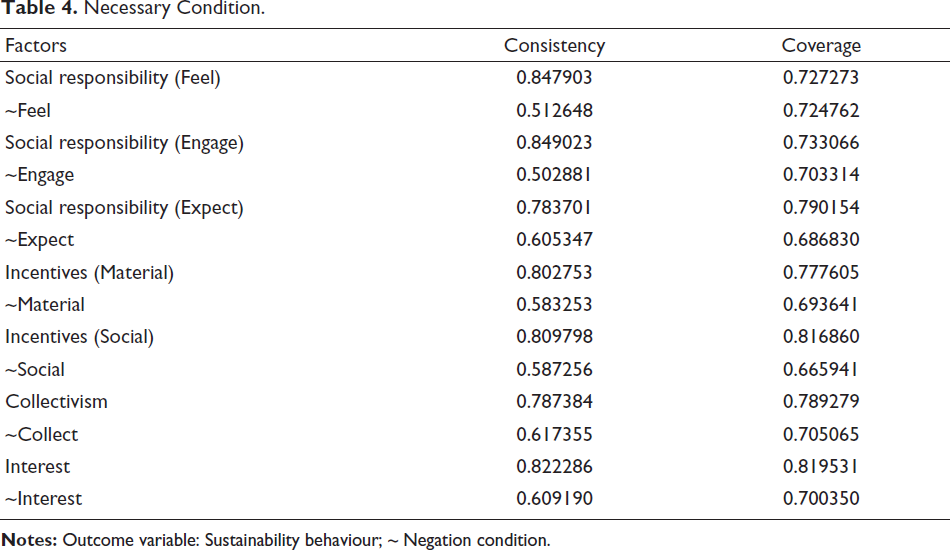
Table 5 presents the configurations leading to high student sustainability behaviour in Thailand. Following standard fsQCA notation, filled circles indicate the presence of a condition, crossed-out circles denote their absence and blank spaces indicate irrelevance. Circle size distinguishes core (large) from peripheral (small) conditions. The relevance of each configuration was assessed using coverage, which represents the extent to which a causal combination accounts for occurrences of the outcome (Ragin, 2008). Conceptually like R² in regression, coverage indicates the proportion of variation in the dependent variable explained by a configuration, aiding the evaluation of its predictive strength both individually and collectively (Woodside, 2013). fsQCA identified three consistently sufficient configurations leading to high sustainability behaviour among Thai students (Proposition 1), with an overall solution consistency of 0.86 and solution coverage of 0.71. In other words, the three configurations predict high sustainability behaviour 86% of the time and account for approximately 71% of outcome occurrences. These high consistency and coverage values underscore the theoretical relevance and empirical significance of the identified solutions.
Solutions Leading to High Sustainability Behaviour of Thai Students.
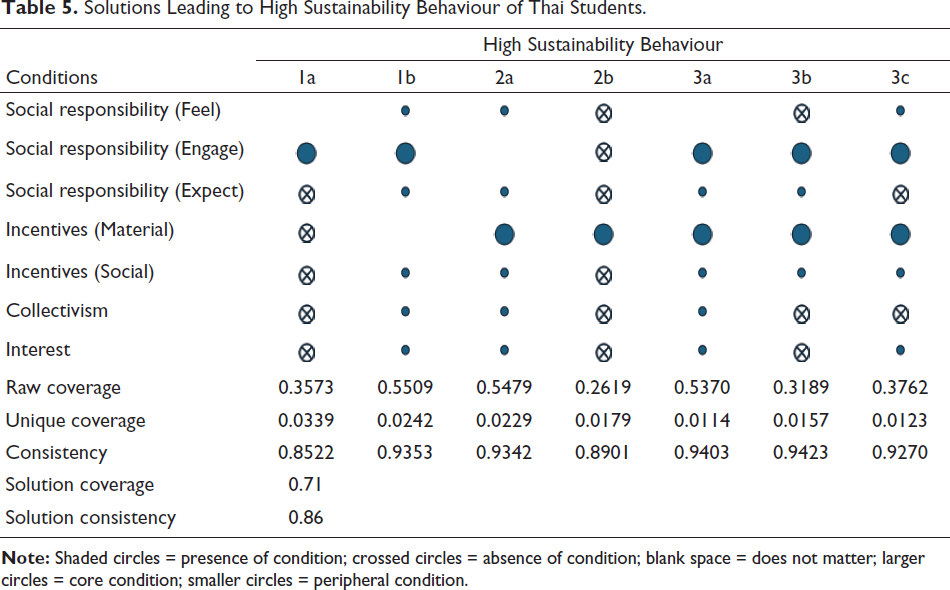
Solutions Leading to High Sustainability Behaviour of Thai Students.
Fiss (2011) noted that multiple pathways leading to the same outcome illustrate the concept of equifinality, where different combinations of conditions produce similar results. For example, Configuration #1a shows that the presence of social responsibility engagement, combined with the absence of other factors such as expectations, incentives, collectivist values and interest, may suffice to generate high sustainability behaviour. In fsQCA, the parsimonious solution highlights core conditions, those essential to any viable solution, while peripheral conditions appear in the intermediate solution but are not indispensable (Fiss, 2011). In Configuration #1a, social responsibility engagement is a core condition, and the remaining factors are peripheral. Configuration #1b shares the same core condition but differs in peripheral factors, making it a neutral permutation. Similarly, Configurations #2a and #2b, as well as #3a, #3b and #3c, share core conditions. Configuration #2 suggests that material incentives can drive high sustainability behaviour regardless of other factors, as illustrated in #2b. Configuration #3 indicates that the combination of social responsibility engagement and material incentives, even in the absence of other factors, can also produce high sustainability behaviour (Proposition 2).
Examination of raw coverage scores in Table 5 shows that Configurations #1b and #2a have the highest coverage (0.55), while #2b has the lowest (0.26). These findings suggest that high sustainability behaviour among Thai students is more likely when most studied factors are present. However, social responsibility engagement and material incentives exhibit greater empirical relevance, as reflected by their higher coverage scores, indicating their stronger role in promoting sustainability behaviour.
In practical applications of the fsQCA, researchers frequently include negation analysis, which explores and reports the configurations that lead to low sustainability behaviours. Table 6 displays the results of negation analysis.
Table 6 presents configurations associated with low sustainability behaviour among Thai students. The first solution, comprising three permutations, is characterized by the absence of three core conditions: social responsibility expectations, material incentives and sustainability interest. Despite variation among permutations, Solution 1 exhibits the highest raw coverage, indicating that the absence of these core factors, along with certain peripheral conditions, substantially contributes to reduced sustainability behaviour. Additionally, Solutions 4–7 suggest that the absence of a single core condition, such as sustainability interest, incentives or social responsibility expectations, can be sufficient to produce low sustainability behaviour, regardless of peripheral factors.
Solutions Leading to Low Sustainability Behaviour of Thai Students.
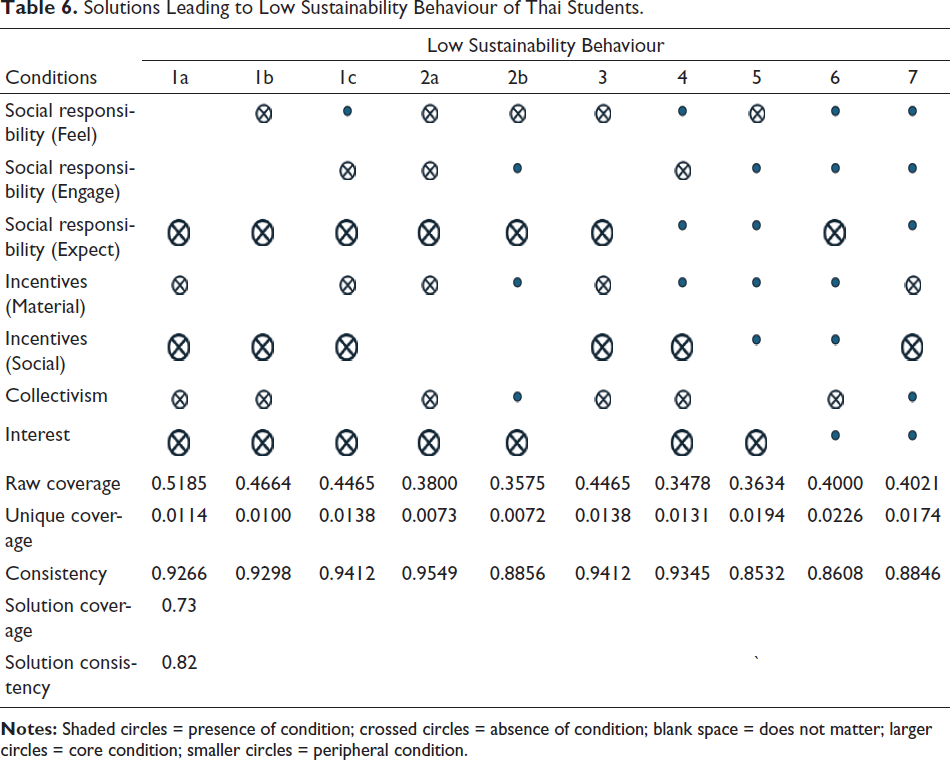
Solutions Leading to Low Sustainability Behaviour of Thai Students.
Although fsQCA was the primary analytical method, a linear regression analysis was also conducted to complement the findings (Leischnig et al., 2014). The regression model yielded an R² of 0.45, indicating that the included factors explained a substantial portion of the variance in students’ sustainability behaviour. However, only two of the seven independent variables, sustainability interest and social incentives, were statistically significant. Comparison with fsQCA results suggests complementary insights: negation analysis identified social incentives and sustainability interest as core conditions associated with low sustainability behaviour, while other core factors, such as material incentives and social responsibility engagement, showed insignificant net effects in the regression. This highlights fsQCA’s ability to capture complex, configurational influences and provides a more comprehensive understanding of the factors shaping sustainability behaviours, offering practical implications for managerial decision-making.
Discussion
In this study, fsQCA was designed to examine the complex causal configurations underlying both high and low levels of sustainability behaviours among Thai university students, with particular focus on Gen Z, a cohort increasingly characterized by heightened environmental awareness, strong normative commitments to social responsibility and technologically mediated forms of engagement (Farrell & Phungsoonthorn, 2020; Phan & Nguyen, 2025a, 2025b). The identified configurations reveal that sustainability behaviours among Gen Z are shaped by interdependent and nonlinear combinations of motivational and social conditions, rather than by isolated antecedents. Consistent with configurational theory (Fiss, 2011), these findings underscore the equifinal nature of sustainability behaviours, demonstrating that multiple pathways can lead to similar behavioural outcomes within this generational context.
The analysis identified three distinct configurations, each with multiple sub-permutations, that were sufficient to explain high levels of sustainability behaviour, thereby providing robust empirical support for Propositions 1 and 2. Across these configurations, engagement in social responsibility and the consistent presence of material incentives emerged as core conditions, underscoring their foundational role in shaping sustainability behaviours among Thai Gen Z students. This result aligns with prior research suggesting that Gen Z exhibits a dual orientation toward value-driven decision-making and pragmatic outcome evaluation, particularly in domains related to ethical consumption and environmental stewardship.
Configuration 1a is theoretically significant in demonstrating that engagement in social responsibility alone can constitute a sufficient condition for high sustainability behaviour, even in the absence of collectivist orientation or normative social expectations. This finding suggests that Thai Gen Zs’ sustainability engagement may be rooted in internalized moral identities and self-conceptualizations as socially responsible actors, rather than in compliance with external social pressures. Such an interpretation resonates with contemporary characterizations of Gen Z as a cohort that prioritizes authenticity, moral coherence and alignment between personal values and observable behaviours, especially in socially and environmentally salient domains (Phan & Nguyen, 2025b).
Configuration 2, particularly sub-configuration 2b, further advances this interpretation by revealing that material incentives alone can also generate high levels of sustainability behaviour. Rather than contradicting Gen Z’s ethical orientation, this finding reflects the instrumental rationality that often accompanies sustainability-related decision-making among younger cohorts. For Gen Z students, who are accustomed to incentive-based digital environments (e.g., gamification, reward systems and platform-mediated feedback), tangible incentives may serve as salient behavioural cues that lower participation barriers and reinforce environmentally responsible actions in educational settings where sustainability norms are still being consolidated. In addition, nudging theory (Thaler & Sunstein, 2009) offers a framework for designing default options that incentivize sustainable behaviour change through reward systems, such as points redeemable at campus bookstores or cafeterias, digital nudges (e.g., badges), offering extra credit for sustainability work and visible prompts near key areas of use (e.g., waste disposal, energy use and recycling). These interventions may be strengthened by incorporating social influence mechanisms, including social proof, visible commitments and behavioural residue, which enhance the public visibility of socially responsible actions. Public cues and signals, such as sustainability-branded giveaways (e.g., mugs, pens or T-shirts), can further reinforce norms and encourage sustained participation in campus sustainability initiatives (Berger & Milkman, 2012; Kara et al., 2025).
Configuration 3 represents a hybrid pathway in which social responsibility engagement and material incentives jointly predict high sustainability behaviour. This configuration provides strong empirical support for self-determination theory (Ryan & Deci, 2000), which posits that intrinsic motivation and extrinsic rewards can function synergistically when autonomy and purpose are preserved. For Gen Z, this synergy appears especially potent, as sustainability behaviours are most effectively sustained when ethical commitment is reinforced by visible, meaningful incentives, thereby integrating moral purpose with tangible acknowledgement.
The negation analysis further enhances understanding by identifying configurations associated with low sustainability engagement among Thai Gen Z students. Several alternative pathways leading to disengagement were observed, most notably the absence of sustainability interest, social incentives and perceived social responsibility expectations. Configuration 1, which exhibited the highest raw coverage among low-sustainability engagement solutions, highlights that disengagement emerges when Gen Z students lack both personal relevance and social reinforcement. This finding suggests that low sustainability behaviour within this cohort is not indicative of apathy, but rather reflects a breakdown in motivational alignment, where sustainability is neither perceived as meaningful nor socially endorsed. Importantly, this result reinforces the relational orientation of Thai Gen Z students, for whom peer influence, social recognition and shared value frameworks play a critical role in shaping behaviour. When sustainability behaviour is disconnected from these relational and social structures, students are significantly less likely to engage in pro-environmental actions.
To assess the robustness of the configurational findings, a linear regression analysis was conducted. Although the regression model explained a moderate proportion of variance (R² = 0.45), only sustainability interest and social incentives emerged as statistically significant predictors. While these results partially converge with the fsQCA findings, they also expose the limitations of linear modelling approaches in capturing the conditional and context-dependent effects characteristic of Gen Z sustainability behaviours. By prioritizing net effects, regression analysis obscures the interactive roles of material incentives and social responsibility engagement, whose influence is contingent upon their configuration with other factors. The divergence between the two analytical approaches suggests that traditional linear methods may potentially underestimate the complexity of sustainability behaviour formation among Gen Z students. In contrast, fsQCA offers a more theoretically congruent framework by identifying configurational causality and acknowledging that different motivational combinations can produce equivalent behavioural outcomes. Consequently, fsQCA emerges as a particularly suitable methodological approach for examining sustainability behaviours within generational cohorts characterized by value pluralism, contextual sensitivity and hybrid motivational structures, such as Gen Z.
Theoretical and Practical Implications
While TPB has served as a dominant framework for explaining rational decision-making, its variable-centred and linear logic limits its ability to theorize sustainability behaviours as complex, context-dependent phenomena. Rather than extending TPB (Ma et al., 2022) by adding predictors, this study contributes to theory building by reinterpreting TPB constructs through a configurational and complexity-informed lens. Drawing on complexity theory, we theorize sustainability intentions as outcomes of interdependent conditions whose effects are contingent on their combination with other elements in the system, consistent with configurational reasoning and the principle of equifinality emphasized in fsQCA research. From this perspective, behaviour is not the result of net effects but emerges from multiple sufficient configurations of attitudes, values, norms, interests, perceived behavioural control and contextual factors.
This configurational theorization advances existing theory by explaining how different causal recipes can lead to the same outcome, rather than identifying which individual factors matter most on average. The use of a configural approach in examining students’ sustainability intentions in an unlike cultural environment is a unique contribution of this study (Kara & Min, 2024), by extending it in a different cultural environment and utilizing configural methodology. For example, in contexts characterized by limited material incentives (Solution 1b compared to Solution 2a), strong engagement in social responsibility can compensate for the absence of instrumental rewards and generate similarly high levels of sustainability intentions. This substitution logic challenges the implicit assumption of symmetric and additive effects in TPB-based models and introduces causal asymmetry and functional equivalence as core theoretical principles for understanding sustainability behaviour in higher education contexts.
Accordingly, this study makes a substantive contribution to theory by reframing the antecedents of student sustainability intentions in HEIs as complementary, nonlinear and context-sensitive conditions rather than stable, independent predictors. By conceptualizing these conditions as potential enablers or constraints depending on their configuration, we offer a more flexible and generative theoretical account of sustainable action among Thai students. This study extends prior scholarship (Pappas & Woodside, 2021; Woodside, 2013; Wu et al., 2014) by theoretically reinforcing the value of asymmetric analytical approaches that integrate qualitative reasoning with quantitative analysis. Such approaches contribute to the advancement of sustainability behaviour theory by reorienting analytical inquiry from variable-centric prediction toward the explication of causal complexity and configurational logic. This theoretical shift deepens understanding of the multiple pathways through which HEIs can cultivate sustainability intentions, thereby supporting progress toward the SDGs (Grunwald et al., 2025b). Hence, HEI can better understand the sustainability domain by treating student characteristics as situational conditions embedded within institutional and cultural contexts, whose effects cannot be understood in isolation.
Finally, while aligning with prior research in recognizing the importance of student social responsibility and material incentives, our findings extend theory by demonstrating that their influence is configuration-dependent rather than universal. The mixed effects observed for collectivist value orientations further reinforce the theoretical claim that values do not exert consistent linear effects on sustainability intentions; instead, their impact varies depending on how they interact with other motivational and contextual conditions. Collectively, these insights contribute to the development of a complexity-aware, configurational theory of sustainability behaviour in higher education.
Limitations and Future Research
We recognize that this research has several limitations, and the results should not be generalized beyond the population studied. First, although the methodology used in this study is appropriate for small samples, the sample size and sampling methods used in this study limit its generalizability to other contexts. While larger samples are generally preferred, fsQCA places greater emphasis on theoretical relevance and causal complexity than on large sample sizes or random sampling. As noted in the literature, concerns about sample size are typically less pronounced in fsQCA compared to conventional statistical techniques, as small- to medium-sized samples (including fewer than 50 cases) are considered appropriate. Nevertheless, we acknowledge that a larger sample could allow for the inclusion of additional conditions and more fine-grained configurational distinctions. Additionally, the data were collected from a single university in Thailand, which further restricts its applicability. Second, the conceptual model included previously tested variables that are known to affect sustainable behaviour. Future studies are encouraged to incorporate additional psychographic variables, such as attitudes, learned helplessness, mindset, habits, knowledge, personal and moral philosophies and ethical values, which could provide further insights into students’ sustainability behaviours. Third, we used self-reported sustainability behaviour as the outcome variable. However, the literature provides evidence that such studies face challenges with a potential VAG between intentions and actions, indicating that what individuals say may differ from what they do. Therefore, future studies should test the relationships identified in this research using a study design that incorporates more objective measures of actual sustainability behaviour. Finally, cross-country comparative studies would provide additional insights into patterns of similarity and differences in students’ sustainability behaviours across different country contexts.
Conclusion
Sustainability issues are inherently complex, and fsQCA offers a method that accounts for the interaction of multiple conditions in a nonlinear and systematic manner. This study demonstrates that Thai students’ engagement in sustainability behaviours (or their hesitancy to engage) should not be viewed as simply opposing outcomes, but rather as distinct states influenced by both independent and interacting factors. Grounded in TPB and informed by a review of theoretical and empirical research on the determinants of student sustainability behaviour, we employed configurational approaches to identify various pathways for enhancing students’ engagement in sustainability behaviours within HEIs. In summary, we found that higher levels of sustainability behaviour among Thai students were influenced by their level of social responsibility engagement, along with the presence of external incentives. Conversely, lower levels of sustainability behaviour were associated with the absence of social responsibility expectations, social incentives and personal interest.
Authors’ Contributions
Ali Kara: Writing—review & editing, conceptualization, questionnaire design, visualization, methodology and formal analysis.
Maung Min: Writing—review & editing, questionnaire design, data collection and conceptualization.
Sathaporn Opasanon: Data collection, review and editing.
Data Availability
The data that support the findings of this study are not publicly available due to privacy or ethical restrictions.
Footnotes
Declaration of Conflicting Interests
The authors declared no potential conflicts of interest with respect to the research, authorship and/or publication of this article.
Ethical Declaration
The authors abide by all the ethics involved in this academic work and have not submitted it to any other journal.
Funding
The authors received no financial support for the research, authorship and/or publication of this article.
