




Abstract
When investigating entrepreneurship, research reveals that there is a need to shift the debate from traditional categorizations based on biological sex to classifications based on gender role orientation (GRO). Apart from evaluating the relationship between GRO and entrepreneurial intentions (EIs), in terms of the theory of planned behaviour (TPB), the moderating influence of implicit person theories (IPT) is examined. The study takes place in South Africa, with a sample size of 415. Partial least-squares structural equation modelling (PLS-SEM) is used to evaluate the hypotheses. Results indicate that individuals do not necessarily correspond to masculinity when considering EIs but instead hold a predominant feminine GRO. Policymakers should focus on developing realistic and relatable role models across all gender groups. The article offers unique insights into the novel topic of GRO and EIs from an African emerging market perspective.
Introduction
Widespread research in entrepreneurship underscores that the decision to start a new venture is highly personal and depends on the individual’s motivation, as intentional agents, entrepreneurs actively interact with their surroundings (Klyver et al., 2025; Urban & Ratsimanetrimanana, 2025). While prior research on entrepreneurship has examined the effects of gender and biological characteristics on the entrepreneurial propensity of individuals, mixed results have been obtained in this regard (Datta et al., 2022; Santos et al., 2016; Shuvam & Mohanty, 2023). Such incongruent findings are often because of a traditional focus on biological sex rather than examining alternative indicators, such as gender role orientation (GRO) (Passah & Panda, 2022; Perez-Quintana et al., 2017). Indeed, research focused on biological sex, examining only the biological differences between men and women, has largely ignored the examination of GRO as an alternative theoretical perspective related to gender and entrepreneurial behaviour (Adamus et al., 2021; Marlow, 2020). Due to these research shortcomings, we argue that there is a need to shift from traditional categorizations based on biological sex to classifications based on GRO when investigating entrepreneurship.
Scholars tend to refer to gender as a ‘social construction, where GRO is operationalized by cultural and societal factors that result from gender role stereotypes as prescribed to people in society’ (Berger & Krahé, 2013), and where such stereotypes are rooted in attributes and characteristics related to masculinity and femininity (Olsson & Martiny, 2018). Some studies report variations within same-gender groups, which means that one male may have a feminine GRO while another male may maintain a masculine or even an undifferentiated GRO (Marsh, 1987; Olsson & Martiny, 2018). Moreover, gender is not limited to the two groups (men and women), and the presence of gender groups such as transgender man, transgender woman, non-binary and gender fluidity raises the question of whether these traditional stereotypes (Balachandra et al., 2019) are still valid and what kind of theoretical research is needed to make research on gender and entrepreneurship congruent (Marlow, 2020).
Recognizing such shifts in gender role prescriptions, we perceive a clear need to expand the theoretical understanding of GRO in relation to entrepreneurial intention (EI) in the South African context, to address this knowledge gap. While previous research has typically linked entrepreneurship with masculinity (Balachandra et al., 2019; Díaz-García & Jiménez-Moreno, 2010), given the shift in the traditional image of entrepreneurship, it is possible that individuals who intend to engage in entrepreneurship hold a feminine GRO (Adamus et al., 2021; Marlow, 2020). Such views suggest that current research cannot overlook the influence of gender roles on the formation of intentions and behaviours (Perez-Quintana et al., 2017). In this respect, the rationale for investigating the link between EI and GRO is by focusing on the intricacies of GRO (Olsson & Martiny, 2018), the one-size-fits-all approach in terms of biological sex prevalent in EI research will be supplemented with new theory and insights.
Following this reasoning, the purpose of this article is to examine the relationship between EI and GRO, while accounting for the moderating role on this relationship of implicit person theories (IPT), also referred to as mindsets, IPT are theories or beliefs a person holds about the flexibility or rigidity of personal traits such as knowledge acquisition and application, intelligence, skills and abilities (Arshed et al., 2024; Carr et al., 2012). While GRO alone could help explain differences in EI (Passah & Panda, 2022), exploring the influence of IPT on this relationship is valuable, which has not been previously tested, especially in an African emerging market setting. Hence, the main research question formulated to achieve the study purpose is: Do variations in GRO relate to variations in the level of EI in the South African context? To provide a more nuanced understanding of the GRO-EI relationship, additional research questions are formulated: (a) to what extent does EI, in terms of the theory of planned behaviour (TPB) dimensions of attitude towards behaviour (ATB), social norms (SN) and perceived behavioural control (PBC) mediate the GRO-EI relationship; and (b) to what extent does IPT (mindset) moderate the interaction between GRO and EI?
The main motivation for authoring this article is that the literature on GRO and IPT is not only insufficient, but there is even less work examining links between GRO, EI and IPT in an African emerging market context.
Currently, the gender situation in South Africa shows that although South Africa is a signatory to the main International Conventions relating to gender equality and the protection of women, with a policy focused on enabling diversity and inclusion, there are still negative attitudes and stereotypes about certain genders and entrepreneurship. Particularly, individuals with a feminine GRO being viewed negatively toward entrepreneurship in the most traditional parts of the country. Research highlights that discrimination against women remains a serious developmental obstacle in the country and that cultural patriarchies remain entrenched within societies. Underrepresentation of women in leadership roles and unequal access to economic opportunities are still prevalent, as male domination and socially gendered professions still continue. Nonetheless, a growing number of individuals are abandoning typical gender role prescriptions, as both sexes tend to take on gender roles that were once prescribed exclusively for only one sex (Commission for Gender Equality, 2023; Vercruysse & Birkner, 2021).
The article makes several important academic and research contributions in relation to a change in the image of entrepreneurial archetypes by considering and incorporating the contemporary literature on gender role stereotypes within the established TPB framework (Schlaegel & Koenig, 2014). By building on prior research, the applicability of the TPB model is tested as EI is the result of socialization processes in which personal perceptions about entrepreneurship (attitudes and behavioural control) play a key role (Ezeh, 2023; Santos et al., 2016; Urban & Ratsimanetrimanana, 2025). Accordingly, the TPB serves as the theoretical scaffolding for the article, and an attempt is made to establish links between GRO and the EI antecedents of ATB, SN and PBC. Such an approach then allows for the evolution of more fine-grained connections in the pathways from GRO to each of the antecedents to EI to emerge. Moreover, by linking GRO to the EI dimensions in a single study and determining how IPT moderates this relationship, it is anticipated that new discoveries may emerge.
From a contextual consideration, the article makes an important contribution as the study takes place in South Africa, which is a member of the ‘BRICS+’ (Brazil, Russia, India, China and South Africa) and has the largest economy in Africa whereas Brazil, Russia, India and China are among the world’s 10 largest countries by population, area and gross domestic product (GDP) nominal and by purchasing power parity (BRICS, 2024). Consequently, the study offers the opportunity to generate new insights into this under-researched topic from an African emerging market perspective.
The article is structured to first attend to the theoretical foundations of the constructs in order to formulate study hypotheses. Next, the study’s methodological design is discussed. Data analysis and discussion of the findings follow, highlighting their contributions to literature and theory. Several policy and practical implications are drawn on the basis of the findings.
Literature Review
Entrepreneurship and GRO
Traditional research focusing on the study of biological sex in the context of EI is fraught with ambiguous findings, where a large body of work suggests that females have less favourable attitudes toward entrepreneurship than males (Gupta et al., 2014; Marlow, 2020; Santos et al., 2016). Biological sex refers to the biological and physiological differences (like chromosomes, reproductive organs and hormones) between individuals, while GRO encompasses societal expectations and norms about how individuals should behave based on their perceived sex (Adamus et al., 2021; Marlow, 2020; Passah & Panda, 2022; Perez-Quintana et al., 2017). Outmoded gender stereotypes are fading in the face of the rise of virtual work, technological developments and a focus on providing customer-focused services and solutions, where a growing number of studies on gender role theory, show that individuals can oscillate between a feminine and masculine GRO (Blake-Beard et al., 2020; Chen et al., 2022).
Recent research on gender role theory argues that the image and social construction of entrepreneurship is also changing (Laguía et al., 2022) as there is a ‘fundamental shift from the dominance of instrumental behaviours to a new social construction of entrepreneurship that requires a new order of attributes, such as being expressive and flexible, showing empathy and being able to adopt more transformational leadership styles’ (Blake-Beard et al., 2020), which in turn warrants feminine entrepreneurial qualities to perform effectively (Laguía et al., 2022).
GRO is a psychological characteristic that manifests itself in adherence to and acceptance of social and cultural gender norms (Berger & Krahé, 2013; Liñán et al., 2020). GRO can also be explained as the recognition and adoption of gendered characteristics that are usually prescribed by the society in which one lives (Olsson & Martiny, 2018). Certain behaviours are considered appropriate or inappropriate based on an individual’s GRO, which is dictated by societal norms and depends on how much positive reinforcement they receive from significant caregivers (Berger & Krahé, 2013). Individuals learn to recognize and align themselves with gender roles in relation to specific functions, such as at work and entrepreneurship (Olsson & Martiny, 2018). GRO is made up of two constructs, namely masculinity and femininity (Perez-Quintana et al., 2017). The category of masculinity is associated with instrumental attributes. The dominant attributes of this category are independence, assertiveness and superiority (Marsh, 1987; Olsson & Martiny, 2018). Therefore, masculinity is typically associated with entrepreneurial attributes such as control, ownership and leadership (Balachandra et al., 2019; Marlow, 2020). On the other hand, femininity is associated with expressive attributes. The dominant attributes in this category include the ability to empathize with others and share their feelings, as well as the ability to care for and protect others. These attributes are seen as crucial in building networks and relationships with others and denote that not all activities and behaviours associated with entrepreneurship are masculine (Chen et al., 2022; Olsson & Martiny, 2018). Even though individuals with a strong male GRO do not associate femininity with entrepreneurship, according to research, individuals with a feminine GRO identify with characteristics associated with entrepreneurship (Vercruysse & Birkner, 2021).
Scholars such as Schlaegel and Koenig (2014) have evaluated and compared the extant theories of intentions, which include the TPB (Ajzen, 1991). The TPB suggests that people intend to perform a specific behaviour if their personal assessments of the questioned behaviour are positive, if they think their important referents agree with it and if they assume that the required resources and opportunities are available (Ajzen, 1991). Furthermore, research is emerging which suggests that gender is an antecedent of ATB, SN and PBC, making GRO a plausible antecedent and predictor of EI (Perez-Quintana et al., 2017). These antecedents of the TPB have an additive effect on an individual’s EI, which means that it is plausible for individuals to have high EI even though one or two of the antecedents preceding their intentions might be low (Urban & Chantson, 2019).
Several studies reveal that the TPB antecedents are moderated and mediated by demographic variables of a personal nature, such as personality and broad life values, as well as demographic variables such as education, age and gender (Santos et al., 2016; Schlaegel & Koenig, 2014). In a recent article, Ezeh (2023) examined the impact of SN, attitude and PBC on Nigerian youths’ agro-EI as well as the moderating role of gender. The study results revealed no significant difference between men and women on PBC and attitude towards agro entrepreneurship, but there is a significant difference on SN. Similarly, prior research at the aggregate and the individual levels of analysis shows that there is a gender gap in EI in the way self-beliefs, cognitions and attitudes about entrepreneurship are processed and developed, insofar as males are typically reported to exhibit a higher level of EI than women (Santos et al., 2016). Such studies suggest that perceptions persist, that the characteristics associated with starting a business are masculine, and therefore an entrepreneurial path is the prerogative of men (Datta et al., 2022; Margaça et al., 2021). However, recent studies emphasize that individuals with a feminine GRO have a higher propensity to engage in entrepreneurship (Adamus et al., 2021), which suggests that the influence of GRO on the formation of EI (Passah & Panda, 2022; Perez-Quintana et al., 2017) cannot be disregarded. Consequently, in line with emerging work arguing for a stronger focus on the intricacies of GRO (Olsson & Martiny, 2018), and to avoid duplicating a one-size-fits-all attitude in terms of biological sex prevalent in research, it is hypothesized that:
H1a: GRO is positively associated with EIs.
ATB
ATB is the degree to which the implementation of a particular behaviour, such as starting a new business, is favourably or unfavourably valued, and is formed by the individual’s ‘expectations and beliefs about the personal impacts of expected outcomes resulting from the behaviour’, where the intensity of the belief is weighted by the evaluation of the outcomes (Ajzen, 1991). In some studies, ATB has been found to be the most important of the three predictors in the TPB, and the dominance of ATB over SN and PBC was reported in a South African study of academic scientists (Urban & Chantson, 2019).
While women-owned entrepreneurship is increasing, systemic bias and attitudes towards segregated gender roles in society are still prevalent (Olsson & Martiny, 2018). In terms of GRO, the congruence or incongruence between masculinity and femininity with entrepreneurial stereotypes has the potential to influence one’s ATB (Blake-Beard et al., 2020). For instance, individuals who see themselves as masculine might see entrepreneurial pursuits as feasible and have a positive attitude towards entrepreneurship because of a perceived congruence between masculinity and entrepreneurial characteristics (Chen et al., 2022). On the other hand, individuals with a feminine GRO may also have a higher propensity to engage in entrepreneurship (Adamus et al., 2021) as a result of changes in the image and social construction of entrepreneurship, where being adaptive, flexible and showing empathy (Laguía et al., 2022) are crucial attributes that shape positive attitudes towards entrepreneurship (Perez-Quintana et al., 2017). Accordingly, it is hypothesized that:
H1b: Attitudes towards behaviour mediate the relationship between GRO and EIs.
SN
SN is the perceived social pressure to perform a particular behaviour, such as creating a business venture and is underpinned by what the individual perceives are the expectations and beliefs of influential people in their life towards creating a start-up. These influential people include the significant other, family, friends, colleagues, mentors or role models (Ajzen, 1991, 2001; Engle et al., 2010). A second aspect of SN is the individual’s willingness to comply with these normative beliefs. The effect of the SN on EI has varied from one empirical study to another (Urban & Chantson, 2019), and in some instances, studies have shown SN to have a strong effect on EI (Ferreira et al., 2012).
Based on the earlier operationalization of GRO, it is possible that individuals who hold a feminine gender role identity are also likely to show an increased need for support and validation from those they hold in high regard (Laguía et al., 2022). This is because feminine gender role identity is also associated with anxiety and fear of rejection by others, so these individuals tend to accommodate others even when it is detrimental to their own needs (Blake-Beard et al., 2020). Indeed, those individuals who align with a feminine GRO may also believe that those they value, such as family and colleagues, view entrepreneurship as a masculine prerogative, which may negatively impact their subjective SN (Balachandra et al., 2019). However, on the other hand, individuals with masculine GRO may pay less attention to what others think about their actions since typically masculine gender role identities are associated with extreme independence, a tendency towards self-isolation and rejection of others (Berger & Krahé, 2013; Perez-Quintana et al., 2017). Following this line of argument, where a significant amount of research is still required, it is anticipated that:
H1c: SN mediate the relationship between GRO and EIs.
PBC
PBC refers to an individual’s perceptions of their ability to execute a given behaviour and is governed by the beliefs about the perceived factors that facilitate or hinder execution of the behaviour (Ajzen, 1991, 2001). The PBC construct is related to the self-efficacy construct, with studies reporting it to be a significant determinant of EI (Urban & Moetse, 2024). While intuitively one could surmise that commercial entrepreneurship is associated with a masculine GRO and social entrepreneurship is associated with a feminine GRO, research findings suggest that social entrepreneurship is not necessarily a feminine prerogative (Gupta et al., 2020). Nonetheless, the congruence or incongruence between GRO masculinity and GRO femininity and entrepreneurial stereotypes has the potential to influence the PBC (Datta et al., 2022). In this regard, individuals with a feminine GRO, despite their belief that they can manage and lead a successful business, are unlikely to develop the vision to lead a business when they perceive a discriminatory environment. In other words, despite a robust level of self-efficacy, a perceived sense of incongruence between GRO and entrepreneurship archetypes can influence EI (Datta et al., 2022). Studies confirm that the perception of high PBC is not sufficient to manifest in the intention to start a business. Rather, the perception that one is supported and has a supportive environment influences the interaction between PBC and EI (Klyver et al., 2025; Santos et al., 2016). Based on this emerging stream of research, the following hypothesis is formulated:
H1d: PBC mediates the relationship between GRO and EIs.
IPT (Mindsets)
IPTs, also referred to as mindsets, have attracted scholarly attention in the psychology literature and more recently in the domain of organizational psychology (Gupta et al., 2020; Levy, 2016), with little literature evident in the field of entrepreneurship. According to Levy (2016), mindsets are characterized by people’s beliefs about the flexibility of the ability to acquire and apply knowledge and disposition or identity. At the core of IPTs incorporate two classifications, namely fixed mindsets and growth mindsets (Carr et al., 2012; Dweck, 2019). Fixed mindsets are also referred to as entity theories and are characterized by the belief that people’s ability to acquire and apply knowledge is fixed and difficult to change (Cheng et al., 2021). Because these individuals perceive their personality and cognitive repertoire as fixed, any effort to improve them is seen as futile (Gupta et al., 2020). On the other hand, proponents of a growth mindset, also known as incremental person theory, view personal characteristics such as ability and intelligence as malleable (Burnette et al., 2020; Dweck, 2019).
Research denotes three mechanisms by which IPT can be understood, namely goal importance, perception of effort and attribution of accomplishment and lack of success (Gupta et al., 2020). Therefore, entrepreneurship-focused goals are less attractive to individuals with a fixed mindset and more desirable to individuals with a growth mindset (Margaça et al., 2021). It is important to note that IPT (mindsets) is malleable and that shifting to a growth mindset may allow the person to see success and failure in relation to their efforts and to view growth or improvement as possible (Burnette et al., 2020). Studies show that mindset can explain EI, like what the TPB has done, insofar as individuals who have a growth mindset tend to have a favourable attitude toward entrepreneurship (Burnette et al., 2020). Therefore, it is plausible that an individual with a growth mindset who has a GRO that is incongruent with entrepreneurial stereotypes believes that this incongruence will not affect their ability to succeed as an entrepreneur (Cheng et al., 2021). On the other hand, it is also reasonable that an individual who has a GRO that is consistent with entrepreneurial stereotypes might show low entrepreneurial inclination if they have a fixed mindset (Burnette et al., 2020). In this regard, it is argued that while GRO alone can explain differences in EI, growth mindsets can strengthen the hypothesized relationship between GRO and EI, as these individuals show resilience in the face of uncertainty and challenges (Cheng et al., 2021; Margaça et al., 2021). Following such findings on the moderating influences of IPT on intentions, it seems logical that IPT in the form of growth mindsets could moderate the relationship between GRO and EI.
H2: A growth mindset (IPT) positively moderates the relationship between GRO and the EIs.
Figure 1 presents the study’s conceptual framework, showing hypothesized relationships. Specifically, GRO is examined as an antecedent to ATB, SN and PBC, which in turn may affect EI. Additionally, the moderating effect of IPT (growth mindset) on the relationship between GRO and EI is investigated.
Conceptual Framework Showing Hypothesized Relationships.
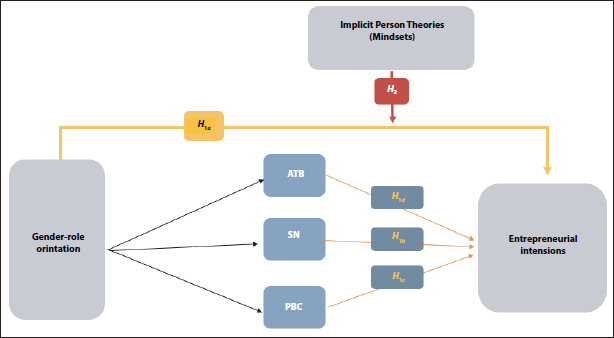
Conceptual Framework Showing Hypothesized Relationships.
Following similar prior studies, a sample of university students was deemed to be suitable for studying EI, as many students are likely to make important career choices soon after graduating (Cheng et al., 2021; Krueger et al., 2000). Consequently, a sampling frame was created based on undergraduate students at South African public universities in their final year of study. Students from South African public universities in the Gauteng Province in the following faculties participated in the study, namely Commerce and Management (43%), Humanities (33%) and Sciences and Engineering (22%). These faculties reflect the current enrolments by major field of study at public universities in South Africa (DHET, 2021; USAF, 2019). Recognizing that prior entrepreneurial experience might influence self-perceptions of EI (Arshed et al., 2024), individuals who already own a business were not eligible to participate.
A letter explaining the research context and the study questionnaire was posted on public university student forums and social media channels such as ‘LinkedIn’. The questionnaires were accessible to the targeted students on a secure password-encrypted website (Qualtrics). Surveys were only administered once the participating university research office issued an approval via the university research office. Ethical concerns were taken into consideration by safeguarding the respondents’ anonymity as well as their rights and protections, which were made explicit and explained at the start of the data collection process. After a period of 6 weeks, a total of 430 responses were collected. After reviewing and cleaning the data in terms of removing incomplete responses, the sample for this study consisted of 415 valid responses for further analysis.
Measures
EI was operationalized based on the entrepreneurial intention questionnaire (EIQ) originally developed by Liñán and Chen (2009). The EIQ has been shown to display high internal reliability, and the applicability of the EIQ has been empirically assessed across cultures (Liñán & Chen, 2009; Urban & Chantson, 2019). As per the hypotheses, the EIQ reflects the TPB model constructs and consists of six questions to measure EI, five questions to measure ATB, three questions to measure SN and six questions to measure PBC. Five of these 20 items were reverse statements to control for acquiescence and to disrupt non-substantive patterns of responding. The original EIQ was based on a seven-point Likert scale (1 = total disagreement to 7 = total agreement), which was adopted.
GRO was measured using the traditional masculinity-femininity scale developed by Kachel et al. (2016). This continuous scale was composed of six questions and captures the degree to which an individual characterizes oneself as either more feminine-orientated or more masculine-orientated. Participants had to indicate the degree to which they assigned themselves to a GRO, namely a rating of one (1) indicates a high degree of association with a strong masculine GRO. In contrast, a rating of seven (7) indicates a strong association with a feminine GRO.
For measuring IPT (mindset), Levy’s (2016) work was consulted, and an instrument was used which consists of eight items that capture the nature of the person at a general IPT domain level and is also referred to as beliefs about human nature because the scale measures respondents’ beliefs about areas of personality and ability. Four of the items assess incremental theories, also known as growth mindset, while the other four items assess entity theories, also known as fixed mindsets. This instrument has established validity and reliability and is measured along a seven-point Likert scale (1 = strongly disagree to 7 = strongly agree).
As a control variable, racial descriptors were used as currently in South African higher education institutions use the following racial descriptors: ‘African’, ‘Coloured’, ‘White’ and ‘Indian/Asian’ for planning, monitoring and funding purposes. These racial descriptors, which characterized apartheid policies in the past, are used to provide historical context and measure the effects of present policy on redressing the inequities of the past, as required by the Constitution of South Africa (DHET, 2021). Based on these descriptors, a sizeable portion of the sample was African (58%), then Indian/Asian (21%), followed by White (10%) and Coloured (9%).
Data Analysis Techniques
Since the study relied upon multiple variables measured using the same method, this may result in ‘artificially inflated correlations between those variables, rather than reflecting true relationships’ leading to ‘common method variance’ (CMV), and hence issues pertaining to ‘common method bias’ was used (Podsakoff et al., 2012. p. 546). The CMV ex-ante approach included managing issues of questionnaire design and administration as well as running a ‘pilot test’ (n = 30) to obtain an understanding of questions and avoid ambiguity. In addition, the CMV ex-post approach necessitated calculating a ‘Harman’s one-factor test, for all multi-item variables’ (Podsakoff et al., 2012). Results provided six distinct factors, with the first factor explaining 14.54%, ‘suggesting no single factor accounted for the majority of the variance and consequently common method bias was not considered to be a serious issue’ (Podsakoff et al., 2012). Furthermore, confirmatory factor analysis (CFA) was used to determine measurement validity and reliability.
A two-step modelling approach was used, where CFA was first conducted to confirm the validity and reliability of the instruments, followed by partial least-squares structural equation modelling (PLS-SEM) (version SMARTPLS3) to estimate the strength of relationships as per the study’s hypothesized model. In terms of moderation analyses, moderation guidelines established by Baron and Kenny (1986) were followed insofar as a moderation effect can be either positive or negative. The bootstrap resampling method for determining the significance of the path coefficients was relied upon. A relationship between EI and independent variables should manifest itself through three paths, for example, the influence of GRO (path 1), the influence of the person’s IPT (path 2) and the product of paths 1 and 2 (path 3) (GRO * IPT). If path 3 (GRO * IPT) is significant, hypothesized moderation is assumed to be present.
Results and Discussions
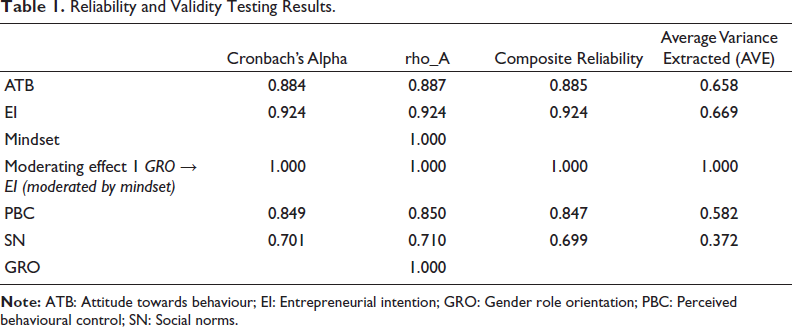
The PLS-SEM outer model was first assessed for internal reliability through ‘Cronbach’s Alpha as well as the Composite Reliability’ method (Hair et al., 2019). A lower bound score of 0.7 (on a scale from 0 to 1) was required to ascertain acceptable levels of reliability of a composite variable. ‘Convergent and discriminant validity of the PLS-SEM model was assessed using the methods’ described by Hair et al. (2019). For convergent validity to be achieved, the ‘measured variables factor loadings, on their respective latent variables, needed to exceed 0.708. In addition, the average variance extracted (AVE), which is the square root of the standardized indicator loading, had to be greater than 0.5 for convergent validity’.
The results are presented in Tables 1 and 2, where the elimination of specific items was made due to poor loadings on the extracted components. Apart from the SN dimension of the TPB, all other constructs had a reliability value greater than 0.70. There was a minor dilemma with the convergent validity of the SN construct, as the value of the AVE was slightly below the minimum acceptable value. However, after a closer examination of these items, it was confirmed that it was not appropriate to delete or separate these items, as this would not improve the composite score of the higher-order construct. It was decided to keep all items in the SN construct because its composite score is above 0.60 (Hair et al., 2019). Divergent validity was established as the diagonal elements of the Fornell–Larcker criterion were greater than the non-diagonal correlations with other constructs, except for SN, which was correlated with the items of the other constructs, as shown in Table 2. Multicollinearity was not an issue since all estimated correlations between the variables were below the cut-off of 0.70 (Hair et al., 2019). The CFA model is depicted in Figure 2.
Confirmatory Factor Analysis (CFA) Model Results.
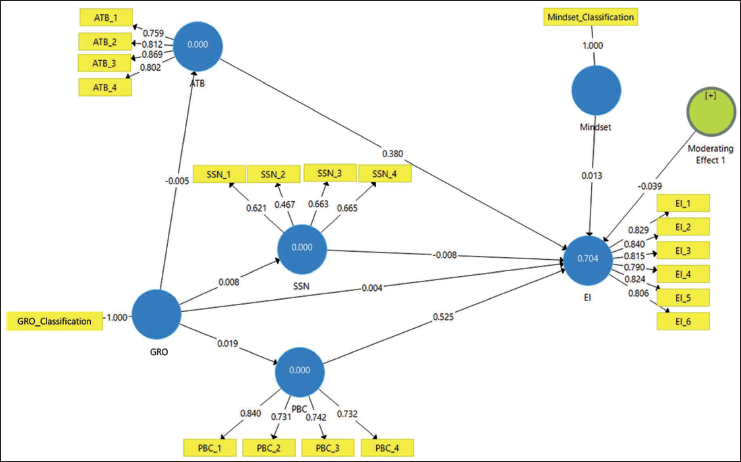
Confirmatory Factor Analysis (CFA) Model Results.
Reliability and Validity Testing Results.
Fornell–Larcker Criterion Results.
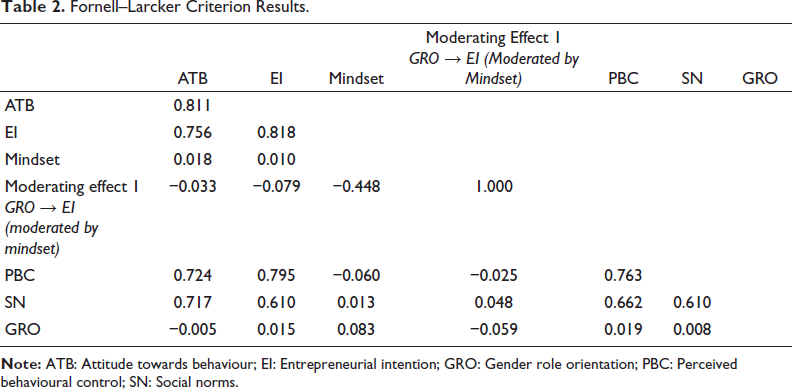
Table 3 shows the descriptive statistics where EI had the highest mean score (5.59), followed by ATB (5.40), PBC (5.36) and SN (5.24) with varying degrees of standard deviations noted. A respondent was designated into a feminine GRO category if they had a mean score greater than 3.5 and a masculine GRO if they had a mean score less than 3.5. Thus, the mean score of 0.70 is skewed more towards a feminine GRO. Similarly, the mindset construct was based on the mean of all items, where a respondent with a mean greater than 3.5 was classified as growth mindset-oriented, while respondents with a mean less than 3.5 were classified as having a fixed mindset. Hence, the 0.98 mean score obtained reflects a predominant growth mindset in terms of IPT.
Descriptive Statistics and Correlations.
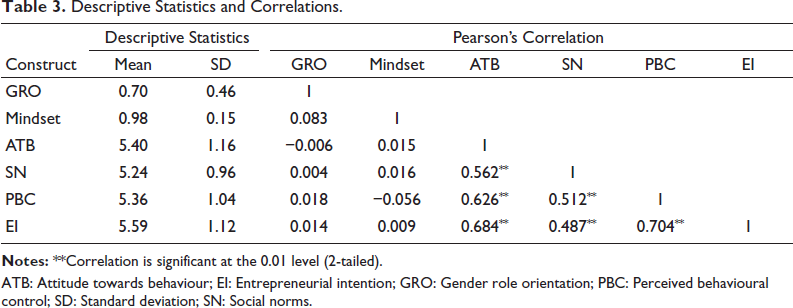
ATB: Attitude towards behaviour; EI: Entrepreneurial intention; GRO: Gender role orientation; PBC: Perceived behavioural control; SD: Standard deviation; SN: Social norms.
Pearson correlation was performed first to evaluate different relationships independently. Some observations are: there was a strong, positive and significant relationship between ATB and EI (r = 0.684, p value < .01). There was a moderate, positive and significant relationship between SN and EI (r = 0.487, p value < .01). There was a strong, positive and significant association between PBC and EI (r = 0.704, p value < .01). There was a weak positive but non-significant relationship between mindset and EI (r = 0.009, p value > .05). There was a weak positive but non-significant relationship between GRO and EI (r = 0.014, p value > .05). In relation to multicollinearity, the collinearity statistics calculated indicated that the variance inflation factor (VIF) values were all less than 10, which implies that there were no problematic issues concerning multicollinearity (Hair et al., 2019).
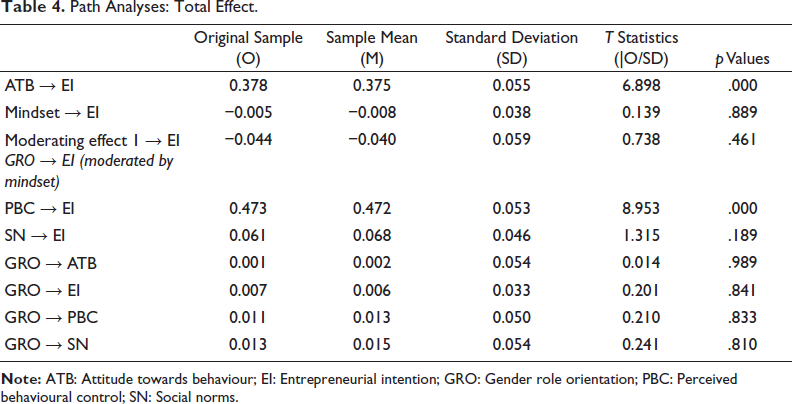
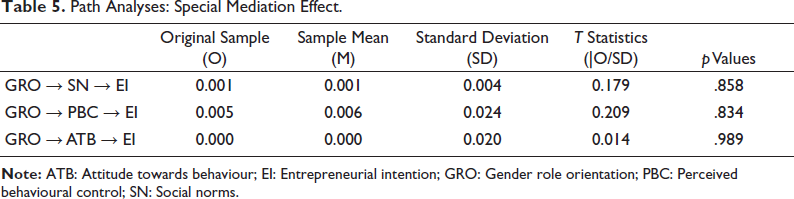
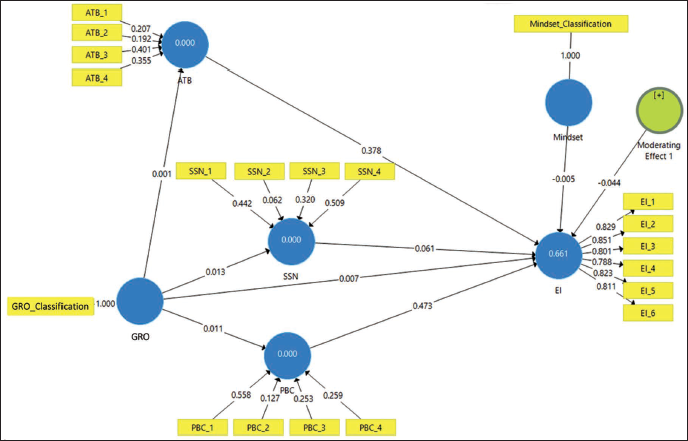
A formative PLS-SEM model with bootstrapping was applied to the final pruned model to evaluate the hypotheses. The model is shown in Figure 3. The estimated model fit summary indices were in line with the recommended values (Hair et al., 2019) and appeared as follows: SRMR = 0.045; d_ULS = 0.425; d_G = 0.297; χ2 = 649.273; NFI = 0.867. We then assessed the path coefficients for the hypothesized relationships, which are presented in Table 4, in terms of the total effect model, and Table 5 with respect to the special mediation effect model.
Path Analyses: Total Effect.
Path Analyses: Special Mediation Effect.
Partial Least-squares Structural Equation Modelling (PLS-SEM) Model Results.
In terms of H1a, the results in Table 4 show that GRO (β = 0.006, p value = .841) has a positive but non-significant effect on EI of university students in South Africa. The effect was positive because the mean (average) bootstrapping effect was greater than zero (0.006). However, the effect was not significant because the p value was greater than .05. Thus, this means that there is insufficient evidence to support H1a.
In terms of H1b, the results presented in Table 5 show that the path GRO → ATB → EI (β = 0.000, p value = .989) was non-significant as the p value was greater than .05. This means that there is insufficient evidence to support H1b.
In terms of H1c, the results presented in Table 5 show that the path GRO → SN → EI (β = 0.001, p value = .858) was non-significant, because the p value was greater than .05. This means that there is insufficient evidence to support H1c.
In terms of H1d, the results presented in Table 5 confirm that the GRO → PBC → EI pathway (β = 0.006, p value = .834) had a positive effect, but non-significant, as the p value was greater than .05. This means that the supposition of a relationship between GRO and EI through the mediating role of PBC was not supported and H1d cannot be accepted.
In terms of H2, the results presented in Table 4 show a negative moderation (β = −0.040, p value = .461); however, the influence was non-significant as the p value was greater than .05. This means that there is insufficient evidence to support H2.
Finally, as a control variable, racial descriptors did not differ significantly in terms of the GRO-EI relationship. The results revealed that the means were not statistically different (t-value = −0.601, p value = .548), as the p value was greater than .05.
The present study has demonstrated that while the relationship between GRO and EI (H1a) was positive but non-significant. This finding is revealing, considering that the participants in the study described themselves as holding a feminine GRO, which is primarily considered to have a negative relationship with entrepreneurship. Consequently, the results, which were obtained in our study, contradict the claim that there is a negative relationship between a feminine GRO and EI (Gupta et al., 2014). Additionally, recent research observations emphasize that the earlier archetype of the masculine entrepreneur is shifting and evolving towards a more androgynous representation (Passah & Panda, 2022). Similar to other recent studies (Varrone et al., 2025), the findings provide critical insights for enhancing gender diversity in entrepreneurship and corporate situations, and serving both academic research and practical managerial and policymaking deeds.
Moreover, the findings for the positive associations (albeit non-significant) between GRO and the antecedents of EI in terms of ATB (H1b), SN (H1c) and PBC (H1d) suggest that numerous factors are at play, which could influence students in pursuing entrepreneurship. This finding adds to the entrepreneurship literature, where several factors such as barriers to entry and access to resources have been reported to be more of a barrier for individuals who hold a feminine gender role than for those with a masculine GRO (Shuvam & Mohanty, 2023; Vercruysse & Birkner, 2021).
This study also evaluated the relevance of the IPT in terms of a growth mindset as a moderator to EI (H2). While non-significant results were obtained in this regard, it is important to remember that mindsets are influenced by the context in which they develop and do not arise in a vacuum (Dweck, 2019). In South Africa, the enabling environment is often seen as a potential barrier for aspiring entrepreneurs, where, due to the dual economy, a high proportion of the population is excluded from participating in the formal economy as a result of inadequate education, regulatory burdens, crime and corruption (Urban & Chantson, 2019). This is especially true for those with a feminine GRO, as stereotypes suggest that the pursuit of an entrepreneurial journey is not an appropriate or viable professional choice for them. Such findings resonate with similar studies investigating the effect of gender on entrepreneurial mindset development, which was tested by Makudza et al. (2024), who find that gender stereotype persists within entrepreneurship and cultural determinants and gender roles influence the uptake of entrepreneurial roles. These findings could also be explained in terms of our sample of students with a predominant feminine GRO who seem to perceive the path to entrepreneurship as less optimal, even if they may find the concept of entrepreneurship appealing. Such stereotypes about certain genders and entrepreneurship lead to gender role stress or strain and the creation of negative self-schemas because of the way these individuals wish to portray themselves, and the GRO they hold does not match those of society (Laguía et al., 2022). Indeed, from an African perspective, some potential boundary conditions that influence the findings are observed, which relate to recent studies that suggest that the sociocultural environment is gradually transforming into a more egalitarian space; however, traditional ideologies persist relating to the gender division of labour and gender disparity, which remains a fundamental problem in South Africa and Africa as a whole. Hence, the focus on the links between GRO, EI and IPT is timely in the South Africa context and allows for new insights to be generated into this under-researched topic.
Investigating the GRO-EI relationship represents a rich area of study which goes beyond a limited view of binary biological sex classifications and the general stereotype that entrepreneurs possess masculine characteristics. Overall, the research findings provide a novel contribution to the management and entrepreneurship literature by extending current theory on EI in terms of integrating the previously unrelated constructs of a non-binary concept of GRO within the overall TPB framework (Urban & Ratsimanetrimanana, 2025). By investigating and combining GRO (masculinity and femininity) as determinants of EI rather than focusing on biological sex, a significant research milestone has been reached, by providing a more robust approach to understanding differences in attitudes and intentions that exist even within the same gender groups (Gupta & Nagar, 2025; Urban & Moetse, 2024).
Policymakers are encouraged to adopt the recommendations on gender equitable practices in terms of the international conventions relating to gender equality and to ensure that regulatory frameworks embed gender equity and accessibility into entrepreneurship development. South African policymakers should re-evaluate their entrepreneurial developmental policies and focus on research-based evidence to devise opportunities and schemes that pay attention to the GRO development for entrepreneurship. Within such interventions, policymakers could integrate elements of GRO, growth mindsets and EI into one unified framework. Additionally, officials need to be held accountable to ensure that gender equality and women’s empowerment are translated into substantive improvements in the lives of women entrepreneurs. Supporting those who hold a feminine GRO is necessary in the South African context, as the country is based on a legacy of inequality that has led to a society that is divided in several respects. Some form of gender division of labour persists in many emerging economies, such as South Africa, where women are still locked into traditional female functions and tend to concentrate on activities compatible with their domestic and reproductive roles (Urban & Moetse, 2024). Consequently, the government needs to address a lack of effective institutional structures and capacity so that various role players can efficiently comply with current legislative and policy requirements.
A critical area where the present study has research implications is that of measuring GRO, where GRO was measured as a global scale rather than focusing on specific indicators or attributes of femininity and masculinity. Prior literature relies on research scales that measure gender-stereotypical attributes of masculinity (assertive) and femininity (caring), as opposed to self-attributed perceptions of masculinity and femininity (Kachel et al., 2016). This leads to an unstable factor structure in these scales, as using attributes such as ‘meek and competitive’ as direct indicators of femininity and masculinity is limited because such attributes depend on the sociocultural context and time (Adamus et al., 2021). Consequently, it is critical to measure gender in a reliable and valid manner by using facets of self-described masculinity and femininity. Subsequently, the application of the GRO scale in the South African setting is a useful methodological adjunct for capturing gender role identity in entrepreneurial research. Following the testing and validation of these scales, this article now allows researchers to conduct replication studies with the same measures in comparable country settings.
In terms of practical recommendations, given that this study was conducted amongst students, this article contributes to how educational institutions could focus on developing practical scenarios of both feminine and masculine entrepreneurs, highlighting realistic and relatable role models for all gender groups. Entrepreneurial education or training not only affects an individual’s expertise and skills but can also influence their perceptions and beliefs about entrepreneurship, this is even more true for young people, such as university students. Managers at universities can also start to think about which entrepreneurial intervention activities and training are more suited for those with feminine GRO, over and above just interventions governed by biological sex. Attributing feminine characteristics to entrepreneurship will promote recognition and awareness of entrepreneurial archetypes with feminine GRO, resulting in more diverse entrepreneurs being represented.
This study, like most others, has limitations, which point to novel directions for future research. Certain non-significant findings were obtained for the hypothesized relationships, and therefore, no claims of causality can be made. Nonetheless, ‘there are precedents for obtaining non-significant findings, and with any scientific endeavour, the business management field cannot move forward without ruling out certain directions as well as ruling in at times some non-significant findings’ (Wagner & Jonkers, 2017). In this regard, the article’s theoretical assumptions need consideration, particularly as gender role theory argues that the social construction of entrepreneurship is changing, as there is an important shift from the dominance of instrumental behaviours to a new social construction of entrepreneurship (Laguía et al., 2022). GRO is a psychological characteristic that manifests itself in adherence to and acceptance of social and cultural gender norms, which are in continual flux and transformation (Berger & Krahé, 2013). Another limitation is that despite assurances of anonymity, self-administered surveys may contain bias. Given the sensitivity of gender and GRO, some respondents may have given answers that they consider socially and culturally appropriate. Moreover, as the study focused on South African university students, this can ‘limits the generalizability of its findings to the broader population, as university students may not represent the diversity and experiences of the entire population’. To remedy such limitations, future studies may look at replicating this study in rural areas, because GRO-EI research in such contexts is still scarce and is only understood through a patriarchal lens, where women are forced to use masculinity as a reference point for entrepreneurship. Another avenue that may be useful for future research is the inclusion of formal and informal institutions in models of GRO-EI. Research could also focus on the influence of the emergence of the digital economy in Africa and its influence on the GRO-EI relationship. Overall, more theoretical and empirical research on GRO and entrepreneurship from another African country perspective would be welcomed.
Footnotes
Authors’ Contributions
Boris Urban was responsible for the article conceptualization, and for the writing of the article and subsequent reviews and editing.
Jeremia Moloi was responsible for the article model, methodology, data analyses as well as the original draft.
Declaration of Conflicting Interests
The authors declared no potential conflicts of interest with respect to the research, authorship and/or publication of this article.
Ethical Declaration
The authors abide by all the ethics involved in this academic work and have not submitted it to any other journal.
Funding
The authors received no financial support for the research, authorship and/or publication of this article.
