



Abstract
Research indicates that job autonomy (JA) plays a pivotal role in enhancing employee creativity (EC); however, our understanding of the underlying mechanisms facilitating this connection is still limited. To address this lacuna, we draw on self-determination theory, which argues that perceived supervisory support (PSS) may act as a mediator. Thus, this study explores how JA enhances creativity through PSS. Furthermore, we explore the moderating role of the job difficulty level on the relationship between JA and EC. Conducting a cross-sectional survey involving 561 employees in the Turkish media sector, our study utilizes structural equation modelling in AMOS and employs moderator analysis in PROCESS Macro. The results unveil that JA not only directly positively impacts EC but also exerts an indirect influence through the mediating role of PSS. Furthermore, our findings highlight the moderating effect of job difficulty level, indicating a negative impact on the relationship between JA and EC. Among the examined control variables, including gender, organizational tenure and sectoral tenure, it is notable that sectoral tenure emerges as the sole factor significantly influencing EC.
These results have significant implications for the development of innovative management strategies and human resources policies tailored to the unique needs of media companies. The study underscores the importance of understanding the intricate dynamics between JA, PSS and job difficulty levels in fostering a creative work environment.
Introduction
Many businesses, whether functioning within domestic or global markets, find themselves immersed in the dynamics of worldwide competition. This global competitive landscape is also impacting Turkey’s media sector, which is experiencing rapid growth driven by digital transformation and substantial investments in media and advertising. Notably, from 2022 to 2023, media spending in Turkey surged by 120%, reflecting significant changes in the sector (Deloitte, 2024). Creativity is crucial in this industry due to its role in producing content that balances commercial viability with cultural relevance. To keep pace with changing consumer demands and rapid technological developments, media companies must constantly innovate. Thus, employee creativity (EC) is essential for maintaining competitiveness and relevance in this fast-evolving industry (Lowe, 2016). EC is defined as the generation of valuable, practical and original ideas that can manifest into products, services, or processes (Woodman et al., 1993). Planning the development process of EC requires recognizing antecedents such as individual characteristics, abilities and environmental factors (Richter et al., 2012). Although the importance of evaluating the work environment for creativity was recognized nearly two decades ago, some specific contextual components, such as job autonomy (JA) and perceived supervisor support (PSS), still need further examination (Amabile et al., 1996).
This study emphasizes the concept of JA as a means to enhance EC. JA offers insights into various aspects of an organization, such as occupational and environmental factors, and these insights have the potential to influence employees’ behaviours and performance outcomes (Alam et al., 2022). Particularly, it is known to foster positive work-related outcomes, including employee attitudes and organizational performance (de Vargas Pinto et al., 2023; Hackman & Oldham, 1976). For instance, JA enables firms to exhibit agility and foster innovation (Frare & Beuren, 2021). The concept of autonomy is the level to which an individual is comfortable using their knowledge to make decisions (Deci & Ryan, 1985). When considering working environments, JA can be defined as the extent to which employees are provided with the independence and discretion to perform their work duties.
According to the self-determination theory (SDT), people have an inherent desire for autonomy, competence and relatedness. The fulfilment of these basic needs is linked to intrinsic motivation and overall well-being (Ryan & Deci, 2000). In this context, JA is significantly interrelated with autonomous motivation, providing evidence of its impact on motivational processes (Veenstra et al., 2022). JA satisfies an individual’s need for self-determination, enhancing motivation to acquire new information and skills (Zhou et al., 2019). Research findings suggest that managers should consider enhancing employee JA, alongside variety, feedback and identity, to foster creative behaviours (Coelho & Augusto, 2010). When employees are granted JA, they are more likely to actively participate in generating creative solutions (Guo et al., 2021).
Another crucial aspect is PSS, defined as the level of belief that employees are respected and encouraged by their supervisors (Kottke & Sharafinski, 1988; Wang, 2022). According to SDT, when managers establish a conducive environment that fosters self-determination, subordinates exhibit an increased level of trust in the organization and demonstrate more favourable views towards their work (Gagne & Deci, 2005). In other words, when the manager understands and accepts the needs, feelings, and attitudes of the subordinate, the employee has more confidence in the work environment he is in and believes that his work-related suggestions, including creative ideas, will be taken into account (Deci et al., 1989). Employees who feel supported by their managers have shown higher work engagement, self-efficacy beliefs, proactive behaviours, intrinsic motivation and creativity than those who do not PSS (Karatepe & Olugbade, 2009; Li et al., 2022; Shalley & Gilson, 2004; Wang, 2022; Wang et al., 2015).
SDT posits that the fulfilment of the autonomy need is positively associated with the encouragement of creativity (Deci & Ryan, 2008). In essence, the granting of JA to employees satisfies their needs, thereby enabling an augmentation in EC. While studies that have made use of SDT have generally explained that JA improves creativity through intrinsic or autonomous motivation (Li et al., 2018), there is another rationalization that satisfying the need for autonomy improves creativity through perceived supervisor support. Building on this background, the present research proposes a novel framework examining the mediating role of PSS in the relationship between JA and EC.
The primary objective of the study is to explore how employees, when granted autonomy, may perceive their supervisors as supportive, which in turn lead to increased creativity. The rationale behind this investigation is rooted in the notion that employees who are granted an adequate amount of autonomy in their work may perceive their supervisor as being supportive (Park & Jang, 2017), as JA influences perceptions of supervisor support through the meeting the need for autonomy and the creation of a positive work environment (Gagne & Deci, 2005; Ryan & Deci, 2000). Additionally, it is posited that a trusting relationship between employees and their supervisors can positively impact creative behaviour (Deci et al., 1989; Gagne & Deci, 2005).
The second objective of the study is to uncover the moderating role of job difficulty on the relationship between JA and EC. Although the effect of task complexity on this relationship has been studied (Sia & Appu, 2015), it has not been questioned before how JA will affect creativity as the difficulty level of the jobs changes. Therefore, we have sought the answer for this question by predicting that the difficulty level of the job may moderate the relationship between JA and EC negatively. Job difficulty, defined as the extent to which a job necessitates considerable physical, mental, or emotional effort to be accomplished (Ercan, 2018; Ivancevich & Smith, 1981), is interpreted in this study as how much effort employees perceive is required to complete their tasks on the job.
In conclusion, this study contributes to the creativity literature by empirically demonstrating the mediating role of PSS, unveiling the moderating impact of job difficulty, and offering practical implications for HRM professionals and practitioners to enhance EC. The findings highlight the importance of creating work settings that enhance both supervisory support and autonomy, with sectoral tenure emerging as a significant influence on creativity.
Review of Literature
Autonomy assumes a critical role in facilitating a high degree of intrinsic motivation, recognized as a fundamental element of creativity (Ryan & Deci, 2000). Occupations characterized by high autonomy levels tend to exhibit greater creativity, as individuals experience a sense of self-determination and freedom from external constraints (Wang & Cheng, 2010). Moreover, JA plays a pivotal role in shaping employees’ sense of responsibility and influencing various individual and job-related outcomes, including performance, motivation, satisfaction and absenteeism (Hackman & Oldham, 1976).
In essence, a heightened level of JA positively impacts employees’ motivation and attitudes, thereby fostering increased creativity and performance (Buch et al., 2015; Guo et al., 2021; Li et al., 2018; Tabiu et al., 2020; Tran et al., 2021). Numerous studies corroborate the positive association between autonomy at work and creativity (Allil et al., 2021; Ghazzawi et al., 2021; Guo et al., 2021). For instance, Jafri (2018) identified a higher level of creativity among employees in the financial sector holding positions with high autonomy. Similarly, Thuan (2020) established a positive association between JA and enhanced creativity among IT workers in Vietnam. The study conducted by Guo et al. (2021) affirmed that JA positively influenced creativity within Pakistan’s hotel industry.
In alignment with SDT, which posits that fulfilling the need for autonomy enhances creativity (Deci & Ryan, 2008), the current study aims to demonstrate, specifically in the media sector, that individuals with substantial autonomy in their roles tend to exhibit more creative behaviours. Consequently, we hypothesize that:
H1: JA is positively related to EC.
Researchers have emphasized the vital role of supervisors’ support for creativity in organizational settings (Amabile et al., 2004). Supportive supervisors exhibit behaviours that assure subordinates of understanding and encouragement for defending their ideas (Deci & Ryan, 1985; Wong & Pang, 2003). In the literature, the relationship between supervisory support and creativity has received considerable attention. Extensive research has consistently shown a positive connection between them (Li et al., 2022; McKersie et al., 2019; Zhang & Bartol, 2010). Supportive supervisors value their subordinates’ ideas, feelings and well-being in the workplace. When employees are aware of this support, they are empowered to generate innovative ideas and achieve more creative results (Cummings & Oldham, 1997).
The cultivation of creativity in the workplace has been widely recognized as dependent on several elements related to the work environment, including JA and PSS (Amabile et al., 1996; Shalley & Gilson, 2004). Most research on JA and PSS has addressed these concepts either as job resources based on Bakker and Demerouti’s (2007) job demands-resources model (Di Marco et al., 2018; Mach et al., 2018; Rashmi & Kataria, 2021), or as moderators on the relationship between the two concepts (Buch et al., 2015; Dysvik & Kuvaas, 2013; Jafri, 2018; Li et al., 2021). Only one recent study, utilizing SDT, indicates that PSS mediates, rather than moderates, the relationship between JA and an outcome variable (Park & Jang, 2017). Although most studies do not directly analyze the relationship between JA and supervisor support, they have examined these two variables together in the context of creativity. For instance, in Jafri’s (2018) study, emotional intelligence increases EC, while JA and supervisor support strengthen this relationship as two separate moderators. Wong and Pang (2003) incorporated JA and supervisor support into five job-related motivators to creativity and tested their impact on creativity. Theoretical studies describing the antecedents of creativity have revealed JA and supervisor support among environmental factors, along with other antecedents (Amabile, 1997; Shalley & Gilson, 2004; Zhou & Hoever, 2014).
In the workplace, supervisors have a crucial role in whether employees can exercise their autonomy (Ryan & Deci, 2000). Just as employees feel organizational support when their company implements HR activities advantageous to them, they will feel supervisor support when their managers willingly give them more autonomy in the job (Park & Jang, 2017). Essentially, as managers give their employees JA, employees perceive them as supportive managers. According to the SDT, since JA influences perceptions of supervisor support through the fulfilment of the need for autonomy and the creation of a positive work environment (Ryan & Deci, 2000), a trustworthy relationship between employees and their supervisors can have a positive impact on creative behaviour (Deci et al., 1989; Gagne & Deci, 2005). When managers create a supportive manager image by giving autonomy to employees, employees are more willing to engage in creative thinking on their job due to both their autonomy and support (Wong & Pang, 2003). Based on these considerations, the following hypothesis is formulated:
H2: PSS mediates the relationship between JA and EC.
In the existing literature, limited studies have directly investigated the concept of ‘job difficulty’ (Ercan, 2018; Ivancevich & Smith, 1981; Varadarajan & Charles, 1984). However, a substantial body of research has explored job goal difficulty and task complexity in the context of work motivation and EC (Shalley, 1991; Sia & Appu, 2015; Wright, 2004). Examining job goal difficulty within the framework of goal-setting theory reveals that setting specific and challenging goals improves performance (Wright, 2004). Goal setting also serves as a managerial tool to foster creativity in the workplace (Shalley et al., 2004). Contrarily, Ma et al. (2021) found that high goal difficulty diminishes the probability of successfully completing tasks, thereby increasing the likelihood of negative performance feedback. They highlighted that goal difficulty moderates the indirect relationship between team-level high-performance work systems and EC through self-efficacy, with this link being stronger when goal difficulty is low. Turning to task complexity, defined as the degree of exciting and challenging responsibilities associated with a specific task, emerges as a crucial determinant of organizational creativity (Sia & Appu, 2015). Individuals often exhibit enthusiasm when dealing with complicated tasks. Increased task complexity fosters positive emotions and attitudes such as engagement, interest and curiosity, ultimately leading to creative performance (Amabile, 1988; Sia & Appu, 2015). Complex tasks stimulate creativity by providing motivation to individuals (Oldham & Cummings, 1996). Despite a prevailing trend of positive results associated with task complexity, it is crucial to acknowledge that both excessive and insufficient levels of task complexity can detrimentally impact individuals (Chung-Yan, 2010).
The discourse on job difficulty, referred as the extent to which a job necessitates considerable physical, mental, or emotional effort to be accomplished (Ercan, 2018; Ivancevich & Smith, 1981), in the literature originates from an examination of the five-job characteristics model proposed by Hackman and Oldham in 1976 (Ivancevich & Smith, 1981). Hackman and Oldham (1976) formulated fundamental job dimensions, including skill diversity, task identity, task significance, autonomy and feedback on the professional workplace. A job designed to be at least moderately difficult within these main characteristics is considered enriched (Herzberg, 1968). Namely, job difficulty is commonly regarded as a favourable attribute of work, frequently associated with job enrichment (Chung-Yan, 2010). However, it is seen that the effect of the difficulty level of the job on the relationship between JA and creativity, rather than the task complexity, is not discussed. While a high degree of task complexity enhances creative performance (Tierney & Farmer, 2002), the interaction effect of task complexity with JA negatively affects creativity at work (Sia & Appu, 2015). Similarly, this study posits that the difficulty level of the job may have a negative effect on the relationship between JA and creativity.
H3: The difficulty level of the job will moderate the relationship between JA and EC such that the relationship is stronger when the difficulty level is low than when it is high.
Materials and Methods
Data
This study collected data from the media sector in Istanbul, which has a pivotal role in the Turkish economy. A convenience sampling method was employed due to the difficulties in contacting the population of interest. This method allowed us to effectively reach participants who are employees at these major media organizations in Istanbul. Individuals’ self-assessments were obtained using a cross-sectional questionnaire from employees who voluntarily participated.
Since the total number of employees in the media sector throughout the province could not be determined, the minimum sample size required for the highest population in the 95% confidence interval was accepted as 384 (Saunders et al., 2009). A web-based sample size calculator employing the Yamane formula was utilized to ascertain the minimum required sample size. To obtain a 95% confidence level with a ±5% margin of error, a minimum of 385 replies or surveys is required, as evidenced by the results (Maple Tech. International LLC, 2024). Out of more than 1,000 surveys, 561 were completed and returned.
The demographic characteristics of the sample (N = 561) are described in Table 1. Participants were 51.3% female and 48.3% male. Most of the participants had been gathering for between 1 and 3 years in terms of organizational tenure (27.8%) and sector tenure (29.2%).
Sociodemographic Profile of Respondents (N = 561).
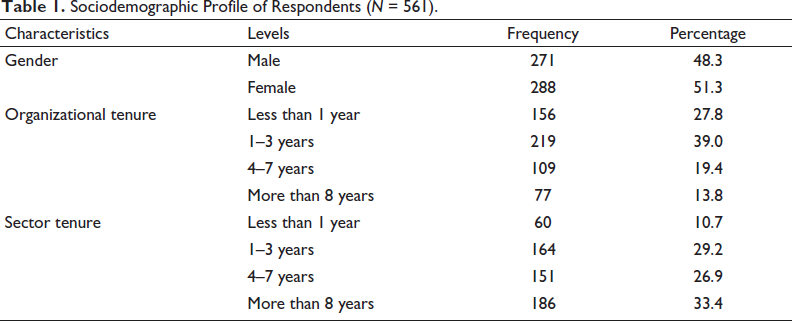
Sociodemographic Profile of Respondents (N = 561).
In the study, all variables were measured using a 7-point Likert scale, ranging from 1 (strongly disagree) to 7 (strongly agree). The scales that were compatible with the research topic and had high validity and reliability were translated into Turkish in accordance with the translation and back-translation procedure suggested by Brislin (1970). The characteristics of the scales used in the survey are as follows:
JA
JA was measured with Wang and Netemeyer (2002)’s four-item scale. This scale is a subscale from the Job Diagnostic Survey (Hackman & Oldham, 1976) and depicts how much the respondents feel autonomous in their current job. The reliability coefficient is calculated to be 0.86. Sample items: ‘I can decide on my own how to go about doing my work’, ‘I have considerable opportunity for independence and freedom in how I do my job’ and ‘I have significant autonomy in determining how I do my job’.
PSS
The scale has an 8-item including two reverse items prepared by Eisenberger et al. (1997). In fact, since this is an organizational support scale, it is written as a supervisor rather than organization in the sentence. Cronbach’s alpha for the scale is calculated to be 0.84. Sample items: ‘My supervisor strongly considers my goals and values’, ‘My supervisor is willing to help me if need a special favour’ and ‘My supervisor cares about my opinions’.
EC
A thirteen-item EC scale, developed by Zhou and George (2001), was used in the study. Sample items: ‘I suggest new ways to achieve goals or objectives’, ‘I come up with new and practical ideas to improve performance’ and ‘I suggest new ways to increase quality’. This scale’s reliability coefficient is calculated to be 0.86.
The Difficulty Level of the Job
Employees were asked ‘What is the difficulty level of your job?’ and the difficulty level of their current job was measured with an item using a response scale ranging from 1 (too easy) to 7 (too difficult).
Control Variables
In our analysis, we controlled for gender (1 = female, 2 = male), organizational tenure and sector tenure (1 = less than 1 year, 2 = 1–3 years, 3 = 4–7 years, 4 = 8–10 years, 5 = more than 10 years). Earlier studies had suggested that these employee characteristics were likely to be related to EC (Zhang & Bartol, 2010).
Results and Discussions
Mediator analysis was conducted using AMOS-SEM that allows for explicit modelling of measurement errors, ideal for latent constructs. Moderator analysis was performed with the PROCESS Macro, chosen for its efficiency in conditional process analysis and testing interactions. Descriptive statistics are detailed in Table 2, which shows the study variables’ mean, standard deviation and bivariate correlations. As expected, JA correlates positively with PSS (0.335, p < .01) and EC (r = 0.23, p < .01). PSS also correlates with EC significantly (r = 0.197, p < .01). All demographic factors have a significant correlation with some variables in the model.
Means, Standard Deviations (SD), and Correlations.
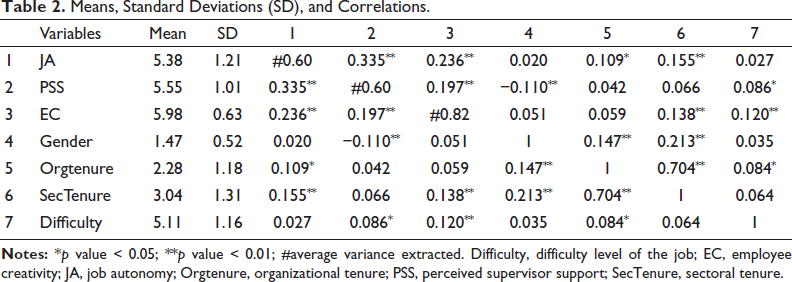
Means, Standard Deviations (SD), and Correlations.
To develop our measurement model, we utilized confirmatory factor analysis (CFA) with the maximum likelihood estimation method in AMOS 25. This approach ensured that each theoretical construct was precisely operationalized through its indicators while rigorously scrutinizing the dimensionality and validity of the variables. Table 3 provides the goodness of fit statistics of scales and measurement model. During the CFA, only items with a loading coefficient of 0.45 or higher are retained for further analysis. However, items with low loadings below 0.45 are removed based on the recommendation of scholars (Fabrigar & Wegener, 2012). Thus, perceived supervisor support6 and perceived supervisor support7 items were deleted due to low loadings.
The Goodness of Fit Statistics of Scales and Measurement Model.
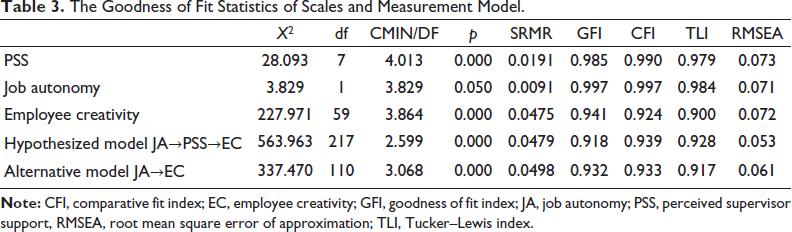
The Goodness of Fit Statistics of Scales and Measurement Model.
Construct Reliability, Convergent and Discriminant Validity Coefficients.
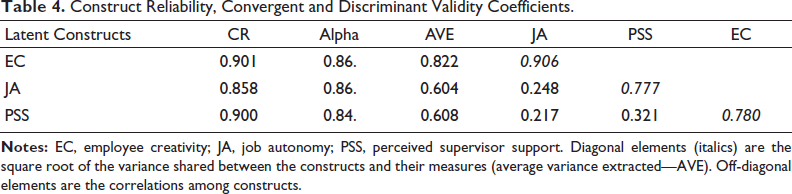
The validity of the measurement model was then checked. Since the composite reliability values exceeded 0.7 and the average variance extracted (AVE) reached at least 0.5, it was concluded that the constructs exhibited sufficient convergent validity. Moreover, the diagonal values, representing the square roots of the AVE for the constructs, confirm that these constructs are distinct, indicating that the measurement model possesses discriminant validity (Fornell & Larcker, 1981).
We also assessed the goodness of fit statistics of the constructs, hypothesized model and alternative model. Values larger than 0.90 for goodness of fit index (GFI), comparative fit index (CFI) and Tucker–Lewis index (TLI) and 0.10 or lower for root mean square error of approximation (RMSEA) show acceptable model fit (Hopwood & Donnellan, 2010). According to these threshold values, both constructs and models met the thresholds of the goodness of fit. To assess the relative fit of our hypothesized model, we compared it to an alternative model. The alternative model was a ‘direct effect’ model, in which the direct effects of JA on creativity. Accordingly, the hypothesized model fits the data significantly better than the alternative model (CMIN/DF = 2.599, df = 217, p = .00, CFI = 0.939 TLI = 0.928).
Since all variables were tested in our study using the same group of respondents, common method bias might have shown up in the analyses. Therefore, the common method bias problem must be checked. We employed Podsakoff and Organ’s (1986) proposed Harman’s single-factor test. After testing each factor, including dependent and independent variables, the variance explanation came out to be 24%. Common method bias is unlikely to be a significant issue in the data because this is less than 50%.
After verifying the measurement model, the research hypotheses that assume direct and indirect effects are tested on the structural model. This study calculated all path coefficients, controlling for gender, organizational tenure and sector tenure. As shown in Table 5, although no statistical relationships were found between PSS and control variables, sectoral tenure emerged as the sole variable significantly associated with EC. Also, the 95% confidence intervals for indirect effect do not contain zero, confirming the proposed construct as a mediator between JA and EC. The estimates of the indirect and direct effects are presented along with standard errors, critical ratios and the 95% bootstrapped confidence intervals for the path estimates in Table 6.
Regression Coefficients, Standard Errors, and Model Summary Information of Control Variables.
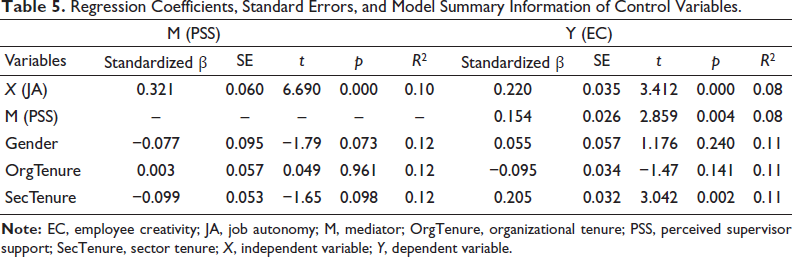
Regression Coefficients, Standard Errors, and Model Summary Information of Control Variables.
Total, Direct and Indirect Effect Results.
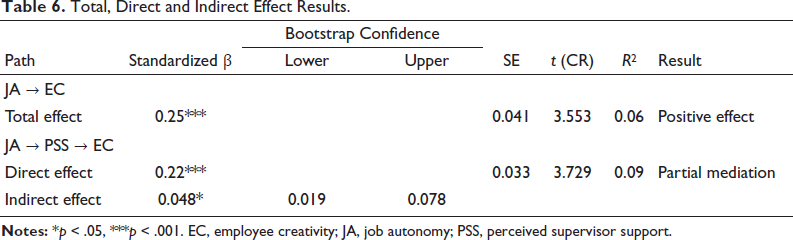
Initially, analysis of H1 tested the total effect of JA on EC. The result of the path analysis shows the hypothesized effect to be significant [β = 0.25, standard error (SE) = 0.41, p < .001], supporting H1. To test H2, a separate model was established in which PSS was the mediating variable. Then, it was seen that JA affected PSS (β = 0.32, SE = 0.060, p < .001), and it was determined that PSS significantly affected EC (β = 0.154, SE = 0.026, p < .05). With the inclusion of the mediating variable PSS in the model, the coefficient of the path from JA to EC was still significant (β = 0.22; SE = 0.035 p < .001). Therefore, there is partial mediation in the model. The fact that the fit indices obtained because of the path analysis are above the threshold values indicates that the model is compatible with the data (X2 [DF = 217, N = 561] = 563.963; p < .01; X2/df = 2.599; RMSEA = 0.053; CFI = 0.939; GFI = 0.918). According to the Bootstrap results, it was determined that the effect of JA on EC through PSS was significant as the effect is 0.048*, and the bootstrap confidence interval is above zero (0.019–0.078), thereby supporting H2.
The coefficient of determination (R2) was assessed with and without the control variables to determine the variance of gender (β = 0.55, p = .240), organizational tenure (β = −0.095, p = .141) and sectoral tenure (β = 205, p = .02) in EC. However, they do not have any relationship with PSS. R2 was found to be 0.11 with all control variables together and 0.08 without control variables. Therefore, the control variables are responsible for a total of 37.5% of the variance in the EC. The results suggest that the control variables influence EC.
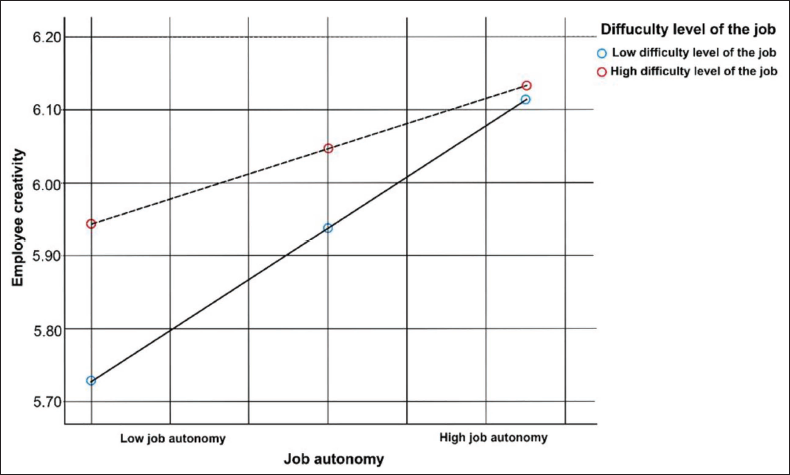
H3 predicts that the relationship between JA and EC is moderated by the difficulty level of the job, such that the positive relationship is strongest when the difficulty level is lowest. This moderation hypothesis was tested using PROCESS macro for Model 5 based on 5,000 bootstrap samples. According to the findings, the regression coefficient of the interaction of JA and the difficulty level of the job is significant (b = −0.0356, p = .0399 < .05). The change of determination coefficient reached the significance level (∇R2 = 0.0070, p < .05). These outcomes validated the H3. The results of a simple slope analysis conducted to understand better the moderating effects’ nature are shown in Figure 2. As seen in Figure 2, the line is much steeper for the low difficulty level of the job; this shows that at a low level of difficulty level, the impact of JA on EC is much stronger in comparison to the higher difficulty level. As the difficulty level of the job increases, the strength of the relationship between JA and creativity decreases.
Proposed Research Model.
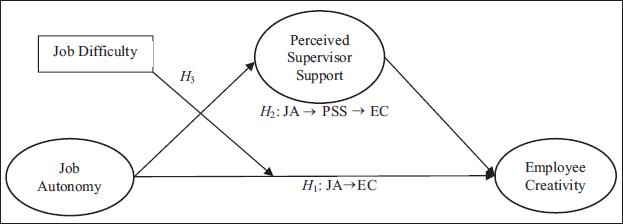
Proposed Research Model.
Interactive Effects of Job Autonomy and Difficulty Level of the Job on Employee Creativity.
This research utilized SDT to investigate the influence of JA on the creativity of media workers by considering the mediating effect of PSS. First, the results indicated that the JA within the workplace significantly influences the generation of creative behaviours among employees. The linear relationship between JA and EC overlaps with previous studies in the literature (Jafri, 2018; Thuan, 2020; Zhang et al., 2017).
Second, we revealed the mediating role of perceived supervisor support in this relationship in accordance with SDT assumptions. From the perspective of SDT, employees who have an adequate level of JA are able to meet their needs for autonomy and perceive their supervisors as more supportive, thereby producing positive work outcomes and behaviours (Gagné & Deci, 2005; Ryan & Deci, 2000). In other words, our findings support the idea that when employees gain autonomy in their work, their creativity develops as a result of their perception of strong managerial support. In line with this result, one recent study has proved that granting JA to employees has been linked with an increased perception of supervisor support (Park & Jang, 2017). On the other hand, several studies also suggest that the provision of regular feedback by managers, coupled with genuine concern for the ideas, feelings and thoughts of employees—referred to as supervisor support—positively impacts EC (Kassa, 2021; McKersie et al., 2019).
Third, our study demonstrated that the difficulty level of the job negatively affects the relationship between JA and employees’ creativity, such that the positive relationship is strongest when the difficulty level is lowest. Our findings align with the study’s assertion that increased task complexity has a negative effect on the link between JA and creativity (Sia & Appu, 2015). Accordingly, we can infer that JA has a more pronounced effect on creativity in easy jobs compared to difficult ones. The rationale behind this result could be attributed to the increased demand for guidance and insight in more challenging work scenarios. As tasks become more arduous, individuals may require additional support for fostering creative actions. Excessive autonomy in such challenging works may, counterintuitively, hinder rather than enhance creativity. If individuals perceive they have unrestricted freedom without clear direction or guidance in difficult jobs, they may feel overwhelmed or uncertain about the next steps, thereby impeding the creative process (Sia & Appu, 2015). In contrast, employees can produce more creative results by using their initiative in relatively easy jobs because it is possible for individuals who feel autonomous to work entirely in line with their own interests and desires and to think differently by stepping out of the routine (Li et al., 2018). Additionally, when a job is perceived as excessively complicated, the employee experiences worry instead of enjoyment from it. Perceptions of complexity may diminish self-efficacy. Efficacy judgments govern people’s effort levels and their ability to persevere in the face of adversity, so the behaviours have a big influence on how productively people perform (Bandura, 1978; Cervone & Peake, 1986). Consequently, raising JA without the required skills, advice and assistance might not promote the effect of JA on EC.
Finally, we concluded that an increase in sector tenure correlates with a slight elevation in creativity. This connection is likely due to the enhanced technical knowledge and experience gained in an employee’s role, fostering the development of domain-relevant skills (Amabile, 2013)—a crucial component of creativity.
Theoretical Implications
This research contributes to the growing literature on SDT by deepening our understanding of the relationship between JA and EC. Specifically, it provides empirical evidence highlighting the crucial role of perceived supervisor support in enhancing employees’ creative capacities within creative workplaces. While existing research primarily links JA with creativity through internal mechanisms such as intrinsic or autonomous motivation (Li et al., 2018), our study offers a novel perspective by examining the mediating role of perceived supervisor support through the lens of SDT.
We propose that JA, by fulfilling employees’ need for autonomy, influences creativity through the perception of supervisor support—an external factor that reflects the work environment’s impact on the individual. Consistent with the prior literature on SDT (Park & Jang, 2017), when managers create a supportive work environment, it allows employees to have greater trust in the organization and a more positive perception of their jobs (Gagne & Deci, 2005). Consequently, employees are more likely to express their work-related suggestions, including creative ideas, when they perceive strong managerial support (Deci et al., 1989).
Additionally, our study addresses a gap in the literature by exploring the interaction between JA and job difficulty in fostering creativity, particularly in demanding job roles. We highlight that while JA generally promotes creativity, its positive effects are contingent upon the complexity of the task. In highly demanding jobs, excessive autonomy without sufficient guidance may hinder rather than enhance creativity, indicating the need for a balanced approach to autonomy in challenging work environments. By examining these dynamics, our research expands the theoretical understanding of SDT in the context of EC in the media industry.
Limitations and Future Research
The current study exhibits several limitations. First, to attain a substantial sample size, a cross-sectional design was employed. Cross-sectional research inherently lacks the ability to establish cause-and-effect relationships due to its snapshot nature, which does not track changes over time. Therefore, researchers can retest our model through experimental design or longitudinal design. Second, all data in the current research were self-reported, potentially introducing bias due to common method variance. According to Harman’s single-factor test result, common method bias is unlikely to be a significant issue in this study. Also, self-report research does not invariably lead to inflated connections and acknowledging the generally overstated concern of social desirability bias (Spector & Brannick, 2009). However, researchers could benefit from employing diverse data collection techniques, such as supervisor evaluations and a product-oriented approach (Shalley et al., 2004). Lastly, the moderator, job difficulty, was measured using a single, straightforward question. Subsequent studies could refine the assessment of the interaction effect between job difficulty and JA on creativity by employing established scales for a more comprehensive evaluation.
Conclusion
In this study, grounded in SDT as a comprehensive theoretical framework, we posit a positive relationship between JA and EC, a hypothesis that receives empirical support. Additionally, we propose perceived supervisor support as the mediating mechanism in the link between JA and EC, and our findings support this hypothesis. Furthermore, our analysis leads to the conclusion that job difficulty exerts a negative impact on the link between JA and creativity. Specifically, lower job difficulty amplifies the influence of JA on EC. Control variables are included to assess potential variations in dependent variables. Our results reveal that the only sector tenure significantly influences EC.
Managerial Implications
Building on existing research that establishes a positive relationship between human resources management (HRM) practices and EC (Jiang et al., 2012), our study offers practical implications for HRM practitioners. First, we suggest that enhancing JA contributes to a positive perception of supervisor support, emphasizing the need to empower leaders with greater authority to grant subordinates autonomy. Drawing from past studies, JA has been identified as a catalyst for creativity among media professionals, enabling them to develop innovative ideas for their work (Slijepčević et al., 2015). This holds particular significance in the ever-evolving media industry (Khajeheian, 2017), which demands novel approaches to storytelling, content creation and audience engagement.
Furthermore, this study underscores the pivotal role of perceived supervisor support in influencing creative actions. Given the potential for conflicts in high-pressure media environments, supportive supervisors play a crucial role in managing disputes (John, 2016). Their involvement in negotiating disagreements and identifying mutually beneficial solutions can alleviate stress and disruption, contributing to a more harmonious work environment.
Moreover, our study recommends that managers tailor job opportunities or implement moderate control mechanisms to harness the creativity of autonomous individuals, especially in roles with relatively more straightforward tasks. Alternatively, employee training programs can be offered to guide employees in consistently incorporating innovative idea generation as a core part of their work, thereby mitigating the potential drawbacks of increased autonomy without sufficient capability (Shalley & Gilson, 2004). Companies aspiring to boost EC can consider various HR strategies, such as adopting flat and egalitarian organizational structures or implementing self-managed teams. Finally, we emphasize the importance of retaining individuals with longer sector tenures, as our study suggests a moderate improvement in EC with increased sector tenure.
Footnotes
Authors’ Contribution
Fatma Halide Kivrak: Conceptualization, methodology, investigation, data collection, software usage, data analysis, resource provision, manuscript writing and visualization.
Mahmut Arslan: Supervision.
Inmaculada Adarves-Yorno: Validation, manuscript review, editing and supervision.
Declaration of Conflicting Interests
The authors declared no potential conflicts of interest with respect to the research, authorship and/or publication of this article.
Ethical Declaration
The authors abide by all the ethics involved in this academic work and have not submitted it to any other journal.
Funding
The authors disclosed receipt of the following financial support for the research, authorship and/or publication of this article: This study was supported by the Research Fund of Ibn Haldun University under Project Number: 2107 and the Scientific and Technological Research Council of Turkey (TUBITAK) under Project Number: 1059B142200102. The funders had no role in the design of the study; in the collection, analyses, or interpretation of data; in the writing of the manuscript, or in the decision to publish the results.
