




Abstract
Executive Summary
Movies offer the perfect media site for placement of brands as part of the emerging marketing strategy. Although attempts to analyse brand placements have been made in the past, the same needs more attention in the Indian context. Given the exposure of Indian audiences to both national and international entertainment industry, it is only reasonable to expect the entertainment event context to have an impact on consumers’ evaluation of the brands placed in each context.
The present research attempts to extend the applicability of the idea of fit, which was till now largely confined to sponsorship and subjects it to the exploration of finding a fit between brands and specific events, in particular, movies. Because the link between country of origin of the entertainment event (national/international) and brand, placement is a relevant area of speculation, the present research aims to study this relationship within the national/international context. Results of an experimental study among 120 respondents are as follows:
Brands placed in a national event will create more positive brand evaluations in terms of positive attitude towards the placed brand and intention to purchase than brands that are placed in an international event. When the presence of a brand is consistent with the context in which it is placed, it would evoke more positive attitudes and behaviour than an incongruent placement. Evaluation of results further reveals that although a brand that fits well with the context in which it is placed generates a positive evaluation of the placed brand, the condition of a brand-event misfit in a Hollywood context will create more negative evaluations among the Indian audiences than if such a disconnect appeared in a Hindi film. In other words, a brand may have more to lose in case of a misfit with the international entertainment event than with a national entertainment event.
Based on the findings of the present study, it is suggested that multinational brands must look at the Indian movies as a suitable medium for reaching out to the prospective buyers as Indians have become consumers of global brands and thus pose to be a huge market for global brands.
As the line between entertainment and marketing communication gets increasingly blended or even erased (de Gregorio & Sung, 2010; Eagle, 2007; Steel, 2007; Winkler & Buckner, 2006), the notion of brand placement in an entertainment context receives considerable attention from scholars and practitioners alike. Although there are many definitions of the term, brand or product placement have often been used interchangeably and generally refer to the use of a product’s name, packaging, signage, or other trademarks in media (Steortz, 1987).
Screening thousands of films every year, the film industry is fast emerging as the medium with the maximum potential to capture and convert audiences to potential consumers. Tag Heuer in Don (2006), Coke in Dhoom 2 (2006), Singapore Tourism Board in Krrish (2006), or Pepsi in Pearl Harbour (2001), product placements have a very significant role in Indian1 and international2 movies. Such placements have also started to appear in television series (Fitzgerald, 2002), live shows (Matthews, 2005), video-games (Gunn, 2001; Nelson, Keum, & Yaros, 2004), and even books (Kretchmer, 2004; Moser, Bryant, & Sylvester, 2004; Turner, 2004). The reason behind using product placement in these media, however, remains the same: generating additional income for the producer while creating an opportunity for the advertisers to present their offering in an entertainment context (Russell & Belch, 2005). By doing so, not only does the offering reach a larger audience, but it also gets a much longer life than a 30-second commercial.
While product placement is riskier than conventional advertising, it is becoming a common practice to place products and brands into mainstream media, including films, which are an extremely popular medium among advertisers. Also, with the traditional media getting overcrowded and nearly saturated, the concept of product placement has become even more popular as a communication technique, which is now being used more than ever by advertisers (Karrh, Mckee, & Pardum, 2003). A lot of research has focused on product placement in all its forms (Gupta & Gould, 2007; Nelson, 2002), but more specifically on product placement in movies (Karrh, 1998). Brand placement in movies seems to be well accepted (O’Reilly, Cripps, Kazani, Patel, & Zarra, 2005) and is sometimes considered less expensive and more effective than a 30-second TV spot (Jaffe, 2005), resulting in a more frequent use of this communication technique.
However, in the era of expanding global competition, where companies are trying hard to reach out to their customers effectively and efficiently to market their product and services to different national cultures, an important yet lurking question that remains unanswered is: To what extent have marketers been able to successfully reach their customers? Although product placement utilizes the global reach of movies, minimal research has been conducted to study the effects of product placement across cultures. Therefore, of particular interest in this study is the influence of brand placements in an entertainment event, especially movies that represent two different cultures. How do viewers perceive brands placed in movies? Do brands placed in Indian movies have a different impact on viewers than brands placed in international movies? Should the advertisers and marketers, therefore, view the placement of their brands in national and international entertainment contexts differently? To answer these questions, the study focuses on the opinions of people who are viewers of both Indian and international movies.
A review of brand placement studies indicates a major gap in the literature. Previous studies of brand placement were largely conducted in the US with little focus on it as a global phenomenon (DeLorme, 1998; Grein & Grould, 1996) given the fact that many movies play to and are often produced for multinational audiences, raising the issue of how consumers in other countries perceive product placements. Also, while product placement has been researched extensively (Karrh, 1998; McKechnie & Zhou, 2003; Russell & Belch, 2005) in studies that have focused on one or more of the placement’s characteristics, in particular, its prominence (Gupta & Lord, 1998; Russell, 1998, 2002) and plot connection (d’Astous & Chartier, 2000; Fontaine, 2002; Russell, 2002), it is not clear from the previous studies if a brand placed in a matching context would have any effect on consumer’s evaluation behaviour. And till date no study, either at the national or the international level, has examined the effects of brand placement’s fit/misfit within movies. Being the first of its kind, the present study finds its need and relevance by investigating congruence between entertainment event and brand.
Furthermore, given the exposure of Indian audiences to both national and international entertainment industry, it is only reasonable to expect the country of origin of the entertainment event to have an impact on consumer’s evaluation. Because the link between the country of origin of the entertainment event and brand placement is a relevant area of speculation, the present research aims to study this relationship including national/international context. And even though measures of product placement evaluation have been problematic, product placement is a fast growing multi-billion dollar industry (McDonnell & Drennan, 2010) making the present study relevant for both, advertisers and marketers. A great deal of research has already been devoted to product placement in movies; however, this article strives to present, for the first time, the effect of fit between brand and the entertainment event on consumer’s brand evaluation.
BRAND PLACEMENT IN MOVIES
There are enough reasons that suggest the growth of product placement. The erosion of traditional media audience and its fragmentation on the one hand (Deloitte, 2005) and the use of alternate media such as the internet, allowing consumers to skip ads (O’Neill & Barrett, 2004) on the other hand, has forced the advertisers to seek a more reliable media to re-establish the link between their offering and their consumers. In such a scenario, product placement has surfaced as an important tool for the advertisers and marketers, posing as competition to the traditional commercial medium of advertising.
In movies, the role of brand placement has increased in recent times. Initially, brands were typically featured in movies in three ways: the product itself was shown, a logo of the brand was displayed, or a brand was displayed as a background prop (Smith, 1985). The role has changed ever since, from the brand being a mere prop in the background to being a central part of the movie, thereby increasing its prominence. The prominence of brand placement is defined as ‘the capacity of the brand to attract the spectator’s attention’ (Fontaine, 2001). Among other factors, such as the size and duration of the brand’s placement on screen (Fontaine, 2002), this capacity can be linked to the brand’s location in the scene (Gupta & Lord, 1998) and the number of times the brand appears on the screen (Bressoud, Lehu, & Russell, 2008).
No matter how the brand is placed in the movie, by using brand placement, marketers hope to gain an advantage in comparison with the traditional commercial advertising format. The availability of a captive audience with greater reach than traditional advertisements and the advantage of showing brands in their natural environment (Stephan & Coote, 2005) provide motivation for product placements (Deigh, 1985; Hulin-Salkin, 1989; Turcotte, 1995). Therefore, brand placement provides an opportunity where the involved audience gets exposure to the brands and products during the natural process of narration of the movie.
The audience can undertake multiple tasks while watching a television programme in a home setting, which may affect the level and degree of the attention span of the audience and hence reduce the overall effectiveness of the medium for enhancing brand memory. In the case of watching a movie in the theatre, the audience makes a voluntary choice for viewing (exposure) at a cost (financial, time, and opportunity cost) for the purpose of entertainment, which makes him more receptive to the information provided. Further, the trend of zapping and change in television usage behaviour due to surfing during commercial breaks has reduced the effectiveness of television commercials. And clearly, brand placements in movies also result in a longer lifespan for the brands than typical advertisements (Brennan, Dubas, & Babin, 1999; d’Astous & Chartier, 2000).
While brand placement has obvious advantages, it is not without its disadvantages. Such disadvantages stem from the marketer’s general lack of control over the brand placement process. Exposure does not actually guarantee that the placement will be noticed (Van der Waldt, 2005). Also, there is little control over how and when the brand will be shown or whether it will be shown at all, as the risk of the scene featuring the brand being edited runs high (Bergman, 1989) and the risk of a negative portrayal of the brand in the movie setting (Fleming, 1990). However, despite the pitfalls which may not allow brand placements to stand as the lone marketing tool, it is becoming an increasingly important part of the integrated marketing strategy.
REVIEW OF LITERATURE AND HYPOTHESES
Over a period of time, researchers have used a number of terms for the same purpose that somewhat overlap each other. The term advertainment (Russell, 2007) was coined to reflect the increasingly intertwined connections between advertising and entertainment and refers to the promotional practices that integrate brand communications within the content of entertainment products. The increased mingling of advertising with the entertainment world has generated a slew of newly coined terms to reflect the trends, such as hybrid advertisement (Balasubramanian, 1994), branded entertainment (Hudson & Hudson, 2006), and brand placement and product placement. In one of the first reviews of brand placement, Karrh (1998) argues that although product placement is the most commonly used description, brand placement would be more correct. He argues that it is a brand (e.g., Ray-Ban) and not a product (e.g., sunglasses) that is placed. However, not many researchers distinguish between the two and, therefore, the terms brand placement and product placement have been used interchangeably throughout the study.
Despite the widespread use of brand placements to reach audiences, it is difficult to ascertain its effectiveness because much of the related data is proprietary (Yang, Roskos-Ewoldsen, & Roskos-Ewoldsen, 2004). Consequently, too little is known about the effect of brand placements given the dynamic nature of this practice (Bhatnagar, Aksoy, & Malkoc, 2004). For example, how the brands are placed in the movies may influence their effectiveness (Ong & Meri, 1994). Indeed, scholars have tested the effect of different types of brand placements, such as whether the placement is visual or verbal (Russell, 2002), the visual prominence of the placement (Law & Braun, 2000), and if the placement is involved in the plot of the story or not (Russell, 2002).
While all these past studies on brand placement have been informative, research in the area of product placement is still not widespread in the Indian context and is concentrated on studying the impact of product placements on a wide, general audience. India, which has a huge and growing section of young consumers who are poised to begin their consumption journey, offers a big future growth market for branded products making it even more important to discover, clarify, and check the effectiveness of brand placements.
BRAND PLACEMENT IN INDIAN MOVIES
Films are a noticeable medium of entertainment in India (Panda, 2004), communicating among other things, the changing fashion trends and promoting marketer’s products and services. Indian audience has always been emotionally involved with onscreen actors and the impact is evident from the fact that stars have iconic status in India. The audience depends heavily on these actors for setting new trends, fashions, and hairstyles (Kripalani, 2006), and it was, therefore, not astonishing when advertisers and marketers started exploiting mainstream Indian cinema as an opportunity to advertise their products and started relying on stars to set trends for costumes, accessories, and other products and services. When the audience watch a movie star with the product placed in the movie, they connect the product with the actor, thus, increasing the intrinsic expressiveness of the placement messages (Morton & Friedman, 2002) such that when the consumers see the movie star using a certain product, they try to associate the credibility of the actor with the product placed in the movie and build a positive behaviour towards the product.
India’s popular Hindi film industry, commonly known as Bollywood, being the largest producer of films in the world (Minocha & Stonehouse, 2006), is fuelled by a large audience eager for consumption (Akram, Dwight, & Muhammad, 2011; Britt, 2002). In addition to the display of national brands, Hollywood’s ‘big players’ of product placement also appear in Indian movies. Coca-Cola, for instance, has benefited from placement in movies in India along with celebrity endorsement by Indian movie star, Amir Khan, helping it increase its market share (Business Week, 2003). Display of both foreign and local brands in the contemporary Indian films is, therefore, a reflection of the globalization forces at play within India, with a number of Indian films being packed with loads of non-Indian product placements. Since Indian or Hollywood movies mostly remain unchanged across countries, international brands, even if placed in local media through cablecast or broadcast, may serve as a global marketing strategy (Gould, Gupta, & Grabner-Krauter, 2000). It is for this reason that since the last few years, multinational brands have looked to Indian movies to reach the Indian market (Rajadhyaksha, 2003).
In addition to placing foreign brands in Indian films, producers of movies have also started exploring different types of product placements, on the lines similar to its Hollywood counterpart. Apart from just a brand placement in a movie or a prominent character talking about it, they have started placing products integral to the storyline. The 2002 film, Road, shot mostly on roads with the lead characters driving the cars, featured Tata Motors’ Safari 4-wheel SUV. For this placement, Tata Motors paid about ` 12.5 million (USD 266,250) (Kripalani, 2006). Such a trend of weaving a product into the storyline has become common in the Hindi3 film industry in the past few years. In fact, a recent film Heroine (2012) included several brands that were integral to the movie’s theme. After the release of the movie, Lakme launched Heroine branded makeup under the Absolute range, endorsed by Kareena Kapoor (an Indian actress) while apparel brand Jealous 21 introduced a special clothing line inspired by the clothes worn by Kareena in the movie, which narrates the behind-the-scenes life of an actor. Given the efforts made by the advertisers and the enthusiasm with which the audiences are accepting brand placements in the Indian movies, this practice has a huge potential to grow.
Hypotheses
Brand placements are, by definition, brands placed within a medium (Nelson & Deshpande, 2013). How audience members respond to the medium likely impacts their responses to the brands within that medium, too. The body of research studying the influence of context on advertising effectiveness leads to the finding that advertising context consists of two important concepts: receiver context and medium context. While the receiver context is described as the situational circumstances in which a person is exposed to an advertisement (Pieters & Van Raaij, 1992), such as the person’s physical environment (e.g., ‘at home, at the dining table’), the social environment (e.g., ‘in the company of friends’), the time frame (e.g., ‘during lunch’), and the mental state a person is in prior to exposure to the medium content (e.g., ‘an early morning mood’), the medium context concerns the environment of the ad provided by the vehicle carrying it, such as a television programme, a book, a video game, or a film.
Although studies on context effect are not found in the brand placement literature, there is some suggestion that the medium context can have an effect on consumers’ responses to an embedded ad (Moorman, Neijens, & Smit, 2005). Some authors have even found a congruency effect between context and embedded ad (priming effect, e.g., Yi, 1990). Therefore, we expect that the medium context should have an effect on the responses to brand placements too. Further, while the medium context may be the same (e.g., films), they may still differ on the basis of culture, such as films made in India and abroad, both of which depict widely different cultures (de Mooij & Hofstede, 2002; Lewis, 2005). In the present study, we conceptualize and explain the classification of film industries into foreign film industry (Hollywood) and domestic film industry (Bollywood), based on their country of origin and term them as the film industry context. Films represent a very typical entertainment medium and each film industry across the globe is influenced by its culture and environment as a whole; therefore, understanding of the film industry context will help understand the differences between domestic and foreign consumer behaviour. In the present study, the film industry context has been used as one of the independent variables that have two levels, Indian and American. Films that were made in India have been defined as Indian movies while those that were made in America have been classified as American movies.
Until recently, placement of branded products in movies was considered an American concept (Segrave, 2004). However, the Indian mainstream Hindi films have caught up with the trend with the Indian audience not only being exposed to product placement in different media but also being exposed to it in both the national and international entertainment industry. Just as the Indian motion pictures have a huge overseas market, Hollywood movies is a huge craze with the Indian masses. With the coming of video-on-demand and DTH, access to any kind of movies has become easier than before; therefore, like many other countries, Hollywood movies have a significant viewership in India too. Also, interest in Hollywood movies is high, with several Hollywood movies releasing in Indian theatres every month. Given the massive exposure of the Indian audiences to movies, it is a question of legitimate curiosity to find out the impact that brand placements in movies have on the audiences.
Hall’s (1959) theory aims to explain culture on the basis of high and low context which varies across cultures (Hall, 1984). Indian culture, being a high context culture, aims to communicate messages through symbols (deMooij, 1998), including brands which may communicate the social standing. Hall (1976) also emphasizes that in a high-context culture, greater confidence is placed in the nonverbal aspects of communication than the verbal aspects. On the other hand, Hollywood films are rooted in a low-context culture. The literature on product placement demonstrates that cultural differences exist vis-à-vis attitudes towards product placement (Gould et al., 2000; Karrh, Frith, & Gallison, 2001). This is primarily because cultural values and communication styles influence advertising persuasion (Aaker & Maheswaran, 1997) and are also likely to influence the way consumers process product placements. In other words, how brand placements communicate is dictated by the cultural context in which they are put. We argue that consumers’ interpretation of brands placed in different contexts, namely, domestic versus foreign films will show a potential bias. For example, Coca-Cola has been widely used in several international as well as Indian movies. In each of the two scenarios, the same brand might be looked at differently due to its placement in two culturally different contexts. An Indian consumer will be able to relate with Coca-Cola more in Rang De Basanti (2006), an Indian film, rather than Coca-Cola in Falling Down (1993). This implies that differences exist in terms of consumers’ response to brands placed in the two different contexts.
In addition to the difference in consumers’ response to brand placements in national and international films due to cultural diversity, we also argue, based on research, that an increase in the number of ads in the environment will have a negative influence on the effectiveness of the target ad or the placed brand (Kent, 1995). Given that Hollywood films contain a greater number of brands overall (Kureshi & Sood, 2011) as compared to Indian films, it is likely that the reaction of viewers towards brands placement in Hollywood movies would be more negative as compared to their reaction towards brand placement in Indian films. In view of the literature on the medium context, cultural differences and the effect of number of brands placed in a movie, we predict that
H1: Brands placed in a national event will create more positive brand evaluations than brands placed in an international event.
Associations between a brand and an event that trigger positive attitudes towards the brand may be an effective marketing strategy, leading to increased sales which could potentially generate a sustainable competitive advantage. However, not all brand–event relationships result in a positive outcome for the brand. It has been suggested that when there is congruence between the brand and the event, consumers are more likely to respond favourably (Hamlin & Wilson, 2004). Meenaghan (2001) explains that perceptions of congruity reflect the extent to which the sponsored partner is seen as predictable. Therefore, it is highly likely that congruence will allow the brand to generate positive returns, whereas a non-congruent relationship may even be detrimental to the brand (Gray, 2000; Hamlin & Wilson, 2004; Murphy, 1996; Simmons & Becker-Olsen, 2006; Welsh, 1999). These studies assume that congruity between brand and event can have a positive influence on consumer responses so that there is a positive attitude towards the event and the brand (Dousteyssier-Fleck, 2004).
The concept of fit, built on congruity theory (Osgood & Tannenbaum, 1955), has been extensively applied to the sponsorship arena and holds that sponsors should seek events that have a logical congruence or fit with the sponsors’ products. There is, however, no evidence of congruence/fit studies in the context of product placements. Nevertheless, given the similarity between product placement and sponsorship, such that both consist of a triangular relationship—a company willing to support a certain activity (the sponsor), a sponsored activity or the target (the sponsee), and in a majority of cases also the different media covering the event or activity (Burnett, 1993)—it is only reasonable to consider that brands being placed in movies are, in a way, sponsoring a part of the movie. For example, brands such as Lakme, Head & Shoulders, Jealous 21, Cera, and so on collectively spent roughly ` 250 million on in-film placement in the movie Heroine. Therefore, application of fit in the context of product placement may be built on the same logic as that in the context of sponsorship.
Sponsorship literature confirms the importance of congruence on the relationship between brand and event, exemplified by brand image beliefs (Gwinner & Eaton, 1999; Speed & Thomson, 2000). Academics and practitioners have long relied on fit to explain sponsorship (Olson & Thjomoe, 2011; Quester & Thompson, 2001). Simmons and Becker-Olsen (2006) showed that high-fit sponsorships (sponsor partner is perceived as congruent with sponsored event) can increase brand value, whereas low-fit (sponsor partner is perceived as incongruent with sponsored event) can dilute brand value. Several studies have shown the importance of a strong link between the sponsor and the sponsored event or entity: the greater the perceived fit of brand associations between the sponsor/endorser and the brand, the greater the impact on the sponsor’s image and the attitudes towards sponsoring itself (McDonald, 1991; Smith, 2004). Since attitudes are found to successfully transfer between parent brands and brand extensions when perceived fit between the two is high (Aaker & Keller, 1990), based on the same argument, it is expected that the degree of fit or congruence between brands and the context in which they appear will determine the extent to which attitudes towards the context transfers onto the placed brand. Additionally, when consumers elaborate on the sponsorship and discover a level of congruence, they experience a sense of cognitive satisfaction that influences their evaluation of the sponsoring brand (Meyers-Levy & Tybout, 1989).
Likewise, strong sponsor–programme congruity suggests that the sponsor’s products and activities are clearly related to the contents of the programme, that is, the product placement is likely to be natural and consistent with the programme. However, when sponsor–programme congruity is weak, the product placement may be seen as inconsistent and not credible. Therefore, extending this basic finding to brand placement in movies, we expect that brands that are perceived as consistent with the event in which they are placed will lead to positive evaluation of the brand. We therefore hypothesize that
H2: When the presence of the brand is consistent with viewer expectations of the event (high fit), it would create significantly more favourable consumer evaluations than brands that are inconsistent (low fit) with the event.
Foreign films, being viewed by the Indian audiences in addition to the contemporary Indian films, are suggestive of the global forces within India. Films, being a product of culture, reflect the cultural values of the people such that the practices, behaviour, and brands from other cultures flow into the domestic culture (Appadurai, 1996). Just as brands are categorized as foreign or domestic in terms of country of origin, films, as a medium of entertainment, are also labelled as foreign and local (Schaefer & Kavita, 2011). When people are exposed to films, they gather information from them in terms of brand schemas and compare them, which determine their judgement with respect to the appropriateness of the event (McDaniel, 1999). Therefore, we can assume the same forces to play a role in consumers’ evaluation of films that affect their judgement about brands. A match leads to more positive evaluations because affect moves from the event schema to the brand schema (Perrachio & Tybout, 1996).
However, the influence of films/media on consumers is not automatic. Consumers in emerging markets, such as India, may readily accept nonlocal brands due to country-of-origin (COO) effects where foreign brands convey quality or status. Conversely, they may reject foreign brands or their depictions based on consumer ethnocentrism, that is, preference for one’s own country’s products (e.g., Zhou & Russell, 2004).
We hope to examine consumers’ responses in terms of their attitude towards the placed brand and their intention to purchase the brand within the context of COO of the event (and not the brand). Given the individual differences with respect to foreign and domestic brands/films based on consumer ethnocentrism or openness to other cultures (Batra et al., 2000), we assume the relationships of these factors to have an influence on attitudes towards the brand. Past research also suggests that a congruity between the brand and the context in which it is placed has an effect on consumers’ evaluation. Specifically, a brand–event fit will draw more favourable responses. Therefore, brand placement and congruity literature suggests that based on cultural differences (Gould et al., 2000; Karrh et al., 2001), which affect the way consumers process product placements (Aaker & Maheswaran, 1997), a low fit between the event and the brand is expected to create more positive evaluation in case of the event being a national event rather than an international event. Therefore,
H3: The low fit between the brand and the event will create more favourable evaluation in a national event context than a low brand–event fit in the context of an international event.
RESEARCH METHODOLOGY
Prior research suggests that the manner in which the brands are presented in the movies, namely in the background, used by the main character or as an integral part of the unfolding story, might lead to different responses from the audience (Russell, 2002). Therefore, the current study focused on only one type of brand placement, that is, the effect of visual brand placements, used by the main character in the movie. Visual product placement means that the product is shown prominently in the movie without the mention of the brand name. For the present study, four different movies were selected, each using product placement such that the placement was visual in nature. Second, the study explored the influence of brand placement using both American and Indian movies so as to study the effect of the link between COO of the entertainment event and brand placement in the movie. For the present study, four different movies were selected—two American and two Indian—each using brand placement which was visual in nature. Experimental design was chosen as the method of study in the present research work because of the ability of such designs to test theoretical relations (Bagozzi & Yi, 1989).
Two pilot studies were conducted prior to the main experimental study. The participants for all of the studies were recruited from the same research participant pool at a large university in North India for no extra credit for their participation.
Pilot Study 1: Selection of the Movies for the Experiment
Ten subjects were asked to list five American and five Indian (Hindi) movies that used brand placement. Subjects were informed that used-by-main-character brand placement should be part of the movies and should be visual brand placement. Used-by-main-character brand placement involved one of the main characters using the brand in some manner such as opening the packet of Tata Tea in the movie, Baghban (2003), by one of the lead characters in that movie while visual brand placement was the one in which no mention of the brand name was made. The subjects were given enough time to think and were allowed to discuss among themselves.
Pilot Study 2: Fit/Misfit Test
Brand Fit and Misfit with the Event
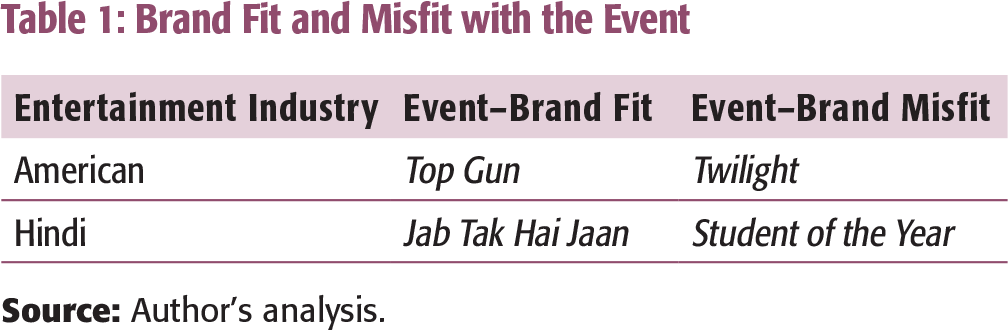
The two movies selected with the most brand–event fit were Top Gun (Ray-Ban) (1986) and Jab Tak Hai Jaan (Canon) (2012) while the movies selected for the least brand–event fit were Twilight (2008) and Student of the Year (2012).
Pilot Study 3: Brand Stature, Brand Perception, and Brand Familiarity
The third pilot study was conducted to establish if the three selected brands, namely Ray-Ban, Canon, and Apple, had the same stature, were similarly perceived, and had the same level of familiarity. The pre-test was conducted on 30 participants and analysis of variance (ANOVA) results reflect no significant difference between the three brands, based on stature/importance (F = 1.45, p = 1.89), perception about the brands (F = 0.838, p = 0.502), and level of brand familiarity (F = 1.127, p = 0.343).
Main Study
Design
The study used a 2X2 between-subjects experimental design with two levels of events (American/Hindi movies) and two levels of brand–event fit (high fit/low fit). Each subject was assigned to only one of the four conditions in the experiment.
Participants
For the purpose of this research, a non-probability sampling approach was used. Non-probability sampling is arbitrary and subjective, due to the fact that a participant does not have a known non-zero chance of being included (Cooper & Schindler, 2006).
The sample chosen for the study was roughly comparable in terms of occupation (all were post-graduate students), gender, and age. A total of 120 students participated in the study (78 females and 42 males) and was drawn from the subject pool of a large Indian university for no extra course credit for their participation. The motivation for this selection was that respondents were thought to be an appropriate sample since young adults (18 to 24 years of age) are passionate film-goers. Moreover, attending movies is a common activity for the age range of the sample (Nebenzahl & Secunda, 1993). Also, many social psychological research studies have used college students as participants but they are usually labelled as ‘adults’ (Arnett, 2000) who possess enough disposable income to attend films (Gough, 2003), making product placement in films an effective way to target young and well-educated consumers. The 120 respondents were divided into four groups such that each group consisted of 30 respondents. Each group was shown one of the four stimuli in the form of a movie clip and their responses were recorded with a standardized scale.
Stimulus
List of Movies, Name of Entertainment Industry, and Brand Placed
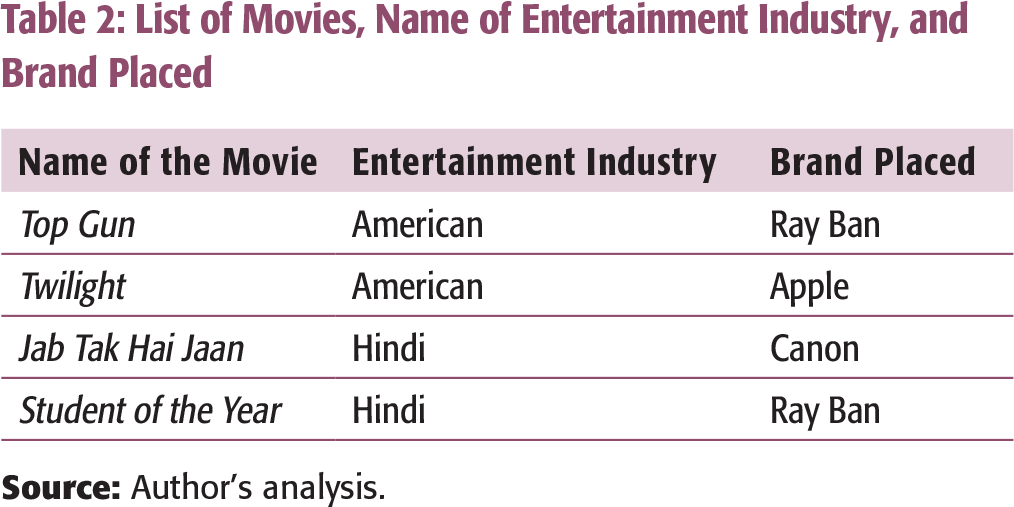
Since all the movies had numerous brand placements, we asked the subjects to identify the scenes where only one brand was placed in a scene. It was also mentioned that the brand should only be a visual prop being used by one of the leading characters of the film but should not be mentioned in the scene. Scenes from the films, where the branded products were featured, were selected. Last, the respondents were also asked if the four movies were comparable in terms of their release time such that none of the films was either too old or too new. It was done to avoid the potential confound of promotional tie-ins and sponsorships that could have drawn the audience’s attention to the brand (Ong & Meri, 1994).
Also, in order to control for star association with the brand, those brand placements were not selected for the final study in which the star of the movie was also endorsing the brand in traditional advertisements, such as Kareena Kapoor was seen holding a Sony Vaio in a scene in Bodyguard (2011) while she is also an endorser of the same brand and can be seen in television advertisement as well. It was done to avoid clouding the respondents’ judgement based on their assessment of the celebrity–brand association.
In the brand–event fit for the international event, Ray-Ban sunglasses worn by the protagonist appears prominently in the centre of the screen in one scene from the movie Top Gun (1986). Tom Cruise’s character in the movie, a US Naval Lieutenant Maverick, embodied the image of a cool jet-fighter pilot, and due to the natural cosmetic effects and military look of the sunglasses donned by him in the movie, the brand was considered to be an overall fit in the movie. The event–brand misfit condition selected from the American movie was a scene from the movie Twilight (2008) in which the female lead of the film was seen working on an Apple computer. The brand was seen to be a misfit with the story of the film which was based on a young adult vampire’s romance with a human.
The movie selected from the Indian panorama in the brand–event fit category was Jab Tak Hai Jaan (2012) in which one of the lead characters of the movie was a Discovery Channel filmmaker and was seen taking shots from her Canon camera. The brand seems to fit perfectly in the movie as the use of the camera is justified by the character in the film. On the other hand, the movie Student of the Year (2012) was selected in the brand–event misfit category. The sunglasses brand Ray-Ban was being used by one of the male leads whose character was a boy from a middle-class background on scholarship, but was seen wearing expensive clothes and branded sunglasses. The audience took notice of this apparent disconnect between the character and the brand and categorized it as a misfit.
Manipulation Check
In order to determine the success of the experimental design, it was necessary to check whether the manipulation remained hidden or visibly obvious to the respondents. The present study manipulated fit between the event and the brand, and this manipulation was checked by measuring the subjects’ response to five items by Speed and Thompson (2000) that were used to measure brand–event fit in this study (Table 3). This manipulation check was carried out by showing the respondents both the high brand–event fit and low brand–event fit formats. The manipulation check, brand–event fit, was assessed by indexing two measures, that is, high and low brand fit. Scores of subjects in the high fit setting (6.3) on a 7-point scale were compared with the scores of subjects in the low-fit setting (3.2). The data supports the intended manipulation [F(1, 38) = 5.673, p < 0.05] and confirmed that our manipulation was effective in creating required experimental conditions.
Research Design
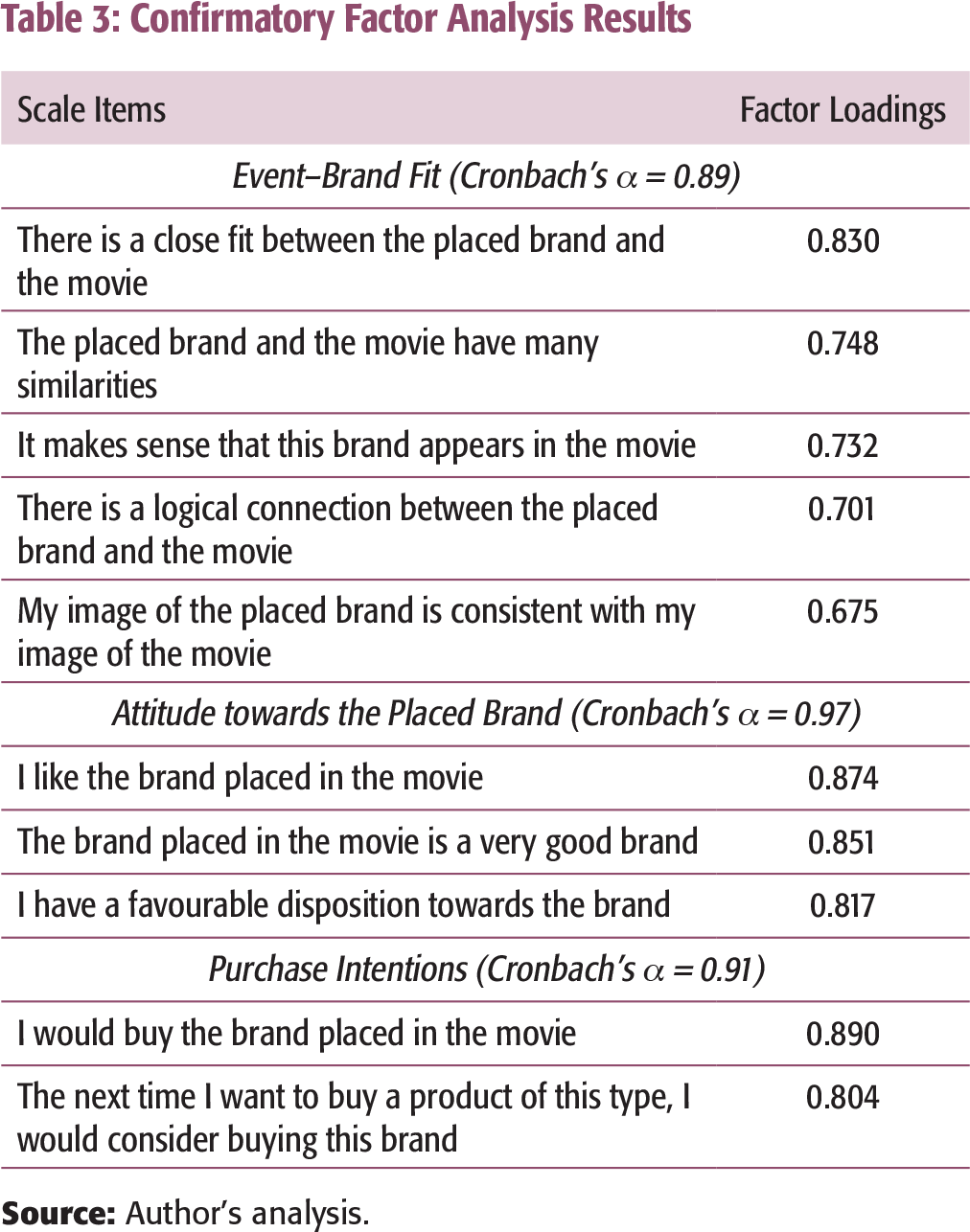
Confirmatory Factor Analysis Results
After watching the movie, subjects completed a questionnaire measuring demographic information, previous exposure to the movie, and enjoyment of the movie they watched. Prior to the testing, respondents were not made aware that the questionnaire was concerned with product placements in the films. To check on the cover story, respondents were asked to write down what they thought was the purpose of the study immediately after viewing the movie, with none of the respondents indicating the true purpose.
Respondents completed the questionnaire on brand evaluation by asking them their attitude towards the brand and their intention to purchase. Attitude towards the brand and intention to purchase were measured using a 7-point scale. The entire task took approximately 20 minutes. Another personality scale was given as a distraction task. After this distraction task, the participants were thanked for their participation and dismissed from the study.
Variable Operationalization
Several measures were modified from existing validated scales and in some cases measures were developed for use in this study based upon the related literature. All measures were subjected to confirmatory factor analysis to assess their psychometric properties and unidimensionality. The final scale items used in the analysis, standardized factor loadings, and reliability estimates are listed in Table 3.
Brand–Event Fit/Misfit
In the present study, the event was operationalized as the appearance of a product in the released film and the context (national event/international event) of its appearance. The fit was conceptualized on a variety of dimensions in the marketing literature. Consistent with Speed and Thompson (2000), however, we did not attempt to tease out the different dimensions of fit in our measure. Rather, we adopted a five-item measure that allowed respondents to consider fit on their own terms without restricting the basis used to define fit. The five items to measure fit, used by Speed and Thompson (2000), were modified to fit the context of this study (Table 3). All items on the perception of event–brand fit were ranked on a 7-point Likert scale (1 = totally disagree, 7 = totally agree).
Understanding brand placements requires that researchers measure event attendees’ (i.e., viewers’) perceptions. The two dependent variables measured in the study are the attitude towards the brand placed in the movie and viewers’ intention to purchase the placed brand. The measurement of these constructs has been summarized below.
Attitude towards the Placed Brand
This construct was measured with a three-item scale using the traditional attitudinal aspects of liking and favourable disposition on a 7-point agree–disagree scale (e.g., Bruner & Hensel, 1992).
Purchase Intention
The behaviour intention measure used in this study consisted of two items. It allows for a more robust test of the paths from attitude to purchase intentions. Responses were operationalized using a 7-point scale ranging from strongly disagree to strongly agree.
Before the final administration of the questionnaire, pre-testing of the questionnaire was carried out for qualitative investigation. Ten respondents were administered the questionnaire for this purpose. Subsequently, the language of one of the questions was simplified. Before the final data collection, respondents were briefed about the purpose of the study and all queries of the respondents were clarified.
RESULTS
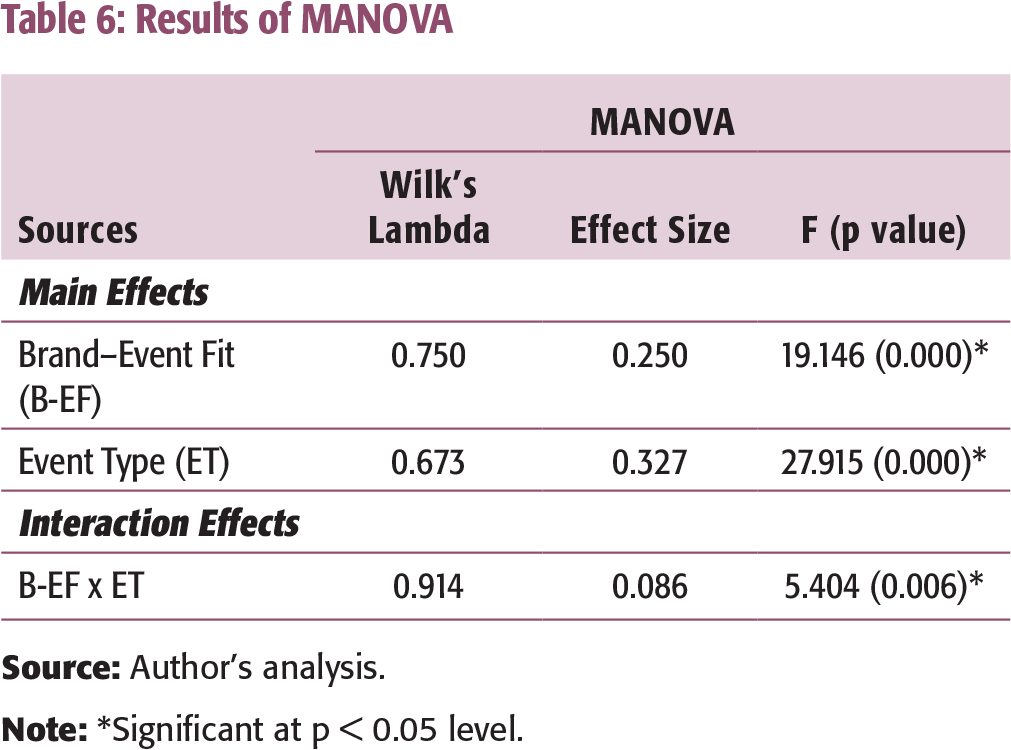
A one-way multivariate analysis of variance (one-way MANOVA) was used to determine whether there were any significant differences between the independent groups (brands placed in Indian and American movies) on the dependent variables—attitude towards the brand and intention to purchase. The two dependent variables were found to be highly correlated with each other (correlation coefficient is 0.426; p < 0.05) and given the positive correlation, MANOVA was applied to examine whether there were differences in the respondents’ attitude towards the placed brand and their intention to purchase on two different levels of entertainment event (Indian movies versus international movies).
The multivariate effect (Table 4) was found to be significant, F2,115 = 27.915; Wilks’ Lambda Value = 0.673; p < 0.05; indicating a statistically significant difference in brand evaluation based on entertainment event levels (brands placed in Indian and American movies).
MANOVA Test Results

Between-subjects Effect
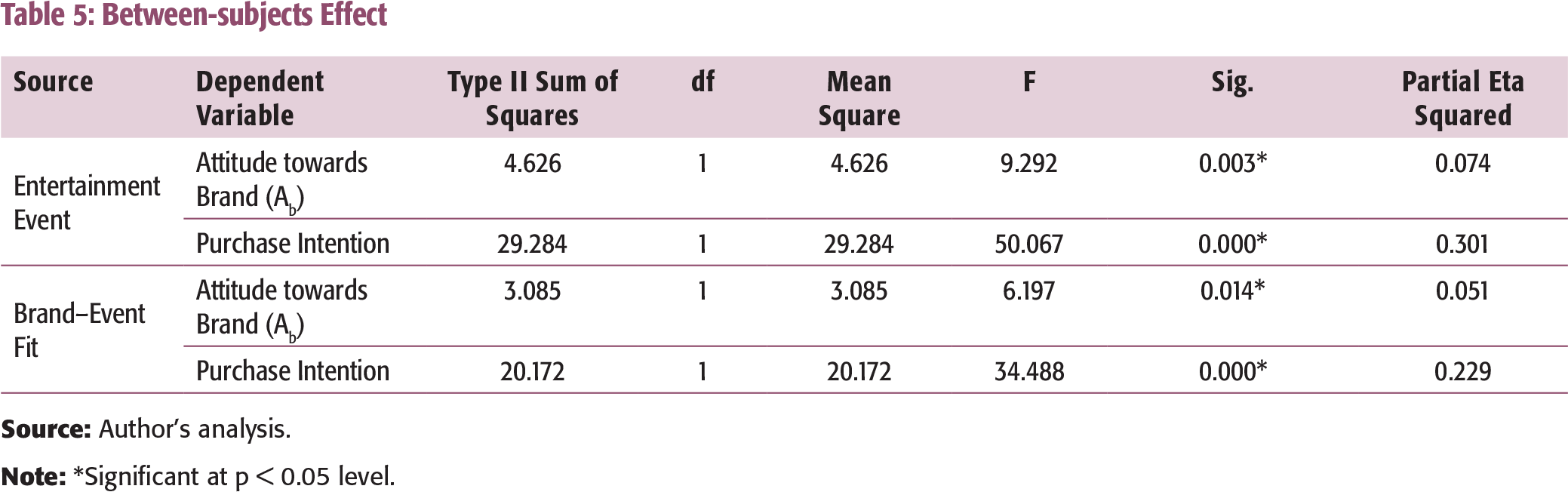
Further analysis using one-way MANOVA reveals that there is a significant difference in the respondents’ Ab and purchase intention on two levels of brand–event fit (high fit vs. low fit). The multivariate effect (Table 4) is significant (F2.115 = 19.146; p < 0.05). The overall result suggests that the consumers’ evaluation of the brand placed in the movie varies significantly depending on the level of fit (high or low) between the brand and the event, irrespective of the type of event, Indian movies or international movies. There are significant differences across the levels of brand–event fit on brand evaluation indicating that significant univariate main effects exist for attitude towards the placed brand, F1.116 = 6.197, p < 0.05, and intention to purchase, F1.116 = 34.488, p < 0.05 (Table 5). However, to find out in which case the respondents evaluated the placed brand more favourably, mean scores for brand–event fit (M = 5.01) and brand–event misfit (M = 4.427) were measured and were found to be statistically different for the two independent groups (t = 3.158; p < 0.05). It suggests that when a brand that fits well with the movie appears, the brand evaluations, measured in terms of Ab and purchase intention, is more favourable as compared to when a brand does not fit well with the movie. These results support H2.
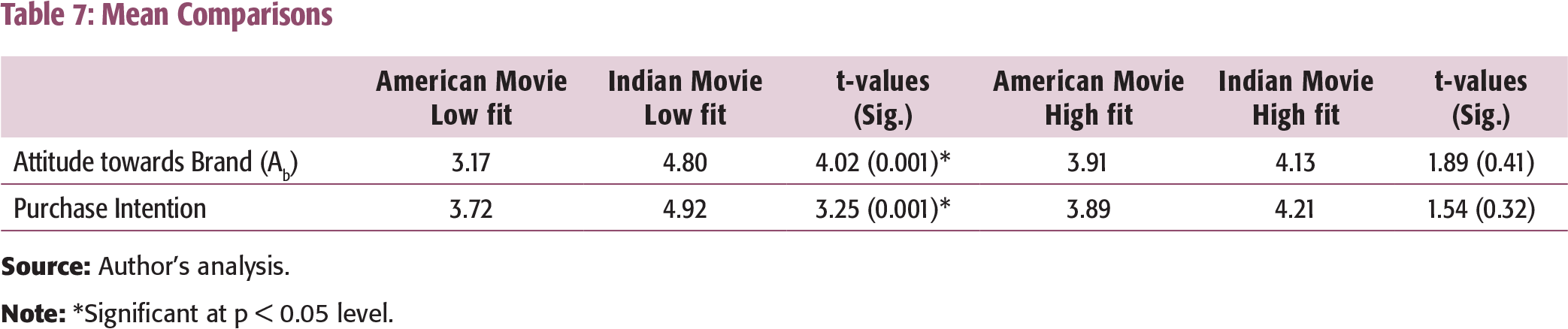
Results of MANOVA
Mean Comparisons
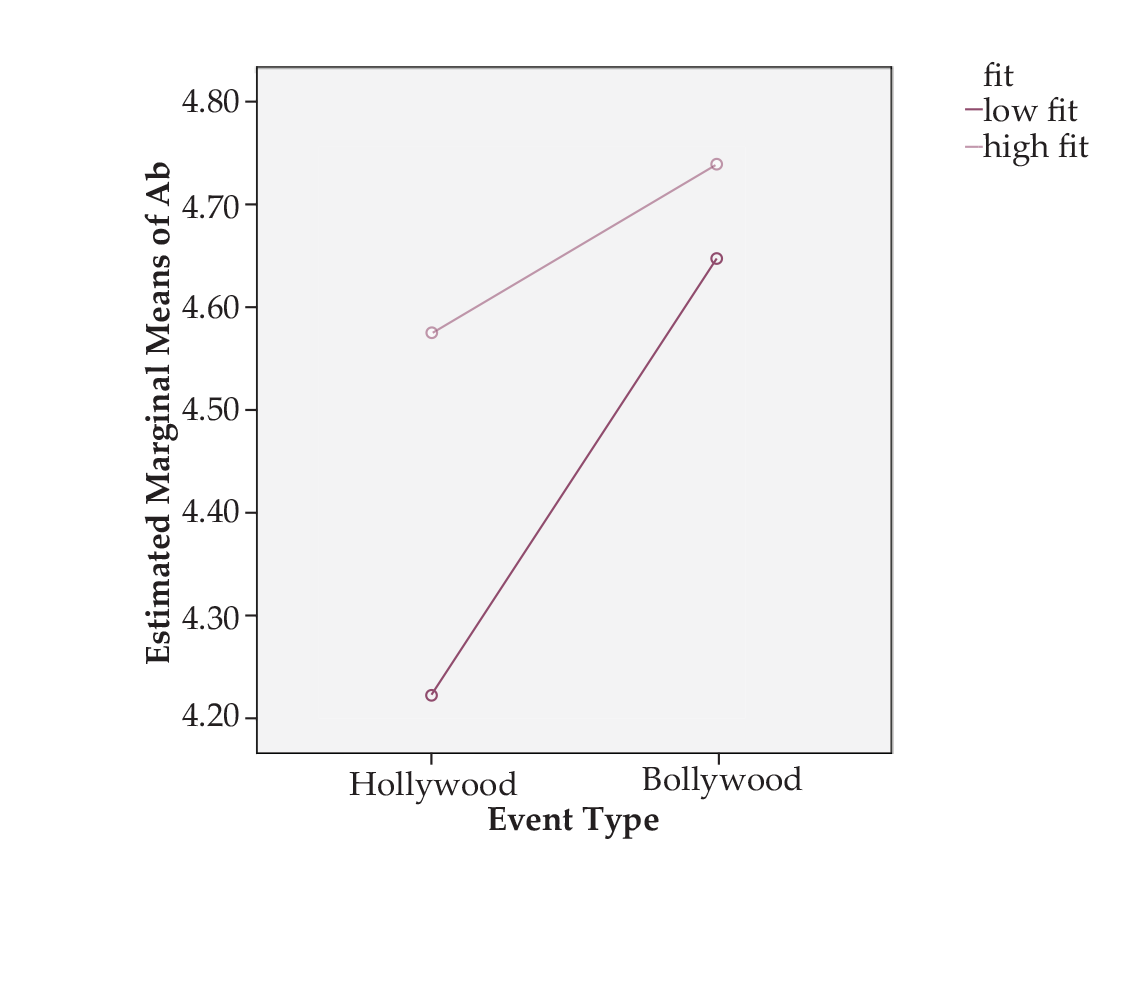
To have a better understanding of the effects of the two independent variables, graphs were constructed showing the mean responses for both of them for each of the dependent variables Figures 1a & 1b.
Plot for Attitude towards Brand (Ab)
Plot for Intention to Purchase
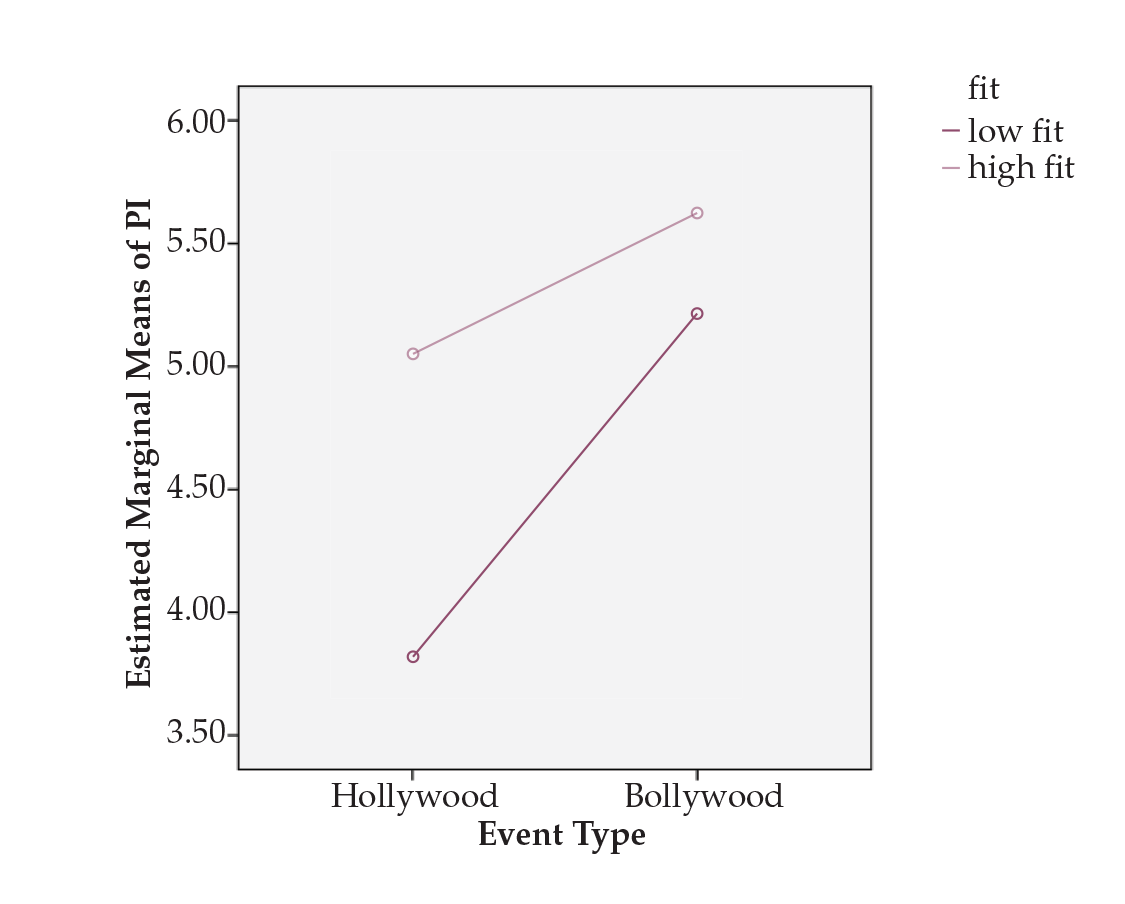
The significant interaction for each dependent variable is visually demonstrated by the absence of parallelism of the lines in each of the plots. The ‘attitude towards the placed brand’ plot (Figure 1a) shows that brands with low fit with the movie tend to draw lesser positive attitude towards the placed brand than brands that fit well with the movie. Also, brands placed in Hindi movies generated much more positive attitude towards the placed brand than when brands were placed in American movies. The interaction effect shows that although there is little difference in the Ab when the brand–event fit is high, the low fit condition leads to more positive attitude towards the placed brand when the brand appears in Hindi movies than when the low brand fit condition appears in Hollywood movies. The plot of ‘purchase intention’ (Figure 1b) shows similar results suggesting that intention to purchase is high when the brand fits well in a Hindi movie while it is less when the brand is a low fit in a Hollywood movie.
DISCUSSION AND IMPLICATIONS
As one of the first attempts to analyse brand placements in the context of Hollywood and Hindi movies vis-à-vis brand fit, this study suggests that the idea of fit, match, or congruence between the brand and the event can be used as a key criterion when explaining brand evaluations. Our research takes us one step closer to developing fitting brand placements, as the study extends the applicability of the idea of fit, which was till now largely confined to sponsorship, and subjects it to the exploration of finding a fit between brands and specific events, in particular, movies. Results of the present study reveal that such relationships between brand placement and the outcome variables is linked with another construct, perceived fit between the brand and the event.
In this context, the purpose of the study was to examine the extent to which matching the brands and the movies in which they were placed would succeed in generating positive consumer responses in terms of positive brand attitude and intention to purchase the placed brand. The study also hoped to find out the difference in the effect of brand placements, if any, based on the context of the entertainment industry in which they were placed.
Results of this study reveal that brands placed in a national event, which in this case is Hindi movies, will create more positive brand evaluations in terms of positive attitude towards the placed brand and intention to purchase than brands that are placed in an international event, that is, American movies. One can attribute a number of reasons for this result to be true. The Indian film industry has always been a reflection of the customs and traditions of the Indian society (Kripalani, 2006) where the audience has been expressively involved with onscreen actors, trying to imitate their styles. A plausible explanation for the Indian cultural values and communication styles being an influence on message persuasiveness (Aaker & Maheswaran, 1997) is that India is a collectivist society (Hofstede, 2001) where individuals operate as part of one or more collectives, such as family or peers. Triandis (1995) argues that Indians are not just collectivist but also score high on vertical collectivism, which means that their desire to stand out from others and admiration of status and celebrity is high (Sivadas, Bruvold, & Nelson, 2008). As a result of this verticality, individuals look up to successful people in the hierarchy, such as movie stars. And, since passion among the Indian audiences for celebrities is no lesser than idol worshipping (Bhatia, 2000), the impact of such emotional attachment is that when an actor performs in a film, the audience wants to emulate their style and image. What it means in a product placement context is that when a celebrity is seen communicating explicitly through endorsements or implicitly through non-verbal or indirect communication, such as brand placements in movies, the consumers view the brand to be associated with the celebrity whom they admire. Without further investigation of the brand, they make a connection between the film, the actor, the product and its consumption, and look at product placement as a perceptual clue which directs behaviour to purchase a product to satisfy a need or reinforce a social status.
On the other hand, results of the study show that brands placed in Hollywood were not as successful in generating positive consumer reactions as brands placed in Hindi movies. Although, in the product placement literature, the impact of context effects has not yet been thoroughly explored, it may be argued that the level of involvement of the Indian audience with a foreign film, which may not be very high given the cultural differences, may have affected the processing of brands tied to the plot. Brands placed in Hollywood movies may be at a disadvantage in terms of their being embedded in a context which is culturally very different from that of an emerging economy like India. Much like the Indian film industry, Hollywood movies too are a reflection of their society. However, unlike India, the US has an individualistic culture characterized by individual benefits and preferences, personal success, and independence. Evidently, brands placed in such a context are less successful in generating the desired response from an audience which is culturally more collectivist in nature.
Furthermore, findings of the present research have contributed to an increased understanding of consumers’ reactions to congruity in brand placement literature. In conjunction with the results of past researches in the field of brand placement (Nelson & Deshpande, 2013), this study reveals that when the presence of a brand is consistent with the context in which it is placed, it would evoke more positive attitudes and behaviour than an incongruent placement. Evidently, when people are faced with incongruity in a message, they begin to wonder why seemingly disparate elements are paired together in a message for no apparent reason, leading to frustration and negative evaluations (Mandler, 1982). Just as the viewers have become weary of excessive exposure to advertisements in the traditional medium, it is feared that unwarranted and obtrusive brand placements that do not fit well with the plot of the movie, is likely to do more harm than good to the sponsors. Also, brands that are subtly placed in the movie and those that are not glaringly forced in the face of the viewer are considered to enjoy a more fitting relation in the film. By doing so, the sponsors are not taking the fun out of the main plot of the movie by focusing too much on brands placed. The brand, therefore, does not become the hero of the movie but is strategically made a part of the scene like a supporting actor.
The direct implication of such a result is that sponsors need to be very selective in identifying movies in which to place their brands. With both, American and Indian movie business, being multibillion dollar enterprises where hundreds of movies in all genres are produced every year (Minocha & Stonehouse, 2006), it should not be too difficult for sponsors to choose the right film for brand placement. A brand like Aston Martin, used by the protagonist in the James Bond movies, helped the business because the character in the film clearly identified with the brand. The result suggests that the connection between the brand and the film is of significance and needs to be considered for improving brand evaluations.
Evaluation of results further reveals that although a brand that fits well with the context in which it is placed generates a positive evaluation of the placed brand; the condition of a brand–event misfit in a Hollywood context will create more negative evaluations among the Indian audiences than if such a disconnect appeared in a Hindi film. A study by Kureshi and Sood (2011) reveals that American films contain a greater number of brands overall. The likelihood that all the brands featured in the film will have the same level of fit with the character and plot of the movie is not very high. As a result of excessive brands being placed in the movie, two possible outcomes are likely: first, viewers will look at the placement as conspicuous; and second, the misplacement of the brands, if any, in the film will become prominent. With too many brands sharing the screen space in a single exposure or spread out throughout the film, it is likely to draw consumers’ attention much more and perhaps more negatively as too much exposure of brands will lead the viewer to think of the movie as yet another long commercial. In the Bollywood context, however, where the brand placement in movies is still growing as a new medium of advertising, exposure to brands is relatively less, leading to lesser chances of a misfit.
Additionally, the reason for a misfit leading to less adverse brand evaluations in Indian movies as compared to Hollywood is that while an Indian film is a three-hour long affair, the Hollywood flicks are of a much shorter duration. As a result, the brands that are placed in the Hindi movies are spread over the entire length of the movie and even if there are times where the brand is a misfit with the context, it is likely to be overlooked because of the length of the movie. The same is not true for Hollywood movies where in a much shorter window of exposure, the movie carries a number of brands. And if the brand is perceived to be disconnected from the film, it is likely to be noticed more, generating more negative evaluations. It implies that not only should sponsors be careful in choosing what type of film to place their brands in, but they should also put more emphasis on placing brands in the national entertainment event when trying to reach the Indian audience. As one of the BRIC (Brazil, Russia, India, and China) countries, India presents an important emerging market with an enormous and affluent middle-class (Bose, 2006). Ever since the global brands have been introduced since 1991, Indians have become consumers of global brands, and thus, India poses to be a huge market for global brands. Based on the findings of the present study, it is suggested that multinational brands must look at Indian movies as a suitable medium for reaching out to the prospective buyers.
Contribution to Research
Although brand placement has been vastly researched in different contexts, the present research has taken a fresh approach to investigating the effects of brand placements in national and international entertainment contexts. And the questions, thus, undertaken to be answered make the research contemporary and useful for marketers who are faced with the ever perplexing question of how and when to use brand placements for greatest effectiveness. Although a few studies have focused on examining the fit between brands and movies, fewer have done so in the context of the Indian film industry and none of the previous studies focused on exploring consumers’ evaluation of congruent and incongruent brand placements, especially within Hollywood movies, which have a huge viewership among the Indian audiences. By studying the main and interaction effects of fit and entertainment event type on consumers’ brand evaluation, this study offers useful insights to sponsors who are looking at the growing India market for their brands by gauging the way Indian audiences feel about brand placements.
Limitations and Future Research
The present research has advanced our understanding of the fit between the event and the brand in the international and national contexts and its role in the framework of brand evaluations. However, the findings of the present research need to be considered in light of some limitations. Any study employing student population is at risk of external validity shortcomings. Although the critical role of external validity in research process is significant (McGrath & Brinberg, 1983), yet this being a pioneering research study, we placed a heavier emphasis on the internal validity, which can be achieved by employing a relatively homogeneous student sample (Cook & Campbell, 1979). While we aimed at higher levels of internal validity, we recognize that a broader and more robust subject pool needs to be examined before drawing generalizations.
The product placement stimuli were presented outside of the actual movie context. Viewing several placements in isolation is an artificial situation and it is not clear that the effects observed in this research would be replicated in a real film-viewing context. The respondents surveyed were not aware of the researchers’ intention of testing respondents’ perceptions of product placements in films. The motive behind this was to recreate a natural viewing environment. Unfortunately, this may have resulted in many respondents regarding the viewing session as purely a form of entertainment and, therefore, failed to notice the placed products in the film clips.
One should also understand that a very narrow stimuli base was used in the present study where the focus was only on the visual placement of brands in the scenes. While used-by-main-character is only one of the types of brand placements used in movies, it is not the only one. As such, these results should be verified for other types of brand placements. In addition, future research should attempt to include additional factors in examining relationships investigated in this article. For example, future researchers may want to find out the outcome of brand evaluations if the brand is used by the villain in the movie and if there will be any effect, positive or negative, on the brand image.
Also, researchers need to find answers to the relevant question of what will be the impact on brand placement if multiple brands are a part of the same entertainment show, such as when a number of brands are used as background props in a movie. An interesting avenue for future research would also be to examine what will happen if the character endorsing a brand in the movie is also a brand ambassador for the same brand and appears in traditional advertising medium? For example, Shah Rukh Khan in Phir Bhi Dil Hai Hindustani (2000) is seen driving a Hyundai car of which he is also the brand ambassador and can be seen endorsing the brand in TV ads as well.
Finally, it is necessary to investigate the extent to which placement findings do not generalize across mediums. For example, consumers may be more tolerant of product placements in television because broadcast television is an advertising-supported medium. Thus, differences in television and film viewing habits (Russell & Stern, 2006) may also alter the factors that drive the success of brand placements. Studies examining the results of this study with different samples and in different settings are certainly another appropriate direction for future research.
NOTES
1 Here we are referring to so-called Bollywood movies.
2 Hollywood.
3 Bollywood.