



Abstract
There are different scales to measure value cocreation, but it still has no consensus about its uses. In this way, the aims to validate a multidimensional scale with seven factors related to individual characteristics and consumer behaviour included a new emerging dimension inside individual characteristics that are relevant to analyse value cocreation: power importance. The measurement instrument was developed, validated and tested using 1,300 Colombian and Vietnam consumers. For the final analysis, a confirmatory factor analysis was used, resulting in an adjusted and reliable multidimensional model. The results suggest seven dimensions (personal interaction, feedback, helping, tolerance, learning, personalization and power importance). Regarding the power importance that includes items that are related to the way in which consumers develop emotions at the moment of influencing others (authority, social recognized, wellness and monetary retribution). Finally, the present study contributes to the literature on value cocreation through the identification of a key aspect in the interaction between the company and the consumer. This term has recently attracted the attention of scholars and that has been little explored in the field of consumer behaviour.
Keywords
Introduction
The budget of the European Commission for Innovation ranges from €95 billion for 2021–2027. This is perhaps one of the most ambitious programmes in the world that have been established for the improvement of the scientific and technological improvement of the productive infrastructure of companies. Another example of this effort is the budget of the European Innovation Council (EIC), beneficiary of this European innovation programme, which will have a budget of €10 billion that will allow small and medium enterprises (SMEs), start-ups and midcaps to carry out innovation processes that improve their productive performance and allow them to face the challenges of the markets they serve (European Commission, 2020).
In this way, the implementation of innovative actions that companies develop capacities to satisfy the needs of consumers becomes a priority for different social actors. It is here where business strategies become important, especially when trying to generate added value, considering consumer behaviour as a priority element in the success of its implementation. Marketing as a business strategy has presented various approaches and orientations towards production, product, sales, the market and the brand (Brodie et al., 2019; Pera et al., 2021; Razmdoost et al., 2019; Schnaars, 1991). The marketing has migrated from a perspective of exchange between producer and consumer towards a business approach focused on the customer as a direct business partner. Within the studies in marketing, a line of analysis centred on the client arises that is established as a company philosophy necessary for the achievement of the goals (Dabrowski et al., 2019; Dwivedi et al., 2021; Narver & Slater, 1990).
Consequently, business dynamics have transformed the customer’s role from being isolated and passive to being connected and active in economic exchange (Benitez et al., 2020; Martins & Terblanche, 2003). Customer participation has been accepted as a cocreation process with various consequences at the company level, affecting aspects like innovation in products and services and the image of the brand. While the consequences at the customer level have focused on satisfaction with the products or services purchased (Bagozzi & Dholakia, 2006; Hurni et al., 2021; Troye & Supphellen, 2012), additionally, value cocreation has acquired greater attention due to the context of the current pandemic. This is not only in the field of consumer behaviour but also in areas like tourism and entrepreneurship (Ratten et al., 2021; Roy & Sharma, 2020).
In value cocreation, the consumer collaborated mutually to achieve common objectives that create value for organizations and for themselves. In this way, cocreation becomes a strategy for generating value among stakeholders, which has the characteristics of being open, participatory, and that demands resources and skills from both the organization and its clients (Benitez et al., 2020; Lenderman & Sánchez, 2008). Value cocreation involves a multidisciplinary team that not only relies on the ideas generated in marketing and research but also considers an external team that includes different stakeholders. In this sense, it becomes an act of collective creativity that leads to the need to assimilate new capacities and abilities to share and make joint decisions. The success of the cocreation process depends largely on the correct selection of the participants who will support all the stages of product creation (Bonomi et al., 2020; Hoyer et al., 2010; Lenderman et al., 2008).
Value cocreation allows companies to take advantage of opportunities and recognize strengths that may not have been detected with their traditional innovation teams. It is not always feasible to clearly record the complex needs of consumers (Bonomi et al., 2020; Hoyer et al., 2010; O’Hern & Rindfleisch, 2009; Von Hippel, 2005), and which may be one of the reasons for the failure of the new product (Hoyer et al., 2010; Ogawa & Piller, 2006; Tronvoll & Edvardsson, 2019). Cocreation is also considered an option to expand the creative and innovative capacity of the company and carry out improvements in the processes. In the same way, it is a technique that can be applied in the definition of the product, business strategy and the management of the processes (Hurni et al., 2021; Ramírez, 2013).
In the past 20 years, the concept of value cocreation has undergone rapid development in the field of consumer behaviour. However, considering the different studies carried out to date, there remains a disagreement on the way in which it can be measured. According to Shamim et al. (2017), there are disagreements in the way the scales are validated and tested. The psychometric properties and the standard procedures for the development of the scales become the main reasons for this disagreement. Some aforementioned examples have been documented with non-specific items in the measurements made or theoretical bases very weak. The need to reduce the gap is presented through the construction of a scale that allows gathering methodological and theoretical elements that allow supporting the measure of new components of value cocreation (Lorenzo-Romero et al., 2014).
An important aspect to highlight is that the present research study makes substantial contributions to the value cocreation literature through the development of a new component in the measurement scale. The standard steps suggested by the literature specifically in Churchill (1979) have been followed. Similarly, the literature on power importance has been considered as a way of theorizing the component in the measurement scale.
According to Ranjan and Read (2016), the construction of measures has been one of the most important components in marketing and, more specifically, in consumer behaviour. Additionally, much of the discussion has been based on the need for formative or reflective measures. In this way, a high percentage of the investigations carried out in the field has focused on the measurements of formative and reflective constructs. This has generated a conceptual gap that demands attention in the design of instruments that allow more adequate measurements of the cocreation of value.
Another important aspect to highlight is that the measurements have been detached from the theoretical foundations of value cocreation. Similarly, the aforementioned goes hand in hand with the following defined criteria on the use of reflective or formative measures (Jarvis et al., 2003). In this way, it is established that the criteria must consider or not consider the cause of the manifestation of a construct that is not interchangeable, that has unique elements of the construct and the non-covariability of the construct. In this way, the present research study considers the four criteria defined earlier to consider the power dimension in the measurement of the value cocreation process.
Studies conducted by Paharia and Swaminathan (2019) show that in design product, values and beliefs, especially related to empowerment, become a key factor in the success of the implementation of this type of strategy (Dahl et al., 2015). In this way, the gap in the literature focuses on finding the degree of influence of power from the consumer’s perspective in the processes of value creation (Chua et al., 2021; Füller et al., 2009; Hurni et al., 2021). This research study focuses on the relationship of power importance with value cocreation as a component in the relationship between the company and the consumer.
This study attempts to validate and operationalize a quantitative scale in value cocreation studies, including the dimension of power importance. According to Brick et al. (2021), studies in the field of consumer behaviour suggest that to the extent that power is shared for decision-making, it will generate greater satisfaction. This is because making decisions will influence the sources of that power defined in self-influence and partner engagement. In this way, to the extent that perceived power increases satisfaction, so will it.
Other studies have focused on control. They argue that power is a very appropriate variable that defines the context in which the relationship with the consumer becomes more dynamic. The foregoing identifies that the key to this context is the set of social interactions that are generated in it and that makes them more satisfactory (Pitardi & Marriott, 2021). As a complement to the aforementioned, some research studies suggest that roles with greater power tend to compromise in processes related to functional value (Tassiello et al., 2021). In summary, the aforementioned leads to the understanding that perceived power is a key factor in interaction with the consumer and purchase products (Puntoni et al., 2021).
In summary, this study aims to consider the gaps found in the literature that calls for a more in-depth investigation of the importance of power in interaction with the company (Brick et al., 2021). This relationship focuses on the way in which decision-making processes involving the consumer are carried out, considering variations such as frequency, sequentially and the weight of their role within product design processes like value cocreation. This is how it starts with the creation of a component of the value cocreation scale that has been properly developed in the field of consumer behaviour. Similarly, this study tries to replicate it to be studied in different sectors and contexts. The proposed items have been validated and taken from the most relevant literature in the area. In this manner, a scale of items has been formulated to facilitate the quantitative evaluation of value cocreation and power importance.
This article is articulated as follows: in the first section, an introduction is carried out, which includes the presentation of the study approach. The second section details the theoretical framework of value cocreation and the power importance. The third section discusses the methodology that is used, in which section the sample and the research results are described. Finally, in the fifth section, the results are discussed to finally offer the main conclusions and implications, as well as suggestions for future research.
Literature Review
Description Scales Used in the Literature
The development of scales in the field of cocreation has been composed of two approaches—one known as cocreation behaviour (McColl-Kennedy et al., 2012; Minkiewicz et al., 2014; Yi & Gong, 2013) and the other the cocreation experience (Füller et al., 2011; Nambisan & Baron, 2009; Randall et al., 2011; Verleye, 2015; Zhang et al., 2020). Scholars from the cocreation experience approach have considered dimensions such as hedonic, cognitive, social and personal experiences (Nambisan & Baron, 2009; Verleye, 2015; Zhang et al., 2015). The most recent studies have begun to integrate psychological aspects, autonomy of competence and connection variables (Dahl & Moreau, 2007; Füller et al., 2011). The latter has been more used in fields like tourism. On the other hand, in the field of cocreation behaviour, there has been a greater number of studies that have incorporated different psychological dimensions—individuals, social, interactions between customers and companies (Zhao et al., 2019; Zhang et al., 2020). However, as a field, there is still little literature on the aspects that influence the interaction between customers and customers in value cocreation (Rihova et al., 2018).
One of the little-explored aspects in value cocreation is the dynamics of power (Benitez et al., 2020). Customer participation can generate stress in the company’s employees in three ways: through the loss of control and power, the increase of uncertainty and the incompatibility of expectations (Chan et al., 2010). Empowering the consumer through their participation implies a loss of power of the internal stakeholders of the company. In turn, consumers may not be used to handling such a level of independence and decision-making capacity. The foregoing can cause ambiguity in the roles assumed and in the perceptions of employees in the duties related to their activities. In the same way, it is possible that struggles between employees and consumers to control may begin to be generated that can negatively impact the provision of the service.
Power and Innovation Theory
One of the concepts that has several definitions in the literature is power. The literature defines power as an ability to overcome resistance to achieve a desired result (Astley & Sachdeva, 1984; Dahl, 1957; House, 1988; Ibarra, 1993; Pfeffer, 1981). On the other hand, other authors define power as a distinction between individuals that is based on a personal or position attribute (Bacharach & Lawler, 1980; Brass, 1992). The present study considers power as an ability to achieve results and that can be measured in terms of individual roles in innovation processes (Mintzberg, 1983; Salancik & Pfeffer, 1977).
Regarding innovation, this is generated by a set of roles that are assumed and that are part of a process where the exercise of power is carried out (Ibarra, 1993). The present study considers that organizations have an important role in the implementation and adoption of innovation. However, it requires a change of perspective in which individuals use and influence the power to persuade others, to mobilize support, information and resources to overcome resistance to change (Kanter, 1983; Kimberly, 1981; Van de Ven, 1986).
Much of the literature emphasizes the relationship between power and innovation. The aforementioned findings allow us to consider that innovators possess systematic legitimacy and knowledge of how to function in the political field of the organization (Kimberly & Evanisko, 1981; Zenger & Lawrence, 1989). Similarly, this power is derived from multiple sources like access to information, and they occupy positions that link them to internal and external information networks (Aiken et al., 1980; Tushman, 1977). Although the findings in the studies have long determined that formal authority within the organization is critical for innovative processes, other scholars have determined that it is necessary to include behaviour and degree of involvement of members, variables that remain unclear in their dynamics within the company (Aiken et al., 1980).
One of the most cited authors in the field of power and innovation is Daft’s (1978). This author raises the so-called dual-core model, which suggests that technical innovations in a process begin in the lower part of the organization, that is, the lower levels and scale within the company. On the other hand, administrative innovation is the one that is generated at the top of the organization, and they oversee the adoption and implementation of this type of process.
Despite the aforementioned suggestion, there are still few studies that determine the variables immersed in the types of innovation and the existing roles of the members in each one (Aiken et al., 1980; Damanpour, 1988; Kimberly & Evanisko, 1981; Zmud, 1984). Other scholars state that there is a problem in understanding the individual level of the roles assumed and especially of the existing sources of power (Pfeffer, 1981).
Additionally, in the literature, it is possible to find three sources of power: personal, formal and informal, and network centrality. In the case of the personal power source, it is related to the attributes that an individual possesses in relation to experience, position, education and professional activity (French & Raven, 1959). As for the formal and informal source, it has a hierarchical nature. It is based on formal authority, which responds to responsibility and discretion in the use of resources (Tushman & Romanelli, 1983). Finally, network centrality relates to networks of relationships (Astley & Sachdeva, 1984; Bacharach & Lawler, 1980; Mechanic, 1962; Pfeffer & Salancik, 1978).
The previous sources of power determine the need for the involvement of the different groups that are part of the company to become a key element in the success of this type of process. In addition, the roles and interaction between the different members that are part of the implementation of innovation processes are key to achieving the expected results (Damanpour, 1988). Despite the aforementioned, the literature shows few theoretical developments that have, as a starting point, the power and roles assumed in innovation processes (Downs & Mohr, 1976; Rogers & Agarwala-Rogers, 1976).
According to Füller et al. (2009), power is fundamental in managing the participation of different stakeholders. In this way, power is described as the control or influence exercised by an individual or unit of the organization over others. In addition to the concept of power, this can also be conceptualized to consolidate a person’s perception of self-determination, self-efficacy and avoid negative feelings like demotivation itself. In this way, power becomes an important component that is part of the experience of the consumer at the initiation of an activity and the persistence in the performance of the task. According to the aforementioned, this study considers power as an important component of value cocreation that allows improving the performance conditions of consumers in the value generation activities in the company.
Service-dominant Logic Perspective: Value Cocreation Process
Value cocreation is a recent term that still presents difficulties for its understanding and differentiation or relationship with other terms such as innovation, customer segments, consumer motivational factors and co-production (Brodie et al., 2019; Hoyer, 2010). Furthermore, there is very little research that allows the construction of a theoretical framework that involves the integration process of the consumer or customer in the development of new products (Gustafsson et al., 2012; Hoyer et al., 2010). Cocreation allows companies to make use of valuable sources of information for the improvement of their products, through the integration of consumers and employees to their value creation processes. This opportunity is being missed by companies due to not integrating cocreation as a business strategy, losing possibilities for business development (Hoyer et al., 2010).
Cocreation arises from the idea that value must not only be created by the company but must also be the result of the interaction between different actors (Arnould et al., 2006; Vargo & Lusch, 2004, 2008; Grӧnroos, 2008; Echeverri & Skalen, 2011; Ramaswamy, 2011; Seth et al., 2000; Lusch & Vargo, 2006). In the same way, the value cocreation is based on the idea that is necessary to find ways to identify consumer personal needs, ways to improve the service and active consumer involvement (Chan et al., 2010; Edvardsson et al., 2011).
Other authors relate the cocreation process, viewing the company as a provider of experiences for the customer and that motivate them to provide relevant information (Dong et al., 2008; Edvardsson et al., 2005; Gebauer et al., 2012; Gentile et al., 2007; Grӧnroos & Voima, 2013; Hilton, 2008; Lusch & Vargo, 2006). Therefore, customer participation is achieved through the mutual construction of experiences and the exchange of information to cocreate value (Bolton & Saxena-lyer, 2009). For their part, there is another group of authors who analyse cocreation associated with the idea of active participation by the client and which implies providing information to the company to create value (Cova & Salle, 2008; Fuller & Matzler, 2007; Maklan et al., 2008).
Involving consumers in the cocreation process is considered a business strategy to improve levels of innovation since they are a source of information and creativity (Kristensson et al., 2008; Sjodin & Kristensson, 2012). The success of the cocreation process depends on the correct selection of the participants who will support all the stages of product creation. This new strategy to integrate the consumer breaks with the paradigm of innovating and creating. As a result, the product’s effectiveness is assessed through consumer acceptance and the identification of improvements that will directly respond to the needs and expectations of customers.
As presented in Table 1, regarding the evolution of the value cocreation concept, the distinct stages can be seen where certain characteristics stand out in the implementation of joint value strategies. In the early stage, cocreation is defined as a process of exchanging experiences to satisfy market needs (Edvardsson et al., 2005). In this stage that could be referenced between 2003 and 2007, interaction is considered an important element for the company that allows having a permanent and valuable source of information to add value to the company’s products. In this stage, the integration of the client with the production and design of products is considered.
Subsequently, it is emphasized that it is not only the client but also the set of actors (suppliers, consumers and society) who become the main source to add value to the product (Cova & Salle, 2008). This stage starts from 2008 to 2013 with a strong emphasis on different stakeholders, mainly in the integration of suppliers and other actors that could somehow intervene in the production and product design processes (Grӧnroos & Voima, 2013; Gustafsson et al., 2012; Ramaswamy, 2011).
The adoption of mechanisms, like the use of technological platforms and other informational resources, has led to a focus on virtual spaces. This stage starts from 2013 to 2021. The above-mentioned statement is considered to improve interaction with the consumer and makes it a participatory actor in the company’s processes (Benitez et al., 2020; Brodie et al., 2019; Holmqvist et al., 2020; Zhao & Wang, 2021).
Finally, and more recently, a part of the literature on cocreation has begun to be generated that focuses on service failures, also known in the literature as the dark side of value cocreation. This approach has made it possible to focus attention on those aspects of cocreation that may have negative results in its implementation. Many of the results even begin to show quadratic effects of cocreation in the company (Pera et al., 2021; Escandon-Barbosa et al., 2021).
Evolution of the Definition of Value Cocreation.
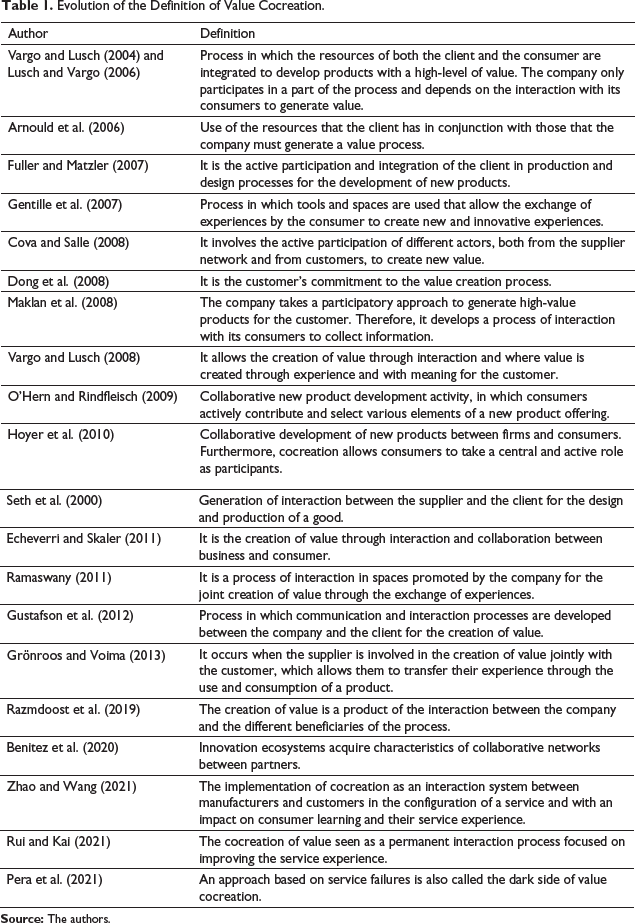
According to the different definitions, it is possible to find approaches throughout the different contributions made by the investigations carried out. Such definitions are based on an approach based exclusively on the exchange of experiences for the customization of products. However, it is going through the integration of resources, process design and, finally, the integration of various stakeholders of the company. Despite the aforementioned approach, in the literature, it is scarce to find those antecedents that have to do with ‘power importance’ in the consumer and its influence on value cocreation. Considering the above-mentioned statement, it is important to investigate the way in which feelings related to power can influence consumers to participate in value cocreation processes.
Power Importance
The concept of power is considered like an ability to exercise control over the behaviour of another person (Keech et al., 2020). On the other hand, power is also defined as the control exercised over some resources (Fiske & Berdahl, 2007).
It should be mentioned that in much of the literature on power, an enormous influence is identified on the desire to purchase products that are related to status. In the same way, the individual power will be more focused on fulfilling their own objectives and needs and then focused on the usefulness of a product (Keech et al., 2020; Rucker & Galinsky, 2008).
According to Schwartz (1992), power must be used in groups as a value—a fact that allows justifying its use in social life and at the same time being accepted by members of the social group. In the same way, the main objective is to consider power as a social value and as an artistic character associated with social status and prestige. Likewise, power has direct relationships with the control of an individual’s behaviour and resources (authority, social power, wealth, preserving public image and social recognition). Additionally, Schwartz (1992) also points out that authority and wealth emphasize the preservation of a dominant position in a broad social system, while the other values are focused on the demonstration of competence in a specific interaction.
Labrecque et al. (2013) report that many researchers in different fields in both sociology and psychology agree that power is a key human concern in the same way that this behaviour is part of a component of the social system and hierarchies. On the other hand, even though it is a concept rarely discussed in the field of consumer behaviour, power influences the way in which consumer activities are carried out, considering online and offline platforms. Considering that virtual platforms have monitoring and control mechanisms that influence the way consumers react to them (due to the fear of being exposed to third parties), it can generate a difference in the distribution of power between the different power groups.
In this way, for the purposes of this research, we consider the definition of power as an asymmetric ability to control the consumer or valuable resources (Labrecque et al., 2013). The previous definition is independent of the context in which a phenomenon is being studied. Finally, it is necessary to define that in social relationships, this ability indicates that an action is usually based on status or admiration on the part of others (Magee & Galinsky, 2008).
Value Cocreation and Power Importance Scale
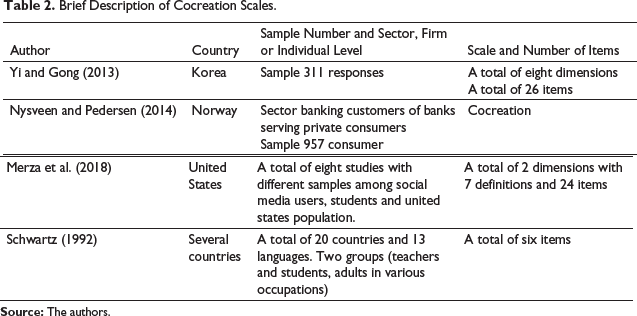
One of the most widely disseminated scales in value cocreation studies has been the Yi and Gong (2013) scale, which has been an important effort to identify the dimensions that can explain the value cocreation process since the prospects of the consumer experience. In addition to this scale, the Nysveen and Pedersen (2014) scale was identified, which, despite finding great differences in its way of measuring value cocreation, its approach was strongly associated with the individual characteristics of the consumer. Finally, a third scale was identified that was applied to the tourism sector by Merza (2018), which considered the inclusion of aspects associated with both the consumer experience and the individual characteristics of the consumer. This is presented in Table 2.
Brief Description of Cocreation Scales.
Methodology
Sample and Procedure
We created a cocreation measurement scale by following Churchill’s (1979) fifth steps: specifying the construct, analyzing items, cleansing the measure, and confirming the scale.
The first step is a literature review to identify different measures, perspectives and ideas about cocreation scale. According to Churchill (1979), a scale must present what the concept includes and excludes, and therefore, a complete list of elements was generated through a review of the literature, followed by in-depth interviews. The selection of articles published in high-impact scientific journals was based on the presentation by Briner and Walshe (2015) in which several articles available on the Web of Science (WOS) were identified. Consequently, the topic of interest was limited to studies published in the main business and consumer behaviour (Gursoy & Sandstrom, 2016).
The search obtained 552 articles: 15 from cocreation, 7 from cocreation scales and 524 from power. The 524 power papers were filtered into those most cited in the field, yielding 34 articles. The refined result base was 59 articles that were reviewed in-depth for psychometric scales to seeking to obtain valid constructs with which to develop the measurement scale. According to Rossiter (2011) and Liu et al. (2017), there are scales in the literature that must be validated, using qualitative methods through in-depth interviews, with experts to indicate the scales that could be used in later quantitative research. In the next step, a group of experts analysed the nine preliminary dimensions to measure cocreation.
Therefore, this research study developed this step to increase the validity. The interviews were conducted in November 2019, and 12 were selected by intentional open sampling (Sandelowski & Barroso, 2007) because the interviews were considered as saturated in the 11th interview, when the answers given by the interviewee were found to be comparable to those of the eight previous interviews. The average duration of the interviews was 40 min with 6 men and 7 women with experience in the cocreation process in different sectors. The interviewees were encouraged to talk openly about their experiences and perceptions. When they talked about cocreation in these interviews, power came up as a dimension; thus, we chose to evaluate this idea to define cocreation.
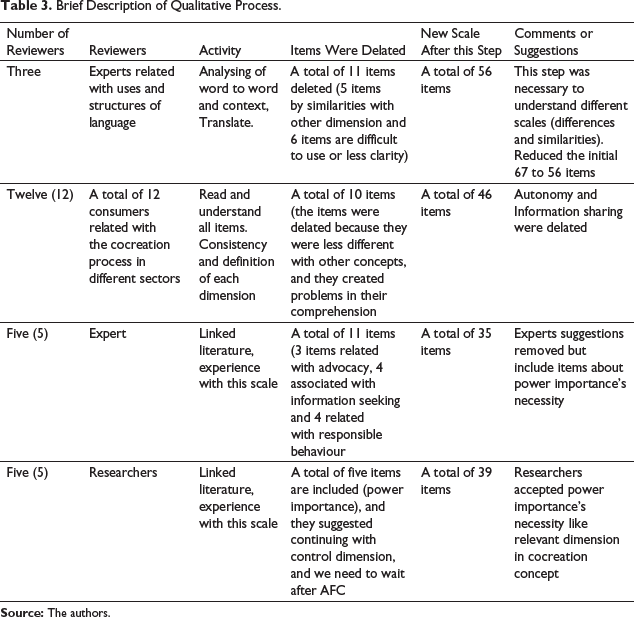
The process of the identification and classification of the information was carried out employing an analysis of the simple thematic content, which consisted of an analysis of the content found in traditional and digital communication media to quantify the number and types of advertisements (Andreú, 2002; Bardin, 1996). This was an interpretive technique for written or recorded texts focused on understanding different aspects and phenomena of social life (Bardin, 1996). More specifically, this research study allowed us to ascertain and understand the opinions of experts on the use of scales of cocreation. The description of qualitative process is presented in Table 3.
Brief Description of Qualitative Process.
Second Step: Analysing of Items
The items for the proposed cocreation scale were chosen from those defined by Yi and Going (2013), Nysveen and Pedersen (2014) and Mertz et al. (2018), who have defined how consumer participation in the development of a product allows for its inclusion in the generation and evaluation of ideas at all stages of product development.
Item by item, four panels of experts evaluated its clarity, pertinence and validity. Experts in English and Spanish language usage and taxonomy backed up the first group. We started with 56 items, and three experts went through each one, analysing and modifying wording and suggestions regarding the ideal translation.
These polls were analysed by experts, who identified 11 items connected to 3 main dimensions, including advocacy and information seeking. They also proposed a new dimension for understanding cocreation called ‘power importance’. Moreover, 12 consumers identified 10 items as prospective candidates for deletion since they were mixed up or repeated with other notions.
Finally, the researchers formed the final group to examine our scale in relation to the literature. They agreed to add a new dimension called power importance and to remove ‘responsible behaviour’ from this stage because the idea and its elements were not represented. Furthermore, because these things could not be tied to control, this group devised a new warning with a control dimension. They did not, however, remove this dimension; nonetheless, it might have been removed following confirmatory factor analysis. The three rounds of expert assessment are summarized in Table 3.
Third Step: Cleansing the Measure
The survey now had 39 items and was ready to be transformed into a pilot survey, at which point we would be able to ensure that participants comprehend all of the items and measures. This pilot test consisted of 30 face-to-face interviews conducted by a polling firm in various Colombian cities (Bogota, Medellin, Cali and Barranquilla). The exploratory factor analysis was created to confirm each construct and its components (Cronbach’s Alpha is high at 0.8).
Fourth Step: Scale
The sample consisted of a basic random sample of 1,300 people from Colombia and Vietnam. In addition, we looked at the demographic composition in each country (48% men and 52% women, with an age range of 18–67 years), which was consistent with data from the World Bank on population distribution in Colombia and Vietnam. With an intermediate education, the majority of customers (69.5%) were married or in free partnerships (57.5%).
The questionnaire was created in English and used in Colombia in Spanish. The variance method bias revealed no issues and showed that the meaning of the questions had not altered. When only one data collecting strategy is used, the common variance method can be used to determine whether there are variance problems between the independent variables. In this case, Harman’s single factor test was used to take into account all of the variables. As a consequence, it is clear that our data do not have any common method problems of variance, as this test was analysed with a factor analysis, which revealed that there were five factors (eigenvalue 45), with the first component accounting for 31.6% of the variation.
Furthermore, each participant was asked to sign an authorization form authorizing them to participate in the study, which was subsequently signed by the project’s chief investigator. The following stratified random sampling method was used: the researchers utilized a 7-point Likert scale, with 1 indicating ’not important’ and 7 indicating ’extremely essential’. Each survey took an average of 15 min to complete. Table 2 presents the study’s technical data architecture.
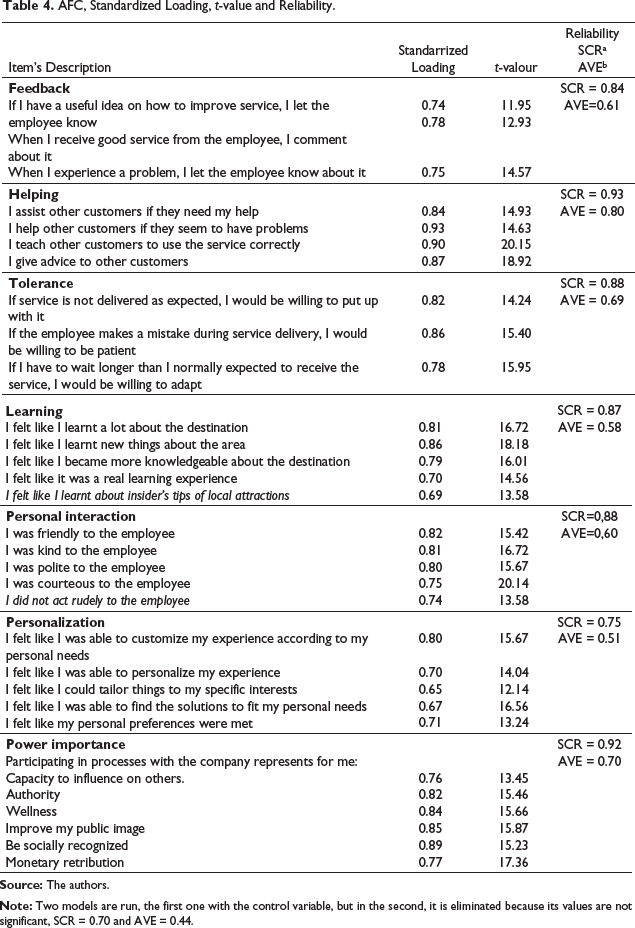
The results of the confirmatory factor analysis are presented in this study, along with a list of factors identified using exploratory factor analysis (EFA) in the third and fourth steps of the procedure. The degree of independence or relationship between them, as well as the relationship between the factors and variables, is determined (Long, 1983; Petrick, 2002; Stapleton, 1997). Additionally, confirmatory factor analysis was calculated, and is presented in Table 3, including the standardized estimators, the statistical value t and the corrected measurement accuracy. According to the findings of the reliability and internal consistency analysis conducted to achieve a greater adjustment indication, the final model included 33 items, with 6 items being eliminated due to a low factorial load.
Given that the compound reliability indices (SCR) were greater than 0.6 (Bagozzi & Yi, 1988) and the average variance extracted (AVE) was greater than 0.5, the factor analysis revealed an acceptable adjustment of the data; all of the measures demonstrated adequate reliability (Fornell & Larcker, 1981). Furthermore, all of the factory loads matched their hypothetical components, and the estimates were significant because the t-value showed high estimates, indicating convergent validity (Bagozzi & Yi, 1988). In this perspective, the constructions of ‘power importance’ and ‘helping’ were thought to have the highest factorial loads—higher levels of legitimacy in the usage of the results.
The comparative fixed index (CFI) of 0.968 suggests that the model is well adjusted, which is greater than the 0.95 recommended (Bentler & Bonett, 1980). The Tucker–Lewis index (TLI) analyses the proposed and unaccepted model’s degrees of freedom adjustment; this index indicates a value of 0.956, which is a satisfactory adjustment because it is higher than 0.9.
In scale development research, model fitting consists of three steps: (a) study of standardized parameters and associated standard errors (Brown, 2015; Byrne, 2001); (b) modification indices (Brown, 2015); and (c) standardized residual covariance with a value greater than 2.0.
Three model-fitting phases were performed to arrive at the final model, with items being deleted due to their low loads (0.01); the covariance of errors indicated that the data fit the model well (Byrne, 2001). Three of the four components had significant correlation (0.05).
The next step was to test the scale with a bigger sample of cocreators; to validate the structure of all elements in a more general population; and to establish convergence, concurrence, discrimination and nomological validity in the final scale.
Fifth Step: Scale Validation
Our second group’s validation purpose is to achieve four goals: validate the scale with a bigger sample of cocreators, validate the structure of all elements in a wider population; and demonstrate convergence, concurrence, discrimination and validity in the final scale. The covariance results are sufficient for determining the link between other constructs, but their levels are too low (about 0.13), implying that they are not independent.
The scale was further confirmed with a Vietnam sample, and the cocreation scale was developed based on a larger sample to see if this measurement accurately captured consumer behaviour in other countries.
Data Source and Sample Frame
The sample size of Vietnam’s consumers who responded was 650, with an average age of 38.74 years and a female-to-male ratio of 55.56%. The structure of the four elements was confirmed from earlier research, and evaluation was carried out to find out whether these six factors reflect higher-order constructs for measuring cocreation. The previous final model’s elements were compared to all of the validation study’s comprehensibility aspects to see if the factor produced different findings with a sample of Vietnamese customers.
Analysis
To establish content validity, we used the theory represented by the subdimensions of the four constructs to validate the content. Due to their large standardized residual covariance, items linked to personalization (P) and the personal interaction (PI) scale were advised to be deleted. In the second 20-item model, an even weaker model was shown. Feedback (F) statistics indicated poor standardized residual covariance values for feedback, tolerance and learning; hence, these parts were deleted.
In addition, the first item was defined in two different ways and was removed. The three components ‘feedback’, ‘tolerance2’ and ‘personal interaction4’ resulted in an overemphasis of that factor.
The items on the scale were assigned at random to avoid response tendencies. This study also used validated scales to describe the nomological network. The final, second-order model had seven components that indicated the cocreation of 31 objects. Table 4 presents the element and factor loads. Above 0.5, all item loads were significant (p = 0.001). In the higher-order cocreation scale, all four elements were substantially loaded (p = 0.001). The model’s general fit was good, with CFI = 0.96, TLI = 0.94, RMSEA = 0.06, CFI = 0.70 and SRMR = 0.06 (Brown, 2015). The cocreation scale had a high quality of information (= 0.88); it would be impossible to improve the helping by removing any parts.
AFC, Standardized Loading, t-value and Reliability.
Discriminant Validity
Discriminant validity is validated when the value of 1 is not within the confidence interval of the reliability indicator for each pair of concepts (Anderson & Gerbing, 1988). The other method to confirm the discriminant validity is the comparison between the average variance and the shared variance with a concept that has been previously removed.
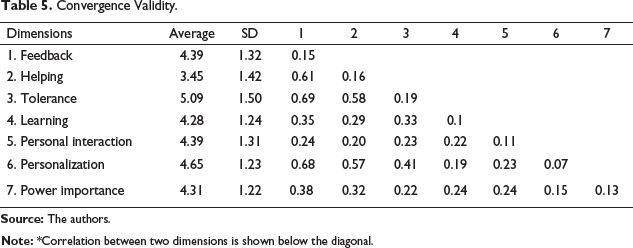
Convergence Validity.
Convergence Validity
Convergence is used to analyse interactions between constructs expected to be in a comparable nomological network, according to MacKenzie et al. (2011). As a result, with all concepts, a regression approach was devised to verify the relationships of cocreation inside its nomological links. Every component or cocreation has a positive association, which is confirmed by the regression.
Table 5 presents a summary of the items for the constructs studied in terms of mean and standard deviation values. The correlation matrix, on the other hand, shows that the mean value of the various constructs’ elements is 4.50, with a standard deviation of 1.
Concurrent Validity
The cocreation scale’s concurrent validity was established by determining the relationship between the generated concept and an outcome variable, like identification (Yin, 1990), which was a widely utilized construct in the business and tourist areas. Identification examined the relationship between buyers and sellers to determine why it was maintained (Moorman et al., 1993; Morgan & Hunt, 1994). This construct was included with the intention to prove the concurrent validity. This scale had four items to determine the relationship between brand and consumer: ‘my behaviour changes when somebody expresses negative opinion about my preferred brand’, I worry about somebody thinking, which is related to my brand’ and ‘when somebody talks about my preferred brand, I will increase my perception about them’.
Cocreation has a favourable influence on identification, according to the commitment scale (Tsao & Hsieh, 2012) with four items and the loyalty scale (Yoo et al., 2013) with three items (Tsai & Men, 2013). A linear regression model was established and confirmed using cocreation as the dependent variable and identification as the independent variable (R2 = 0.13, = 0.31, B = 0.16, SE = 0.02, t (1) = 3.62, p = 0.001).
Conclusions
The purpose of the scale was developed in response to the large number of measuring instruments related to the aspects of experience in value cocreation. This scale assessed the dimensions of value cocreation that measured those aspects that were related to the implementation of this strategy at the company level, facilitating the creation of shared value for organizations. Previous papers tend to use Yi and Gong (2013) scale related to cocreation, but it was concentrated in consumer experience. On the other hand, Merza et al. (2018) created a scale with seven dimensions, but all dimensions were associated with individual characteristics of consumers.
According to Pfeffer (1981), we included three factors that were related to individual characteristics and four dimensions with consumer experiences. So, they could be included in cocreation scales, but there was a lack of consensus in these dimensions due to these scales that were created for specific sectors. However, the necessity to include ‘power importance’ was confirmed by experts and different studies (Labrecque et al., 2013; Schwartz, 1992), but it was not included in other previous scales. Additionally, this study proposed an emergent dimension that becomes a fundamental part of the value cocreation construct, in terms of the feelings that an individual develops in influencing consumer’s behaviour or the use of valuable resources. The foregoing allowed to know in greater depth the stimulus that led consumers to be part of these value creation processes.
Our findings are consistent with prior requirements addressed by Verleye (2015), Zhang et al. (2015), Benitez et al. (2020) and Chan et al. (2010), which emphasize the need of taking into account factors related to cognitive, social and personal experiences. As a result, current research has begun to incorporate psychological components as well as managerial characteristics like ‘power’ (Dahl & Moreau, 2007; Füller et al., 2011).
For this reason, our scale proposed to measure cocreation that had seven dimensions (multidimensional scale) with dimensions related to both aspects: individual characteristics and consumer experience such as personal interaction, feedback, helping, tolerance, learning, personalization and power importance. The scale had reasonable adjustment for each level and dimensions. It could obtain a second-order scale for cocreation, which reflected in seven dimensions that were related to consumer experience (personal interaction, feedback, tolerance) and individual characteristics (power importance, learning, helping). This multidimensionality scale could be used and adapted for different sectors and countries. Threfore, it is possible to link the most common scales and collect a new dimension that professionals and researchers deem relevant.
In recent years, these dimensions have been studied in isolation. Despite the foregoing, multiple questions, about what the antecedents of value cocreation can really be, the relevance of the dimensions studied so far as well as the role that power importance plays in cocreation, have remained unsolved. In this way, this study should be of interest to those who seek to analyse the antecedents and consequences of value cocreation at an applied research level that allows researchers to provide tested and validated measurement instruments.
According to Churchill (1979), this scale had different quantitative and qualitative steps to obtain the definitive version. In the qualitative steps were four groups (grammar experts, consumers, cocreation experts and researchers), which allowed to give different perspectives and academic rigour. Then, advanced fundamental concrete (AFC) model confirmed the dimension and eliminated control dimension (six items) because its significance and other indicators showed less relevance. In relation to the dimension of power importance that included items related to how consumers could develop a feeling related to influence on the other (authority, social recognized, wellness and monetary retribution), that allowed to include a concept sparsely explored, but important.
Consequently, this research study should contribute to study cocreation at various levels since this scale will provide a measure with elevated level of reliability and validity. Additionally, the power importance relevance is a new dimension with less study, but that literature and expert groups are according to its relevance.
Another practical implication is that this scale can be used to understand and study the cocreation concept more deeply. This effort could help to unify its measure without a dependence of sector or country location. Additionally, cocreation scale will be a proof for researchers, managers and politicians because this field is relevant in their future decisions about the cocreation process. In addition, entrepreneurs can develop a cocreation process. At the same time, they will measure the consumer experiences and individual characteristics of everyone through this scale and will make decisions about their products.
This scale was developed and tested in Colombia and Vietnam for consumers of different sectors, but it could be used in developed and developing countries. Future research could apply this scale in other countries to test all dimensions inside this scale and its validity.
Managerial Contribution
This research study finds various managerial implications. In the first place, considering power as a key aspect in the relationship between consumer and company allows us to identify clear roles. Additionally, the power influences the contributions that different stakeholders can make in a value cocreation process. Similarly, considering power as a psychological and innate aspect in people allows the company to create strategies that allow it to more adequately involve the consumer. Therefore, a company that aims to implement an effective cocreation process should not only consider power as an important management aspect but also as a potential element to increase the results of ‘share activities’.
Limitation/Future Research Lines
Despite the important contributions that this study makes to the literature, the limitations are present as in any investigation. In the first place, it is found in the results of external validity in consumers from two countries with diverse cultural characteristics. Future studies should validate the scale in different population groups, not only by geographical origin with other types of variables like age ranges and economic sectors. Considering what is stated by scholars like Zhang et al. (2021) and Netemeyer et al. (2003), the scales must be tested considering multiple samples and contexts. In this way, adaptation processes must be developed considering different scenarios. Another aspect in the future lines of research is the replication of the scale not only at the country level but also in industries characterized by high innovation dynamics and analyse the antecedents and consequences of the cocreation of value that allows evaluating the behaviour of power importance in the relationships already studied in the field.
Additionally, future studies should consider the validity of the constructs using other types of variables related to the satisfaction that allows validation of the construct defined in the present study. Similarly, subsequent studies should consider the roles of antecedent and consequent variables of the cocreation of value.
Footnotes
Declaration of Conflicting Interests
The authors declared no potential conflicts of interest with respect to the research, authorship and/or publication of this article.
Funding
The authors received no financial support for the research, authorship and/or publication of this article.
