




Abstract
Addressing the problem of lecturer turnover in Malaysia, this study investigated the motivations behind the intention of employees to stay in private higher education institutions (PHEIs) in Malaysia, with a focus on the relationship between the perceived practices of human resource management (HRM) and the intention to remain at Malaysia’s PHEIs. Based on the social exchange theory (SET), this article proposed that the perceived HRM practices at those institutions are uniquely positioned to support employee intention to stay, particularly with the intervention of organizational citizenship behaviour (OCB). Data from 323 lecturers working at PHEIs in Malaysia confirm this model. Based on the analysis, this study revealed that recruitment and selection; training and development; and rewards and recognition all had a meaningful relationship with the intention to stay. In contrast, notably, performance appraisal did not have any significant relationship with the intention to stay.
Keywords
Introduction
The emergence and rapid growth of private higher education institutions (PHEIs, 2018) in Malaysia have changed the landscape dramatically. Indeed, the globalization of the education industry is a common trend in developing countries generally. With such intense competition in this sector, the Malaysian education industry is aware of the pressure to meet the high demands of this economic sector in terms of recruiting and retaining a knowledgeable and skilled workforce (Othman et al., 2011). Also, to be able to compete globally, the development of human capital is vital. Education can be viewed as a capital good, used to develop human capital for social and economic transformation. In addition to public higher education institutions, PHEIs also, therefore, need to be able to quickly respond and adapt to the changes of the dynamic broader world to meet the economic, political and social demands of the present times.
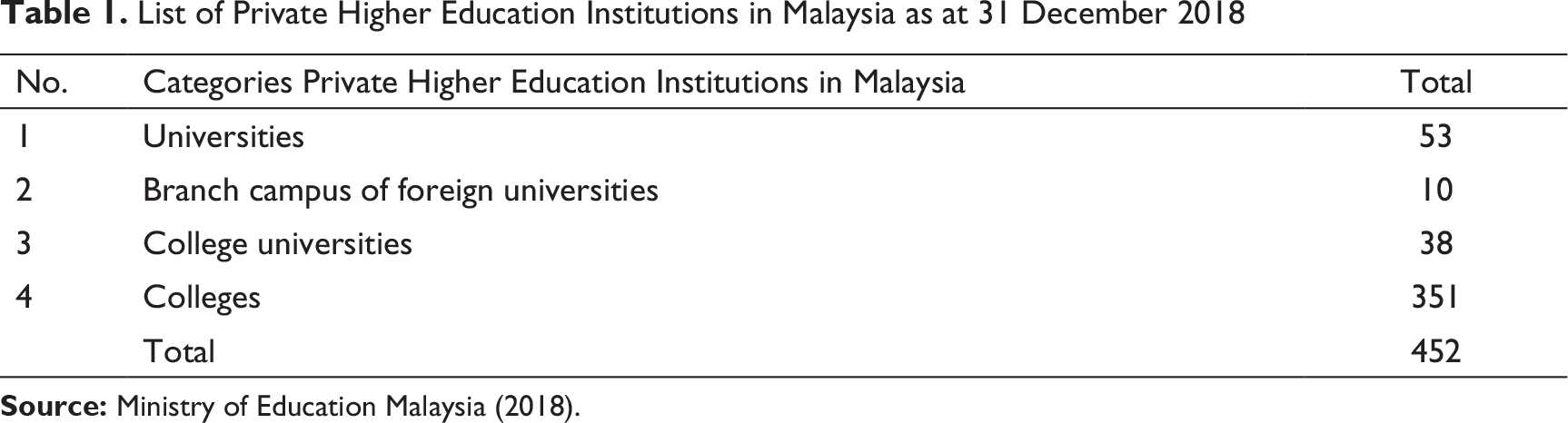
PHEIs in Malaysia has received international recognition, with ten PHEIs making their presence known in the recent Quacquarelli Symonds (QS) University ranking of 2019 (QS Asia University Ranking, 2019). It is a reliable indicator that PHEIs now are the leading players in Malaysia’s tertiary education industry. The demand for PHEIs in Malaysia also continues to increase due to the rising population of high school leavers and better recruitment and awareness campaigns in schools (MAMPU, 2009). As of the 31 December 2018, there were 53 private universities, 38 college universities, 10 branch campuses of foreign universities and 351 colleges in the country (Ministry of Higher Education Malaysia, 2018). Table 1 provides information regarding the total number of PHEIs in Malaysia.
However, the shortage of lecturers is a significant problem for this sector, and Malaysian PHEIs has suffered from high turnover among academic staff for many years (Saraih et al., 2017). Hashim and Mahmood (2011) claimed that the lecturer turnover rate at PHEIs is at an alarming rate; supported by research conducted by Zakaria et al. (2014), who found that the job mobility of private college lecturers has become a real issue for these institutions. The Malaysian Employers Federation (MEF) also reported that the typical ratio of turnover rate for the education sector generally was 29.28 per cent in 2011. High turnover is an important issue. Notably, as reported by the Critical Skills Monitoring Committee (CSC), the role of the university and higher education professional academician is a critical occupation for Malaysia, with a marginal growth of 11.06 per cent in 1 year (Talent Corp Critical Occupational List, 2016/2017, p. 75). It was also observed that, especially in the case of private colleges, the turnover rate for skilled employees such as senior lecturers, faculty heads and new lecturers is quite high (Manogharan et al., 2018).
List of Private Higher Education Institutions in Malaysia as at 31 December 2018
Since turnover is costly to the organization, identifying factors that enhance employees’ intention to stay would be beneficial to an organization. Tett and Meyer (1993) described an intention to stay as employees’ willingness to stay with an organization, and it consistently demonstrates a stronger relationship with turnover. Naturally, the leaving of lecturers is usually a negative for any institution in the long run as lecturers not only act as the most valuable assets of these organizations but also the guardians and disseminators of knowledge to students. When lecturers decide to leave, it has a significant impact on other lecturers, students, support staff and management, and there is a need to find a replacement to fill up the vacant post. Dubosc and Kelo (2011) reported that one crucial reason why employees leave the organization is due to inappropriate human resource management (HRM) practices which are inadequate to address the challenges faced. Branham (2012) suggested there are, in fact, seven main reasons why employees leave: low pay, lack of recognition, limited career advancement, untrustworthy leadership, poor management practices, unfulfilling jobs and dysfunctional work cultures. All these factors are closely linked to HRM practices, which is why a proper understanding of the relationship between HRM practices and intention to stay will help organizations make the right decisions in the interest of achieving their organzsational goals.
Studies strongly suggest that organizations will benefit by encouraging employees to be involved in organizational citizenship behaviour (OCB), bringing an increase in productivity, customer satisfaction, reduced costs, turnover rates and absenteeism (Podsakoff et al., 2009). Current studies by Chinomona et al. (2017) also support the view that OCB is a crucial way of enhancing employees’ intention to stay. Therefore, this study also argues that improving employees’ OCB can help to explain the perceived HRM-intent to stay relationship, and OCB is, therefore, proposed as a potential mediator.
The objective of this research is to examine the relationship between perceived HRM practices and intention to stay in Malaysia’s PHEIs. The second objective of the study is to determine if OCB is a potential mediator for the above relationship. The first section reviews the relevant literature related to HRM practices, OCB and intention to stay. The second section describes the methodology and procedure used for the present study. Further ahead, the next section discusses the analysis, result findings and discussions in light of the findings. Finally, the article concludes with the implications, limitation and future directions.
Literature Review
Intention to Stay
An intention to stay is defined as the employees’ readiness to stay in the present organization with their current employment relationship on a long-term basis (Aslam & Safdar, 2012; Johanim et al., 2012). According to Rissanen (2017), the intention to stay shows employees’ dedication towards their work and organization and to stay working for the long term. Johanim et al. (2012) contended that intention to stay is the contrary idea of leaving the organization and look for other jobs. Eketu and Ogbu (2015) in their study additionally concur that concern should be given on intention to stay as and when an employee leaves, an organization has to bear the cost of recruiting and selecting a new employee. Furthermore, employees’ intention to stay has been a significant discourse in the field of management. It requires urgent attention on how to retain talented employees in the organization (Noor et al., 2018). Consequently, every organization needs to explore the factors that can influence employees’ intention to stay.
In the present study, the employee is referring to the lecturer. Altbach (2009) and Baruch (2004) have labelled the academic profession as the vital profession of the twenty-first century. The academic job is a critical profession in the development of every developing country such as Malaysia. Hence, the importance of understanding the role academician plays in Malaysia in moving the country towards a developed nation status. Therefore, factors that can retain the academician should be investigated.
Perceived Human Resource Management Practices
Perceived HRM practices can be interpreted as an individuals’ perceptions of this system that are most relevant to individual-level attitudinal and behavioural outcomes (Conway & Monks 2008; Gerhart, 2005; Gerhart et al., 2000; Gratton & Truss, 2003; Guest, 1999; Kuvaas 2008). In this study, HRM practices are the main predictors that can influence the intention to stay off in the PHEI industry. This study also contributed on an understanding of how employees perceived five HRM practices namely, recruitment and selection; training and development; performance appraisal; reward and recognition; and career opportunities, are linked with the intention to stay.
Recruitment and Selection
Recruitment is the process of searching and attracting qualified, talented people to apply for job vacancies in the organization. At the same time, the selection is the process of choosing the most appropriate person from the pool of applicants recruited to fill the relevant job vacancy (Gamage, 2014). Besides that, Werner and DeSimone (2011) stated that the organization might not face problem to hire a competent employee, but to retain them will be the most challenging task. Previous research found that recruitment and selection have statistically significant on intention to stay in Equity Bank, Kenya (Karemu et al., 2014). Furthermore, current research by Uraon (2017) also supports previous studied that recruitment and selection have a significant impact on intention to stay in the organization.
Training and Development
Training and development are other dimensions of HRM practices where firms invest in the development of their employees’ knowledge, skills, ability and other required skills to improve the productivity of employees (Gamage, 2014). According to Cesário and Magalhães (2017), the training provided by the organization will have an impact on employees; if the employees perceive that the training increased their value and that it is beneficial to their careers, employees decrease their intention to leave and increase their intention to stay with the organization. In the previous study it has been found that training and development have a strong positive link with employee intention to stay in lodging industry (Costen & Salazar, 2011) Besides that, Asil et al. (2013) in their research also found that there is a strong positive relationship between training and development practice with the intention to stay. Therefore, based on the previous study, it proved that training and development is the leading HRM practice that can influence employee intention to stay.
Performance Appraisal
Performance appraisal is defined as the systematic process measuring and developing job performance of the employees in the organization concerning the set of standards for a particular period to achieve various purposes (Opatha, 2010). Hong et al. (2012), in their study of retention in the context of Malaysia’s institutes’ higher learning, found that performance appraisal positively influences intention to stay among academicians. Besides that, Ghazali et al. (2011) also agreed that performance appraisal has a strong relationship with the intention to stay. In other words, performance appraisal is a critical component of HRM practices that could lead to employees’ intention to stay. A positive perception of performance appraisal by employees may perceive as an excellent treatment, and they may return the favours rendered by employers.
Reward and Recognition
A rewarding practice is a structured scheme of appraising and rewarding employees based on their performance (Nathaniel et al., 2010). The rewards and recognitions practice determine the type of appreciation received by employees, monetary and non-monetary rewards, from the organization based on their performance. Nazir et al. (2013) studied the relation of reward and recognition practices in higher education institution in the UK, and they found that the higher education system offers both financial and non-financial rewards to academician. Furthermore, a study on childcare teachers’ intentions to stay in the Singaporean childcare service industry also indicates a positive relationship with reward and recognition (Pek-Greer et al., 2016). Moreover, according to Zin (2017), reward and recognition practices have a significant impact on the intention to stay. In this study, it was found that respondents’ feeling of satisfaction towards the pay, such as salary and bonus, were related to intention to stay (Zin, 2017). Hence, in the context employee–employee relationship, when employees feel satisfies with reward and recognition package provide organization automatically, they will increase their desires to remain in the organization and develop extra-role performance.
Career Opportunities
This research has investigated the career opportunities factors which influence lecturer’s intention to stay in PHEIs in Malaysia. According to Cesário and Magalhães (2017), if employees can feel that they have career opportunities and advancement, they may perceive that the organization appreciates and value them; this could lead to an intention to remain in the organization. Ans et al. (2006) found an intention to stay decision has positive effects on career opportunities. Murugappan and Durga (2015) have been studied on employee retention also found the same result that career opportunities influence the intention to stay in the organization. Furthermore, Sanjeevkumar and Wei (2012) conducted a study on employees’ intention to remain in public companies, Kedah, Malaysia, also found that career opportunity has a positive relationship with the employee’s intention to stay. Therefore, based on evidence in the previous literature, it is shown that excellent practice career opportunities will increase employee intention to stay with the organization.
Organizational Citizenship Behaviour
The OCB has been defined as ‘individual behaviour that is discretionary, not directly and explicitly recognized by the formal reward system, and in the aggregate promotes the efficient and effective functioning of the organisation’ (Organ, 1988, p. 4). Organizations need employees who monitor and adapt to rapid changes in the dynamic business environment and discover how to deal with these changes to enhance effectiveness (Organ et al., 2006). Nowadays, managers need to lessen absenteeism, deviant workplace and turnover behaviour and increase OCB to retain a good employee. For Small Medium Enterprise’s (SME’s) employee, OCB refers to the willingness to stay with the organization, their actions beyond their job description and responsibilities (Chiang & Hseih 2012; Yildirim et al., 2012). While, in the case of the education industry, the concepts of OCB are primary determinants of lecturers’ efficiency, productivity and they will have a positive effect on overall performance of colleges and universities (Dirican & Erdil, 2016). Past studies demonstrate that positive perceptions of HRM practices influence employees to exhibit more OCB (Lam et al., 2009) and to be less likely to quit (Takeuchi & Takeuchi, 2013). Alfes et al. (2013) found that perceived HRM practices were significantly related to OCB. While the previous study also indicates that there is a positive relationship between OCB and employees’ intention to stay (Chinomona et al., 2017). Hence, it is interesting to investigate how perceived HRM practices affect the intention to stay through the engagement of OCB as an indicator of behavioural reaction.
Perceived Human Resource Management Practices and Intention to Stay
HRM practices are considered a vital part of the success of organizations and deal with staff recruitment and selection; training and development; performance appraisal; rewards and recognition (Huselid, 1995); and career opportunities (Huo et al., 2015). All of these practices can play an essential role in influencing employee attitude and behaviour and can affect employees’ intention to stay in the private higher education industry in Malaysia. While many studies view the effect of HRM practices only in terms of organizational-level outcomes (e.g., Atteya, 2012; Delery & Gupta, 2016), Alfes et al. (2013) suggested that it is vital to consider the impact of HRM practices on the individual employees themselves, in terms of employee outcome variables. To examine the effect of HRM practices on employee behaviour, then, it is vital to discover precisely how employees perceive those practices (Boxall et al., 2008). In this study, HRM practices are hypothesized into five dimensions: (a) recruitment and selection are positively related to the intention to stay; (b) training and development are positively related to the intention to stay; (c) performance appraisal is positively related to the intention to stay; (d) reward and recognition are positively related to the intention to stay; and (e) career opportunities are positively related to the intention to stay.
Organizational Citizenship Behaviour and Intention to Stay
Sengupta and Dev (2013) highlighted in their study that the employee’ willingness to remain in the organization is related to the personality of the individual, the characteristics of the job and the organization he or she is working currently. There is a concession among scholars that OCB is voluntary, and it is not a part of the formal system of the organization and also benefits to employee and organizations (Podsakoff et al., 2009). Cho and Johanson (2008) described the employees involved in OCB assisting their colleague, avoiding unnecessary conflicts, volunteering for additional work, obeying the organization rules and regulations. A previous study by Bolino et al. (2015) suggested that OCB plays a vital role to enhance employee’s intention to stay. Chinomona et al. (2017) examined the relationship between OCB and intention to stay of employees in Zimbabwean SMEs. This study found there is a strong positive relationship between OCB and employee intention to stay in Zimbabwean SMEs (Chinomona et al., 2017). Another study by Shanker (2018) also found that OCB influence employee intention to stay in the Indian organization. However, many previous studies have focused on the relationship between OCB and turnover intention or intention to leave from the organization (Fasanmi, 2018; Iftikhar et al., 2016; Khalid et al., 2013). Nevertheless, the turnover issue seems to have not been resolved. Hence, the researcher needs to look at how to enhance employee intention to stay in the organization to engage in OCB. Therefore, the following hypothesis is proposed: (a) OCB is positively related to the intention to stay.
The Mediating Influence of OCB on the Relationships Between Perceived HRM Practices and Intention to Stay
OCB is defined as the individual discretionary behaviour, not directly or explicitly recognized by the formal system and that in the aggregate promotes the effective functioning of the organization (Organ, 1988). According to Yaghoubi et al. (2011), there is a relationship between OCB and management areas such as strategic management, leadership and HRM practices. Jena and Goswami (2014) also stated that employee who is satisfied with the working condition of the organization would displays OCB. Employees that engage OCB will accomplish their job duties as well and take care of those around them, such as assisting their colleagues (Harvey et al., 2018). Furthermore, they are also willing to tolerate any inconvenience situation, tend to be more cooperative in the workplace and are more active in employee’s social groups.
Consequently, employees with high OCB tend to remain in the organization for more extended periods. Hence, this present study is attempted to explore factors that can increase employee intention to stay in Malaysia’s PHEIs. Although previous findings have generally supported the view that HRM practices are positively connected with individual and organizational outcomes (Cesário & Magalhães, 2017), researchers have recently sought to discover the mechanism through which HRM practices are linked to individual and organizational outcomes.
Studies have suggested that OCB is a potential mediator, connecting employees’ perceptions of HRM practices and their attitudes towards the organization, particularly in terms of their intention to stay. Undeniable, many previous studies have been proven that OCB plays a role as mediator especially the relationship between HRM practices and turnover intention (Cesário & Magalhães, 2017; Husin et al., 2012; Lam et al., 2009; SamGnanakkan, 2010). Therefore, the questions of how HRM leads to better employee outcomes and how HRM forges strong linkages to mediators need to be answered: (a) OCB mediates the relationship between recruitment and selection and the intention to stay; (b) OCB mediates the relationship between training and development and intention to stay; (c) OCB mediates the relationship between performance appraisal and intention to stay; (d) OCB mediates the relationship between reward and recognition and intention to stay; and (e) OCB mediates the relationship between career opportunities and intention to stay.
Theoretical Framework
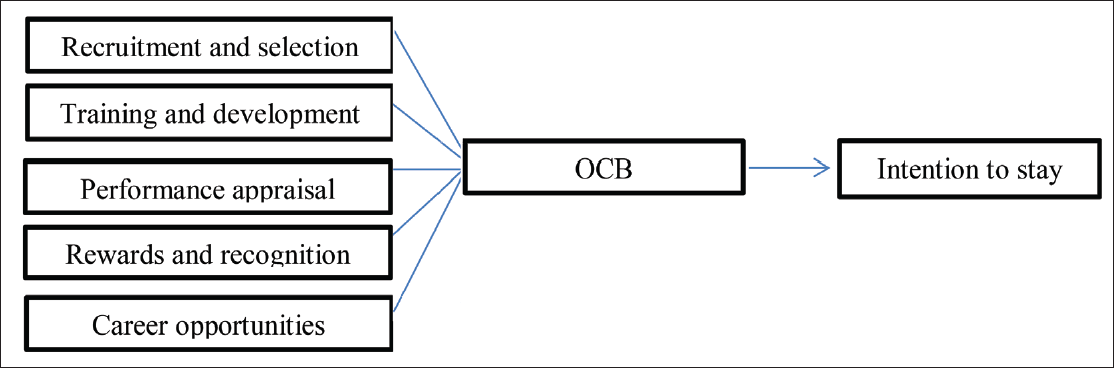
Social exchange theory (SET) provides an explanatory framework to clarify how employee perceptions of HRM practices are linked to OCB and intention to stay. The manifestation of engaged employees arising out of HR practices can be theoretically explained through the SET (Blau, 1964). The previous study also suggested that in workplace relationship, employees generally try to reciprocate to those who supported them (Pradhan et al., 2019). Based on SET, this framework posits that effect of perceived HRM practices on individual behaviour outcome is mediated by OCB. This study argues that employees who have positive perceptions of their HRM practices will exhibit more OCB and will stay longer with the organization. Therefore, this study developed a framework in measuring intention to stay among lecturers in Malaysian PHEI. The research framework is presented in Figure 1.
Methodology
Sample and Data Collection
Data from 323 PHEIs in Malaysia were collected to test all the hypotheses. The total numbers of PHEIs registered in Malaysia was, at the time of writing this article, 452 (Ministry of Higher Education, 2018). The target population of this research included all categories of PHEIs and the respondents were the lecturers in these registered PHEIs. A total of 2,424 questionnaires were distributed to the target respondents. A total of 341 questionnaires were returned. However, 18 questionnaires were found to be unusable because foreign lecturers answered them. The final usable questionnaires had a 323, 13.32 per cent response rate.
Measurement
At the early stage, this research used valid measurement to measure all variables and also conducted a pre-test using expert opinions. This was because the questionnaire in this study was developed from a different context, so the questionnaires needed to be refined based on an interview with five respondents who were lecturers at PHEIs in Penang to ensure the reliability and validity of the scales. The five respondents chosen for pre-test were requested to identify any ambiguity about the contents of items. Based on their feedback, some items were adapted to fit into the local context.
Human Resource Management Practices
For this research, HRM was divided into five practices: (a) recruitment and selection (α = 0.84), (b) training and development (α = 0.80), (c) performance appraisal (α = 0.83), (d) rewards and recognition and (α = 0.83) and (e) career opportunities (α = 0.83). A total of 16 items were adapted from Langford (2009) and a 5-point Likert scale (from 1 = strongly disagree to 5 = strongly agree) was employed.
Organizational Citizenship Behaviour
Ten items were adopted from Spector et al. (2010) to measure OCB. The Cronbach’s alpha value reported for the overall items from this study was 0.80. Each dimension of OCB was measured on a 5-point Likert scale, ranging from 1 (never) to 5 (every day).
Intention to Stay
Three items were adopted from Langford (2009) to measure intention to stay. The Cronbach’s alpha value reported was 0.89. A 5-point Likert scale, ranging from 1 (strongly disagree) to 5 (strongly agree) was employed.
Analysis
Measurement Model
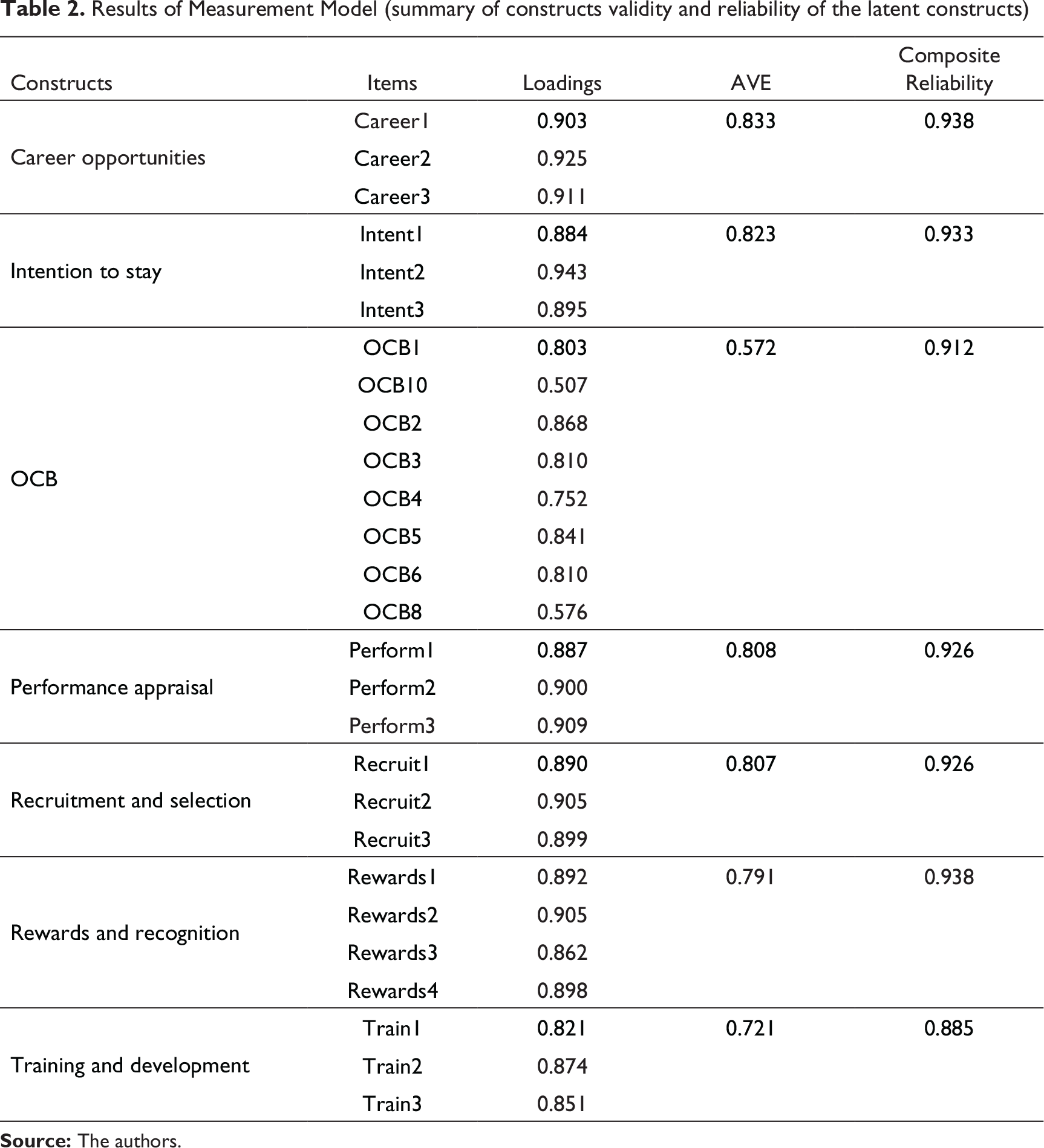
Results of Measurement Model (summary of constructs validity and reliability of the latent constructs)
Structural Model
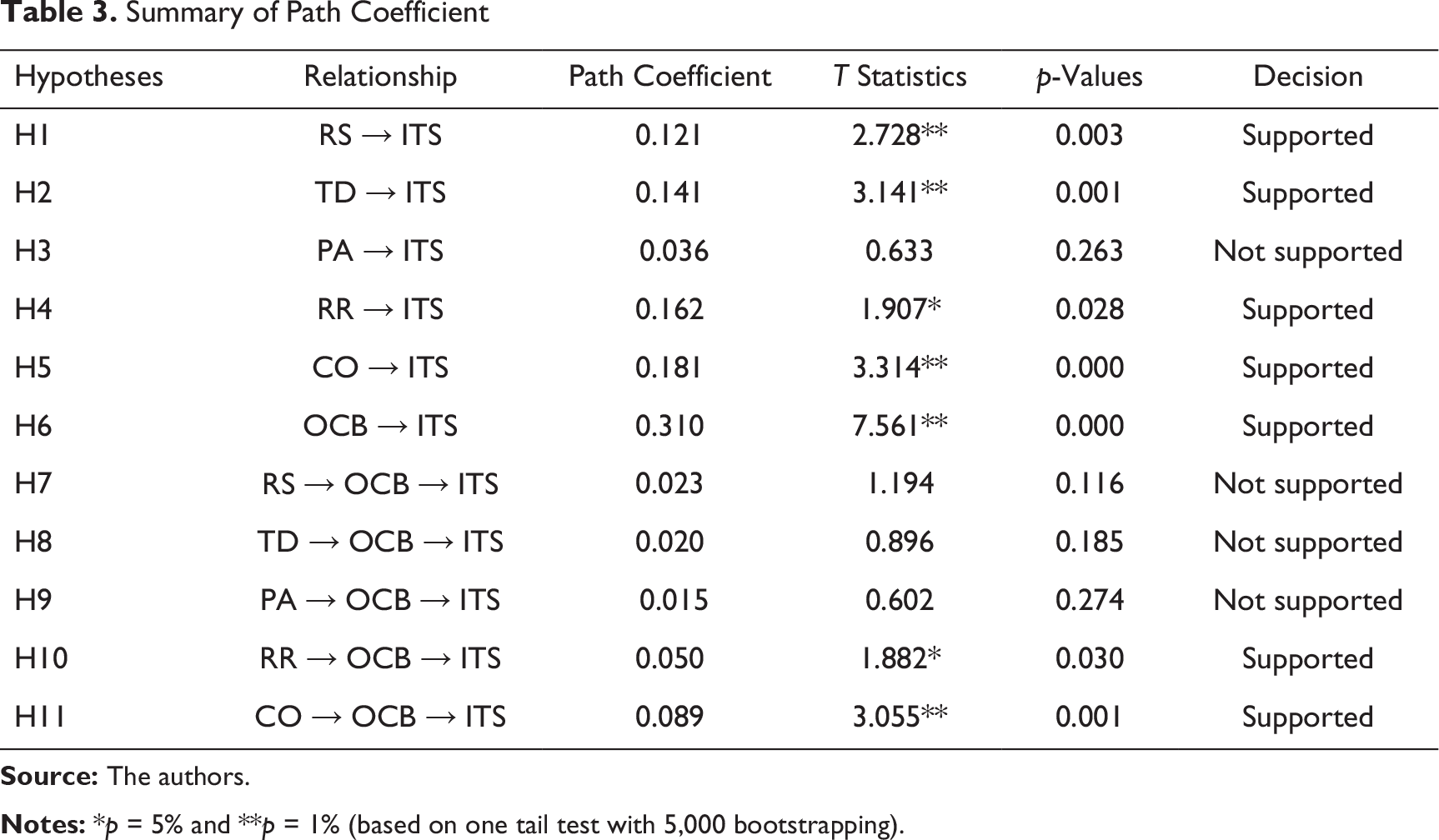
The results are presented in Table 3. Bootstrapping of 5,000 resamples was then conducted to determine the path coefficient values and the t values for each path. Each result was then examined: structural path recruitment and selection (β = 0.121, p < 0.003), training and development (β = 0.141, p < 0.001), rewards and recognition (β = 0.162, p < 0.028) and career opportunity (β = 0.181, p < 0). All were found to have a significant relationship with the intention to stay, meaning that H1, H2, H4 and H5 are supported. However, performance appraisal (β = −0.036, p > 0.263) was not found to be significantly related to intention to stay. Hence, H3 is not supported.
Looking at the structural path, OCB (β = 0.31, p < 0) was found to have a significant relationship with the intention to stay, and H11 is, therefore, supported. Regarding indirect relationships, rewards and recognition (β = 0.05, p < 0.03) and career opportunities (β = 0.089, p < 0.001) had a significant indirect effect on intention to stay through OCB as the mediator. On the other hand, recruitment and selection (β = 0.023, p > 0.116), training and development (β = 0.020, p > 0.185) and performance appraisal (β = −0.015, p > 0.274) were not found to have a significant indirect effect on intention to stay through OCB as the mediator. Therefore, hypotheses H10 and H11 are supported and hypotheses H7, H8 and H9 are not supported.
Discussion
Summary of Path Coefficient
This study also found that the factor of career opportunities has a highly significant relationship with intention to stay. This result is supported by earlier studies (Murugappan & Durga, 2015) which found that career opportunities are positively related to the intention to stay. Employees perceived career opportunities within their organization as an indicator that the organization appreciates employee contributions (Allen et al., 2003). It follows that lecturers also appreciate when their institutions provide career opportunities for them and that this will encourage loyalty and retention. Recruitment and selection have also been found to be significantly and positively related to the intention to stay. This finding highlights that lecturers working at PHEIs perceive that the quality of the recruitment and selection practices at their institutions are a significant influence on their intention to stay longer with the organization, a view supported by Gamage (2014). Santhanam et al. (2018) also suggested that recruitment and selection practices are crucial markers for the beginning of the employment relationship and will affect employee intention to stay within an organization.
Training enables employees to develop and enrich their skills, which also has a positive effect on employee retention (Nkosi, 2015). The results of this study confirm that training and development have a significant relationship with the intention to stay. Lecturers working at PHEIS perceived that the training and development practices are essential factors which can enhance their intention to stay. This finding is consistent with previous studies which also confirmed that training and development were positively related to employee intention to stay (Asil et al., 2013). In the current study, rewards and recognition have also been found to have a significant positive relationship with the intention to stay. The finding is also in line with the results of prior studies (e.g., Chew & Chan, 2008; Johanim et al., 2012) which found that rewards and recognition are positively related to intention to stay. The current study confirms that PHEI lecturers in Malaysia who are rewarded for their work and who are recognized for their contributions will have the intent to stay longer within an organization. Nadarajah et al. (2012) make the point that Malaysia’s PHEIs need to do much more to improve their rewards and recognition practices if they want to retain talented lecturers.
The research question of this study asked whether OCB is positively related to the intention to stay and found that OCB does, indeed, have a significant relationship with the intention to stay. This result is consistent with prior studies (e.g., Chinomona et al., 2017) which found that OCB is positively related to intention to stay. Intention to stay is, therefore, a positive result of employees’ OCB performance. For this study, the PHEI lecturers who have OCB will inevitably be more inclined to stay in their organization. The indirect relationship between rewards and recognition and intention to stay through OCB is significant. By examining the mediating role of OCB, this study can, therefore, advance OCB as the mechanism behind the positive relationship between rewards and recognition and intention to stay. This finding suggests that lecturers who perceive rewards and recognition as an essential part of their employment can enhance their OCB, which in turn increases their intention to stay in their organization and reduces their likelihood of quitting. Besides, career opportunity has a significant positive indirect relationship with intention to stay, through OCB. These findings highlight that lecturer who perceives career opportunities as an essential influencer will indirectly stay longer with their organization. They will, in other words, express OCB, leading to the intention to stay.
Conclusion
Retaining and maintaining good employee becomes a challenge for organizations. In conclusion, the present study provides an expanded understanding of the impact of perceived HRM practices on the intention to stay in the PHEI industry in Malaysia. As mentioned earlier, recruitment and selection; training and development; reward and recognition and career opportunity are significantly related to intention to stay. Lecturers perceived that these practices are an important factor that can influence their intention to stay longer with their institutions.
The current study argues that the employees’ OCB, in particular, is involved in their behavioural process to help explain the HRM–intent to stay relationship. This behaviour comprises of extra efforts that go beyond the core list of job descriptions such as finding out the changes in demand, advocating initiatives to adapt to changing conditions and exercising a proactive stance toward the development of organization. Thus, OCB may support the role that HRM practices in determining the extent to which employees create an intention to stay their current employment relationship. This study also sheds some light on the part of OCB as a mediator and provides fresh insights on the relationship between perceived HRM practices, OCB and intention to stay. However, in this study OCB mediated 3 out of 5 relationships between perceived HRM practice and intention to stay.
Besides that, findings of this study are also in line with the basic of SET; employees who positively value HRM practices such as recruitment and selection will reciprocate through showing attitudes and behaviours that are valued by the organization (Gould-Williams, 2007). Therefore, other researchers are encouraged to use these results to further their understanding of and find solutions to the problem of high lecturer turnover in the rapidly expanding PHEIs of Malaysia and beyond. Overall, this study has made a significant contribution to gaps in the literature by linking perceived HRM practices, OCB and intention to stay within the context of PHEIs in Malaysia.
Managerial Implications
Recruitment and selection; training and development; reward and recognition and career opportunity are significantly related to intention to stay. Based on the result shows that performance appraisal has a small effect size on the intention to stay. Although the effect size was small, it is still meaningful and relevant. On a practical level, these findings indicate that employee perceptions of HRM practices play an essential role in increasing levels of employee intention to stay. These findings provide a valuable contribution to practitioners in Malaysia’s PHEIs. Specifically, HR managers may benefit from the results of this study by giving strategy directions related to HRM practices and processes with a focus on the intention to stay. Furthermore, HRM practices aim to foster positive employee attitudes and enhance individual and organizational performance.
The results indicate that OCB has a positive relationship with the intention to stay. In the direct relationship, reward and recognition and career opportunity have a significant effect on the intention to stay in PHEIs through OCB. These findings also help managers to understand the importance of OCB to increase employees’ intention to stay. Thus, it suggests that organizations, especially PHEIs, promote OCB among lecturers in order to encourage them stay longer with the organization. In other words, OCB are behaviours that often go beyond an employee’s job description and include acts such as putting in extra hours, taking on additional responsibilities, like helping others, defending the organization and discuss important organizational issues (Organ et al., 2006). It showed when employees’ perceptions of HRM practices were positive, OCB will enhance and employees’ intention to stay will increase. Therefore, OCB assists the organization in retaining employees and in turn, employees will improve their skills and performance.
Limitations of the Study
Although this study provides practical contributions to practitioners, there are still some limitations in this study. First, this study relies on self-report questionnaires, which is subjected to bias. As a result, several steps have been taken to minimize common method variance during the development of the questionnaire which consists of promising respondents for their anonymity and confidentiality and given the guarantee that their organizations will not be individually acknowledged in any reports. Besides, the Harman single-factor test was performed, indicating that there were no issues of common method variance. Even though the best efforts have been taken to address common method variance, the results should still be interpreted with care because some minor degree of biases may always be present. According to Podsakoff et al. (2003), it is impossible to design survey research that is free from common method variance even though appropriate steps can be taken to lessen and control common method variance. Thus, common method variance may not be completely eradicated in survey research. Second, this study is a cross-sectional study and therefore, causality between the variables could not be strongly demonstrated when data are collected at the same point of time (Sekaran & Bougie, 2013). Regardless of the limitation of a cross-sectional study to establish the direction of causality, this limitation can be partly mitigated by relying on a theory to develop and to explain the causal relationships between the variables in a cross-sectional study (Hair et al., 2010).
Footnotes
Acknowledgement
The authors are grateful to the anonymous referees of the journal for their extremely useful suggestions to improve the quality of the article. Usual disclaimers apply.
Declaration of Conflicting Interests
The authors declared no potential conflicts of interest with respect to the research, authorship and/or publication of this article.
Funding
The authors received no financial support for the research, authorship and/or publication of this article.
