




Abstract
This article focuses on the application of behavioural economics and its nudge theory in unused medicine disposal. Although regulated by law, some users ignore these regulations, which brings social losses, resulting in increased consumption, excessive accumulation and negative externalities due to environmental contamination. The research examines the impact of nudging by additional information on the return of unused medicines to the pharmacy in the Slovak Republic. Based on the empirical analysis, this article concludes that nudging had a positive impact on users’ behaviour. Respondents who were provided with additional information on drug handling showed a 10% increase in the claimed return on unused and expired medicine compared to the control group, which was not nudged. The outcomes show that nudging by additional information can be a supporting instrument how to increase the efficient handling of unused medicines.
Introduction
In this study, in the case of a typical Central European country (Slovak Republic), we investigate how much it is possible to influence the undesirable behaviour of users when handling unused drugs. Medicines in households are most often disposed of by flushing down the toilet and disposing of as municipal waste. At the same time, the law orders public pharmacies to collect unused medicines and to hand them over to the State Institute for Drug Control, which ensures their disposal. However, some users ignore the regulated disposal of unnecessary drugs. This is a striking fact if we consider that the consumption of medicines in Slovakia has an increasing tendency.
When we compare 2019 with 2018, it is an increase of 6.2% to 1,903.2 million EUR. These are considerable funds that are paid for from public funds (Nemec, 2020). The disposal of unused medicines is also covered by public funds, so we ultimately pay for the medicines twice. For the first time, we pay through health insurance companies and also in co-payments for medicines, and the second time, we pay liquidation. On average, 170 tons of waste from unused medicines are burned annually. It is evident that improper handling of unused medicines causes social harm. It is therefore necessary to look for ways to change the behaviour of medicine users in order to avoid economically irrational handling and incorrect disposal of unused medicines.
When looking for a way to solve this problem, we were inspired by studies that investigate how nudging tools influence the behaviour of citizens when dealing with waste. Analysis of scientific discourse shows that, while positive achievements of nudge techniques have been made in food waste (e.g., Barker et al., 2021; Parry et al., 2014) or recycling the area of reducing medicine waste by means of nudging techniques has not been widely researched. Therefore, in our study, we focus on this little-explored spot. We aim to investigate what changes in the behaviour of drug users will be made by additional information (leaflet) about the disposal of unused drugs, and then, based on the empirical findings, formulate scientific conclusions and practical recommendations for public policy.
The structure of the article is as follows. In the first part, we create a theoretical and conceptual framework for research. Based on an assessment of contemporary scientific discourse, we anchor our research on the concept of nudge. The second part of the study deals with the empirical study of the behaviour of medicine users. To this end, our own empirical research was conducted. The research results are then discussed in the ‘Results and Discussion’ section. At the end of the study, theoretical generalisations and practical recommendations for the policy of unused medicines are provided.
Theoretical and Conceptual Framework
The theoretical and conceptual framework is created based on the steps as follows.
Definition of the Subject of Investigation and Analysis of Scientific Discourse on Factors Influencing Behaviour
The research subject of this study is the analysis of the behaviour of users with unused medicines. Analysis of scientific discourse shows that drug misuse is influenced by several factors, such as lack of awareness, unpleasant experience, side effects, excessive confidence, mental illnesses, influence of other household members or carers, lifestyle and events, medicine users’ age, fear of lack of medicines, improper placement or loss of medicines and the controversial impact of advertising. Makki et al. (2019) examine the role of these factors. Dolan et al. (2010) describe nine factors that influence an individual’s behaviour. Their concept is known by the acronym MINDSPACE, named according to the initials of each factor: Messenger, Incentives, Norms, Defaults, Salience, Priming, Affect, Commitments, Ego. People consider information from authorities to be more reliable and relevant to our decisions (Webb & Sheeran, 2006). The ‘incentives’ express the fact that people feel a higher aversion to loss (Kahneman & Tversky, 1979). The ‘norms’ indicate the social context of the behaviour. An individual’s behaviour is influenced by what other individuals do (Muthová & Mikušová Meričková, 2016). It is a follow-up effect that affects, for example, ethnicity (Andreoni et al., 2016), group membership (Alesina & La Ferrara, 2000; Fehr & Hoff, 2011; Shayo, 2009) and different types of social groups (Chakravarty & Fonseca, 2014). The ‘defaults’ factor indicates the role of erroneous decisions made based on incorrect information, resp. half-truths and illusions (Dolan et al., 2010). The ‘salience’ factor concerns the focus of our attention (Cialdini, 2007), which in the case of unused medicines is, for example, the availability and visibility of the collection containers (Cialdini, 2007; Dolan et al., 2010). The ‘priming’ expresses the empirically established fact that individuals’ actions are influenced by subconscious stimuli. An information leaflet is such a subconscious stimulus. The ‘affect’ factor relates to emotions, to the fact that emotions are an important factor and a catalyst for our decisions (Kahneman, 2011). The ‘commitments’ factor expresses the fact that procrastination, laziness and lack of willpower are common causes of our personal failures. However, we can change this negative attitude based on the so-called mutual influence. For example, if a pharmacist answers our question amicably, we can be expected to reciprocate amicable behaviour. This is an evolutionarily rooted need for cooperation (Nowak, 2011). The ‘ego’ factor indicates the possibility of moving the individual to the desired behaviour. We can strengthen the ‘ego’ factor by changing preferences and then strengthening them. For example, if we involve medicine users in research on how to properly dispose of unused medicines, there is an increased likelihood that they will return unused medicines to a pharmacy (Bem, 1967 in Dolan et al., 2010; Festinger, 1957).
Identifying Incentives to Influence Behaviour When Disposing of Unused Medicine
In our study, we are inspired by the idea that individual behaviour can be influenced in different ways. Gidey et al. (2020) conclude that an effective unused drug disposal system should be provided along with an extensive media campaign to educate customers on safe medicine disposal practices and to implement an awareness creation campaign through an appropriate medium of communication on the appropriate medicine waste disposal method. We use the concept of human behaviour based on behavioural economics to explain the irrational handling of medication users and to examine the change in their attitudes in the form of nudge (Camerer & Loewenstein, 2004; Dolan et al., 2010; Tversky & Kahneman, 1974), and the concept of nudge. We are interested in why medicine users make good and bad decisions and whether there is a way to help them make better decisions.
Choice of Core Theory (Explanatory Paradigm) and Its Limits, Research Questions
Based on the evaluation of the current scientific discourse on nudging and the identification of factors and incentives influencing the behaviour of users in the disposal of unused drugs, we anchor our research on the concept of nudge. To explain the investigated problems, we use explanation in the form of subsumption under theory (Ochrana et al., 2022).
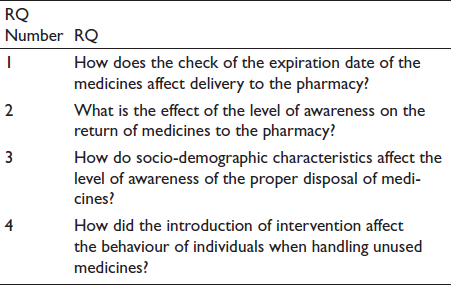
The basis for answering RQ 1 will be the respondents’ reactions to the question ‘Do you check the expiration date of medicines in the first aid cabinet at home’ and ‘Do you hand over unused medicines and medicines after the expiration date to the pharmacy?’ In this case, we assume that if the expiration date of medicines would attract the attention of an individual (Cialdini, 2007), a certain reaction can be expected on their part, which in our case will be the return of unused medicines to the pharmacy after the expiration date. In practice, this means that if the expiration date of medicines is sufficiently highlighted, it cannot properly direct the attention of the individual, while eliminating their distraction (Cialdini, 2007; Fang et al., 2007).
The RQs 2, 3 and 4 are followed up by H1.
H1: We assume that more than 50% of respondents have enough information on how to properly dispose of medicines.
We test the hypothesis for the questions: ‘Do you think you have enough information on how to properly dispose of unused medicines and medicines after the expiration date?’, ‘Do you know about the possibility of returning unused medicines and medicines after the expiration date back to a pharmacy?’, ‘Do you return unused medicines and medicines after the expiration date to a pharmacy?’.
As reported by Dolan et al. (2010), influencing an individual’s behaviour is based on the environment in which they find, feel, see and hear the dissemination of the message during decision-making (Aarts & Dijksterhuis, 2003; Greitemeyer, 2009). As stated by Dijksterhuis and Bargh (2001), these are the basic attributes that an individual imitates or adapts to what they see or hear. Issuing an individual with an information leaflet and its subsequent verification by questionnaire questions should ultimately contribute to increasing the level of awareness among individuals, thereby contributing to the correct behaviour regarding the handling of unused medicines. We will consider these factors in the following empirical research.
Research Methodology
The aim of the article is the application of behavioural economics and its nudge theory in the unused medicine disposal. The reason is that users often do not know what belongs in collection containers for unused medicines and medicines after the expiration date. Users regularly carry bags full of medicines in the outer packaging, which can be separated in the usual way, and often other products that do not belong in the collection container. Although the users know about the possibility of returning unused and expired medicines to the pharmacy, they have little information on the correct way of disposing of unused and expired medicines. Therefore, the main goal of our behavioural intervention is to increase citizens’ awareness of the proper disposal method of unused medicines and medicines after the expiration date by means of educational information leaflets. We want to increase citizens’ awareness by compiling information leaflets which were compiled based on the MINDSPACE concept (Dolan et al., 2010) presented in the previous section (Appendix 1).
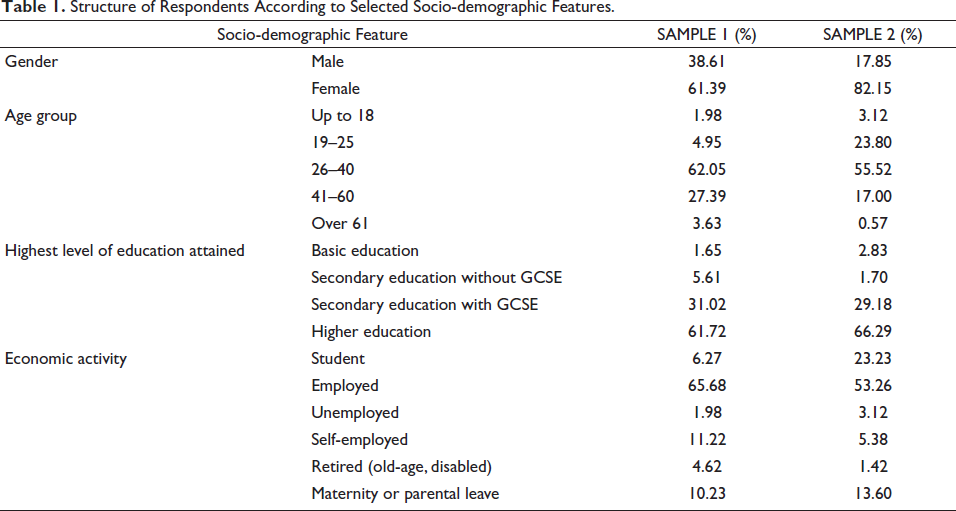
The object of our research is the inhabitants of the Slovak Republic, heterogeneous in terms of gender, age, educational attainment and economic activity. Respondents were addressed randomly by an electronic form created via Google Forms. Subsequently, we sent it out and shared it using a social network. Data collection took place from 14 April to 26 April 2021.
We tried to verify the effectiveness of the behavioural intervention by means of a questionnaire and a comparison of two groups. By choosing the following methodological procedure, it was possible to compare the answers in the control group (SAMPLE 1), that is, the group that did not see our information leaflets and in the experimental group (SAMPLE 2), that is, the group that saw the information leaflets. We chose this procedure to be able to check the effectiveness of the established behavioural intervention. We are aware that the methodological procedure may have certain limitations when we cannot verify whether all respondents in the experimental group saw the information leaflets. However, we assume that, due to the relatively high sharing rate—84 shares and 125 likes of the ‘I like the article itself’ as of 30 April 2021, it is possible to expect that the respondents who filled in the questionnaire also saw the information leaflets, as the questionnaire and information leaflets were part of that message on the Facebook social network.
The first control group was respondents who did not see the information leaflets. There were 303 respondents in the control group (SAMPLE 1). The second group (SAMPLE 2) surveyed were respondents whom we contacted through the profile of the State Institute for Drug Control, which also published our questionnaire together with information leaflets on the social network. The number of respondents was 353. The total number of respondents was 656.
We processed the outputs from the questionnaires using relevant mathematical and statistical methods and used them to evaluate the results of the questionnaire. SPSS is used to analyse the data. When evaluating the results, we consider 0.05 as a statistically significant level. From statistical methods, we used descriptive statistical analysis (for data representation), inferential statistical analysis (to make inferences or draw conclusions about a larger population based on findings from a sample group within it) and associational statistical analysis (to make predictions and find causation).
We verified the representativeness of the sample with the Chi-square test. In our case, the samples are not representative, as the structure of the basic set, that is, all inhabitants of the Slovak Republic, in terms of gender, age and educational attainment, do not correspond to the structure of our sample for individual groups (control and experimental).
Results and Discussion
Structure of Respondents According to Selected Socio-demographic Features.
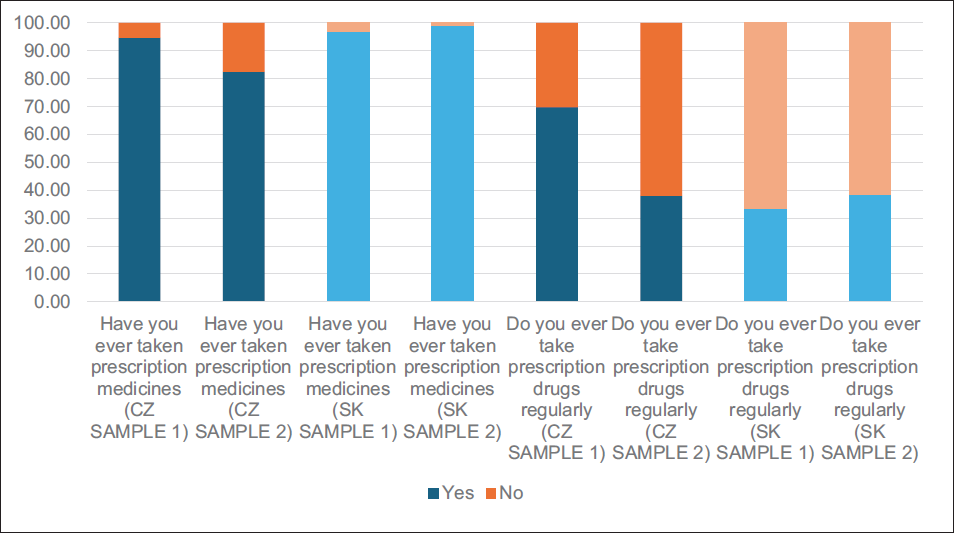
In our survey, we were interested in how often respondents buy over-the-counter medicines. In this case, we found that the behaviour of respondents from individual samples is similar, and respondents buy over-the-counter medicines only occasionally (up to 70% from SAMPLE 1 and 64% from SAMPLE 2). In Figure 1, we show the share of answers in SAMPLE 1 and in SAMPLE 2 to: question 5 (Have you ever taken prescription medicines?), question 6 (Do you take prescription medicines regularly?) and question 7 (Has it happened to you that side effects discouraged you from taking your own medicines?). In these questions, we tried to discover how many respondents have real experience with the use of prescription medicines. As can be seen in Figure 1, almost all respondents have at some time taken prescription medicines. However, regular prescription medicines have only been taken by approximately one-third of respondents. Question 7 offered us the opportunity to discover the respondents’ discipline in the use of medicines because a large volume of unused medicines consists of medicines not used completely. We identified the area of discipline as an area where behavioural intervention could be applied.
Proportion of Respondents’ Answers to Questions 5, 6 and 7.
We were also interested in the source of information where the respondents obtained information about the possibility of returning medicines to a pharmacy. Respondents in SAMPLE 1 prioritised ‘pharmacist’ (24.1%; in SAMPLE 2, 18.7%), ‘package insert’ (23.8%; in SAMPLE 2, 24.4%) and ‘people in my area do it’ (23.8%; in SAMPLE 2, 23.2%). In SAMPLE 2, after the intervention, respondents prefer the answer ‘internet’ (28%; in SAMPLE 1, only 11.9%). This fact may also be influenced by the fact that we addressed the respondents in SAMPLE 2 through ŠUKL and their profile on the social network, through which ŠUKL spreads awareness among the population about the problem of unused medicines and medicines after the expiration date.
Furthermore, we investigated the frequency of handing in unused medicines and medicines after the expiration date to a pharmacy. In SAMPLE 1, before the intervention, 170 respondents out of 303 answered the question, of which 80 respondents handed in medicines less frequently than once a year, 79 respondents gave one to two times a year and 11 respondents answered more than one to two times a year. In SAMPLE 2, after the intervention, it was 258 respondents out of 353 respondents. The largest part consists of 135 respondents who hand in medicines one to two times a year, whereas 86 answered rarely more than once a year. One of the factors that influences the consumer to do something repeatedly and correctly is also a pleasant and positive experience. This knowledge is based on the concept of MINDSPACE emotions (affects). Therefore, we tried to discover what the respondents experience with returning medicines to a pharmacy. A positive experience with the return of medicines to a pharmacy was reported by 33.3% of respondents in SAMPLE 1 and by 47.3% of respondents in SAMPLE 2. Only 1.0% of respondents in SAMPLE 1 reported a negative experience.
What Does Not Belong to a Medicine Collection Container?
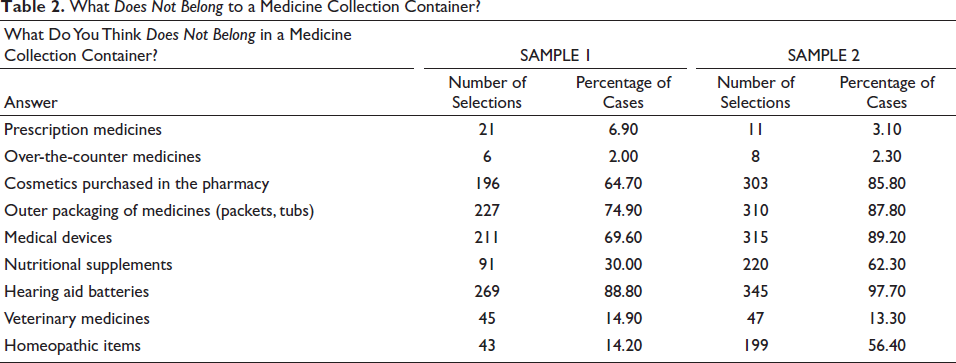
Table 3 describes the reasons for returning the medicines to a pharmacy. In SAMPLE 1, the most common answer is ‘Medicines after expiration are no longer effective and therefore there is no point in storing them’ (68.8%); in SAMPLE 2, the most common answer is ‘I want to protect the environment’ (79.1%).
Reasons for Returning Medicines to a Pharmacy.
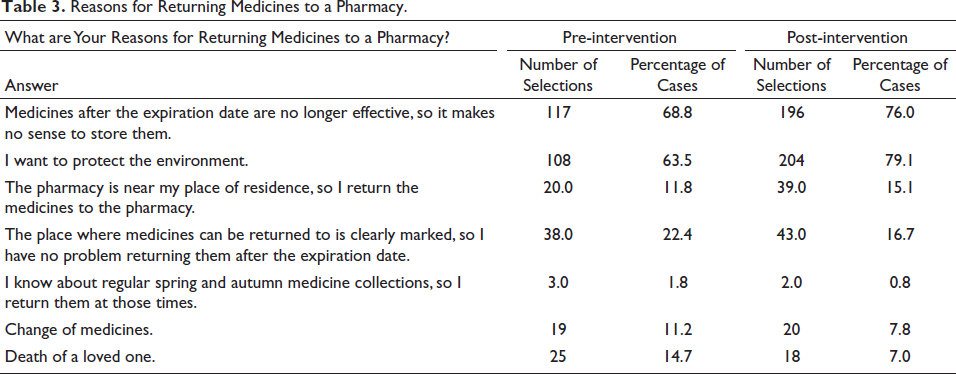
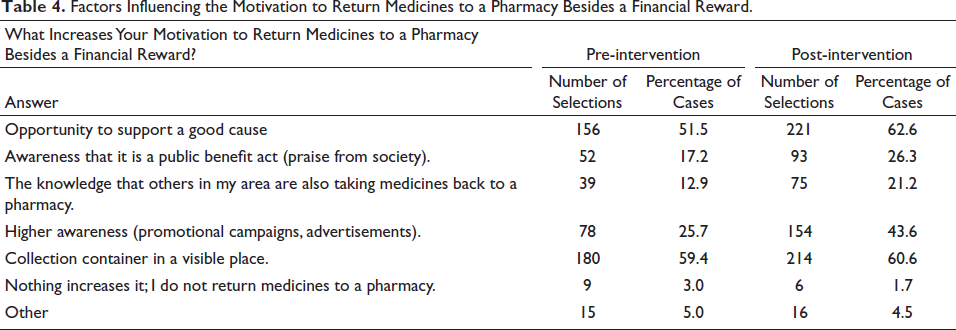
Table 4 describes the factors influencing the motivation to return medicines to a pharmacy in addition to a financial reward. In the first group, the most frequent choice is the answer ‘Collection container in a visible place’ (59.4%); in the second group, the most common choice is the answer ‘Opportunity to support a good cause (act of charity—I will support a charity project by returning medicines)’ (62.6%).
Factors Influencing the Motivation to Return Medicines to a Pharmacy Besides a Financial Reward.
The interdependence between the individual questions and answers for SAMPLE 1 and SAMPLE 2 was determined using the Spearman correlation coefficient. The interdependence between individual characters, or the rate/degree of how the characters are related to each other, was determined as follows: values of the correlation coefficient (rs) in the interval from 0 to | 0.3 | we evaluate as a weak direct, or indirect dependence, values in the interval from | 0.3 | to | 0.6 | we evaluate as a medium direct, or indirect dependence and values in the interval from | 0.6 | to | 1 | as a strong direct, or indirect dependence.
From the comparison of the interdependence between the individual questions using the Spearman correlation coefficient, we found the relationships of moderately strong dependence between Q12 and Q18 (sufficient information and returning unused medicines and medicines after the expiration date to a pharmacy). It is apparent that the more information people have about the management of unused medicines, the more they actually return unused medicines and medicines to a pharmacy after their expiration. Similarly, we found a weak relationship between Q12 and Q14, which means that people who have enough information hand in unused medicines and medicines to the pharmacy after the expiration date.
In the first and second samples, we found a moderate relationship between Q10 (Check the expiration date in the first aid cabinet at home) and Q18 (Do you hand in unused medicines to a pharmacy). This relationship is interesting for us in terms of the direction of possible further intervention, or more precisely, the focus of the area in which we should raise awareness. This relationship suggests that respondents who check the expiration date are more likely to hand in medicines to a pharmacy. We could achieve increased awareness in respondents to check their home first aid cabinet at home by highlighting the expiration date of medicines on the outer packaging of the medicine, for example, red numbers. In Table 5, we test our hypotheses for the questions ‘Do you think you have enough information on how to properly dispose of unused medicines and medicines after the expiration date?’, ‘Do you know about the possibility of returning unused medicines and medicines after the expiration date to a pharmacy?’, and ‘Do you return unused medicines and medicines after the expiration date to a pharmacy?’.
Determining the Level of Awareness of Respondents.
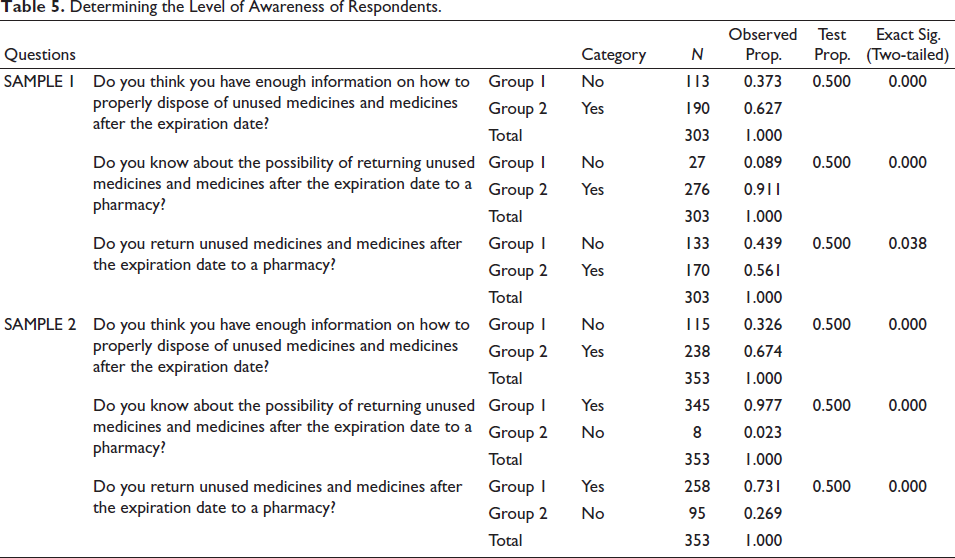
We assume that more than 50% of respondents have enough information on how to properly dispose of medicines. We tested the hypothesis with a binomial test. The hypothesis was confirmed; more than 50% of respondents have enough information on how to properly dispose of medicines (p value is .000).
We assume that more than 50% of respondents know about the possibility of returning unused medicines to a pharmacy. We assume that more than 50% of respondents hand in unused medicines and medicines after the expiration date to a pharmacy. In both cases, the hypothesis was confirmed because the p value is less than .05. At the same time, it is possible to assume that after the publication of the information leaflets, the respondents’ awareness of the possibility of returning unused medicines to a pharmacy increased from 91% to 98%.
Using the Mann–Whitney test, we discover whether a respondent who saw the information leaflets was influenced by its wording in Q12 (Do you think you have enough information on how to properly dispose of unused medicines and medicines after the expiration date?), Q13 (What do you think does NOT belong in the collection container for medicines?), Q14 (Do you know about the possibility of returning unused medicines and medicines after the expiration date to a pharmacy?), Q18 (Do you hand over unused medicines and medicines after the expiration date to a pharmacy?) and Q20 (What are your reasons for returning medicines to a pharmacy?) (Table 6).
Mann–Whitney U test with Q12, Q14 and Q18.

We do not reject the assumption that respondents who saw the information leaflets and those who did not have the same information on how to dispose of medicines. The fact whether the respondent saw, or did not, is not an important factor in assessing the adequacy of information on the disposal of medicines (Q12). In other cases (Q14 and Q18), however, we confirmed the hypothesis that seeing the information leaflets is an important factor in the possibility of returning unused medicines and medicines after the expiration date to a pharmacy, and handing over unused medicines and medicines after the expiration date to a pharmacy (p value is less than .05). We presented information on the correct handling of medicines after the expiration date and unused medicines in three simple steps in the information leaflets (see Appendix 1) (Table 7).
Mann–Whitney U Test with Q13.

The information leaflets influenced the accuracy of the determination (see Table 8), namely what does not belong in a collection container for medicines, and the respondents correctly marked the answers: ‘cosmetics bought in a pharmacy, outer packaging of medicines (packets, tubs), medical devices, nutritional supplements, hearing aid batteries, homeopathy’. The number of incorrect answers for the option ‘prescription drugs’ also decreased; this option was selected 21 times by the respondents in SAMPLE 1 before the intervention. For SAMPLE 2, the number of samples dropped to 11, which we consider to be a statistically significant change based on the Mann–Whitney U test. In the information leaflet, we have clearly summarised and illustrated what belongs and what does not belong in the collection container (see Appendix 1).
Mann–Whitney U Test with Q20.

The information leaflets influenced the respondents in the choice of Q20 (What are your reasons for returning medicines to a pharmacy?) in selecting the options in the answers. We see a statistically significant change in the answers: ‘Medicines after the expiration date are no longer effective, so it makes no sense to store them’, ‘I want to protect the environment’, and ‘The pharmacy is near my place of residence, so I return the medicines to the pharmacy’. In our information leaflets, we drew the respondent’s attention to the protection of our planet with an image located at the bottom of the leaflet (see Appendix 1).
Conclusion
The following conclusions emerge from the investigation: Empirical analysis has shown that the unwanted behaviour of users with unused medication can be influenced by nudge tools. Additional information has been found to have a positive effect on users’ behaviour when dealing with unused medication. The nudge concept can therefore be used as a suitable public policy tool for shaping the desired behaviour of users of unused medication. We conclude that the respondents who check the expiration date are more likely to hand in medicines to the pharmacy. The more information people have about the handling of unused and expired medicine, the more they actually return to a pharmacy. Similarly, people who have enough information hand in unused and expired medicine to the pharmacy. The respondents are becoming more aware of the correct return of medicines to the pharmacy as their age increases. The information leaflets influenced the accuracy of the determination, namely what does not belong in a medicine collection container. In the experimental group, we recorded a higher proportion of correct answers that identify a change in behaviour. The publication of the information leaflet raised awareness of the possibility of returning unused and expired medicines by 10%. The hypothesis that more than 50% of respondents have enough information on how to properly dispose of medicines (p value is .000) was also confirmed. This implies that even such a simple form of nudge as additional information influences respondents’ decisions in the disposal of unused and expired medicine. In the experimental group, we recorded a higher proportion of correct answers that identify a change in respondents’ behaviour. For example, to the question ‘What does not belong in the medicine collection container?’, we observed an increase in the number of correct answers and a decrease in incorrect answers in all experimental groups compared to the control group. The publication of the leaflet has raised awareness of the possibility of returning unused and expired medicines by 10%. It cannot be strictly stated that this change was made due to the provision of additional information, but it is evident that this increase in awareness was affected by the information leaflets. At the same time, it cannot be ruled out that the increase was also influenced by some coincidence. In the field of practical recommendations, we recommend health policy managers create a managerial mix in health policy. In addition to regulatory tools, we recommend using various forms of nudging to create desirable behaviour patterns. We have also identified that environmental protection is a great motivation for users to return unused and expired medicine back to the pharmacy. This finding can be used to innovate and coordinate health and environmental policy. In further research, we recommend focusing on investigating the appropriateness and effectiveness of different forms of nudging for different target groups of the population.
Footnotes
Declaration of Conflicting Interests
The authors declared no potential conflicts of interest with respect to the research, authorship and/or publication of this article.
Funding
The authors disclosed receipt of the following financial support for the research, authorship, and/or publication of this article: The study was supported by project VEGA 1/0003/24 Inter-municipal cooperation in providing local public services, by the long-term institutional scientific research funding scheme in the Faculty of Finance and Accounting, Prague University of Economics and Business (IP 100040), by the Specific Higher Education Research (SVV 260 596) and the Grant Agency of Charles University (project no. 70222).