




Abstract
Passion at work (PAW), organisational support (OS), happiness and trust have been studied in many contexts of organisational activities and consequences at work. The uniqueness of the current study lies in the fact that it focused on a unique research population (physicians) and, to the best of our knowledge, it is the first study to examine these four variables in one model. The present study explored the relationships among levels of trust, OS, happiness and PAW (harmonious and obsessive). A convenience sample of 170 physicians from throughout Israel answered questionnaires dealing with attitudes towards PAW, trust in managers, level of happiness and perception of OS. The research findings show that the higher the level of trust, OS and happiness, the higher the level of harmonious PAW. The level of harmonious PAW was higher compared with obsessive PAW. In addition, in accord with the hypothesis, happiness made the greatest contribution to predicting PAW. Hence, the research findings validated the dual model of passion. One main conclusion of this study is that work occupies a significant place in most individuals’ lives; therefore, promoting their well-being, showing concern for their happiness, and providing opportunities to realise happiness within the walls of the organisation are essential elements for promoting both feelings of involvement and PAW. Therefore, to the extent that managers of an organisation can promote a culture of OS, which could include the adoption of a policy of home–work balance, the more they can contribute to the feeling of harmonious PAW among physicians.
Introduction
Passion at work (PAW), organisational support (OS), happiness and trust have been studied in many contexts of organisational activities and consequences at work. The term passion refers to both private and professional life and is defined as a strong tendency towards an activity that people like and consider important to them; therefore, they are willing to invest significant time and energy in it (Houlfort et al., 2015). The research literature refers to two main types of passion, known as the dual model of passion: harmonious and obsessive passion. Harmonious passion refers to a voluntary or autonomous internalisation of an activity in which an individual is involved. This passionate activity occupies a significant place in their being, but does not take over their identity. On the other hand, with obsessive passion, individuals feel a strong need to engage in an activity that they love to the point that it takes over their identity; therefore, in this sense, they are obsessed with it to the point that they give up engaging in other activities (Gillet et al., 2023). Over time, the dual model has been applied to the world of work, which is an important component of everyday life (Vallerand, 2015). Because there is a flow of experiences from the workplace to private life and vice versa (Martinez-Corts et al., 2015), it is likely that an obsessive passion will damage the individual’s level of happiness.
In recent years, happiness has become a central issue in various fields and can be classified into two main categories: the first is happiness in personal life, which is divided into two types: momentary and continual happiness.
Momentary happiness is expressed in a temporary feeling of joy and is often based on satisfying personal needs and achieving goals (Aslman & Becher, 2014). Therefore, joy is momentary and happiness is continuous (Shamir-Balderman et al., 2024). On the other hand, continual happiness is long-lasting. It is a constant human feeling, mainly based on having good social relationships, optimism, positive self-esteem and meaning in life (Aslman & Becher, 2014).
The second category involves the person’s professional life and is called happiness at work, which refers to an employee’s experiences at their place of work. Fisher (2010) stated that happiness at work is characterised by work involvement, satisfaction and organisational commitment. Today, happiness has been ranked in several empirical studies as the most important issue in both personal life (Aslman & Becher, 2014) and professional life (Fisher, 2010).
Recognising the importance of experiencing a balance between activities related to private life and work (Clark, 2000), the current study focused on the concept of PAW. Today’s understanding is that to optimise the organisation’s performance and retain employees in the organisational system, one challenge facing the management of the organisation is to cultivate positive feelings among employees. This may be achieved through feelings of balance and satisfaction at work (happiness at work) while recognising other activities (such as leisure activities, family and friends) that affect their functioning, development and well-being. This can be achieved through a policy of OS (MacEwen & Barling, 1988).
OS is defined as the extent to which employees feel that the organisation cares about their well-being and values their contributions. In the research literature, evidence suggests that OS may reduces the number of absences and conflicts in the organisation (Aga et al., 2016). More importantly, it can significantly increase the level of organisational productivity, organisational engagement (Eisenberger et al., 1986) and trust in the organisation (from both employees and managers).
Trust is a necessary basis in relationships between people and is defined as a tendency to trust others and expect that others will behave in a way that does not cause harm (Gambetta, 2000). Trust is of crucial importance in various relationships and at work because it affects the involvement of employees and their relationships with each other and their managers (Spector & Jones, 2004).
Although studies have examined PAW, happiness, OS and trust, to the best of our knowledge, no studies have examined these four variables in one model. Also, these variables have not been studied in the context of medical organisations, which are characterised by a turbulent organisational environment (Shamir-Balderman, 2021). Hence, the current study tested the relationship between PAW and happiness, OS and trust among physicians in public service and the community. The results of the study may help explain factors that can promote PAW and encourage policies that increase the level of trust among physicians in their organisation, their happiness and their feeling of support from the organisation, thus keeping them in the medical system in Israel.
Theoretical Background
PAW
The term passion has attracted much attention from philosophers, especially from an emotional point of view. Two emotional perspectives, one negative and one positive, have been used to explain passion. The negative perspective assumes that passion involves a loss of rationality and control, and thus, people with passion are seen as experiencing a kind of suffering and enslavement because it controls them. The second perspective presents passion in a more positive light, characterised by strong emotions with behavioural tendencies based on reason and an element of choice. The underlying assumption is that high levels of passion are necessary to achieve high levels of achievement. Together, these two positions emphasise the duality of desire, with the potential for both good and bad outcomes (Vallerand et al., 2014).
Later definitions of passion described a strong tendency to engage in an activity that is considered necessary (Toth et al., 2021); and a strong desire to invest time and energy in the activity. If an activity is highly valued by a person, it becomes a central aspect of their identity and can become a passion (Pollack et al., 2020). We can distinguish between two types of passion: harmonious and obsessive passion. Harmonious passion refers to an autonomous internalisation that allows an individual to choose to perform an activity that they like, and despite it being very important, this activity is not unambiguous and leaves room for the person to pursue other interests in life. These people feel obliged to perform the activities they like, yet they feel empowered to choose to do them freely. In contrast, obsessive passion contains an element of control, with the individual potentially feeling frustrated if they do not engage in the activity. In other words, obsessive passion can have negative effects that often manifest in taking over activities in other areas of life (Bañuelos et al., 2016).
Passion generally has been conceptualised as a strong tendency to engage in an activity that produces pleasure and has important meaning in life. Therefore, people are willing to invest time and energy in such an activity on a regular and continuous basis. Thus, it is possible that work can generate passion, given that it is not only a distinctly productive activity and the main organising domain of daily life, but also a central domain in achieving goals and developing personality. In this sense, PAW is defined as a state of persistent passion based on cognitive and affective evaluations of work (Salessi et al., 2017). PAW is seen as an essential part of this work because work is an essential part of an individual’s identity and self-concept; it is subject to change and implies the quality of the relationship a person has with work (Vallerand, 2015). In addition, enjoyment is a central aspect of PAW, and passionate people experience a great need to engage in activities that they find meaningful and valuable, and that can be experienced through positive emotional experiences (Salessi et al., 2017).
Contemporary perspectives on passion—in both the academic literature and the popular press—support the assumption that PAW is generally desirable due to a multitude of positive outcomes, including perceived meaning, persistence, overall success, enthusiasm, financial gain and happiness (Fisher, 2010). When passion is lacking, people often feel prompted to rediscover their PAW and life. Given the relative agreement regarding the positive aspects of passion, it is not surprising that passion research has advanced rapidly in recent years, focusing on its role in work (Pollack et al., 2020). Although there are several streams of passion research based on different theoretical perspectives, they share one basic aspect: strong positive emotions are included as defining characteristics of PAW. Specifically, they all implicitly rely on the hedonic approach to well-being and argue that passionate people derive meaning from work, investment to continue to experience positive affect and well-being from their work (Pollack et al., 2020), which in turn may increase the level of happiness.
Happiness
Happiness is a multidimensional term that has received significant and widespread attention in research and theory over the years, and accordingly, has different definitions that emphasise different points of view (Shamir-Balderman et al., 2024). The existing definitions of happiness describe cognitive aspects alongside emotional aspects that define it as an expression of an individual’s subjective experiences and a general structure that reflects a person’s general assessment of life (Satuf et al., 2018; Semedo et al., 2019).
Happiness is a desirable and top priority for many people, creating a yearning for happiness throughout their lives and prompting them to engage in various actions designed to promote their personal happiness. An individual’s happiness may contribute significantly to interpersonal relationships with others, because it can promote their level of stability (Haar et al., 2019). In addition, an individual’s happiness may predict their success in various aspects of life, such as studies, work, social behaviour, contributions to society, mental and physical health and life expectancy (Diener & Tay, 2017; Salas-Vallina & Alegre, 2021).
Happiness at Work
In recent years, research on happiness has continued to develop in employment contexts, including its consequences for the performance and productivity of an organisation—that is, happiness at work (Fisher, 2014). This term refers to positive feelings in relation to the job and workplace, job definition and the organisation; positive judgment; positive experiences and feelings and good mood at work (Fitriana et al., 2022).
Another definition of happiness at work is positive emotional well-being, or a sense of competence, ambition, autonomy and satisfaction. In accordance with the overall definition of happiness, some researchers have described happiness at work as consisting of an abundance of positive emotions in the workplace and fewer related negative emotions (Semedo et al., 2019). Likewise, happiness at work may be expressed in the employee’s experience of work as meaningful and enjoyable, and the perception of their job being more than ‘just work’ (Salas-Vallina & Alegre, 2021).
Various factors are related to the development of happiness at work. Veenhoven (2015a, 2015b) found that two factors influenced the development of happiness among employees. First, she stated that organisational autonomy and work role are significant factors that predict the happiness of employees. In addition, the size of the organisation was also found to predict employee happiness. In other words, wide-ranging factors may influence the development of happiness at work. Fisher (2010) showed that factors related to the development of happiness at work can be divided into personal (internal) factors and environmental factors. Internal factors relate to a sense of job satisfaction, optimism and positivity, high self-image, high self-efficacy perceptions, emotional stability and internal focus of control. Environmental factors can be divided into factors at the job and organisational levels. At the job level, these factors include the degree of pride in the organisation, empowerment, being challenged at work, feedback and relationships between members of the organisation. At the organisational level, feelings of respect, fairness and equality are related to the feeling of trust in the workplace (Malla & Malla, 2023).
Trust
The concept of trust is difficult to define because it is complex and belongs to different fields. In a review of definitions, Tschannen-Moran and Hoy (2000) indicated seven central dimensions included in this concept. The first dimension refers to the willingness to risk vulnerability—that is, the trustor is aware of, and ready to accept, this risk. The second dimension refers to the fact that the trustor trusts the trust receiver to a certain extent, and that they will meet expectations. In the third dimension, the trustor believes that the trust receiver will not harm their well-being or the things that are important to them. The fourth dimension refers to reliability, according to which the goodwill of another can be predicted, and they will act consistently in different situations. The fifth dimension focuses on the performers of a task who are trusted, and who will indeed perform the task professionally. The sixth dimension refers to honesty, which is expressed in matching statements with actions and related responsibilities. The seventh dimension is the openness of the giver of trust towards the receiver of trust. This openness rests on the reality of all previous dimensions in the relationship between the giver and the recipient (Bogeyski, 2011; Masry-Kharzallah & Arar, 2022; Tschannen-Moran & Hoy, 2000). As for its effects on various indicators in society, trust has become part of the public debate in the global era that requires changes and new social arrangements and interdependence. To allow people to deal with situations of uncertainty, lack of security and various risks, which characterise contemporary society and employees in the labour market, the need arises to develop and nurture trusting relationships (Egozi, 2019). For example, in situations of reform and organisational change, the trust among the members of the organisation allows them to promote a set of values, beliefs and behaviours, which reduce their sense of vulnerability (Bogeyski, 2011). In this way, trust, which consists of the previously mentioned dimensions—such as trust in the goodwill, generosity, ability, integrity and openness of the other party—affects the cooperation between parties. For example, trust in the abilities of partners and their care and goodwill can encourage cooperation with them through reducing internal competition and raising their sense of self-worth, making it of enormous significance regarding interpersonal trust in work teams (Egozi, 2019).
Trust among work teams, such as health workers, affects various factors in the organisation’s environment. A functioning and productive health organisation is based on, among other things, the existence of relationships among employees based on trust between employees and the organisation. Moreover, the environment in health organisations is sometimes characterised by an environment with few resources. To function such that the distribution of resources in the organisation is cooperative, it is important to cultivate partnerships between the organisation’s members. By cultivating a trusting environment in health organisations, such that it creates a successful partnership, it is possible to deal with the limitations of human and material resources in the health organisation. To create and foster a work environment that allows partnerships between all its members, OS is needed to establish a sense of trust between members, the existence of common goals, respect and mutual responsibility (Dursun, 2015).
OS
OS is an essential and significant element that affects the behaviour of employees and can create a pleasant work environment (Galván Vela et al., 2022). Management deals with the operation of the organisation’s resources and investment in the realisation of its goals (Studney & Opaltka, 2022). The research literature on OS posits that the quality of the manager–employee relationship is a key element that affects employee behaviour in the workplace. This is because OS is not only a professional assessment of the manager, but also a recognition of the organisation’s structure and workplace relationships. If so, the quality of the relationship between the manager and the employee directly affects the employee’s behaviour at work (Hassan & Hatmaker, 2015). Therefore, there is an understanding among managers that they are required to develop and adapt different relationships and management styles with different employees. For example, some managers develop relationships of trust and respect with some employees, and formal and defined relationships with other employees (Hassan & Hatmaker, 2015). Hence, quality relationships between employees and managers may lead to strong support, open communication and autonomy from the manager; in return, such employees may offer a high level of commitment towards their work and the performance of their tasks (Hassan & Hatmaker, 2015). However, an employee’s negative perception of their manager may lead to feelings of anger, frustration, suspicion and other negative emotions (Reig & Marcoline, 2008). That is, it is likely that a lack of support from and a shaky relationship with a manager may lead to a loss of trust, a reluctance to share information, and even a decrease in the level of PAW to the point of leaving the workplace.
In conclusion, so far, studies have been concerned with explaining the quality of the relationship between PAW and various organisational aspects such as happiness and trust (Shamir-Balderman, 2018). Other studies have examined the relationship between trust and OS (Utomo et al., 2023). However, the uniqueness of the present study lies in the fact that it both focuses on a unique research population (physicians) and, to the best of our knowledge, it is the first study to examine these four variables in one coherent model (see Figure 1). The present study examined the relationships among the levels of trust, OS and happiness with PAW (harmonious and obsessive). The current study findings may help hospital managers and policymakers understand factors that can increase the level of harmonious passion and decrease the level of obsessive passion among physicians.
The Research Model.
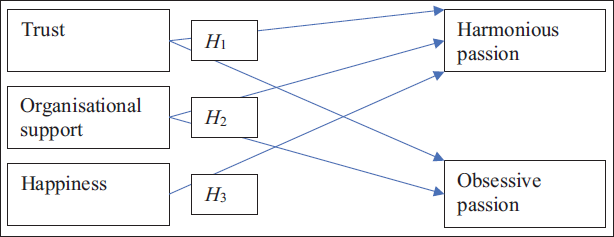
Considering the research question, we derived the following hypotheses:
A positive relationship exists between the level of trust and PAW, such that the higher the level of trust, the higher the level of PAW. At the same time, the level of harmonious PAW will be higher than that of obsessive PAW. A positive relationship exists between OS and PAW, such that the more OS is perceived, the higher the level of PAW. At the same time, the level of harmonious PAW will be higher than that of obsessive PAW. A positive relationship will be found between happiness and PAW. A relationship will be found between the level of harmonious PAW and happiness because when the employee is happy at work, both PAW and involvement in work will be harmonious and balanced with their professional, personal and social life. However, no relationship will be found between happiness and obsessive PAW. Significant unique contributions will be found from happiness, trust and OS to PAW, but happiness will have the greatest unique contribution.
Method
Sample
A convenience sample included 170 physicians from throughout Israel. The age of the respondents ranged from 20 to 77 (M = 42.67, SD = 11.55). In this sample, 131 (77%) respondents were female and 153 (89%) were married or living with a partner. The occupational characteristics of the participants show that about half of them worked in public hospitals (45%), about a fifth (19%) worked in health insurance funds, and 11% worked in private hospitals or clinics. The average seniority of the respondents in their position was 15.72 years (SD = 11.88).
Measurement
The level of trust between respondents was assessed using an interpersonal questionnaire regarding trust at work (Cook et al., 2009) that had been translated into Hebrew by Heller (2016). The questionnaire includes five items, and physicians expressed their agreement on a seven-point Likert scale ranging from 1 (do not agree at all) to 7 (completely agree). A sample item is: ‘Your direct manager trusts your professional abilities’. The internal consistency obtained for this measure was α = 0.84.
Most studies use the abbreviated version of a questionnaire for examining OS, developed by Eisenberger et al. (1986). The scale includes six items. Physicians were asked to rate their answers on a seven-point Likert scale from 1 (do not agree at all) to 7 (completely agree). A sample item is: ‘The organisation cares about my opinions’. This study derived a reliability coefficient of α = 0.92.
To examine the level of happiness, we used the Oxford Happiness Questionnaire developed by Hills and Argyle (2002). The questionnaire includes eight items (for example: ‘I find beauty in some things’). It was translated into Hebrew, then two other assessors translated it back into English (Shamir-Balderman, 2018). Physicians were asked to rate their answers on a seven-point Likert scale from 1 (do not agree at all) to 7 (completely agree). A high score indicates a high level of happiness. In the present study, Cronbach’s alpha was 0.77.
The measurement of PAW was based on the Vallerand and Houlfort scale, with a reliability coefficient of 0.70–0.85. The scale consists of two subscales with seven items each: harmonious passion (e.g., ‘My work allows me to live a variety of experiences’) and obsessive passion (e.g., ‘I am emotionally dependent on my work’). Physicians rated their answers on a Likert scale ranging from 1 (do not agree at all) to 7 (completely agree). The reliability was α = 0.74 for the harmonious desire subscale and α = 0.87 for the obsessive desire variable. We also assessed personal details, such as gender, age, marital status, seniority and education.
Research Process
Data collection was conducted using non-probability snowball convenience sampling of physicians who answered an online self-report questionnaire. First, the researchers turned to colleagues and acquaintances from their immediate social environment with a request to pass the questionnaire among their friends who worked as physicians at hospitals. The questionnaire was distributed through two methods: in the first, messages were sent via WhatsApp to friends and colleagues of the researchers, inviting them to fill out the questionnaire and requesting that they send it to additional people working in the medical profession. The researchers’ Facebook was also used to distribute the research invitation and questionnaire. In both WhatsApp groups and Facebook posts, the researchers provided an explanation of the study and a guarantee of confidentiality, according to the rules of ethical research. Also, at the beginning of the online questionnaire, participants had to acknowledge a mandatory item: ‘I express my informed consent to participate in the research and I am aware of my right to leave at any time without explaining’. The study received the approval of the affiliated ethics committee (2021–2020).
Findings
First, descriptive findings are presented, providing the positions of the physicians in relation to the research variables. Table 1 shows that the physicians reported a medium-high level of harmonious PAW (M = 5.12, SD = 0.92) and a low level of obsessive PAW (M = 3.70, SD = 1.35), with a relatively high standard deviation, which shows great variability among these physicians. In addition, physicians reported moderate levels of trust (M = 4.91, SD = 1.31) and happiness (M = 4.92, SD = 0.97). Finally, the physicians reported a medium level of OS (M = 4.23, SD = 1.17).
Descriptive Statistics and Correlations Between Research Variables (N = 170).
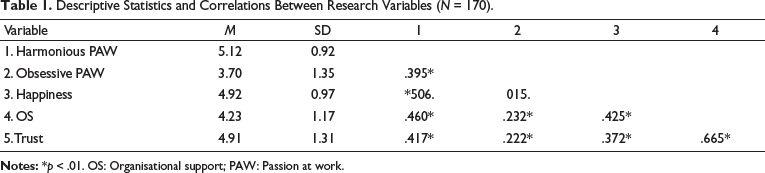
To test the existence of statistically significant relationships, Pearson correlations were calculated between trust, happiness, OS and the two types of PAW (Table 1). In accordance with the hypothesis, there was a positive relationship between happiness and harmonious PAW (r = 0.506, p < .001) and no relationship between happiness and obsessive PAW (p > .05). Positive relationships were found between OS and harmonious PAW (r = 0.460, p < .001) and between OS and obsessive PAW (r = 0.232, p < .001). Finally, positive relationships were found between trust and harmonious PAW (r = 0.417, p < .001) and between trust and obsessive PAW (r = 0.222, p < .001). In light of this, the research hypotheses were confirmed.
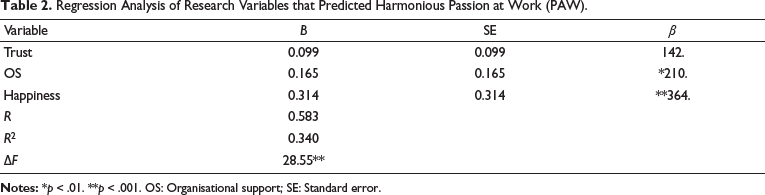
The regression findings regarding harmonious PAW, which are shown in Table 2, suggest that a significant regression was obtained, F(3, 169) = 28.55, p < .001, with a multiple correlation of 0.58 and an explained variance of 0.34. The standardised regression values indicate that the contribution of happiness and OS to predicting harmonious passion was significant, and the level of happiness had a stronger effect (0.364) than OS (0.210) in predicting harmonious PAW. Finally, the trust variable had no effect on the level of harmonious passion. Hence, the hypothesis was confirmed.
Regression Analysis of Research Variables that Predicted Harmonious Passion at Work (PAW).
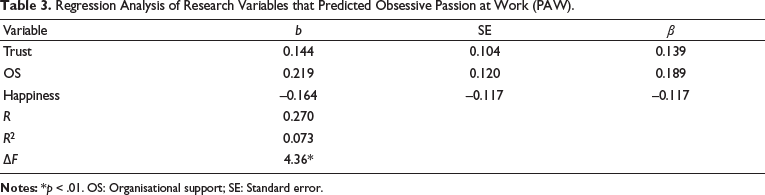
The regression findings regarding obsessive PAW, which are presented in Table 3, show that a significant regression was obtained, F(3, 169) = 4.36, p < .001, with a multiple correlation of 0.27 and an explained variance of 0.07. The standardised regression values indicate that none of the research variables made a unique contribution to the prediction of obsessive PAW.
Regression Analysis of Research Variables that Predicted Obsessive Passion at Work (PAW).
Discussion
Although previous studies examined PAW, trust, happiness and OS, little was known about how these variables might combine in one model, particularly in the physician population. Therefore, the present study examined the relationships of trust, happiness and OS with PAW among public service physicians.
The first research hypothesis posited a positive relationship between trust and PAW, such that as the level of trust increased, so would the level of PAW. At the same time, we assumed that the level of harmonious PAW would be higher than that of obsessive PAW. This finding is consistent with the findings of a previous study, in which a correlation was found between harmonious and obsessive PAW among employees and their trust in their managers (Ho et al., 2021). Hence, harmonious PAW was related to positive results in the organisation, such as the experience of personal support and a sense of satisfaction among employees. On the other hand, obsessive PAW can lead to negative feelings that are expressed in a strong need to engage in professional activity only, which takes over both the employee’s life at work and in their personal sphere. That is, trust was positively related to both types of PAW (Ho et al., 2021; Shamir-Balderman, 2018), such that trust in managers explained both obsessive and harmonious PAW.
The second hypothesis posited that a positive relationship would be found between OS and PAW, such that the more positive OS is perceived, the higher the level of PAW. At the same time, we assumed that the level of harmonious PAW would be higher than that of obsessive PAW. The analysis of the data confirmed the hypothesis and is consistent with previous studies that showed that OS for employees promotes their well-being in the organisation, alongside the understanding that space must also be given to various aspects of their personal lives (Mann et al., 2020; Reig & Marcoline, 2008). Moen et al. (2016) showed that intervention programmes that focused on cultivation of employees led to reduced burnout and stress at work, and as a result, employees perceived their involvement at work in an important and meaningful way, such that it did not take over their whole being (they did not experience passion). Hence, for them, the activity was part of an integrated self-structure that is under their control and in harmony with other important life aspects, which contributed to feelings of harmonious PAW (Verner-Filion et al., 2014).
The third hypothesis suggested a positive relationship between happiness and PAW—that is, that a relationship would be found between the level of harmonious PAW and happiness; because when the employee is happy at work, both PAW and involvement in work will be harmonious and balanced with professional, personal and social life. However, no relationship would be found between trust and obsessive PAW. This hypothesis was also confirmed and is in line with previous studies (Ali et al., 2020; Studney & Opaltka, 2022). From these studies, it appears that employees who have close and personal relationships with their managers experience happiness expressed in general satisfaction with life and their workplace, which causes satisfaction, commitment to work and pleasure in performing their duties. Moreover, when managers provide their employees with a pleasant work environment, the level of efficiency and happiness of the employees increases. Hence, a good relationship and good communication between employees and their managers are related to the level of happiness and general well-being, prompting employees to be more satisfied and efficient in their work. Finally, we assumed that the variable with the highest unique contribution to predicting harmonious PAW would be the level of happiness. Indeed, from the regression findings, it appears that OS contributed to the prediction of harmonious PAW, but happiness had a stronger contribution. A possible explanation is based on the hedonistic approach, which posits that the basic instinct of every person is to increase their pleasure as well as to satisfy their own desires, which causes a sense of self-fulfilment and satisfaction on one hand and minimises feelings of suffering on the other. Because work is an important part of their lives, it can be assumed that employees seek happiness both in their personal lives (Pollack et al., 2020) and at their workplace (Fitriana et al., 2022). Hence, when employees feel that they are happy, their work is meaningful, and they can balance the different areas of life, this may lead to a sense of autonomy and meaning at work (Salas-Vallina & Alegre, 2021)—that is, feelings of harmonious PAW.
These findings are supported by the regression model regarding obsessive PAW. The findings show that none of the research variables (trust, happiness and OS) predicted obsessive PAW. Because these physicians reported medium-high levels of job happiness, OS and trust in their managers, which are positive feelings, it is likely that they feel that they can choose to engage in their work and that their work does not take over other areas of their life (Bañuelos et al., 2016). If these variables were predictive of obsessive PAW, this would suggest that their level of trust in their managers is low, they have to prove themselves all the time, and therefore, their work ‘takes over’ all other areas of life. These feelings may harm their level of happiness.
Limitations and Recommendations for Further Research
First, the current study sampled physicians from various hospitals and inpatient departments, but no distinction was made between the various areas of expertise and the organisational characteristics of each department (for example, the size of the organisation, organisational culture or management style). Hence, researchers should conduct a similar study using a probabilistic stratified sampling method to ensure adequate representation of all hospital wards. Because each department has different characteristics, further research could examine whether and to what extent differences exist among physicians associated with various departments in the level of trust in the system and the OS, expressed in the support of their direct manager, and hence, their effect on the level of PAW. Second, the study was conducted at a certain point in time (cross-sectional), so no conclusions can be drawn regarding changes over time. Furthermore, the study relied on self-reported surveys, so it may have been influenced by social desirability bias. Hence, longitudinal studies and research using qualitative methods such as semi-structured interviews and focus groups could enhance these results obtained from self-report questionnaires, with the aim of better understanding the meaning of and how harmonious or obsessive passion develops in an organisation.
Practical Contributions and Recommendations
Despite these limitations, this research led to practical contributions and recommendations. The research findings contribute to the understanding of the relationship of trust, OS and happiness with harmonious PAW. Although the research is rich in studies that have tried to predict causes of PAW, it is often considered a general concept (Hubner et al., 2020). This study examined factors that explain harmonious and obsessive PAW, thereby validating the dual model of passion (Vallerand et al., 2014). Extensive research has dealt with PAW (Gómez-Salgado et al., 2019), trust (Cook et al., 2009) and OS (Galván Vela et al., 2022), but they did not combine all these variables in one study and did not deal with this unique research population. Beyond theoretical contributions, this study generated practical recommendations. In general, hospital managers should take actions that could increase the passion of employees in their workplace in four main ways. First, hospital management could often carry out activities that generate meaning and autonomy among physicians to develop and cultivate positive feelings. Second, it would be useful to verify their satisfaction from time to time through a survey shared among physicians or by acquiring periodic feedback that can indicate changes in their feelings. Third, because the research indicated that trust in managers is positively correlated with harmonious PAW, hospital managers should implement strategies that increase trust in the system through transparency in decision-making, consistent and clear communication, fair and respectful treatment of employees, recognition and reward for the contributions of physicians. Fourth, managers of an organisation should promote a culture of OS, which generally encourages the adoption of policies enhancing home–work balance, so they can contribute to the sense of harmonious passion among physicians. Finally, because physicians work in a demanding job, characterised by long shifts and a need for high availability (being on call), it is crucial to establish an organisational culture that encourages balance among the various activities in which physicians participate—that is, activities that are not necessarily related to their workplace. In this way, physicians might feel that their work is not taking over their life and identity (obsessive PAW), making room for autonomy and balance among diverse areas of life (harmonious PAW). In that vein, there is an understanding that happiness is an important element in everyday life, and individuals invest a lot of effort in achieving it (Diener & Tay, 2017). Moreover, because work occupies a significant place in an individual’s life, promoting their well-being, their happiness and opportunities for fulfilment within the walls of the organisation (in the form of a sense of belonging, meaning, enjoyment and satisfaction) are essential elements for promoting feelings of involvement, engagement and PAW.
Footnotes
Declaration of Conflicting Interests
The authors declared no potential conflicts of interest with respect to the research, authorship and/or publication of this article.
Ethical Approval and Informed Consent
The authors conscientiously respected all ethical considerations involved in the study. The research protocol was approved by the Ethics Committee Approval of the college (2023-95). An informed consent form was signed by each participant, guaranteeing their anonymity and the confidentiality of the data was maintained throughout the research.
Funding
The authors received no financial support for the research, authorship and/or publication of this article.