




Abstract
This study was conducted to determine the relationship between environmental health and health status. The data were obtained from the Environmental Performance Index and Global Health Observatory database. Air quality, sanitation/drinking water, heavy metals and waste management were used as environmental health data. Life expectancy at birth, healthy life expectancy and neonatal mortality rate were used as health status data. Canonical correlation analysis was performed with data from a total of 130 world countries. As a result, a statistically significant correlation was found between environmental health and health outcomes. 65.48% of the change in the health status was explained by environmental health. ‘Air quality’ and ‘sanitation/drinking water’ were the variables that affected health status the most. Life expectancy at birth was the variable most affected by environmental health. It can be said that increased investment in environmental quality has the potential to ultimately lead to better living conditions and improvements in health status. It is recommended that policymakers, business partners, city leaders and health managers collaborate to design environmental health policies that will protect environmental resources and ensure their sustainability.
Introduction
Environmental quality and many related factors have an impact on human health. Environmental health indicators have been defined as an expression of the link between the environment and health (Tisch et al., 2014). At both national and international levels, welfare, health, morbidity and mortality rates associated with environmental measures are used as ‘environmental health indicators’ (Gulis, 2000). Environmental indicators focus on two purposes. These are reducing environmental pressures on human health and protecting ecosystems and natural resources (Emerson et al., 2012; Shah & Longsheng, 2020). Reducing the environmental pressure on human health is possible with environmental health policies that address the impact of the environment on the quality of life (Gallego-Álvarez et al., 2014).
A healthy environment is vital for human health and development (World Health Organization, 2019a). Environmental health indicators significantly affect both life expectancy and a longer, high-quality life. Studies have shown that environmental quality is a very important factor affecting health status and well-being (Angelakis et al., 2021; Balakrishnan et al., 2019; Beyene & Kotosz, 2021; Hill et al., 2019; Nkalu & Edeme, 2019). According to these studies, environmental factors such as air and water pollution, the depletion of natural resources, and soil degradation have important effects on morbidity and mortality.
Studies in the literature have emphasised that globally, about a quarter of all diseases and deaths are caused by environmental problems (Prüss-Üstün et al., 2016; WHO, 2019b). WHO (2018a, 2019a, 2019b) reports indicate that air pollution results in 7 million deaths annually globally; more than 90% of the world’s population breathes polluted air; more than half of them live with polluted water, poor sanitation and hygiene conditions; and it is concluded that this causes more than 800,000 deaths each year. Again, according to the WHO (2017, 2018a), the lack of effective environmental management resulted in 400,000 deaths from malaria and 700,000 deaths from other vector-borne diseases annually. In addition, the 10 most common causes of death due to environmental problems are stated as ‘cancer, heart diseases, chronic respiratory diseases, neonatal conditions, diarrhoea, stroke, respiratory tract infection, malaria, accidental and non-accidental injuries’ (Beyene & Kotosz, 2021). It has been observed that health plans and policies are formed on the basis of the link between environmental quality and health status, in parallel with all these environmental risks to health and their consequences. Many local and international organisations such as the World Bank, WHO and the United Nations (UN) have now recognised the importance of environmental conditions on human health (United Nations, 2015; World Bank, 2018; WHO, 2019a). The Global Sustainable Development Goals (SDGs) include reducing environmentally related deaths since 2015 (UN, 2015). On the other hand, policies regarding the necessity of taking environmentally friendly economies, such as renewable energy, soil, water and waste management, legal regulations, socio-economic, demographic and technological measures, in order to improve health status by reducing environmental pollution, constitute the agenda of many countries (Beyene & Kotosz, 2021).
In recent years, the overuse of resources and therefore the environmental burden has increased in many developed and developing countries with the effects of industrialisation, economic growth, population growth and urbanisation (Wu, 2017). The overuse of natural resources may limit the future availability of these resources and cause public health to be endangered (Halkos & Zisiadou, 2018). Thus, there is increasing global concern about the public health consequences attributed to environmental pollution (Musoke et al., 2016). The negative health consequences for societies can also have economic, social and political effects. Healthy individuals in societies contribute directly or indirectly to the economic growth and development of a country by providing a workforce to different sectors, increasing per capita income and reducing poverty and income inequality. Policymakers can also contribute to sustainable development by reducing the incidence of unnecessary deaths and preventable diseases caused by the environment (Beyene & Kotosz, 2021). This important sustainability problem requires that environmental measures be taken for the promotion and development of health. The aim of this study is to determine the relationship between environmental health indicators and the health status of societies, and which of these indicators have an effect on health status. It is thought that the results of the study are important in terms of determining environmental health policies that can improve the health status of society.
Materials and Methods
Aim
The aim of this study is to determine the relationship between environmental health and health status indicators with canonical correlation analysis and to determine the contribution of each variable to this relationship.
Variables
Variables in two different sets were used in the study. One of these variable sets is the indicators in the ‘environmental health’ dimension of the Environmental Performance Index (2020). These are ‘air quality’, ‘sanitation and drinking water’, ‘heavy metals’ and ‘waste management’. The air quality indicator measures the direct impact of air pollution on human health in each country. The sanitation and drinking water indicator measures how well countries protect human health from environmental risks through two indicators: unsafe drinking water and unsafe sanitation. The heavy metals indicator measures the direct impact of exposure to heavy metal pollution on human health in each country. The waste management indicator is related to solid wastes that threaten human health (
Data Collection and Analysis
In the study, environmental health and health status indicators data related to world countries were used. Data on environmental health indicators are taken from the Environmental Performance Index (2020) (
The skewness and kurtosis coefficients of the variables were examined, and it was determined that the data were normally distributed. In addition, the variance inflation factor (VIF) and tolerance values of whether there is multicollinearity or not were examined, and it was seen that there was no multicollinearity. Finally, the autocorrelation assumption of the canonical correlation analysis was examined with the Durbin–Watson coefficient, and it was determined that the independence of the errors was ensured.
Ethical Consideration
Since the data are open access, ethical approval was not required for this study.
Results
In the study, three canonical variables were obtained because there are four variables in the environmental health set and three variables in the health status set.
It is seen that only the correlation coefficient between the first (V1 – W1) and the second (V2 – W2) canonical variable pair is statistically significant (p < .05) (Table 1). Accordingly, a 91.3% relationship was obtained between the first canonical variable pair, and a 39.0% relationship was obtained between the second canonical variable pair. There is a strong linear relationship between the dependent set of health status and the independent set of environmental health indicators. Considering the first canonical variable pair, it can be said that the environmental health variables can explain the health status by 83.4%, and the second canonical variable pair can explain by 15.2% (Table 1).
Canonical Correlation Coefficients and Significance Test Results.

The canonical correlation function for the environmental health set is as follows:



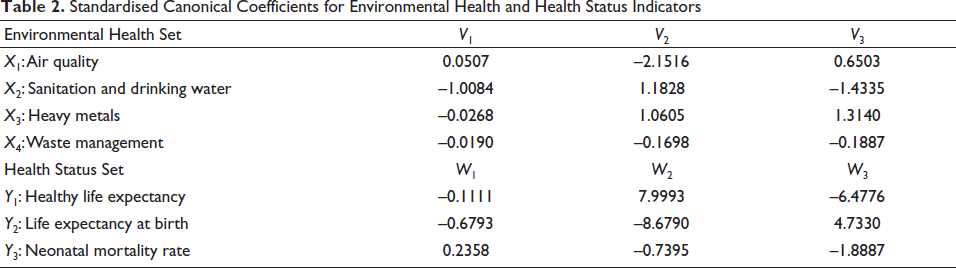
Considering the weights of the variables related to the environmental health set, it can be said that the variable with the highest weight in the canonical variable V1 is ‘sanitation and drinking water’, and the variable that contributes the least is ‘waste management’. In the canonical variable V2, the highest weight was obtained in ‘air quality’, and the least weight was obtained in the ‘waste management’ variable. In other words, the original variables that most explain the first canonical variable of the data on environmental health indicators are ‘sanitation and drinking water’, ‘air quality’, ‘heavy metals’ and ‘waste management’, respectively. The original variables that most explain the second canonical variable are ‘air quality’, ‘sanitation and drinking water’, ‘heavy metals’ and ‘waste management’, respectively (Table 2).
Standardised Canonical Coefficients for Environmental Health and Health Status Indicators
The canonical correlation function for the health status set is as follows:



Considering the weights of the variables related to the health status set, it can be said that the variable with the highest weight in the canonical variable W1 is ‘life expectancy at birth’, and the variable that contributes the least is ‘healthy life expectancy’. In the canonical variable W2, the highest weight was again obtained in ‘life expectancy at birth’, and the lowest weight was obtained in ‘neonatal mortality rate’. In other words, the original variables that most explain the first canonical variable of the data on health status indicators are ‘life expectancy at birth’, ‘neonatal mortality rate’ and ‘healthy life expectancy’, respectively. The original variables that most explain the second canonical variable are ‘life expectancy at birth’, ‘healthy life expectancy’ and ‘neonatal mortality rate’, respectively (Table 2). In the test for the significance of the canonical correlation coefficients, there was statistical significance only between the first two canonical variable pairs, so the third canonical variable was not analysed.
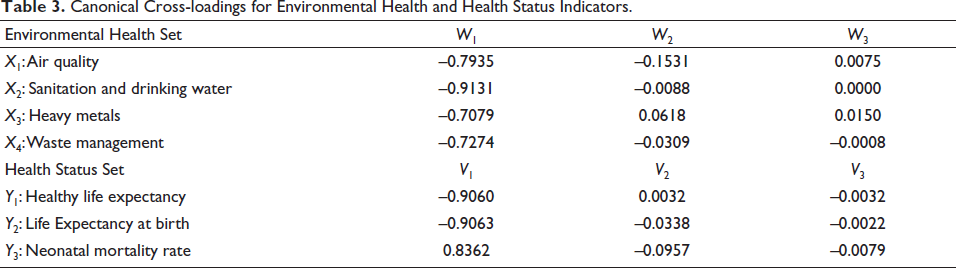
In the environmental health set, the ‘sanitation and drinking water’, which is one of the independent original variables, has the highest correlation with the first dependent canonical variable. The ‘air quality’, which is one of the independent original variables, has the highest correlation with the second dependent canonical variable. In the health status set, ‘life expectancy at birth’, which is one of the dependent original variables, has the highest correlation with the first independent canonical variable. The ‘neonatal mortality rate’, which is one of the dependent original variables, has the highest correlation with the second independent canonical variable (Table 3).
Canonical Cross-loadings for Environmental Health and Health Status Indicators.
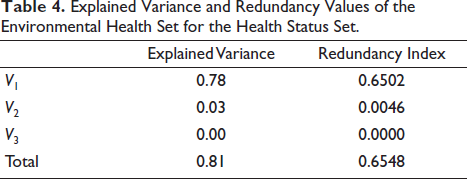
In the environmental health set, the V1 canonical variable explains 65.02% of the variance, and the V2 canonical variable explains 0.046% of the variance in the health status set. In total, 65.48% of the change in the health status set is explained by the environmental health set (Table 4). Since only the first and second canonical variables were statistically significant, variance explanations and redundancy indices were interpreted for only the first and second canonical variables.
Explained Variance and Redundancy Values of the Environmental Health Set for the Health Status Set.
Discussion
Environmental conditions are seen as an important determinant of social health and welfare. Within the scope of this study, the aim is to analyse the relationship between environmental health and health status.
The statistically significant and high correlation between environmental health indicators and health outcomes was the most important finding of this study. Supporting the findings of this study, Raffin and Seegmuller (2014) found a positive relationship between environmental quality and longevity. Beyene and Kotosz (2021) found that improvements in environmental quality significantly increased health outcome indicators. Balan (2016) investigated the causal relationship between environmental quality and human health. The result of the study revealed that there is a causal relationship between environmental quality and health. Hill et al. (2019) found that it may increase health risks associated with environmental degradation. Ghorani-Azam et al. (2016) and Manisalidis et al. (2020) estimated that the diseases and adverse health outcomes facing humanity today are due to long-term exposure to environmental pollution.
The results of the research showed that ‘air quality’ and ‘sanitation and drinking water’ indicators, which are environmental health indicators, are the variables that affect health status the most. Air pollution can be quite destructive for public health. Studies examining the effect of air pollution on health outcomes also support the findings of this study. The WHO (2019a, 2019b) emphasised that air pollution results in 7 million deaths annually globally. Research over the past two decades has shown that various forms of air pollution increase adult deaths from heart disease risk, lifetime all-cause mortality, respiratory diseases, cardiovascular diseases, malignant neoplasms and unintentional injuries (Heutel & Ruhm, 2016; Hill et al., 2019; Knittel et al., 2016; Mikati et al., 2018). Correia et al. (2013) estimated that reductions in air pollution in the United States accounted for 18% of the overall increase in life expectancy in recent years. Balakrishnan et al. (2019) estimated that if air pollution levels in India were lower, life expectancy would increase by 1–7 years. Naqvi et al. (2021) associated improvements in air quality with reduced death rates. All these results show that human health around the world largely depends on clean air.
On the other hand, the increase in life expectancy has been affected by the improvement in water quality in different parts of the world over the centuries. Studies examining the impact of sanitation and drinking water quality on health outcomes have similar findings. According to WHO (2019a, 2019b), more than 1 billion people do not have access to safe drinking water, and the water supply of more than 3 billion people lacks minimal acceptable sanitation requirements. It is estimated that about 10% of the global burden of disease is associated with a lack of access to adequate sanitation, safe drinking water, proper hygiene and effective water management (Prüss-Üstün et al., 2014). Gulis (2000) emphasised that investment in water resources and health services can have a relatively strong impact on health status. It was concluded that water technology, sanitation and personal hygiene also contributed to reducing the morbidity and mortality rate, along with an overall increase in the standard of living (Angelakis et al., 2021). These results show that improved sanitation, personal hygiene and water technologies have an important role in living standards and health status. Improving access to safe water and basic sanitation has direct implications for better health, as they disrupt the transmission routes of communicable diseases. Improvement in water resource management also has significant potential to reduce vector-borne diseases.
Another finding of the study was that life expectancy at birth was the variable most affected by environmental health variables. Life expectancy at birth is frequently used to estimate the impact of different environmental variables on health. It is accepted as a good outcome indicator of environmental health (Gulis, 2000; Nkalu & Edeme, 2019). The research results in the literature support the findings of this study. Analysis from multiple regression showed that life expectancy at birth was statistically significantly affected by environmental factors such as access to safe water and the percentage of woodland. The results of the research conducted with 67 countries show a strong relationship between life expectancy at birth and environmental health (Onel & Mukherjee, 2014). Beyene and Kotosz (2021) examined the impact of environmental quality on life expectancy in 24 African countries. The results confirmed that, in the long term, improvements in environmental quality significantly increased life expectancy over the study period in the African countries that were studied. Lu et al. (2017) compared some environmental quality and health care parameters from 30 Chinese provinces and revealed the dynamic relationship between environmental pollution and public health (mortality rate, perinatal mortality rate, infant health condition, etc.). According to them, environmental factors are responsible for a large part of longevity. Wu (2017) emphasised that there is a positive bilateral relationship between life expectancy and environmental quality. On the one hand, it was emphasised that increased investment in environmental quality would positively affect public health, and on the other hand, it was emphasised that the way individuals value the future is greatly influenced by their life expectancy. It is concluded that if someone expects to live longer, that person will be willing to invest more in environmental quality and future generations.
Conclusion
This study revealed the effects of environmental health on the health status of societies as a component of environmental performance. Increased investment in environmental quality has the potential to eventually lead to better living conditions and improvements in health status. The fact that a high level of environmental performance is associated with a high quality and standard of life may raise concerns about the link between environmental degradation and health. It is important to identify environmental health indicators that can improve health status.
Environmental indicators tend to relate to areas close to human activity and may include economic, social and sustainability parameters. The aim of sustainable development is to ensure the fair distribution of wealth, which can be shared between current and future generations. Therefore, it is important to design public environmental policies that will protect environmental resources and ensure their sustainability. In this context, it may be recommended to support developing countries to significantly reduce air, soil and water pollution through pollution management planning and investment, to produce and share information about the effects of the environment on health, and to promote awareness of pollution management and environmental health issues among policymakers, business partners, city leaders and the general public. In addition, it is recommended that healthcare managers use renewable resources in a way that does not reduce their benefits for the future and lead the studies in order to transform non-renewable resources into renewable resources.
Footnotes
Declaration of Conflicting Interests
The authors declared no potential conflicts of interest with respect to the research, authorship and/or publication of this article.
Ethical Approval
Ethical approval was not required for this article as it worked with secondary data.
Funding
The authors received no financial support for the research, authorship and/or publication of this article.
