




Abstract
In the era of globalisation, a lot of disruptions have brought about radical changes in how businesses operate. This has led to the changing patterns of employer-employee relationships which are important for the health of the organisation. This has called for the need to understand the career attitude of employees, working in the organisations. The purpose of this article is to investigate the relationship between protean career, boundaryless career attitude, organisational mobility preferences and organisational citizenship behaviour (an important parameter of sound organisational health) of Indian millennials. Data from 204 employees, working in multi-national organisations located in Delhi and the NCR region of India, was used to investigate the relationship between the said constructs and their relationship. The study focussed on multi analytical approach using structural equation modelling to study the relationships among the various dimensions. The results of the study show that protean career attitude, boundaryless career attitude and organisational mobility preferences are significantly related to each other. The study would help the organisations to work on designing career coping strategies for the employees to enhance their productivity at work. The study may add some important perspectives to the literature on career already available and may serve as a basis for further enhancing the psychological contract of the current workforce.
Keywords
Introduction
In the era of globalisation, a lot of disruptions have brought about radical changes in how businesses operate. This has led to the changing patterns of employer-employee relationships in the organisations and has called for the need to understand the career attitude of employees working in the organisations. In line with other significant changes being experienced across the globe, the essence and importance of career have changed tremendously. Values, such as adaptability and freedom, are presented as an important perspective in the approach of employees (Hall, 2004). The careers of employees are very critical and important for realising their management by the organisation (Singh, 2003). This has given a rise to new forms of careers. In the recent years, protean career and boundaryless career attitudes have gained significant attention during these years. On the other hand, the organisational citizenship behaviour (OCB) is an important aspect of organisational health. The study is conducted to examine the relationship between protean career, boundaryless career attitude, organisational mobility preferences and OCB of Indian millennials.
The article is divided into six sections. The second section discusses the review of the literature and proposed framework for the study. The third section discusses in detail, the research methods used for the study. The fourth section discusses the data analysis and results. The fifth section consists of the data findings, and finally, the sixth section discusses the conclusion, limitations of the study and managerial implications.
Literature Review and Conceptual Framework
OCB: An Important Aspect of Organisational Health
OCB is viewed by employees as a means of essentially compensating the organisation in lieu of the actual fulfilment of the terms stated in the psychological (implicit) contract between employees and employers (Organ, 1988).
Studies have found several dimensions of OCB (Smith et al., 1983; Van Dyne et al., 1994; William & Anderson, 1991). Organ (1988) identified five dimensions of OCB. The dimensions are altruism, sportsmanship, conscientiousness, civic virtue and courtesy. Podsakoff et al. (2000) and Salehzadeh et al. (2015) further supported what Organ (1988) had stated. Ever since then, several dimensions have been added to OCB. Civic virtue involves the participation of employees in the decision-making and suggesting the policy related changes in organisation (Moon et al., 2005), whereas conscientiousness refers to the behaviour in which employees go beyond the basic requirement of jobs in terms of attendance, work rules and job performance (Snape & Redman, 2010). Sportsmanship is the behaviour which explains accepting inconvenience at workplace (Organ, 1988). Sportsmanship, civic virtue and conscientiousness among the employees can easily be differentiated (Hui et al., 2004), whereas altruism and courtesy cannot be differentiated that easily (Bachrach et al., 2001; Podsakoff & MacKenzie, 1994).
Protean Career Attitude
Globalisation, digital revolution and communication advances have revolutionised the job scenario. Consequently, this has led to the changes in job design, which means key adjustments are to be made in many ways for the employees (Burke & Ng, 2006). Millennials, the largest generation cohort today, prioritize forging their own career trajectories rather than depending on the organizations they work for. Employees try to empower themselves by empowering their own career escalation (Direnzo & Greenhaus, 2011). The employees of today gain satisfaction and benefits on the goals set for themselves on their own. (Weng & McElroy, 2012; Weng et al., 2010). This specifically gives way to protean career orientation among the young population. A Protean career refers to a career in which an individual strives towards the fulfilment of self-objectives and heads towards development progression. (Volmer & Spurk, 2011)
Employees with protean career attitude establish their career goals in the organisations to direct their own career paths (Direnzo, 2010). On the contrary, individuals who do not possess protean career orientation adjust themselves to the organisational goals (Direnzo, 2010). The idea of a protean career refers to a proactive career attitude, and it focuses on the psychological satisfaction and subjective success (Briscoe & Hall, 2006). A protean career is positively linked with career insight, satisfaction in career and perceived employability (De Vos & Soens, 2008). It has also been closely associated with the performance of an individual and their psychological well-being (Briscoe et al., 2012).
Boundaryless Career Attitude
An individual possessing boundaryless career attitude tends to have preference of steering psychologically and physically across many organisations (Sullivan & Arthur, 2006). Over the years, various researchers have studied protean and boundaryless career attitude with respect to various organisational and individual variables. An individual with boundaryless career attitude aims at surpassing and transcending the conventional boundaries at work, at both physical and psychological levels (Sullivan & Arthur, 2006). The concept is further explained and delineated by challenging the said boundaries, exploring the norms through various learning approaches (Arthur & Rousseau, 1996).
The boundaryless career mindset relates to organisational mobility preferences of employees and boundaryless career attitude. Organisational mobility preference refers to an attitude to conduct actual moves between different occupations, jobs and organisations (Volmer & Spurk, 2011).
Conceptual Framework of the Study
It has been posited that careers are becoming more and more protean in nature with a focus on individuals who look beyond the limits set by the organisation and take the responsibility for their own development in terms of career (Arthur & Russeau, 1996). This in turn might bring physical mobility preference among employees. Therefore, a framework to study the impact of protean (self-driven and value-driven) and boundaryless attitude on organisational mobility preference and OCB was developed.
Hypotheses Development
Protean career attitude is a well thought-over and studied topic of interest and can be explained by self-directed career attitude and value-driven career attitude. (Briscoe & Hall, 2006). It is a behaviour demonstrated by individuals who do not believe in borrowing external standards. They are the owners of their own career. On the other hand, organisational mobility preference of employees refers to the preference of employees to make a physical move from the organisation they work for. Since protean career attitude makes an individual become an architect of his own career, it is hypothesised as follows:
H1: Self-directed career attitude significantly impacts the organisational mobility preference of employees.
H2: Value-driven career attitude significantly impacts the organisational mobility preference of employees.
It has been seen that boundaryless career attitude relates to psychological mobility preference of employees. It has been seen that psychology impacts how an individual behave. Therefore, it is hypothesised as follows:
H3: Boundaryless career attitude significantly impacts the organisational mobility preference of employees.
It has been reported in the research that there is a positive association between OCB and protean career attitude (Rodrigues & Ferreira, 2015). Vigota-Gadot & Grimland (2008) further supported it. Thus, in the study, it has been hypothesised as follows:
H4: Self-driven career attitude will positively impact OCB.
H5: Value-driven career attitude will positively impact OCB.
It has been observed that boundaryless career attitude brings high autonomy in one’s career management (Colakoglu, 2011). There are only a few studies demonstrating the linkage between boundaryless career attitude and OCB. On the premise that organisational mobility preference among employees will lead to lesser OCB for the current employer, it was hypothesised that there is a negative relationship between OCB and boundaryless career attitude. There is plethora of research showing positive association between organisational commitment and OCB (Philipp & Lopez, 2013; Podsakoff & Organ, 1986). There is a research showing the association between boundaryless career attitude and organisational commitment (Lo Presti et al., 2019). Therefore, theorising and assuming that high organisational mobility preference will lead to lesser OCB can reasonably be expected. This is for the reason that employees believe that the nature of relationship which they have with the organisation is transitory in nature. This leads to the following hypotheses:
H6: Boundaryless career attitude positively impacts OCB.
H7: Organisational mobility preference negatively impacts OCB.
Research Methodology
Participants and Procedure Involved in the Research
Self-administered questionnaire was used to collect the data for the purpose of study. Convenience sampling method was used to maintain fairness in collecting the data. The questionnaire was circulated among 1,000 employees working in select organisations of India, to which 204 employees responded. All the respondents were working in organisations in Delhi and NCR and belonged to diverse set of organisations. The organisations were very diverse in nature and ranged from top-notch consulting firms to IT service providers. The portfolio held by the respondents majorly held middle-level management positions. The demographic characteristics of the population under study have been presented in Table 1.
Demographic Profile of the Respondents.
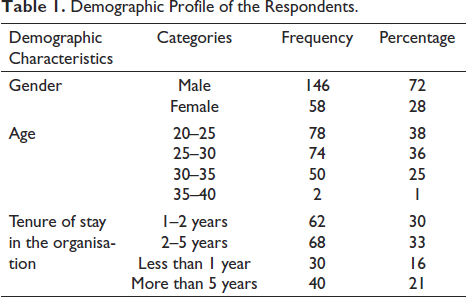
This section presents the demographic profiles of the respondents. With regard to Gender, 72% were male and 28% were female. In terms of age, 38% were between 20–25 years of age, 38% were between 25–30 years of age, 25% were between 30–35 years of age and 1% were between 35–40 years of age. Of all the employees, 16% had less than 1 year of experience, 33% had between 2–5 years of experience, 30% had 1–2 years of experience and 21% had more than 5 years of experience.
Measures for the Study
The scales used in the study have been adapted from previous research discussed in the Review of Literature section. Out of the five constructs used in the study, three were independent, whereas two were dependent. A total of 19 statements were used to measure the predicting variables and 9 were used to measure the dependent variables. In the study, three are independent factors, namely, self-driven career attitude, value-driven career attitude and boundaryless career attitude, and there are two dependent factors, namely organisational mobility preference of employees and OCB. The various measures used in the study have been discussed.
Protean Career Attitude
For assessing the protean career attitude, scale by Briscoe et al. (2012) was used. The 14 items scale had two dimensions: self-driven career attitude and value-driven career attitude. Sample items used in the study included two sub-dimensions: self-driven career attitude (with eight items) and value-driven career attitude (with six items). The sample items for the study included statement like ‘I navigate my own career, based on my individual priorities’. The responses were taken on a 5-point Likert scale, in which 1 meant ‘completely disagree’ and 5 meant ‘completely disagree’.
Boundaryless Career Attitude
For measuring the career attitude of the respondents, a scale developed by Briscoe et al. (2012) was used, which had two sub-scales: boundaryless career attitude (with eight items) and organisational mobility preference (with five items which are negatively keyed). The sample items used for measuring boundaryless career attitude included statements like ‘I seek those assignments which allow me to learn something new’.
Organisational Citizenship Behaviour
The OCB of employees was measured using inventory by Podsakoff et al. (2000) with sub dimensions: altruism, sportsmanship, courtesy, conscientiousness and civic virtue. The sample items included ‘I help others who have heavy workload’.
Organisational Mobility Preference of Employee
The organisational mobility preference of employees refers to the intention of individuals to move from the organisations. For assessing the organisational mobility preference of employees, a scale by Briscoe was used. Organisational mobility preference was measured using statements like ‘If my organisation provides me lifetime employment, I would never look for opportunities outside my workplace’ (Briscoe et al., 2012).
Data Collection and Sampling
The survey form was circulated online to the respondents through the email and personalised platforms to reach out to them. Convenience sampling technique was used for the study. The survey consisted of five constructs in total and comprised of 28 items. The survey form was administered to a sample of 204 respondents from Delhi and NCR region of India. Non-probability sampling was used to run the survey. Though the survey form was sent to 1,000 employees holding middle-level management positions, yet only 204 responded. The sample size was considered to be fit for the study as it is more than the value recommended for running structural equation modelling (Hair et al., 2010).
Data Analysis
A multi analytical approach was used for analysing the data obtained from 204 respondents. For testing the hypotheses, a two-step approach was followed. Chin (2010) and Anderson and Gerbing (1988) suggested that the measurement model is to be checked first, and then, structural model may be checked.
Confirmatory Factor Analysis
To measure the composite reliability, convergent validity (CV) and average variance extracted (AVE) were calculated. It is suggested in the literature that CV should be greater than 0.7, AVE should be greater than 0.50 and CV should be greater than AVE, in order to confirm the CV (Hair et al., 2010).
Discriminant validity was measured using values of AVE, maximum shared variance (MSV) and average shared variance (ASV). The values were well in the accepted range. The values of CV, AVE, MSV and ASV are presented in Table 2, and it summarises the results of validity check for the data.
Reliability and Validity of Constructs.

Measurement and Structural Analysis
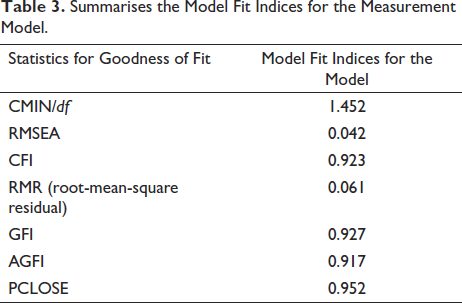
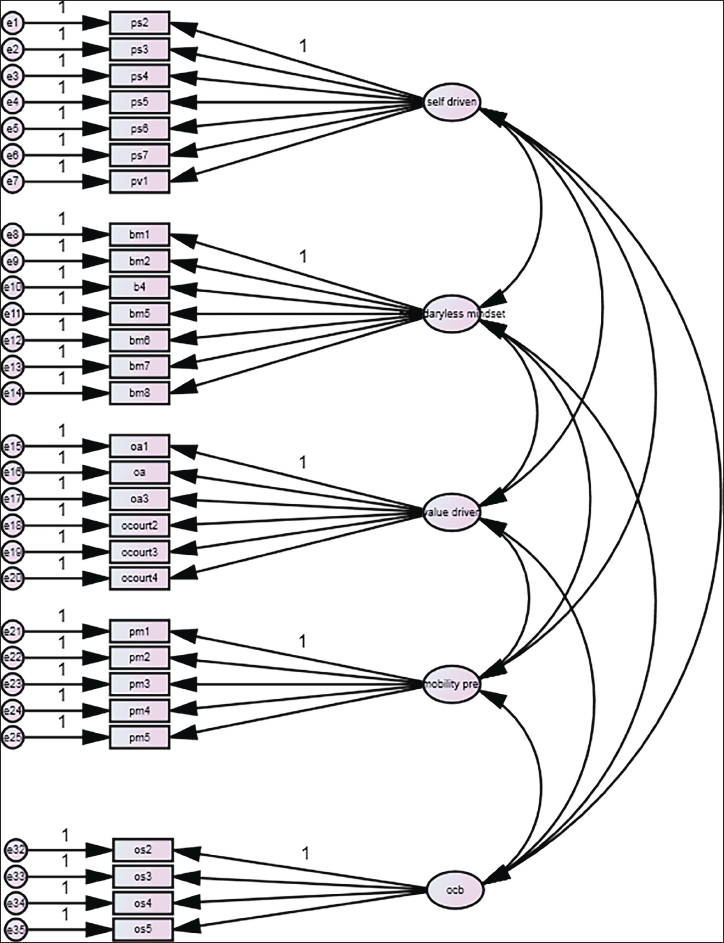
Measurement model was assessed first, and it was followed by structural model for testing the hypotheses (Figures 1 and 2). The measurement model indices are presented in Table 3 which explains the indices for the measurement model. The model proved to be fit. For assessing the fit, six indices were chosen, as recommended by previous researches. CMIN/df (≤ 3), comparative fit index (CFI ≥ 0.90), root-mean-square error of approximation (RMSEA < 0.05), goodness-of-fit index (GFI ≥ 0.9) and adjusted goodness-of-fit index (AGFI > 0.85) (Arbuckle & Wothke, 1999, Brown & Cudeck, 1993; Hair et al, 2010). The indices were well within accepted ranges and are presented in Table 3. This was conducted after the results of model fit were obtained. The model was found to be fit. The indices for the model have been summarised in Table 3.
Summarises the Model Fit Indices for the Measurement Model.
Measurement Model Used in the Study.
The structural model analysis was done after re-specification of the model. The change was made by removing sportsmanship dimension of OCB in the present study, as it accounted for only 13% of the variance, and after removing the statement on sportsmanship, the model fit also improved. Thus OCB of employees was measured by considering four aspects of OCB, namely on altruism, courtesy, conscientiousness and civic virtues. In the structural analysis, a total of seven hypotheses were tested, all of which were supported at p < .05 and p < .01, respectively. The hypotheses testing with p value, standard error and beta value have been discussed further under hypotheses testing section. Figure 2 explains the structural path model used for testing the hypotheses.
Structural Path Model for the Study.
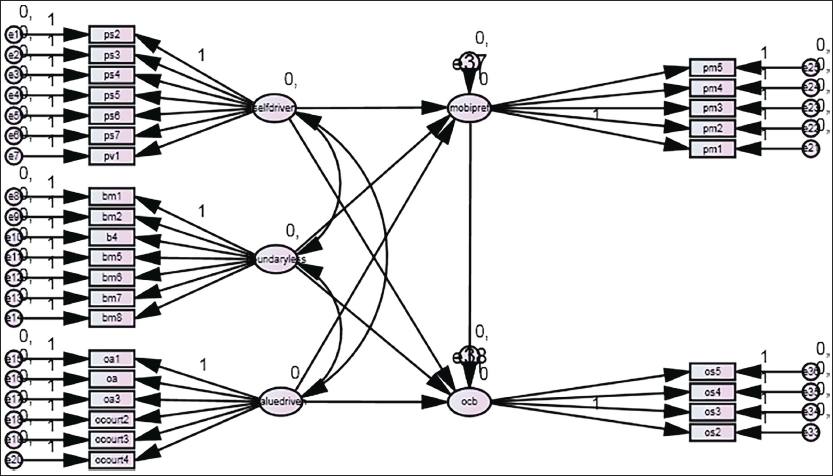
The figure shows the path diagram of the structure followed for determining the impact of self-driven career attitude on organisational mobility preference of employees, value-driven career attitude of employees on their organisational mobility preferences, boundaryless career attitude on the organisational mobility preference of employees, self-driven career attitude on OCB of employees, value-driven career attitude on OCB of employees, boundaryless career attitude on the OCB of employees and organisational mobility preference of employees on OCB of employees.
Hypotheses Testing: The Hypotheses were Postulated for Testing the Impact of Self-Driven Career, Value Driven Career Attitude, Boundaryless Career Attitude on Organisational Mobility Preferences of Employees
Path Coefficients for Self-Driven Career, Value-Driven Career Attitude and Boundaryless Career Attitude on Organisational Mobility Preferences of Employees.
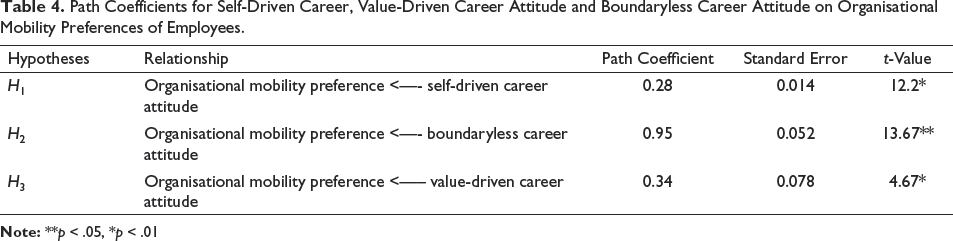
Three hypotheses were postulated for testing the relationship between self-driven career attitude, value driven career attitude and boundaryless career attitude on organisational mobility preferences of employees (Table 4). Path analysis was done using structural equation modelling with AMOS to study the relationship among the various career attitude and organisational mobility preference of employees. Self-driven career attitude and value-driven career attitude are the dimensions of protean career attitude. Hypothesis 1 stated that self-driven career attitude significantly impacts organisational mobility preference. The hypothesis was supported at 0.01 significance level, and hence, it is supported that self-driven career attitude significantly impacts organisational mobility preference. The path coefficient for self-driven career attitude is ß = 0.28. Hypothesis 2 stated that boundaryless career attitude significantly impacts organisational mobility preference. The hypothesis was supported at 0.05 significance level, and hence, it is supported that boundaryless career attitude significantly impacts organisational mobility preference. The path coefficient for boundaryless career attitude is ß = 0.95. Hypothesis 3 stated that value-driven career attitude significantly impacts organisational mobility preference. The hypothesis was supported at 0.01 significance level, and hence, it is supported that value-driven career attitude significantly impacts organisational mobility preference. The path coefficient for value-driven career attitude is ß = 0.34.
Hypotheses Testing: Self-Driven Career Attitude, Value-Driven Career Attitude and Boundaryless Career Attitude on Organisational Mobility Preferences of Employees
Path Coefficients for Self-Driven Career, Value-Driven Career Attitude and Boundaryless Career Attitude on OCB of Employees.
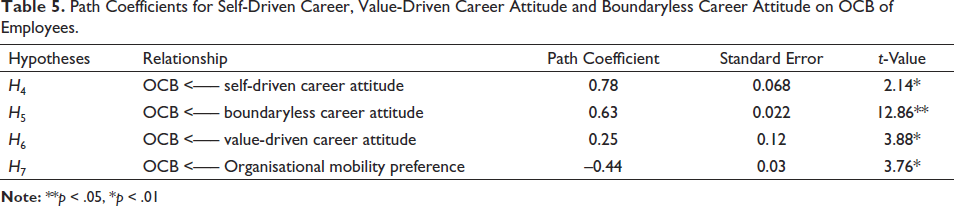
Three hypotheses were postulated for testing the relationship between self-driven career attitude, value-driven career attitude and boundaryless career attitude on OCB of employees (Table 5). Path analysis was done using structural equation modelling with AMOS to study the relationship among the various career attitude and OCB of employees. Self-driven career attitude and value-driven career attitude are the dimensions of protean career attitude. Hypothesis 4 stated that self-driven career attitude significantly impacts OCB. The hypothesis was supported at 0.01 significance level, and hence, it is supported that self-driven career attitude significantly impacts OCB. The path coefficient for self-driven career attitude is ß = 0.78. Hypothesis 5 stated that boundaryless career attitude significantly impacts OCB. The hypothesis was supported at 0.05 significance level, and hence, it is supported that boundaryless career attitude significantly impacts OCB. The path coefficient for boundaryless career attitude is ß = 0.63. Hypothesis 6 stated that value-driven career attitude significantly impacts OCB. The hypothesis was supported at 0.01 significance level, and hence, it is supported that value-driven career attitude significantly impacts OCB. The path coefficient for value-driven career attitude is ß = –0.25. Hypothesis 7 stated that organisational mobility preference significantly impacts OCB. The hypothesis was supported at 0.01 significance level, and hence, it is supported that organisational mobility preference impacts OCB. The path coefficient for boundaryless career attitude is ß = –0.44.
Findings and Discussions
The objective of the study was to understand the nuances of disruptive career attitudes and organisational mobility preferences of Indian millennials. In the study, the impact of different career attitude, namely self-driven career attitude, value-driven career attitude and boundaryless career attitude was measured on organisational mobility preference of employees and OCB. Results of regression analysis show that self-driven career attitude positively impacts the organisational mobility preference of employees. Value-driven attitude has a positive impact on organisational mobility preference. It is found that boundaryless career attitude also has a positive impact on organisational mobility preference of employees. The results are in coherence with the basis on which the hypothesised relationship was established. Organisational mobility preference of employees refers to the actual ability to conduct the physical moves by employees in different occupations and organisations. The protean careerists do not believe in borrowing external standards and are driven by their self-beliefs and values. The claim that protean career attitude significantly impacts mobility preferences of employees is substantiated empirically and has been presented under hypotheses testing section.
The study also highlighted that self-driven career attitude positively impacts OCB. Regression result show that value-driven career attitude positively impacts OCB. Boundaryless career attitude was found to be positively impacted on OCB. Self-driven career attitude and value-driven career attitude are two determinants of protean career attitude. Research has found that there exists empirical evidence with respect to the positive association between OCB and organisational commitment (Organ et al., 2006; Philipp & Lopez, 2013). The relationship between organisational commitment and boundaryless career attitude has also been studied. Therefore, it is reasonable to theorise and assume that studying the relationship between career attitude and OCB can be a good starting point. Moreover, it is also reasonable to assume that an individual who has high preference for organisational mobility will be less committed to the organisation he works for and will therefore demonstrate less OCB.
They tend to be less committed towards the organisation and, therefore, do not perform beyond the said limits. Hence, efforts should be put in order to improve the OCB of employees.
Conclusion, Managerial Implications and Limitations of the Study
While there is an existence of literature pertaining to protean career attitude, boundaryless career attitude, organisational mobility preference of employees and OCB individually, but the relationship between each of the dimensions of career attitude and organisational mobility preferences and OCB has not been studied. During the literature review, several papers examining the impact of protean career attitude and organisational commitment level were studied. The study is unique in the sense that it studies the impact of various career attitudes on organisational citizenship behaviour. All the seven hypotheses formed for the study have also been supported in it. There were three limitations of the study, thus, needed caution to explain the outcomes obtained. First, the research was conducted with a sample size of 204 respondents, which is not large enough to represent the entire population. Second, the study was cross sectional in nature, a longitudinal study would have contributed immensely to the results. Third, the study was confined to millennials of India with no comparison with millennials of the other countries. There have been recent attempts to foster entrepreneurial learning and training in India (Dana, 2001).
The study may be highly beneficial for the organisations to work on the career coping strategies, keeping in mind the new career attitude. It can set the tone for the organisations to emphasise upon improving OCB by introducing employee-friendly strategies like intrapreneurship, co-career production and so on. This study may be replicated in the settings of other countries as well to validate the impact on the proposed model. The study can be a valuable food for thought for the researchers to build on this field further and may add some important perspectives on the literature on career already available and may serve as a basis for further enhancing the psychological contract of the current work force.
Footnotes
Declaration of Conflicting Interests
The author declared no potential conflicts of interest with respect to the research, authorship and/or publication of this article.
Funding
The author received no financial support for the research, authorship and/or publication of this article.