




Abstract
The purpose of this study is to know how students in school and parents perceive social networks. A random sample of 50 adolescents aged 17–21 and 50 parents aged 45–48 irrespective of gender were selected randomly from students in the eleventh and twelfth grades with their parents in Ambala, Haryana, India. A self-developed questionnaire consisting of 60 items about social networking was used, of which half of the items were in favour and half not in favour of social networking. The scoring of the questionnaire was done using scores 1 to 7 correlating to the options from ‘strongly disagree’ to ‘strongly agree’. Descriptive analysis and part–whole correlations and t-ratios were used to analyse the obtained data.
The difference in opinion between parents and adolescents about social networking is more evident when one considers the generation gap, income group and rural and urban groups. The attitude of parents, teachers and adolescents towards social networking sites is neutral. Social networking sites are both a boon and a curse, depending upon the level of awareness pertaining to the different aspects such as privacy, accessibility and the purpose for which they are being used.
Introduction
Social networking is communication among members of the social community through computer network infrastructure to support and serve social purposes. It is a means of grouping individuals into specific groups, such as small rural communities or a neighbourhood subdivision. Although social networking is possible in person, especially in the workplace, universities and high schools, it is the most popular online service which unites people of diverse cultures. When it comes to online social networking, websites are commonly used. These websites are known as social sites.
A social networking service is an online service, platform or site that focuses on building and reflecting a social network or social relations among people.
The terms ‘opinion’ and ‘attitude’ have been used interchangeably. A continuum has been used to include opinion, attitude, interest and value. A large number of definitions of attitude have been reported by researchers dealing with the measurement of attitude. An opinion is an overt expression of attitude; that is, we express attitude with an opinion.
As reported by Allport (1935, p. 810), ‘attitude is a mental or neural state of readiness to respond organized through experience exerting a directive and/or dynamic influence on behaviour’. The definition reflects that attitude is a component of mental life and can be measured either physiologically or phenomenologically.
The operational aspect of attitude has been stated by Campbell (1963, pp. 94–172) as attitude representing consistency in response to a social object.
Triandis (1971, p. 2) has treated attitude as ‘an idea charged with emotion which predisposes a class of actions to a particulars class of social situations’. This definition considers attitude as having three dimensions, cognitive, affective and conative, which reflects that the measurement of attitude can be related to these three dimensions.
Kerlinger (1973, pp. 495–496) used many definitions to report that attitude is an organised predisposition to think, feel, perceive and behave towards a referent. A referent can be a category, a class, a set of phenomena, physical objects, events, behaviours or even constructs. The definition is quite comprehensive to include all the aspects of attitude.
Moreno (1979) has described attitude as some disposition or preparedness to attend to some parts of objects rather than others.
Social media in India is growing by leaps and bounds, but to date, there has been no definitive research that has tracked this growth. The findings of a report on social media say that about 30 million Indians who are online consumers are members of social networking sites. Over the next six months, 45,000 online Indians intend to join social networking sites each day.
Today, children spend up to 49 minutes each day texting, 38 minutes surfing the net and one hour playing video games. Excessive internet use is emerging as one of the more negative aspects of young people’s online activities. Internet addiction, the term we use here, has been defined as the use of the internet to escape from negative feelings, continued use of the internet, thinking about the internet constantly and the experience of any other conflicts or self-conflicts due to internet use. Facebook as one of the social networking sites is one of the major characteristics involved in web 2.0 technologies, as it involves information sharing and communication between different users (Madge et al., 2009, pp. 141–155).
Adolescents and Social Media Networks
The research on adolescents and social media networks requires us to employ network thinking to understand the social experiences of young people and how they influence their behaviour as they provide a fresh way of investigating and interpreting the links among people, objects and ideas. It also allows for examining social structures that extend beyond the immediate group in the local setting to incorporate larger patterns of relationships (Cotterell, 2007).
Children, adolescents and adults differ in their usage of media and in their evaluation of how the media influences them. They all like to apply ‘the third person effect’ when it comes to media influences, as adults perceive that the younger the other person is, the stronger the effect of the media will be on them. Even teens among themselves endorse a kind of third-person effect, claiming that only ‘little kids’ imitate what they see on TV. Adolescence, on the other hand, is often characterised as a time of challenge and turbulence, as teens are faced with increased independence and growing self-discovery. One of the main features of this age is the great challenge a teen faces in forming an identity. There is growing evidence that adolescents use the internet to experiment with their identities. Adolescents are also characterised by increased independence and spending more time away from their parents. A third feature of adolescence is that they are risk-takers; they face tough decisions regarding activities and experiences to go through, such as smoking and sexual activities, and they are willing to experiment such activities in a reckless way as a form of asserting independence from parents. A fourth feature of adolescence is the importance of peers for them, as they spend a great deal of time with friends and place a high value on these relationships (Strasburger et al., 2009, pp. 10–16).
In the past few years, online social networks have turned into a mainstream social phenomenon used by everyone, not just children and teens. No doubt, Facebook in particular has completely changed the way young people communicate together. When comparing the design of Facebook to other social networks such as MySpace, we find that Facebook is highly private, with a member-only policy. It presents one unified profile page, or ‘wall,’ that can’t be changed, compared to the flashy and highly personalised nature of MySpace. As a social network, Facebook places people into ‘networks’ defined by location, class, special interest or even finding people with similar interests in their area. In the United States, MySpace is mainly used by teens as a provider of music and videos, as well as to experiment with their self-image because of its highly customised nature (King, 2009).
‘It is more for socialization and taking to friends about work than for actually doing work’, this is how university students described their re-registration engagement with a university Facebook network. University students use Facebook for social reasons, not for formal teaching purposes, although it is sometimes used informally for learning purposes (Madge et al., 2009).
Risks Associated With Social Media Networks
There is an ongoing debate on how to keep young Facebook users safe on the site. Different tools and advice have been spread over the web, guiding parents and guardians on how to protect their kids from the dangers of the web. Among these advices is to limit the time children spend on the internet, use software that allow parents to monitor their children’s navigation on the net and continuously examine the child’s friends list.
The research also found significant differences in coping with risk between different genders and age levels, pointing to different styles of how youth manage risk themselves (Staksrud et al., 2009).
Risk is defined as ‘the possibility that human actions or events lead to consequences that might harm the human being value’ (Hohenemser et al., 1983; Kates & Kasperson, 1983). As less amenable to parental mediation, children are considered worldwide as the ‘online experts’ (Livingstone, 2008).
Using such adult social networks has become a major concern among researchers worldwide as it consumes a lot of children’s time, provides them with a false sense of privacy, makes teens become targets of scammers and Facebook impacts their person-to-person and social communication skills as well (Fodeman & Monroe, 2009).
As social networks allow people to share messages, they can be used as a tool to activate unmotivated groups (Boyd, 2008). Normally, anyone seeks to participate in public life for many reasons, such as identity development, status negotiation and community maintenance. Social media networks are considered by activists as a bullhorn that can reach many people through shared space on an unlimited scale.
Rationale
The significance of the study of the opinions of adolescents and parents towards social networking lies in knowing their attitudes towards this aspect of social networking and for determining their behaviours concerning this means of communication among the members of society.
The study will also help in knowing about their opinions, interests and values, as they depend upon the attitudes of the adolescents’ and parents.
The Likert-type opinionnaire constructed and standardised can be effectively used for the measurement of the opinions of parents and adolescents towards social networking, which is widely used all over the world. The study reveals that parents and adolescents have their responses on the positive side (agreement side). The concept of social networking is quite useful, as this medium is more interactive in approach. Effective communication is due to social networking.
Social networking is also a means of problem-solving in different areas associated with education. Adolescents are an important section of our society as they are the future leaders and have a major role in development of our country.
The different items of the attitude measure, which also reflect the educational benefits of social networking, are:
Social networking has the potential to develop manpower.
Social networking makes a person alert and active.
Social networking serves as a good medium for developing friendships.
Social networking is of great significance as it is a rapport-building exercise.
Social networking develops the spirit of enquiry.
Social networking is the most abused enterprise.
Social networking just realises the dipping of the body and soul into unreal things.
Social networking makes the user cynical.
Social networking is a worthless strategy as it neutralises talent.
Social networking for most people is a source of confidence in sharing thoughts and feelings publicly.
Objectives
To study attitudes towards social networking among adolescents and parents.
Hypothesis
It is expected that adolescents will be in favour of social networking, whereas parents’ attitudes will be negative towards social networking.
Methodology
To measure attitude towards social networking, a random sample of 50 adolescents (17–21 years) and 50 parents (45–48 years) irrespective of gender was derived to survey on a social networking questionnaire with 60 items.
The background questions concerning name, subject, area and sex were written on the top of the opinionnaire, followed by instructions and items. The sample of 50 students and 50 parents was selected randomly from students in the ninth and tenth grades with their parents in Ambala, Haryana, India. The investigator was face-to-face with the respondents. The subjects were asked to read the instructions carefully and respond to the items of the opinionnaire on a 7-point scale.
Tools
A self-developed questionnaire consisting of 60 statements in favour of and against social networking was used. The scores used were 1–7 for options from ‘strongly disagree’ to ‘strongly agree’.
Construction of the Items and Selection of Likert Format
In all, 60 items were constructed keeping in mind the characteristics of social networking towards which the attitude is directed. Most of the items were derived from articles in magazines or research journals.
Standardisation of a Likert-type Attitude Scale/Opinionnaire
Internal consistency along the attitude/opinion measure has been found for the purpose of selecting items for the final draft of the attitude scale/opinionnaire. The reliability and validity of the final draft of the attitude scale/opinionnaire have also been obtained for the purpose of its standardisation.
Internal Consistency
There are two methods of finding internal consistency along the attitude scale or opinionnaire. One method is based on finding the critical ratio (t-test) values on each item between high scores and low scorers (27% high scorers and 27% low scorers on the attitude measure). If t ≥ 1.65 (using a one-tailed test), then the item is selected for the final scale.
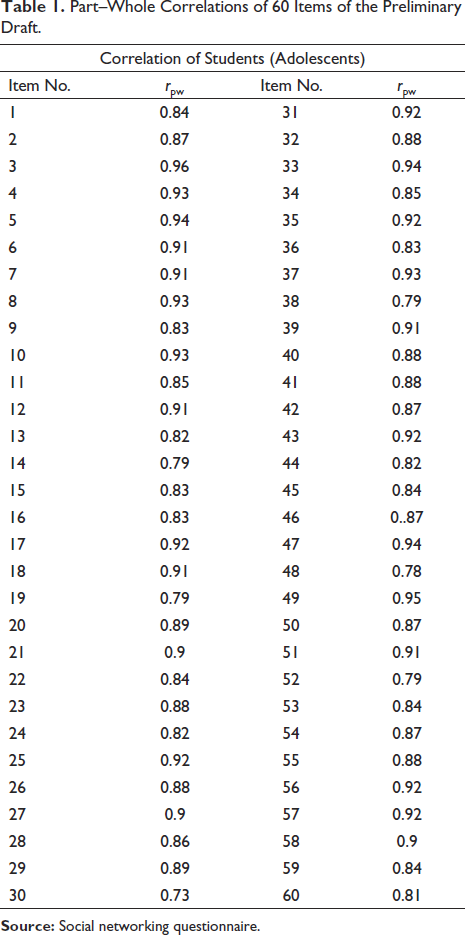
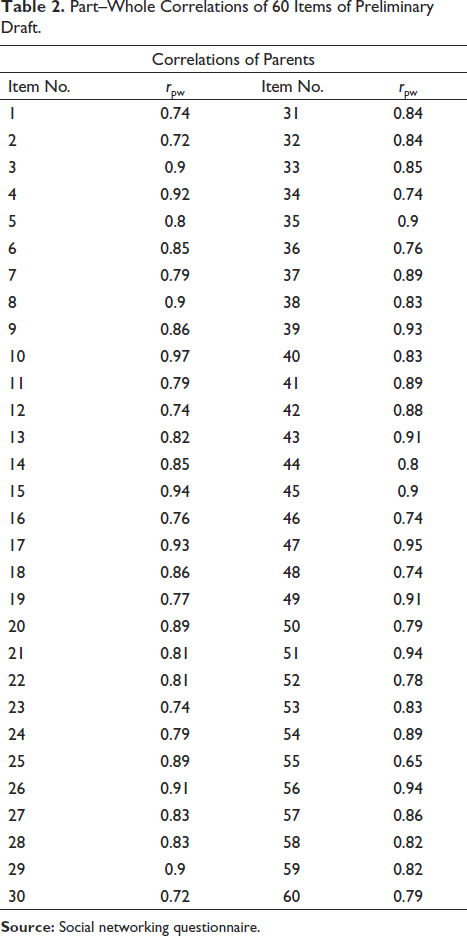
The other method is that of finding part–whole (item total) correlations. The correlation between the scores of an item and the summed scores of all the items is found in this method. The part–whole correlation for each item is calculated. If rpw ≥ 0.325, the item is selected for the final draft of the attitude/opinion measure. In the present investigation, a second method has been used to find the part–whole (item total) correlation for each of the 60 items.
Part–Whole Correlations of 60 Items of the Preliminary Draft.
Part–Whole Correlations of 60 Items of Preliminary Draft.
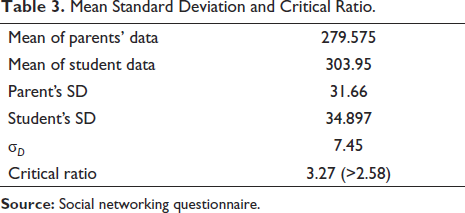
Mean Standard Deviation and Critical Ratio.
Validity of the Opinionaire
The validity of the opinionnaire was found by known groups method (contrasted groups method). Two known groups, one having a favourable attitude towards social networking and the other having an unfavourable attitude, were subjected to analysis by finding the significance of the difference between the means of the two groups. The t-ratio was found to be 2.71 (p < .01). So the scale was found to be valid as it differentiated between the two contrasted groups selected.
Results
Thes table reflect the difference in opinion between parents and adolescents about social networking. This difference of opinion is more evident due to the generation gap, income group, and rural and urban groups. Parents and adolescents had a favourable attitude towards social networking. Further, male and female adolescents, parents–adolescents residing in rural and urban areas, parents–adolescents living in rural and urban areas, parents–adolescents from joint and single families and parents–adolescents with an arts and science stream possessed a favourable attitude towards social networking sites.
Both male and female adolescents possessed an equal degree of favourable attitudes towards social networking.
Adolescents studying in urban school possessed a more favourable attitude towards social networking than adolescents in rural schools.
Parents–adolescents of joint and single families possessed an equal degree of favourable attitude towards social networking.
Parents–adolescents in the arts and science streams possessed an equal degree of favourable attitude towards social networking.
Discussion
A favourable attitude towards social networking was observed, which means parents and adolescents have accepted social networking as a part of their lives. While reading relevant literature, it was found that social networking sites, including Facebook and information technology, are expected by teachers and different sections of society. Soomro et al. (2014) indicated that pre-service teachers showed more positive attitudes towards using Facebook for collaborative learning than the attitudes of their faculty. Findings also indicated a positive relationship between participants’ Facebook intensity and their attitudes towards its use for collaborative learning. Somanathan Nair (1997) showed that the majority of librarians showed a favourable attitude towards information technology. Ina and Yehuda (2012) indicated that teachers’ openness to changes in professional life and their attitudes towards ICT predict 22.3% of the variance in online communication and 35% of the variance in online information search, for both personal and pedagogical purposes.
The second finding of this study was that both male and female parents–adolescents possessed an equal degree of favourable attitude towards social networking. There is less research work which examines gender differences in attitude towards social networking sites. Females interact more with family, friends, colleagues and people staying far away, whereas males speak more with relatives and strangers. Males were seen engaged in activities such as sharing pictures and information, instant messaging and keeping in touch with friends, family and relatives, while females were more engaged in reading comments posted on social networking sites. Only one significant difference was found in the present study on the basis of the location of the school. Students in urban schools possessed a more favourable attitude towards social networking than students in rural schools. No study was found in this respect. It also indicates that there is a need to conduct research on attitudes towards social networking sites, along with other variables.
Analysis and Interpretation
The first step in analysing qualitative research involves organising the data. After data collection, the whole data was analysed by frequency tabulation and percentage analysis. Qualitative research often results in voluminous notes from questionnaires. The attitude scale was analysed by totalling the frequency of responses. The responses were then converted to a percentage score for each of the 60 statements; the responses were then divided by each category.
Interpretation of each statement was done for all seven Likert scales. The questionnaire was analysed by calculating the percentage of responses for each question for close-ended questions, and content analysis was done for open-ended questions.
Conclusion
The analysis and interpretation of raw data led to a number of findings pertaining to the research work undertaken. Most adolescents use social networking sites mainly through their smart phones. The claimed awareness of the privacy terms and conditions of the adolescents is 100%, but they still provide partial information on their profiles. Adolescents visit social networking sites every day but spend less than one hour a day. Adolescents have more than 300 friends but are cautious about friend requests from strangers. Adolescents mainly use social networking sites for chatting with friends and believe that social networking is seriously affecting their studies, but their face-to-face communication is getting affected to some extent only. Adolescents claimed that their parents were aware of their usage of social networking sites. The privacy policies are effective, but adolescents still face offensive comments sometimes. Adolescents were of the opinion that social networking sites helped them in the development of their communication skills. A day without social networking sites will be very boring and depressing, according to adolescents, which shows their dependency on social networking sites. The adolescents have a neutral attitude towards social networking sites. Social networking sites help adolescents maintain their social relationships, form bonds with peers, keep them updated with new information and become a member of the global family. Due to the high frequency of visits to social networking sites, adolescents are not able to strike a balance between their real and virtual worlds, resulting in less family interaction and a higher stress level. Adolescents agreed that extensive use of social networking sites might lead to antisocial activities, so they need to update their awareness about the antisocial activities prevailing through social networking sites. Adolescents were of the opinion that they are able to choose their privacy settings but do not feel safe about the information they provide. Parents agreed that social networking sites provide a platform for discussion between parents and adolescents. Parents believe that most of the adolescents are not aware of the purpose of creating a social networking account, and moreover, most of the social networking accounts are a result of peer pressure. Parents opined that adolescents are not able to strike a balance between social networking sites and academics. The social networking sites do not play any significant role in the development of skills, according to the parents. Parents were of the opinion that adolescents believe that social networking sites are the only means of social acceptance. Parents opined that adolescents should not be able to access a parent’s complete profile, and in a similar manner, parents’ access to adolescents’ profiles should be limited. Parents agreed that social networking sites help their wards stay updated and become members of the global community. Parents do not hold any value in social networking sites for the development of essential life skills. Parents believe that adolescents’ level of awareness about the purpose of social networking sites and their usefulness is low. Parents claimed to know about the hours spent and sites visited by their wards. Parents agreed that access to data on social networking sites should be limited and the policy terms and conditions of social networking sites should be stringent. Parents agreed that their wards spend a major portion of their leisure time on social networking sites, which make them unable to strike a balance between the real and virtual worlds and also decreases face-to-face communication.
The study aimed to gauge the attitudes of parents and adolescents aged 17 to 21 years towards social networking sites. In accordance with the findings of the study, it can be concluded that social networking sites have become one of the most popular mediums of communication among adolescents. The boom in mobile technology has meant that most adolescents have easy access to smart phones, which allows easy access to social networking. Social networking offers an individual the opportunity to keep updated with the latest information and, at the same time, keep in touch with people all across the globe. Social networking helps adolescents maintain social relationships and bond with peers. Adolescents find it a comfortable way to communicate, especially the shy ones. This can help them boost their self-esteem and confidence. The correlation between the use of social networking sites and social interaction among adolescents is high. It helps in mediating discussion portals among adolescents and parents.
Footnotes
Declaration of Conflict of Interests
The authors declared no potential conflicts of interest with respect to the research, authorship and/or publication of this article.
Funding
The authors received no financial support for the research, authorship and/or publication of this article.