



Abstract
The entire world is progressing towards an ageing population, as, until 2030, 1.4 billion population will be elderly, which leads to 2.1 billion by 2050. The changing lifestyle and the declining fertility rate are main reasons for drastic makeover of economic environment and business issues. This study aims to examine the critical issues of Human Resource Management (HRM) in elderly care sector. The success of a business is associated with employed staff and ‘human resource’ in elderly care centres entails knowledge, skills, passion, loyalty, and personal traits. A qualitative research strategy is adopted, and semi-structured interviews were conducted with 10 HR executives of elderly care centres throughout Malaysia. Saldana’s structured inductive data analysis method for analysis. The result revealed critical issues of human resource management such as lack of professional and competent workers, absence of flexible and adaptive potential of employees. A recommendation plan is proposed regarding planning, recruitment, selection, training and professional development and supervision, and support of staff. Thus, it is imperative to achieve these objectives of human resource management in elderly care centres to provide graceful ageing to an older adult. The findings of the study may use as a guide for HR executives in elderly care centres.
Overview
The demographics changes in contemporary society show the drastic increase in ageing people all around the world, including Malaysia. Malaysia is a developing country and facing an extraordinary increase in ageing population as the number of people aged 60 years and above outnumbered the children younger than 5 years old (DOS, 2015; Phua et al., 2019). It portrays the phenomena of ageing population demonstrated by United Nations (UN, 2019) as a process in which older people fulfil the larger span of the overall population. According to the National Population and Family Development Board (LPPKN, 2015), Malaysia is expected to attain the status of the ageing population until 2035, 15% of the population will be 60 years or older. The drastic increase in the elderly population demands the systematic, organised, technological, and well-equipped social protection system. It is of utmost essential to overcome the challenges faced by social protection to support and fulfil the needs of the elderly. There is a need for the application of the modern methodology in terms of planning organising and overall control mechanism. Malaysia is a country where the private sector is more involved for providing services to elderly in the form of elderly care centres, ageing care centres or old folk homes, retirement homes, and nursing homes (Noor et al., 2020a; Phua et al., 2019). Today, social protection in the form of these elderly care centres is considered as a significant area of support of elderly confronting the critical issues related to missing or limited optimum ways of human resource management and overall control mechanism (Bach et al., 2009; Noor et al., 2020b; Rainbird et al., 2011) for quality care of elderly. However, these centres are lacking in terms of providing professional, systematic, and efficient care management. Studies demonstrated that majority of the managers in these centres are middle aged and less educated and lack relevant professional certificates and pieces of training (Shirinashihama, 2019; Yang et al., 2020) related to clinical care. Previous literature highlights that robust management of organisation may lead to efficient and effective operations, sustainability, and teamwork (Cherry & Jacob, 2014; Meranius & Karin, 2018). Thus, improved human resource management may lead to better elderly care centre (Jonasson et al., 2019) in terms of staff teamwork, effort, motivation, and overall services as Bush (2008) opined that management must pay attention to administration, planning, directing, and decision making for quality services. Josefsson and Hansson (2011) uttered unresolved conflicts, less supervision, and no evaluation feedback amongst the healthcare and aged care industry.
Past studies revealed ample literature on the role of HRM within the health sector and improved health service outcomes and well-being of patients and support staff (Bartram & Dowling, 2013; West et al., 2006). However, human resource management issues about the care sector, such as elderly care and social care services, have yet to gain adequate research attention. There are 365 registered ageing care centres in Malaysia, while various non-registered centres are also working under religious and charity organisations (Noor et al., 2020b; Phua et al., 2019). In Malaysia, the majority of the staff in these centres are international migrants from Nepal, Bangladesh, Philippines, India, and Pakistan as a leading source of labour. The effective staff management is the most prominent issues as centres are experiencing the worsening shortage of nurses, caregivers, and severe staff retention issues due to less satisfied and committed staff in aged care industry (King et al., 2013; Leggat et al., 2011; Md Isa et al., 2020; Noor et al., 2020a). This study aims to highlight the critical issues of human resource management in Malaysian ageing care centres. The objective is to advance theoretical and empirical knowledge associated with workforce management and the role of human resource management in the aged care sector.
Literature Review
A common challenge faced by the aged care industry about elderly care all across the globe is accessibility to affordable and quality care services. However, in various countries across the world, the government respond to this need in an entirely different way based on the various cultural, environmental, institutional, and cultural factors (Fotaki, 2007; Potter, 2010). Consequently, in developed countries such as the USA, UK, Germany, and Australia, healthcare sector reform is acknowledged by the New Public Management (NPM) ideology, which recommends cost-efficient services and liability to the public (Dyer et al., 2020; Hood, 1991) and introduction of various agencies to monitor the overall delivery of services. National Health Services (NHS), United Kingdom, reforms stressed on market-based approach from the appointment of health services managers centred on overall performance-based contracts and management of competition (Cookson et al., 2012; Light, 2006) in the public and private health sector. Thus, the involvement of public and private sector organisation is taken into account for the overall operation of healthcare facilities (Song, 2018).
Past literature shows that the application of human resource management practices may have the potential to retain the caregiver staff with the provision of training and career progression approach. The improved terms and conditions for caregivers may lead to quality care (Atkinson & Lucas, 2012; Hafford-Letchfield, 2009), as staff competence is directly judged and targeted by human resource management (Cameron & Moss, 2007). Thus, to retain the workforce in the aged care sector, considerable investment in training and professional development is needed (Gray & Birrell, 2013). Furthermore, Song (2018) supports the participating learning procedures to make the staff feel involved and motivated. As Batistic et al. (2012) demonstrated quality service to the elders as a serious concern because of the remarkable increase in the ageing population. This is possible when the staff will be motivated and keen towards their duties as providing care of the older people that are prone to various health-related issues can be quite challenging and must be properly managed. An integrated healthcare system will provide better health outcomes and gives an improved return on investment (Eklund & Wilhelmson, 2009. Lengnick-Hall et al. (2011) propose that formal and informal training and qualification details have been made clear; similarly, soft skills may also be imparted by proper mentoring. Hence, human resource management practices such as incentive, quality control, evaluation, and appraisal may have negative effects, although this can be compensated when training is included. It depicts the importance of training in a workplace environment, which becomes the reason for high turnover (Seeck & Diehl, 2016).
The current management of care centres is not clear about the specific ways and procedures by which the management may foster quality care of the elderly. The hired staff is mostly untrained and less qualified. Thus, effective utilisation of human resource management in aged care industry has been called by the World Health Organisation for managing the elderly in ageing care centres (Araujo de Carvalho et al., 2017). This practice should not only be limited to healthcare services but needs to be extended to healthcare centres as well. Human resource management and operations side of elderly care centres are quite complicated and may adopt the WHO approaches about information, knowledge and data sharing, leadership, and financing mechanisms (Araujo de Carvalho et al., 2017).
Research Objective
RO1: To identify the critical issues of human resource management in Malaysian ageing care centres.
RO2: To propose a successful human resource management model in ageing care centres.
Methodology
The adaptation of correct methodology plays a significant role in eliminating the issues that arise while conducting the research. This study has adopted the qualitative research strategy, as it deals with marketing research methods, which stress on data collection by semi-structured interview technique. However, for any research method as highlighted by (Hall et al., 2016) that philosophical underpinnings are considered very important, as it depicts the researcher’s stance and it covers the entire schema of the researcher based on data collection and analysis technique. Furthermore, Clough and Nutbrown (2012) demonstrated that questions that are under investigation are considered as a base for the entire study. Thus, this study considers the interpretivism, as it is associated with the people experience as interpretive philosophy stresses on individual interaction with the society (Creswell & Poth, 2012). In this study, purposive sampling is employed due to its focus only on the interest group. Moreover, it can generate insight and in-depth understanding as opined by Patton (2002). It was agreed by Braun and Clarke (2006) that one of the concepts that can drive the question of quantity of data needed for the qualitative study is ‘saturation’; a concept that is developed from grounded theory. Theoretical saturation is often used to determine the sample size and often is the point in data collection when new data no longer provide additional insight into the research questions (Braun & Clarke, 2006). For this study, 10 elderly care centres HR executive from leading states of Malaysia were interviewed. The interview was conducted in English and Malay Language, both from May 2019 to December 2019. The interviews were tape recorded and later on transcribed for analysis purposes. The interview lasts about 45 minutes to 1 hour. The 10 interviews were conducted from HR executive of 10 different centres in Malaysia. Hence, for five interview questions, the transcription of each interview questions was proceeded into traceable chunks and coded by the participants. The study followed the Saldana and Omasta (2016) technique for data analysis later on Nvivo Software used for final data analysis (Hall et al., 2016). Table 1 depicts the interview questions.
Interview Questions (HR Executives of Ageing Care Centres).
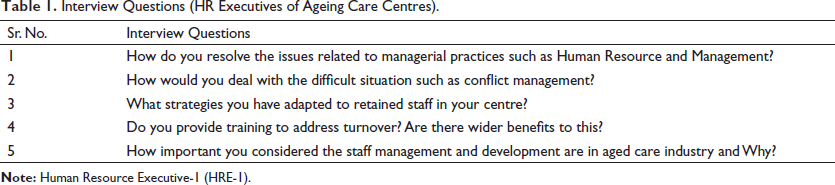
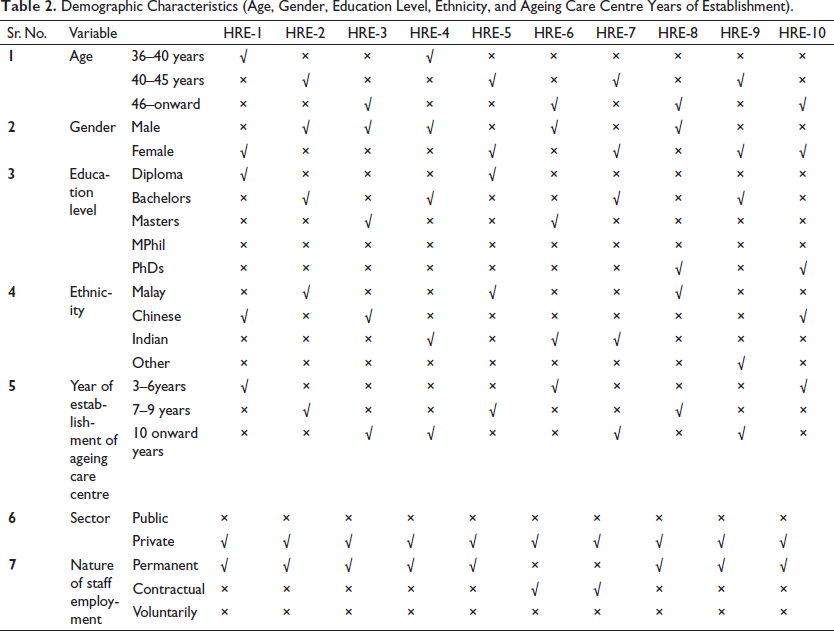
Table 2 demonstrates the demographic characteristics of participants consisting of age, gender, education level, ethnicity, and year of establishment. Two participants belong to age group 36–40 years, while four each belong to age group 40–45 years and 46–onward. The five each male and female are interviewed in this study. However, concerning education level two each PhD, Maters, and diploma holder, whereas four with a Bachelor’s degree. Regarding the ethnicity of participants, three Malays, Indian and Chinese each, and one from other nationality included in this study. Related to a year of establishment of ageing care centre majority of centre (4) are working from 10 years onward, while three centres each working from 3–6 years to 7–9 years. The private sector ageing care centres are included in this study. Most of the centres have permanent staff, while two of the centres have staff on contract basis also.
Demographic Characteristics (Age, Gender, Education Level, Ethnicity, and Ageing Care Centre Years of Establishment).
Findings
After interviewing the HR executive from ageing care centres, the coded data from each interviewee were cross referenced with other to reveal the similarities and differences for elimination of redundant themes. Crotty (1998) demonstrated that cross referencing of coded data reducing the number of themes. Table 3 shows the generated themes from the interviews.
Generated Themes.
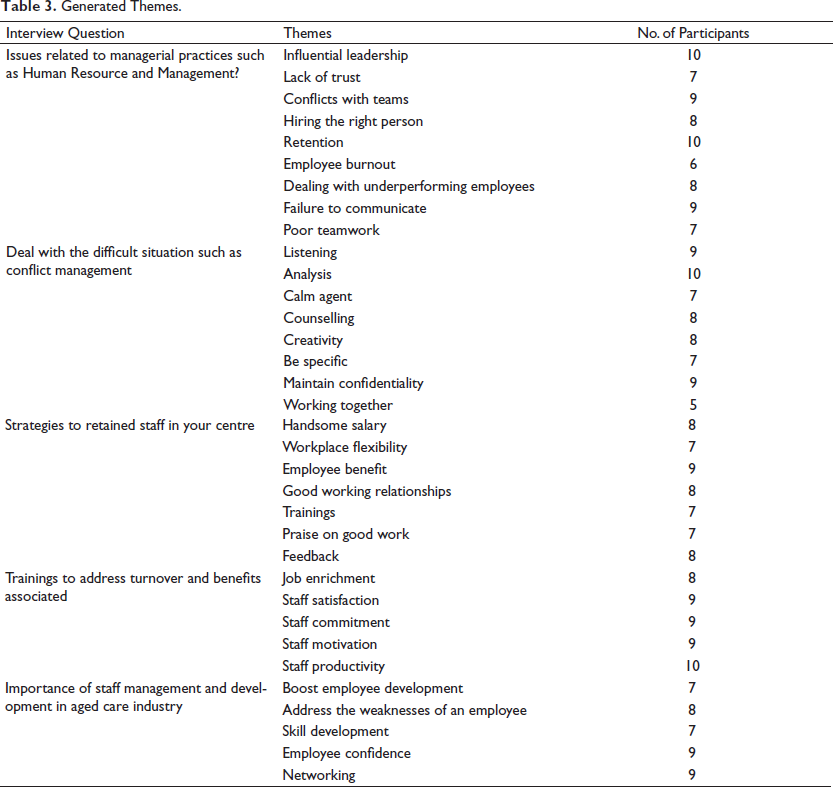
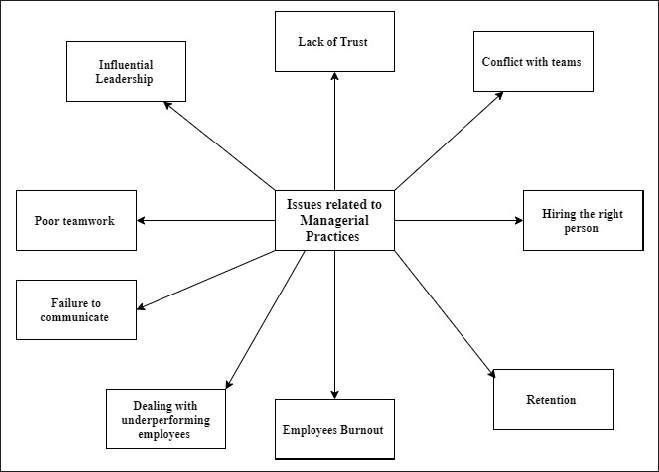
Regarding issues relating to managerial practices majority of the participants expressed their concerns about influential leadership, retention issues, and conflicts with the team, failure to communicate, hiring the right person, and dealing with underperforming employees and employee burnout (Figure 1). The findings correspond to previous literature (Cherry & Jacob, 2014; Kessler, 2015; Jonasson et al., 2019). Some of the quotes from interviews are as follows:
I feel that strong leadership is missing due to which the conflicts arise. Sometimes we are unable to communicate as the staff is very emotional and do not listen. The mistake is hiring should be the right person for the right job and staff left job sometimes without discussing the reason. (Participant HRE-7) I am facing staff retention issues and employee burnout; we are barely sustaining our business and using different ways to cover our operational cost. Staff retention is another issue because we have a mostly young staff, and they become emotional sometimes and takes their decision haphazard. (Participant HRE-2) Dealing with the underperforming staff is the main issue as they are not much serious to opt it as a profession as the nurses who come into the elderly centre they usually left us as they get a job in a big hospital so here we cannot stop them as the government has to do, something in making elderly home care as an industry and opt it as a career path. (Participant HRE-9)
Issues Related to Managerial Practice (Human Resource Management) in Ageing Care Centres.
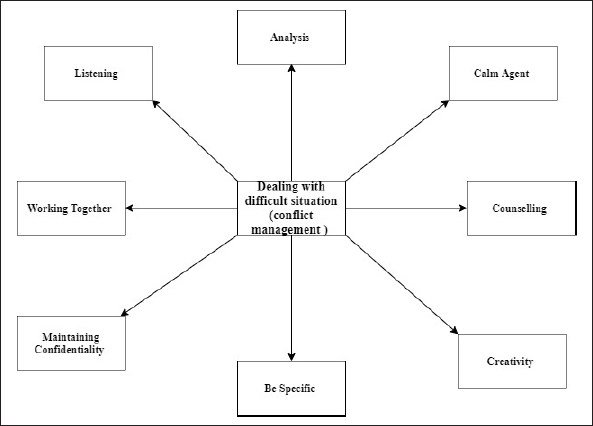
Concerning Q-2 about dealing with a difficult situation such as conflict management, interviewees stressed listening, analysis of the situation, counselling to solve the issue, behaving like a calm agent, be specific, and maintaining confidentiality in order to tackle the situation and calm down the two parties by listening both sides stance (Figure 2). The findings are in line with past literature (Bartram & Dowling, 2013; Khatri et al., 2009; Meranius & Karin, 2018). Few verbatims from interviews are as follows:
To handle the conflict is becoming a big issue. We need to manage it by acting as a calm agent and listening to both parties. I try my best to counsel to resolve the matter. If the staff want to meet, I never regret and try to manage it to tackle the situation in a pleasant and peaceful environment. (Participant HRE-8) In order to avoid thinking of favoritism among employees, we try to treat all staff equally because staff conflict increases by this, and de-motivation also comes. We need to listen to everyone and let them clear their point of view to calm down the situation. (Participant HRE-6)
Dealing with Difficult Situation (Conflict Management).
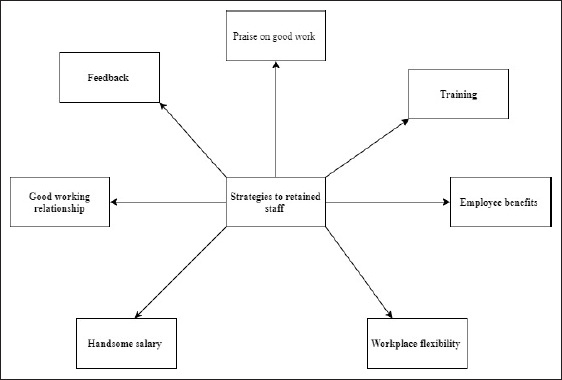
Regarding Q.3 related to adopted strategies by HR executive for staff retention. The majority of the HR executive highlighted attractive salary packages, flexible working hours, good working relationships, training workshops, evaluation, and acknowledgment (Figure 3). The findings are in tandem with previous literature (King et al., 2013; Leggat et al., 2011; Shirinashihama, 2019). The feedback from the participants is listed below.
We have set the salary packages keeping in view the experience of the staff. We are trying to facilitate them with a flexible working environment with tea and lunch break. Monitoring is continuous, and feedback is given to staff about their weaknesses and strengths. (Participant HRE-1) We allow the female staff to bring their kids and providing the facility of care of children free of cost, in break time they can visit their children in the same premises. Similarly, every month our employee goes on training on a rotation basis to learn something new and implement it. We believe in providing a good working environment and making trust-worthy relationships with our employees; that is how we can retain our staff. (Participant HRE-3)
Strategies to Retained Staff.
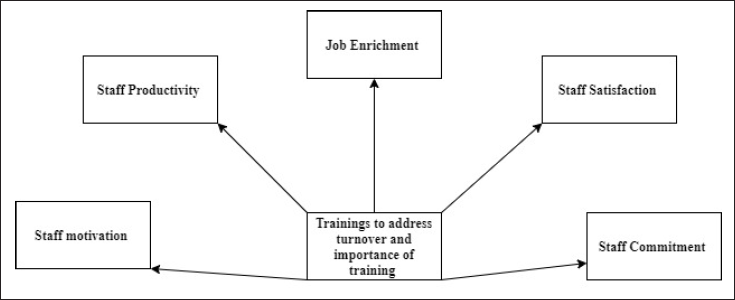
Concerning Q4 importance of pieces of training to address turnover and associated benefits, interviewees explained about job enrichment, staff satisfaction, commitment, motivation, and productivity (Figure 4). The present findings are in line with past literature (Bartram & Dowling, 2013; Cookson et al., 2012; Yang et al., 2020). Some of the verbatim from the interviews are as follows:
Training is very important, and currently, we have less trained staff. We try to send staff on Training on a rotation basis. The staff get groom by Training, and it increases the motivation and productivity of staff also. (Participant HRE-5) Training plays an important role to strengthen the staff skills and helps in overcoming the weaknesses. We are trying to get our staff trained, but still we are in the infancy stage and struggling. (Participant HRE-2)
Trainings to Address Turnover.
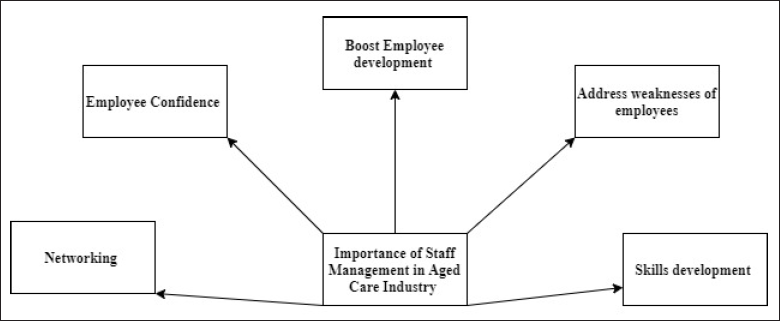
Reference to Q5 about the importance of staff management and development in the aged care industry. The interviewees revealed that it is essential to train the staff to boost employee development, addressing the weaknesses of an employee, enhancing skills development of staff, networking, and employee confidence (Figure 5). This findings correspond to previous literature (Jonasson et al., 2019; Kessler, 2015; Khatri et al., 2009; Meranius & Karin, 2018). The feedback from the participant is as follows:
There is a need for staff management and development in the aged care industry as the majority of staff in centres are untrained and possess less confidence. Proper management, evaluation and training will help them to enhance their skills and learn new techniques and procedures. The staff management is an important strength of an organisation as staff of any organisation is the backbone of the organisation. So I agree that proper staff management and its importance in the health segment, specifically in the aged care sector. (Participant HRE-9)
Importance of Staff Management in Aged Care Industry.
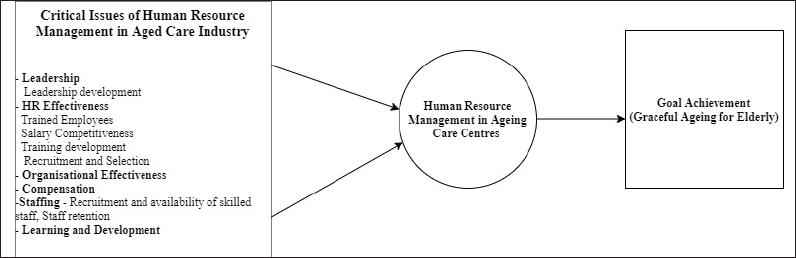
Based on the finding a successful human resource management model in ageing care centres is proposed.
Successful Human Resource Management Model in Ageing Care Centres
It is imperative to highlight the critical issues of human resource management that contribute to the overall development of care business management, specifically in the aged care industry. Thus, extracting the issues may help in to maintain strong management in ageing care centres like other business such as cottage industries, SMEs, and enterprises. Figure 6 demonstrates the critical issues of human resource management in ageing care centres such as leadership, HR effectiveness, organisational effectiveness, compensation, learning, and development. Thus, every human resource executive must be fully equipped with the knowledge of planning, recruitment, selection, training, and professional development, and overall supervision and support of staff. Based on the findings, a successful human resource management model in the aged care industry is proposed (Figure 6).
Successful Human Resource Management Model in the Ageing Care Centres.
Theoretical Justification
Resource-based view (RBV) theory, which has been recognised as one of the most influential and cited theories in contemporary strategic management research, was developed by Wernerfelt (1984), Rumelt (1984) and Barney (1986) in the mid-1980s. It adopts an inward approach by focusing on a firm’s internal strengths and weaknesses (Barney, 1991). Immensely, it helps to explain under which conditions that resources possessed by a firm can generate sustained competitive advantages. RBV suggests that, if a firm is to achieve sustained competitive advantages, it must possess bundles of strategically relevant resources and capabilities (Barney, 1991) that are valuable, rare, imperfectly imitable, and non-substitutable. Hence, RBV theory stresses on the forces of internal resource factors of an organisation that add to its ability to do superior to the other firms and organisations in an industry. Therefore, for this study, RBV is a good fit. Relate this theory to the HRM strategies or practices plays a vital role to in overall achievement of organisational goals (Atkinson & Lucas, 2012; Bartram & Dowling, 2013).
Implication to Move Forward
Senior management in elderly care centres gets some pieces of training related to leadership skills. It will help in maintaining a good rapport with staff. The training related to goal setting, conflict management, emotional intelligence, and stress management will be very fruitful in this regard.
It is essential to maintain goodwill and create a conducive working environment for the staff.
The job description, along with the required skills needed, maybe clearly define and training related to soft skills and may be tailored to fulfil the specific needs of staff and organisation as a whole.
The staff in elderly care centres require pieces of training such as communication skills, personal development, leadership, care training, caregiver ethics, dementia care, end of life care training.
Training should include both methods of traditional and technological training room learning and on-job training. The evaluation should be regular, and feedback may be provided while highlighting the strengths and weaknesses.
HR executive may adopt necessary measure to motivate employees by demonstrating that training is considered as a talent development path. It is essential to have an equal distribution of work so that the staff is not overburdened.
There is a need of teamwork approach, and staff can experience the importance of teamwork by training session especially away from the office, and it will give them a more positive experience and help them to look forward training as a new experience.
For motivating the staff, it is vital to acknowledge them with additional incentives such as certification, bonus, or small gifts, which have completed the training. Recognition may appear as a powerful tool to motivate the staff by showing them that they are valued.
Conclusion
The increasing ageing population is making the care support of the elderly as the most significant challenge for the aged care industry. The question arises how much the human resource management of these ageing care centres are strong and efficient to tackle the care services challenge of elderly. To fulfil the need of elderly in ageing care centres, strong human resource management is needed to provide a higher quality of care to elderly’s in centres, as they are vulnerable, sensitive, dependent on others, attention-seekers, and it will not be wrong to say that they need to be taken care of just like children. The human resource may be considered as an important segment for providing protection and care to the ageing population, as it signifies the professional staff. Due to increasing demand for elderly care in these care centres, human resource management plays a remarkable role in providing quality care and service along with economic sustainability. It is one of the strategic management processes, which stresses on human resource development to gain competitiveness in the service market. The critical issues of human resource management in ageing care centres are the absence of professional and trained staff. Few of the staff have no caregiving certification and previous knowledge of caregiving. The staff needs constant development and training programs related to caregiving and elderly care. The training programs may motivate the staff in achieving their job security and for the centre staff retention whereas for elderly may come up with quality and adequate care, which may lead to healthy and graceful ageing in Malaysia. Future researches can be conducted on the role and characteristics of human resource practices in ageing care centres. Further study may give comparisons of ethnicities, as this study highlights all three races in Malaysia. Furthermore, the same methodology may apply and study may conduct in Asian countries such as Pakistan, India, and Bangladesh, and further studies can be done on perspective of ASEAN countries.
Footnotes
Declaration of Conflicting Interests
The authors declared no potential conflicts of interest with respect to the research, authorship and/or publication of this article.
Funding
The authors received no financial support for the research, authorship and/or publication of this article.