




Abstract
This article discussed some of the important issues regarding the effect of epidemics like COVID-19 on the migrant population. These impacts are most troubling for low-income households, which are less well positioned to cope with earnings losses during a recession, have no alternative earnings and have no social security available. Most of these workers earn little more than a subsistence wage and have no other means to protect their incomes if they lose their jobs. Migrant workers constitute quite a large proportion of such vulnerable population.
Millions of migrant workers are anticipated to be left unemployed in India due to the lockdown and subsequent fear of recession. Many of the migrant workers have returned to their villages, and many more are just waiting for the lockdown to be lifted. The risk is particularly higher for those who are working in unorganised sectors, and those who do not have writer contracts, or those whose contracts are at the verge of completion. The lockdown and the subsequent recession are likely to first hit contract workers across many of the industries.
On the one hand, lockdowns and social distancing measures are drying up jobs and incomes, whereas they are likely to disrupt agricultural production, transportation systems, and supply chains on the other. This poses a challenge of ensuring food security and controlling already rampant malnutrition, particularly among children, which is likely to result in increased infant and child mortality. There is a need to relook at the national migration policies, which should accommodate the assistance and protection of migrants arriving from, or faced with the prospect of returning to, areas affected by health crises. Also, there is a need to establish resilient food systems that could reduce food insecurity and the pressure to return to origin among migrants.
Background
The relationship between migration and health is found to be multidimensional and bidirectional. Health status can drive a decision to migrate, but such relocation may in turn have an influence on health (Ginsburg et al., 2018). Circular migration has further been associated with the spread of health conditions or behaviours between destination and origin areas, affecting the health status of others. The structure of urban and rural populations in India and the dynamic component of migration are likely to exacerbate the COVID-19 epidemic in the country. A large number of migrants who are from rural areas but work in the cities may be susceptible. The quarantine measures taken by the government are appropriate, but these may lead to inefficient outcomes because many of the migrants would prefer to escape the centres of disease, consequently inflicting negative externalities on other uninfected people. Studies indicate that when a disease has an epicentre, the marginal migrant imposes a net negative externality (Mesnard & Seabright, 2009). Research has also confirmed suspicions that travel restrictions do not have much effect on the spread of pandemics (Carter, 2016). The major problem is that usually enough cases have been ‘seeded’ by the time awareness of an epidemic crystallises. Many models have been developed and used to study the spread of an epidemic in space. Most of these are based either on contact distributions or on processes describing migration or movements of individuals in space (Noble, 1974).
Public health interventions mainly aim at three types of population to prevent or mitigate the spread of an emerging infectious disease and its negative effects: (a) the population in the source area, (b) the floating population leaving the source area and (c) the population travelling from the infected area to other areas. Although there have been several studies on how migration affects the spread of epidemic, however, another important dimension of the problem is the way in which an epidemic affects the migrant population. Epidemics not only pose a public health crisis, but often convert into an economic crisis and a migration crisis too. In epidemic conditions, a large number of internal migrant workers are trapped in cities after being laid off due to the measures taken by the government to control the spread of the disease. Most of these workers earn little more than a subsistence wage and have no other means to protect their incomes if they lose their jobs.
This issue drew attention of the administrators and researchers when it was noted that after the announcement of the 21-day-country-wide lockdown due to COVID-19 in India, there was a sudden gathering of tens of thousands of migrant workers from across the city of Delhi, walking towards bus terminals to cross into Uttar Pradesh, Bihar and other states. They gathered in thousands being desperate to reach their hometowns in adjoining states. With most transport links shut down, many were trying to walk hundreds of kilometres back to their rural homes with their families. The government, who initially had stopped all the public transportation, and emphasised on ‘remaining at home’, had to take the decision to allow people to reach bus terminals and city borders and arranged hundreds of buses into service. Further, the Central government asked State governments to take measures to prevent a mass exodus of migrant workers in the wake of the national lockdown. A mass departure of migrant workers from cities in several states to their villages raised concerns that the COVID-19 outbreak could turn into a humanitarian crisis. Realising the gravity of the problem, the government launched a new scheme, namely Migrant Workers Return Registration. This scheme’s main motto is to count the number of daily labourers and migrant workers who got stuck in other states, as well as to provide them with 14 days of quarantine facilities and arrangements after they reached their hometowns. State governments across the country launched their portals and accumulated the data of their people (daily labourers and migrant workers), so that they could be shifted to their hometowns easily. A large number of buses were arranged for their interstate movement. The Indian Railways also introduced Shramik special trains for the relocation of migrant workers, tourists, pilgrims, students and others.
There is a fear that COVID-19 recessions in India can take an extraordinary human toll that extends well beyond temporary earnings losses for unemployed workers. The studies on earlier recessions suggest that the job loss during a downturn sometimes results in long-term unemployment and wage setbacks, deteriorating the health of unemployed workers and increasing poverty. These impacts are most troubling for low-income households, which are less well positioned to cope with earnings losses during a recession, have no alternative earnings and have no social security available (Papademetriou et al., 2010). Migrant workers constitute quite a large proportion of such vulnerable population. In this article, we have discussed some of the important issues regarding the effect of epidemics like COVID-19 on the migrant population.
Predicted Global Recession
Due to a wide and sudden spread of COVID-19, the world economy faces the thread of a serious recession. The Organization for Economic Cooperation and Development (OECD) forecasted that in a best case scenario, its fallout would slash global growth by half a percentage point (Lowrey, 2020). Similarly, bodies such as the International Monetary Fund (IMF), the World Bank and the Secretary-General of United Nations also predicted global recession and significant economic crisis in many countries (Business Today, 2020, April 3).
The threat of recession is particularly important for India, as the pandemic came at a time when the country was already facing problem of economic slowdown. Early estimates by the government suggest that there will be a hit of 0.3–0.5 per cent on the GDP in the next fiscal year, and growth in the first two quarters of the next fiscal could be as low as 4–4.5 per cent (Economic Times, 2020, March 17). Sectors such as tourism, aviation, hospitality and trade will be severely affected, and these sectors would be the first to face the impact. According to the International Monetary Fund (IMF), micro-, small- and medium-sized enterprises (MSMEs) and the services sectors are likely to be among the most affected due to reduced consumer spending. Fitch has cut GDP growth forecast for India to 2 per cent for the fiscal year ending March 2021, which would make it the slowest growth in India over the past 30 years (Business Today, 2020, April 3).
Impact of Recession on Workforce
There have been evidences in the past about how a recession affects the workforce. During the global financial crisis of 2008–2009, an estimated 22 million people had lost their jobs, according to the International Labour Organization (ILO). India, like many other countries of the world, had to face recession in 2009. A study carried out by the United Nations Development Programme (UNDP; Kumar et al. 2009) revealed some facts about how that recession impacted the migrant workers in India. According to UNDP, job loss was around 40,000 for engineering, 100,000 for gems and jewellery and 500,000 for garments. Of these, engineering job losses were spread throughout India; the gems and jewellery ones were especially located in Gujarat; and the garments losses were located mostly in Ludhiana and Tirupur. Around 20,000 construction workers lost their jobs in the Gulf. Overall, these job losses were more in the unorganised sector. The experiences of the recession of 2009 suggested that downsizing adversely affects those who are employed in unorganised enterprises and those who are employed in organised enterprises, but whose employment contracts are of informal nature (Kumar et al., 2009).
Another study on the impact of recession in Kerala (Zachariah & Rajan, 2010) indicated that more than one-fifth of the emigrants returned home because they lost their jobs due to the financial crisis, while another 3.3 per cent came because they were compulsorily repatriated. Another 11.5 per cent of the emigrants reported that they returned home because their contract had expired and was not renewed. Adding up all, the total percentage of emigrants who returned home owing to the economic recession was around 36 per cent (about 63,000 emigrants) in the state of Kerala.
The recession due to COVID-19 appears to be more serious than what we faced in the 2009 recession. The ILO has estimated that up to 25 million people might become unemployed worldwide due to the impact of COVID-19, ranging between 5.3 million job losses on a ‘low scenario’ and 24.7 million on a ‘high scenario’ (ILO, 2020). The impact may differ from country to country. During the peak of the COVID-19 in Wuhan, almost 5 million people in China lost their jobs in January and February 2020 (Cheng, 2020). A survey from the Angus Reid Institute found that 44 per cent of Canadian households have experienced some type of job loss (Macleans, 2020). Nearly 900,000 workers lost their jobs in Spain since it went into lockdown in mid-March 2020 (Keeley, 2020). In March 2020, more than 10 million Americans lost their jobs and applied for government aid (Weissmann, 2020). The Federal Reserve Bank of St. Louis estimated that the coronavirus outbreak could cost 47 million jobs in the USA and unemployment rate may hit 32 per cent (Davidson, 2020).
According to the early estimates, tens of millions of migrant workers were left unemployed in India by the end of March 2020 due to the lockdown (Al-Jazeera, 2020). Many of the migrant workers have returned to their villages, and many more are just waiting for the lockdown to be lifted. The magnitude of migration and the job conditions of migrant workers are discussed below.
Migration and Employment Conditions in India
Generally, economic crisis in the destination reduces the number of migrants, reduces remittances, and disrupts migrant systems (Curran et al., 2016). The Economic Survey 2016–2017 had estimated that more than 9 million people migrate annually within the country, and mort of such migration is for job or education. While Delhi, followed by Mumbai, is the top destination for migrants, many people are migrating to the cities in southern states, like Bangalore, Chennai, etc. The largest number of these migrants sets off from the states of Bihar, UP, Bengal and Assam.
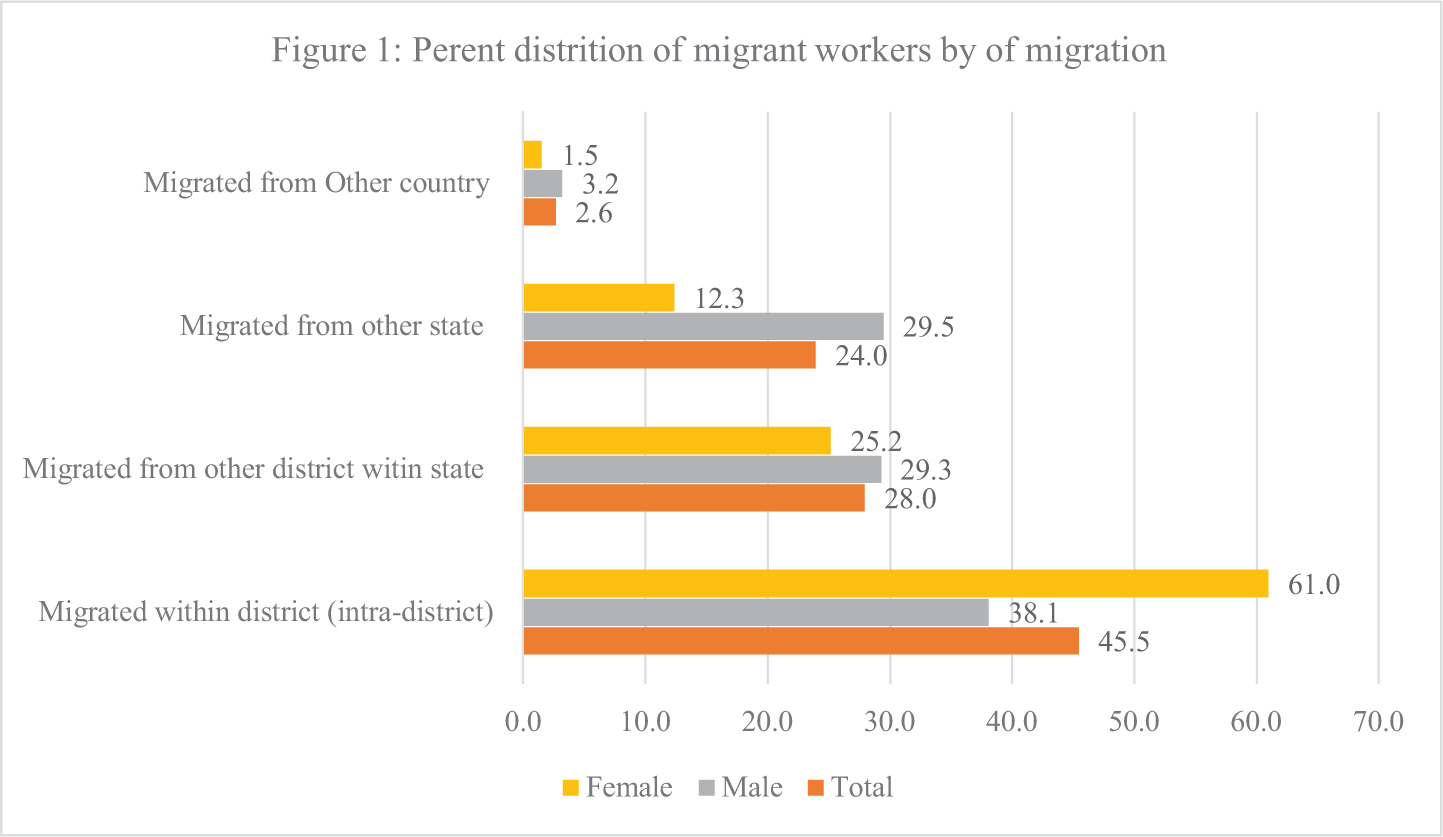
The Census 2011 data show that, in India, a large proportion of migration of the workers is within the district and to the other districts within the state (Figure 1). Around one-fourth of the total migration is to the other state. The migration of workers is more in urban areas due to the availability of educational and employment opportunities.
International migration constitutes around 2.6 per cent of the total migration (Census, 2011). As per ILO (2018), there are over 30 million Indians overseas, with over 9 million of the Indian migrants concentrated in the GCC region (now known as the Cooperation Council for the Arab States of the Gulf). Over 90 per cent of Indian migrant workers, most of whom are low- and semi-skilled workers, work in the Gulf region and South-East Asia. The contribution of migrant workers, both highly skilled and low skilled, has led to India becoming the top recipient of remittances in the world, with over US$62.7 billion received in 2016 (ILO, 2018).
Internal migrants form a crucial part of India’s economy. The Economic Survey 2016–2017 estimated that there are an estimated 100 million internal migrants in India, which make up about 20 per cent of the total workforce. They contribute an estimated 10 per cent of India’s economic output (Al-Jazeera, 2020) and play an important role in the economy of the country. Many of the internal migrants travel from poorer states such as Bihar and Uttar Pradesh in the north to work in the industrial hubs of more developed states like Gujarat and Maharashtra in the south, or to the metro cities.
According to Census 2011, there were around 65 million migrant workers working in various occupations, excluding cultivators and agricultural labourers (Table 1). The analysis of non-agricultural migrant workers according to occupational category shows that a large proportion of them are engaged in craft and related trades or as plant and machine operators and assemblers.
Migrant Workers (other than cultivators and agricultural labourers) in India by Occupation (percentage)

The migration data of Census 2011 also indicated that a large number of migrants are arriving in different urban areas, particularly metro cities from different states. For instance, in Delhi, a large proportion of migrants are coming from Uttar Pradesh, Bihar, Haryana, Uttranchal, Rajasthan and Punjab. They depart from remote villages seeking work in large cities to support families whom they usually leave behind. In Delhi, around 39 per cent of the migrants came from Uttar Pradesh alone. Bihar also had around 12 per cent share in the total migration to Delhi.
A recent study by Mehrotra and Parida (2019) estimated that around 115.3 million people are engaged in industrial employment, of which the manufacturing sector employment accounts for 56.4 million, while the remaining 58.9 million are in the non-manufacturing employment (Table 2). In the manufacturing sector, the largest proportion of employment is in textiles and wearing apparel, followed by food and beverages. A large majority (92%) of those who are working in non-manufacturing employment are engaged in construction work.
Around 144.4 million people are employed in the service sector. Of these, more than one-fourth are engaged in retail trade except motor vehicles (Table 3). Land transport accounts for around 15 per cent of the total service sector. Nearly 6 per cent of the total people are employed in hotels and restaurants, while around 12 per cent of the total people in service sector are engaged in the education sector.
Subsector-wise Industrial Employment Trends in India

Sub-sector-wise Service Sector Employment Generated in India

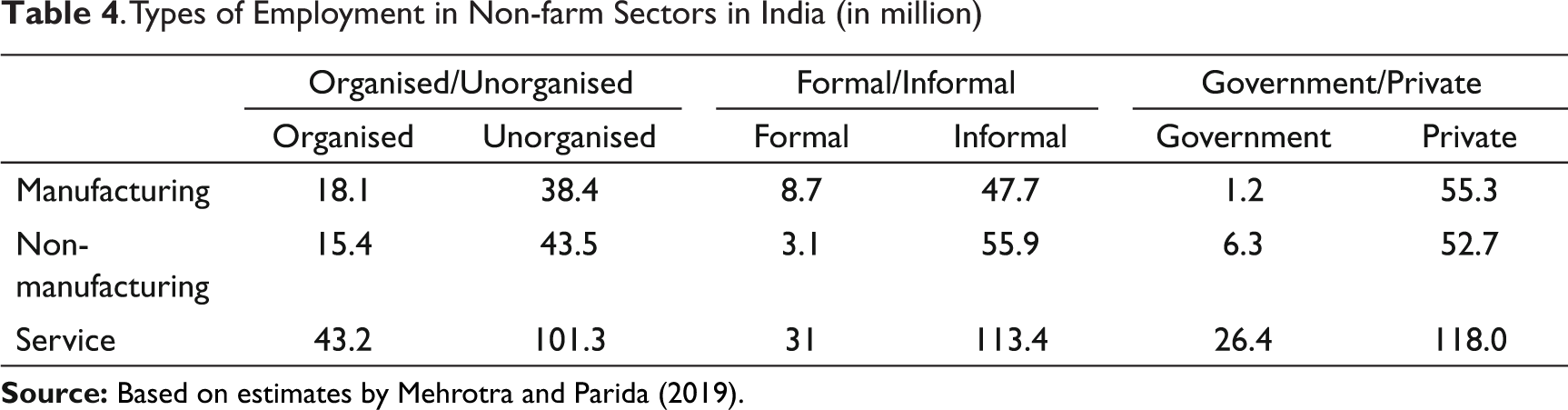
Considering that the large cities in India have a large number of migrant workers coming from different states, it is also important to understand under what conditions they work. Mehrotra and Parida (2019), in their study, estimated that there are around 260 million people working in the non-farm sector. Of these, more than 101 million people are working in the unorganised sector, which is around 71 per cent of the total people working in the non-farm sector, as indicated in Table 4. A large majority of the workers engaged in non-farm employment are working in the informal (83.5%) and the private sectors (87%). The proportion of people working in unorganised, informal and private sector was found to be higher irrespective of whether they are engaged in manufacturing, non-manufacturing or service sector.
Types of Employment in Non-farm Sectors in India (in million)
Situation of Employment
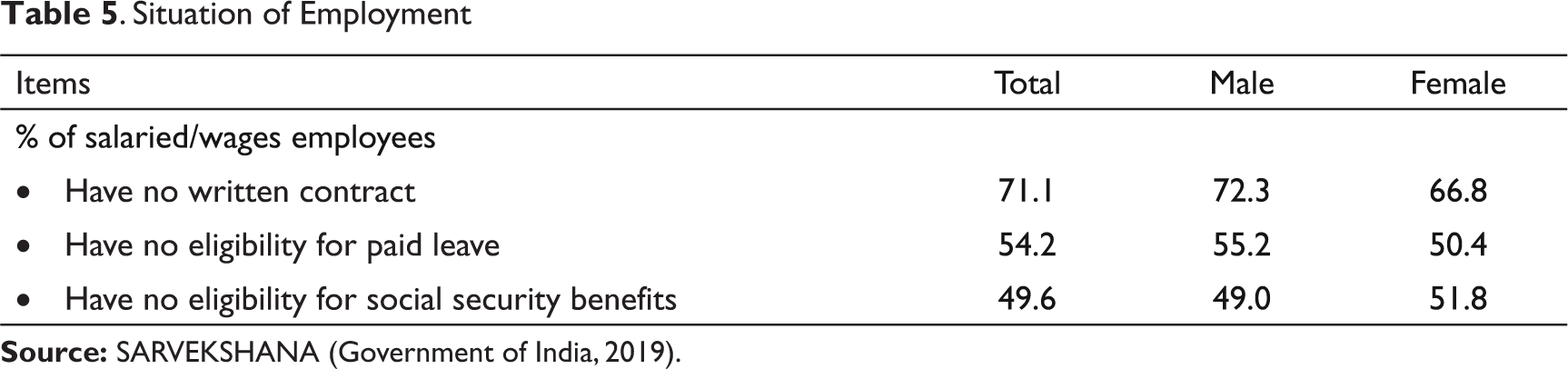
The national statistical office’s (NSO’s) report presented in SARVEKSHANA (Government of India, 2009) revealed that among regular salaried employees in the non-agriculture sector, nearly 71 per cent had no written job contract, and such proportion was higher among males than females (Table 5). Around 54 per cent of regular salaried employees in the non-agriculture sector were not eligible for paid leave. Moreover, nearly half of them were not eligible for any social security benefit.
The SARVEKSHANA report also indicated that more than 68 per cent of the workers in non-agriculture sectors were engaged in the informal sector. The share of informal sector among male workers was 71 per cent, while the corresponding figure for females was 55 per cent. Hence, the informal sector constitutes a large proportion of the total workforce in the country.
The biggest impact of the slowdown in business is expected on micro-, small and medium enterprises (MSME), particularly in retailing, tourism and transportation, etc. The Confederation of Indian Industry (CII) indicated that more than half of the tourism and hospitality industry can go sick with a possible loss of large number of jobs if recovery in the industry stretches beyond October 2020 (Das, 2020). It would also affect the self-employed workers. The start-ups, which are in development stage, would also be affected, as their demand is not likely to pick up immediately after the lock down. At least for 1 year, any non-essential hiring will slow down, as the corporates will take a conservative approach towards employment and expansion. According to the Retailer Association of India (Nahata, 2020), about 40 million people in the informal sector and 6 million people in the formal sector are employed by the retail sector alone. Even in the formal sector, about 3–4 million people are employed on a contractual basis. Hence, in case of COVID-19 situation also, a large number of migrant workers are at immediate risk of losing their current job, temporarily or permanently. The risk is particularly higher for those who are working in the unorganised sector, and those who do not have writer contracts, or those whose contracts are at the verge of completion. The lockdowns and subsequent recession are likely to first hit contract workers across many of these industries.
What is Next?
When large-scale population migration occurs as a direct result of a health crisis, the movement mostly tends to be internal, temporary and early on in the health crisis. It generally happens to regions directly outside the immediate crisis zone, and mostly happens because of misunderstandings and panic, including financial crisis or fear of losing job. During the 2003 SARS outbreak, up to 1 million people left Beijing. In such example, people tended to go back to their native villages and return to the city after the crisis had subsided. A pneumonic plague broke out in Surat in August 1994, and receding that was a bubonic plague in Maharashtra’s Beed district. Compared to its bubonic form, the pneumonic plague spreads rapidly, and the plague in Surat caused widespread panic. The outbreak of the disease led to more than 200,000 people fleeing the city, making it one of the largest post-independence migrations in the country (Leo, 2020). Bihari workers fled from Maharashtra some years ago, when hostile nativists turned against them. Similarly, racial hostility spread panic among migrants from the North-East living in Bangalore in 2016.
Whether it is economic recession or an epidemic like COVID-19, migrant workers in large cities are forced either to stay in perilous conditions in the urban areas, or go back to their places of origin—villages or smaller towns. Initially, they change from becoming providers of remittance incomes to their households, to becoming dependents of these households. Many of these migrant workers come from the most depressed and backward regions of the country, where there is currently little potential for employment and education (Kumar et al., 2009). In this way, any health or economic crises at the destination also increase return migration to origin communities (Castles, 2011).
Another major challenge raised by the pandemic could be on the food security and nutrition. The COVID-19 may bring hunger to millions of people around the world. Available evidence suggests that insecurity is one of the main reasons why people abandon their livelihoods and move to other places. Crisis increases food insecurity and limits the livelihood options of migrant populations. On the one hand, lockdowns and social distancing measures are drying up work and incomes, whereas they are likely to disrupt agricultural production, transportation systems and supply chains on the other. According to the United Nation’s World Food Programme (WFP), an estimated 265 million people could be pushed to the brink of starvation by the end of year 2020 (Dahir, 2020). India is one among the countries where child undernutrition is severe. Around 38.4 per cent, 21 per cent and 35.7 per cent of children below 5 years suffer from stunting, wasting and underweight, respectively. Malnourishment results in compromised immunity, which puts an individual with a greater risk and susceptible to the spread of the virus. Undernutrition is a major underlying cause of child mortality in India, as it is the primary reason behind 69 per cent of deaths of children below the age of 5 in India (UNICEF, 2019).
Contemporary theories of migration suggest that decisions to move or stay and the overall patterns of movement are closely related to economic conditions in places of destination and origin, relationships that connect people between origins and destinations and the accumulated experiences at destinations among individuals and members of their community (Haas, 2012). Evidence from the Asian Financial Crisis and the Global Economic Crisis indicates that migrants’ cumulative experiences and shared migrant associations might influence the propensity for migrants to return to origin after an economic tremor (Curran et al., 2016). A number of migrant workers who left the big cities during the crisis may never return, preferring to drag out a living on their marginal farms or find work in nearby towns. It would deprive industrial centres such as Delhi, Gurugram, Surat and Tiruppur, Mumbai, etc. of labour for a long period of time, resulting in temporary shortage of human resources in the industries.
An epidemic is a problem that tests the ability of a nation to effectively protect its population, to reduce human loss, to save the economy and to rapidly recover (Rachaniotis et al., 2012). The Central and State governments are preparing strategies to cope with the crisis. The states and union territories have also been advised to make these vulnerable groups aware of measures taken by the government, including provision of free food grains and other essential items through public distribution system (PDS), and streamline the procedures. The Union government is planning to give unemployment benefits to a section of organised workers who may lose their jobs due to the COVID-19 pandemic. The labour and employment ministry is looking to extend the scheme and allow workers to avail unemployment insurance if they are impacted by coronavirus (Jha, 2020). However, these measures are not sufficient considering the intensity of the crisis. Much more can be done by the government to protect its people and economy.
The coronavirus epidemic has come with extraordinary, intense uncertainty. It is difficult to estimate how long and to what extent will the impact of the epidemic be on the lives of people and economy of the country. The government has to come up with a well-crafted strategy to deal with this crisis. At the national level, greater coordination is required between government agencies separately tasked with migration and health mandates. There is also a need to relook at the national migration policies, which should accommodate the assistance and protection of migrants arriving from, or faced with the prospect of returning to, the areas affected by health crises. Establishment of resilient food systems could reduce food insecurity and the pressure to return to origin among migrants. More research is required on the impact of health crises on migration, particularly in distinguishing health from other motivations to migrate.
Footnotes
Declaration of Conflicting Interests
The author declared no potential conflicts of interest with respect to the research, authorship and/or publication of this article.
Funding
The author received no financial support for the research, authorship and/or publication of this article.