




Abstract
Employee performance, supported by creativity and innovative work behaviour (IWB), is one significant predictor of organizational success. Creative employees with IWBs are crucial for an organization to achieve sustainable and competitive advantage over its rivals. Human resource (HR) management practices are critical in fostering employee creativity (EC) and IWB. Organizational support and knowledge-sharing (KS) are other factors that largely contribute to EC and work behaviour. Organizations must understand these variables and their interactions to develop an environment of creativity and innovative work practices. This article explores the mediating role of perceived organizational support, KS and EC between HR practices and employees’ innovative work practices. For this purpose, a theoretical model has been developed, and six hypotheses were set for statistical testing. Data collected from 404 employees working in various IT companies in Kerala are analysed using structural equation modelling. The results showed significant direct and indirect effects of the variables in predicting employees’ work behaviour. The study’s insights provide valid information for strategy formation that fosters IWBs supported by HR practices, organizational support, KS and EC.
Keywords
Introduction
Human resource management (HRM) practices are highly concerned with developing employees’ knowledge, skills and behaviours to achieve organizational goals better (Chen & Huang, 2009). HR practices help organizations achieve higher productivity, increase profits and grab competitive advantages over competing companies (Cascio, 1992). Productivity and profitability are the outcomes of employee engagement and organizational performance. Hence, every organization is concerned about optimizing employee and organizational performance. One way to improve employee performance is to invest in employees to enhance their knowledge, skills and behaviours. Knowledge management, which encompasses knowledge generation, identification, sharing and application, can improve human capital within an organization (Iqbal et al., 2018; Rezaei et al., 2021). High-quality human capital not only provides higher value to the organization, but its complexity makes it harder to copy or substitute (Wright et al., 1994). In this era characterized by globalization, technological advancement and fierce competition, businesses that leverage knowledge effectively can gain a significant edge over their rivals (Rafique et al., 2018).
One vital resource that is seen to be essential to an organization’s success and survival is knowledge (Caputo et al., 2019; Carayannis & Meissner, 2017; Islam et al., 2021). In this context, there is a solid need to foster an environment of knowledge-sharing (KS) across employees in every workplace. KS can help achieve higher-quality performance at work, support employee creativity (EC) and encourage innovation in work practices (Luu, 2021). KS can benefit individuals’ and organizations’ performance (Anand et al., 2021). Collaboration and knowledge exchange have long been seen as the cornerstones of success in the modern workplace. Personal knowledge can become organizational knowledge if it is shared among the employees (Akhavan & Imani, 2016). If not shared, knowledge will remain personal property, harming the company’s competitive advantage in the future (Philsoophian & Akhavan, 2017).
Conversely, it is not uncommon for individuals to show reluctance in sharing knowledge, information and skills with others (Anand et al., 2020; Babcock, 2004). In many workplaces, there is a widespread problem of knowledge hiding or lack of sharing, which has severe damaging consequences for the organizations (Butt & Ahmad, 2020). EC and innovative work behaviour (IWB) are two major areas associated with an organization’s performance where KS behaviour can make valuable contributions. Organizations where employees are open to sharing their knowledge, skills and expertise with others demonstrate higher levels of innovation, creativity and operational success than similar organizations (Ganguly et al., 2019; Lee et al., 2015). The literature identified many factors that contribute to KS and knowledge-hiding. As HRM practices are supposed to develop the human factor/employees, it is the responsibility of HRM to develop a culture that supports the employees freely sharing their knowledge with people in need to achieve the organization’s targets effectively.
From this viewpoint, it will be beneficial to understand the contribution of HRM practices and organizational support that leads to EC and work behaviour through a free sharing of knowledge. Many previous studies revealed the association between HR practices, organizational support (Chen & Huang, 2009; Rhoades & Eisenberger, 2002), KS behaviour of individuals, EC and their work behaviour (Anand et al., 2021; Luu, 2021) in association with organizational performance. However, a few studies have investigated the connection of HR practices with employees’ work behaviour associated with organizational support, KS and EC, especially in the Indian context. This article intends to address this gap and develop a comprehensive model for fostering IWBs supported by HR practices, organizational support, KS behaviours of employees and their creativity. The study is designed to assess the direct and indirect effects of predictor variables on IWB through the mediating variables and to decide on the type of mediation where there are direct and indirect relationships. The study results are expected to provide valuable information of strategic importance for shaping or reshaping HR strategies and practices to foster KS, EC and IWB at workplaces. It will also contribute to the literature with added knowledge on the psychological traits of employees in dealing with new technologies.
Literature Review
HRM practices are supposed to develop the employees to the desired level of knowledge, skills and behaviours to achieve the organization’s strategic goals (Chen & Huang, 2009). HR practices help organizations achieve higher productivity, increase profitability and grab competitive advantages over competing companies (Cascio, 1992). HR practices should develop a culture of ‘caring and trust’ and be supported by transparent communication and fairness in decision-making. (Cabrera & Cabrera, 2005). Employees who perceive that they have a voice in decision-making are more likely to view their work as a collaborative effort and never consider their co-workers as competitors, thereby being more likely to share their knowledge (EI-Kassar et al., 2022). Employees shape their perceptions at the workplace by gathering information from various sources (Salancik & Pfeffer, 1978). When they feel that their organization supports their creativity by incorporating policies that empower them, participate in problem-solving and support their career advancement (EI-Kassar et al., 2022), they will likely trust their management and co-workers more. In such situations, employees feel protected and believe the organization supports their creativity. According to Rhoades and Eisenberger (2002), employees’ perceptions of organizational support can improve their loyalty and performance and reduce their tendency to withdraw. Beyond that, perceived organizational support (POS) can positively shape employee behaviours (Ibrahim et al., 2016). According to social information processing (SIP) theory, people construct their attitudes and control their subsequent behaviours by evaluating the information they perceive about their surroundings (Zalesny & Ford, 1990). The practices mentioned above are anticipated to fortify the relational dimension of social capital, elevate mutual trust within groups of employees and enhance the expectations of reciprocity (Cabrera & Cabrera, 2005). Thus, HR practices are determinant in developing an organizational culture that supports employees’ knowledge transfer.
In the rapidly changing business landscape, knowledge has become one of the most valuable assets a company can possess (Barney, 1991; Zahedi et al., 2024). KS is a desirable behaviour among employees and is very important to effectively achieve a sustainable and competitive benefit to the organization (Cabrera & Cabrera, 2005). KS means transferring knowledge and skills between individuals, groups, or organizations (Lee et al., 2021). The extent of trust among the employees will naturally positively influence the employees’ KS behaviour (Seba et al., 2012). Employees who have trusting relationships with their co-workers are more willing to exchange knowledge with one another (Okyere-Kwakye et al., 2012). According to Paulin and Suneson (2012), KS is possible when employees have the motivation to share their knowledge. However, workers prefer to refrain from imparting their knowledge to others (Barner-Rasmussen & Aarnio, 2011). Organizations where employees are generous in sharing knowledge with their colleagues are found to be more innovative and successful (Ganguly et al., 2019; Kim et al., 2015). The project team members can perform better and excel through innovation when they are open-minded enough to share their knowledge (Olaisen & Revang, 2017). Knowledge supports informed decision-making, drives innovation, provides a competitive advantage and contributes to long-term sustainability for business enterprises. In the present business environment, knowledge often differentiates successful companies from their competitors (Yeboah, 2023). Companies with unique insights, proprietary information, or specialized expertise have a distinct advantage. Organizations thrive on their employees’ collective intelligence and expertise in a knowledge-based economy.
The significant advantage of KS is that it enhances the quality and creativity of individuals and teams in the workplace, thereby improving organizations’ performance (Anand et al., 2021). Given the impact that HRM practices have on employee behaviour, it is helpful to look into the relationship between HR practices and work behaviour and EC through KS among employees, subject to ensuring organizational support for this practice (Sheehan et al., 2014). Since KS and the resulting increase in EC are linked to an organization’s and its employee’s ability to adapt to a changing business environment quickly, they are significant for the sustainable performance of any organization (Almahamid et al., 2010). Knowledge capitalization across the entire organization is necessary, as organizations rely on their team for product development to develop new products (Malhotra & Majchrzak, 2019).
Studies revealed various organizational dimensions that have a close connection with KS. These include management or organizational support for KS (Wang & Noe, 2010), rewarding strategy (Hau et al., 2013; Amayah, 2013), organizational structure (Abili et al., 2011; Seba et al., 2012) and the culture of the organization (Abili et al., 2011). De Long and Fahey (2000) state that knowledge creation, exchange and utilization heavily depend on organizational support. They opined that creating explicit norms that encourage employee KS is the first step in promoting a healthy KS culture. The next step is developing an environment of caring and trust among the individuals, which is essential in motivating them to impart their knowledge and skills to others. In an environment that is supportive of employees and is open and trustworthy, people are more likely to share knowledge (Settoon & Mossholder, 2002). Kaabi et al. (2018) observed a direct relationship between HR practices and KS behaviour in ICT companies. A well-designed HRM strategy can enhance the KS behaviour within an organization (Minbaeva et al., 2012). According to EI-Farr and Hosseingholizadeh (2019), HRM strategy becomes more effective when combined with a knowledge management strategy as part of the overall organizational strategy. Than et al. (2023) established a mediating effect of KS between HR practices and innovative employee behaviours. The study conducted by Lopez-Cabrales et al. (2009) revealed a significant indirect impact of HR practices on IWB through KS. While Ganguly et al. (2019) identified a direct link between KS and innovation capability, Zahedi et al. (2024) observed the direct and indirect influence of KS on the organizational innovation capability of the organization. The following seven hypotheses are set for testing in light of the above-discussed observations:
H1: HR practices have a significant impact on POS.
H2: HR practices significantly influence employees’ KS behaviours.
H3: HR practices positively influence employees’ creativity in workplaces.
H4: POS has a significant influence on KS behaviour.
H5: KS has a positive impact on EC.
H6: EC significantly impacts an employee’s IWB.
H7: POS, KS and EC significantly mediate between HR practices and employees’ work behaviour.
Methodology
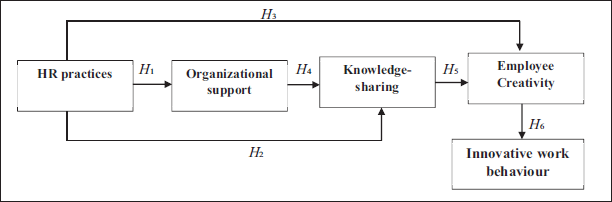
As the initial step of the study, a conceptual framework based on the literature is developed, as shown in Figure 1. ‘HR practices’ is the only independent variable that impacts all other variables. ‘Innovative work behaviour’ is the final predicted variable. Organizational support, KS and EC are mediating variables. The model assumes a direct impact of HR practices on organizational support, KS and EC (H1, H2 and H3). The model also hypothesizes a direct effect of POS on KS (H4), the direct influence of KS on EC (H5) and finally, the impact of EC on employees’ IWB (H6), as shown in the conceptual diagram.
Conceptual Framework for the Study.
Scale Development and Measurement of Variables
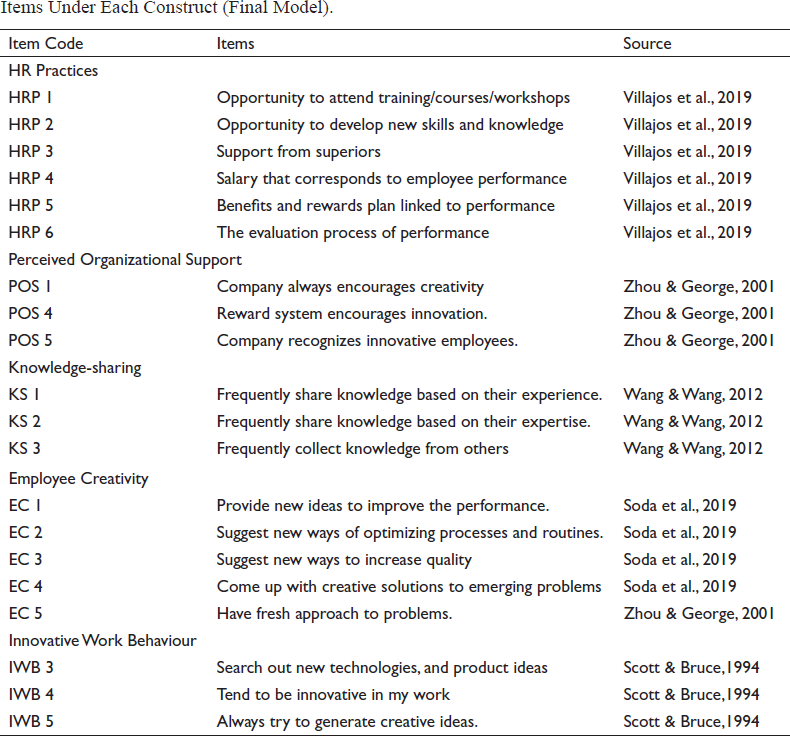
The five variables in the study model are measured using appropriate scales adapted from the literature (Scott & Bruce, 1994; Soda & Pedersen, 2019; Villajos et al., 2019; Zhou & George, 2001). The original instrument for data collection contained five items to measure organizational support (POS1–POS 5), eight items to measure HRM practices (HRP 1–HRP 8), five items to measure KS (KS 1–KS 5), eight items to measure EC (EC 1–EC 8) and five items to measure IWB (IWB 1–IWB 5). Thus, the questionnaire contained 31 items under five latent variables. The items and respective sources are furnished in Annexure A.
Sample Selection and Data Collection
The study was conducted at IT companies in Kerala. A priori sample size calculator for structural equation models (Soper, 2024) showed a minimum sample size of 233 for a model consisting of five latent variables and 31 observed variables with an effect size of 0.3 and statistical power of 0.8. However, for this study, 450 questionnaires were served to the selected employees from 15 companies in Kerala’s north, middle and south regions, either offline or online. The questionnaire contained two parts, one for demographic details and the other for collecting opinions on the study variables. The data on study variables are collected in a 5-point Likert scale. The employees are requested to mark their degree of agreement on a scale ranging from 1 to 5, where 1 stands for strong disagreement and 5 for strong agreement. The researchers received back 414 filled-up questionnaires that were processed for analysis.
Assessing Common Method Bias and Non-response Bias
Harman’s single-factor test using SPSS 22 (Harman, 1976) was applied to check the presence of common method bias (CMB), a measurement error that must be controlled (Podsakoff et al., 2003) in cross-sectional research. The test showed a variance of 41% when all the items were taken together to form a single factor. A variance below 50% confirms that the model is free from the ill effects of common method bias. A paired sample t-test was performed using SPSS 22 to assess the non-response bias (Armstrong & Overton, 1977) that adversely affects the relationship between the predictor and predicted variables. The t-test results showed no significant difference in the scale items of different constructs between the early and late respondents. Hence, it is concluded that the model is free from non-response bias.
Data Analysis and Discussion
While cleaning and preparing the data, 10 faulty instruments were eliminated from the final analysis. Data collected from 404 respondents are analysed using IBM SPSS statistics version 22 and IBM SPSS Amos version 23. The analysis progressed through demography, descriptive statistics, correlation and structural equation modelling (SEM). The multiple relationships and hypotheses are tested as part of SEM.
Demographic Profile of the Sample
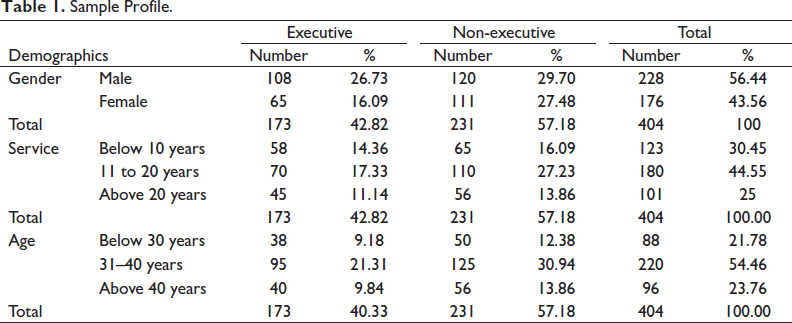
Demographic information is collected under four heads: Gender, Category, Period of Service and Age. The respondents are grouped under executive and non-executive categories with details of gender, service and age. Out of the respondents 43.56% belong to the female category and 56.44% from the male category. Executive employees represent 42.82%, and the rest belong to the non-executive category. All the details are furnished in Table 1.
Sample Profile.
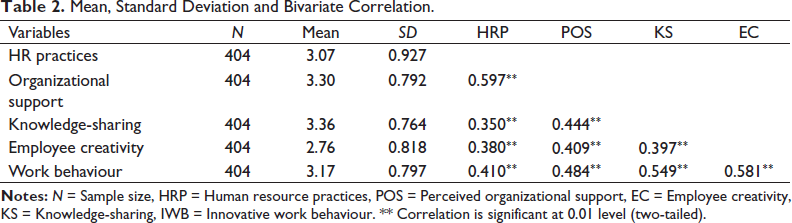
Mean, Standard Deviation and Bivariate Correlation.
Descriptive Statistics
The mean scores, standard deviation and bivariate correlation are provided in Table 2. All the variables except EC have mean scores above 3, with the middle value representing the respondents’ neutral position. The standard deviation ranges from 0.764 to 0.927. Bivariate correlation ranges from 0.350 to 0.597, which reveals a moderate correlation across the variables.
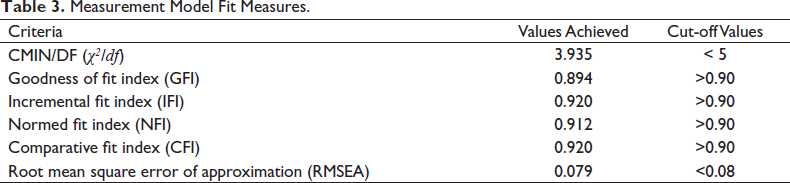
Measurement Model Fit Measures.
Structural Equation Modelling
Structural modelling comprises a two-level assessment. The first is the measurement model assessment, which examines the reliability and validity of the scales used to measure the study variables and the fitness of the data with the proposed study model. This assessment stage is also called the confirmatory factor analysis (CFA). The second level of assessment, referred to as the structural model assessment, is applied to test the multiple relationships across the variables.
The model fit measures are assessed to examine and ensure the fitness of the data with the model. The fit measures and the cut-off values are provided in Table 3. The NFI, IFI and CFI are found greater than >0.9 (Bentler & Bonett, 1980; Hair et al., 2017). The RMSEA value is less than 0.08 (Hair et al., 2017; Hu & Bentler, 1999). The goodness of fit index (GFI) is almost near the recommended value. CMIN/df = 3.935, which is acceptable (Hu & Bentler, 1999; Schumacker & Lomax, 2004). Thus, the data shows a good fit with the proposed study model. At this stage, 11 items are eliminated from the model to enhance the model fit, as described above. Thus, the final model presented in this article has only 20 items under five variables.
Reliability Assessment
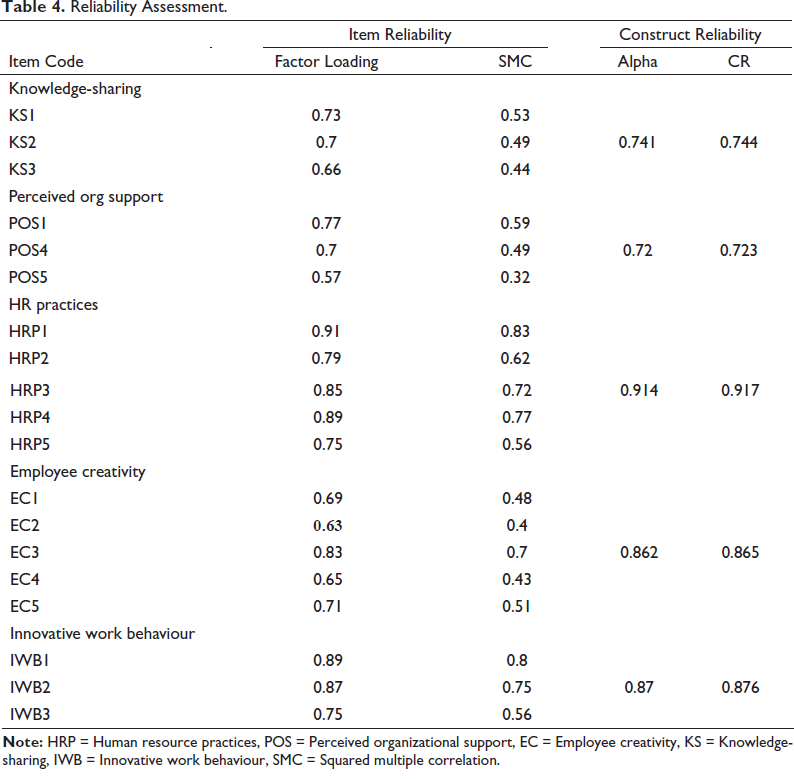
In this study, four reliability measures are assessed and ensured as per the recommendations (Figure 2 and Table 4). Factor loadings (FL) and squared multiple correlations (SMC) are used to assess the item reliability, and Cronbach alpha and composite reliability are used to assess the internal consistency of the constructs. Factor loading greater than five and SMC greater than 0.5 are considered good for ensuring item reliability (Carmines & Zeller, 1979). Here, all factor loadings are greater than 0.6. SMC values, except for four items, are above 0.5. Hence, all items (indicator variables) can be considered sufficiently reliable in measuring the respective attributes. For construct reliability, Cronbach alpha and composite reliability greater than 0.7 are considered good to ensure reliability (Cronbach, 1951; Gefen et al., 2000). In this study, the Cronbach alpha values range from 0.72 to 0.917, and the composite reliability ranges from 0.723 to 0.917. Hence, all constructs are also reliable to measure the intended attributes.
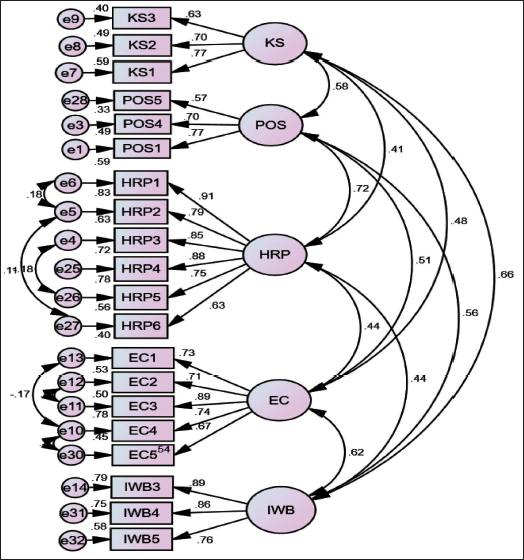
Reliability Assessment.
Validity Assessment
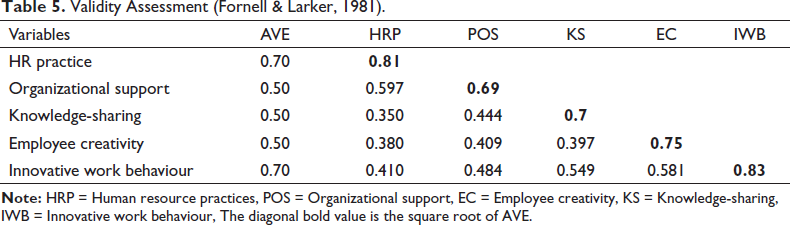
The validity of the constructs in measuring the intended attributes is assessed by a three-way approach to assessing content, convergent validity and divergent validity. Convergent validity ensures the unidimensional pattern of the items under the construct and is evaluated by examining the average variance extracted (AVE). Discriminant validity, which examines how distinct the constructs are, is evaluated by comparing the square root of the AVE of each construct with the intercorrelation between the other constructs. For convergent validity, the AVE values should be greater than 0.5, and for discriminant validity, the square root of AVE should be greater than the intercorrelations (Chin, 1998; Fornell & Larcker, 1981). In this study, AVE for all the constructs are greater or equal to 0.5, and the square root of AVE (shown as diagonal values in Table 5) is greater than the intercorrelation values. Hence, all the constructs have sufficient convergent and discriminant validities. Even though this study adapted validated scales, the validity of the content was confirmed by discussions with expert academicians and practitioners.
Validity Assessment (Fornell & Larker, 1981).
Assessment of Structural Model
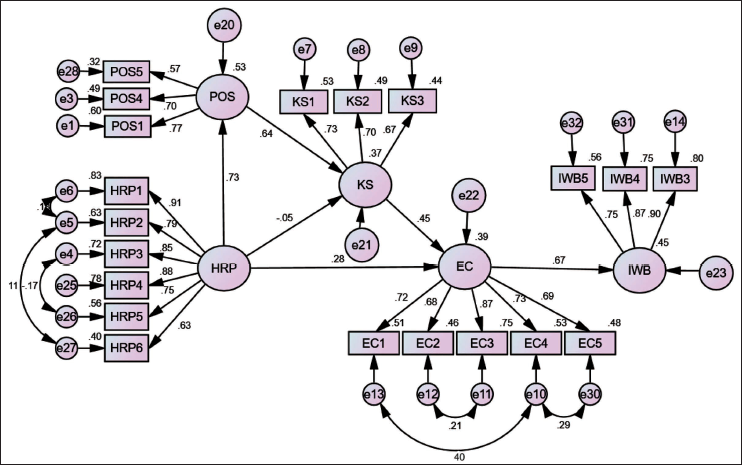
After ensuring good reliability and validity measures through CFA for the scales developed to measure the variables, the next step is to assess the structural model, which provides the path values and relationships between the variables. In this stage, many researchers ensure the model fits by comparing the recommended value measures with the achieved values, as done in the first step of the CFA. Here, the researchers ensured the CMIN/DF (χ2/df), CFI, NFI, GFI and RMSEA values were as per the recommendations. The R2 values of the endogenous variables are another measure for assessing the model fit (Chin, 1998; Hair et al., 2012). Here, the R2 values range from 0.37 to 0.53. R2 values in Table 6 show a moderate explaining power of the endogenous variable by the predictor variables.
R2 Values of Endogenous Variables.

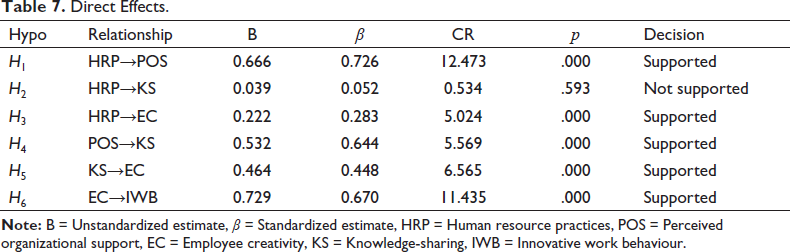
Figure 3 shows the structural model generated by SPSS Amos 23 with the standardized beta values. It is clear from the model that it comprises the six paths/relationships hypothesized to test their significance. In addition to that, there are many indirect relationships through one or more mediating variables. All these relationships are analysed for their significance of impacts, either directly or indirectly. Finally, a comparative analysis of direct and indirect effects is also done to decide on the type of mediation for two relationships. The results are provided in Tables 7–9.
Direct Effects.
Direct Impacts
Table 7 shows the unstandardized and standardized beta values, p values and the decisions on the six hypotheses. All the hypotheses except one, set for the relationships between the variables, are found to be significant. The direct influence of HR practices on KS is found to be non-significant. The influence of HR practices on POS is highly significant (β = 0.726, p = 000). These findings reveal that in any organization, HR practices have a determinant role in developing organizational support conducive to employees’ KS practices. Employees who trust their employers/managers will likely share the knowledge with their co-workers. The second robust relation is between EC and IWB (β =0.670, p = 000). This finding shows how creativity is enhanced through KS and contributes to IWB. The benefit of KS operates through their creativity and leads to IWB that is a valuable asset for competitive advantage. This finding supports the results of previous studies conducted by Bos-Nehles and Veenendaal (2019), Ganguly et al. (2019) and Zahedi et al. (2024).
The third robust relation is between organizational support and KS (β = 0.644, p = 000). The results clearly show the strong bond between organizational support and employees’ KS behaviour. If the employees feel a lack of support or caring attitude from the management, there is every possibility of hiding knowledge or showing unwillingness to share the knowledge with others. In such a situation, the employees keep a suspicious mind towards their employer and worry about the negative consequences of KS. This finding supports the earlier findings of El-Kassar et al. (2022) and Bos-Nehles and Veenendaal (2019).
The path between KS and EC (β = 0.448, p = 000) is more significant and influential among the two relationships tested towards EC. The path between HR practices and EC is also significant (β = 0.283, p = 000) but less potent than the relation with KS. This shows the importance of KS in making employees more creative. These results are supportive of the earlier studies conducted by El-Kassar et al. (2022), Bos-Nehles and Veenendaal (2019) and Wang and Wang (2012).
Indirect Impacts and Mediation
A bootstrap test with 200 sub-samples is carried out to assess the significance of indirect impacts using SPSS Amos. The results are furnished in Table 8. Interestingly, all six indirect impacts are significant, with p values < .05. A significant total indirect effect indicates the presence of mediation between the predictor and predicted variables. From the beta values, it is evident that, even though the HR practices have no direct impact on KS, it has a significant indirect effect on KS (β = 0.468, p = .006) through the mediating variable of POS. This finding emphasizes the importance of POS in developing a culture of KS and IWB among the employees.
Total Indirect Effects Through the Mediating Variables.
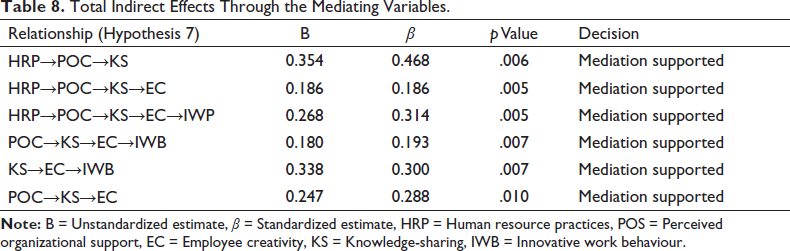
Another valuable finding is the indirect impact of HR practices through the mediating variables of POS, KS and EC on IWB (β = 0.314, p = .005). Even though the indirect influence of HR practices through POC and KS on EC is found to be significant, it emerged as the weakest one among the six indirect effects (β = 0.186, p = .005). The indirect impact of KS on IWB through EC is also found to be significant (β = 0.300, p = .007). It shows how KS can influence employees’ creativity and work behaviour, the two critical elements of organizational performance. The indirect effects of POS on IWB through KS and EC are found to be significant (β =0.193, p = .007). The indirect effect of POS on EC through KS is also found to be significant (β = 0.288, p = .010). These results show the role of POS in organizational performance by ensuring EC and IWB at the workplace. In summary, the indirect effect analysis clearly revealed the paramount importance of HR practices and POS in maintaining the business firm’s competitiveness and success.
Mediation Analysis
To identify the type of mediation, a comparative analysis of direct and indirect impacts is done for two relationships, for which the model revealed the direct and indirect effects simultaneously as path values. To decide on the type of mediation, the researcher has to compare the total indirect and direct effects of the predictor variable on the predicted variable for their significance (Memon et al., 2018; Nitzl et al., 2016). If both impacts are found significant, it indicates a partial mediation, while only indirect impact is significant; it contributes to a full mediation effect. In this study, out of two tested relationships, one shows partial mediation, and the other shows complete mediation (Table 9).
Regarding the impact of HR practices on EC through the mediating variable KS, both the direct impact (β = 0.283, p = .000) and the indirect impact (β = 0.186, p = .005) are significant. So, it shows a partial mediation effect of the variable KS between HR practices and EC. Hence, HR practices and KS are essential to fostering EC, leading to IWB.
Mediation Analysis.
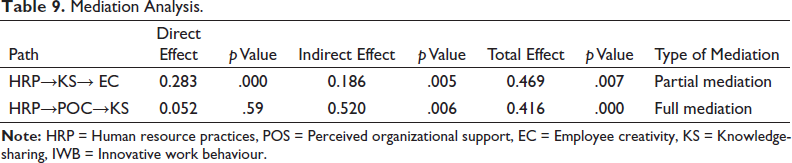
However, in the case of the impact of HRP on KS through POS, the indirect impact is found to be significant (β = 0.468, p = .009). In contrast, the direct impact is non-significant (β = 0.052, p = .59). This indicates the full mediation effect of POS between HR practices and employees’ KS behaviour. This shows a higher importance of POS over HR practices in developing a culture of KS among the employees. This means good HR practices and POS bring better results of KS due to employees’ trust towards their management.
Conclusion
Managers are always concerned about performance, which is the prime requirement for maintaining an organization’s competitiveness and sustainability. In turn, organizational performance is the outcome of employee performance, determined by employees’ work behaviours. The HR department is responsible for formulating and implementing tailor-made policies that could bring desirable employee behaviours. This study highlights the relationships between selected variables closely connected to HR practice and organizational performance. Six hypotheses are set to understand the significance of direct relationships between these variables. The analysis results showed that all these relationships, except one, are significant. In addition to the direct effects, the study revealed the indirect effects of variables, which are highly useful in strategy formation. These indirect effects provide the management with alternate ways to achieve better results in addition to attending to the direct influencing variables. Interestingly, the study observed that the quality of the HR practices only impacts KS if the employees perceive organizational support for their jobs and creativity. Thus, the findings of this study are instrumental in formulating strategies for improving IWB through KS and the associated improvement in EC.
The study results are significant for both theory and practice. The impact of HR practices on IWB through the mediating variables provided exciting insights into the interactions of the five study variables. On the theoretical side, all these observations contribute to a better understanding of the psychological traits of individuals about KS in the workplace. On the practice side, each of these observations may be adequately addressed to improve the organizational climate and strengthen the practice of KS, thereby enhancing individuals’ creativity and IWBs.
Managerial Implication
The findings of this study are beneficial for making managerial decisions concerning performance improvement through fostering a work culture that supports KS among the employees and developing IWBs. In addition to the direct effects, this study revealed the mediating effects of POS, KS and EC in shaping employees’ IWB. The result of the study clearly shows the importance of HR practices and POS in shaping creativity and IWB with the support of KS among the employees at the workplace. In many situations, management is more interested in knowing the indirect effects than the direct effects, as they provide the management with alternative and more practical ways to achieve better results by attending to mediating variables. For example, the results of this study show that HR practices have no significant direct influence on KS behaviour but a high indirect effect on KS through POS. This observation indicates that the quality of HR practices alone can only do something if the employees feel a fair level of organizational support at their workplace for KS. Hence, the management needs to formulate policies and actions that enhance the POS through the lens of employees. In this way, the information on all six indirect effects is precious input for managerial decision-making.
Developing an employee-care approach is essential to develop employee trust and avoid job insecurity. Thus, by creating and nurturing a cordial and trustworthy work culture, any firm can ensure KS among the employees and improve EC, leading to IWB, one of the critical elements of sustainable organizational performance. KS can improve creativity and IWB to a large extent. So, organizations concerned with high-level performance and competitive advantage should develop a strong culture of KS behaviour among the employees, which is a robust input for improved individual and team performance.
Limitations of the Study
The study model included some of the influencing variables. Literature shows numerous variables that directly or indirectly affect employee innovative behaviour. Only 45% of the predicted variable could be explained by the other variables. Hence, it would be better to conduct detailed studies by formulating extended models that include more predictor variables to maximize the percentage of variance of the predicted variables explained by the predictor variables. Another limitation is that the study only collected data from IT companies working in Kerala.
Annexure A
Items Under Each Construct (Final Model).
Footnotes
Declaration of Conflicting Interests
The authors declared no potential conflicts of interest with respect to the research, authorship and/or publication of this article.
Funding
The authors received no financial support for the research, authorship and/or publication of this article.
