




Abstract
While traditional science, technology and innovation (STI) policy has emphasised protecting intellectual property through patents and copyright, evidence suggests these tools may not optimally serve both innovators and society. Alternative innovation approaches based on openness and shared technology are emerging that could better address societal needs while supporting more sustainable production. We examine the development of 3D printing technology, where the expiration of key patents enabled a dynamic, open innovation ecosystem. This open-source approach has led to new forms of collaborative organisation around shared designs and resources, facilitating broad technology adoption across diverse communities. Analysing these practices through the lens of digital commons practices, we explore how they enabled alternative business models in 3D printing, while acknowledging tensions with dominant market structures. We propose an STI framework based on the commons that prioritises social and environmental benefits in alignment with post-growth values.
Keywords
Introduction
Patents and intellectual property are a heavily contested topic in science, technology and innovation (STI) policy. Yet, despite the critique and empirical cases against patents, they are still considered an indispensable ingredient for successful innovation. Innovation is conventionally understood as successful market exploitation of new knowledge and technology. In a market economy premised on the necessity of continuous expansion and economic growth, knowledge and technology are purposed for accumulation. In this direction, patents are inextricably linked to both diffusion of innovation and economic growth, by serving the appropriation of knowledge and technology and, in turn, accumulation. Hence, the patent system is an indispensable feature of innovation structured to operate as an engine of economic growth (Robra et al., 2023).
Conversely, innovation requires broad and heterogenous knowledge diffusion and experimentation factors, including formal and informal actors and their relations. A wider variety of ideas, agents, motivations and potential combinations within innovative processes can increase the scope of innovation (Fagerberg, 2006). Diffusion, thus, requires less barriers and less adherence to strict business models with primary focus on accumulation. Free flows of knowledge and collaboration across different sectors are essential for a robust scientific base to yield the types of practical research payoffs that innovation builds upon, which are more serendipitous than calculated in advance (Nelson, 2004). Hence, a patent system purposed to serve innovation as an engine of economic growth poses barriers to the conditions through which innovation emerges in the first place.
With the latter as a starting point, we need to critically examine the nexus among patents, innovation and economic growth. To begin with, there is growing evidence that strict patents do not necessarily favour technological advance and innovation, nor do they singlehandedly secure successful market exploitation (see, e.g., Boldrin & Levine, 2013; Dosi et al., 2006; Nelson, 2006). The view of innovation as an engine of economic growth predisposes technologies and techniques that are inextricably linked with successful introduction to markets. In this approach, much of the innovation process is primarily focused not on socially useful production of goods and technologies, but rather on a way for enterprises to organise around ideas and develop management techniques that have commercial appeal.
Further, it is questionable whether patents, intellectual property and other legal instruments are successful in terms of both economic growth and diffusion of innovation (Falvey et al., 2006). Literature suggests that the diffusion of innovation is not always compatible with economic growth, certainly not without complications. In a number of sectors, innovation systems and products themselves may be critical factors that either hinder innovation diffusion or leave unexploited market advantage (Roh et al., 2021). In the case of national innovation systems between high- and lower-middle income countries, research shows that strong IPR regimes may stop local economies from experimenting and learning by stopping the flow of knowledge (Dosi & Stiglitz, 2014).
The above leaves us with a conundrum: Why would we insist that a strong patent system is always a viable way to innovation that matters? Innovation in the current STI framework falls into what seems to be an inherent contradiction between the need for appropriation and capital accumulation, on one hand, and the need for diversity and diffusion, on the other. Arguments on patents fostering innovation are based on the advancement of a particular configuration of the socio-technological options available that best conforms to the institutional environment the patent system creates to begin with. A self-referential cycle is created, where innovation is perceived through patents, while patents evince innovation. In reality, patents are merely evidence of an institutional framework that upholds only those types of innovations that fuel profit maximisation and economic growth.
The prominence of an innovation paradigm associated with market dominance is encapsulated in the Schumpeterian concept of creative destruction (Schumpeter, 2021). Among other things, this interpretation of innovation affects intertwined socio-political and economic categories such as increasing global inequalities (Fagerberg et al., 2010; Fagerberg & Verspagen, 2021), the creation of monopolies (Thompson, 2018) and processes of financialisation and wealth extraction (Birch & Muniesa, 2020; Pistor, 2020). In addition, issues of developing technology and production techniques that are not market-oriented but rather geared to the needs of the society can be raised, as evinced by social movements in the past (Smith, 2005; Werskey, 2007) as well as some sections of the largely libertarian Maker’s movement (Smith, 2020) in its distinctive varieties (e.g., makerspaces, hackerspaces, FabLabs).
The drive of the subsequent ‘innovate or die’ mantra (Pansera & Fressoli, 2021), coupled with the exploitation of scientific knowledge for market expansion has spawned an unprecedented era of capitalist economic growth, alongside an ever-increasing use of materials and resources (Robra et al., 2023). Since the 1970s, this pursuit has been scholarly problematised (see Georgescu-Roegen, 1971; Meadows et al., 1974), with more recent discourse (see, e.g., Daly & Farley, 2011; Hickel & Kallis, 2020; Spash, 2021; Victor, 2019) showing how the ever-increasing use of materials and resources propels climate change and ecological degradation. In the face of these challenges it is now more important than ever to deepen our exploration and enrich our understanding of alternative manifestations of innovation that are compatible with safeguarding a sustainable future on the planet.
The broad diffusion of information and communication technologies, albeit spawned out of the conventional innovation paradigm, has effectuated unseen knowledge and technological sharing capabilities across diverse groups of experts and laypeople that challenges such long-held orthodoxies around innovation. Benkler (2002, 2006) documented innovations within early digital commons practices, such as Wikipedia and Free and Open Source Software (FOSS), based on different social and institutional arrangements. With no predefined roles or structure, dispersed communities of individuals and groups freely collaborate with no exclusive control over productive resources such as knowledge, information, software code and design, and openly share the results, enmeshing in the process the digital with communal physical resources through diverse commoning processes. Commons-oriented practices demonstrate an alternative configuration of knowledge and technology that produces socially meaningful outcomes, while expediting diverse socio-technical trajectories that break away from the imperative for accumulation and growth. In other words, the technologically mediated organisation and production arrangements emerging around the commons may embody a different set of values and imperatives. Throughout this article, we draw hints towards what those imperatives may be and how they may materially manifest in society.
From this perspective, this article operationalises patents to exemplify the inadequacies of the current STI framework to formulate the basis for technology and innovation that serves people and the planet. Our argument is premised on a critical analysis of the role of patents in effectuating and reproducing a socio-technological system that is inherently at odds with planetary boundaries, while failing to meet societal needs. Instead, we advocate for an emerging commons-oriented technological paradigm, which may help us address the climate crisis and other global challenges. We critically explore the role of patents in shaping the 3D printing socio-technological system, alongside diverse factors that contributed to its development outside of the patent regime. The second section presents our methods and the research tools used in the article. The third section summarises the main strains of critique on patents as a paradigmatic institution of the incumbent STI system and associated techno-economic paradigms, followed by a brief analysis of the innovation dynamics exemplified by digital commons. The fourth section examines 3D printing and the accompanying discourse around patents within the socio-political developments of the time. The fifth section then discusses the main lessons for an STI framework based on the commons and a tentative post-growth transition. The sixth section concludes by reflecting on an alternative technological trajectory that may lead to possibly more socially relevant and ecologically sustainable, socio-technological outcomes.
Methods
This article deploys an explorative digital ethnographic approach to understand what is important for the examined phenomena within the specified context (Coombe & Chapman, 2020). More specifically, we focus primarily on a specific 3D printing method named Fused Deposition Modelling (FDM). This is one of the methods adopted early in the development of what is now being called 3D printing or additive manufacturing, which was under patent protection from 1989 to 2009. FDM is a 3D printing method in which filaments of thermoplastics are deposited according to a specific pattern. The end point of this process is a product that is essentially ‘printed’ layer by layer, which may or may not require extra processing.
We choose the FDM technology on two grounds. First, today it is the most popular and commercialised 3D printing technology that is widely distributed in many different types of organisations, from industrial, to commercial and hobbyist communities. Not only has FDM been one of the critical methods in the development and broad diffusion of 3D printing, but it has also set a benchmark for the types of applications and users of relevance (Sculpteo, 2021). Second, the FDM technology was initially developed in the 1980s and was first commercialised in 1992, yet its utilisation remained limited throughout the twenty years of patent protection. In the years following the expiration of the FDM patent in 2009, the technology co-evolved alongside shared socio-technical imaginaries of a new industrial paradigm (Bechtold, 2016).
We build our argumentation upon the literature, also considering empirical data before and after the patent’s expiration to discuss its effect, along with contemporary social and economic developments, on innovation and the development of the industry. Data is collected from a variety of sources, including relevant research, reports by industry and market organisations (most notably Wholers 1 and Sculpteo 2 ) and also discourse in informal domains, such as community blogs, commentaries, wikis and news outlets (e.g., Hackaday, 3 TechCrunch, 4 CNET 5 and The Verge 6 ) that are representative of the tech-savvy consensus contemporary to the various events examined in our article. We use tools such as Google Trends as indicative of broader social impact and compare them with respective searches in the Scopus database. Moreover, data is collected from patents’ reviews and the concerned companies’ public financial information. The data has been collected across several years, following the developments in the field as the various events have been unfolding. In turn, the data is qualitatively turned into a thematic analysis (Trainor & Bundon, 2021) and assessed in the context of the background of interpreting the observed phenomena.
Literature Review
Patents and Innovation
The appropriation of new knowledge and technology enables innovators to commercially exploit innovation. Contrary to colloquial references in daily media or business on capitalism being almost identical to free market and competition, it is, arguably, much closer to a system fuelled by dynamic imperfect competition and rent-seeking (Reinert, 2008). Knowledge, a non-rival good, is associated with a general inability of markets to motivate rent-seeking behaviour under perfect competition (Arrow, 1962). Patents create artificial scarcity and are thus a structured form of rent-seeking that allow profitability, which would otherwise not be possible under perfect competition (Reinert, 2008). From this perspective, the degree of appropriability of knowledge is paramount in enabling entrepreneurs to profit from innovation.
In his seminal piece for STI policy, Teece (1986) identifies three building blocks for profiting from innovation: appropriability regimes, complementary assets and a dominant design paradigm. Appropriation is thus only one of the necessary conditions that allow market exploitation of knowledge and technology, while IPRs are one form of appropriation among several. Furthermore, appropriation mechanisms are contingent on the nature of knowledge, leading to different organisational and innovation patterns (Pavitt, 1984; Teece, 1986).
However, the tools through which firms can reap the benefits of innovation have been somehow reduced to appropriability regimes. These are further reduced to refer almost exclusively to IPRs and patents in particular (Dosi et al., 2006). Nevertheless, the ‘stronger patents are always better’ creed (Nelson, 2006, p. 1109) seems to be more of an ideological fixation of actors dominating patent law and practice than an empirical fact. Conventional debates on the theory and practice of IPRs largely revolve around the inability of innovators to benefit from their innovations through market functions. However, this proposition ignores qualitative characteristics of knowledge and technology and presumes a linear relation between patents and innovation (Dosi et al., 2006). Hence, critique on patents concerns both the underlying logic of patent laws and their function concerning the needs they purportedly serve.
In theory, a robust patent system is essential in providing incentives to invent. But in practice, the long-term equilibrium effect can be considered negative (Boldrin & Levine, 2013; Dosi et al., 2006). Based on a significant body of theoretical and empirical data related to the US patent system, Boldrin and Levine (2013) make a case against patents, arguing that there is no empirical evidence for the claim that patents increase innovation and productivity. Likewise, there is little empirical evidence connecting the unquestionable technological advance in the USA over the last three decades with the strengthening of patent laws (Dosi et al., 2006; Jaffe et al., 2000).
Therefore, the view that strong patents equal more innovation appears to result from long-term effects of political and economic pressures by various actors on the government-operated patent system. As Boldrin and Levine (2013) put it, the patent system is a case where ‘the regulators act in the interests of the regulated, not the wider public’. In other words, the patent system has rarely been the enabling factor for innovation and the creation of new industries. Rather, mature industries seek legal protection once their growth potential starts diminishing.
Patents and Financial Innovation
Coriat and Weinstein (2012) trace the incumbent paradigm of IPR regimes back to the 1980s USA in response to the emergence of the knowledge-based economy. They argue it is not primarily marked by the increasing importance of knowledge for industrial development. Instead, its distinct trait is a heavy shift towards knowledge commodification, making it a strategic asset (Winter, 1987). Therefore, the conditions under which economic agents can appropriate knowledge and turn it into a revenue source have become increasingly important (Coriat & Weinstein, 2012).
Contingently, Birch and Muniesa (2020) conceptualise assetization as a process of transformation of resources into capitalised property, a general shift from commodity-based economic activities to ones focusing on rent, which is not derived from the production of goods but from the ownership and control of assets (Birch, 2020; Birch et al., 2020). This process exacerbates the commodification of knowledge, information and even social relations, which are now increasingly viewed through the lens of financialisation (Birch, 2020; Birch & Ward, 2023). Patents, as a form of intellectual property, play a significant role in this direction by serving as tangible representations of technological innovation that can be negotiated, financed and strategically managed.
Kang (2020) further elaborates on the assetization of patents as ‘a new frontier, a novel financial “innovation” affecting a knowledge practice that hitherto had not been regarded as an object of speculation: law’ (p. 65). Therefore, the development of the patent system in the knowledge economy paradigm, following the patterns of ever-increasing financialisation of the economy (see Krippner, 2012), has not necessarily been a means supporting innovation, but rather an ends in itself, driven by speculation about legal outcomes and decisions. The function of patents is, arguably, shifting away from any reference to an invention or a commodity they supposedly serve, towards a pursuit of financial yield.
The transformation of technological innovation into rent-seeking assets evinced in the above process of financialisation is, arguably, not a derailment but more of a natural extension of the role of patents in fostering technological advance. Patents, like other ‘codes’ of capital (Pistor, 2020), are legal inventions serving to convert knowledge, technological invention and the relations associated with them to wealth-producing assets. As such, they become instrumentalised into the system of wealth production; however, this gets mutated. As Kang (2015) observes, any remaining ‘intellectual’ attribute in intellectual property, after being transformed into a financial asset, is only self-referential. Patents merely create the conditions reproducing certain assemblages of knowledge and technology, and the associated perceptions of progress, in which creative ideas and relations are only means to an end.
Innovating Beyond Patents
Patents are not merely legal instruments. They are deeply embedded in socio-economic contexts, actively shaping their effectiveness, directionality and ethical implications. Historical evidence suggests most innovations occur outside the patent system. Innovative firms typically prefer to rely on alternative mechanisms to support their inventions, such as secrecy and lead time, despite patent laws. For the same reason, the absence of patent laws in some countries does not appear to affect the overall occurrence of innovations (Moser, 2013). Already established industries with a strong lobbying position pressure for stronger patent protection for their mature technologies, rather than the new disruptive ones, seeking to reap the benefits of their innovations (Boldrin & Levine, 2013).
Τhe effects of patenting are also questionable for incumbent firms, industries or countries in the long run. Nelson (2004) argues on patents hindering innovation as a driver of capitalism by restraining the co-creation of a strong science base, which is largely a product of publicly funded research (Nelson, 1993; Mowery & Nelson, 1999; Nelson, 2004). The quality of scientific research depends on openness and collaboration, as the practical payoffs of research cannot be predicted but are usually serendipitous and based on the informed judgement of scientists. To this end, non-market incentives, and control mechanisms in academia, such as peer review and mutual scientific acclaim, imperfect as they may be, still appear to function well enough to support quality in science production and the scientific commons (Nelson, 2004).
Technological advance is ‘a collective, cultural, evolutionary process’ (Nelson, 2004, p. 458). It constitutes a cumulative result of the previous work of many inventors and developers (Nelson, 2004; Scotchmer, 1991). Therefore, the lines between science and technology are blurry, especially in scientific discoveries that simultaneously contribute to scientific research and commercial applications (Murray & Stern, 2007). In the latter case, empirical evidence shows that the diffusion of scientific results is indeed restricted by IPRs, while it is debatable whether publicly funded research and development (R&D) should be patentable from universities, as is the case in the USA. Patenting of advanced technologies thus threatens the publicly supported scientific commons, on which these technologies rest (Nelson 2004; Murray & Stern, 2007).
A wisely designed patent system that could serve innovation as a driver for growth is, in principle, possible under the right circumstances. But in the long run, it remains susceptible to political and economic pressures from powerful interest groups (see Boldrin & Levine, 2013) and broader economic tendencies of financialisation (see Birch & Muniesa, 2020). The cumulative nature of science and technology poses a significant challenge in designing effective patent laws that would adequately reward early research and innovation for providing the foundations and later innovators for improvements (Scotchmer, 1991). Policies, which grant solid legal protection to early inventors, may pose barriers to further innovation.
Technological systems are amalgams of economic, social and political components besides being purely technological, like those found in the ecosystems built around the monolithic automobile and modern electricity grids (Hughes, 1987). Such systems gained inertia as massive infrastructure and relevant standards grew around them. With sunk costs, fixed assets, numerous people employed and complex embedded interests, they define much of the spatial and organisational arrangements globally. On the contrary, innovation often emerges from a wide spectrum of economic activities that are qualitatively different from one another (Dosi et al., 2006). Opportunities may occur within the R&D system, in the efforts of new or established firms or from the broader technological system, including relationships with suppliers, users and support services. Patents often ignore these qualitative differences and stifle innovation opportunities within the broader technological system.
An understanding of innovation measured in terms of patents has been shown to have reached its limits (Huebner, 2005), while the yields of such innovation trajectories for society are being questioned (Pansera & Fressoli, 2021). Incumbent innovation trajectories, arguably, are hindered by and in turn sustain dominant technological systems in society, the materialities of which contribute to the unsustainability of modern societies. Patents as institutions of innovation shape knowledge production and technological development in ways that may not align with societal needs. The premise of economic growth as a direction of innovation is noxious to begin with, as it is premised on the creation of barriers to innovation, hindering cumulative research and exacerbating inequalities in access to technology. Such an institutional framework seriously limits our collective capabilities to be directed towards resilient pathways of addressing pressing societal and environmental challenges.
Innovation is primarily a serendipitous phenomenon, and as such, it often stems from collective invention (Allen, 1983; Nuvolari, 2004) rather than individual rent-seeking. So, suppose the subject of STI policy is not to merely foster more innovation in the conventional sense, detached from societal needs, but rather to steer productive forces towards a socially meaningful direction. In that case, there needs to be another way to understand and foster innovation, built around alternatives that prioritise open access, equitable distribution of knowledge and sustainable innovation practices, and as a consequence, new technological systems which can effectively replace existing ones.
The Emergence of Commons-based Innovation Trajectories
Free and open-source software (FOSS) came into prominence at a time of fierce competition between enterprises ahead of the dot-com bubble. It was a counterreaction to enable and support the conditions that favour the free circulation of information (Coriat & Weinstein, 2012). There is much more to identify in the practices first observed in FOSS than simply an alternative approach to IPRs. Such practices shift away from the logic of knowledge commodification and instead focus on the rights to access, use and control resources and the production and distribution of shared goods, built upon and along with a knowledge commons (Benkler, 2006; Weber, 2005).
Benkler (2006) coined the term ‘commons-based peer production’ to describe such practices that came to achieve economic significance in the digital economy (Pazaitis & Kostakis, 2022). The digital commons, co-created and maintained by contributions of self-organised communities across the globe, based on commonly upheld rules and norms, revitalised the engagement with the rich and diverse scholarship and practice of the commons (Pazaitis & Kostakis, 2022). There are three critical characteristics identified that distinguish the digital commons from traditional capitalist practices: (a) the decentralisation of the conception of problems and the execution of solutions, (b) the diversity of participants’ motivations and (c) the decoupling of governance from private property and contract (Benkler, 2016).
Digital-commons projects effectively mobilised autonomous individuals and groups, organised in distributed networks, coordinated into open projects, largely without traditional hierarchical organisation or, often, any (direct) financial incentives (Benkler, 2006). By engaging an ‘enormous pool of underutilized intelligent human creativity and willingness to engage in intellectual effort’ (Benkler, 2002), digital-commons communities produce value as a collective affair among the participants and society as a whole. Digital-commons practices follow an anti-rivalry logic of knowledge and introduce alternative patterns to raise the level of innovation opportunities through open participation and collaboration.
The peer-to-peer dynamics of digital commons arguably manage to transcend the ‘market failures’ discourse by not requiring formalisations and thus considerably lowering the transaction costs of production (Bauwens et al., 2019; Benkler, 2002). A few years ago, FOSS or Wikipedia were widely considered as exceptions to the rule. However, their eventual success represents a core challenge to conventional organisational patterns and knowledge appropriation (see Pavitt, 1984; Teece, 1986) that are based on property, contract and market exchange, with one based on modularity, self-organisation and motivational diversity (Bauwens et al., 2019; Benkler, 2017).
The case of the 3D printing industry has triggered visions of transferring the digital-commons logic onto the physical realm. Seeds of such an approach have been observed in grassroots and commons-oriented projects in various domains, from the RepRap project family in 3D printing (Jones et al., 2011) to the L’atelier paysan and Farm Hack initiatives in agriculture (Giotitsas, 2019), the WikiHouse project in construction systems (Priavolou & Niaros, 2019), Wind Empowerment Network in small-scale energy production, Open Bionics in prosthetics (Kostakis et al., 2018, 2023b) and Sensorica in electronics (Pazaitis, 2020).
Such initiatives exemplify an emerging productive configuration that taps onto the convergence of digital-commons practices, with localised manufacturing capabilities (Kostakis et al., 2023a). This convergence has demonstrated the innovative capacities of the commons as an alternative path to technological development in response to social needs, enabling communities to collectively address global challenges, as, for instance, the recent response of open hardware communities to COVID-19 indicated this (Bowser et al., 2021; Pazaitis et al., 2020). This configuration has also been identified as the exemplifying potential for the disentanglement from current technological and production configurations towards degrowth oriented alternatives (Kostakis et al., 2018). This is made possible through more localised, small-scale and scope-oriented production as opposed to the globalised logistics chains of the current scale-oriented infrastructures.
The digital commons point to a new socio-technological system articulated by practices qualifying access, variety and diffusion over control and domination. Thereby, digital-commons practices contribute to the re-politicisation of the role of innovation in society by questioning the widespread convictions and pointing to alternative options (Kostakis et al., 2023b). They provide the grounds for an alternative STI framework that is based on openly accessible knowledge as commons, adaptability, repairability and maintenance of technologies, and the consideration of ecological limits in the fulfilment of human needs. A commons-based STI framework is, thus, enabling an institutional setting in which post-growth values and imaginaries around technology and societal progress may flourish. In this light, an in-depth exploration is necessary on the socio-technical phenomena through which the seeds for such an alternative approach to STI have been planted.
Exploring the Development of FDM
Motivation and Primary Observations
Paraphrasing Noble (2011), the history of 3D printing is also the history of politics around technology. In broad terms, as in other technological advancements, enclosures and patents in 3D printing came to ensure that innovators receive their proper reward (Baker et al., 2017). And yet, communities flourished under frugal conditions, effectuating conditions of low-cost replication for the technology. The FDM case reveals that innovations are not a direct rationalisation of the market alone.
Collective and individual imaginaries and contributions aggregate in shaping innovation in a specific context, and connection to society’s aspirations often creates a chasm between a good trajectory, as in ‘good life’, from one that is profitable. Therefore, it is legitimate to examine the case of 3D printing, from the origins of the technology and its initial development in the late 1980s to the rapid development of the field after the expiration of key patents in the late 2000s.
The graphs in Figure 1–4 indicate the interest over time in Google Search and Scopus for some of the most known terms that have been associated with the process that today is broadly referred to as 3D printing, such as ‘Additive Manufacturing’, ‘Rapid Manufacturing’, ‘Direct Manufacturing’ and ‘Rapid Prototyping’.
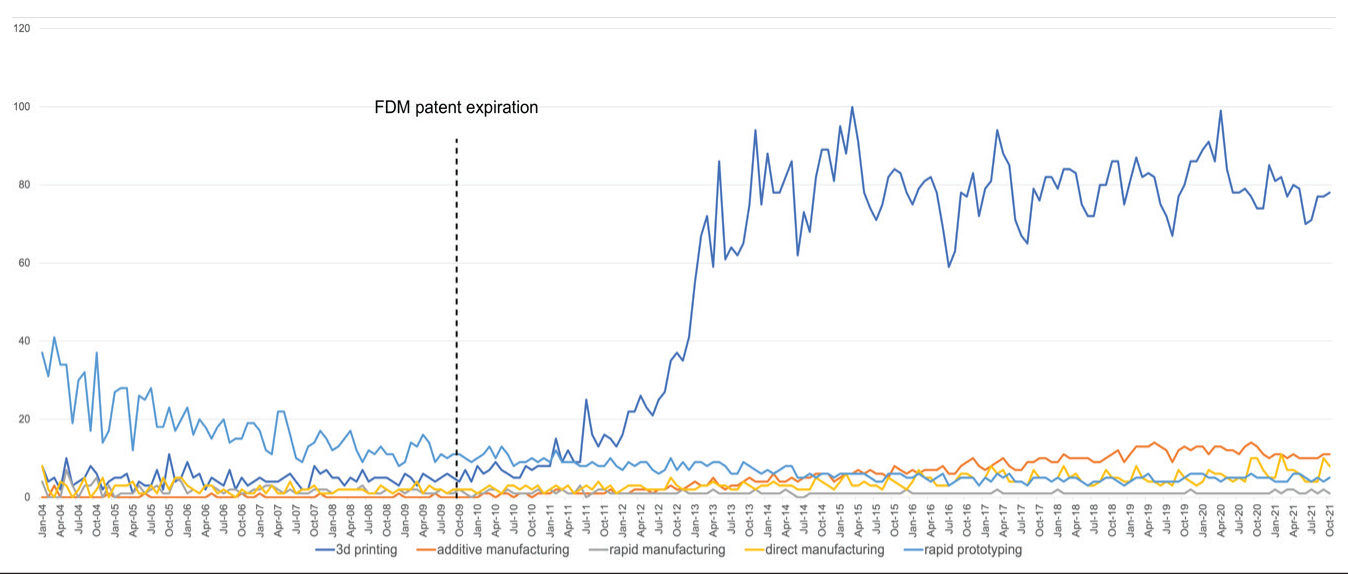
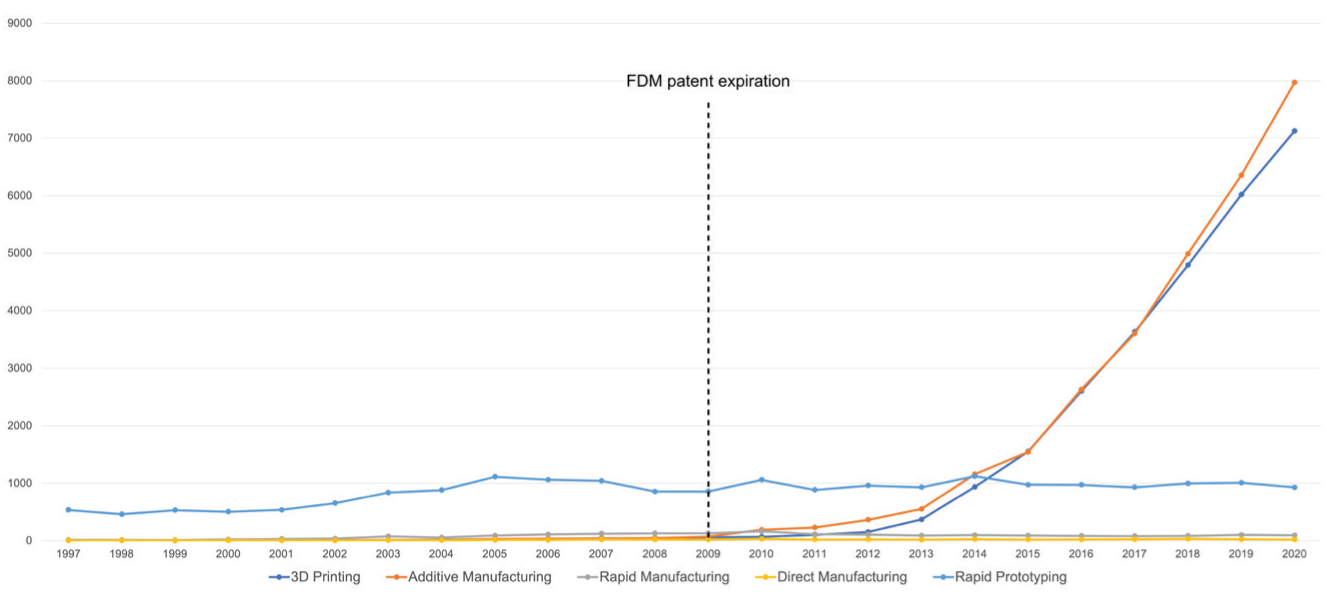
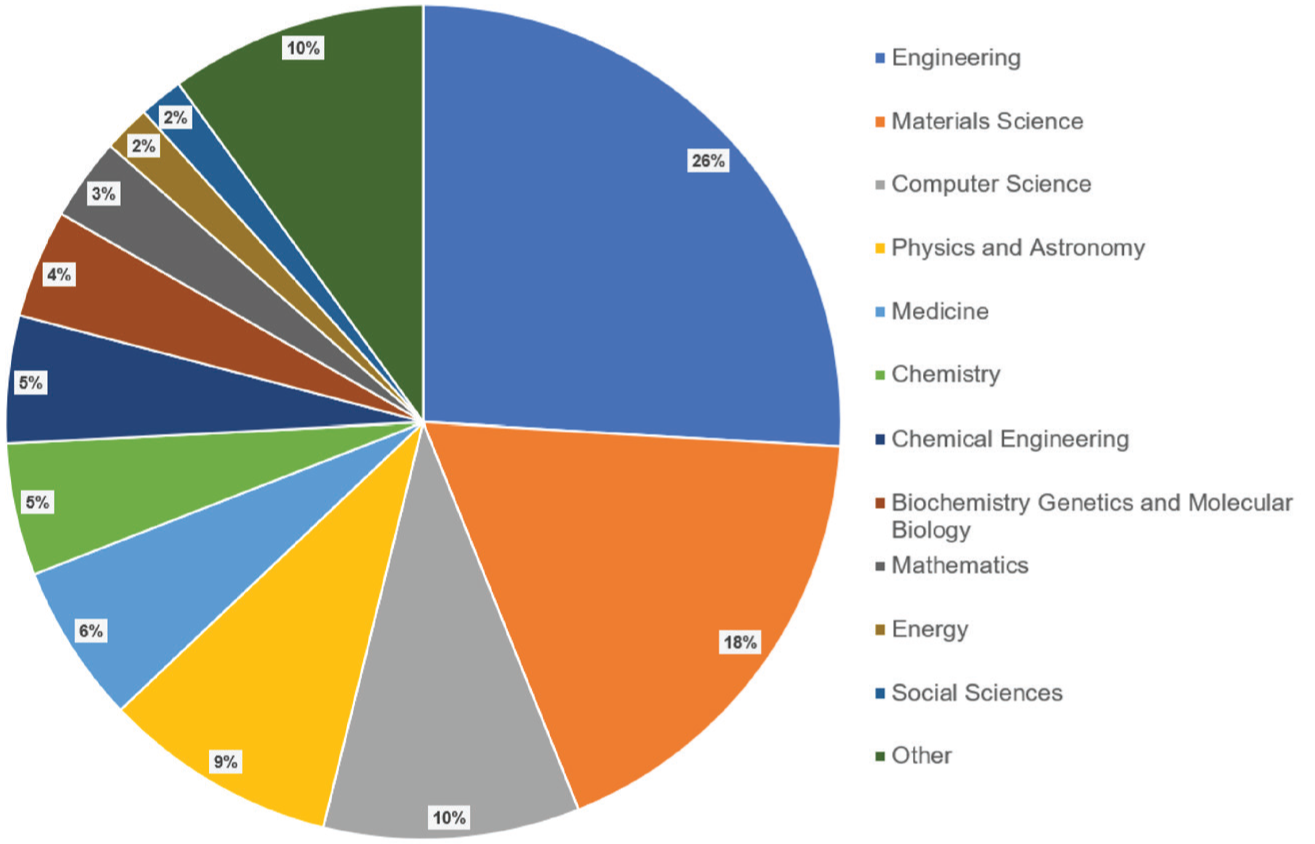
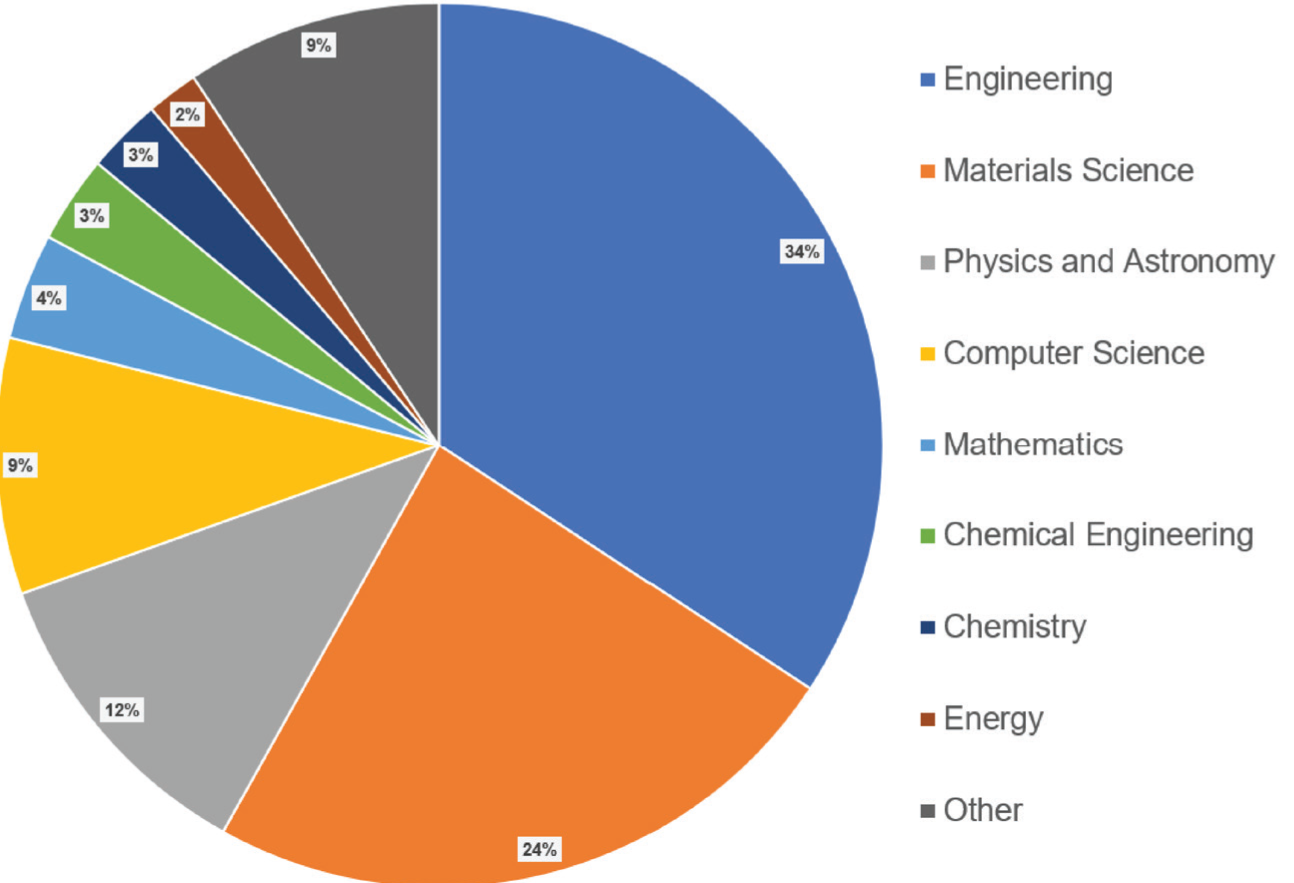
Two main observations are as follows: (a) there is a notable gear shift in the years following the FDM patent expiration in both broader public and academia and (b) ‘3D printing’ seems to be the most widely used term in society, while in academia, ‘additive manufacturing’ is following a similar trajectory with ‘3D printing’. Further analysis of the subject areas in Scopus indicates that ‘additive manufacturing’ is the term largely preferred in STEM fields, while ‘3D printing’ has a broader appearance across different research disciplines. Our exploration of the FDM case concerns the broader socio-technological and cultural phenomenon; we henceforth adopt the term ‘3D printing’.
After the FDM patent expired in 2009, a growing space of experimentation emerged involving users and small-scale manufacturers that defined new paths of applications and technical improvements. Diverse socio-technical and cultural imaginaries accompanied this process on the technology’s potential in revolutionising manufacturing, industry and consumption towards more distributed, autonomous and collaborative forms of production (Anderson, 2012). The current study aspires to encapsulate these heterogeneous aspects in STI policy.
Finally, we should note some practical advantages for selecting the FDM technique. Before and after the patent expiration, the time frame is adequate for data collection. Current developments indicate that the technology is reaching relative maturity and a dominant design paradigm. Considering the more recent expiration of other patents related to 3D printing, such as stereolithography (SLA), selective laser melting (SLM) and selective laser sintering (SLS) in 2014, the exploration of FDM development enables a more nuanced understanding of different technological options available, which may lead to more sustainable and socially meaningful pathways of the technology.
Historical Development of 3D Printing Technology
To understand the state of 3D printing today, it is vital to track its origins and how it grew from an industrial to a cultural phenomenon. The evolution of 3D printing technology coincides with an amalgam of breakthroughs in various fields within the industrial paradigm, brought about by the ICT revolution and the relevant changes in the political economy and structural transformations in the global economic environment. We observe the technological development of 3D printing occurred in three waves: (a) the initial period of experimentation and articulation of the concept from prior technologies in the early 1960s, (b) the first commercial applications and emergence of multiple 3D printing methods between 1984 and 2009, and, after that, (c) broad adoption of the technologies by the ‘maker movement’ (Anderson, 2012) giving rise to a consumer boom for 3D printers.
The first period was a capital-intensive, enclosed and formal research-oriented undertaking, first conceived in the Cold War laboratories of the Battelle Memorial Institute (Wohlers & Gornet, 2014), in close collaboration with academia and industry. The idea of 3D printing is about the building of solid objects by depositing successive layers of material on top of each other, rather than moulding or subtracting material (Bechtold, 2016). During the 1960s, the initial focus was to develop a technology that uses photopolymers to create solid objects from light-sensitive materials. These attempts were also based on various incremental breakthroughs during the 1950s, including experimentations with light-sensitive materials by DuPont chemicals and a series of methods for imprinting thermoplastic objects developed by Munz (1956, 1968), referred to as ‘photo-glyph’.
Photo-glyph paved the way for the emergent techniques that came to shape what is today understood as 3D printing, including ‘photographic-printing process’ (Edward, 1919), ‘radio echo system for mapping contours’ (Holser, 1952) and ‘making models in relief in gelatine by photographic processes’ (Frank, 1954). The historical timeline shows how, despite concept and theory having been formulated and proved, the technology proper had to await the invention and availability of yet undeveloped components before it could be effectively actualised.
In the 1980s, the first commercial applications of 3D printing technology emerged, with ‘stereo-lithography’ (Hull, 1989). Later, it was commercialised by 3D Systems, initially named ‘three-dimensional printing’ by MIT researchers (Sachs et al., 1993) and FDM (Crump, 1992), granted on 30 October 1989 to Scott Crump, later co-founder of Stratasys. The first FDM 3D printer, the 3D Modeler, was introduced by Stratasys in 1992 to challenge the market leader 3D Systems and its stereolithography-based printers. However, competition at the time mainly concerned industrial contracts as broader paths of commercialisation were yet to be found.
The commercial breakthroughs developed in the 1980s were based on methods and R&D in the previous decades. The National Science Foundation (NSF) in the USA played a crucial role in funding both the precursor technologies that helped pave the way and the development of 3D printing from concept to technological reality (Weber et al., 2013). The precursors of 3D printing technologies developed in the 1970s, such as computer numerical controlled machining and solid modelling tools, were NSF-funded projects. Likewise, NSF supported turning early 3D printing patents in the 1980s into proofs of concept and prototype machines in two major commercial technology areas, namely binder jetting and laser sintering. The NSF also funded application development (e.g., medical) and academically oriented networking activities in subsequent years. More recently, as the technology has matured, the NSF has supported research efforts related to new processes, new applications for existing processes and benchmarking and road-mapping activities (Weber et al., 2013).
The development timeline of 3D printing indicates the heterogeneity of factors and motivations that contributed to the development and early commercialisation of the technology. Furthermore, it testifies to the evolutionary view of innovation that combines diverse inputs from public and private agents within a broader socio-technological context.
The FDM Patent Expiration and the Nascent Political Economy of Open-source 3D Printing
With the FDM patent approaching expiration, Adrian Bowyer, an engineer from Bath University, began creating RepRap (short for Replicating Rapid prototyper). RepRap was the first open-source, self-replicating 3D printing machine. At that stage of its development, the market for 3D printing was growing. Still, the performance of FDM machines in terms of speed and accuracy constrained the prospects for its use in the industry and posed challenges for those trying to advance further development. The technology was not in great demand for commercial 3D printing activities at the outset either.
This began to change during the 2010s. Despite early experiments and research by national science institutes (Weber et al., 2013), it was left to small start-ups to commercialise the technology. 3D printing needed a qualitative breakthrough to enter the mainstream like the personal computer industry before. 3D printing could become a consumer electronic device (never intended in early stages) or a production technology. With the RepRap model, low-cost 3D printers began to spring up, giving a significant boost to the spreading of the technology and helping generate more capital flow into emerging markets for 3D printing.
RepRap tapped into an emerging mode of production that was, at the time, primarily associated with the digital sphere, namely commons-based peer production (CBPP) (Benkler, 2002, 2006). Harnessing a long tail of smaller and larger contributions by dispersed communities on a global level in a coherent collaborative relation, open-source RepRap managed to solve the bottlenecks that impeded the expansion of a consumer 3D printing market. In a matter of a few years, a vibrant market was created along with a distinct commons-based innovation ecosystem comprising communities of open hardware enthusiasts, FOSS developers, service providers and funding instruments (Bechtold, 2016). As a result, the cost of a 3D printer dropped within a few years from roughly 100.000 USD to a few thousand, with RepRap do-it-yourself kits made available for a few hundreds.
Open-source 3D printing communities co-developed all the necessary building blocks for innovation based on diverse motivations, often not including (direct) financial compensation or foreseen returns. They shared designs that solved technical issues or improved performance, while collaborative platforms were developed to share ideas and user-generated design files for potential objects that could be printed or other applications (Bechtold, 2016; West & Kuk, 2016). Physical spaces, such as FabLabs or Makerspaces, providing access to 3D printing t echnologies began to appear and became grounds for rapid learning and experimentation. A political economy emerged where the lines between producers and consumers were blurred, and productive forces responded directly to social signals and the needs of user communities.
One of the first commercial success stories of open-source 3D printers is MakerBot, a company that in 2011 received $10 million in venture capital (Feld, 2011). By 2013 MakerBot was valued at more than $400 million when it was acquired by industry leader Stratasys, which saw a major market opening for desktop 3D printers (Etherington, 2013). For a time, MakerBot was very popular in the tech industry and the open hardware movement. It was viewed by the former as evidence for the highly innovative character of the start-up model and the latter as a successful open hardware project, which emerged from the community and was growing symbiotically. Yet this symbiosis did not last for long. After being acquired by Stratasys, MakerBot struggled to balance contradictory interests between investors and its user community until eventually giving in to the pressures of the former. This was signified by the restriction of parts of its new technologies (Brown, 2012) and by the rebranding and tighter control over its community platform Thingiverse (West & Kuk, 2016).
MakerBot was facing community outrage due to the concealing of important features of the machine, such as a nozzle part, which only became worse when the company sought to file a patent for a smart extruder that was mainly developed through the efforts of the user community (Benchoff, 2014). MakerBot attempted to maintain the support of a global community of users by claiming that restricting certain aspects and parts of its machines would allow it to continue production in its headquarters in Brooklyn, maintaining local jobs. However, in 2015 MakerBot implemented massive layoffs (O’Kane, 2015; Pearson, 2015), and, eventually, in April 2016, it closed down its central manufacturing facility in Brooklyn to move its operations to China (Heller, 2016).
The cautionary tale of MakerBot illustrates its failure to formulate a business model which would guarantee profitability while maintaining the vibrant community spirit and engagement that has driven innovation in the field. Other companies stepped in to engage with the community and have followed different paths, further analysis of which exceeds the confines of this article. Still, the incongruences exhibited in the case of MakerBot largely remain, and the hybrid models employed by other open-source 3D printing companies to maintain openness face difficulties, ensuring long-term financial sustainability for the companies that use them. After a decade of vibrant experimentation, the open-source 3D printing community has been gradually transformed into an expanding consumer market, before it got matured and semi-concentrated in monopolies (Grand View Research, 2023). As such, tensions within the community continue, as the partial adoption of open innovation techniques and technologies by the industry is at times seen as parasitic to community experimentation, thus harming socially relevant diffusion of innovation (Kulkarni & Pearce, 2023). The development of flexible IPRs which would make this conjunction possible seems imperative.
Discussion
Patent Matters in Open-source 3D Printing
A direct causal relationship between the patent expiration and the development of open-source 3D printing relies on anecdotal evidence as it is seemingly difficult to empirically show such a direct correlation (Bechtold, 2016). Admittedly, Bowyer started experimenting with FDM technologies a few years before patent expiration, attesting to the argument that patents do not stop people from experimenting in garages and other informal spaces, outside production sites and the market (Kurman & Lipson, 2013). Nevertheless, the absence of legal barriers arguably enhanced the prospects of experimentation. It accelerated the broad use of the technology by universities, makers, hackerspaces and grassroots communities, seeking to develop and improve the process during the first decade of the twenty-first century, which opened up different commercialisation paths.
Simultaneously, an accompanying ecosystem of open-source 3D printers and open, physical and digital spaces of knowledge and technology sharing was crucial to the development of the innovation ecosystem and was both contingent to, and inspired by, the open-source mindset and culture (Bechtold, 2016). Even if patents per se were technically not prohibiting experimentation, they remain seminal for an STI logic based on technological appropriation and knowledge commodification that largely defines technological development.
Hence, the leap signified by open-source 3D printing is not strictly a technical endeavour, but, most notably, a political one. Narratives inspired by 3D printing predominantly encourage individuals and small groups to use the machines to serve their needs. Power in this kind of politics is associated with access to technology rather than specific political assertions. Thus, patents, representing barriers to access, are seen as the enemy. The corporate world, largely associated with patents and rent-seeking behaviour, is considered by communities as stealing from the pool of shared resources that small groups and individuals create.
Users of open-source 3D printing have the freedom to venture down the paths of innovation via bypassing legal constraints. Productive relations in ‘makerspaces’ or ‘hackerspaces’ hover between labour and recreation, while significant value is produced for local communities, along with great learning and innovation potential and participatory visions of governance (Niaros et al., 2017). The broad diffusion of the Internet facilitated these small-group dynamics to scale globally. The popularisation of the technology and its growing use by hobbyists and activists brought along an upsurge of research on the impact of sharing platforms, such as Thingiverse (Claussen & Halbinger, 2021) and user-driven innovation or household sector innovation (von Hippel, 2005, 2017).
The role of patents in 3D printing, as in any technology, remains ambivalent. The development of open-source 3D printers is based on technological advancements led by industrial manufacturers, in which patents played a significant role. Yet open-source 3D printers and their accompanying ecosystem demonstrated novel combinations of 3D printing methods with forms of communication and collaboration effectuated by digital media, which paved the way for expanding the consumer 3D printing market (Bechtold, 2016). Therefore, it is impossible to quantify the contribution of patents or open-source practices to the development of the technology—and trying to do so may already be in the wrong direction (Pazaitis & Kostakis, 2022). Yet it is vital to acknowledge the diverse social and cultural phenomena that emerged after the patent expiration, which defined pathways that were not foreseen before. Openness played a substantial role in developing the technology (Bechtold, 2016; Birtchnell et al., 2018), but raises serious concerns around the transformations the emerging socio-technical systems spawn, which IPR rules alone seem unfit to address.
Towards a Commons-based STI Framework
Open-source 3D printing was able to develop through a variety of factors coming together in the technological, social and political fields to eventually define the fate of 3D printing in the economy and society. FDM exhibited specific technological capabilities, but they alone did not determine any specific trajectory. The social and cultural context to which future 3D printing manufacturers responded were co-created by a broad community of users and agents driven by diverse motivations, eventually defining the route to commercialisation and uptake. Our argument is that patent expiration was one crucial event that allowed other factors to come together into a multifaceted phenomenon. Yet, focusing on the patent expiration alone does not explain the diverse conditions that enabled such outcomes. The absence of patent protection was probably a necessary but not a sufficient condition. The point through the study of 3D printing development is to gain a deeper understanding of how a diverse and rapidly expanding innovation phenomenon emerged. This sort of understanding may inform STI policies to steer the directionality of innovation towards addressing key societal challenges and vulnerabilities in the face of climate collapse and immense global inequality.
One of the key enabling factors for the expansion of commercial 3D printing was openness. Still, as the MakerBot story demonstrates, even as openness contributed to the development of its commercial base and community, patenting new technologies was considered essential to sustain its market position. This contradiction requires a closer examination of openness and its role within the incumbent STI framework. The ambivalence of openness has been puzzling STI scholarship and practice (Dahlander & Gann, 2010). Even though open innovation has been recognised as a distinct paradigm contrasted to vertical R&D (Chesbrough, 2006a, 2006b, 2011), openness is still viewed as a paradox in profiting from innovation, conventionally linked to appropriability and control (Laursen & Salter, 2014). In its most watered-down form, openness is discussed in the sense of ‘contingencies under which it makes sense to be open’ (Dahlander et al., 2021, p. 8). Indicative of this tendency is the case of MakerBot and, specifically, the company’s clash with its user community in Thingiverse. Within conventional STI literature, it has been analysed as a strategic option to manage external knowledge flows through the prism of complementary assets (West & Kuk, 2016) or pre-innovation diffusion (Claussen & Halbinger, 2021).
Notwithstanding any lessons or incremental improvements to STI policies that such approaches offer, it remains questionable whether the concept of openness brings anything new in conceptualising innovation (Pazaitis, 2020). Operationalised in an STI framework premised on the appropriability of knowledge, market domination, wealth extraction and economic growth, openness becomes a malleable term, often distorted to the point of a meaningless buzzword. In this view, openness is rather seen as the exception that eventually reifies the ‘normal’ way of doing innovation. Scholarly engagement with openness under this framework fails to understand and tap onto the potential of pathways of organising innovative capacities under radically different conditions.
Conversely, we can examine the potential of the conditions that emerged in the institutional and cultural setting of openness within the organisational and production arrangements of a radical STI framework, in our case, one built around the concept of the commons. The dimensions of openness demonstrated in cases like FDM were inspired by the salient success of innovations from digital commons projects such as Wikipedia and FOSS. Such projects demonstrate how a rich diversity of motives, not limited to financial ones, can be mobilised in mass through social signals, based on open collaboration and shared resources (Bauwens et al., 2019; Benkler, 2002, 2006). The economic success and meaningful social relations stemming from the digital commons have sparked collective imaginaries that found physical manifestations through the RepRap project.
Parallel to the more commercially oriented cases like MakerBot, the same imaginaries were manifested in projects aimed at covering community needs, with strong ecological and sustainability considerations. The convergence of digital commons of knowledge, software and design with local manufacturing capabilities has been documented in various domains, such as prosthetics (Kostakis et al., 2018), construction and housing (Kouvara et al., 2023; Priavolou & Niaros, 2019; Priavolou et al., 2021), small-scale wind turbines (Latoufis et al., 2015; Troullaki et al., 2022), agricultural machines (Giotitsas, 2019; Kostakis et al., 2023a; Pantazis & Meyer, 2020) or emergency response in the context of the COVID-19 pandemic (Bowser, et al., 2021; Pazaitis et al., 2020).
Such cases examined under the mantra of ‘design global, manufacture local’ (Kostakis et al., 2015) encapsulate innovation features that cast the FDM case’s story in a different light. These features go beyond openness, seen as the mere absence of legal barriers of access to knowledge and technology. Instead, they demonstrate specific organisational and productive configurations that can be better grasped under a more clear-cut framework, namely that of commons-based innovation (Coriat, 2015; Pazaitis et al., 2020; Pazaitis & Kostakis, 2022). Such cases already indicate socio-technological practices and preliminary institutions of a commons-based STI framework that can better align with post-growth (Robra et al., 2023).
Unlike the industrial logic of exploiting tight IPR and global supply chains for massive economies of scale, commons-based innovation promotes global access to knowledge and technology, while delegating physical manufacturing and maintenance locally with the assistance of small-scale fabrication technologies. Technological design benefits from diverse contributions and motivations on a global scale, while manufacturing can be adapted to specific community needs and their given biophysical considerations. Communities can produce better and more socially relevant technology, based on commonly held values and rules. Moreover, such a structure may provide a pathway to gradually disengage from current technological systems which hinder any radical attempt to step away from unsustainable practices in society.
Lessons for a Tentative Post-growth Transition
A concurrence of particular socio-technological assemblages arguably elucidates the emergence of an STI framework that can foster a post-growth transition. Yet the viability, let alone prevalence, of these assemblages is not expected to be an outcome of either technologically determinants or rational market selection (Pazaitis & Kostakis, 2022). As Dosi et al. (2020) emphasise, institutions are not mere configurations of efficiency spawned by individual rationality, but path-dependent social arrangements co-evolving alongside cumulative organisational patterns on different levels.
Likewise, the solutions and potentialities evinced by commons-based initiatives may provide favourable institutional grounds for the development of technological practices aligned with post-growth, yet a commons-based institutional set-up cannot alone condition the latter practices. In other words, commoning does not necessarily condition a post-growth transformation of STI, but the latter would most probably entail commoning practices. The key aspects characterising this interrelation can be observed through the tensions in the development of FDM technology.
The FDM story unveils numerous layers of tension with the current institutional framework. Property-based legal and economic arrangements failed to acknowledge and support a cluster of economic practices that could benefit both innovators and the economy in markets and society. The co-dependence between technological appropriability and the need for growth could not adequately cover a participatory innovation process that defined the course of a low-cost 3D printing industry. Nelson (2006) rightly asserts that the viability of alternative technological practices is less a matter of how a single firm, or innovator, may profit from innovation, and of how the economy as a whole may progress. Hence, an alternative trajectory would require a substantial number of economic agents aligning with an integrated approach of organising technology and production.
In this direction, for a viable STI framework based on the commons, a critical mass of social provisioning and economic organising would need to be organised around commoning practices and capabilities. These may create alignments with post-growth values and technological imaginaries, such as convivial technology or appropriate technology (Priavolou et al., 2022). In turn, such values and imaginaries may be articulated based on practices such as agroecology, localised production and infrastructures, and grassroots innovation (Giotitsas, 2019; Troullaki et al., 2022), which are aligned with post-growth. As the examination of such cases has evinced, post-growth elements emerge as outcomes from the conscious choices that commons-oriented initiatives make to enable and support their statutory values and practices. Importantly, as Pandey and Cabral (2025) highlight through their exploration of transformative agroecology in the same issue, post-growth transformation is an ever-evolving process without a static end goal to be reached. Thus, the values and practices embedded onto post-growth technological trajectories ought to be under constant critical reflection and negotiation in maintaining a radical focus in sustainability and care.
Finally, a commons-based STI framework should aim at institutional diversity, which departs from the current colonial regimes. Indeed, the incumbent STI system is largely premised on values qualifying economic growth above societal or ecological aims, which did not emerge in a vacuum. From a global political economy perspective, patents have historically been an essential instrument for enforcing economic penetration and control of industrialised nations over colonies, dependent regions and, later, lower-middle income countries (Bracha, 2016; Rahmatian, 2009). The very essence of intellectual property is unequivocally rooted in Western and capitalist understandings of knowledge and creativity that assume an individual author or creator (Birnhack, 2021). It is, thus, no surprise that global economic discourse champions patents, which are necessary for incumbent industries and developed nations to maintain their dominance, but condemns trade barriers, which are necessary for nascent industries mature (Reinert, 2008). Instead, less industrialised countries are compelled to ‘specialise’ in providing the much needed raw materials and labour. The global perspective of IPR-centred STI is one where knowledge is made scarce but material resources are treated as abundant.
The commons encapsulates the wealth we collectively inherit or co-produce as humanity, including natural wealth, as well as knowledge, heritage and traditions (Bauwens et al., 2019). As such, an STI framework based on the commons may mobilise the infinite possibilities of human creativity and intellectual effort to a direction that enables options of just transition in different regions.
Obviously, global cooperation and state structures have a crucial role in a tentative post-growth transition. In the current STI system, the emphasis is placed on mission-oriented public investments that pave the way for markets to crowd in innovation (Kattel & Mazzucato, 2018). Yet such investments arguably reproduce the conditions from which global inequality and exploitation have originated and is still perpetuated. In contrast, global investments in the development of—or the repurposing of existing—global infrastructures for digital commons, and the provision of commonly defined protocols of collaboration, standardisation and interoperability, may empower communities to mobilise local resources and capabilities in the most ecologically sensible fashion. Public investments in local manufacturing capabilities, including community spaces, such as makerspaces, and the necessary skills and vocational training capacities can facilitate this process (Pazaitis & Kostakis, 2022). Finally, appropriate forms of organising through democratic and cooperative arrangements can support economic viability by ensuring decent livelihoods and societal reproduction.
There is, admittedly, an endless list of limitations and challenges concerning the mechanics of this transformation. Yet, the purpose of this article is not to address them, as it is seemingly impossible at this point. Instead, it is to open a critical and inclusive discussion among scholars and practitioners to begin delineating how to better technology for society. This path is steep but inevitable if we surpass humanity’s most significant challenges.
Conclusions
This article attempted to raise critical insights on innovation by operationalising discourses around patents as paradigmatic institutions of the incumbent STI system. Our aim has been to discuss limitations and viable alternative trajectories of technological innovation that break away from unsustainable productive practices and may, instead, align with post-growth values. Setting off from well-established arguments against patents, we explored the development of 3D printing technology after the expiration of key patents. The patent expiration for the FDM technology, broadly utilised in 3D printing, coincided with a dynamic synergy among diverse communities harnessing the digital revolution to establish new commercial paths and a vibrant market. Most notably, open-source 3D printing emerged as an alternative innovation ecosystem that managed to pull together diverse creative capacities, which conventional industrial practices were seemingly unable to beget. New innovative ventures elicited rapid market growth encapsulating open-source organisational practices. However, the innovation process that defined the course of open-source 3D printing faced immense structural pressures to remain viable in an institutional setting premised on technological appropriability and growth.
The incumbent STI failed to support innovation trajectories and associated economic practices that could benefit both innovators and society. To address these limitations, we proposed an alternative framework for technological innovation based on the commons. We took insights from paradigmatic projects building on the confluence of global digital commons of knowledge, software and design, with local shared manufacturing capacities. We argued for a commons-based STI framework that promotes global access to knowledge and technology, while delegating physical manufacturing and maintenance locally, driven by community needs and with ecological considerations in check. Such a framework enables the development of socially relevant technology, based on commonly held values and rules, prefiguring alternative technological trajectories that break from unsustainable production and consumption patterns.
With the proposed framework, we aim to contribute to discussions exploring the types of technologies and socio-economic practices that may enable a tentative post-growth transformation. Through a commons-based STI framework, a critical mass of social provisioning and economic organising may be based on commoning practices and capabilities, which align with post-growth values and technological imaginaries. Further exploration of such a framework may unveil emerging post-growth pathways in research and practice reframing technological innovation around serving societal needs, while contributing to the viability of ecologically sustainable forms of production.
Footnotes
Declaration of Conflicting Interests
The authors declared no potential conflicts of interest with respect to the research, authorship and/or publication of this article.
Funding
The authors disclosed receipt of the following financial support for the research, authorship, and/or publication of this article: Open Access has been enabled by EIFL (Electronic Information For Libraries). This work was supported by the European Research Council [Grant Number 802512] (Alex Pazaitis, Chris Giotitsas, Vasilis Kostakis) and the Estonian Research Council [Grant Number PUTJD1204] (Alex Pazaitis).