



Abstract
Higher educational institutions coupled with research and development (R&D) and S&T institutions are intimately intertwined with the rise of Asia in the global knowledge economy. First Japan, followed by the Dragon economies together with China, South Korea and India continue to play a dominant role in characterising twenty-first century as the Asian Century. In the last couple of decades, the rise of China has caught up the imagination of people and governments alike all over the world. This has happened not only because of China’s manufacturing prowess and skills that the country has mastered over the decades, but also because of her ability and potential to develop human capital, training, advancement of knowledge and innovation impacting the national economy. In other words, science, technology and innovation policies (STI) in the last couple of decades enabled a select band of Chinese universities to not only enhance their research intensity but scale up in the rankings of world-class universities. STI strategies were systematically deployed towards building human capital and promoting ‘triple helix’-based entrepreneurship and innovation in universities. China is second only to the USA in the global research output of papers in science and engineering as well as R&D expenditure. It is the leading nation in the world not only in the production of science and engineering undergraduates and graduates but also PhDs. Chinese multinational firms such as Alibaba, Tencent, Huawei and others, emerged to rival those in Japan and the USA in the last two decades. All this could not have been possible without harnessing education at all levels, but particularly in universities impacting advances in science and technology research. In the early 1990s, none of the Chinese universities figured in the top 200 list of World University Rankings. Within two decades, more than half a dozen Chinese universities were listed in the top 200, three in the Top 100 and two in the Top 50. More than any other factor, universities have come to occupy a very significant position in the Chinese national innovation system.
Keywords
Introduction
Universities play an important part not only in the nation-building process but also in meeting societal challenges, whether it is in health, aging, sustainability and climate change or in economic growth. The rise of Asia in the global knowledge-based economy in the mid-1990s is closely associated with the rise of knowledge institutions for higher learning and scientific research output. Mansfield found that one-tenth of the new products and processes commercialised from 1975 to 1985 could not have seen the face of the market without substantial contribution from the academic research undertaken in universities (Mansfield, 1991). Further, Grilliches drew attention to the fact that the rate of return on basic science (generally found in academic research settings) is about three times that of applied research and development (R&D) (Grilliches, 1995). In a most revealing way, Schapper, in his recent chapter on universities and their role in economic development for a UNESCO Report (2014) on Asia. pointed out, ‘it is estimated that between 1988 and 2010, U.S. federal investment in genomic research generated an economic impact of $796 billion, while spending on the Human Genome Project between 1990 and 2003 amounted to $3.8 billion’ (Schapper, 2014).
Two features stand out that signify the transformation that is taking place. First, there is the coupling of teaching and research for the advancement of knowledge, which indicates the research intensity in universities and HEIs. Second, the ability of these institutions to convert this research potential into an impact on society and industry (Mowery & Bhaven, 2005). There are now some interesting studies to show the impact of universities in specific regions. There are classic cases of Stanford and MIT boosting innovation ecosystems and development in Silicon Valley and Route 128 in Boston, respectively (Leslie, 1990). Somewhat similar developments can be seen in the regions of some leading Asian countries, such as China, India, South Korea, Japan and Singapore. The rise of Asia in the twenty-first century was possible, in large measure, due to the role played by the research and innovation capacities of universities. China deserves a special mention as its higher educational sector witnessed phenomenal growth both in terms of numbers, quality of teaching, research and innovation capacities. No other developing or emerging economy in the world has attained the position in the world-class universities (WCUs) rankings compared to China. The other factor that singles out China among emerging economies is the rise of its scientific and technological prowess, which now competes at the global level and has achieved an enviable position next to the USA in most of the frontier fields of knowledge production. More than any other factor, state mediation through economic instruments and the role of science, technology and innovation policies played an important part in the rise of China. This article mainly focuses on the role of the higher education sector with a focus on universities and their role in economic progress through research intensity and innovation strategies towards attaining WCU. Given the limitations of space and time, we will be devoting much of our exploration to the post-1978 era. Before we get down to exploring this main objective of the article, it is pertinent to briefly explore the massive growth of the higher education sector in China since 1978 and the potential of human capital.
Growth of Higher Education 1
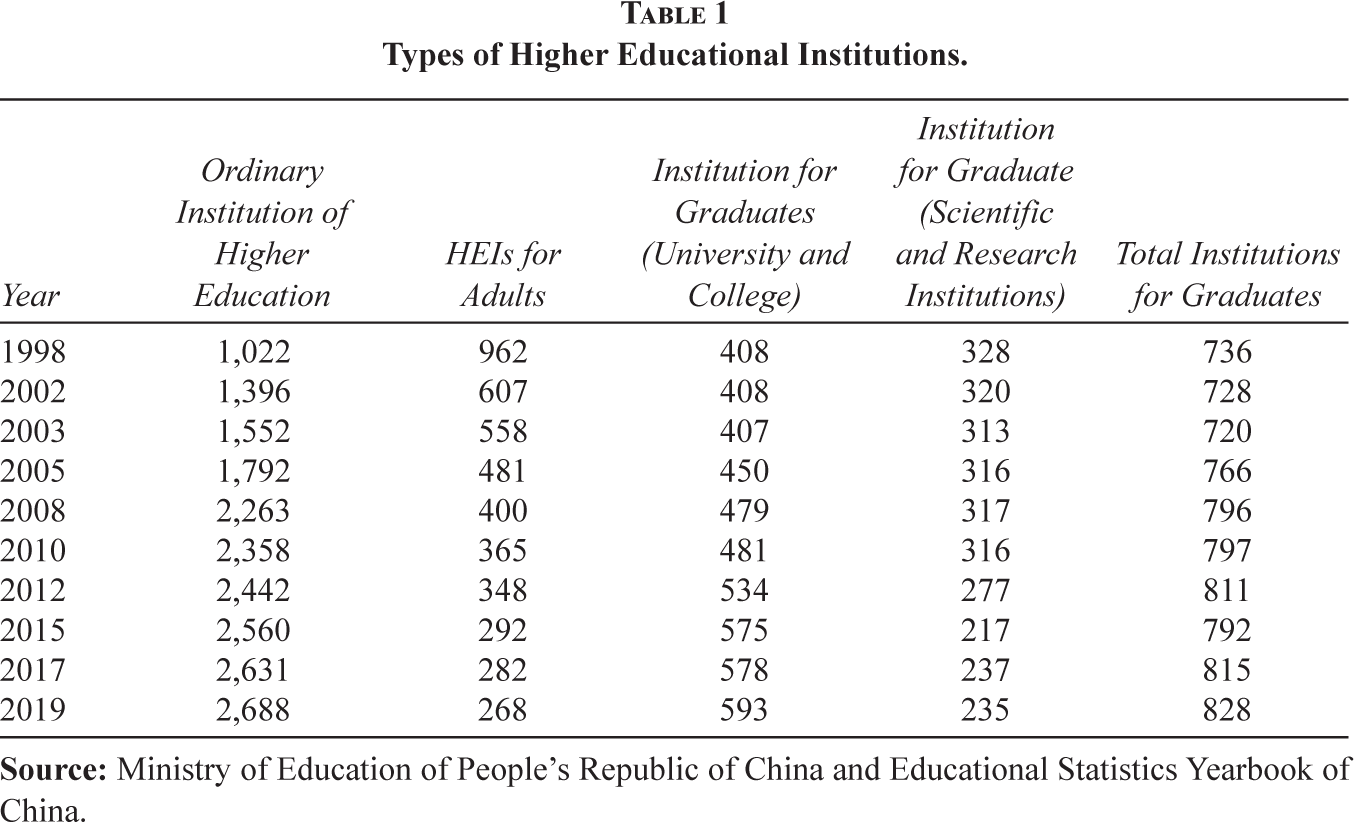
The Chinese higher education system mainly consists of two major divisions or groups of institutions: regular higher educational institutions (HEIs) and adult HEIs. Adult HEIs operate at several levels for people in employment, including media, broadcasting and in-service teacher training colleges. Regular HEIs offer full-time four-year programmes for a degree or diploma in universities; independent specialised colleges; 2–3 years based colleges and vocational colleges. Higher education is accessible through gaokao, the National Higher Education Entrance Examination. The contemporary structure of public higher education with respect to universities comprises mainly four different types of institutions, namely (a) first-class academic research-based universities; (b) teaching cum research based universities; (c) applicable universities with undergraduate courses; and (d) vocational–technical colleges, as shown in Table 1 (Han & Zhang, 2014).
After Chinese economic reform in 1978, the average growth rate of enrolment was 8.5% for around 20 years. Higher education in China has experienced rapid expansion after the reform era, particularly since the 1990s. In 1998, the Chinese government announced the massification of higher education as a formal goal, which resulted in a tremendous growth of the student population across different types of Chinese higher educational institutions. The GER has more than doubled during the last two decades, reaching a level of nearly 59% in 2022. It is estimated that about 46.5 million students are enrolled in HEIs. The number of HEIs has also increased steadily. In 2019, there were about 9 million students who graduated from Chinese universities, almost a tenfold increase over the previous two decades. The Chinese higher education sector currently comprises a total of 2,956 HEIs. Among these institutions, 2,688 are regular higher education institutions, and 268 are adult higher education schools (see Table 1). Private HEIs in China have come into prominence in the last decade. The total number of students enrolled in private HEIs increased from 5.3 million in 2012 to 7.6 million in 2017 and is estimated to rise to 10 million in 2021. Currently, about 22% of total students are in private HEIs.
Types of Higher Educational Institutions.
The aim of the massification of higher education policy was to meet the demands arising from a rapidly growing economy and to promote the development and utilisation of human resources (Cai, 2013; Xiaoguang & Wu, 2018). The rapid economic growth and international trade-driven policies created a great demand for university education. The massive number of students put China as a leading country in the production of graduates as well as PhDs both in science and engineering disciplines. From 1990 to 2010, the number of bachelor’s graduates increased tenfold from 307,865 to 3,038,473. Master’s and doctoral degrees increased more rapidly than bachelor’s degrees. Master’s degrees increased nearly fifteenfold from 1990 to 2010. Doctoral degrees increased nearly twentyfold. The total number of bachelor degrees in China in 2014 surpassed the figure of the USA’s S&E graduates for the year 2015, which stood at 650,000 (S&E Indicators 2018, National Science Board, USA). However, in 2014, the figure for the award of S&E doctorates in China stood at 34,103 which was closer to that of the USA which produced 39,834 PhDs in S&E. In this, China surpassed India (13,144), Japan (6,743), South Korea (6,032), Germany (14,625) and UK (14,271) (S&E Indicators 2018; National Science Board, USA) for the year 2014. Enrolment estimates indicate that China will continue to rise in these numbers and surpass the USA in a few years. Some 313,000 students were enrolled in doctoral programmes in 2014, along with 1.5 million in master’s programmes. Out of these figures, 182,000 were S&E PhD students and 666,000 were master’s S&E students. As noted earlier, one important factor in Chinese HEIs has been the introduction of various policy instruments and strategies for increasing the quality and excellence in teaching, research intensity and innovation in select universities towards attaining WCU.
1990–2020: Reform Measures and Higher Educational Policies 2
The decade of the 1990s can be considered as one of the most dynamic decades after the founding of New China in 1949, particularly after the 1978 reforms, towards modernisation and globalisation through the application of S&T factors. The policy thrust of the third plenum of the 14th National Congress of the Chinese Communist Party in 1993 triggered a market-driven economy, including a modern tax system, enterprise reforms and a financial system conducive to market norms. Since the 1990s, public expenditure in R&D witnessed a rapid dynamic growth phase. For instance, the basic research expenditure on research institutes and universities increased from 0.45 billion RMB in 1987 to 7.38 billion RMB in 2002, with an annual growth rate of nearly 20%. In 2020, China’s R&D investment was 2.44 trillion yuan, ranking second in the world after the United States. R&D funds are invested in enterprises, research institutes, universities and other departments. In 2020, 59.0% of R&D funds were invested in research institutes, 23.4% in universities and 10.9% in enterprises. In 1995, a National Conference on Science and Technology promoted the slogan, ‘Revitalize the Country through Science and Education.’ New plans and programmes not only boosted higher education but also expanded the role of basic research and advanced science and technology system. CAS played an important policy advisory and research role with the 1997 report on ‘Knowledge-Based Economy and the Construction of the National Innovation System’. From 1990s, a series of special university related projects, such as Project 211, 973 Programme, Project 985, C 9 and Double First-Class Projects transformed Chinese universities.
Project 211
In 1995, the policy instrument ‘Overall Planning of Project 211 Construction’ was issued by the government. This policy instrument brought 112 universities into construction and became the largest higher education key project since the founding of China. One notable development that began in the late 1990s was the merger of universities and the consolidation process. The main thrust of the 211 project was to strengthen the higher education foundation. Improving teaching standards and enhancing the research base at selected universities remained important objectives of Project 211.
One of the major developments that have come about during this phase is the transition from quantity (of the pre-1999 era) to quality orientation in education in the post-1999 period. Project 211 construction progressed in three phases. The first phase was implemented in 99 universities, with 602 key disciplines and 2 national education public service system construction. The second phase was implemented in 107 universities, with 821 key disciplines and 3 national education public service systems. In order to realise breakthroughs in key areas, emphasis was laid on innovative talent training and team construction, sustaining reform goals, building an international advanced higher education public service platform. etc. The third phase was implemented in 112 universities, distributed in 31 provinces, with a total of 1,073 key disciplines. As the foundation project for speeding up higher education development in China, this programme provided unprecedented development opportunities and corresponding resources.
Project 211 resulted in strengthening a number of basic, applied and development research projects in S&T and social sciences. For example, facing the strategic needs of national development, Tsinghua University (THU) promoted networks in information technology, energy, material science and other frontier areas to promote mainly academic research groups. In line with the idea of ‘comprehensive integration,’ University of Science and Technology of China built a large-discipline platform in condensed matter physics, an advanced research programme in chemical sciences, etc. Nanjing University adopted the mechanism of the ‘discipline special zone’ and gave more autonomy to the allocation and use of talents, money and materials, thus forming a management and operation mechanism that is not only relatively independent but also mutually supportive with related disciplines. Infrastructure in universities had been greatly improved through Project 211.
973 Programme
The 973 Programme initiated in 1997 was the national basic research programme. This was China’s largest basic research funding instrument. The 973 Programme covered agriculture, energy, information technology, resources and environment, population and health and materials, among others. In an effort to develop China’s research capacity in key disciplines and promote interdisciplinary research in universities and research institutions, the programme provided enormous budget sources.
The 973 Programme focuses on scientific research institutions, universities and enterprises. Universities accounted for more than half of the funds. The 973 Programme produced a large number of PhDs and master’s degrees. In 1998, the number of postdoctoral workstations was 1897, which witnessed considerable growth to 7,903 in 2007. The development of postdoctoral research in many ways contributed to the science output of China in the late 1990s. China’s total S&T output of research papers increased from 8,131 in 1990 to 32,289 in 2000 and further increased to a whopping figure of 175,329 by 2011, when Project 211 came to end (Krishna, 2018). The universities accounted for more than 80% of these publications.
Two other important programmes initiated by the government since the late 1980s and 1990s, which had a tremendous impact on the high level of technological innovation in the country, are the 863 Programme and the Torch Programme. The 863 Programme was meant to enhance technological capacities in new materials, ICT, biotechnology, space, etc., and the Torch Programme was mainly focused on high technology spin-offs in enterprises and the creation of high technology zones, including science and technology parks (Gu, 1999). During the decade preceding 2003, about fifty-three state-level science and technology industrial parks (STIPs) were created, which have become an important economic source contributing to the national economy. According to some reliable estimates, from 1991 to 2002, the total revenue from fifty-three parks increased from 8.73 billion yuan to 1.53 trillion yuan with an average annual growth rate of over 60%. By the end of 2002, STIPs were the important source for field research for more than 14,000 PhDs and 80,000 master’s degrees.
Project 985
When celebrating the 100th anniversary of the Peking University (PKU) in 1998, Jiang Zemin, the former President called for first-class universities with advanced levels of research and teaching to compete at the world level. He pointed out that universities should be able to cultivate and bring up high-quality creative talents to advance knowledge, which will provide a scientific basis for humans to solve the major problems facing the country. This front, he further observed, ‘should be the knowledge innovation, promoting the transformation of scientific and technological achievements to real productivity power, should be a national excellent cultural exchange with the world advanced civilisation achievements for reference’ (Ministry of Education, 1998). In 1999, ‘Education Revitalization Action Plan Facing to 21st Century’ (Ministry of Education, 1998) was announced which mobilised financial resources to various sectors and fields of research to reach advanced international standards. It was envisaged that in the next 10 to 20 years, China will strive to bring a number of universities and a number of key disciplines to a world-class level. Beijing University, THU and other higher education institutes were shortlisted for building WCUs in the country. Consequently, budget allocations to education peaked during this period. China’s financial budget for education has been less than 4% of GDP for a long time since 1990. Before 2006, the ratio of fiscal expenditure on education to GDP was at a level less than 3%. From 2006 to 2012, the ratio of fiscal expenditure of education to GDP increased year by year, reaching its highest level of 4.28% in 2012.
The Project 985 was officially launched along with the ‘Education Revitalization Action Plan for 2003–2007’ in 2004. The focus was laid on the construction of a national innovation system. As an important part of Project 985, the innovation platform was launched in 2006 which was jointly managed by the Ministry of Education and the Ministry of Finance. The main task of the project was to focus on key areas and major demands that are urgently needed for the country and industrial development. Centring on national science and technology development strategy and frontier disciplines, the project aimed to enhance the national strength of the top dominant disciplines of industry-featured universities and build a number of world-class academic groups. Universities under construction for this project are selected from the universities in Project 211 but not in Project 985.
A total of thirty-three top universities were listed on the innovation platform. Unlike Project 985, which focused on building top comprehensive universities, the innovation platform relied on building top industrial characteristics or innovation universities. A policy document on ‘Opinions on Accelerating Construction of World-class Universities and High-level Universities’ issued by the Ministry of Education and Ministry of Finance in 2010 stressed that China must adhere to the path of ‘distinctive and high-level’ development and achieve ‘Chinese characteristics and world standards’. This ideological component sustaining Chinese values and sociocultural milieu was given considerable importance in the strategies of higher education in the county. The task of accelerating the building of WCUs and high-level universities continuously stressed the building of talent pools and enhancing the capacity of independent or endogenous innovation. With a spirit of reform and innovation, Project 985 was viewed as an instrument for building WCUs and high-level universities.
As a major education deployment in China at the turn of the century in 2000, ten of China’s Project 985 universities were allocated budgets for three-years in excess of 30 billion RMB for quality improvements (Wang, 2002). Some of the prominent universities in this phase included PKU, THU, Fudan, Zhejiang and Nanjing universities. The second phase of Project 985 began in 2004 and ended in 2007 with thirty-nine universities distributed in eighteen provinces and municipalities. The top eleven universities (including the first-phase universities) were allocated 17.43 billion RMB (Yao et al., 2011). The second phase of construction’s goal was to actively explore new mechanisms for attracting WCU academic leaders and academic teams towards building innovation platforms. As the highest level of elite university groups in China’s higher education system, Project 985 played a leading role in cultivating a batch of high-level elite talents, bearing many frontier science and technology innovation researches, promoting industry–university–research cooperation and supporting the development of universities in less developed areas and disciplines.
The construction of Project 985 had achieved remarkable results. Through WCU and innovation platform construction, new breakthroughs have been made in universities discipline construction that are close to or reach the advanced international level. The team building had gone up to a new level, bringing together a number of international academic masters and young and middle-aged scholars. In 2007, the government announced the Thousand Talents Programme or Overseas High-Level Talent Recruitment Programmes. China attracted global talents from both foreign and expatriate faculty in USA, Europe and other leading institutions in the world. Consequently, the overall strength and professional standards of universities have been significantly improved, and the gap with world level science and technology frontiers in some areas has been significantly narrowed. However, compared with the world’s top universities, there is still a considerable gap in the cultivation of top innovation talents, independent innovation ability and international competitiveness.
Project 211 and Project 985 were not only continuation and extension of previous construction policy of key universities, but also strategic choices for higher education to cope with the challenges of the twenty-first century in the knowledge economy and international competition. The developments in higher education led to the contemporary strategy of ‘Double First-Class University’ project initiated in 2014. With the expansion and improvement of infrastructure in select universities under Project 211, the research intensity of universities has begun to witness considerable progress.
C 9 and Double First-Class Project (2014–2020)
C 9 is an alliance of nine universities, 3 which is made up of the top nine universities selected for China’s Project 985. As pacesetters, C 9 alliance universities take the cultivation of elite talents as their responsibility and first undertake the output of high-level scientific research achievements and the cultivation of innovative talents in China. The key slogans of C 9 alliance include training for the country and the nation, to meet the needs of the twenty-first century socialist modernisation, develop first-class scientists, research engineers and high-level talents. In 2015, the State Council issued a note on ‘Push Forward World First-class University and First-class Discipline Construction Overall Plan’ in an effort to speed up the process of building a batch of world first-class universities and first-class disciplines to improve the comprehensive strength and international competitiveness of higher education in China. It was also envisaged, that in terms of higher education, the country should progress from a big country to a strong country. In September 2017, the Ministry of Education, the Ministry of Finance, and the National Development and Reform Commission announced the list of Double First-Class construction universities. Among them, there are forty-two first-class universities, thirty-six in class A and six in class B. The number of first-class discipline universities is ninety-five. In 2018, Double First-Class construction covered a total of 137 universities. The new strategy was not solely a mechanical continuation of Project 211 and Project 985.
The Double First-Class project pays attention to first-class universities and first-class disciplines. At the macro level, the policy is a national strategy to improve higher educational international competitiveness in the new era of socialism with Chinese characteristics. The new policy target may be categorised into three time nodes. By 2020, a number of universities and disciplines were expected to enter a world-class level and dominate the world level further by 2030. The ultimate goal of the Double First-Class Project is to establish a highly recognised professional and world-class system of HEIs. Concentrated financial resources were expected to help ‘leap frog’ the system to a take-off stage in the realisation of national objectives. Second, the construction of first-class university should have a certain number of leading domestic and international high-level disciplines. Third, the new measure introduced competition and a dynamic exit mechanism, which is a new concept. More support was given to the universities and disciplines with strong implementation, good progress and results. While for those with poor implementation, some measures of correction or exiting the list of support were introduced.
Internationalisation and Building World-Class Universities
The policy and reform measures, beginning with Project 211, Project 985, 973 Project, 863 Project and Torch Programme, enabled China to have footprints in the rankings of WCU. Together with this development, the process of attracting global and expatriate foreign-based Chinese scientists and internationalisation of Chinese universities enhanced Chinese higher educational reputation at the global level. Taking into consideration two popular world rankings, namely the Times Higher Education World Rankings (THE) and Quacquarelli Symonds (QS), Chinese universities have begun to feature in the Top 100 and Top 200 places since 2011–2012. In world university rankings, universities in China can be said to have made a great leap forward. In the QS Ranking of 2012, there were three universities in the Top 100. PKU and THU ranked in the Top 50. Four universities were ranked in the Top 200, and twelve universities ranked in the Top 500. In the 2022 QS Ranking, six universities ranked in the Top 100, whereas, PKU, THU and Fudan University ranked in the Top 50. There were five universities from Hong Kong in the Top 100 in the QS rankings. In the THE rankings, there were five Chinese universities in the Top 100 in 2022 and three universities from Hong Kong.
Whereas higher education policy strategies enabled Chinese leading universities to climb up the ladder of WCU, Chinese science institutions and universities have witnessed other modes of international recognition by the global science peer review systems. As reported by the Nature Index, some Chinese institutions achieved the highest overall research output index in 2020. CAS in Beijing has topped the Nature Index 2020 (a measure of an entity’s contribution to articles in the eighty-two journals tracked by the index) by achieving a share of 1805.22 in 2019, which was almost twice that of Harvard University which was listed as second. Among the top ten leading institutions in the world, CAS topped the list, while the University of Science and Technology of China stood at the eighth position and PKU stood at number 10. Harvard University stood at second, Max Planck at third, French CNRS at fourth, Stanford University at fifth, MIT at sixth, Helmholtz German Centre at seventh and Oxford University at the ninth position. 4 The University of Science and Technology of China has about 16,000 students, including 1,900 PhDs and 1,812 faculty. In 2019, this university’s scientists published a paper on the discovery of a stellar black hole with a mass seventy times greater than that of the Sun. In 2019, Zhejiang University faculty published a paper that indicated a method for boosting plant growth while reducing water. This is the university where Dr Dawei Di, who was recognised as a top innovator by the MIT Technology Review in 2019 for his work on light-emitting diodes and perovskite light-emitting diodes. 5 The rise of Chinese science at the global level has not only put the country in the league of top science producing nations in the last decade, but the country is also closing its gap with the world leader, the USA. According to an index covering a number of frontier science fields, ‘the US leads the world with a score of 204.9 points in the year 2019, followed by China with 139.7, the United Kingdom at 80.9, Germany at 67.5 and France at 46.3. 6
Research Intensity to Innovation
Twin factors that have contributed to the rise of universities as important actors in the Chinese innovation system are the entrepreneurial ecosystem and university- centred innovation strategies to impact new technology in firms. The entrepreneurial ecosystem involves various science, technology, higher educational and innovation-related actors, policies and agencies which influence and stimulate innovation. They include science and technology parks, universities, R&D institutions, spin-off firms, venture capital, technology transfer offices, incubators and other supporting institutions. Over the last two and a half decades, three major policies in 1999, 2002 and 2015 were introduced to strengthen entrepreneurship education for teachers and undergraduates in universities to promote start-ups and hi-tech enterprises. These policies systematically targeted research-intensive universities, assigning specific tasks to initiate and strengthen innovation and entrepreneurship education on their campuses. For instance, THU, being a pioneer in this task, launched X-Lab. This is a university-based platform to foster student innovation and entrepreneurship across fourteen schools and departments. Similar platforms were initiated at more than thirty leading universities, such as Shanghai Jiao Tong University, Zhejiang University, PKU, among others (Gaofeng et al., 2022). Some notable developments in institutional and policy measures that have aided commercialisation of university research and innovation deserve some elaboration.
Startups and New Firms from Incubators and Accelerators
The innovation incubators of recent years in China follow much more the North American model of high-tech start-ups being nurtured through in house training, mentoring, venture capital investment, and other supports needed by start-up companies developing new consumer technology products or advanced services for businesses (McCuaig-Johnston & Zhang, 2015). In 2017, the top five regions with the largest number of incubators were Guangdong, Jiangsu, Shandong, Zhejiang and Shanghai. Geographically speaking, Beijing, Shanghai and Shenzhen are the only truly global start-up ecosystems in China. Shenzhen is often referred to as ‘the Silicon Valley of Hardware’ as it has grown to become a powerful and innovative ecosystem. The presence of entrepreneurs and talent, combined with suppliers and factories, makes it an ideal ecosystem for hardware startups. The city’s innovation community attracts large numbers of startups, and many have achieved global success. Tencent, owner of WeChat and social networking platform QQ, one of the world’s largest internet companies, was founded in the city. The city’s districts house many successful high-tech companies including BGI (China’s largest genome company), BYD (electric cars and batteries), telecommunications conglomerates ZTE and Huawei and Shunfeng (e-commerce and logistics). And, for the last 11 years, Shenzhen has maintained its top spot as China’s patent filing capital, with almost 20,000 PCT applications filed in 2017, accounting for around half of China’s total patent applications (Xinhuanet, 2018).
During 2013–2015, the Chinese State Council announced various policy measures for the country to promote incubators and accelerators. China’s 13th Five-Year Plan (2016–2020), which had the goal of becoming an ‘innovation nation’ by 2020, incorporated accelerators into the national incubator system. In 1987, China’s first technology business incubator, Wuhan Donghu Pioneers Centre, was formally established. Since then, business incubators have sprung up across the country. As of the end of 2017, China was home to 4,063 incubators, and a total of 110,701 enterprises emerged from these programmes. According to the ‘China Business Incubation Development Report 2018’ issued by the Ministry of Science and Technology, these incubators led to 2.565 million jobs, including 273,000 college graduates. The technology business incubators in China have 307,000 effective intellectual property rights, including 52,000 invention patents, accounting for 2.5% of the national effective invention patents. These incubators have helped 40,000 companies to obtain 194 billion yuan in venture capital. The country increased the total number of domestic incubators, makerspaces and accelerators to more than 10,000 by 2020, with a target of 100 overseas incubators, makerspaces and accelerators for the same period. Overall, the number of start-ups increased from 11.32 million in 2013 to 21.79 million. In this period, the number of new enterprises rose from 2.5 million to 7.4 million. A total of 301 Chinese companies are on the Hurun Global Unicorn List 2021. Top of the list is Beijing Byte Dance Technology Co., a social media company with an estimated value of 2.225 billion yuan (Zhang & Gaofeng, 2024).
University Science and Technology Parks
The University Science Park has played an important role in accelerating technology transfer, promoting project incubation, cultivating innovative talents and promoting local economic development. On the surface, the University Science Park exists as a subsidiary of the university and is a manifestation of the university’s function development to a new stage. But in essence, the University Science Park is an innovation network, which is a network organisation environment composed of social networks, commercial networks and professional networks. The first national high-tech parks in China appeared in 1988, when the Chinese government launched the Torch Programme. Zhongguancun Science Park (1988) is the hub of Beijing hi-tech industry, located in the Haidian district very close to THU and PKU. Since 2022, this park has been operating sixteen sub-parks in Beijing city. Zhongguancun Science Park is home to some 20,000 high-tech enterprises. By the end of 2021, the science park boasted a total of 457 listed companies and 102 unicorn companies (Hao, 2022). Founder and Legend, the two global computer enterprises, have their headquarters inside the Science Park and many MNCs such as Motorola, Microsoft and IBM have R&D centres and laboratories in the park. In fact, the founder spun off from PKU, and Lenovo Group spun off from the Chinese Academy of Sciences. Universities played an important role in the emergence of science parks. Besides being a central source of new knowledge, universities provide advanced human resources and the science parks attract new talents and ideas in incubation and start-ups (Tabanelli, 2020). At the end of 2017, there were 115 National University Science Parks covering a total space area of 7.938 million square meters. The number of tenant companies were 10,448 with a total income of 34 billion yuan. These University Science and Technology Parks have achieved rapid development with the support of relevant national policies. They have played a unique role in accelerating technology transfer, project incubation, entrepreneurship, employment creation and local economic development (Yang, 2017).
Venture Capital
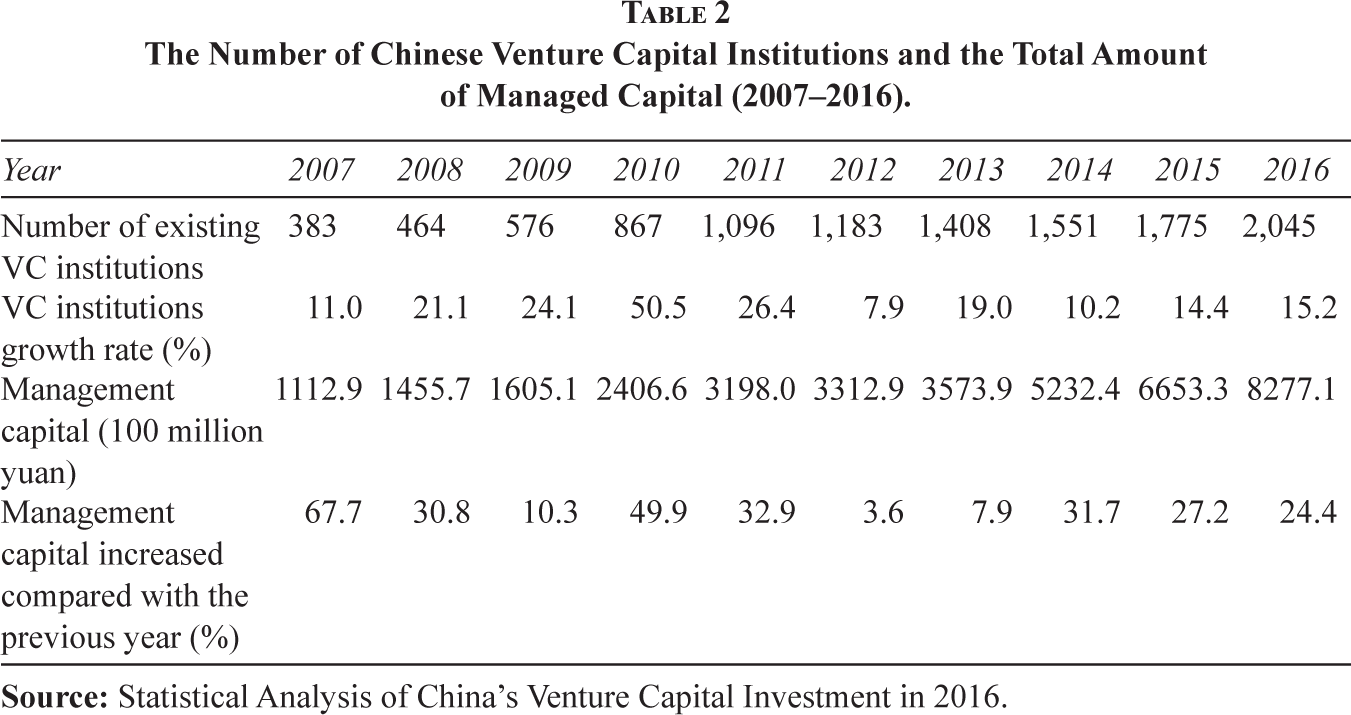
After the mid-1990s, venture capital came in to play a significant part in spurring innovation both in R&D-based firms and research-intensive universities. In 2004, China Venture Capital Company was expanded with a mandate as a national venture capital strategy centre. In 2016, the number of venture capital institutions and management capital was second only to the United States. In 2016, the total amount of China’s venture capital investment management capital reached 827.71 billion yuan, an increase of 162.38 billion yuan over 2015, an increase of 24.4%. In recent years, the capital structure of China Venture Capital has become increasingly diversified. According to statistics, in 2016, the source of funds still dominated by the government and state-owned sole proprietorships, accounted for 36.1% of the total, private and mixed-ownership enterprises accounted for 24.02%, and foreign-funded enterprises accounted for 4.42%. Table 2 gives a snapshot of venture capital growth in China during 2007 to 2016.
The Number of Chinese Venture Capital Institutions and the Total Amount of Managed Capital (2007–2016).
In recent years, in order to support the development of emerging industries and major industrial transformation and upgrading, various government guidance funds have sprung up. The State Council announced in 2015 that China will be setting up the 40 billion yuan (USD 6.5 billion) State Venture Capital Investment Guidance Fund to support start-ups in emerging industries to foster innovation and upgrade industry. Universities and higher educational institutions were mobilised to create institutional provisions for student faculty start-ups.
University Spin-off Companies and University-Owned Enterprises
From the time the Chinese Academy of Sciences professionals gave birth to a spin-off of Lenovo Group around the 1980s, China embarked rapidly on the potential of university spin-off companies (USC). Institutional structure, however, emerged after 2001, when the State Economic and Trade Commission and the Ministry of Education jointly set up the first group of national technology transfer centres in six universities. In 2008, the Ministry of Science and Technology identified 76 institutions as the first batch to explore different modes of technology transfer and build a new technology transfer system in different institutional settings. Given the limitations of space, the USC firms of two major universities, namely PKU and THU are depicted in Table 3.
Typical Spin-offs of PKU and THU (30).
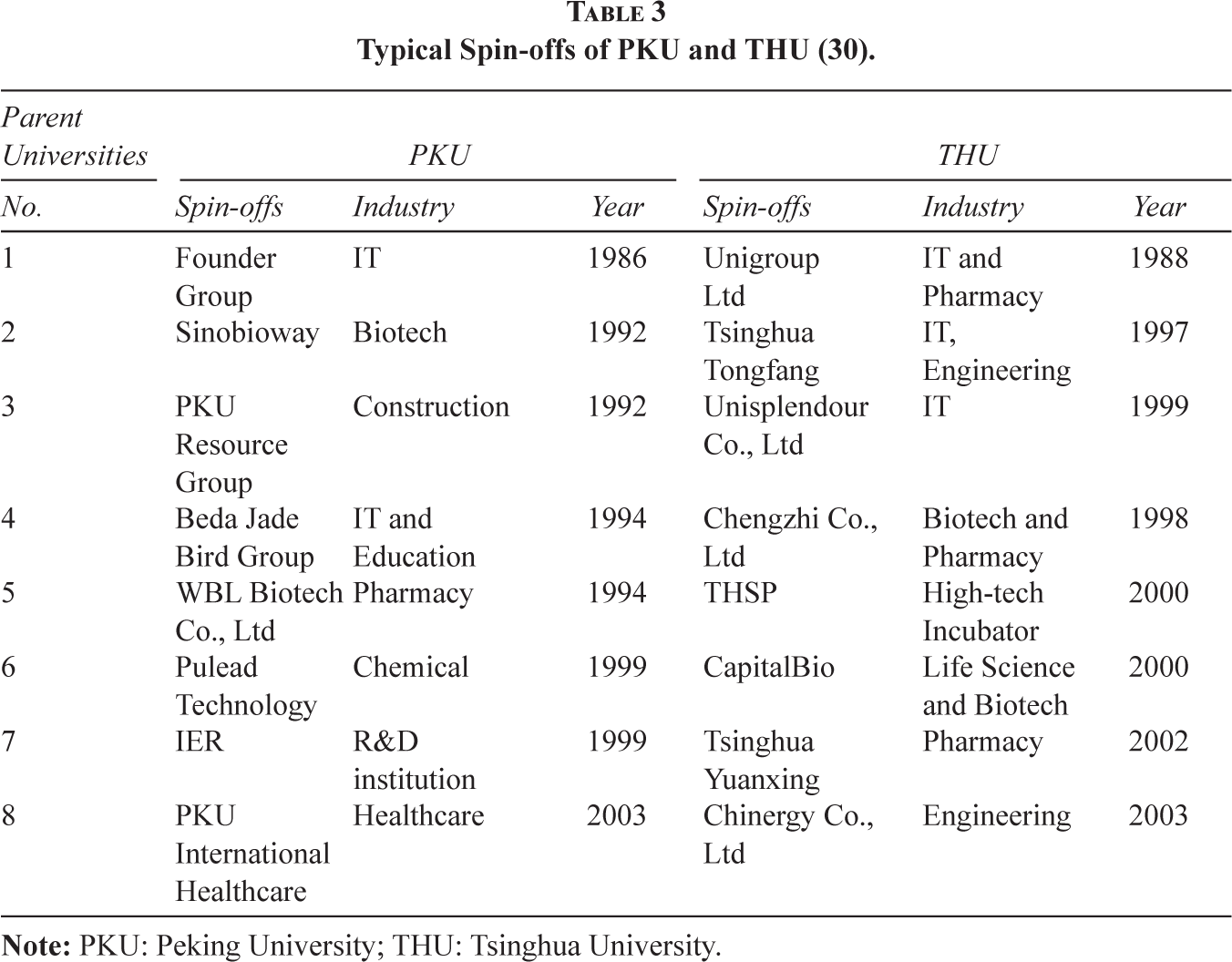
University-owned enterprises (UOEs) refer to those enterprises that are controlled by the universities they are affiliated with. This, in fact, is a development unique to China’s higher educational sector and closely linked with USC. The legitimacy of this control derives from the fact that many universities are the largest shareholders in these enterprises (Xue, 2006). Some of the UOEs have become leading actors in high-tech industries in China (Eun et al., 2006). For instance, Founder Group, Weiming Group, Beida Jade Bird Group, Pulead Technology Industry Co., Ltd and Virtus Group were established and developed on the basis of PKU research results finding their way into forming firms. In another prominent example, Tsinghua Tong Fang Co., Ltd., was floated as an IPO (initial public offering) in 1997 on the Shanghai Stock Exchange with THU as the main shareholder. The company acts as an incubator for THU’s IP. The company now owns more than 300 Chinese patents in information technology, energy resources and the environment and applied radiation technologies, as well as 44 copyrights on software.
University Links with Big Firms
As Project 211 and Project 985 universities in China increased their research intensity and innovation potential in the last two decades, they began to play an important part in the national innovation system. In 2010, THU and China Telecom jointly established a joint laboratory for next-generation Internet technologies. The other joint lab is with Tencent’s Internet platform. Tencent, one of China’s leading technology companies, is involved in various areas such as gaming, social media, e-commerce and technology services.
Companies outsource basic research tasks to universities and public research institutes or jointly develop with external knowledge institutions. With the rising costs of R&D and the constant expansion of the scientific field, this model is favoured both by companies and university research groups. For example, Commercial Aircraft Corporation of China, Ltd (COMAC) signed a Framework Strategic Cooperation Agreement with Shanghai Jiao Tong University on 10 April 2015, in order to strengthen university–industry cooperation and innovation and promote trunk liner careers. COMAC would develop in-depth exchanges and cooperation on scientific research capability, talent training and international cooperation with Shanghai Jiao Tong University (COMAC, 2015). Another example can be drawn from the case of the Cooperative Medianet Innovation Centre (CMIC). CMIC was jointly established by Shanghai Jiao Tong University, PKU, the Digital TV National Engineering Research Centre and other units. It is the only identified cooperative innovation centre in the digital media field in China.
Alibaba Group invested RMB 17 billion (USD 2.7 billion) in R&D in 2017, ahead of Baidu, Tencent and Jingdong. Alibaba Innovative Research (AIR) is a bridge between Alibaba and the scholars from non-profit research institutions worldwide. In 2017, many proposals were received by AIR, which are from ninety-nine universities and institutes in thirteen countries and regions. In addition to setting up its DAMO Academy (a global research programme set up in 2017), Alibaba has recently established strategic partnerships with two top Chinese universities: THU and Zhejiang University. The Alibaba–Tsinghua lab aims to resolve issues of interactions between ‘humans, machines and the environment’. Both parties will collaborate on different research projects on frontier technologies, including multi-source emotion data analysis, affective computing, tangible interaction and multimodal perception and interaction. These technologies are fundamental to driving the advancement of HCI studies.
Zhejiang Lab was co-funded and established by the Zhejiang Provincial Government, Zhejiang University and Alibaba Group. The institution conducts basic research and makes key technological breakthroughs based on big data and cloud computing in such areas as network computation, artificial intelligence, data security and intelligent manufacturing (CHE, 2018). Aliyun, Alibaba’s cloud computing subsidiary, has launched a cooperation programme with Shenzhen University to cultivate talent in the fields of cloud computing, big data and artificial intelligence.
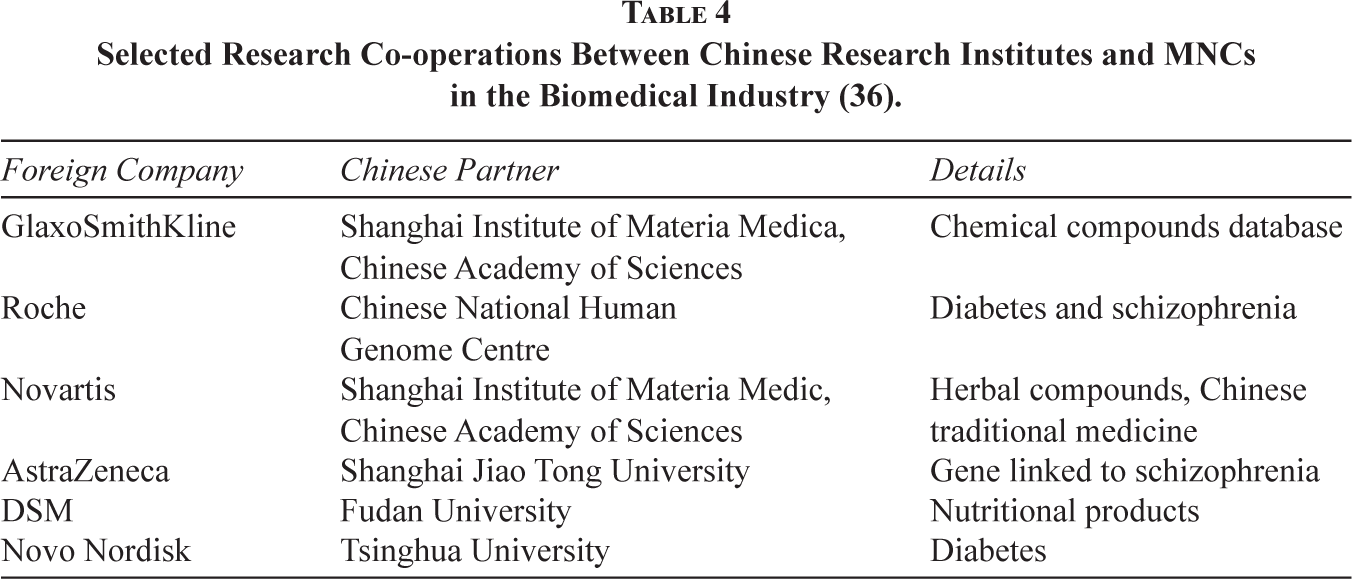
In recent years, Chinese universities have increasingly engaged in collaborative efforts with major firms, particularly in the fields of technology, innovation and aerospace. Universities such as Tsinghua, Beijing Institute of Technology (BIT) and Harbin Institute of Technology (HIT) have forged partnerships with prominent Chinese companies, including those in the technology and aerospace sectors. These collaborations often aim to bridge the gap between academia and industry, fostering innovation and knowledge transfer. In the context of space research, institutions like BIT and HIT have joined forces with state-owned enterprises such as China Aerospace Corporation and China Aerospace Science and Technology Corporation. These partnerships leverage the expertise of academic institutions in research and development, while the industry provides resources and practical applications for cutting-edge technologies. Such /collaborations play a pivotal role in advancing China’s technological capabilities, contributing to breakthroughs in satellite technology, space exploration and other critical areas. The synergy between academia and industry fosters a dynamic ecosystem that accelerates scientific progress and propels China’s position on the global stage in various high-tech sectors. Some of the partnerships between multinational companies in the biomedical industry and Chinese universities or research institutions are shown in Table 4.
Selected Research Co-operations Between Chinese Research Institutes and MNCs in the Biomedical Industry (36).
Concluding Remarks
The transformation of universities in China over the last three decades presents us with an interesting landscape, wherein, political actors and state policies on higher education have played a dominant role. The era of opening up after 1978 and a phase of massification in higher education during the 1980s and 1990s revolutionised higher education, particularly the growth of universities. The whole policy discourse and Chinese political thinking around the mid-1990s began to question the phase of massification of higher education. The concern for international comparisons and internationalisation and globalisation of HEIs came into sharp focus. With the rise of China in the economic and political spheres, the rise of Chinese universities and HEIs became an issue for the leadership. The whole concern of how HEIs could compete at a global level and develop WCUs became a vital policy issue. In response, the government came out with three major policies in the form of Project 211, Project 985 from the 1990s and the Double First-Class University Plan including C-9 programmes in 2015.
The autonomy of leading universities governed by the central government and its vision to attain global standards and reputations are intertwined with the mediation of the government. This combined governance of elite universities with the massive inflow of research budgets through special projects (such as Project 211 and Project 985) enabled Chinese universities to compete at the global level. However, this has led to a form of pyramid structure with a small proportion of elite universities. These universities have not only developed world-class quality in teaching standards, but the academic research community has begun to compete at the global level in various frontier areas of science, technology and engineering. Higher education has leapfrogged to attain international recognition and to build some WCUs during the last decade, particularly in 2010 and 2020.
Improving research intensity, human capital and talents, teaching standards and the infusion of high-level infrastructure in select bands of universities enabled China to develop WCUs. The other important development that has come about in the last decade is that universities have become important actors in the national innovation system and as frontiers of innovation. Here again, state mediation with recurrent and systematic policy support and funding has enabled a select band of universities to play an important part in the national innovation system through an entrepreneurial ecosystem (science and technology or innovation parks, universities, R&D institutions, spin-off firms, venture capital, technology transfer offices, incubators and other supporting institutions). In totality, the last two decades witnessed considerable progress in the university-centred entrepreneurial ecosystem and university—industry relations. After years of development, China’s innovation and entrepreneurship ecosystem has gradually been established and will make a great contribution to the world’s science and innovation system.
Footnotes
Declaration of Conflicting Interests
The authors declared no potential conflicts of interest with respect to the research, authorship and/or publication of this article.
Funding
The authors received no financial support for the research, authorship and/or publication of this article.