




Abstract
During the last two decades, numerous policy actors have advocated multiple models for the diffusion of solar energy-based technologies in India. In recent years, the social development-based energy business model was promoted by some NGOs, civil society groups and academicians for reaching the poor for meeting their energy needs. Using a case study approach, this article explores the social shaping of a solar micro-grid established in rural Bihar through the hybrid model of environmental governance. The article employs the social shaping of technology framework to explain the top-down and bottom-up interpretations of the solar micro-grid in rural India. By focusing on the idea of citizens and consumers, it explains the influence of the wider socio-political context in closing down the debate and stabilising the choices. The article illustrates the implications of the narrow framing of the socio-technical ensemble by the NGO’s and civil society groups (top-down perspective) on the diffusion potential of the solar micro-grid. The bottom-up perspective adds more layer to the interpretation of the socio-technical ensemble. An integrated, comprehensive understanding based on both the top-down and bottom-up perspective would help in developing a responsible research and innovation paradigm.
Introduction
India, one of the fastest growing economies in the world over the last two decades, has not been able to provide hundred per cent access to electricity at household level in the rural areas of the country (Dugoua, Liu, & Urpelainen, 2017). Nevertheless, in April 2018, the Prime Minister of India declared that every single village in India has now access to electricity. Interestingly, it does not mean that now every household has access to electricity. According to the Government of India (GoI), if 10 per cent of the households in a village get connected then it can be declared as ‘electrified’ (Oda & Tsujita, 2011). According to some reports, only 7.3 per cent of the total 18,452 villages in India have 100 per cent household connectivity. 1 Thus, energy poverty is a perennial issue in the rural areas of India (Bhide & Monroy, 2011). Further, there is a great mismatch in energy access in different provinces of India (Kemmler, 2006; Oda & Tsujita, 2011). The more critical challenge is to ensure reliable and affordable access to electricity in a sustained manner. Bihar, one of the eastern states of India having a predominantly rural population (around 88 per cent), has still thousands of villages and millions of families without electricity. According to the Government of India, around 15.75 million households were un-electrified in rural areas and around. 0.306 million un-electrified households in urban areas of Bihar until March 2015. The state government planned to reach to 14 million households in rural areas through different programmes using both grid and off-grid solutions by 2019 (GoI, 2015).
In this background, a unique experiment took place in Bihar in 2014 for addressing the energy poverty in rural areas. A solar-based micro-grid was established in a village named Dharnai in Jehanabad District (Greenpeace, 2014a). Jehanabad is notoriously known in Bihar for several incidences of caste-related killings or caste-wars during the 1990s (Kunnath, 2008). The Greenpeace established possibly the first solar village in the country. Unlike a pure state-led developmental intervention or a pure market-led or community-led project, this project was a collaboration between an international environmental NGO (Greenpeace India), civil society organisations (BASIX and the Centre for Environment and Energy Development-CEED) 2 and the local rural communities (villagers). This multi-partner model is conceptualised in the environmental and political science literature as hybrid environmental governance (Agrawal & Lemos, 2007; Rhodes, 1996). Hybrid environmental governance implies the joint action of different actors, such as state agencies, communities, businesses, non-governmental organisations and civil society organisations.
Contrary to the dominant model in the country in which electricity connectivity is provided in rural areas through centralised conventional grids (Kemmler, 2006), this was a decentralised rural electrification model, completely based on renewables. In this hybrid model, the role of the state was weakly envisioned. Instead of the state, the market-based actors were supposed to take the lead role in rural development. The village community was acknowledged as an active partner rather than passive receivers of state interventions. The villagers were trained by the Greenpeace India, BASIX and CEED for maintaining and regulating the solar micro-grid use. This hybrid model was presented as an exemplary case for connecting villages in the rural areas of Bihar, where main grid connectivity was not possible due to geographic and other reasons.
Greenpeace India considers the decentralised rural electrification model as an ideal model for knowledge creation, awareness generation, technology demonstration and policy development in rural India. The decentralised renewable-based rural electrification models have been advocated by many other scholars (Chaurey & Kandpal, 2010; Kabir, Kumar, Kumar, Adelodun, & Kim, 2018; Kumar, Kumar, Kaushik, Sharma, & Mishra, 2010; Oda & Tsujita, 2011; Raman et al., 2012). In India, both central and different state governments are vehemently advocating for solar energy. Under the National Solar Mission (2010), the central government wanted to achieve ‘the ambitious target of deploying 20,000 MW of grid-connected solar power by 2022’, which has been revised in 2015 to achieve the total solar power capacity target of 100,000 MW (40 GW rooftop and 60 GW grid connected). 3 The hybrid model of off-grid installation of solar energy technologies in rural Bihar is part of these broader schemes of things. Moreover, solar energy is being pushed by experts and promoters as a potential solution for confronting phenomenal environmental challenges such as climate change and meeting the future energy demand (Creutzig et al., 2017; Jawaharlal Nehru National Solar Mission, 2010; Kabir et al., 2018; Sims, 2004).
In this background, the article deals with the top-down and bottom-up approaches to understand this new technological intervention in rural Bihar and the diffusion dynamics of solar-based micro-grid at the village level. The article draws conceptual framework from the social shaping of technology (SST) (Bijker, Hughes, & Pinch, 1987; Williams & Edge, 2006) and the Public Understanding of Science (PUS) (Michael, 1998, 2009) literature. The article explores three major research questions. First, how do the different social groups understand, envision and interpret this new technology? Second, how are different values associated with solar energy and other alternatives negotiated by the local community and outside actors involved in this project? And third, how can the framing of the social groups under the lens of ‘public in particular’ and consumer/citizen (Michael, 2009) help us in understanding the technological choices made by the local villagers?
The article employs two sets of methods for data collection. To collect the bottom-up understanding, the article primarily draws from the fieldwork carried out in Dharnai between 2015 and 2017. By bottom-up perspective, we imply the opinion of villagers who were the beneficiaries of this project. The author has conducted qualitative interviews among the following groups: users of solar micro-grid including, farmers, agricultural workers, solar micro-grid operators, local village committee members and several non-users of the technology in the four neighbourhoods (Dharnai, Dharnai mahadalit tola, Bishunpur and Jhitkoria) of the village. Overall, fifteen individual interviews and eight group interviews were conducted. The interviews ranged between 15 minutes and 50 minutes. All the interviews were recorded and transcribed. To collect the top-down understanding of the relevant actors, we primarily relied on government reports, news reports, policy documents, reports prepared by NGOs (Greenpeace) and civil society groups (CEED), and the official website developed by the promoters named Dharnai Live. The top-down understanding implies the opinion of the domain experts, and more specifically the promoters of this project. The data collected through these methods were analysed with the help of the conceptual framework discussed below.
The article is divided into seven sections. The next section presents the conceptual framework. The third section provides background information about the overall electricity scenario in Bihar and specifics of the new hybrid model introduced by Greenpeace India and their associates in Dharnai. The fourth, fifth and sixth sections discuss the case, and finally, the final section offers the concluding remarks.
The Social Shaping of a Solar Micro-grid: Understanding Technological Choices
Under the broad ambit of SST, social construction of technology (SCOT) is one of the widely used frameworks to analyse the social shaping of technological artefacts (Bijker, 2010; Williams & Edge, 2006). Innumerable studies have employed this framework to explore diverse issues, ranging from study of facts and artefacts (bicycles) (Pinch & Bijker, 1984), mountain bikes (Rosen, 1993), automobile (Kline & Pinch, 1996), environmental indicators (Elle, Dammann, Lentsch, & Hansen, 2010), clinical trials (Bijker, Sauerwein, & Bijker, 2016), recumbent bicycles (Ahmed, Qureshi, & Khan, 2015), contraceptive technology (Watkins, 2011), nano water filter (Saidi & Zeiss, 2016) and many more.
Continuing this line of thought, in this article, we will study the social shaping of a solar micro-grid in rural Bihar. In empirical terms, the literature on the social shaping of technologies in rural areas and especially in developing countries is mostly missing. Further, this case provides an opportunity to intervene in theoretical terms. The complexity among different social groups (in rural population along the line of caste, economic disparity, rurality, embeddedness in political systems) in our case will help us to further extend the debate on the idea of relevant social groups. The hybrid model promoted by Greenpeace and other civil society groups emphasises that this model is led by community actors and involves wider participation of local community in governance (Greenpeace, 2014b). However, they view the local community as ‘public in general’, where the public is conceptualised as ‘uniform and total’, whereas the internal differentiation among the public is downplayed. In ‘public-in-particular’ framework (Michael, 1998), the public has an identifiable stake in particular technological issue/controversy, and the internal differentiation among the public is brought in the discussion. To bring out these aspects, we will draw from the PUS literature which delineates the tension among the idea of the public as consumers and citizens (Michael, 1998, 2009). Similarly, in this article, we emphasise the role of the wider social context in shaping technological choices. The SCOT literature often does not pay enough attention to the wider social context in shaping the closure (Klein & Klineman, 2002; Rosen, 1993) and is criticised for ignoring structural embeddedness (Sovacool & Hess, 2017). We believe the idea of ‘public in particular’ and the consumer/citizens distinction complements the SCOT perspective, and this fusion is helpful in further strengthening the conceptual framework of SCOT. It helps in explaining the wider socio-cultural and political milieu in shaping the closure. The consumer/citizen distinction will help us understand how the rural users of the solar micro-grid view themselves, as common consumers (as envisioned by Greenpeace and their partners) or do they emphasise the idea of citizenship and entitlements. A different conceptualisation of the public will have a bearing on understanding the impact of the wider social milieu in shaping individual/public choices.
In this study, rather than taking photovoltaic (PV) cells as a single technological artefact or categorising solar micro-grid as a technological system, drawing from Bijker (2010), we will employ the idea of the socio-technical ensemble. We see technological and social issues as complexly intertwined with each other, and thus they present a ‘seamless web’, which cannot be analysed using other categories. Employing the idea of relevant social groups and interpretative flexibility we will analyse the top-down and bottom-up narratives on solar micro-grid. We believe, the social setting of rural Bihar, exhibiting extreme economic and social disparity among masses (Sharma & Rodgers, 2015) will help us understand the multiple ways in which the solar micro-grid was understood by the different user and non-user groups. Finally, we will explore the question of closure and stabilisation. How were the choices being made? How the negotiations about the meaning and potential benefits of the solar micro-grid among different local social groups got closed? In this context, the idea of technological framing (Bijker, 2010) would be used to analyse the responses. The idea of changing technological framing and dynamic positions of relevant social groups is crucial in this case. Unlike many existing studies (Ahmed, Qureshi, & Khan, 2015; Kline & Pinch, 1996; Pinch & Bijker, 1984; Rosen, 1993; Watkins, 2011), which used the SCOT framework for analysing the social construction of technologies in historical contexts, we analyse a contemporary case which is still unfolding.
A Hybrid Model Based on Decentralised Renewable Energy for Tackling Energy Poverty in Rural India: The Case of Dharnai
According to some studies, around 450 million Indians are living without electricity (Kemmler, 2006). Bihar is one of the most energy-deficient states of India (Oda & Tsujita, 2011). The installed power generation in Bihar is way below the other industrialised states, such as Maharashtra and Tamil Nadu and so is the per capita consumption against the national average. To overcome the energy deficiency, the state government has pledged to increase the investments in renewable sources of energy to increase the installed power generation capacity. Non-conventional sources such as solar PV technology is promoted for increasing energy access in rural areas of the state, especially after 2011. Several government policies and schemes are devised for promoting grid connectivity and off-grid models. 4
As part of such interventions, the decentralised micro-grid (100 kW) was installed in Dharnai at the cost of around $497,700 by Greenpeace and partners (BASIX and CEED were the co-implements). 5 The tariffs were decided by the village level committee (VLC) in consultation with the BASIX and the local residents of Dharnai. According to Greenpeace, the micro-grid was capable of supplying power to 3,000 people (Greenpeace, 2014b). Greenpeace advocated the mini and micro-grids as a more effective, reliable and sustainable alternative for rural electrification (Greenpeace, 2014a, 2014b; Gurtoo & Lahiri, 2012; Khator & Kumar, 2014). The experts working with Greenpeace envisioned Decentralised Renewable Energy System (DRES) or distributed micro-grids as the solution for addressing energy poverty in rural areas (CEED, 2014; Greenpeace, 2014a, 2014b; Gurtoo & Lahiri, 2012). The solar grid in Dharnai was supposed to provide electricity supply for all kind of purposes, that is, residential use, commercial use and agricultural use (Greenpeace, 2014a).
In this hybrid model, the finance was supposed to be invested by private players, civil society organisations were supposed to train the local community, and finally, the local community was supposed to drive and manage these projects (Greenpeace, 2014b). It was projected as a social development-based energy business model, which was self-sustainable and required little support from outside actors (state or non-state actors) once the project is established. The next section analyses how the experimental social development-based energy business model for bringing rural transformation and addressing environmental challenges unfolded over the years after its establishment in Dharnai.
Interpreting the Solar Micro-grid: The Top-down and Bottom-up Narratives of Relevant Social Groups
The top-down and bottom-up perspectives to analyse relevant social groups explicates the major stakeholders involved in this project. Greenpeace and their partners considered the local community as ‘uniform and total’ and downplayed their internal differentiation. In other words, for Greenpeace and partners, the local community was ‘public in general’ (Michael, 2009). Greenpeace and their associates formed a major social group in our case. They viewed the solar micro power grid as an effective, reliable and sustainable way to provide access to electricity (CEED, 2014; Greenpeace, 2014a, 2014b). From the bottom-up perspective, we identified a couple of non-user groups 6 (Elle et al., 2010) as a relevant social group which shaped the diffusion of solar micro-grid. After the installation of the solar micro-grid in Dharnai, the promoters of the project (Greenpeace, BASIX and CEED) invited the former Chief Minister (CM) of Bihar Nitish Kumar to formally inaugurate the project in August 2014. By this time, the project had received huge publicity in the national and regional media (Khator & Kumar, 2014). The solar micro-grid has started providing electricity, and all the four major neighbourhoods in Dharnai were getting electricity supplied through this micro-grid (Greenpeace, 2014a). When the former Chief Minister visited the village to inaugurate the project, a small group from the village, greeted him with provocative slogans and placard. They demanded, ‘We do not want fake energy, give us the real one’. According to this small group of protestors, solar energy provided through micro-grid was fake energy and conventional grid connectivity was the real source of energy.
This non-user group advocated for conventional grid connectivity instead of renewables-based solar micro-grid. The protest was led by the educated adults from the farming families of the upper caste. A couple of them (the organisers and the leaders of the protest) were already working towards getting their village connected with the central grid before this Greenpeace initiative unfolded for their village. They have visited the State Electricity Board Office several times and petitioned for grid connection in Dharnai. Thrice they have attended the Janta Darbar of the CM to submit their application for getting grid connectivity. 7 These youths, supported by some other non-users (agricultural workers from marginalised communities) of solar micro-grid in Dharnai, saw the visit of the former CM as an opportunity to express their long-pending demand. This social group interpreted solar micro-grid as an inefficient system, which was incapable of addressing their energy poverty. The existing users and early adopters of the solar micro-grid in the village pursued this group of non-users to not to show such placard. The early adopters and users of the solar micro-grid formed the third major social group. The non-users persisted with their demand in front of the CM. The former CM accepted their demand, but made the remark that ‘[s]olar energy is the real energy, which will stay forever and the conventional one is fake, which will deplete over the years.’
—(Fieldwork) As narrated by the villagers
Two different interpretations of the same solar-based micro-grid presented and promulgated by different social groups (non-users from the village and users and the promoters of the micro-grid) in Dharnai contradicted each other (Pinch & Bijker, 1984; Saidi & Zeiss, 2016). The non-user group saw the solar energy as the stop-gap arrangement and the conventional energy supply through the centralised grid as the permanent technological solution. The former CM and the non-state promoters of the project, which represents the expert-led top-down vision of the technology emphasised on the finiteness of the coal reserves and the infinite nature of solar energy. The top-down view is endorsed by several scholars working on renewable sources of energy (Creutzig et al., 2017; Kabir et al., 2018; Oda & Tsujita, 2011; Raman et al., 2012). The former CM announced that the demand of the non-users of Dharnai would be met by the state. After this event, within a month the village was re-connected with the conventional grid.
The integration of Dharnai with the centralised grid substantially depleted the chances for wider adoption of the solar micro-grid connections in the village. CEED envisioned that ‘The 100 Kw solar micro-grid at Dharnai is going to power about 500 households, 50 commercial shops and other social infrastructure like schools, hospitals and panchayat bhawan etc.’ 8 However, this political rupture and the clash of ideas on the nature of technologies which can fulfil the demands of the villagers has led to a drastic reduction in the number of connections among the residential users (see Table 1).
Number of Solar Micro-grid Connections in Dharnai
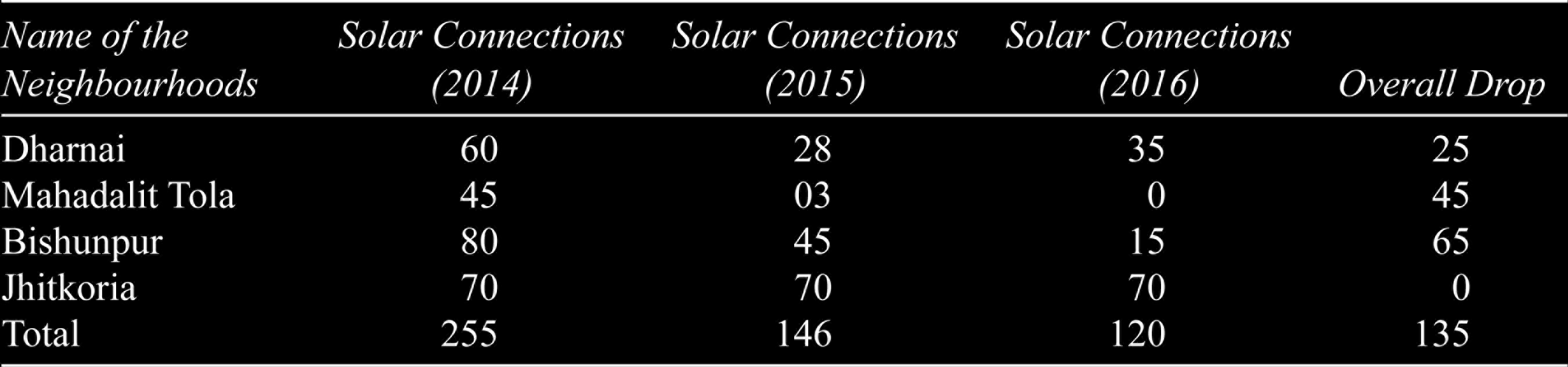
The social groups are also not static in their composition. Their make-up can also change with altering interpretations and varying technological framing (Bijker, 2010). When Dharnai was un-electrified, many families from the weaker socio-economic backgrounds also adopted solar micro-grid for re-electrification. Dharnai has a sizable population of Schedule Castes (SC) population, also termed as mahadalit by the state. The village has around 225 mahadalit families, out of which, initially around 45 families signed for solar energy. This was made possible due to the efforts of Greenpeace and BASIX campaigners. One of the female respondents from the mahadalit tola stated that
We left solar connection after using it for one year. How can poor people like us pay such amounts of money? They used to give electricity only for two hours. During rain, they do not use to give electric supply and so does during the fog in the winter.
Every user of the solar micro-grid from this neighbourhood abandoned the solar connection when the main grid connectivity was provided to the village. In other words, when other options emerged for them, they abandoned the existing solution. Whereas, in another neighbourhood, Jhitkoria, where the villagers have not received the main grid connection, the early users continued to use solar power. Whereas, in the mahadalit tola, the early users initially acted as a passive receiver, but with the change in electricity provisioning scenario in the village they asserted their interpretation, which was counter to the position fostered by the promoters.
During the initial year, the promoters of the project were unable to provide individual electric meter in the households for residential use. Instead of that, two packages were offered. In package one, the consumer had to pay ₹75, and they were allowed to use one bulb and one plug point for charging mobile. Additionally, the users had to pay a security deposit of ₹500 for availing this service. In package two, the consumers had to pay ₹140 and they were allowed to use three bulbs and one plug point. For this package, users were supposed to pay a security deposit of ₹1,000.
In the initial three months after the inauguration of the project, the users faced no problem, as the energy requirement among the users was limited. However, within six months, many of the users have started overusing the power supply and started using other heavy electrical appliances (such as TV, electric heater for preparing food). The micro-grid was not able to continuously generate enough electricity for meeting the increased demand. The unmet expectations and the desire of using more electricity created discontent among the villagers. To overcome this, BASIX and CEED with the help of VLCs conducted a campaign about the do’s and don’ts in terms of using electric appliances. However, the VLC failed to implement those norms for judicious use of the solar connection. Several consumers abandoned their solar connection after this episode in Dharnai. The promoters of the project interpreted the solar micro-grid as a solution to the existing energy poverty of the villagers (CEED, 2014; Greenpeace, 2014b). However, the users were not only interested in solving their immediate concerns but looking for solutions, which were able to meet their increasing energy demand. The idea of hybrid governance (Agrawal & Lemos, 2007), which emphasises joint action by different groups, failed to get operationalised in this context. The local community found it difficult to regulate and manage the project on its own, as envisioned by Greenpeace and associates (Greenpeace, 2014b).
The multiple relevant social groups described above have differently interpreted the same socio-technical ensemble. The external service providers believed that solar energy is the future and decentralised rural electrification is the new model, which would be adopted widely (CEED, 2014; Greenpeace, 2014a; Gurtoo & Lahiri, 2012). Greenpeace and their co-partners also interpreted the solar micro-grid as a solution for addressing the global environmental problems, and a system capable of meeting the specific needs of diverse social groups, especially the poor sections of rural India. In their own words, ‘Decentralised Renewable Energy System (DRES) or distributed micro-grids can be designed to meet the specific power needs of different populations on a variety of different scales, and therefore, are an inclusive solution that can meet the needs of diverse economic segments.’ 9 As described above, the weaker sections of Dharnai were the first to reject this interpretation of solar micro-grid.
Within Dharnai, there were multiple social groups (user and non-users) having a diverse socio-economic and educational background, and they interpreted this socio-technical ensemble in their own ways. Many in the upper-caste farming families were existing users of low power (40 W to 80 W) rooftop solar plates. They saw the supply from the micro-grid as an additional source of power, which supplemented their daily needs. In their world view, solar power was an alternative to address their energy poverty and later on it augmented their overall energy requirement. The adoption of private solar rooftop panels was minimal among the poor upper-caste farming families. They continued with kerosene-powered lantern and later switched to conventional grid. In the second phase, in January 2016, the promoters of the project installed electric meters in every household. The per unit (kW hour) price of solar energy was fixed at around ₹9, whereas the per unit price of electricity supplied through the main grid in rural Bihar was around ₹3. Definitely, there was no financial rationale for using solar energy. Many of the farmers perceived that solar energy is not going to fulfil their energy demands and is a wasteful option in terms of financial investment. One of the farmers stated that ‘[t]he original energy is provided through the main grid connection, as with that we can irrigate our field and get proper supply. The capacity of solar energy is too low, almost zero in comparison to the main grid.’ The top-down narratives on solar micro-grid, which are led by civil society groups and experts, completely differed from the bottom-up narratives given by the villagers.
Apart from the residential users, the project also envisioned to provide solar-based renewable energy to farmers (Greenpeace, 2014a). Unfortunately, none of the farmers were interested in using the solar energy for irrigation purpose. Agriculture is a major sector in rural Bihar (Sharma & Rodgers, 2015), which requires huge energy supply to sustain different agrarian activities. There were more than 100 diesel-based pumps for irrigation in the village. One of the farmers while comparing solar energy with other sources stated that
how can we pay exorbitant prices of solar energy? We do not earn that much from farming. We want an electric connection even for agricultural use. The current electric transformer cannot provide enough electricity to meet our farming needs, that is why most of the farmers are dependent on diesel pumps for irrigating fields; solar energy is unable to meet our agricultural energy demands.
This hints at an interesting relation and expectation of farmers from the state. The farmers are expecting increased state support for meeting their energy requirement, rather than the weak role envisioned for the state in the hybrid model for meeting energy requirements. The farmers wish for higher investment from the state for developing rural infrastructure in the agrarian sector.
Closure and Stabilisation of Choices: Rejection/Acceptance of the Solar Micro-grid
From the top-down perspective, the experts envisaged that the solar micro-grid would be accepted by the local community as a solution for their energy poverty. The environmental benign nature of the technology was believed to further stabilise their choices (CEED, 2014; Greenpeace, 2014b). Interestingly, the closure and stabilisation of choices (Pinch & Bijker, 1984) in this case did not happen because of environmental considerations. Most of the respondents in Dharnai stated that they were unaware of the main source of energy through which the electricity is produced in the conventional grids. The environmental dimensions and the finitude of resources of the conventional sources failed to influence their choice. For the experts, it is one of the major factors for advocating renewables (Kabir et al., 2018). Only very few selected individuals from the village shared that understanding; mostly, the educated farmers in Dharnai and few other educated individuals from other backward communities in Jhitkoria. Even among them, acceptance of this technology was not based on environmental considerations, but primarily due to other reasons. For the farmers, it was a matter of prestige, as they were the leaders and early adopters. This project has given them visibility. 10 For other users, it was because of the lack of alternative (one of the neighbourhoods was not connected with the main grid). The closure happened by redefining the problem (Pinch & Bijker, 1984). The user groups re-defined the problem. The solar grid was not a solution to their energy woes but an alternative for some to augment their energy supply and for others a stop gap measure. Whereas, the individuals from the SC population were not at all interested in the environmental dimensions or any other aspect of the technology (even as an alternative). Even though their electricity requirement was minimal, but they declined to engage with this new socio-technical ensemble. Either they continued with the kerosene oil to lighten up their houses or moved to the main grid. The majority of the population from the SC community rejected the solar micro-grid, and for them, the closure had been reached after the availability of main grid connectivity.
For almost all the social groups in the village, the end matters most (energy sources capable of fulfilling their daily requirements), not the origin or source of the energy. From the top-down perspective, the origin of the energy source was crucial. It was argued that environmentally benign renewables will be widely adopted due to environmental considerations (Kabir et al., 2018; Khator & Kumar, 2014; Sims, 2004). The aspirations of the villagers were discounted by the service providers. It was assumed that they will continue with the subsistence mode. The unmet expectations from the solar energy in terms of receiving continuous energy supply for residential purpose helped in stabilising their technological choices in favour of the main grid connection.
The hybrid model (Agrawal & Lemos, 2007) was supposed to encourage the wider adoption of solar micro-grid (Greenpeace, 2014b). In all the four neighbourhoods, during the initial stages of the project the local VLCs were created with the help of BASIX and CEED, but they became completely dysfunctional in the mahadalit tola and Bishunpur within some time. In Dharnai and Jhitkoria, members of the committee narrated the difficulties in enforcing rules or norms in their neighbourhood for restricting the use of different electrical appliances by the users. When they failed to implement the rules at the household level, they devised a way to curb energy overuse by changing the timings for supplying electricity. Instead of giving electricity all through the day, they restricted the supply only in the evening and the night. This was to discourage users from using solar energy for heavy electrical appliances during the daytime. However, the unavailability of the electricity, all through the day, encouraged the discontented users and non-users to ascertain that solar micro-grid is not the solution for their energy woes.
The political rupture and connection with the main grid due to the insistence of non-users was the second major factor which led to the closure and stabilisation of choices among different user groups within the village. The closure and stabilisation, in this case, were dependent on the perception of users about themselves as consumers or citizens (refer to the next section) and their expectations from the state, apart from their interpretation of the solar micro-grid. Rather than considering them as ‘public in general’, the public should have been viewed as ‘public in particular’ (Michael, 2009). The ‘public in particular’ implies that the public who is directly involved in this project. The concerned public has a different say over various matters, in comparison with ‘public in general’, who are not directly involved in a project. Within this ‘public in particular’, the early adopters were big farmers, who were using solar rooftop panel before the micro-grid was introduced. They produced their energy and consumed it in the absence of electric supply provided by the state. This new source added to their overall energy supply. The families who were living without PV cells first adopted it in the absence of any better alternative and then rejected it once the electric connection was established through the main grid. They agreed to become the energy consumers in this new arrangement under the hybrid model. However, once the state returned back as the main service provider, they abandoned their role as the consumer of solar energy produced by the hybrid model. They returned back to the conventional service provider, that is, to the State. Among this particular public, the concern for green energy was minimal. Rather than looking for the nature of the technology and its environmental benefits, the ‘public in particular’ was interested in getting proper uninterrupted supply of electricity from the conventional grid. As the supply from the micro-grid was only able to meet their basic demand and not enough for meeting their increasing demands, it was rejected by them.
The agricultural labourers were also enrolled as the consumers in this hybrid model, but it seems they were not ready to reconcile with that identity thrust upon them by Greenpeace and their associates. Some of them initially adopted the new technology promoted by the NGO’s and the fellow villagers but once the village was re-connected with the main grid, they immediately switched the side. The agricultural labourers abandoned their role as consumers and preferred to become the citizens having entitlements. The promoters of the project viewed the whole local community only as consumers. The state provides subsidised electricity to this social group given their low socio-economic status. Community engagement in the hybrid model is based on the neo-liberal economic assumptions, which constitutes public as consumers (Beumer, 2017). It is important to note that the majority of the mahadalit community not even got enrolled for the solar energy provided through the micro-grid from the beginning. Paying the ‘affordable price’ set by the VLC and the project partners for solar electricity was not affordable to them. A number of them asserted that they are entitled to get free electricity from the government. They rejected to act as a consumer of solar energy in the hybrid model. During this period (2014–2015), many of the nearby villages were connected to the centralised grid by the efforts of the state machinery. It further eroded the worth of solar energy provided through the hybrid model.
The Wider Context: Citizens vs Consumers
How the wider socio-cultural and political situation shapes the values of different social groups is one of the less explored dimensions of SCOT (Klein & Klineman, 2002; Pinch & Bijker, 1984). In this article, I have augmented this dimension by bringing insights from PUS literature (Michael, 1998). Greenpeace and associates viewed the local community as a ‘homogenous community of consumers having a limited requirement’, whereas contrary to this view, different social groups within the village mostly failed to envision themselves as active decision-makers as consumers. Greenpeace developed this project as a market-based solution. In their words, in this model, scarce government resources will not be utilised to provide electricity to the rural population. Instead of that, small investors will invest in these low-cost projects (Greenpeace, 2014b).
The hybrid model was expected to help in capacity building in the villages and was meant for creating rural jobs. Within a year, it became evident that the staffs working for the project were not even able to collect enough rent from the users. The project was supposed to be self-sustainable and led by the community after the initial support of outside actors (private business, NGO’s, civil society groups) in setting the project (Greenpeace, 2014a). The local community never took complete control of the system. The village community is not a homogenous group, and it is marred along different socio-economic and cultural parameters. Ignoring the internal differentiation and the changing conceptions of community identity would be a serious mistake (Kumar, 2005).
Second, the state is still having towering influence in the life of common public in rural areas of India. Especially, the lower socio-economic groups rely on state support. In Bihar, the state has the policy to provide free electricity connection (100 per cent capital subsidy) to families below poverty line (BPL) and subsidised tariff for the rural population.
11
All the mahadalit families in Dharnai were under BPL, and they preferred to abandon the use of solar power once the village was connected with the conventional grid and shifted to the main grid. A female respondent while emphasising on her mahadalit identity asserted her entitlement from the state along with the helplessness while describing the main grid connectivity in her house. She said,
If we were able to pay and would have paid then why would we had been categorised as mahadalit? We are using the main grid connection without paying; if we will be coerced to pay then we will ask the state to take back the connection, we cannot pay like the farmers.
The women respondents from SC communities stated that
the kerosene lantern cannot be abandoned, that is going to stay. From our birth, we are seeing it, that remained constant, electricity given by the state is just a fashion. Even now, often when there is no electricity, we rely only on lantern and lamps.
The narrative explains the deep-seated inequalities among the different social groups within the village, and which shapes their values, norms and understanding. It would be erroneous to treat different social groups within the village as a ‘homogenous community’ or consumers of services, which has been traditionally provided by the state; as it was done by the Greenpeace and their partners while implementing the project (Greenpeace, 2014b). Within a year, large sections from this social group have entirely forgotten this new technological experiment that happened in their village. The environmentally superior renewable technology was summarily rejected by the most socially and economically disadvantageous communities of the village.
Conclusion
In pursuit of the hybrid model of environmental governance (Agrawal & Lemos, 2007), Greenpeace and their associates co-implemented the solar micro-grid project in Dharnai as an alternate model for rural electrification in rural Bihar. The article employing the conceptual framework of SCOT and fusing it with PUS literature explains how various social groups (promoters/experts/farmers of different categories/agricultural workers/other rural communities/non-users) have interpreted the same socio-technical ensemble differently. In the top-down narratives of the experts and the promoters of the project (Greenpeace, BASIX and CEED), the solar micro-grid was envisioned as an environmentally superior technology, affordable to the local community and democratically controlled and governed by the community actors. The bottom-up narratives given by the various relevant local social groups were focused on the functional limitations of the socio-technical ensemble, the idea of ‘real’ and ‘fake’ energy, the distrust on the solar micro-grid for meeting their energy requirements.
From the bottom-up perspective, the social groups did not view the solar micro-grid as a solution to their energy woes. The solar grid was an alternative for some groups to augment their energy supply, whereas for others it was merely a stop-gap measure. The local groups failed to acknowledge the environmental benignness of the technology, which was a major reason for the promotion of this technology by the experts (CEED, 2014; Greenpeace, 2014a; Kabir et al., 2018). The closure happened along two lines, by redefining the problem and because of the political rupture. For one user group, it was a matter of prestige and for the other, the absence of any viable alternative was the reason for acceptance of the solar micro-grid connection at the household level. Similarly, the political rupture, which happened with the interference of non-user groups sealed the fate of the project. The non-users succeeded in getting the main-grid connectivity by the interference of the former CM of the state during the inauguration of the project. The failure of the solar micro-grid to meet the increased demand of the users and the failure of the village electrification committees in enforcing norms for judicious use of solar power stabilised the choices of the users. The article also explained the influence of the wider social context in shaping the solar micro-grid in Dharnai. At a broader level, most of the social groups within the village failed to envision themselves as consumers. More importantly, the weaker sections asserted the idea of entitlements, which they receive from the state. They expected the state to provide them energy and rejected the idea of becoming the consumer of a solar energy-based hybrid model.
The non-state actors involved in promoting this hybrid model viewed the village community as a homogenous group capable of self-organising themselves and looked at the users from the lens of the consumer. The article argues that it is erroneous to consider the rural community as a homogenous group, the internal differentiation and the changing conceptions of community identity should be considered while planning such interventions. The formulations of the public as citizens or consumers (Michael, 1998) will have an enormous influence on the shaping of new technologies. The article adds to the STS literature, which explains how the non-users influence the shaping of different socio-technical ensemble. In the hybrid model, the role of the state was made subdued and the market-based rationalities were promoted for the adoption of solar power-based technologies, but public (non-users in this case) intervention has brought the state back. The wider socio-political contexts, thus, pose a great challenge for the wider adoption of this hybrid model for delivering quality energy service to the local communities in resource-constrained settings of rural India. Ignoring the bottom-up perspectives and the wider social milieu while promoting new technological interventions would fail to provide desired results. The article argues that an integrated, comprehensive understanding based on both the top-down and bottom-up perspectives would help in developing a responsible research and innovation paradigm (Pandey, Valkenburg, Mamidipudi, & Bijker, 2020).
Footnotes
Declaration of conflicting interests
The author declared no potential conflicts of interest with respect to the research, authorship and/or publication of this article.
Funding
The author received no financial support for the research, authorship and/or publication of this article.