




Abstract
In the Anthropocene era, humanity exists in an ecologically and socially unsustainable way. The global food system is not able to produce sufficient healthy food for all. The purpose of the article is to contribute both to theory and practice through understanding the characteristics of ecological consciousness and sustainable food production, and how they can help businesses in transforming themselves into an ecologically conscious and socially responsible agent. The article studies the aspects of the global food crisis, how to transform food production to be sustainable, and how ecological consciousness can contribute to this transformation. Through presenting eight real-world cases practising ecological consciousness in food production, the study provides some insights into how sustainability transformation is possible at the level of business models, social and economic business networks, cities and countries. The cases highlight that for sustainability transformation, one should consider the role of disciplined small steps in paradigm shift, the value of no compromise, and the need for combining minds and hearts, regeneration and stewardship for human and natural values.
Keywords
Global Food Crises: Wasting the ‘Currency of Life’
Indian physicist and agroecologist Vandana Shiva argues that food is the ‘currency of life’ that makes humans who they are physically, culturally and spiritually. She is determined that despite the many challenges, humanity can end world hunger while saving the planet and preserving unique cultural traditions and human values (BBC, 2021).
For decades, humanity has not been on the right track to achieving these noble goals. British economist Ernst F. Schumacher foresaw the food crisis as early as 1977, among those that would afflict humanity (Schumacher, 1977). In 1983, the World Bank announced that food policy would be of paramount concern to economic development efforts (Timmer et al., 1983). After its first seminal report, ‘The Limits to Growth’, the Club of Rome published, in 1991, a strategy titled ‘The First Global Revolution’ for world survival in the twenty-first century. Global food security was listed among the top twelve dangers caused by human intervention and to be overcome through changed attitudes and behaviour within a new global governance paradigm (King & Schneider, 1991).
Although in the second half of the twentieth century, the ‘Green Revolution’ in agriculture resulted in increased crop yields through industrial farming technologies and contributed to reductions in poverty and hunger for millions worldwide, it has also resulted in far-reaching ecological and social consequences. The frameworks of the United Nations’ Millennium Development Goals, and then afterwards the Sustainable Development Goals, have reinforced the objectives to eradicate hunger and all forms of malnutrition, enhance food security, and promote sustainable agriculture. As a result, extreme poverty rates and hunger declined in the 2000s, but the improvement stalled, and we still do not provide all human beings with adequate food in a sustainable way on a global scale (FAO et al., 2024; Pathak et al., 2022; United Nations, 2025).
In fact, the outlook is even worse today. In recent years, multiple regions have been painfully hit by food crises, experiencing significant food price inflation and major food shortages and global hunger and food insecurity have been rising to a record high. By 2023, compared to 2019, the total number of people affected by hunger rose to between 713 and 757 million, one out of 11 people in the world, and one out of every five in Africa. Approximately 2.33 billion people suffered from moderate or severe food insecurity in 2023, and nearly 2.8 billion people could not afford a healthy diet in 2022. Over 343 million people across 74 countries are facing acute hunger; women, children and poor and vulnerable communities have been among the most severely affected (FAO et al., 2024; Pathak et al., 2022; United Nations, 2025; WFP, 2025; World Bank, 2025). Main causes behind these trends can be identified as violence and instability in fragile and conflict-hit countries such as Ukraine, Gaza, Sudan, Mali or Haiti; climate shocks (floods, heatwaves, droughts); energy price inflation; slow recovery after the COVID-19 pandemic; supply chain failures or economic downturn and endangered livelihoods in many countries (FAO et al., 2024; WFP, 2025; World Bank, 2025).
Global food systems have also inherently contributed to the current ecological crisis. While capturing about 50% of the Earth’s biocapacity (Wackernagel & Antonelli, 2021) and having an unsustainable ecological footprint, mainstream intensive agriculture is not able to cope with resource inefficiency in food production and food waste. The prevailing industrial agriculture is based on fossil fuel energy and prioritizes animal products, which are significantly more resource-intensive than plant-based food. About 21%–37% of total anthropogenic greenhouse gas emissions are attributable to the food system. Meat production, particularly beef, as well as livestock feed, is responsible for 57% of all food production emissions. Livestock take up 77% of global farmland and only produce 18% of the world’s calories and 37% of total protein. Regarding food waste, about 1.3 billion tonnes per year, which is roughly one-third of the food produced for human consumption, get lost or wasted in both high- and low-income countries (Crippa et al., 2021; EOD, 2025; Pathak et al., 2022; Ritchie & Roser, 2024; Schwarz et al., 2023; Xu et al., 2021).
In the era of the Anthropocene, humanity exists in an ecologically and socially unsustainable way, and the global food system is not able to satisfy the basic need for healthy food for all. Ecological cycles, ecosystems and social communities are seriously harmed, and urgent and radical transformative change, ecological consciousness and a regenerative approach are indispensable at all levels of society and the economy to make food production serve the well-being of all human and non-human stakeholders while respecting planetary boundaries and a safe operating space for humanity (Dasgupta, 2021; EASAC, 2025; GFN, 2025; IPBES, 2024; Schwarz et al., 2023; Steffen et al., 2015, 2018; Waters et al., 2016; WEA, 2025).
How to Transform Food Production to Be Sustainable
To resolve the present ecological and social polycrisis, the transformation of food systems plays a critical role. Among other system-shifting steps, besides mitigating poverty and inequality, lifting up marginalized people, and transforming energy systems, humanity badly needs to transform the global food system as well (Club of Rome, 2025; Dixson-Declève et al., 2022; EASAC, 2025; Pathak et al., 2022; United Nations, 2025).
The challenge of sustainable food production, as a decisive factor of sustainable food systems, is immensely influenced by government subsidies to the agricultural sector. Food is considered to be a strategic commodity, and the sector tends to be closely controlled by the governments. Government policies provide a framework and parameters for the market conditions in every country, and progress in how they cope with food loss and waste, nutritional and fair accessibility challenges and enabling sustainable, regenerative agricultural practices is crucial.
Historically, governments’ aspirations to settle food problems have been immersed in the broader context of economic development, and, as a complex task, included a long-run vision about how food systems should evolve. Food policies cover collective efforts of governments to shape the decision-making environment of food producers, processors, distributors, marketing agents and consumers to promote social objectives. Throughout the last decades of the twentieth century, most societies have had the following basic goals for a national food policy: (1) efficient growth in food supply; (2) improved income distribution, primarily through employment creation; (3) satisfactory nutritional status for the whole population; and (4) adequate food security (Timmer et al., 1983). Recently, these goals have been completed with environmental sustainability. All these objectives are interconnected, with potential important synergies and trade-offs, so a holistic approach and increased coordination between policymaking bodies are pivotal. Making robust food policies does not only require a fact-based common understanding of how the world is but also a shared view of how the world should be—including the need to balance diverging interests of stakeholders to overcome value differences while avoiding policy capture by special interests (OECD, 2021).
Beyond national food policies, there are numerous international initiatives targeting to tackle different aspects and drivers of the food crises and help the transition towards sustainable food production, such as organic farming, permaculture, agroforestry, agroecological, regenerative or biodynamic agriculture. The second of the 17 United Nations (UN) Sustainable Development Goals, the UN’s development agenda for the twenty-first century, is about ending hunger, achieving food security and promoting sustainable agriculture by 2030 (United Nations, 2025). The Food and Agriculture Organization (FAO) of the UN assists countries on priority policy issues such as climate-smart agriculture, food chain crisis, food loss and waste, right to food, sustainable food and agriculture and several more (FAO, 2025). In 2020, the European Commission approved the European Green Deal, a set of policy initiatives aiming to make the European Union climate neutral by 2050. The plan introduces new legislation on the ‘Circular Economy Action Plan’, the ‘Farm to Fork Strategy’, and the ‘Action Plan for organic production in Europe’ to pursue food sustainability and a better balance of nature and food systems while protecting people’s health and well-being and increasing resilience (European Commission, 2025).
Making a productive, sustainable and stable food system depends on country-specific aspects, governance and market operation (Timmer, 2015). Policy change across the economic sectors, including agriculture, trade, finance, commerce and industry, is also required for transforming the global food system more sustainable. These sectors can, however, be influenced by historical economic policy agendas and paradigms supported by strong mainstream global actors such as the World Bank or the International Monetary Fund (IMF) (Thow et al., 2021). For transformation towards a more just and sustainable food system, food policy integration uniting various food-related actions and overcoming dominant, siloed and fragmented approaches is essential, too. Current policies seem unable to catalyze these (Edwards et al., 2024). How we frame food may also shape food policies and their impact. Defining problems and solutions is rarely neutral in their political effects, reflecting underlying values. Failure to build new narratives beyond food as a commodity towards food as a human right or as a common good contributes to a policy lock-in (Jackson et al., 2021).
To realize sustainable food production, its enabling food policies, however, are not enough. In 2023, the heads of the FAO, IMF, World Bank Group, World Food Programme and World Trade Organization released a statement to call for preventing a worsening of the food and nutrition security crisis through urgent actions to rescue hunger hotspots, facilitate trade, improve the functioning of markets, enhance the role of the private sector, and reform and repurpose harmful subsidies with careful targeting and efficiency (World Bank, 2025). Coordinated efforts across governments, financial institutions, and the private sector are the only way to end the global food crisis. Also, strengthening peacebuilding efforts; addressing the underlying causes to build resilience; adapting to climate change; promoting good nutrition and improving food systems while making financial resources available are inevitable (FAO et al., 2024; United Nations, 2025; WFP, 2025).
Besides governmental actions, the responsibility of mainstream agribusinesses to change how they produce and commoditize food cannot be understated. Studies have proven that big corporations, including ‘Big Food’ companies with mainstream business approaches generate ecological and social ills (Birkinshaw & Piramal, 2005; Brown & Timmermann 2015; Dixson-Declève et al., 2022; EASAC, 2025; Hauter, 2012; Mintzberg, 2007; Shrivastava et al., 2019). The intensive food industry maximizes bulk production and economic efficiency, overuses artificial fertilizers and chemical pesticides, and misuses the massive asymmetry of power and resources. When economic actors tend to be driven by self-interest, instrumental rationality, material value orientation, cruel competitive strategies, short-term profit maximization and prioritizing economic growth and shareholder value, they consider living beings simply as resources and deplete natural ecosystems and social communities (Daly, 2008; Ims et al., 2014; Shrivastava et al., 2019; Shrivastava & Zsolnai, 2022; Zsolnai, 2015).
How can humanity transform food production to be sustainable and oriented towards human values? How can we transcend the limitations of present food systems, and where can we intervene in this complex system?
In 1997, American environmental scientist Donella Meadows introduced leverage points, defining ‘places within a complex system (a corporation, an economy, a living body, a city, an ecosystem) where a small shift in one thing can produce big changes in everything’ (Meadows, 1999, p.1). Understanding them can help influence complex systems and solve global problems. The hierarchy of twelve leverage points from less to more impactful adjustments can be grouped into four categories. (a) Parameters consist of constants, sizes of buffers, and the structure of material stocks and flows. (b) Feedback contains the length of delays, the strength of negative feedback loops and the gain around driving positive feedback loops. (c) Design includes the structure of information flows, rules of the system and the power to change the system structure. (d) Intent involves the goals of the system, the mindset or paradigm that the system arises from, and the power to transcend paradigms. Expanding from parameters to intent, changes can have more significant and long-lasting consequences. The categories are connected; higher ones affect the lower ones when intervening in complex systems (Abson et al., 2017; Meadows, 1999).
The challenges of global food production urge us to transform the system and even the paradigm with its underlying values. Critical review of the basic assumptions of modern economic thinking and business practices is inescapable (Club of Rome, 2025; Costanza et al., 2018; EASAC, 2025; Korten, 2018; O’Higgins and Zsolnai, 2018; Tencati & Zsolnai, 2010; Wallis, 2020; WEA, 2025). To transform food production, one must create a consciousness about its characteristics, burdens of economic interests, our attitudes and genuine human values (Schumacher, 1977). Psychologist Stanislav Grof argues that the obstacles to transformation for a better future lie within the human personality and reflect the level of consciousness of humanity (Grof, 1998). At the highest leverage point, that is, transcending the predominant paradigm, a new kind of consciousness is needed.
Ecological Consciousness as a Leverage Point for Transformation
The signs of ecological consciousness can be traced back to Palaeolithic societies, where it included the identification of the ‘self’ with nature and respect for life. Humans, like every being, were considered parts of the great unity of the holy universe and dependent on it, not dominant over it. Every animate and inanimate being was seen as interconnected. The first great civilizations’ mindset incorporated ecological consciousness. As the biosphere-transforming activity of humanity had extensively increased over the centuries, humans gradually became physically, psychologically, and spiritually separated from non-human nature, thus ecological consciousness weakened (Hughes, 1991).
The concept of ecological consciousness began to be differentiated from environmental consciousness in the 1960s, as environmental activists and philosophers believed that conventional natural conservation movements were interpreting environmental problems too narrowly. Over the recent decades, this viewpoint has spread and led to significant changes in society and cultural, political and economic institutions by redefining the concepts of the individual, society and nature (Christopher, 1999).
Ecological consciousness is a concern for environmental problems when experiencing nature’s degradation. Conventional environmental consciousness considers environmental problems as technical ones and does not understand their root causes. Ecological understanding of nature, society, and the individual relationship is a prerequisite to solving environmental problems, which are inevitable consequences of the instrumental rationality manifested in social and cultural institutions of modern capitalism, industrial technology, individualism, and mechanistic science. The new metaphysical framework of rationality and a new understanding of the nature of the self and its place in the universe can help transcend ecological concern, threat, and anxiety. Possible steps to reach these states require (a) replacing the atomistic concept of the self with a holistic approach; (b) developing an ethical system based on new ontology beyond anthropocentrism; (c) recognizing that the process to extended self-understanding needs changes in one’s feelings and relationships to the world; and (d) achieving an ecological rationality that supports the actualization of ecological consciousness (Christopher, 1999).
Ecological consciousness can be derived from the philosophical and operative approach of ‘deep ecology’. Instead of focusing on short-term problems and superficial technological solutions (‘shallow ecology’), deep ecology explores the roots of problems, redefines reductionist, anthropocentric ideology, and the individual itself. Ecological consciousness addresses questions of ‘ecological self’, ‘ideal state of being’, ‘self-realization’, and ‘ecological sensibility’. It can be defined as deep awareness about biological, ecological, emotional, and spiritual relationships among human and non-human beings. Through ecological consciousness, one can understand that global environmental crisis is generated by the globalized, industrial, consumer modernity and a disconnected consciousness, and can handle concern for the environmental destruction through rationally understanding it and actively, experientially, and emotionally reconnecting to nature. Radical mindset change and a personal ‘ecosophical’ approach can help every human being to develop their own worldview, values and norms, act upon them, and take responsibility (Ims, 2015; Naess, 1989; White, 2011).
German-American philosopher Hans Jonas calls for a new kind of ethics in an era when human activities cause cumulative and irreversible damage to living nature. The ‘principle of responsibility’ developed by Jonas requires humanity to take care of natural beings, all of whom have intrinsic value. We must live and act so that we do not endanger the chances of future life. Human responsibility towards nature and future generations is of a non-reciprocal and substantive kind (Jonas, 1984). The claim for expanding the scope of human responsibility also spurred American naturalist Aldo Leopold to argue for an ‘ecological conscience’. Only those actions are ethically right that preserve the integrity, stability and beauty of the natural communities, including soil, water, flora and fauna. ‘Land ethics’ acknowledges that humanity is a part of natural ecosystems and encourages proper land use, avoiding sacrificing ecological values for short-term economic gains (Leopold, 1949). A universal form of ecological consciousness was developed by British geochemist and ecologist James Lovelock and American biologist Lynn Margulis. According to their ‘Gaia theory’, animate and inanimate systems are interconnected and form a complex, self-regulating system of Earth that makes life possible on the planet. As human activities cause global ecological change, we must respect the integrity of global patterns and mechanisms (Lovelock, 2009).
British-American biologist Gregory Bateson agrees that the world consists of systems of individuals, societies, and ecosystems as part of a supreme, comprehensive system, which many call ‘God’; he refers to it as ‘Mind’, and consciousness bridges the different elements. Duality in modern Western philosophical and scientific thinking (mind–body, man–nature, society–ecology, biological–emotional, God–nature) is inherently false, and the limited conception of consciousness is not compatible with the universal Mind. The excessively purpose-driven Western mindset narrows attention and receptivity, so humanity misbelieves that it can control and instrumentally use all systems, thus destroying self-correcting mechanisms of natural systems. Bateson proposed to recognize naturally self-controlled systems and develop a more complete form of consciousness. The following may help the way towards these objectives: extending love from individuals to societies and ecosystems; practising arts, poetry and music; expanding the capacity of the mind; developing relationships between humans, animals and nature; and religious practice, spirituality. Nature and human civilization should exist in a unified way, where civilization is as flexible as nature and is open to changes in its basic characteristics (Bateson, 1972).
Enlarging consciousness through practising love, the arts, and spirituality is important to develop ecological consciousness. Nobel laureate Indian poet and philosopher Rabindranath Tagore was also searching for solutions to ecological stability and sustainable development, driven by his deep respect for nature. Building on traditional Indian values such as non-dualism, oneness, and the interconnectedness of all beings, Tagore argued that modern civilization has disembedded from the context of the universe, and materialistic values prevent us from living in harmony with nature. To regain unity with nature, humanity should develop a deep kinship with natural entities, and consider the world as the expression of divine beauty. Through experiencing it, one can expand aesthetic, moral, and spiritual consciousness and rise above the narrowly defined ego (Mukherjee, 2018; Sarin, 2014).
Transforming Food Production Through Ecological Consciousness
This section presents selected real-world cases practising ecological consciousness in food production at the level of business models, networks of social and economic businesses, cities and countries. A less structured qualitative research design is applied for the case analyses of eight well-known ecologically conscious food systems throughout the world, selected by purposeful and maximum variation sampling to explore heterogeneity of the field. Cases are Green Monday (Hong Kong), SEKEM (Egypt), Slow Food (Italy), Montreal (Canada), Tel Aviv (Israel), El Hierro (Canary Islands, Spain), Costa Rica and Sikkim (India).
Green Monday
Green Monday, based in Hong Kong, is a multifaceted social business platform dedicated to tackling issues of climate change, animal welfare, global food security, food-related illness and shifting the public towards sustainable living. David Yeung and Francis Ngai, economists and Buddhist practitioners, founded Green Monday on Earth Day in 2012 with the aim of promoting low-carbon, sustainable, plant-based lifestyles and local and global community building, parallelly implementing a triple-bottom-line approach. It is an ecosystem of social and economic businesses and an impact investment fund that brings together the efforts of a variety of industries, restaurants, schools, and members of the public to promote social and environmental responsibility and feasible lifestyle change around the world. As Asia’s first plant-based grocery store, its Green Common initiative aims to provide its customers with food that is produced and marketed in a sustainable, innovative, healthy, and ethical way. Green Monday also strives to minimize suffering through shaping consumer consciousness, inspiring other businesses to transform themselves, increasing the network of partners involving knowledge sharing and value transfer, and strengthening sustainable food industry cooperation (Green Monday, 2025; Ócsai, 2021).
SEKEM
Egyptian pharmacologist and social entrepreneur Ibrahim Abouleish founded the organization SEKEM in Cairo in 1977. SEKEM’s main mission is to restore and maintain the vitality of the soil and food and the biodiversity of nature through sustainable, organic agriculture and to catalyze social and cultural development in Egypt. The organization is a network of more than 2,000 farmers and partner organizations home and abroad. Inspired by the synthesis and values of Islam and Anthroposophy, SEKEM’s network involves biodynamic farms; trading companies for produce and processed food, herbal teas and beauty products, medicinal herbs, medicines, organic cotton products, a medical centre, a school, a vocational training centre, a college, a research centre and a university focusing on sustainable development. Through its cooperation with numerous farms throughout Egypt, SEKEM also actively advises them about the transition to and the maintenance of biodynamic farming practices. In 1990, SEKEM established the Centre of Organic Agriculture in Egypt for researching and supporting organic and regenerative agricultural methods. All its companies follow the policy of ensuring transparency, health and stability in their relationships (SEKEM, 2025; Zsolnai, 2015).
Slow Food
Slow Food is a non-profit, member-supported global movement acting together to ensure good, clean and fair food for all stakeholders. In 1986, Carlo Petrini established the Arci Gola association in Italy to promote a gastronomic culture that combines local traditions and resources and the pleasure of food as an alternative to the fast-food industry and approach. In 1989, with 400 members from 18 countries, the Slow Food International Association started its operation, which now reaches around one million people throughout the world and joins forces with more than 4,500 agroecological gardens, 6,000 food producers, and 1,300 cooks. Inspired by an ecological worldview, the basis of Slow Food is a vision of ‘neo-gastronomy’. This innovative approach embraces consciousness of the cultural, historical, social and ecological values of quality food through which responsibility, care, respect and love for the land, its people and culture are manifested in the operation of Slow Food members. In contrast with the dominant mainstream food system, Slow Food prioritizes small-scale, local and ‘slow’ production and service, also delivered in restaurants operating according to the values and principles fostered by the movement. Slow Food disseminates knowledge and best practices through their university, festivals and foundation for biodiversity (Slow Food, 2025; Tencati & Zsolnai, 2012).
Montreal
Montreal, as the second-largest city in Canada, has a population of more than 1.7 million, and a metropolitan population of around 4.2 million with a diverse and vibrant economic and cultural life. Despite the city’s strengths, one person in ten does not have the financial means to access fresh food and eat healthfully, and some 600 community organizations work to feed people in need. The infrastructural barriers to preserving and distributing local farms’ production have also made it necessary to establish the ‘Montréal Local and Integrated Food System’ (SALIM) to help food security organizations source supplies and distribute more fresh, local food. The SALIM project, supported by the city and steered by the Récolte collective, aims to improve distribution logistics from farm to table and builds bridges between local producers and organizations that serve the community. Its goals are to accelerate the ecological transition and stimulate innovation aligned with the orientations of the ‘Montréal 2030 plan’. Montreal is also leading an innovation community, ‘Montréal in Common’, to experiment with new solutions to food access, mobility and municipal legislation to redesign the whole city (Montreal, 2021).
Tel Aviv
Tel Aviv is the second most populous city in Israel, with a population of almost 475,000, the economic and technological centre of the country, a global high-tech hub and the fourth top global startup ecosystem. The food sustainability movement is flourishing in Israel; its vibrant food culture celebrates farm-to-table eating. The country has become a world leader in sustainable agriculture thanks to the drip irrigation technique, combining ancient Chinese knowledge and advanced innovation. In Tel Aviv, a large variety of innovative, artistic vegan restaurants are becoming sustainably sourced, and suburban eco-educational farms try to connect Israelis to their environment and have a better understanding of the food they eat. The Dizengoff Centre Urban Community Garden is located on the rooftop of the busiest mall, grows local sustainable food, and features workshops to get the community involved in learning about ecologically conscious principles. The ‘Tel Aviv Foundation’ also promotes and supports establishing neighbourhood greenhouses to grow local food and educate residents on how to grow their own vegetables and herbs at home (Brown, 2021; TAF, 2025).
El Hierro
El Hierro is the second-smallest of the Canary Islands in Spain in the Atlantic Ocean off the coast of Africa, with a population of less than 12,000. Having had a sustainable development plan since 1997 to guarantee an improved level and quality of life for the population and conservation of the natural areas, El Hierro became, in 2015, the world’s first island that uses 100% renewable energy. Declared a UNESCO ‘World Biosphere Reserve and Geopark’ since 2000, the island generates 60% of its energy needs from hydro and wind energy at the Gorona del Viento Power Plant, which opened in 2014. El Hierro plans to power the entire island with clean energy, making it self-sufficient; create an environmentally friendly tourism model; practise regenerative organic farming; introduce a refuse strategy that incorporates zero waste; and go forward to install wave power, photovoltaics and a battery bank. For several decades, El Hierro has been considered an industry leader in the organic production of bananas and also the island with the largest area of certified organic production. Permaculture principles are applied to projects in agriculture, politics, economics, and sustainable life, and agroecology, ecofeminism and art are taught in a permaculture school (CIT, 2025; de Pablo, 2024).
Costa Rica
Costa Rica is located in Central America between Nicaragua and Panama, having a population of just over five million. Based on its natural richness, national parks or biological reserves cover one-quarter of its territory. In the second half of the twentieth century, Costa Rica developed along a unique social and environmental path due to its progressive constitution; for example, natural capital investments supported its ecotourism’s success. In the 1990s, the introduction of the ‘Payments for Environmental Services’ financial mechanism helped forest ecosystem conservation and sustainable land use, and Costa Rica became the first tropical country to halt and even reverse deforestation caused by agricultural land expansion. Costa Rica, through its recent ‘National Decarbonization Plan’, aspires to create a green, resilient and equitable economy without emissions, and agricultural land use change and nature-based solutions are among the focal areas. The country is a co-lead of the UN One Planet Network’s Global Sustainable Food Systems Programme, and the recent ‘National Policy on Sustainable Production and Consumption 2018–2030’ deeply integrates environmental objectives. Collaboration among different ministries and food system actors through a participatory process also embodies the traditional Costa Rican relational lifestyle ‘pura vida’ and the traditionally deep interconnectedness of communities (Roosendaal et al., 2021; Zsolnai et al., 2023).
Sikkim
Sikkim, with a population of about 600,000, is the least populous and second-smallest state in northeastern India, bordering Tibet, Bhutan and Nepal. Its economy is among the fastest growing in the country, but is still the fifth smallest and largely dependent on agriculture and tourism. After announcing the vision in 2003, Sikkim became the world’s first fully organic state in 2016, with the aim of preserving the local environment, fragile ecosystems and rich biodiversity while ensuring healthier lives for its people. All 760 km2 of its farmland and 66,000 farms are now certified organic with a ban on importing or using chemical inputs. The country’s model is based on interconnection, rather than competition, between humans and nature. Regenerative impacts of the ecologically conscious policy, public investment, and a detailed transition plan and roadmap to gradually phase-out agrochemicals can already be detected in the increasing population of bees and other wildlife, the rejuvenation of the shallow and arid soil and cleaner waterways (Fagott, 2024; GoS, 2025; Toop, 2022).
Table 1 summarizes the main characteristics of the above-discussed cases of ecologically conscious food production systems.
Cases of Ecologically Conscious Food Production Systems.
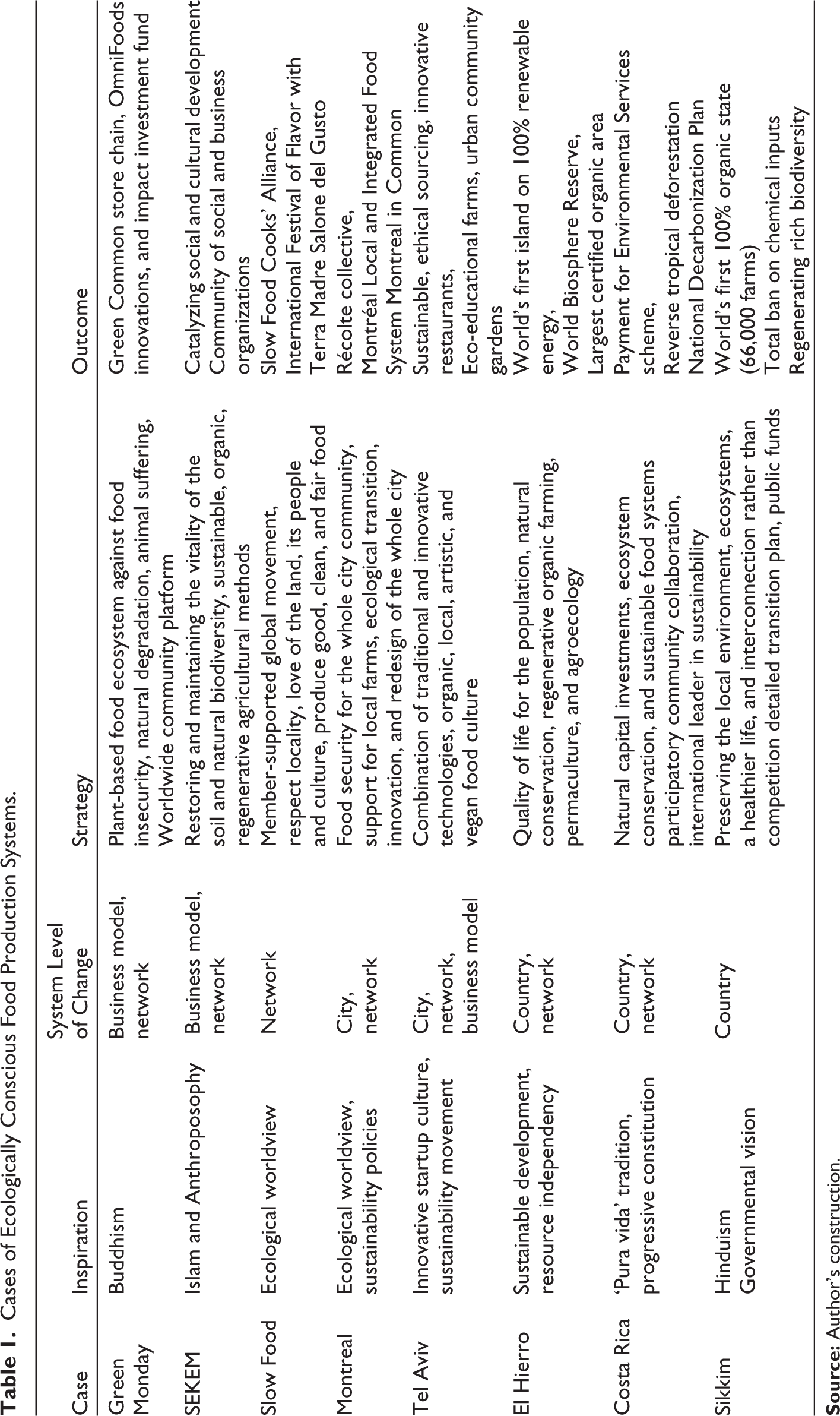
Common characteristics of the cases listed above are the intention and action towards gradually transforming their food production systems to be regenerative and organic and the strong community focus. Behind these efforts, one can identify the genuine value commitment and ecological consciousness of their founders, leaders and managers, who take care of real human and natural values with responsibility.
Conclusions
To cope with the challenges of the Anthropocene era, humanity has to transform its food production systems into an ecologically conscious and socially responsible functioning that respects the planetary boundaries and serves the flourishing of life on Earth. The article is intended to contribute both to theory and practise through studying the aspects of the global food crisis and how to transform food production to be sustainable. We analyzed how ecological consciousness can address the highest and most impactful leverage point in intervening in a system, transcending the predominant paradigm, to transform food systems into ones based on strong ethical commitments to serve real human needs and ecological regeneration. Through presenting selected real-world cases that practise ecological consciousness in food production, the article showed how sustainability transformation is possible at the level of business models, social and economic business networks, cities and countries.
Some key principles can be highlighted, which may be useful or inspiring to other businesses and industries to develop their own models of sustainability transformation.
Paradigm shift through small steps. To transform food production to be sustainable, a radical change in the prevailing paradigm and its underlying values is indispensable. This starts at the highest leverage point with rethinking attitudes and values and deep philosophical reorientation; however, it seems manageable in real life only through incremental changes based on detailed action plans and roadmaps strictly followed and supported by all means at every level.
No compromise. Genuine ethical value commitment and intrinsic motivation of the decision makers, leaders and managers are needed; through their exemplary approach and behaviour, other stakeholders can be more engaged in the change.
Combining minds and hearts. The importance of honest, stable relationships and communities is indisputable in joining efforts for radical change. Within and among the widest possible networks of stakeholders, sharing of knowledge, innovation, best practices, and personal emotions, attitudes and values can help cope with the difficulties of the transformation.
Regeneration. In the era of enormous environmental degradation and social challenges, the regeneration of social and environmental values while eliminating further harm is a must.
Stewardship. Acknowledging and practising interconnectedness and respecting the intrinsic value of every being, local and indigenous culture, art and spirituality can help us expand our consciousness to become committed stewards to preserve real human and natural values for the flourishing of human and non-human beings on Earth.
Footnotes
Declaration of Conflicting Interests
The author declared no potential conflicts of interest with respect to the research, authorship and/or publication of this article.
Funding
The author received no financial support for the research, authorship and/or publication of this article