



Abstract
Entrepreneurial orientation (EO) and dynamic managerial capabilities (DMCs) are beneficial to the development of organisational dynamic capabilities (DCs) in SMEs. Nevertheless, there is still a lack of detailed understanding of the development of DCs. No study has approached how DMCs with EO transfer to become organisation-wide DCs, much less with a configurational approach. This article considers the dimensions of DMCs: human capital, social capital and managerial cognition, and those of EO’s: innovativeness, risk-taking and proactiveness in conjunction. This is in contrast with the underlying assumption of independent effects. The authors survey Portuguese SMEs in a wide range of industries and treat the data through fsQCA, performing a necessity and sufficiency analysis for the presence and absence of DCs. The findings indicate that the dimensions of EO and DMCs are sufficient for consistently determining the presence of DCs in SMEs. Managerial cognition has a symmetric core role in their presence and absence. For the presence of DCs, innovativeness or proactiveness is additionally required.
Keywords
Dynamic capabilities of small and medium enterprises (SMEs) are of undeniable importance to the firm’s overall success (Barreto, 2010; Fainshmidt et al., 2016). Roughly over the last 30 years, research on their relationship to the firm has, therefore, been extensive (Schilke et al., 2018), despite the several issues surrounding conceptual clarity and methodology (Arend, 2015; Bruyaka et al., 2024), as well as other critiques of prevalent approaches (e.g., Arend & Bromiley 2009). Dynamic capabilities may operate at an organisational level as organisational dynamic capabilities (DCs, referring to these) (Kump et al., 2019; Teece, 2007) or at an individual level as dynamic managerial capabilities (DMCs) (Adner & Helfat, 2003; Helfat & Martin, 2015). They may be conceptualised as domain-specific or generic (Andreeva & Ritala, 2016), influencing and being influenced by capabilities at other conceptual levels (i.e., respectively, operational capabilities, higher-order dynamic capabilities) (Arend, 2015; Schilke, 2014; Winter, 2003). As dynamic capabilities relate to the firm’s ability to alter its resource base, their effects range, directly or indirectly, from firm performance (Correia et al., 2022) to survival (Weaven et al., 2021), and international expansion (Ledesma-Chaves et al., 2020), with complex interactive effects between these outcomes and the resources available to be put back into dynamic capability development (Scheuer & Thaler, 2022; Zahra et al., 2006). Despite this more than evident relevance, and although much work has been done in this regard, what determines if a firm has DCs is still unclear (Correia et al., 2022; Eriksson, 2014; Schilke et al., 2018), with further work required. This is particularly true when considering several antecedents simultaneously and under possible equifinality of differing configurations leading to dynamic capabilities (Wilden et al., 2016).
DCs can be described as an organisation’s ‘ability to integrate, build and reconfigure internal and external competences’ (Teece et al., 1997, p. 516) through sensing, seizing and reconfiguration capabilities (Kump et al., 2019; Teece, 2007). As such, they are the capabilities that, at an organisational level, allow the firm to renew its resources under a broad scope of understanding of the firm’s resources. Of entrepreneurial orientation (EO) as an antecedent and as an orientation composed of the dimensions of innovativeness, risk-taking and proactiveness (Covin & Lumpkin, 2011; Covin & Slevin, 1989) beyond the seminal work of Zahra et al. (2006) laying the foundational theoretical work structuring EO as such, other authors have established a positive relationship between EO and DCs (e.g., Correia et al., 2022). EO may be summarised as the acting force or impetus behind firms’ desire to renew their resources and competencies. DMCs, for their part, through the dimensions of human capital, social capital and managerial cognition, address ‘the role of managers, individually and in teams’ (Helfat & Martin, 2015, p. 1282) and likewise have a positive relationship with DCs (Durán et al., 2022; Heubeck, 2023). In the case of DMCs, the theoretical foundations are set as being the capabilities that allow managers to take dynamic action and transfer it to and throughout the firm’s departments and processes (Adner & Helfat, 2003; Ambrosini & Altintas, 2019; Helfat & Martin, 2015).
While broadly established, both these relationships still have underexplored developmental avenues, particularly considering their contingencies (Heubeck, 2023), with critical importance in better understanding the conjunctive role of entrepreneurship and EO within the DMC and DC relationship (George et al., 2022). The research gap exists in this space, where it is still unclear how the dimensions of EO’s and DMC’s articulate conjunctively in facilitating the development of DCs and the unaddressed possible asymmetric nature of these relationships.
EO is an orientation pervasive throughout the firm, influencing the micro and macro levels of managers’ decisions (Wales et al., 2011). DMCs, as key capabilities of managers within the firm (Helfat, 2022; Helfat & Martin, 2015), with the relevance they entail towards it (Hambrick, 2007; Hambrick & Mason, 1984), do not, in themselves, deal with any entrepreneurial proclivity managers might have. EO and DMCs have, through pervasive and wide-reaching impact, the characteristics Wilden et al. (2016) called for, where the internal architecture of the firm is relevant to the understanding of DCs. Therefore, configurational thinking is needed to understand these highly interconnected dimensions.
In this sense, this article inquires if DMCs, through human capital, social capital and managerial cognition, are, on their own, important but not sufficient for the development of DCs. Following this rationale, the firm would also need enough dimensions of EO, either innovativeness, risk-taking or proactiveness, to catalyse the development of DCs, creating the impetus for managers to act with their existing DMCs. If this theoretical dynamic is validated, then the central research question becomes what dimensions of EO and DMCs are relevant, in what configurations and whether these relationships are symmetric towards the presence or absence of DCs. Addressing these issues has critical implications for developing both the dynamic capability view and theory through a better understanding of the interaction of dynamic capabilities at different organisational levels, how they transfer between individuals to the firm, and the role EO plays in this process.
This gap is addressed in this article through a fuzzy-set qualitative comparative analysis (fsQCA) of Portuguese SMEs in a wide range of industries, with data acquired through a survey by questionnaire issued to the firms’ top managers while simultaneously considering the dimensions of EO and DMCs. Through a sufficiency analysis, the sufficient conditions that, in conjunction, consistently determine the presence of DCs’ and, asymmetrically, their absence are addressed. This process yields several equifinal configurations (Fiss, 2011; Schneider & Wagemann, 2012).
In the following section, the authors develop this article’s theoretical review and hypothesis formulation, then present the methodology and results, and, finally, the discussion and conclusion, pointing out the theoretical and practical implications of the findings and future avenues of research.
Theoretical Review and Hypotheses Formulation
The following section is composed of three subsections. The first deals with the theoretical review of dynamic capabilities, focusing on DCs (organisational) and DMCs, followed by hypothesis formulation. Later, the connection between EO and DCs is addressed. Finally, the connection between DMCs and EO, given the criticality of conjunctive effects between both for this research, is discussed. This subsection also addresses the issue of symmetry.
Dynamic Capabilities and Dynamic Managerial Capabilities
Dynamic capabilities have a variety of forms on how they can be construed and measured, levels of the organisation where they operate, whether they are generic or domain-specific, and the order they have among themselves (Andreeva & Ritala, 2016; Fainshmidt et al., 2016; Winter, 2003). Dynamic capabilities are the firm’s capabilities that allow it to shape its resource base, including other capabilities. The structuring of DCs as sensing, seizing and reconfiguring capabilities is perhaps their most ubiquitous and widely used conceptualisation at an organisational level (Schilke et al., 2018; Teece, 2007). Sensing capabilities relate to the firm’s ability to gather relevant and valuable information from the external environment in a timely manner, seizing capabilities to being able to seize opportunities it identifies and expand the utilisation of existing assets, and reconfiguring capabilities relate to it being able to shape itself more explicitly, in a manner congruent with sensed information and identified seizing targets (Teece, 2007).
In applying these capabilities to managers, Adner and Helfat (2003) devise the concept of DMCs, where managers develop these capabilities at an individual level (Helfat, 2022) if they have human capital, social capital and managerial cognition. Human capital relates to managers’ broad learned knowledge, both formally and informally acquired. Its possession is related to interpreting and structuring information correctly, and it may or may not be firm-specific (Helfat & Martin, 2015). Social capital can be both internal and external. Externally, it allows the utilisation of this network for unlocking sensing and sometimes seizing opportunities through goodwill within this network. Internally, it facilitates the mobilisation of the firm for sensing and reconfiguring efforts. Finally, managerial cognition is the broad knowledge of the firm and its business, how it relates to the external environment, whether institutional, industrial or of its competitors, the firms’ weaknesses and strengths, which can be summarised as an alignment between the managers’ mental model and reality (Harvey, 2022; Helfat & Martin, 2015).
In this form, DMCs are, nearly tautologically, but importantly, the generic dynamic capabilities of managers. Crucially, they are not the generic dynamic capabilities of organisations (Kump et al., 2019). This article is chiefly concerned with this distinction and how individual dynamic capabilities transfer to the organisation. SMEs typically have a single management team, which has significant importance to their operations, performance and strategic initiatives (Alves & Carvalho, 2023; Khan et al., 2020). The authors propose that for an SME to detain DCs, its managers first should detain dynamic capabilities at an individual level, DMCs. The authors are not so strict as to hypothesise that all dimensions must be present, but that at least one acting as a fulcrum should be. Methodologically, this is structured as the requirement of a core condition, the significance of which is elaborated in the methodology section.
H1: Any configuration leading to the outcome of DCs should have at least one dimension of DMCs as a core condition.
Entrepreneurial Orientation
Currently, EO is a well-established dimension within the firm, being first developed by Miller (1983) and Covin and Slevin (1989), typically being formulated by three dimensions: innovativeness, proactiveness and risk-taking (Covin & Miller, 2014; Montiel-Campos, 2018). Innovativeness measures the firm’s proclivity and ability to create new products, change processes and, broadly, innovate; proactiveness measures the firm organisational culture and disposition towards seeking new opportunities and information, that is, leading rather than following market actions; risk-taking measures the firm’s willingness to undertake challenging projects and opportunities, often depositing a substantial amount of its resources in said pursuit, without guarantees of their success (Abu-Rumman et al., 2021; Balodi, 2016; Covin & Miller, 2014). It is worth highlighting that, while an orientation, EO presupposes that these actions occur within the firm rather than an unspecified and unmaterialised desire towards them (Covin & Lumpkin, 2011).
Zahra et al. (2006) first connected EO with the field of dynamic capabilities, postulating EO as an antecedent. The mechanisms for this are the enhancement of the firm’s learning processes due to entrepreneurial action and the firm dedicating its existing resources and skills to extend its scope of operation. This entrepreneurial proclivity would then interact with the firm’s organisational knowledge and operational capabilities, catalysing dynamic capabilities as an adaptative requirement to fulfil the desired entrepreneurial actions. This process yields a higher performance, which then iteratively allows the firm to have the necessary slack to pursue further entrepreneurial action. In this view, a firm without EO might be able to shift its resource base but lacks the willingness to do so. Other authors then broadly verify this proposal, confirming the hypothesised link (Kim, 2018; Madsen, 2012), although the research thread launched by Zahra et al. (2006) is still ongoing (George et al., 2022) due to the several specificities and contingencies of the matter. As such, the authors structure the following hypothesis:
H2: Any configuration leading to the outcome of DCs should have at least one dimension of EO as a core condition.
Dynamic Managerial Capabilities and Entrepreneurial Orientation
One key area where the extant literature is still lacking is how different dimensions of EO interact with dynamic capabilities at different levels of the organisation, particularly DMCs. Put explicitly by George et al. (2022): ‘what are the entrepreneurial processes that shape the evolution of DMC to firm-level capabilities?’ (p. 19) and ‘we propose that DMC’s connection with entrepreneurship research needs to be extended further and suggest that DMC aids in clarifying the boundary conditions of DC’ (p. 19). This proposal comes in the context of the arguments made by Zahra et al. (2006), where EO, in short, acts as the impetus mentioned above towards DCs.
In this article, the authors make note of yet another line of reasoning that strengthens the need for and importance of this scope of research. As noted by Madsen (2012), for a long time, there was a substantial critique in the field of dynamic capabilities due to an inability to measure them in a consistent form at the organisational level, such that different authors devised different forms of doing so. Since substantial developments were made in the matter, Kump et al. (2019) have developed a scale specifically for said purpose, integrating Teece’s (2007) dimensions at an organisational level.
Simultaneously, it is relevant that when structuring DMCs, formed by managerial cognition, human capital and social capital (Adner & Helfat, 2003; Helfat & Martin, 2015), this conceptualisation and their theoretical underpinnings leave as a given that said managers would be both able and willing to implement these capabilities at an organisational level or at least within the organisation (Adner & Helfat, 2003; Helfat & Martin, 2015; Heubeck, 2023). Furthermore, there is still no consensus on whether all of them are necessary or which are sufficient for this transfer to occur and under what conditions.
As such, the articulation of all previous sections results in the following hypothesis:
H3: All configurations leading to DCs are comprised of both, at least, a dimension of DMCs and EO.
Furthermore, the research on what determines the lack of DCs is notable. This may be a methodological artefact, as many quantitative research methods are symmetrical. In this sense, theory becomes implicitly subordinated to methodology. Arguments are first and foremost structured in the positive, but symmetrical analyses presuppose symmetrical arguments towards the negative outcome (i.e., a lack of DCs). However, the foundation and discussion of what determines a firm as rigid instead of dynamic (i.e., possessing DCs) are comparatively limited.
From firms that detain DCs to firms without them entirely, there is a substantial space in between, and the drivers of the first need not be the anchors of the latter. For instance, on the matter of risk-taking, it might be expected that for a firm to be rigid, such would be an important condition within configurations that would lead to an absence of DCs. On the other hand, given a firm that is both innovative and proactive, even if it is to some extent risk-averse, the first dimension could have it nevertheless take the required entrepreneurial action for resource renewal, even if in a more cautious manner. Regardless of the previous postulation, what becomes clear to the authors is that there is insufficient evidence in the literature in this regard. Following the general strand of reasoning stated above, with the mentioned limitations, the authors formulate the following hypothesis:
H4: The lack of DCs requires the absence of all dimensions of EO or DMCs.
In it, it is assumed that if at least one dimension of EO with DMC exists, firms may have an avenue of developing DCs, and their absence may not be determined consistently.
All these arguments must be understood in the context of SMEs, where the relevance of dynamic capabilities overall is exacerbated by a generalised lack of other resources compared to larger companies. As such, both entrepreneurship and dynamism resources are crucial for SMEs’ sustainability and competitiveness, as one of their advantages is higher organisational flexibility and ability to pivot (Fabrizio et al., 2022). Not only does this reinforce the importance of understanding how these resources interact and transfer to the organisation as a whole, but it also has meaningful implications for SME survival, as these tend to present lower survival rates than larger firms, being that dynamic capabilities are an important factor in determining the likelihood that SMEs may weather crisis periods (Fabrizio et al., 2022).
It is useful to note the method to be used to contextualise the formulation of the hypotheses. In configurational thinking, it does not make sense to speak of significance or relatedness but of presence or absence within configurations that lead to the presence or absence of an outcome. This requires a shift in reasoning, and a lack of presence within any given configuration sufficient for consistently determining an outcome does not mean there is no positive relation. The specific characteristics of configurational thinking and theorising are further developed in the next section.
Methodology and Results
Sample, Method and Calibration
The authors approach this study through fsQCA, a set-theoretic configurational approach that will materialise in necessity and sufficient analyses (Ragin, 2008). Further details on each analysis are provided immediately before it, while currently, a few key aspects of fsQCA are presented. Throughout both processes, two measures are relevant to determine the presence of the outcome: consistency and coverage. Consistency measures the consistency of how frequently a given condition or configuration is present in the cases identified as possessing the outcome under study (Ragin, 2008; Schneider & Wagemann, 2012). A configuration is a set of conditions treated as a unit of analysis. Coverage measures how much of the outcome under study is covered by cases with the conditions or configurations under analysis. Specific benchmarks and applications of both concepts will be addressed when they appear, but the underlying meaning is retained throughout.
Furthermore, it is important to note that three key properties of fsQCA are relevant to the correct interpretation of results: asymmetry, that the conditions leading to an outcome need not be the same that lead to its absence; equifinality, that each configuration leading to an outcome is an equally valid path towards it; and conjunction, that in configurations, conditions are treated in conjunction. Therefore, their individual effect is not evaluated, but the conjunctive effect of the conditions in a configuration (Ragin, 2008; Schneider & Wagemann, 2012) is examined. Lastly, regarding fsQCA, the distinction between core and peripheral conditions is important. According to Fiss (2011), ‘core elements as those causal conditions for which the evidence indicates a strong causal relationship with the outcome of interest. In contrast, peripheral elements are those for which the evidence for a causal relationship with the outcome is weaker’ (p. 398).
Additionally, peripheral conditions are influenced by the theoretical presuppositions laid out in fsQCA, which are all positive for the presence of the outcome in this case. In this regard, the research position is that, given the previously established literature, stronger evidence is required to consider the absence of a condition leading to the outcome as a peripheral condition belonging to a configuration (e.g., absence of human capital as a peripheral condition and part of a configuration leading to DCs). To enhance clarity, this does not affect core conditions within configurations, the conditions for which there is already strong evidence, and is a required step within an fsQCA sufficiency analysis.
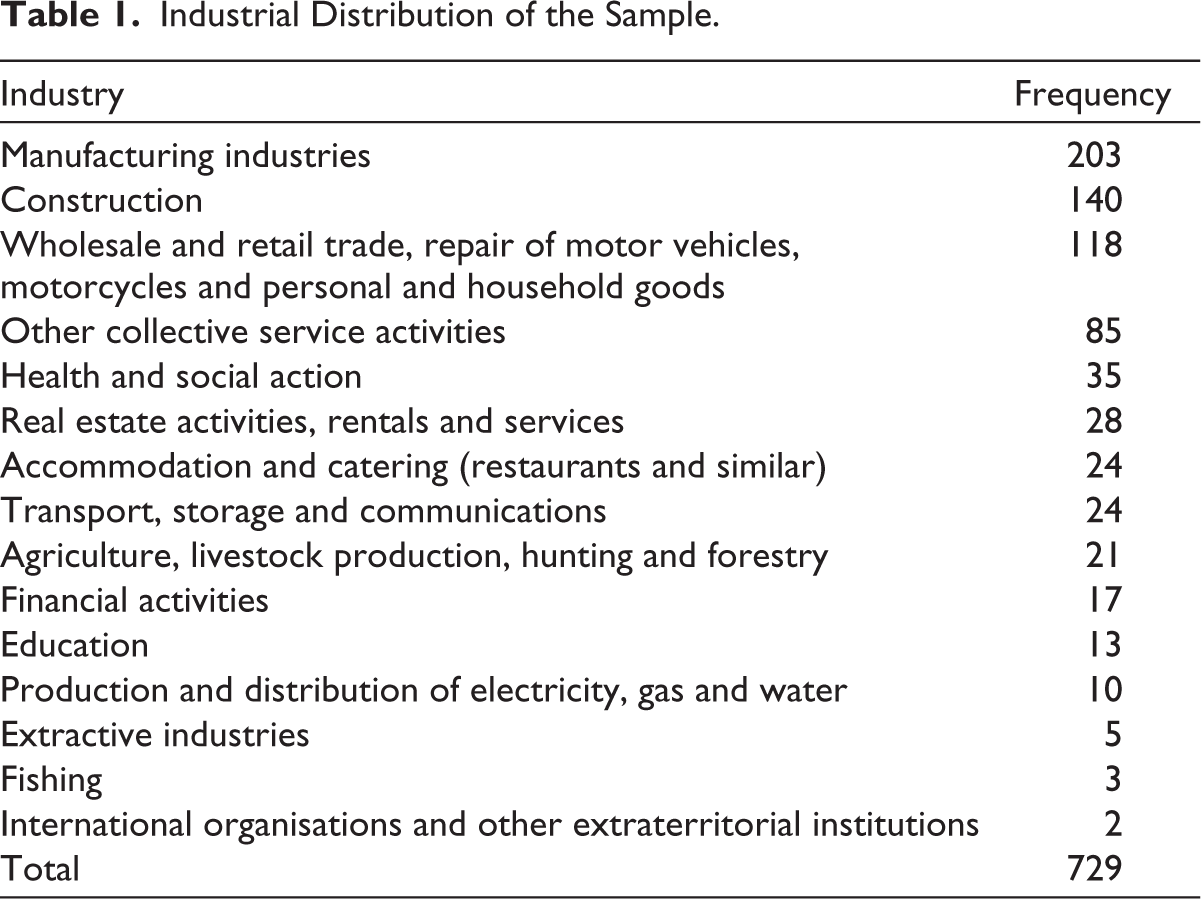
The sample comprises 729 Portuguese SMEs, characterised by having between 10 and 250 employees and a turnover of less than 50 million euros (European Commission, 2003). The authors obtained the data through a survey by questionnaire and the firm’s contact information through access to the Orbis Europe Database. The survey was issued through the Lime Survey platform, and responses were collected in the summer of 2022. The participants were reassured about the neutral stance of the researchers regarding their answers and their anonymity. Several items in the questionnaire were also shuffled as the researchers attempted to limit any information gathering on the participant’s part (Podsakoff et al., 2003). Regarding common method bias, Harman’s single-factor test was under 0.5, and, hence, the researchers proceeded with the analysis. Firms had, on average, 36 employees, indicating a trend towards the smaller side of SMEs. The standard deviation was 40, meaning that, nonetheless, a good amount of size heterogeneity was present. The industrial distribution of the sample can be seen in Table 1.
Industrial Distribution of the Sample.
To measure the variables, this article uses Kump et al.’s (2019) scale for DCs, Covin and Slevin’s (1989) scale for EO (Covin & Miller, 2014), Subramaniam and Youndt’s (2005) scale for the human capital and social capital dimensions of DMCs, and Schrauder et al.’s (2017) scale for managerial cognition. The utilised scales can be seen in the Appendix.
Table 2 shows the correlations between the several measured dimensions, construct reliability and average variance extracted. Convergent validity and internal consistency can be found under the standard benchmarks listed in Table 2. Finally, as the square root of the average variance extracted is higher than any related correlations, discriminant validity is achieved (Hair et al., 2019).
Correlations, Average Variance Extracted and Composite Reliability.
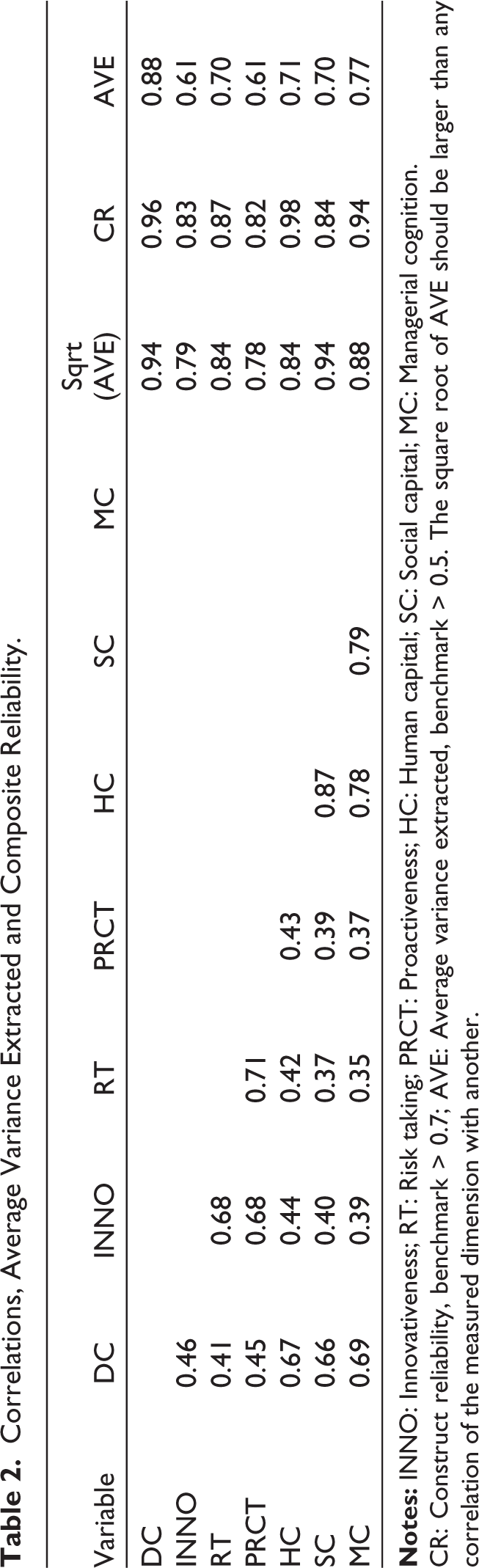
CR: Construct reliability, benchmark > 0.7; AVE: Average variance extracted, benchmark > 0.5. The square root of AVE should be larger than any correlation of the measured dimension with another.
The first step in any fsQCA analysis must be the calibration of the data. The 90th percentile was used to determine that a variable was fully-in in a given case, with the 50th percentile as the midway point and the 10th percentile as the fully-out threshold. The Appendix shows the sensitivity analyses where the 95th and 85th percentiles were used as the fully-in threshold, with the symmetrical alteration to the fully-out threshold, and the predictive validity analysis. These analyses are meant to evaluate the robustness of configurations and met all benchmarks, so the researchers proceeded with necessity and sufficiency analyses (Pappas & Woodside, 2021; Ragin, 2008; Schneider & Wagemann, 2012).
Necessity and Sufficiency Analyses
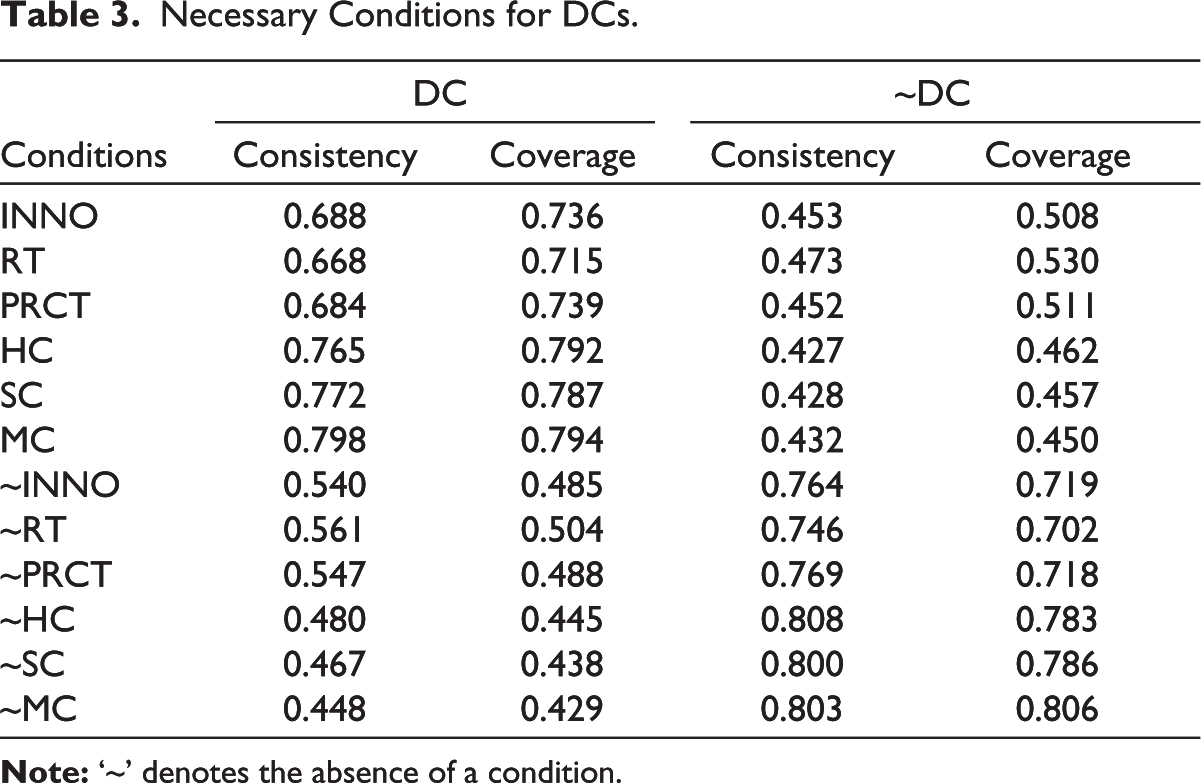
In the necessity analysis, each condition is evaluated individually, and it serves as a contextual procedure intending to inform the sufficiency analyses for the presence and absence of the outcome. To determine necessity, a consistency of 0.9 should be identified. Where higher coverages are comparatively better, there is no benchmark. If necessity is established, the relevance of necessity can then be evaluated (Schneider & Wagemann, 2012). However, as seen in Table 3, no condition or its negation meets the consistency benchmark for either the presence or absence of the outcome. As such, there are no necessary conditions.
Necessary Conditions for DCs.
First, a truth table is constructed to proceed with the sufficiency analysis. To do so, three benchmarks were set. The first was regarding the minimum number of cases observed in a configuration that must be observed, where a configuration is a set of observed conditions (e.g., cases where all the variables are present or all but one, such as human capital). This is always, to some extent, arbitrary, but must balance the expulsion of spurious or outlier observations with that of retaining as much information as possible (Furnari et al., 2021; Greckhamer et al., 2018). Typically, the analysis should retain at least 80% of the initial sample (Ragin, 2008; Schneider, 2018; Schneider & Wagemann, 2012). With these concerns in mind and to meet this threshold, the minimum number of cases in a configuration is 10. In each configuration that remains in the truth table, for the presence of the outcome to be determined as observed (as opposed to it being a configuration where the outcome is absent), the configuration should have a consistency of above 0.8 and a proportional reduction in inconsistency (PRI) of above 0.7. PRI has an additional benefit compared to consistency, as it considers the possibility that a given configuration is determinant in an outcome’s presence and absence, therefore being meaningless towards either (Ragin, 2008; Schneider & Wagemann, 2012). The resulting truth tables can be seen in the Appendix.
The results of the sufficiency analysis for DCs presence can be seen in Table 4, where big circles represent core conditions and small circles represent peripheral conditions. In line with the discussion above, the focus of the discussion is on core conditions.
Configurations Sufficient for DC.
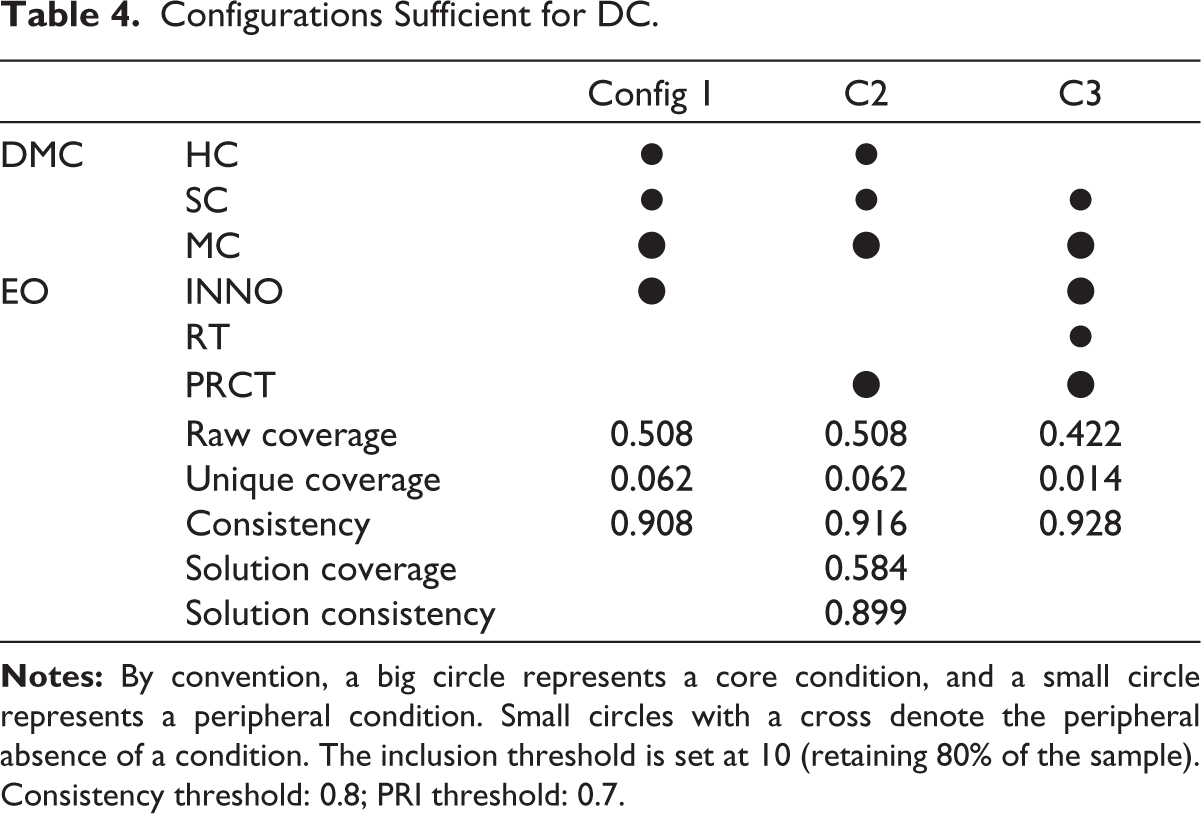
In a sufficiency analysis, the solution’s consistency should be above 0.9 for a satisfactory solution to have been found. With a result of 0.899, this requirement is substantively met and the solution can be deemed acceptable, as EOs’ and DMCs’ dimensions are sufficient conditions for determining the outcome. Furthermore, each of the configurations identified as solutions has consistencies above 0.9, where above 0.8 would be advisable, and the coverage is substantial, as these variables can consistently account for 58.4% of all firms with organisational dynamic capabilities.
Additionally, and with the same benchmarks, Table 5 presents the sufficiency analysis for the absence of DCs. Again, a satisfactory solution consistency, configurations’ consistency and solution coverage can be observed. In this case, the proposed conditions are sufficient to determine the absence of DCs in 59.3% of firms. The large, crossed circles deem the absence of a condition as core, while the small cross circles determine it as peripheral.
Configurations Sufficient for Absence of DC.
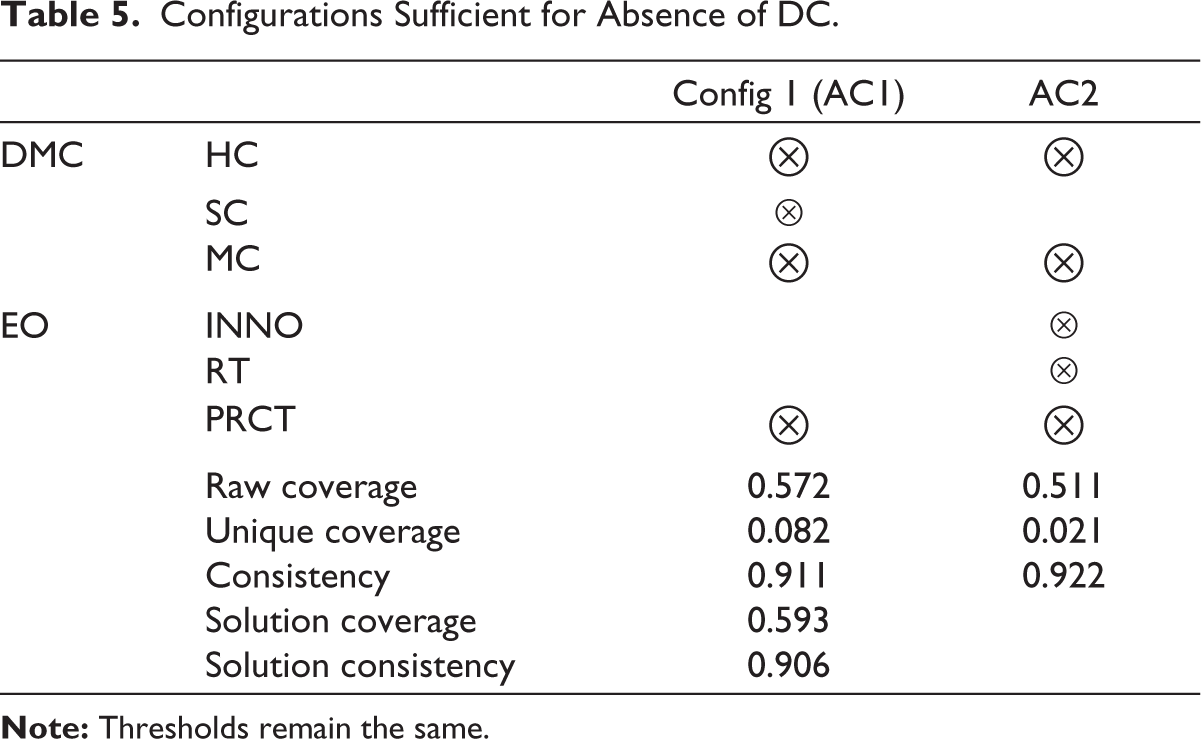
In determining the presence of DCs, there are two main equifinal core configurations: the conjunction of managerial cognition and either innovativeness or proactiveness. C3 is only the conjunction of both, which forms a configuration indicating no negative interference, but is expectedly with comparatively lower unique coverage. When consistently determining the absence of DCs, there is a single core condition, the simultaneous absence of human capital, managerial cognition and proactiveness, with two different peripheral constellations surrounding it.
Considering the results, H1, H2 and H3 can be confirmed, as in determining the presence of DCs, all configurations have a core condition of DMCs’ dimensions and EOs’. H4, however, is not strongly confirmed, as neither all dimensions of EO nor DMCs need to be absent in determining DCs’ absence, considering core conditions as strong evidence (Fiss, 2011). Nevertheless, the peripheral constellations point to the proposed relationship. However, the absence of human capital, managerial cognition and proactiveness takes precedence in importance and may be evidence of a more robust predictor of absence, with the simultaneity of the absence of these dimensions of DMCs and EO being critical to a firm with a lack of DCs.
It is worth highlighting, as well, that managerial cognition is the only condition that has a symmetric relationship, being relevant in determining both the presence and absence, as well as a core role in each equifinal configuration. In contrast, innovativeness is only relevant as a core condition in determining the presence of DCs, and human capital, and their absence. Proactiveness is mixed, determining DCs’ absence, but only sometimes their presence.
Discussion
The results of this study show that at least a dimension of DMCs, conjunctively with at least one of EO, is required to determine the presence of DCs consistently. Namely, managerial cognition is always present, and conjunctively innovativeness, proactiveness or both. Only one core configuration exists for consistently determining DCs’ absence: the simultaneous absence of human capital, managerial cognition and proactiveness. As such, managerial cognition is a non-negotiable and symmetric core condition that is insufficient for consistently determining any DCs’ outcome independently. However, it is required in every case where sufficiency is achieved.
This does not mean human (Durán et al., 2022) and social capital (Durán & Aguado, 2022b), or even risk-taking, are not beneficial towards DCs development, as all have peripheral roles, but that concerning DMCs, managerial cognition is sufficient with solid evidence (Durán & Aguado, 2022a; Fiss, 2011). As such, the managers’ understanding and mental maps of their business come to the forefront (Harvey, 2022; Maitland & Sammartino, 2015), focusing particularly on SMEs (Khan et al., 2020). Through possessing managerial cognition, the findings suggest that the first step in implementing DCs is set. Such managerial cognition allows managers to identify opportunities and threats in the environment and, as such, perform sensing functions. They matter, as well, in evaluating the best course of action for them, performing seizing functions (Durán & Aguado, 2022a). Typically, managerial cognition has been less associated with reconfiguring efforts, although the issue is not yet settled and could be offset by higher involvement in smaller firms (Durán & Aguado, 2022a). However, managerial cognition alone is insufficient and must be channelled conjunctively through an orientation towards actions materialising in innovation or proactiveness efforts (Covin & Lumpkin, 2011). As such, the importance of addressing conjunctive effects is exposed clearly in the results. As it is expounded upon throughout this article, managerial cognition is a critical component for managers to have, relevant to capacitating productive sensing, seizing and reconfiguring efforts at an organisational level (Durán et al., 2022; Durán & Aguado, 2022a, 2022b). However, that alone neglects the impetus to take such actions, move them to the whole organisation, and materialise a change in the firm’s resource base. For that, it is also necessary that managers are at least either innovative or proactive.
These results also contextualise previous findings on the covariate relation between EOs’ dimensions and DCs’ (Kim, 2018). While important, the insights brought on by configurational thinking are different in nature, and in this case, for the first time, the configurational structure of DMCs and EO in relation to DCs has been established, showing the complementary and equifinal ways through which DCs may be obtained. Considering the above, innovativeness and proactiveness may be more relevant in developing reconfiguration capabilities, as reconfiguration poses a higher stress to the firm and its resources, which, as stated, are usually quite limited in SMEs.
In determining the absence of dynamic capabilities, there is ostensibly a single configuration with different constellations of supporting peripheral conditions (Fiss, 2011). The said configuration requires the absence of both human capital and managerial capital, as well as proactiveness. This insight presents us with an asymmetrical view of what drives SMEs to detain DCs, compared to what consistently determines their absence. Furthermore, finding no necessary conditions underlines the relevance of configurational thinking and conjunctive effects when it comes to an analysis of the capability architecture of the firm (Wilden et al., 2016).
These findings contribute to theory building by developing and highlighting the configurational nature of the capability ecosystem of SMEs, creating a meaningful connection between their entrepreneurial resources (EO), individual and team-based dynamic capabilities (DMCs) and their transfer mechanisms to the organisation as a whole (DCs). Given the previously established importance of dynamic capabilities overall towards SMEs (Weaven et al., 2021), having a better understanding of these mechanisms is of critical importance. In this form, the interconnected nature of capabilities and orientations comes to the forefront. Furthermore, these insights are leveraged by considering the heterogeneous roles of different dimensions within both EO and DMCs towards the presence and absence of DCs.
Finally, it is worth discussing the sample and how the findings relate to it. The sample comprises Portuguese SMEs from various industries, making the results non-industry specific. The obtained configurations also point to this, as industry-specific configurations would likely hold a unique coverage closer to their raw coverage, indicating a narrower applicability. In this regard, the results suggest that, at least within SMEs, there is the possibility of finding a relatively high amount of consistency. However, four industries have a more prominent presence, specifically: manufacturing industries; construction; wholesale and retail trade; repair of motor vehicles, motorcycles and personal and household goods; and other collective service activities. These account for roughly 63% of the sample, and the results have a higher pertinence to these. However, the cut-off of 10 observations and the particularities of the analysis method are also worth highlighting. Even a few firms showing the presence or absence of DCs throughout other industries, for which there are fewer observations, would also easily constitute a unique configuration.
Conclusion
This article evaluated, through an fsQCA analysis of Portuguese SMEs, the dimensions of EO and DMCs as conditions of organisational DCs, having found them to be sufficient for the determination of both the presence and absence of this outcome. In doing so, previous calls for a configurational analysis of antecedents of dynamic capabilities, with consideration of the architecture of the firm (Wilden et al., 2016), the need for further in-depth study of EOs’ relation to these (Monteiro et al., 2019; Zahra et al., 2006; Zhang et al., 2016) and the transfer mechanisms from individual-level dynamic capabilities, materialised in DMCs, to organisational DCs have been followed (Bruyaka et al., 2024; Vogel & Güttel, 2013).
Managerial cognition is a core component of both DCs’ presence and absence. To consistently determine DCs’ presence, the dimensions of innovativeness, proactiveness or both must also be present conjunctively. To consistently determine DCs’ absence, in addition to managerial cognition’s absence, human capital and proactiveness must be absent. Social capital and risk-taking only take peripheral roles.
SMEs have notoriously limited resources and comparatively higher survival risk, particularly small firms (Weaven et al., 2021), and typically a single management team, being organisations with comparatively limited complexity against the counterpart of large firms. In the sample, firms have, on average, 36 employees, indicating that it contains chiefly the smaller side of SMEs. Even then, no configuration is found to be comprised specifically of medium firms. As such, this research also highlights the rich complexity that exists within them. DMCs, addressing the management team, do not immediately or on their own indicate adequately that the organisation has DCs and deploys them at a firm level. EO is, then, characterised as a critical facilitator in this endeavour. Even then, the results highlight the particularities of specific DMCs’ and EOs’ dimensions and how they conjunctively operate, such that different dimensions of DMCs and EO have meaningfully disparate effects. With a sample of firms from a wide range of industries, and with the necessary caution and constraint, these results point to wide applicability, as the most prominent industries in the sample belong to the secondary and tertiary sectors. Only the primary sector is less represented. As such, the mechanism where managerial cognition, supported by either proactiveness or innovativeness to catalyse dynamic capability development at an organisational level, seems widespread, at least within the Portuguese institutional setting.
These results evidence that asymmetry is also an important characteristic to consider. Human capital only has a core function in determining DCs’ absence, while innovativeness only in their presence. All solutions have strong conjunctive effects, where no dimension of DMCs or EO operates alone as a core condition (Fiss, 2011). While several peripheral conditions have also been found, these always act as constellations surrounding the core determinants, may be influenced by theoretical assumptions, and may be considered weaker evidence of their actual necessity in the found sufficient configuration (Fiss, 2011).
This study has its limitations. First, there are limitations to the sample, where only SMEs in Portugal are studied and only at one time. The fact that they are from a wide array of industries can be seen as an advantage because it helps obtain consistent and generalisable findings. However, it is also a limitation because finer-grained analyses may highlight industry disparities. For instance, within specific sectors, only a subset of the configurations may be sufficient (e.g., only managerial cognition). Likewise, DCs are treated as a second-order construct, such that further studies delving into sensing, seizing and reconfiguring capabilities may bring additional insights. This leads, second, to another type of limitation, namely that of fsQCA. While having important properties and allowing for configurational thinking, one of the fundamental limitations is the exponential rise in required observations for the increase in conditions. As such, models generally need to be parsimonious. Lastly, the data were obtained through a questionnaire based on managers’ perceptions. While previous literature has validated this approach, studies that rely on multiple sources and types of data can provide yet more robust evidence.
This research opens several avenues for future research. Configurational thinking, when it comes to addressing the architecture of firms’ capabilities, is still very much in its infancy, and so other factors that were not possible in this study may be considered. Understanding how environmental factors may moderate the configurations, whether market, industry or institutional, is of particular interest. The competitive landscape may affect the importance of proactiveness or innovation, and this may also be the case for the institutional landscape where the firm resides. Organisational capabilities are also eclectic in the way they are formulated. Additional studies, approaching other capabilities, tackling different organisational levels and capability orders in a configurational form, are likely to deliver important insights into understanding what drives both DCs and operational capabilities, and, crucially, under what conditions.
The findings could not be clearer for managers seeking practical implications about the stark necessity of focusing on developing managerial cognition and proactiveness. Innovativeness is also relevant, although asymmetric. Managers dealing with particularly rigid organisations may, in that case, benefit most from an investment in their human capital beyond their managerial cognition.
Supplemental material
Supplemental material for this article available online.
Footnotes
Declaration of Conflicting Interests
The authors declared no potential conflicts of interest with respect to the research, authorship and/or publication of this article.
Funding
The authors disclosed receipt of the following financial support for the research, authorship, and/or publication of this article: This work has been funded by national funds through FCT—Fundação para a Ciência e a Tecnologia, I.P., Project UIDB/05037/2020, in association with the University of Coimbra, CeBER, Faculty of Economics of the University of Coimbra, and by national funds through FCT—Fundação para a Ciência e a Tecnologia, I.P., Project SFRH/BD/151420/2021.
References
Supplementary Material
Please find the following supplemental material available below.
For Open Access articles published under a Creative Commons License, all supplemental material carries the same license as the article it is associated with.
For non-Open Access articles published, all supplemental material carries a non-exclusive license, and permission requests for re-use of supplemental material or any part of supplemental material shall be sent directly to the copyright owner as specified in the copyright notice associated with the article.
