



Abstract
This article analyses how dynamic capabilities are enacted in micro-enterprises and what role different parties and managerial time allocation play in this enactment. Drawing upon three in-depth case studies of micro-enterprises, we make three theoretical contributions. First, after arguing that micro-enterprises are likely to enact individual- or group-level dynamic managerial capabilities rather than organisation-level dynamic capabilities, we counter Teece’s warnings about the vulnerable nature of dynamic managerial capabilities. Second, we identify that how managers allocate their own time, is a core micro-foundation of dynamic managerial capabilities; we illustrate that failure to allocate time to capability enactment can lead to capability vulnerability. Finally, we introduce the notion of ‘self-damaging dynamic managerial capabilities’ – these being capabilities that damage established micro-foundations.
Keywords
Introduction
Dynamic capabilities are ‘the capacity of an organization to purposefully create, extend, or modify its resource base’ (Helfat et al., 2007: 4). As they can be a source of performance improvement (Helfat et al., 2007), they are strategically valuable for enterprises that enact them successfully. In this article, we contribute to contemporary debates about the enactment and micro-foundations of dynamic capabilities by critically evaluating, ‘How are dynamic capabilities enacted in micro-enterprises and what role do different parties and managerial time allocation play in this enactment?’. To address this research question, we draw upon an interpretivist ontology using in-depth case studies.
Teece et al. (1997) introduced dynamic capabilities over two decades ago as a source of sustainable competitive advantage in dynamic industries. Since then, the concept has undergone development to be applied to less-dynamic industries (Ambrosini et al., 2009; Eisenhardt and Martin, 2000) and has been extended to the individual and group level in the form of dynamic managerial capabilities (Adner and Helfat, 2003; Shilke et al., 2018). One important development is the growing interest in the micro-foundations underpinning dynamic capabilities (Vogel and Güttel, 2013). Micro-foundations are constituent component units, for example, skills, processes, individual agent behaviour that underpin and enable dynamic capabilities (Barney and Felin, 2013). Micro-foundation research has made important steps in unpacking dynamic capabilities, which have been criticised as a black box concept (Pavlou and El Sawy, 2011). Nevertheless, there is scope for further analyses in this area. Indeed, there is little evidence of how dynamic capabilities are enacted and of their micro-foundations in micro-enterprises (Kevill, 2014). Micro-enterprises offer a notable contribution to the UK economy, accounting for an annual turnover of nearly £900 billion (Department for Business, Energy & Industrial Strategy, 2019). Given the economic contribution of micro-enterprises and the performance advantages that can ensue from dynamic capabilities (Helfat et al., 2007), it is critical to explore their enactment and the key micro-foundations that enable them in these firms. Consequently, we focus specifically on the micro-foundational role of different parties who enact dynamic capabilities and managerial time allocation. This is because, as we argue below, these factors are salient to micro-enterprises, are particularly helpful for assessing the applicability of the concept to the micro-enterprise context and offer the opportunity to extend theoretical understanding of dynamic capabilities.
We commence by conceptualising dynamic capabilities and questioning its applicability to micro-enterprises, framing our arguments around issues of enactment, micro-foundations, stability and vulnerability of such capabilities. We then explain the research methods adopted, followed by our empirical findings. Next, we outline our theoretical contributions, disputing the applicability of the dynamic capability concept to the micro-enterprise context and challenging Teecian theorising regarding the vulnerability of dynamic managerial capabilities. We argue that managerial time allocation is a micro-foundation of dynamic managerial capabilities and introduce the notion of ‘self-damaging dynamic managerial capabilities’.
Literature analysis
Dynamic capabilities
Dynamic capabilities are the ability of an organisation to change to either initiate or respond to transformations in its external environment (Helfat et al., 2007; Teece, 2014). In this article, we emphasise the situated nature of dynamic capabilities and prioritise the social practices, understandings, and engagements constituting a specific capability (Antonacopoulou, 2008; Jarzabkowski and Wilson, 2006). Competitive advantage does not flow automatically from the possession of an intangible asset (Boisot, 1998), such as a capability, but from when the activities underpinning it are carried out (Helfat and Winter, 2011). We also follow Helfat and Peteraf’s (2003) lifecycle approach, which suggests that regular enactment of a capability will allow it to mature and result in its stability. Reduced enactment of a capability would lead to its deterioration, making it vulnerable to retrenchment or, in some extreme cases, its retirement or death. The lifecycle approach also proposes that exogenous and endogenous forces can stimulate capability development through redeployment, renewal or recombination or can lead to retrenchment or retirement of the capability (Helfat and Peteraf, 2003).
Dynamic capabilities which have matured and become embedded in organisational practices have three characteristics that make them identifiable within organisations: they have a change-oriented purpose that is strategically and economically important for the organisation (Helfat and Winter, 2011; Teece, 2007); they lead to repeatable change (Helfat et al., 2007; Teece, 2007) and they have both routine and non-routine elements (Teece, 2012). These characteristics are elaborated in Table 1.
Identifying characteristics of dynamic capabilities (Adapted from the work of Helfat et al. (2007), Helfat and Winter (2011), and Teece (2007, 2012)).
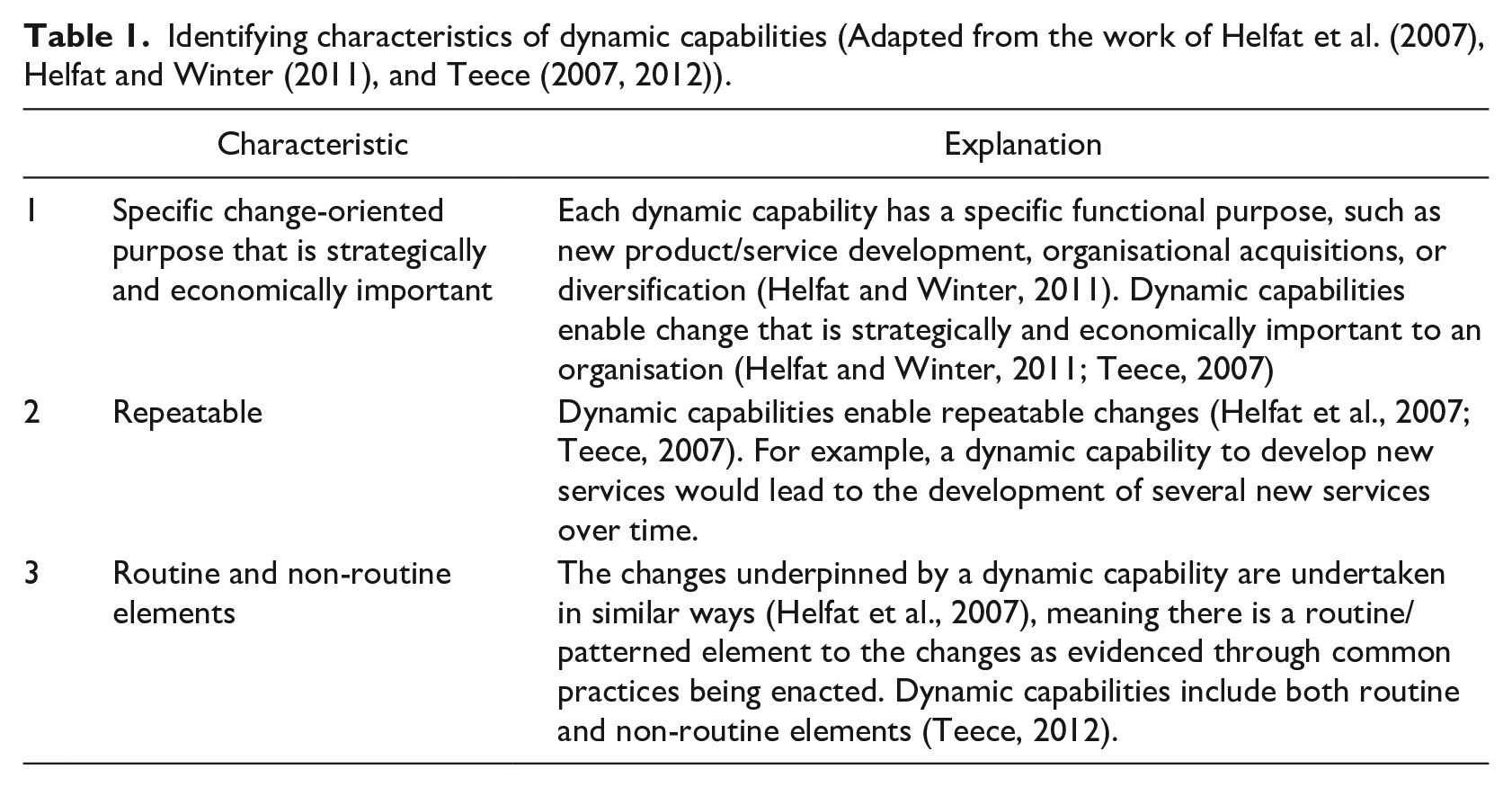
The first identifying characteristic suggests that dynamic capabilities are change-oriented. Change is central to the concept and distinguishes dynamic capabilities from the operational capabilities which enable the organisation to perform its basic functional activities (Winter, 2003). The consensus that dynamic capabilities lead to change is well established (Winter, 2003) and supported by empirical studies (Shilke et al., 2018). Nevertheless, in line with our argument, while these capabilities lead to change if enacted, they can remain latent if not fully utilised to respond to the strategic environment (Easterby-Smith et al., 2009; Pablo et al., 2007). Furthermore, the impact of dynamic capabilities on successful change can be hindered by inappropriate cognitive representations of the need to change, the appropriate method to change and the organisation’s external environment (Ambrosini et al., 2009; Tripsas and Gavetti, 2000).
The second and third characteristics in Table 1 concern the repeatable and routine nature of dynamic capabilities, something that has engendered debate in extant literature. Routines refer to ‘repetitive patterns of interdependent organizational actions’ (Parmigiani and Howard-Grenville, 2011: 414). They include common practices – those practices that are enacted repeatedly. Although Winter (2003) conceptualises dynamic capabilities as highly patterned and routine in nature, the enactment of those routines in practice will typically involve some improvisational and non-routine elements resulting from individual agency and contextual considerations (Feldman and Pentland, 2003). Indeed, Teece (2012) argues that dynamic capabilities are likely to include more creative, entrepreneurial and non-routine behaviours acting alongside routine behaviours. Since even Winter (2003) acknowledges that his solely routine conceptualisation of dynamic capabilities is unlikely to be found in organisations, we join Teece (2012) in arguing that dynamic capabilities in practice encompass both routine and non-routine elements.
Our conceptualisation of dynamic capabilities as both routine and non-routine has implications for how we position ourselves in the debate on the heterogeneity of dynamic capabilities across different organisations. While Eisenhardt and Martin (2000: 1105) position dynamic capabilities as best practices that ‘have significant commonalities across firms’, Teece et al. (1997) see them as largely idiosyncratic. Since the enactment of dynamic capabilities incorporates some non-routine elements, certain practices and engagements underpinning these capabilities may never be replicated. This brings into question the usefulness of the best practice approach and further supports the importance of understanding dynamic capabilities from a Teecian perspective.
The Teecian perspective disaggregates dynamic capabilities into their component capabilities (sensing, seizing and transforming) (Teece, 2007). Sensing refers to an organisation’s ability to sense opportunities or threats within the external environment to either neutralise threats or create opportunities and includes activities such as the scanning and assessment of opportunities (Teece, 2007). Seizing involves deciding on suitable investments, orchestrating assets, and designing business models to capture sensed opportunities. Transforming refers to repeated adaptation and transformation of the organisation, which involves recombining and reconfiguring the resource base of the company (Helfat and Martin, 2015). Decomposing dynamic capabilities in this way helps understand their micro-foundations, which is crucial to our study. Following from this and our arguments above, we adopt the Teecian perspective on dynamic capabilities in this study. 1
Despite the conceptualisation of dynamic capabilities becoming more refined since its inception, it is still criticised theoretically for being ‘black box’ in nature (Pavlou and El Sawy, 2011). This stems from little consideration being given to what these capabilities look like when enacted in situ and to a lack of focus on their micro-foundations during early theorising. While disagreement exists about the precise meaning of micro-foundations (Barney and Felin, 2013), there is a strong consensus that they are the constituent components (Felin et al., 2012) ‘rooted in individual characteristics and behaviours’ (Foss, 2011: 1414) that ‘make the realization of . . . capabilities possible’ (Abell et al., 2008: 492). They can include not only individual-level factors like self-efficacy (Kevill et al., 2017) and entrepreneurial initiatives (Mahringer and Renzl, 2018) but also interactional factors such as trust (Fainshmidt and Frazier, 2017), residing in processes and practices. By attempting to explicate how such factors influence the enactment of dynamic capabilities, the micro-foundational approach goes some way to bridging the micro–macro gap. Since all organisations are made up of individuals, the micro-foundational approach seeks to re-focus attention on that which has previously been lost as a result of a dominant focus on higher-order organisational routines and capabilities (Molina-Azorín, 2014; Vahlne and Jonsson, 2017).
How dynamic capabilities are enacted and the micro-foundations underpinning them have traditionally been analysed within large organisations (Koryak et al., 2015), ignoring micro-enterprises which are an important segment of the business population. While a heterogeneous category, micro-enterprises share a number of characteristics in terms of size, limited market share, resource scarcity and an owner-manager undertaking the majority of managerial tasks with, in some cases, support from small generic management teams (Gherhes et al., 2016; Jaouen and Lasch, 2015; Martín-Tapia et al., 2010). These characteristics make micro-enterprises vulnerable to the effects of market shifts and loss of key customers (Kelliher et al., 2018). Thus, enhanced dynamic capabilities in micro-enterprises would strengthen their market sustainability and competitiveness, and so, investigating these capabilities has practical importance. Investigating dynamic capabilities, in this under-researched context, also has theoretical benefits, offering the potential to illuminate new insights into enactment and micro-foundations that are unacknowledged in prior theorising focused on larger firms. This would further help to unpack dynamic capabilities.
Dynamic capabilities and micro-enterprises
The small body of literature that does investigate dynamic capabilities in micro-enterprises is typically fragmented and lacks focus. In most cases, these studies include organisations of differing sizes in their samples (Alegre et al., 2011; Arend, 2014; Vickers and Lyon, 2014), thus losing focus on the specific context of the micro-enterprise. The focus on the effects of dynamic capabilities in micro-enterprises (Alegre et al., 2011; Arend, 2013; Uhlaner et al., 2013) often relies on conceptualisations of dynamic capabilities developed for larger firms because of the limited understanding about the nature of these capabilities in micro-enterprises. Greater understanding of the enactment and micro-foundations of dynamic capabilities in the micro-enterprise context would provide a gateway to future empirical research into the effects of these capabilities in these firms. However, it is first important to take a step back to consider whether current conceptualisations of dynamic capabilities are applicable to the micro-enterprise context at all. In this vein, an exploration of dynamic capabilities within micro-enterprises provides a pathway for further inquiry. A particular concern revolves around units of analysis. Dynamic capabilities have traditionally been conceptualised at the organisational level (Teece et al., 1997), with early theorising paying little attention to the micro-foundational role of individuals (Helfat et al., 2007). Zahra et al (2006), however, emphasise the role of the manager within smaller organisations, suggesting that the creation of dynamic capabilities is often through internal workings. The concept of dynamic managerial capabilities – ‘the capacity of managers to purposefully create, extend, or modify the resource base of an organization’ (Helfat et al., 2007: 24) – was introduced by Adner and Helfat (2003) to remedy the lack of focus on individuals in dynamic capabilities research. Research into dynamic managerial capabilities has focussed largely on the role that social capital, human capital and managerial cognition play as micro-foundations of these capabilities (Helfat and Martin, 2015). Like dynamic capabilities research more generally, there is little extant research into the enactment of dynamic managerial capabilities in situ and their wider micro-foundations. Nevertheless, by acknowledging that managers can act as important micro-foundations of organisation-level dynamic capabilities, the dynamic managerial capability concept has helped to unpack dynamic capabilities. We may, however, not yet have the complete picture due to the extant focus on larger organisations.
In micro-enterprises, there is a limited number of individuals and the owner-manager/management team is typically dominant (Jaouen and Lasch, 2015), leading to the links between the individual, group and organisational levels to become blurred. This questions whether the theorised relationships between dynamic capabilities at different analytical levels apply in the micro-enterprise context. While some studies have helpfully shown that managers can be important micro-foundations of dynamic capabilities in micro-enterprises (Evers, 2011; Kelliher et al., 2018; Schlemmer and Webb, 2008), little empirical consideration has been given to the unit(s) of analysis at which the capabilities reside. To address this, research should investigate the micro-foundational role played by different parties in the enactment of organisational change initiatives in micro-enterprises. Understanding the roles played by these parties enables the units of analysis and the relationships between dynamic capabilities at different analytical levels to be deciphered. This helps open the black box of dynamic capabilities and helps assess the fit of the concept to the micro-enterprise context.
One possibility is that, due to resource scarcity, dynamic capabilities in micro-enterprises may reside in only a small number of individuals, which may make these capabilities more vulnerable than those in their larger counterparts. This vulnerability stems from the possibility of the individuals that are key to dynamic capability leaving the organisation (Teece, 2014), meaning that the capability retires. This provides impetus for uncovering the micro-foundational role played by different actors in the enactment of dynamic capabilities, as this could illuminate the degree to which these capabilities are stable or vulnerable in nature. This could be a critical determinant of the competitive advantage of micro-enterprises and is thus worthy of investigation.
Another scarce resource in micro-enterprises is time (Kelliher and Reinl, 2009; Lévesque and Stephan, 2019). Dynamic capabilities are likely to require significant time investment to develop and enact (Winter, 2003). Following the lifecycle approach, the time invested to their enactment will have a direct impact on the extent to which dynamic capabilities are stable or vulnerable to retrenchment or retirement (Helfat and Peteraf, 2003). This suggests that the allocation of management time, and that of other employees, may be an important micro-foundation of dynamic capabilities, especially to understand why certain capabilities face retrenchment and retirement in the long term. However, extant research has given little attention to the issue of time allocation – the time allocated by managers to complete activities at work – and its micro-foundational role. Investigating the temporal aspect of capability enactment will develop theoretical understanding of the micro-foundations of dynamic capabilities while responding to calls for more research into time in entrepreneurial contexts (Lévesque and Stephan, 2019). The scarcity of resources, such as time and people, in micro-enterprises also provides researchers with the opportunity to investigate potential feedback loops from dynamic capabilities to such scarce micro-foundations.
Methodology
Our data collection and analysis spanned two years, involving several stages which are explained below and summarised in Online Appendix A1. Our study was exploratory and inductive, favouring in-depth qualitative research to generate rich understanding to extend prior theorising (Woldesenbet et al., 2011). We evaluated the quality of our study against Tracy’s (2010) eight criteria for excellent qualitative research (see Table 2).
Achieving Tracy’s (2010) criteria for excellent qualitative research.
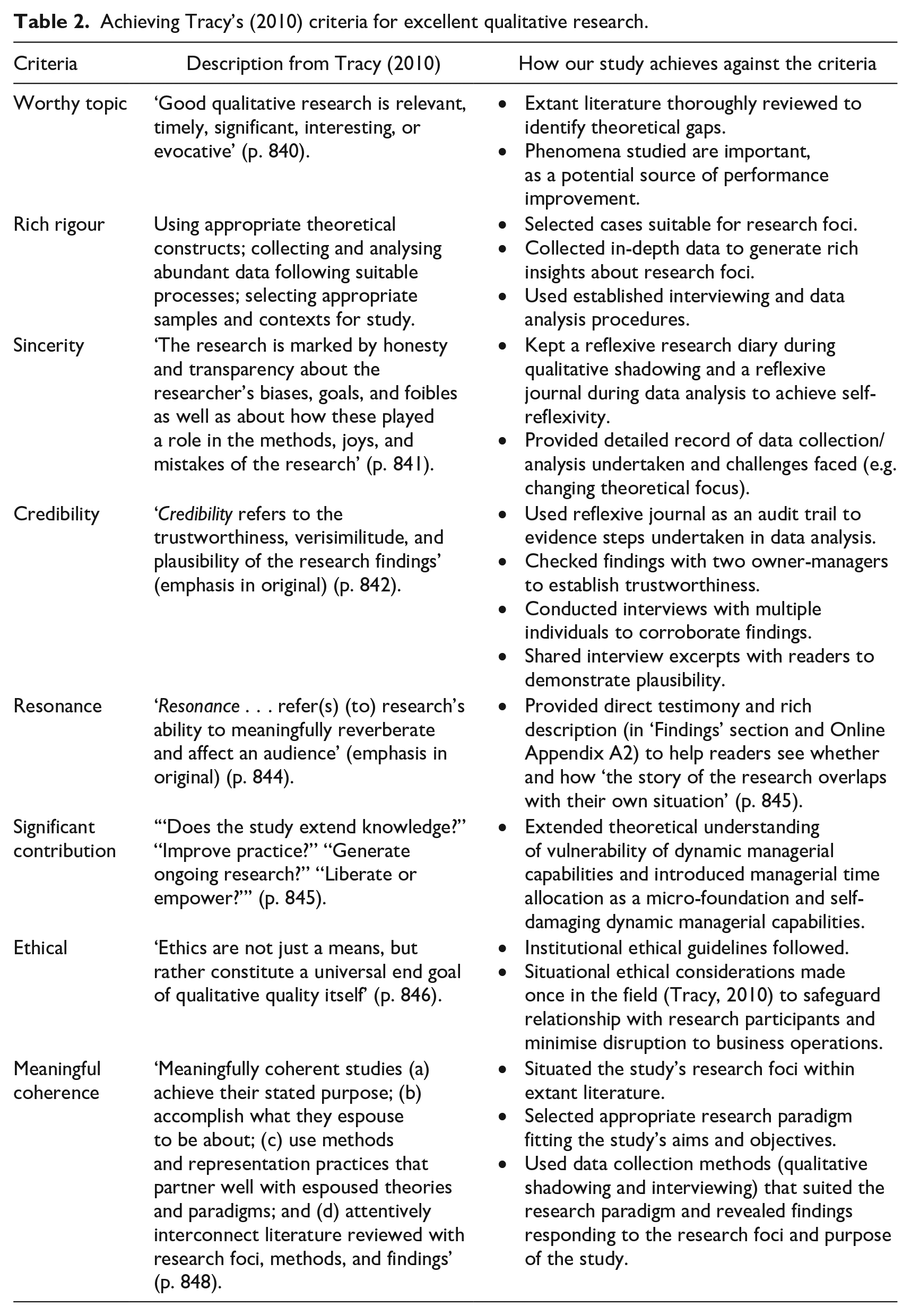
Initial interviews
The intangible nature of dynamic capabilities (Easterby-Smith et al., 2009) makes them difficult to identify without in-depth research. Hence, to begin, we needed to identify micro-enterprises that appeared to have dynamic capabilities. We, therefore, undertook qualitative interviews with owner-managers from 12 micro-enterprises. We asked about past and future organisational developments, to identify those that may be underpinned by a dynamic capability. We also investigated the nature and background of the enterprise to gain contextual understanding. These data were analysed using a directed content analysis approach (Hsieh and Shannon, 2005: 1281), culminating in cross-case analysis to determine which enterprises were most likely to have dynamic capabilities. At this stage, we used the first two characteristics in Table 1 to identify dynamic capabilities, as these were easily accessible through initial interviews. As such, we sought organisations that had undertaken a number of similar developments that were strategically and economically important to them.
Research sample
The initial interviews enabled us to identify three relevant firms (Table 3). At this point, we had only identified that the changes may be underpinned by dynamic capabilities, so we labelled them ‘potential dynamic capabilities’. To determine whether they were dynamic capabilities, further in-depth research was required to understand praxis – actions undertaken in situ – involved in the enactment of the changes. This would help understand whether the repeatable changes were enacted in similar ways, satisfying the third characteristic that dynamic capabilities are routine to some degree.
Company information.
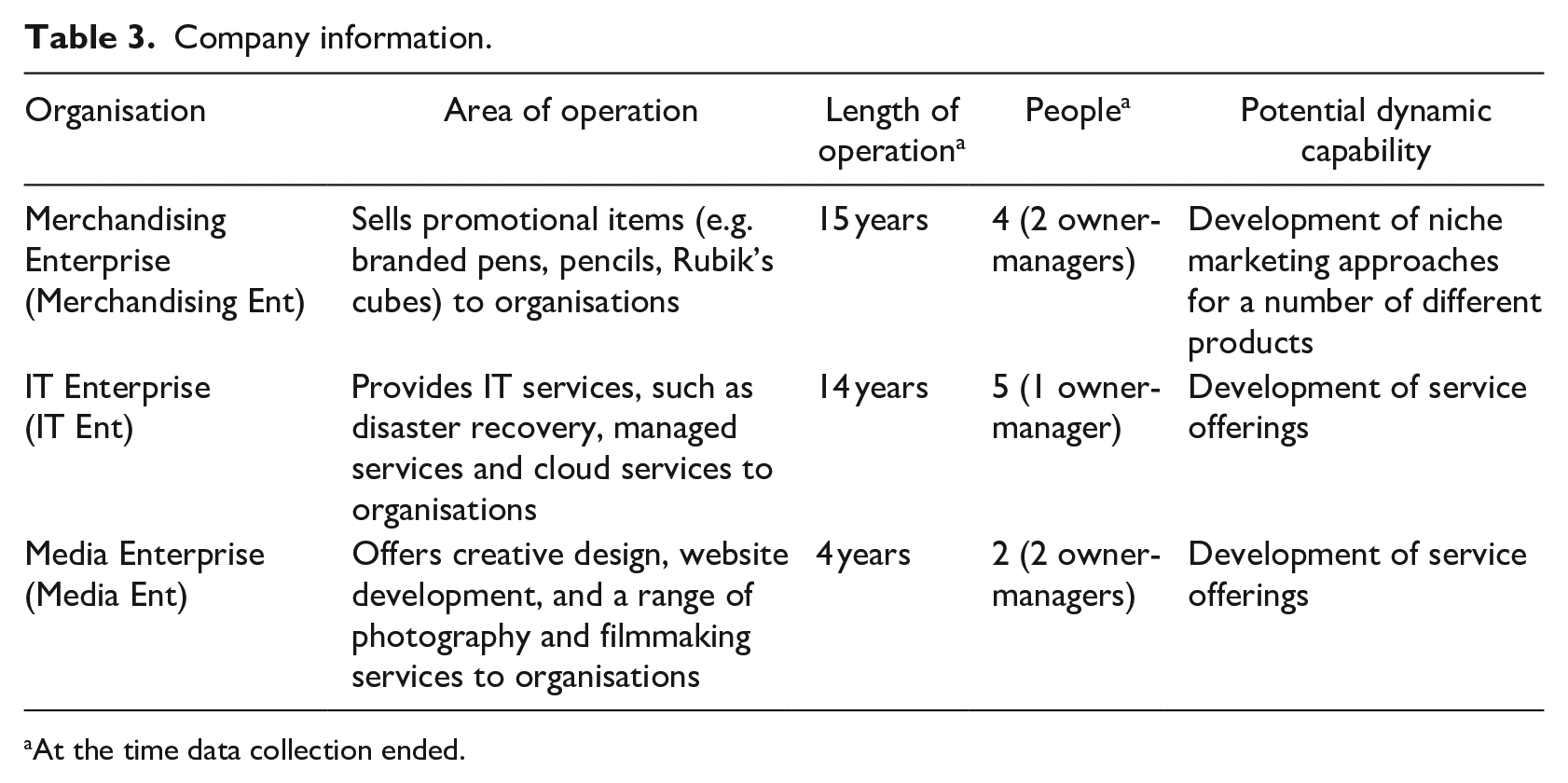
At the time data collection ended.
Further data collection
Most of the data collection was undertaken with the owner-manager, who drives the strategic development in each organisation, to access deep understanding of their enterprise and its capability. Following the initial interviews, qualitative shadowing was undertaken in IT Enterprise (IT Ent) and Merchandising Enterprise (Merchandising Ent). 2 The researcher followed the owner-manager throughout their working day (Czarniawska, 2007) to observe their behaviour and access their perceptions through a running commentary (McDonald, 2005). While the owner-manager was the main shadowee, a small amount of time was spent shadowing other individuals in the organisations to gain a more holistic understanding. Qualitative shadowing was undertaken to gain insight into the operations of the organisation and the context within which the potential dynamic capability resided, rather than to shed light on the capability itself. This was important since dynamic capabilities ‘become tailored to the settings in which they function’ (Helfat et al., 2007: 7). For example, while, through interviews, we probed the dynamic capabilities with the actors who played a role in their enactment, the qualitative shadowing helped reveal that this enactment was embedded alongside busy day-to-day operational work, allowing us to gain insight into the wider context these capabilities resided in.
Next, an interview gathering the life story (Lieblich et al., 1998) of the enactment of the capability was conducted with the owner-manager. Here, ‘life story’ refers to a chronological recounting of all the organisational developments enabled by that capability over time. In each enterprise, we concentrated on one capability, satisfying the advice of Shilke et al. (2018: 413) to ‘zoom in on a particular instance of dynamic capabilities’ in organisations. Asking the owner-manager to tell the story of each organisational development facilitated rich understanding of the enactments, engagements and interactions underpinning each development. Similar to Corner and Wu (2011), we utilised this knowledge to identify patterns across different enactments of the capability to see whether they had a routine element and to better understand the practices.
The capabilities we researched had been enacted on several occasions over an extended time period. Life story interviews enabled chronological information spanning these enactments to be provided in an accessible and timely manner (Elliott, 2005; Riessman, 2008). To mitigate lapses in memory (Golden, 1992) and post-event rationalisation, we undertook similar life story interviews with multiple individuals in IT Ent and Merchandising Ent, which helped corroborate key insights provided by the owner-manager (De Massis and Kotler, 2014; Eriksson, 2013) and added credibility to our findings (Tracy, 2010). Conducting repeat interviews with the owner-managers also enabled us to assess consistency of accounts of organisational changes and address inconsistencies with them where necessary.
Further interviews were later conducted with the owner-manager of Media Ent and Merchandising Ent. 3 These interviews sought additional insights and clarifications and enabled our preliminary findings to be checked with them. In total, 18 interviews and five days of qualitative shadowing were undertaken (see Table 4), producing almost 400 pages of interview transcripts and almost 50 pages of shadowing notes. Additional data were also collected through short telephone conversations and emails with the owner-managers.
Data collection undertaken.
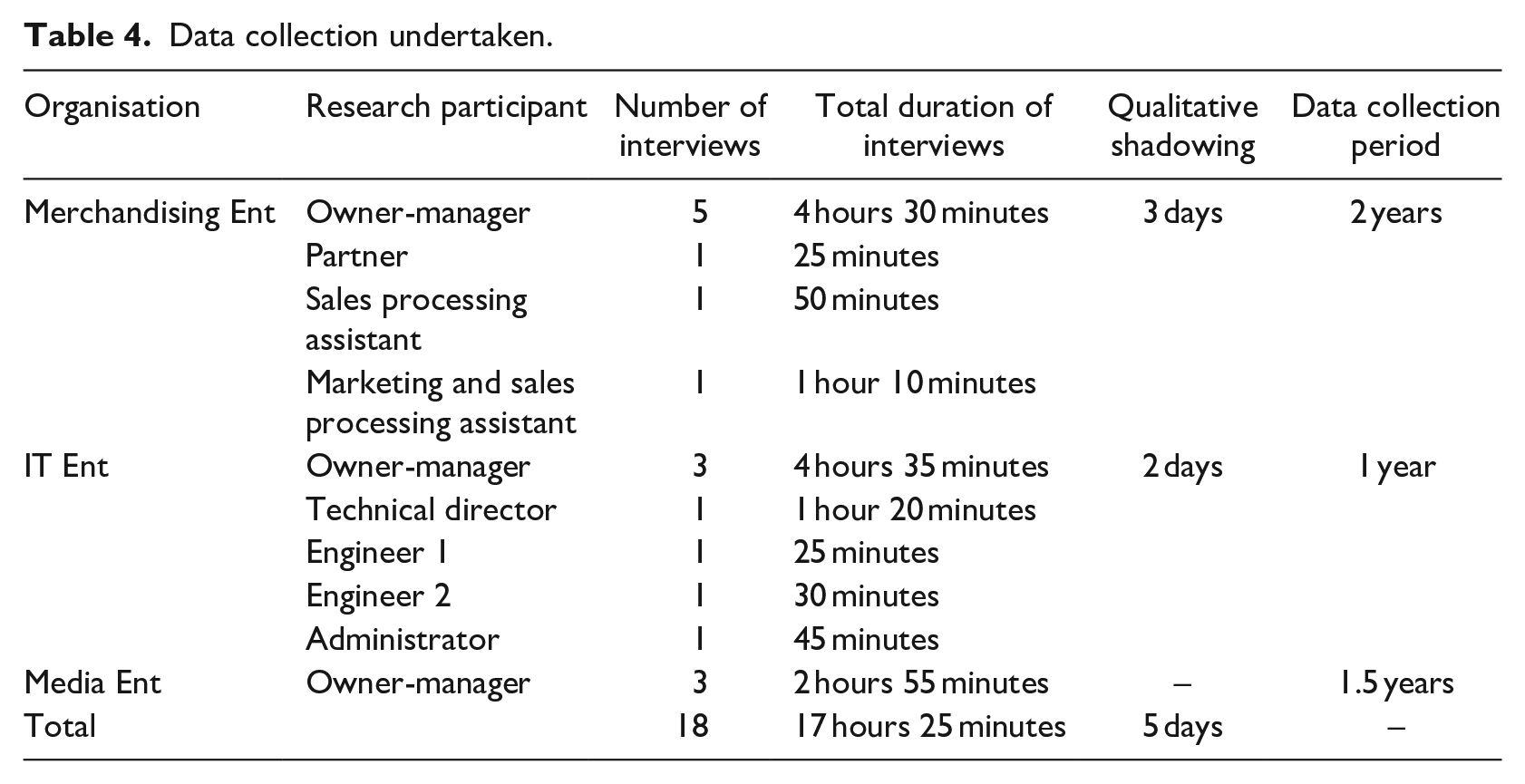
Data analysis
The owner-manager interviews were analysed manually over the course of a year. We adapted an version of the holistic-content narrative analysis approach used by Lieblich et al. (1998). We amended the process to meet Tracy’s (2010) criteria for excellent qualitative research more fully. For example, a reflexive journal was used to record the researcher’s sensemaking (Marshall, 1995), and we incorporated an opportunity to check preliminary findings with the owner-managers of Merchandising Ent and Media Enterprise (Media Ent), helping improve the credibility of the findings (Tracy, 2010). Amendments were also made to fit the analysis process to the specific characteristics of our study, such as to take account of both narrative and non-narrative data collected.
The analysis began with immersing ourselves in the interview data, reading repeatedly until patterns and contradictions emerged organically. At first, the transcripts were read uninterrupted, letting the data speak for itself (Lieblich et al., 1998). This involved reading the transcripts ‘carefully, empathically, and with an open mind’ (Lieblich et al., 1998: 62), with the reflexive journal being used to highlight and mitigate the researcher’s impact on the themes generated. Progressively, themes emerged from the data and were noted on the interview transcript. As themes emerged more clearly, they were captured in global impressions with regular revisiting of the interview data to ensure appropriate interpretations. The global impressions were documents in which the themes were written up using a combination of the researcher’s commentary and interview extracts. Separate global impressions were created for each owner-manager interview, with over 150 pages of global impressions being produced.
Attention then turned to understanding the praxis involved in the organisational developments underpinned by the capabilities. These were captured in as much detail as possible, with individual practices being mapped against the organisational developments. Here, we identified that the capabilities were dominated by one or two owner-managers and that they had both routine and non-routine elements (Teece, 2012).
Next, all global impressions were revisited to determine themes to be analysed further. Themes were chosen based on factors such as their prominence/importance and their potential to illuminate new insights not found in extant literature. The importance of themes was determined by their relevance to the topic being studied and the organisational context (Lieblich et al., 1998). These themes were then analysed more deeply in the owner-manager interview transcripts and lengthy conclusions were written for each theme. This identified interesting findings such as IT Ent and Merchandising Ent owner-managers struggling to allocate time to capability enactment due to other demands upon them. Preliminary findings were then presented to the owner-manager in Merchandising Ent and Media Ent, with additional insights and feedback being drawn into the theme conclusions. The themes were then analysed in the interviews with the business partner/employees in Merchandising Ent and IT Ent, with the theme conclusions being added to accordingly.
Findings
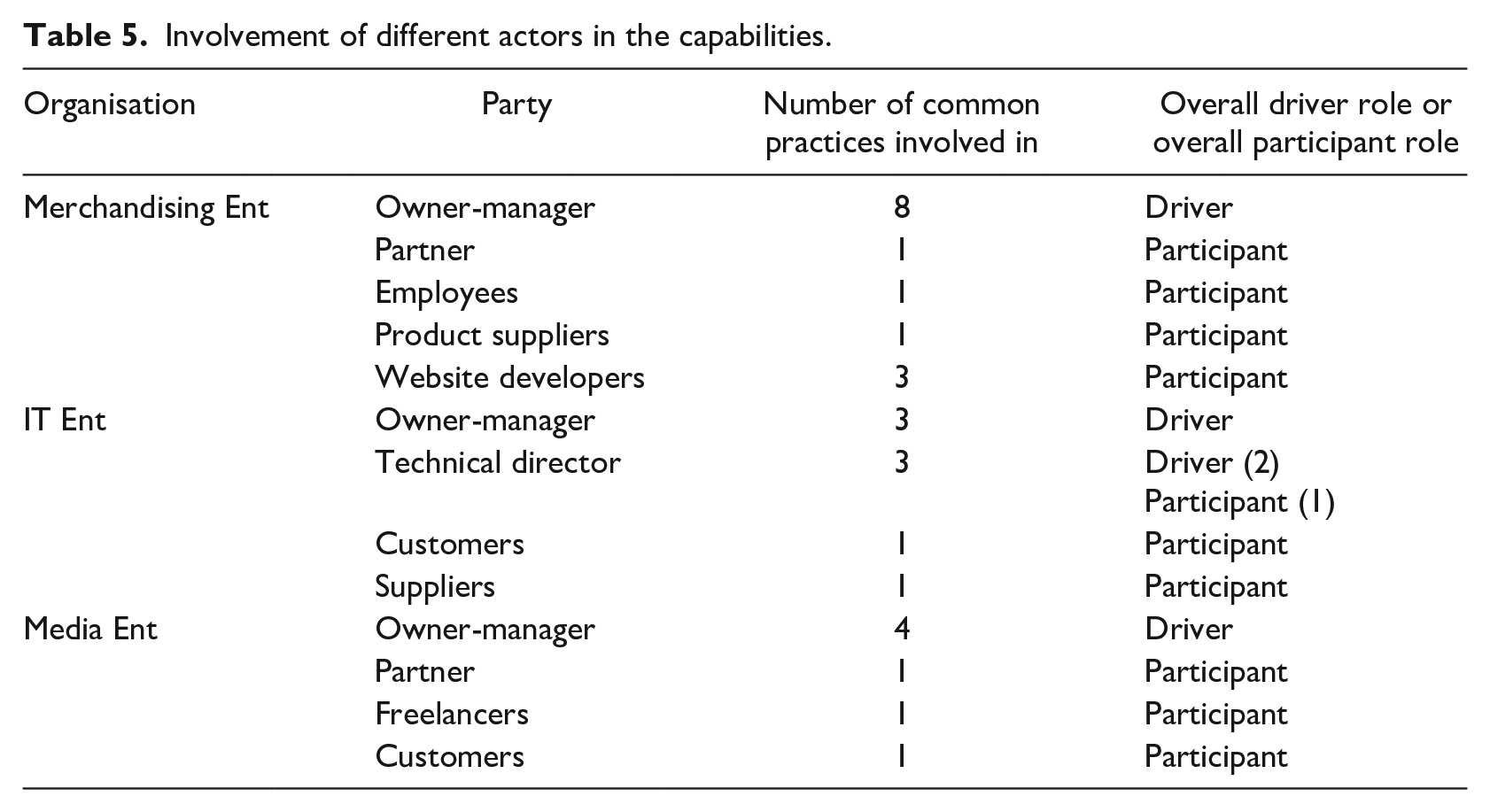
The enactment of each capability is made up of a cluster of common practices. Common practices refer to practices that are enacted during more than one organisational development. Information about the involvement of different actors in the common practices are detailed in Table 5. While these common practices show a routine element to the capabilities, there was some variation in which practices were undertaken and how practices were enacted during different organisational developments. This showed the capabilities had both routine and non-routine elements (Teece, 2012).
Involvement of different actors in the capabilities.
The following three sections present our key findings. Additional data to support the findings are provided in Online Appendix A2.
IT Ent
IT Ent has a capability to develop new services. This includes services that are new to IT Ent and the redevelopment of services they already offer. The capability has enabled the development of cloud services, managed services, and disaster recovery services. Dynamic capabilities have strategically and economically important consequences (Helfat and Winter, 2011; Teece, 2007), and in line with this, the development of such services in IT Ent has been central to forming the enterprise’s value proposition, which involves providing proactive and preventive services to clients rather than being a typical reactionary ‘break/fix’ IT company. The development of managed services has also allowed a recurring revenue model to be implemented, providing greater financial stability.
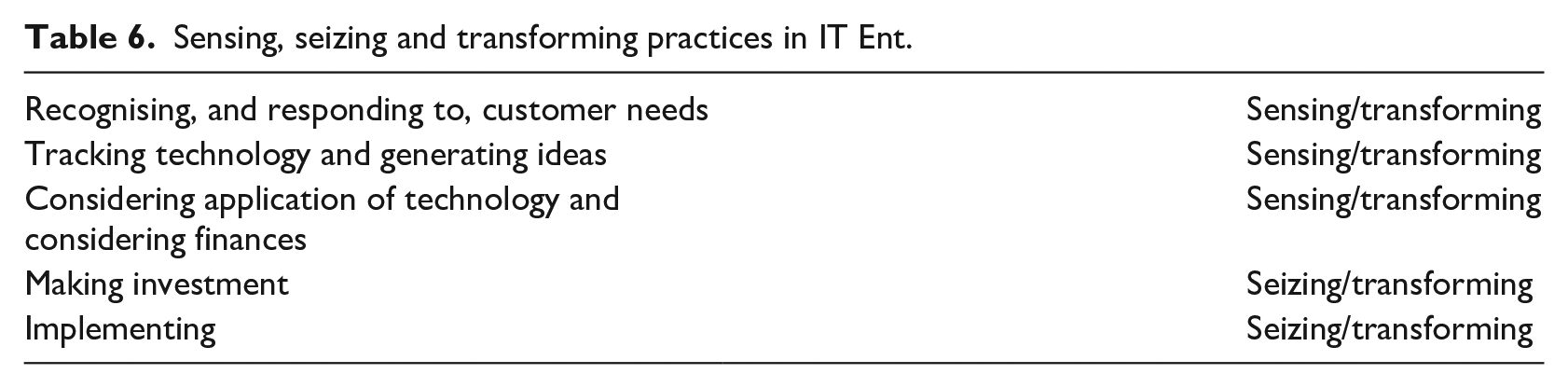
The enactment of the capability includes up to five common practices. Table 6 shows whether the individual practices are involved in sensing, seizing or transforming, 4 and Figure 1 shows the parties that enact each practice.
Sensing, seizing and transforming practices in IT Ent.
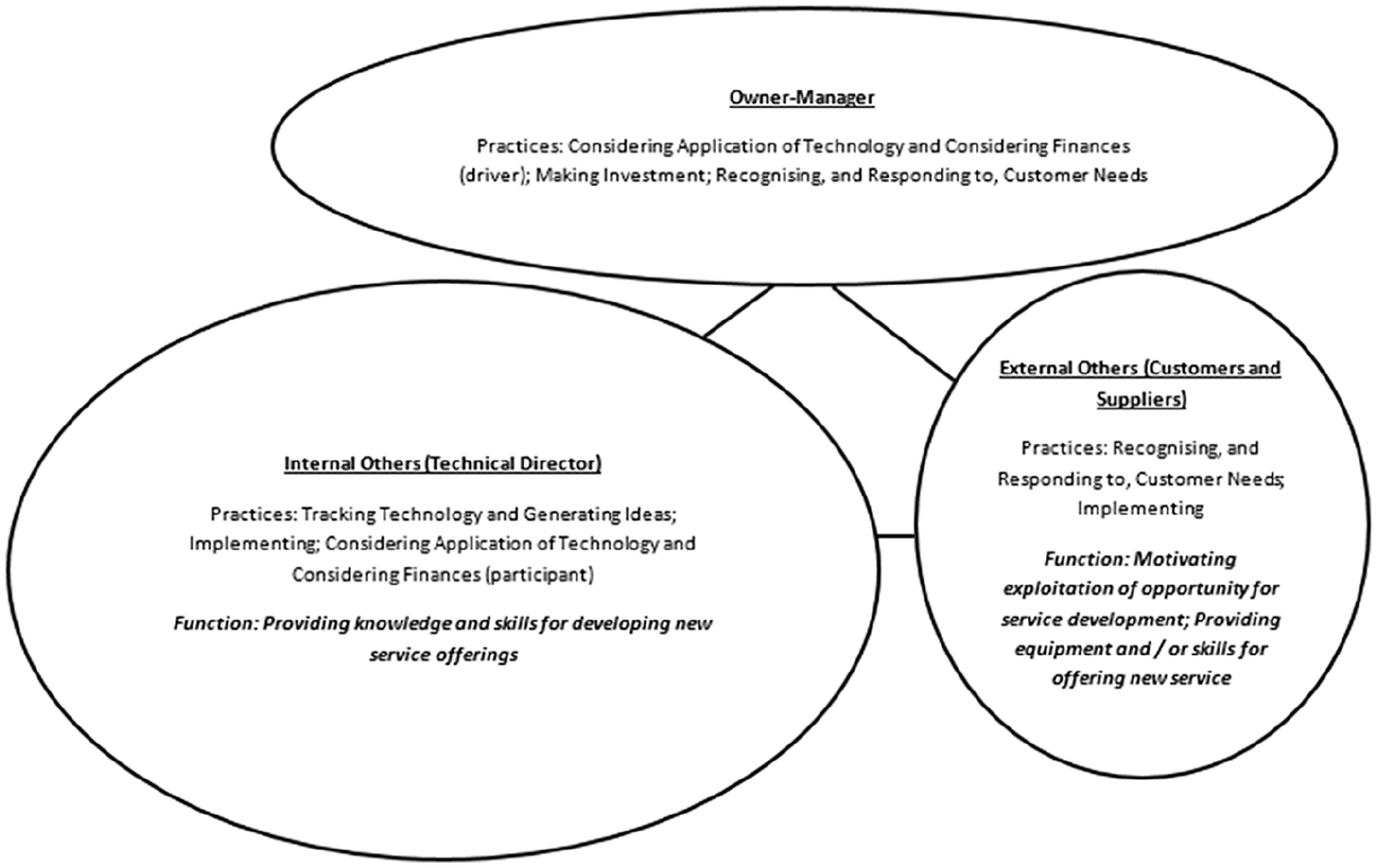
IT Ent’s capability enactment.
Although these are common practices, this does not mean each practice is involved in every development. Furthermore, where common practices are enacted in different service developments, the way in which they are enacted can vary. This suggests that while the capability is routine to some degree, there are also variances in the overall form it takes. The following interview extract illustrates the development of cloud services and disaster recovery services. In both instances, there is variability in how the process was enacted: (Technical Director) had emailed me to say, ‘I want to start looking at putting something together where we can offer it to the client, a hosted solution’, and now we’re doing it . . . it’s been a case of, ‘Right, well is there a path to it? How is it going to develop for the future?’ and they tend to . . . evolve rather than being a snap decision of ‘We’re going to do this’. Disaster recovery was more of a snap decision. (Owner-manager)
The owner-manager and technical director dominate the enactment of the capability (see Table 5), indicated by the larger circles being assigned to them in Figure 1. Both are involved in sensing, seizing and transforming activities. The technical director, drawing on his motivation and passion for technology, drives the technical side of new service developments. The owner-manager, who retains the decision-making power regarding whether new services will go ahead, focusses more on the business and customer elements of the developments. Customers and suppliers play a largely passive role, since they merely participate in practices that are driven by the owner-manager and/or technical director.
While both the owner-manager and technical director place importance on the long-term strategic development of IT Ent and play a dominant role in the capability, they are also heavily involved in the day-to-day operational work. This results from a lack of staff and the need to satisfy customer/operational requirements: When you’re a small company like ourselves and you’ve got the server experts and myself and (Technical Director) . . . I’ve got to work in the company and I’ve one major client who takes, I would say, seventy percent of our work up and I run that client so I’m well right stuck in inside it, so I don’t always have the time to step back. (Owner-manager)
This operational involvement limits the time available for the owner-manager and technical director to engage in service development processes. This makes the capability vulnerable since operational demands can divert attention and effort away from its enactment: (Technical Director’s) role (is) he’s the one who understands the technologies. He develops the technologies within the company and for the company. My role, in effect, is to assess where he’s up to and look at how it can fit within the company . . . I can only do that part of it if I’m not working in the company. The difficult part is, like at the moment, we’ve got so much pressure on I’ve ended up working back in the company. (Owner-manager)
Interestingly, while the operational involvement of the owner-manager and technical director can limit their ability to enact the capability, proximity to customers that result from their operational involvement allows them to determine which sensed opportunities are worth seizing.
Merchandising Ent
Merchandising Ent has a capability to develop niche marketing approaches for several merchandising products, including clear acrylic keyrings, loop fobs, customised pencils and mouse mats. This niche marketing strategy is central to Merchandising Ent’s business model, with the niche products offering an important route to market. Up to eight common practices are involved in the enactment of this capability. These practices, and the parties involved in enacting them, can be seen in Figure 2. Table 7 indicates which practices are involved in sensing and seizing. 5
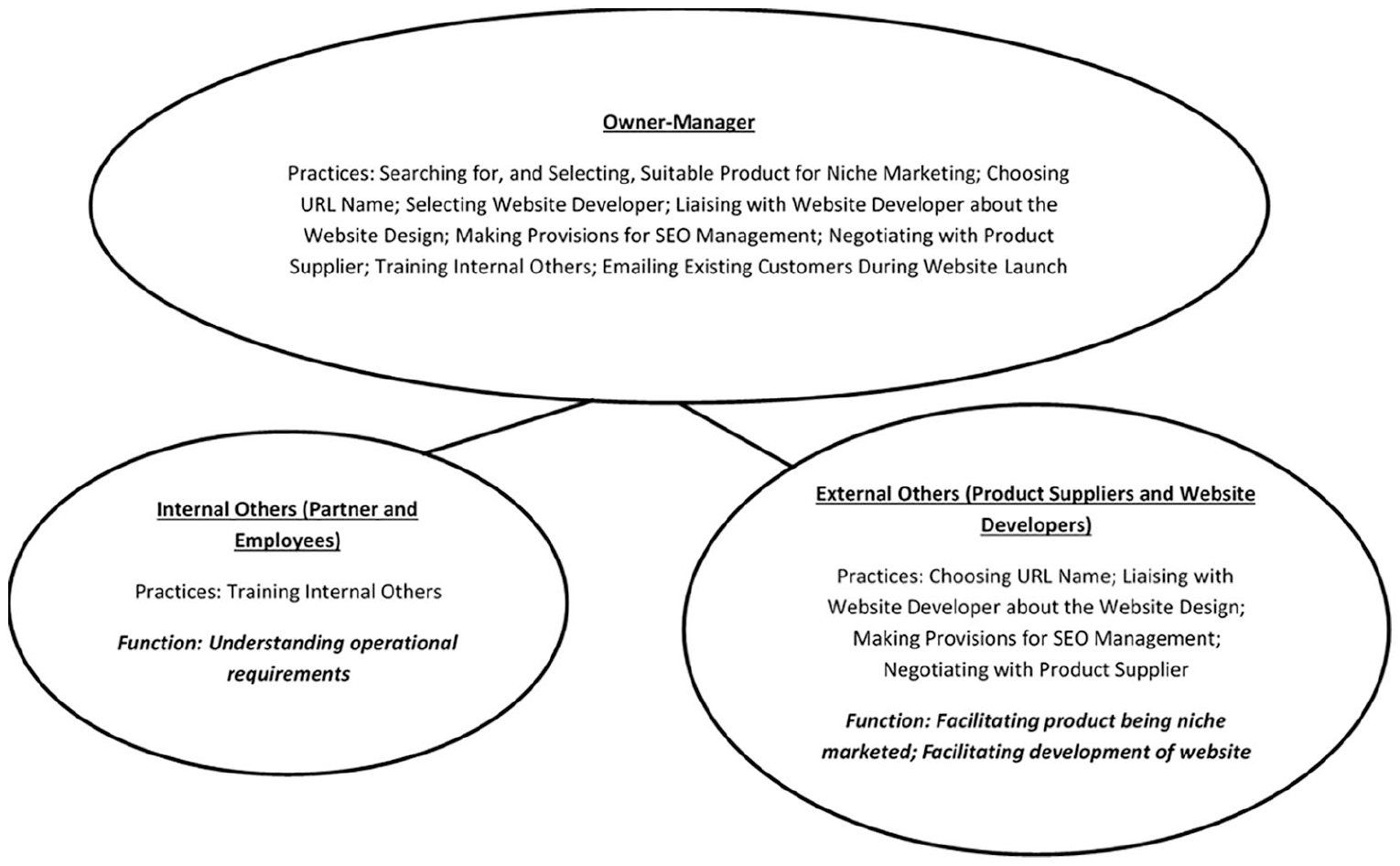
Merchandising Ent’s capability enactment.
Sensing and seizing practices in Merchandising Ent.
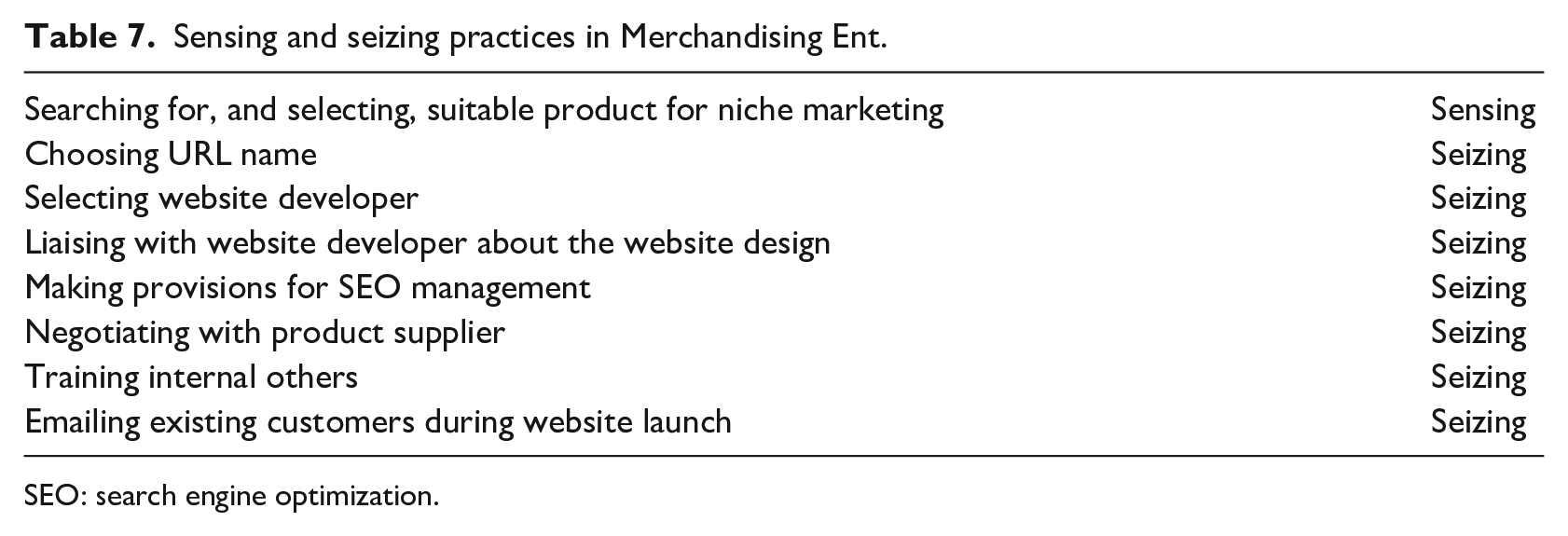
SEO: search engine optimization.
As indicated by the circle sizes in Figure 2, and the information in Table 5, the owner-manager is central to the development of niche marketing. He is the key decision-maker with strong business planning capabilities. He fully believes in the value of the niche marketing approach and drives sensing and seizing of these developments. He is involved in all eight common practices and is the key catalyst behind their enactment. The account of his business partner (his wife) illustrates the following: It’s usually been (Owner-Manager’s) remit. It’s what he likes to do. I am one of his employees when it comes to administering what he has in mind. He develops these websites with the help of other outside sources. (Business partner)
The role of employees in the development of niche marketing is very limited in that they are mainly involved in being trained by the owner-manager to understand the developments: These things are all done behind the scenes a lot of the time and I just remember them all being introduced gently. (Sales processing assistant)
The developments of niche marketing also rely quite heavily on collaborations with the product supplier and website developers. For example, although the product supplier is only involved in one practice – the ‘negotiating with product supplier’ (seizing) practice – the owner-manager would not niche market a product unless he receives concessions from the supplier. Nevertheless, generally external organisations take a participative role in the practices they are involved in, as opposed to the owner-manager’s driving role.
Despite his central role in enacting the capability and his commitment to niche marketing new products, the owner-manager often finds himself heavily involved in day-to-day operational work. This means niche developments can be held up, since he needs time for sensing and seizing activities. When operational demands become too great, the potential for capability enactment is reduced, suggesting the inherent vulnerability of the capability: If a customer needs sorting out, or a technical issue in the office, or a member of staff has a problem, then those three things tend to take a priority over and above the working on the business, the management of the niches. . .the marketing, the social media, and just the basic planning ahead that tends to get deferred for a more current need. (Owner-manager) The (niche website) is more or less finished but we’ve been so busy we’ve hardly touched it, hardly done anything with it yet. (Owner-manager)
Successful niche marketing of the loop fobs (the second product to be niche marketed) increased sales and associated workload to the extent that the owner-manager did not stop to sense the need to niche market more products. Indeed, successful niche marketing of a product can increase operational workload so much that it makes it difficult for the owner-manager to allocate time to niche marketing subsequent products. In other words, successful deployment of the capability can make future enactment of the capability more vulnerable: One of the things is, of course, by having each (niche development), as each one starts to do business you do find that you’ve got less time again because there’s more things going on with the (niche website) that is working well . . . eventually your own success is further diluting the time you’ve got to focus and do the next (niche development) properly, to the extent by which the fourth (niche development) being the mouse mats, probably never got the full launch and email that it warranted. (Owner-manager)
Media Ent
Media Ent has a capability to develop new services, such as filmmaking services, website development services and niche photography and filmmaking services. These services are complementary to the photography and creative design services that were originally offered when the company was founded. This complementarity is part of the core strategy of Media Ent, with the business model being based around cross-selling different services to customers. Being a ‘one-stop-shop’ for customers is key to the value proposition, distinguishing Media Ent from its main competitors. Up to four common practices are involved in new service development. These practices are outlined in Table 8 and the parties involved in enacting them are displayed in Figure 3.
Sensing, seizing and transforming practices in Media Ent.

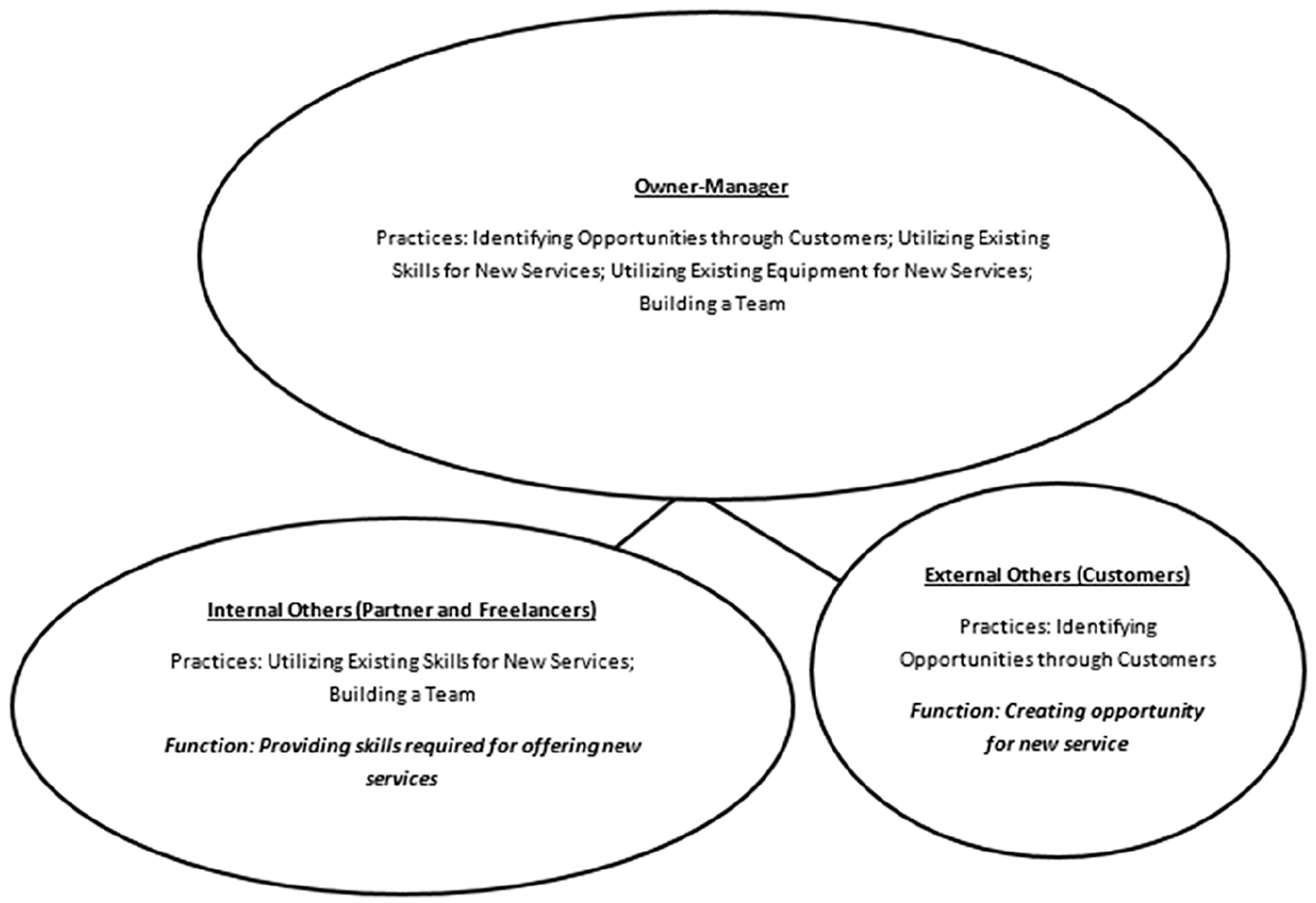
Media Ent’s capability enactment.
The enactment of these practices can be illustrated by the process involved in developing website development services. The owner-manager sensed the opportunity through customer requests and his observations while working for a customer (‘Identifying Opportunities through Customers’). Equipment did not need to be purchased because Media Ent made use of computers they already had (‘Utilising Existing Equipment for New Services’) and the owner-manager’s wife applied her design skills for website design (‘Utilising Existing Skills for New Services’). However, the owner-manager perceived that the level of website development skills required was not currently held within Media Ent. Therefore, he took on a freelancer to fill this gap (‘Building a Team’). The following interview extract explains the ‘Identifying Opportunities through Customers’ and ‘Building a Team’ practices: We’d (been) doing some photography for a T-shirt company and I saw an opportunity that we might be able to do the website, so pitched an idea (and) they liked it and sanctioned the job . . . prior to that . . . I was in a coffee shop just here and I bumped into a young programmer, quite a high-level programmer and he was very keen . . . I gave him a couple of projects to do. (He) seemed very, very competent . . . So, I asked him like, you know, ‘If we got some work would you be interested?’ He said, ‘Yes’. So that’s when I thought, ‘Right, let’s pitch cause it looks like we’ve got the team to do it’. (Owner-manager)
As summarised in Table 5, and illustrated by circle size in Figure 3, the owner-manager is the main actor involved in service development in Media Ent and he generally drives the sensing, seizing and transforming practices. The capability is motivated by the owner-manager’s personal value to always maximise his earning potential, something the capability enables through the development of complementary services.
Internal others are involved in a participative, as opposed to driving, manner. For example, when ‘Building a Team’ (seizing), the owner-manager actively searches for freelancers, with these freelancers merely participating in the practice in a rather passive way. Furthermore, by ‘Identifying Opportunities through Customers’ (sensing/transforming), these external customers are involved in the practice, but it is the owner-manager who senses opportunities for service developments. Often, his proximity to these customers facilitates this. The interview extract below illustrates this, where the owner-manager proactively senses the opportunity for offering a niche photography service for football screening events: They came to me for doing some promotional work, sorry, promotional videos . . . I saw they had a photographer there but he wasn’t very good and I said, ‘Look, I can give you much better and plus because we’re doing video I can give you a better price’. And before you know it, you know, I’m, you know, doing that as well. (Owner-manager)
The owner-manager’s involvement in day-to-day operational work appears to facilitate sensing, seizing and transforming activities by enabling him to spot opportunities and leverage his own skills and existing operational equipment to enact service development.
Discussion
The capabilities we identified were shaped by two common characteristics of micro-enterprises: dominance and operational involvement of the owner-manager. Following Shilke et al. (2018), we now utilise our in-depth research findings to draw theoretical generalisations on dynamic capabilities and related concepts.
Owner-manager dominance and the stability of dynamic managerial capabilities
Dynamic capabilities are operated at the organisational level (Shilke et al., 2018) and dynamic managerial capabilities are practised at the management team, or individual manager level (Adner and Helfat, 2003; Beck and Wiersema, 2013; Kor and Mesko, 2013). While extant research in micro-enterprises has given little consideration to the level at which capabilities are enacted, the dominance of the owner-manager in the capabilities we explored raises the question of whether these capabilities are dynamic managerial capabilities rather than organisation-level dynamic capabilities. There are few guidelines for distinguishing the levels at which dynamic managerial capabilities and dynamic capabilities sit (Kevill, 2014), but the micro-foundations of dynamic managerial capabilities can provide some direction.
The three currently accepted micro-foundations of dynamic managerial capabilities are managerial cognition, human capital, and social capital (Helfat and Martin, 2015). Social capital indicates that dynamic managerial capabilities, even at the individual level, involve other actors suggesting a ‘degree of dominance’ approach is adopted to distinguish between dynamic managerial capabilities and organisation-level dynamic capabilities (Kevill, 2014). This suggests that if an individual manager, or the management team, dominates and is the hub of the capability, then the capability is an individual-level, or group-level, dynamic managerial capability. This is based on the premise that without the manager(s), the social ties that underpin the dynamic managerial capability would be absent.
In Media Ent and Merchandising Ent, the owner-manager is involved in all sensing, seizing and transforming practices and drives capability enactment. Furthermore, internal and external parties are involved only through their links with the owner-manager, as demonstrated by the connections between different parties in Figures 2 and 3. In these two enterprises, the owner-manager is, therefore, the dominant actor and hub through which other parties are involved, reflecting the above conception of an individual-level dynamic managerial capability. In IT Ent, the key actors in sensing, seizing and transforming are the technical director and owner-manager. These individuals are also the hub through which external parties are involved in new service developments (see Figure 1). Following the ‘degree of dominance’ approach, this capability is, in effect, a group-level dynamic managerial capability.
With an owner-manager or small management team dominating the strategic, operational, and cultural side of micro-enterprises (Jaouen and Lasch, 2015; Kearney et al., 2019), the lines between individual, group and organisation levels become difficult to demarcate. Initially, this might question the applicability of the dynamic capability and dynamic managerial capability concepts to the micro-enterprise context, given that these concepts are distinguished by analytical level. Nevertheless, the very dominance of the individual or group in micro-enterprises shows just how conducive the dynamic managerial capability concept – which is also dominated by an individual or group – is to these organisations. However, while dynamic managerial capabilities in large organisations typically drive the development and evolution of organisation-level dynamic capabilities, the dynamic managerial capabilities we identified have remained at the individual/group levels. This is likely to be common in micro-enterprises, given that they have a small headcount and tend to be dominated by their manager(s) (Devins et al., 2005; Jaouen and Lasch, 2015). As such, organisation-level dynamic capabilities are unlikely to evolve in such enterprises, suggesting that the dynamic capability concept lacks applicability to the micro-enterprise context.
The Teecian perspective of dynamic capabilities acknowledges that ‘certain dynamic capabilities may be based on the skills and knowledge of one or a few executives’ (Teece, 2012: 1395). Accordingly, this recognises that dynamic managerial capabilities do not always extend to the organisational level. Nevertheless, Teece (2012, 2014) argues this is dangerous since key individuals may leave the organisation and, in so doing, retire or retrench the capability to which they are integral. He thus suggests that these capabilities should be developed into organisation-level dynamic capabilities where possible (Teece, 2014), something that requires time and financial investment (Salvato and Vassolo, 2018). While Teece’s argument is logical for many organisational contexts, we contend that it becomes redundant in many owner-managed micro-enterprises. This is because owner-managers are typically emotionally attached and strongly committed to their enterprises in which they have invested substantial blood, sweat and tears (Pierce et al., 2001; Wahlgrén and Stewart, 2003). Self-identification with their enterprise, and their attachment and commitment, also tends to strengthen the longer the owner manages the enterprise (Kammerlander, 2016). As such, these owner-managers are less likely to leave their enterprises in the short term. Indeed, the owner-managers in our study displayed commitment through long-term tenure (IT Ent and Merchandising Ent) and/or communicating long-term visions for their enterprises. This reduces the risk associated with micro-enterprises having dynamic managerial capabilities that remain at the individual or group level, with Teece (2014: 339) himself acknowledging that the longevity of individual- or group-level capabilities ‘depends on the tenure of entrepreneurs/managers/leaders’ that are central to them.
A lack of organisation-level dynamic capabilities may even benefit micro-enterprises. As acknowledged by Ambrosini et al. (2009) and Helfat and Peteraf (2003), depending on managerial perceptions of the need to change, dynamic capabilities and dynamic managerial capabilities may need to be refreshed. When current dynamic capabilities/dynamic managerial capabilities are deemed insufficient to affect the organisation’s resource base, managers may decide to renew dynamic capabilities/dynamic managerial capabilities to allow the organisation to change its resource base. Dynamic managerial capabilities residing at the level of the individual or the group are quicker to change than organisation-level dynamic capabilities (Salvato and Vassolo, 2018). So, having dynamic managerial capabilities, rather than organisation-level dynamic capabilities, could support the flexibility advantage many micro-enterprises enjoy over their large counterparts.
The preceding discussion contests Teece’s concerns about the vulnerability of dynamic managerial capabilities that do not evolve to the organisational level. We will now illustrate how owner-manager operational involvement – a typical feature of micro-enterprises – provides some support for Teece’s concerns on capability vulnerability, but for different reasons than Teece had identified.
Managerial time allocation as a micro-foundation and the stability and vulnerability of dynamic managerial capabilities
In all three organisations, the owner-managers were heavily embedded in day-to-day operations; they were ‘sucked into’ operational work, not only because such activities provide fast, often positive, feedback translating into increased customer demand and profit (Gupta et al., 2006), but also because these firms are too small to have gatekeepers preventing interruptions from employees or customers (Volery et al., 2015). The rhythm of operational work becomes ‘zeitgeber’ (‘time emitter’ in German), dominating the rhythmic patterns of other work (Bluedorn, 2002). This operational involvement enhanced the ability of Media Ent’s owner-manager to sense, seize and transform, since he could quickly spot and capture opportunities to use existing skills and equipment to offer new services. However, while customer proximity resulting from operational work supported the enactment of some dynamic managerial capability practices (Kearney et al., 2017; Kelliher et al., 2018) in IT Ent and Merchandising Ent, the greatest impact of operational involvement was to limit time allocated to capability enactment, thus slowing and constraining the capability in these enterprises.
By focusing on the practices underpinning capability enactment, the evidence from this study enables us to develop a nuanced understanding of the interplay between operational work and dynamic managerial capabilities. It is noted that when the practices involved in the dynamic managerial capability shared significant commonalities with those of the operational work, the owner-manager’s operational involvement supported the capability’s enactment. This can be seen in Media Ent where proximity to customers and knowledge of operational skills and equipment capabilities supported all the dynamic managerial capability practices. In cases such as this, where all or most dynamic managerial capability practices share significant commonalities with operational practices, allocating time to operational tasks also means allocating time to dynamic managerial capability enactment. This creates opportunities to mature and stabilise the capability. Excessive operational involvement becomes detrimental when dynamic managerial capability practices do not align closely with operational work; this diverts time from dynamic managerial capability enactment. This was the case for the majority of practices involved in the dynamic managerial capabilities in IT Ent and Merchandising Ent. This suggests that while operational work and dynamic managerial capabilities are not always mutually exclusive and co-destroying, in the instances where they lack significant commonalities, then operational work can impede dynamic managerial capability enactment by limiting the time allocated to enacting such capabilities.
There is some acknowledgement of time allocation as a micro-foundation of dynamic capabilities, focussing predominantly on time investment required for developing new and changing existing capabilities at the organisational level (Salvato and Vassolo, 2018). Our findings show the need for individuals to also allocate time to undertake practices involved in enacting dynamic managerial capabilities – crucial in maturing and stabilising the capability. This aligns with Winter’s (2003) argument that time is necessary for enacting organisation-level dynamic capabilities, with a theoretical contribution to analysing dynamic managerial capabilities, by showing that the three core micro-foundations of such capabilities (cognition, human capital and social capital) also require managerial time allocation in order to be deployed to enact organisational change. Indeed, individual temporal perceptions, such as conceptions of how much time is available and what is urgent, have a major impact on their activities (Granqvist and Gustafsson, 2016) regarding how they allocate their time to various activities (Crossan et al., 2005), including those involved in enacting dynamic managerial capabilities. As such, we propose ‘managerial time allocation’ as a fourth core micro-foundation of dynamic managerial capabilities. This contribution responds to the call by Shilke et al (2018) for researchers to extend understanding of micro-foundations.
While operational work can lead to capability stability where operational practices share significant commonalities with most, or all, of a dynamic managerial capability’s practices, our findings also provide some support for Teece’s (2014) warning about the vulnerability of dynamic managerial capabilities embedded in just one or a small number of managers. However, in the micro-enterprise context, this vulnerability can stem from factors outside those considered by Teece. While micro-enterprise owner-managers are less likely to leave their enterprise in the short term, they, and other key individuals, can become overwhelmed by operational workloads. This restricts their participation in capability enactment where capability enactment does not share significant commonalities with the practices performed in operational work. This can delay or slow the enactment of dynamic managerial capabilities and, in the long term, result in delayed maturity or possible retrenchment of the capability – something that may be less of an issue if these capabilities were not solely situated in individual’s practices and rather were embedded in organisation-level routines. Accordingly, while Teece’s (2014) warnings about individual- and group-level dynamic managerial capabilities were based on a fear of key personnel leaving, the stronger danger in micro-enterprises comes from key personnel perceiving themselves to be too busy and deeply embedded in their operational roles and hence not enacting the capability regularly enough for maturity/stability to be realised. This extends Teece’s theorising regarding the stability and vulnerability of dynamic managerial capabilities by identifying temporal conflicts as a potential source of vulnerability.
Self-damaging dynamic managerial capabilities
In Merchandising Ent, we found that the deployment of the dynamic managerial capability increased sales. While this demonstrates success, it also required more operational involvement of the owner-manager to fulfil work generated by the extra sales. Since the practices involved in the dynamic managerial capability in Merchandising Ent share few commonalities with operational tasks, this further depleted the time he allocated to future enactment of the sensing and seizing activities involved in the niche marketing developments. In that regard, this capability became a ‘self-damaging dynamic managerial capability’ since it harmed one of its own key micro-foundations (‘managerial time allocation’). This illustrates one way in which dynamic managerial capabilities can influence their own micro-foundations.
Deciding how to allocate time and other resources between exploitative activities to ensure current viability of a firm and explorative activities for future viability is a problem confronted by all organisations (March, 1991). However, the tension between these two competing demands is experienced at higher levels as the size of the organisation decreases (Gupta et al., 2006). Ambidexterity helps organisations to navigate this tension (O’Reilly and Tushman, 2008) and could potentially counteract the impact of self-damaging dynamic managerial capabilities. However, with their limited resource endowments, micro-enterprises find ambidexterity challenging (Özşahin, 2019; Voss and Voss, 2013). In a micro-enterprise, the structural complexity to separate out units to perform exploitative or explorative activities, structural ambidexterity (Benner and Tushman, 2003), is lacking. Also, the resources to instil higher-order organisational context to motivate employees to balance exploitative and explorative activities in their daily work, contextual ambidexterity (Gibson and Birkinshaw, 2004), are inadequate. Furthermore, the costs associated with alternating between periods of exploration and exploitation by realigning organisational processes sequentially, cyclical ambidexterity (Birkinshaw et al., 2016), are too high. Micro-enterprises often do not even have a top management team that would allow them to attain ambidexterity at the group level through ‘behavioural integration’ of top manager task processes around exploitation versus exploration (Lubatkin et al., 2006). All of these suggest that the owner-manager might be the key driver of ambidexterity in such contexts (Volery et al., 2015). When the owner-manager lacks the competencies/behaviours to pursue the two disparate activities of exploitation or exploration with equal dexterity, and when operational activities do not share significant commonalities with dynamic managerial capability practices, it can be expected that dynamic managerial capabilities can acquire a self-damaging nature.
Introducing the notion of ‘self-damaging dynamic managerial capabilities’ is an important theoretical contribution that responds to the call for more research into the feedback loops between capabilities and their micro-foundations (Shilke et al., 2018). Furthermore, this contributes to conversations on time in entrepreneurship research by providing new insights into factors that can divert owner-manager attention from strategic planning to present-day operational concerns (Lévesque and Stephan, 2019). While the feedback loop we identified can damage dynamic managerial capabilities in micro-enterprises, it is important to note that it is not necessarily fatal. In Merchandising Ent, for example, while successful deployment of the dynamic managerial capability slowed further capability enactment, it did not stop it completely, with further niche marketing developments being enacted at later dates.
Limitations and future research
Although not our purpose, the results of our study may be transferable to other micro-enterprises, since these firms are typically dominated by one or two individuals (Jaouen and Lasch, 2015) and typically have scarce time resource (Kelliher and Reinl, 2009). Nevertheless, we can only infer this, given the limited scope of our study. As such, we recommend further deductive research that investigates whether our findings hold in a broader range of micro-enterprises. We also encourage additional research exploring how micro-enterprise owner-managers juggle different temporalities and resolve the paradox of intertemporal choice through temporal leadership. This will advance understanding of the micro-foundational role of managerial time allocation and provide insights into how practitioners can restrain self-damaging dynamic managerial capabilities. Furthermore, while qualitative shadowing provided important contextual information to help understand the dynamic managerial capabilities, our cross-sectional use of it made it difficult to observe the enactment of the capabilities directly and to ascertain whether the organisational context changed and shaped the capability differently over time. Future longitudinal qualitative shadowing enhanced by other ethnographic tools, such as video diaries collected from organisational actors, could allow researchers to capture in real time the practices and engagements underpinning dynamic managerial capabilities.
Conclusion
This article has presented the results of in-depth qualitative research to investigate ‘How are dynamic capabilities enacted in micro-enterprises and what role do different parties and managerial time allocation play in this enactment?’ We assessed the degree to which the concept fits the micro-enterprise context, unpacked the micro-foundations of dynamic managerial capabilities, and provided insights into the stability and vulnerability of these capabilities in micro-enterprises.
Three important theoretical contributions ensue. First, after identifying that micro-enterprises are likely to have dynamic managerial capabilities rather than organisation-level dynamic capabilities, we extended the Teecian view by suggesting that vulnerabilities he associates with dynamic managerial capabilities are less likely to apply in the micro-enterprise context. Our second contribution relates to the operational involvement of owner-managers, introducing ‘managerial time allocation’ as a new micro-foundation of dynamic managerial capabilities. This responds to the call of Shilke et al. (2018) to broaden understanding of the micro-foundations of capabilities and to Lévesque and Stephan’s (2019) call for more attention to be given to time in entrepreneurship research. Here, we show that, in some instances, Teece is right to highlight vulnerabilities of dynamic managerial capabilities, but the reasons for the vulnerabilities in micro-enterprises are different than those that he identifies. A more likely vulnerability here is key personnel within the enterprise perceiving themselves to be too busy with operational practices that conflict with dynamic managerial capability practices, thus restricting their participation in capability enactment. Finally, we illustrated that successful deployment of the dynamic managerial capability in Merchandising Ent increased operational workloads and depleted time available to enact the dynamic managerial capability in future. We thus coin the term ‘self-damaging dynamic managerial capabilities’ to show how these capabilities can negatively affect one of their own micro-foundations. This theoretical contribution addresses Shilke et al.’s (2018) call for research into the feedback loops between these capabilities and their micro-foundations.
Supplemental Material
sj-pdf-1-isb-10.1177_0266242620970473 – Supplemental material for Dynamic managerial capabilities in micro-enterprises: Stability, vulnerability and the role of managerial time allocation
Supplemental material, sj-pdf-1-isb-10.1177_0266242620970473 for Dynamic managerial capabilities in micro-enterprises: Stability, vulnerability and the role of managerial time allocation by Alex Kevill, Kiran Trehan, Shelley Harrington and Selen Kars-Unluoglu in International Small Business Journal: Researching Entrepreneurship
Footnotes
Acknowledgements
The authors are grateful to Professor Nick Williams, Dr. Isla Kapasi and Dr. Mariana Estrada-Robles for their very helpful and constructive feedback on an earlier version of this paper. The authors would also like to thank Professor Sue Marlow and two anonymous reviewers for their very insightful feedback and support during the review process.
Funding
The author(s) disclosed receipt of the following financial support for the research, authorship, and/or publication of this article: This work was supported by doctoral research funding provided to the lead author by the Economic and Social Research Council.

Supplemental material
Supplemental material for this article is available online.
Notes
Author biographies
References
Supplementary Material
Please find the following supplemental material available below.
For Open Access articles published under a Creative Commons License, all supplemental material carries the same license as the article it is associated with.
For non-Open Access articles published, all supplemental material carries a non-exclusive license, and permission requests for re-use of supplemental material or any part of supplemental material shall be sent directly to the copyright owner as specified in the copyright notice associated with the article.
