




Abstract
Despite the undisputed importance of feedback-seeking for new venture advancement, little is known about the circumstances that make it effective. In this study, it is proposed that the collective psychological ownership of new venture teams over the new venture (i.e. this is ‘OUR’ venture) can help leverage the value and bear the costs of self-improvement feedback-seeking behaviour (SI-FSB), amplifying the expected positive relationship between new venture teams’ SI-FSB and new venture performance. Insights from a survey-based study involving 166 new ventures support the hypotheses. Contributing to the nascent feedback-seeking research in the new venture context, this study shows that SI-FSB matters and suggests that new venture teams should keep their collective psychological ownership over their new venture strong.
Feedback plays a vital role in developing new ventures (NVs) (Alexy et al., 2021; Bhave, 1994; Grimes, 2018). Yet, its availability is not a given (Collewaert et al., 2016; Drencheva et al., 2021). Moreover, emerging feedback, like a loss of venture customers, project failure or negative media coverage (Domurath et al., 2020), may come (too) late or at a high price. Given the constraints regarding timely feedback availability, the relevance of proactive feedback-seeking behaviour (FSB) (Ashford & Cummings, 1983; Grant & Ashford, 2008) for NVs has been recognised in both practice (Blank, 2013) and academia (Drencheva et al., 2021; Shepherd et al., 2022). For instance, entrepreneurs may engage in FSB to learn what aspects to consider for being a successful entrepreneur and how to navigate related demands (Drencheva et al., 2021). Based on previous research, in this study, it is assumed that self-improvement FSB (SI-FSB) is particularly instrumental as it diagnostically determines gaps and ways of improving abilities and skillsets to improve achievements (Janssen & Prins, 2007). Further, and in line with recent studies showing FSB’s value for entrepreneurial performance (Shepherd et al., 2022; Uy et al., 2024; Xu et al., 2023), it is expected that NV teams’ (NVTs) SI-FSB will be positively associated with NV performance (NVP). Such NVP, in turn, is of critical interest not only for NVs but also for society, as NVs create jobs, radical solutions, qualitatively compelling innovations and economic growth (Hessels & van Stel, 2011; Homfeldt et al., 2019; van Praag & Versloot, 2007).
A first research question (RQ), thus, is
RQ1: How does SI-FSB relate to NVP?
However, SI-FSB is costly because it may elicit different interpretations and, therefore, different reactions from the feedback sources. A feedback source will only invest more effort in providing useful feedback if they believe that it is being sought out of an instrumental motive to improve rather than a desire to create a positive image (Minnikin et al., 2022). Further, grappling with elicited feedback can be intense (Grimes, 2018). Given NVs’ resource limitations (Freeman & Engel, 2007; Klotz et al., 2014), insights on conditions that can make SI-FSB most effective despite its costs are warranted but remain scarce since FSB research in the entrepreneurial context is still nascent (Collewaert et al., 2016; Drencheva et al., 2021). It is thus further asked,
RQ2: What boundary condition can render NVTs’ SI-FSB efforts effective for NVP despite related costs?
In tackling this RQ, in this study, it is suggested that NVTs’ collective psychological ownership (CPO) over the NV—‘the collectively held sense (feeling) that this target of ownership (or a piece of that target) is collectively “ours”’ (Pierce & Jussila, 2010, p. 812)—may help NVTs to send the right signals and deal with the elicited feedback. First, CPO may convey NVTs’ felt responsibility to grow the NV, desire to see it prosper, work engagement and confidence in their ability to improve by having a say in the NV, as informed by ownership feelings (Gray et al., 2020; Pierce & Jussila, 2010; Su & Ng, 2019). This might convince sources of NVTs’ instrumental FSB motive to give better developmental feedback (Minnikin et al., 2022). Second, with its cognitive-emotional characteristics (Pierce & Jussila, 2010), CPO may help with the affect-laden and cognitively demanding process of engaging with developmental feedback (Cannon & Witherspoon, 2005). Overall, it is thus expected that high CPO enables NVTs to get the most out of SI-FSB, amplifying SI-FSB’s positive link with NVP.
The moderation model was tested in a survey study involving 166 NVs associated with 10 European start-up accelerators. Findings support the hypotheses. This study contributes to the developing FSB research in the entrepreneurial context (Collewaert et al., 2016; Deng et al., 2019; Drencheva et al., 2021), extending it by introducing CPO as a relevant boundary condition that helps to make SI-FSB effective despite its costs. Moreover, by explicating the value of strong CPO regarding SI-FSB efforts, this study complements recent entrepreneurial research suggesting strong psychological ownership as a potential barrier for entrepreneurs to engage with elicited feedback (Grimes, 2018). Thereby, it enriches understanding of the roles that strong psychological ownership can play for NVs in relation to feedback (seeking). NVTs can glean from this study the value of cultivating high CPO regarding their NV alongside their efforts in SI-FSB.
Theoretical Background
NVTs are ‘the group of individuals that is chiefly responsible for the strategic decision making and ongoing operations of a new venture’ (Klotz et al., 2014, p. 227), playing a crucial role in NVP (Ensley et al., 2006). For instance, in their meta-analytical investigation of NVP predictors, Jin et al. (2017) showed that heterogeneity within NVTs benefits NVP. Given this coupling of responsibilities and power, NVT (members) are not only interested in obtaining feedback to navigate the NV but also have joint leeway to act on feedback. For instance, Shepherd et al. (2022) interviews suggested that entrepreneurial teams engaged with and built on inputs from relevant community members to varying degrees of breadth and depth. Furthermore, Baur et al. (2023) pointed out that NVTs’ broad efforts in eliciting feedback may confront them with contradictory insights and found that NVTs approached them either through leveraging an internal specialist or the wider team.
Such feedback, as ‘a special case of the general communications process in which some sender (…) conveys a message [regarding past behaviours and/or performance] to a recipient’ (Ilgen et al., 1979, p. 350), is vital for NVs. It indicates the (in)appropriateness of products and strategy (Bhave, 1994), stimulates updates in ventures’ internal functioning (Alexy et al., 2021), or in developing creative elements (Toivonen et al., 2023). However, compared to established organisations, entrepreneurs’ unstructured work environment deprives them of regular supervisor-provided feedback (Collewaert et al., 2016), and NVs’ resources are much more restricted (Freeman & Engel, 2007; Klotz et al., 2014). This context renders active FSB especially crucial for entrepreneurs because it helps them to gather otherwise unprovided feedback from sources typically residing outside their NV and is a relevant strategy to keep approached (re)sources involved (Drencheva et al., 2021).
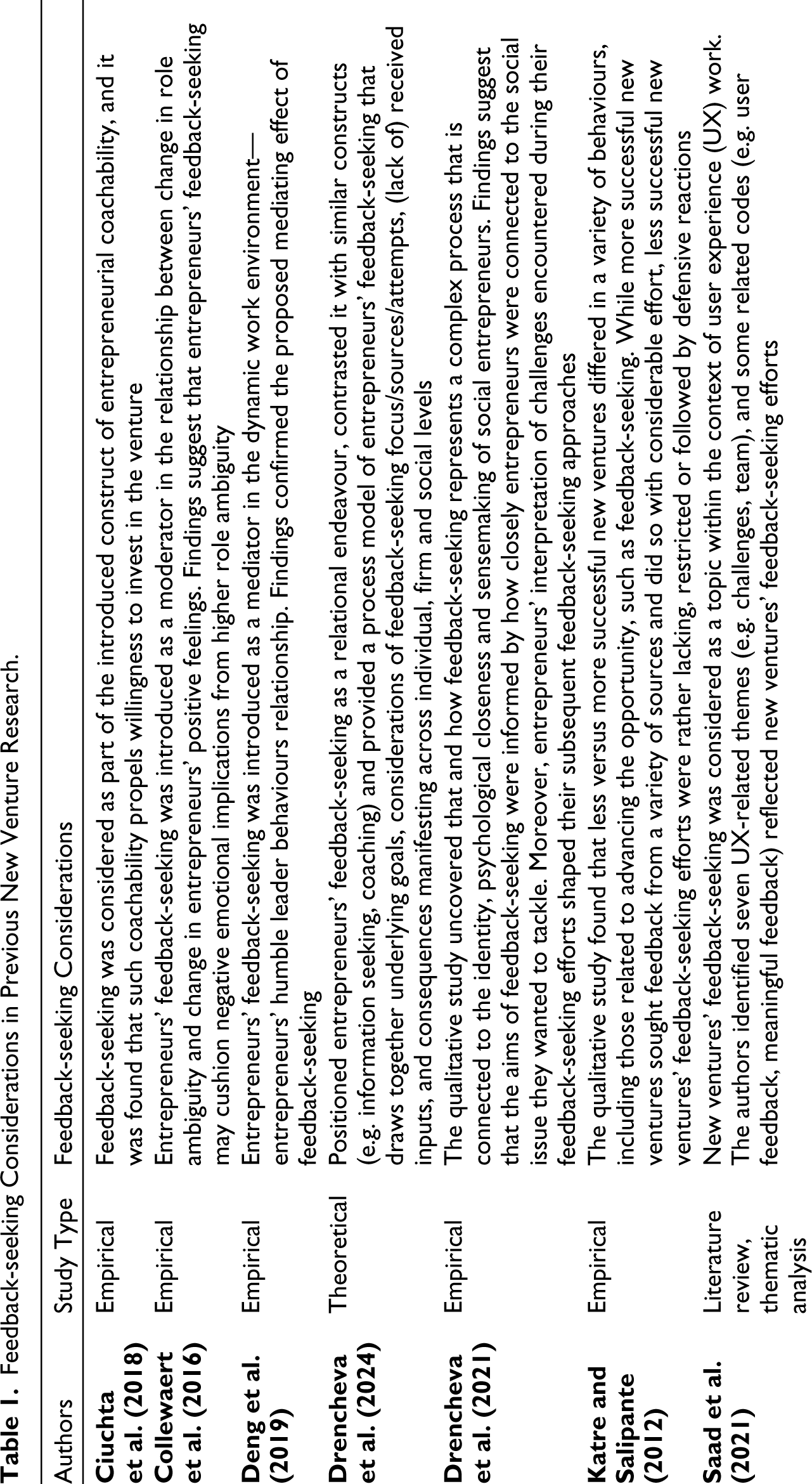
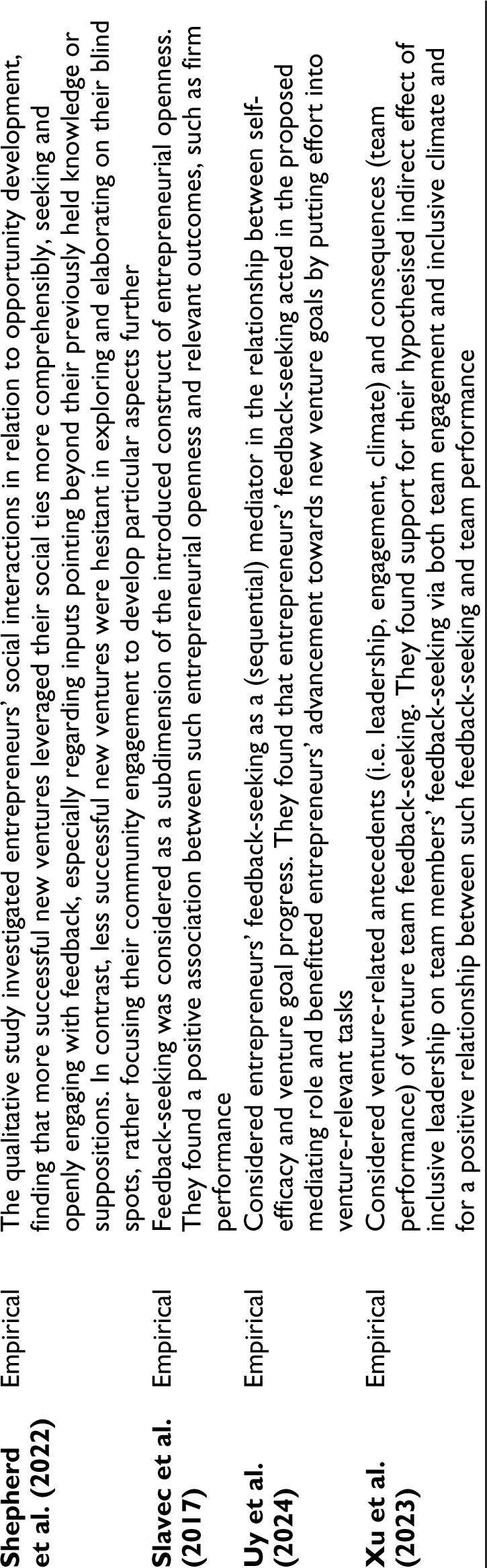
FSB is the ‘conscious devotion of effort toward determining the correctness and adequacy of behaviors for attaining valued end states’ (Ashford, 1986, p. 466). An overview of how FSB was considered in previous research in the NV context is provided in Table 1. In particular, despite its relevance for NVs, scholars have often investigated entrepreneurs’ FSB indirectly as part of other constructs, such as coachability, user experience or entrepreneurial openness (Ciuchta et al., 2018; Saad et al., 2021; Slavec et al., 2017). Only recently have scholars started to consider the FSB construct more directly within the venture context, illuminating its role for entrepreneurs. For instance, entrepreneurs’ FSB may cushion negative emotional implications from higher role ambiguity (Collewaert et al., 2016), facilitate certain entrepreneurial leadership behaviours (Deng et al., 2019) and unfold as a complex process (Drencheva et al., 2021, 2024) that may culminate into outcomes touching several levels such as the NV (Drencheva et al., 2024). For instance, Chen and Zhang (2024) found that NVs’ moderate engagement in seeking market feedback from customers benefits NVP. Further, Xu et al. (2023) found that members’ feedback-seeking within their venture team was positively associated with their team performance. Uy et al. (2024) showed that entrepreneurs’ FSB benefitted their advancement towards NVP goals through increasing effort. Two qualitative studies further suggested that more successful ventures engaged in greater efforts to seek feedback from a broader base, remaining open to diverse and revelatory, though unexpected, insights (Katre & Salipante, 2012; Shepherd et al., 2022). Based on feedback-intervention theory (Kluger & DeNisi, 1996), this study argues that SI-FSB relates positively to NVP by stimulating relevant motivation and learning processes.
Feedback-seeking Considerations in Previous New Venture Research.
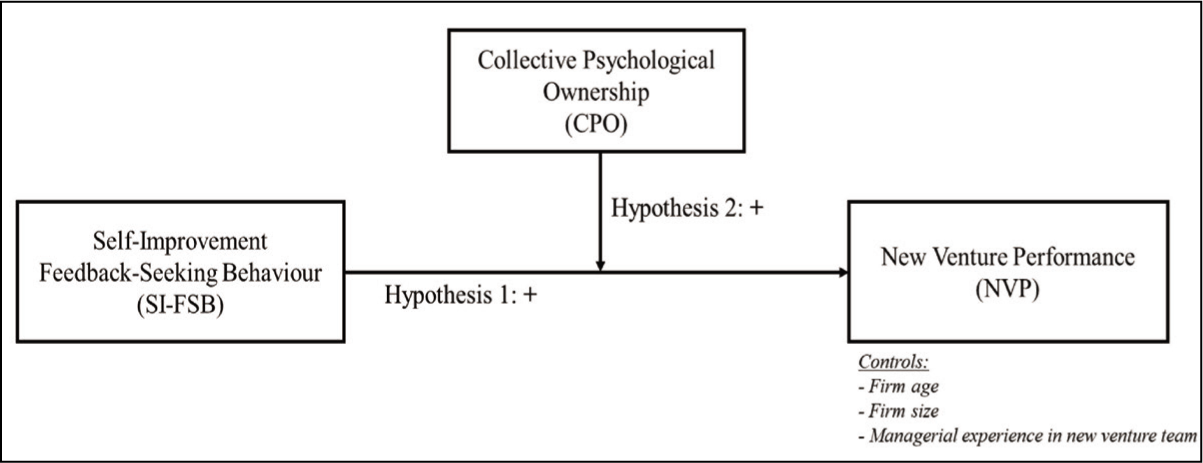
While providing benefits, SI-FSB remains costly for NVTs. On the one hand, given SI-FSB’s learning connotations (Janssen & Prins, 2007), collaboration partners could assume that NVTs seek feedback merely to signal desirable attitudes (e.g. being engaged, professional) for cultivating a positive image (Ashford et al., 2003; Drencheva et al., 2021)—a motive perception that disengages feedback sources (Minnikin et al., 2022). However, SI-FSB also exposes knowledge- and skill gaps (Janssen & Prins, 2007); thus, NVTs risk being negatively evaluated (Ashford & Cummings, 1983). Seeking it, nevertheless, may signal a real need for, and interest in, inputs—a genuine instrumental motive (Ashford et al., 2003) that can elicit high-quality feedback from sources (Minnikin et al., 2022). On the other hand, when processing such elicited feedback, entrepreneurs encounter cognitive–emotional challenges that may undermine the motivation and learning processes stimulated by SI-FSB. Entrepreneurs must make sense of critical feedback, which may or may not motivate respective learning or changes since they have to grapple with their own cognitive assertions (i.e. assumptions, attention, intentions, identity) that impact the implementation of elicited feedback (Grimes, 2018). Moreover, critical feedback can trigger intense negative emotions (Toivonen et al., 2023), which could undermine motivation (i.e. lower performance goals) (Ilies & Judge, 2005) and, further, ‘may hinder learning and development’ (Cannon & Witherspoon, 2005, p. 122). Nevertheless, insights on what renders NVTs’ FSB most effective despite such costs are limited. This study thus introduces CPO as a relevant moderator because it can help both to attenuate negative SI-FSB implications (i.e. by handling signalling costs) and to reinforce SI-FSB’s positive effects (i.e. by facilitating the instilled beneficial motivation and learning processes that otherwise may be undermined), thereby amplifying SI-FSB’s positive relation with NVP (see Figure 1 for the conceptual framework).
Conceptual Framework: Collective Psychological Ownership Moderates the Effect of Self-improvement Feedback-seeking Behaviour on New Venture Performance.
Hypotheses Development
NVTs’ SI-FSB and NVP
In their feedback intervention theory, Kluger and DeNisi (1996) proposed that if the provided feedback guides attention towards the task—specifically towards related motivation processes by outlining gaps between actual and desired performance standards (i.e. stimulating effort to catch up) or towards related learning processes (i.e. stimulating reconsideration of initial attempts if feedback provides hints about what does/not work, and why), it has the potential to improve performance. SI-FSB should allow NVTs to elicit and work from respective cues because it helps obtain diagnostic, guiding information that points out adjustment needs and what could be done to develop related abilities and skills (Janssen & Prins, 2007).
First, due to its diagnostic value, SI-FSB can provide NVTs with cues regarding where adjustment is needed (Janssen & Prins, 2007). This should direct their attention towards motivational processes, increasing effort (Kluger & DeNisi, 1996). NVTs are interwoven with NVP to the point where venture failure can follow from NVT insufficiencies (Klotz et al., 2014). Proactively seeking out adjustment needs through SI-FSB should motivate NVTs to channel their efforts, thus contributing to NVP. Since FSB can provide clarity on how well members function as a team or on scope to contribute towards joint goals (Robinson & Weldon, 1993), it offers NVTs information regarding areas in which improvement is necessary and possible. Furthermore, FSB requires resource investment, motivating seekers to act on elicited feedback (Ashford & Cummings, 1983). Bingham and Kahl (2014) also found that entrepreneurs rather acted on feedback if gaining the same from relevant sources was associated with certain costs.
Second, since SI-FSB provides cues on how to improve competencies (Janssen & Prins, 2007), it should direct attention towards learning processes, thus improving performance over time (Kluger & DeNisi, 1996). As Alexy et al. (2021) found, if feedback was challenging but also detailed, and informed of alternatives combined with urgency to act without sticking to former logic, it stimulated adaptations of ventures’ internal organising. As this shows, learning processes are key for NVs to react in anticipation or to navigate business-model development (Bingham & Kahl, 2014; McDonald & Eisenhardt, 2020). DeRue et al. (2012) elaborated that FSB is a behavioural learning process that flexibly leverages learning experiences across situations, which expectedly benefits performance. Correspondingly, team learning behaviour, including FSB, has been positively related to team performance (Edmondson, 1999; Wiese et al., 2022). Chandler and Lyon (2009) found that learning mechanisms such as seeking knowledge for problem-solving are positively related to NVP. Ashford et al. (2018) argued that FSB allows CEOs to learn, adjust and thus perform better and found that CEOs’ FSB was positively related to firm performance.
H1: SI-FSB is positively related to NVP.
The Moderating Role of CPO
Nevertheless, SI-FSB entails outlined signalling and processing costs. In this study, it is argued that NVTs with high CPO (i.e. a shared mental model and feeling that the NV is theirs; Pierce & Jussila, 2010) are better equipped to encounter such costs, amplifying SI-FSB’s relation to NVP.
First, CPO may elicit higher quality feedback by signalling instrumental motives. CPO involves responsibilities to enrich the ownership target and rights to have a say in it (Pierce & Jussila, 2010), which could convey that the NVT is interested in and equipped to improve—indicating an instrumental motive and thereby eliciting better feedback (Minnikin et al., 2022). Further, Gray et al. (2020) found that conveying psychological ownership by emphasising past investments and future aspirations signalled a leader’s high commitment to enhance the idea, rendering the idea and its devoted team meaningful and worth contributing to. Thus, NVTs’ high CPO may convey a commitment to develop the NV and, thereby, an instrumental interest that is worth the contribution of useful feedback. Moreover, giving feedback allows external actors to invest in and affect a target, which can create ownership feelings and thereby increase resource-investment willingness (Baker et al., 2021). Thus, CPO may convey an instrumental motive, engaging collaboration partners to give high-quality feedback, and thereby, sources themselves may develop a (distal) ownership sense over (parts of) the NV, stimulating them to invest resources—for instance, by providing high-quality feedback again in the future.
Second, CPO may facilitate subsequent motivation and learning processes through cognitively intertwining NVTs with the venture and helping to handle FSB-related emotions. Cognitively, CPO positions the NV as a joint psychological possession, entailing certain responsibilities and rights (Pierce & Jussila, 2010). Further, the willingness to adjust the ownership target is heightened if the change is self-initiated (Pierce et al., 2001). Thus, while CPO responsibilities may enhance NVTs’ motivation to enact feedback to nurture the NV, members’ rights can empower them to initiate joint enactment and the proactive nature of FSB (Grant & Ashford, 2008) makes the CPO target permeable to changes. Moreover, CPO should make it more likely that NVT members share their thoughts and ideas within the team (Pierce & Jussila, 2010), offering a setting to discuss whether, how and where to apply feedback. Grimes (2018) found that if founders engaged with others to make sense of received feedback, this legitimised inputs, provided learning opportunities and stimulated readjustments of psychological ownership, facilitating changes. Taken together, CPO may prompt NVTs to jointly discuss feedback, stimulating them to shape their NV, leveraging CPO as a dynamic learning resource. Further, Druskat and Pescosolido (2002) suggested that CPO augments willingness to learn to function well as a team, which requires good knowledge of how the team collaborates and to what effect. Since joint intimate knowledge regarding a target is an essential CPO precondition (Pierce & Jussila, 2010), NVTs with high CPO should have an in-depth understanding of how their venture (team) works. This could help them pin down skills, abilities or situations to which the feedback can be best applied.
Emotionally, CPO is ‘pleasure producing per se’ (Pierce & Jussila, 2010, p. 812), providing NVTs with positive emotions that, in turn, counteract negative ones (Fredrickson et al., 2000) and stimulate a more open and flexible way of understanding and acting on information (Fredrickson, 1998). Correspondingly, CPO might help NVTs bring negative SI-FSB emotions to a manageable level and use feedback creatively, enabling them to learn how to use it best. Psychological ownership also stimulates to make sacrifices for the target (Pierce et al., 2001), which may motivate NVTs to put their own interests aside and work against emotional defences to enact feedback.
H2: CPO moderates the relationship between SI-FSB and NVP in the sense that the relationship is stronger when CPO is high.
Methods
Data Collection Procedure and Sample
The data collection and sample definition procedure involved three steps (Figure 2).
Flow Chart for Data Collection and Sample Definition Procedure.
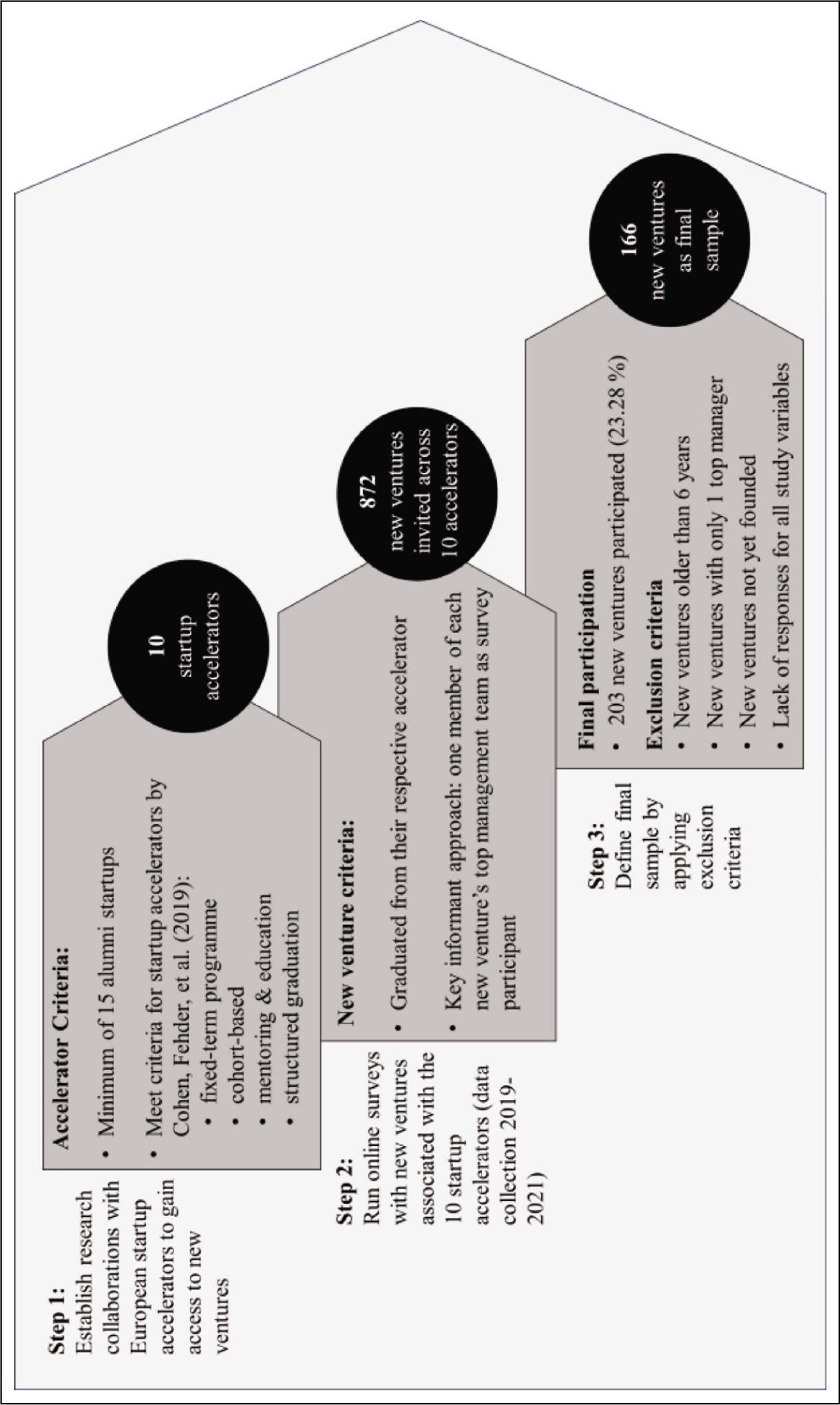
In the first step, the authors established research collaborations with 10 European start-up accelerators that fulfilled several criteria as defined by Cohen et al. (2019b): they employed fixed-term programmes (i.e. approximately two weeks up to six months), were cohort-based (i.e. one to 12 batches/classes yearly), provided mentoring and education, and allowed for structured graduation (i.e. pitching opportunities, demo-days and prize competitions). Moreover, it was checked that each accelerator had at least 15 alumni start-ups. An accelerator-specific report was provided as an incentive for accelerators’ participation.
In the second step, online surveys were conducted with the NVs that were affiliated with the 10 collaborating startup accelerators. Data were collected between November 2019 and December 2021. In this period, steps one and two of the data collection procedure overlapped (e.g. when a research collaboration with an accelerator was established, the related survey was run, while in parallel, further research collaborations were established, followed by respective data collections). With eight accelerators, the researchers conducted one survey round each. With two accelerators, two or three once-a-year surveys respectively were run to increase sample size. Participating NVs had to have graduated from their accelerator. Similar to other NV research (e.g. Hmieleski & Cole, 2022; Yu & Wang, 2021), a key informant approach was applied. One member of each NVT, as identified by the accelerators, was invited, or, if unavailable, the accelerator’s primary NV contact person was addressed to forward the invitation to the CEO. At the start, participants were informed about the research collaboration, purpose, procedure, and data usage. Participation was voluntary, and NVs were reminded two to three times. An accelerator-specific report regarding the study variables was offered to NVs, and five Swiss francs per participant were spent on climate-protection projects. Out of 872 NVs invited across the 10 accelerators, 203 participated (23.28%).
After finishing data collection, in the third step, the final sample was defined. In line with other studies (Breugst et al., 2020; Fernhaber & McDougall-Covin, 2009), NVs older than six years were excluded (n = 15). Given the study’s interest in collective ownership feelings and FSB, NVs indicating only one top manager (n = 12) were excluded, and, for comparability, NVs that were not yet founded (n = 2). Finally, eight NVs who did not provide responses for all the study variables were excluded, resulting in a final sample size of 166 NVs.
On average, the firm age was 2.70 years (SD = 1.55) and the number of employees was 11.20 (SD = 17.33). Further, 60.24% of NVs were in their early stages, and 77.71% had NVT managerial experience. NVs belonged to the sustainability, cleantech/energy, smart-city and mobility (25.30%); healthcare, life-sciences and biotech (19.87%); food (14.46%); finance-technology (9.04%); education-technology (6.63%) and other (24.70%) industries.
Measures
Dependent Variable
Private firms’ objective firm performance data are often inaccessible (Dess & Robinson, 1984), and NVs’ setting renders traditional objective measures inapplicable (Chandler & Hanks, 1993). Thus, subjective perceptions of NVP are commonly used (e.g. Anwar et al., 2023; Wang et al., 2017), often in comparison to competitors (e.g. Mueller et al., 2017; Stam & Elfring, 2008). Accordingly, based on Dess and Robinson (1984), NVP was assessed with a global perceptual item compared to competitors as ‘firms of similar sales volume in your industry and region’ (p. 268). Given the young NVs in the study’s sample, the timeframe was adapted, formulating the item as ‘For the last 12 months, compared to your competitors, where would you put your start-up in terms of overall performance?’, rated on a 5-point scale from 1 (lowest 20%) to 5 (top 20%).
As Scarpello and Campbell (1983) noted in their study of job satisfaction measures, a global single item allows respondents to take into account the elements they consider relevant regarding a construct without precluding critical aspects upfront. This might be particularly relevant regarding NVP, since entrepreneurs include various elements in their understanding of entrepreneurial success (Wach et al., 2016), and given the lack of consensus on NVP dimensions evident in the variety applied across studies (e.g. Anwar et al., 2023; Mueller et al., 2017; Stam & Elfring, 2008). Further, Dess and Robinson (1984) found significant correlations between their subjective overall performance item and objective economic measures, and subjective single-item NVP measures have been used in previous NV studies (Breugst et al., 2020; Gruber, 2007).
The validity of the used single-item measure was checked as follows. Approximately two years after the end of the study period, NV survival information was gathered by examining websites, social media and third-party information. It was coded as still active if there existed cues that the NV was still active or acquired but active (e.g. open jobs; recent social media posts, blog entries, website updates), as not active anymore if cues indicated that it had stopped operating or had been dissolved, as missing if information was inaccessible/cues were unclear. Survival information for 123 NVs was found, 105 of whom were still active, while 18 were no longer active. A t-test revealed that still-active NVs had rated their NV’s overall performance as significantly higher (M = 3.65, SD = 1.00, n = 105) than those that were no longer active (M = 2.94, SD = 1.11, n = 18) (t(121) = −2.71, p = .008).
Independent and Moderator Variables
When evaluating SI-FSB and CPO, respondents were asked to refer to their top management team according to the introduced NVT definition (Klotz et al., 2014). For SI-FSB, the 5-item scale by Janssen and Prins (2007) was adapted. For the present study, the items were related to the ‘collective NVT self’ (e.g. using ‘we’ instead of the original ‘I’). Further, the timeframe was detailed, and since collaboration partners are important resource providers for NVs (Weiblen & Chesbrough, 2015), they were specified as feedback sources (i.e. relevant business partners like pre-/proof-of-concept partners, customers, research partners and other project partners that NVs had worked with during the past 12 months). A sample item is: ‘In the last 12 months, we, the top-management team, asked our collaboration partners for feedback to learn how we can improve performing our work’ (adapted from Janssen & Prins, 2007, p. 242 1 ), answered on a 5-point scale from 1 (never) to 5 (very frequently) (α = 0.82).
For CPO, the 4-item scale by Pierce et al. (2018) was adapted so that the ‘start-up’ was the CPO target. A sample item is: ‘We (my team members and I) collectively agree that this is OUR start-up’ (adapted from Pierce et al., 2018, p. 785 2 ), answered on a 7-point scale from 1 (strongly disagree) to 7 (strongly agree) (α = 0.92). See also Appendix A regarding measures.
Control Variables
Following previous NVP research (e.g. Anwar et al., 2023; Ensley et al., 2006; Stam & Elfring, 2008; Toft-Kehler et al., 2014; West & Noel, 2009), it was controlled for firm age (i.e. number of years since foundation), firm size (i.e. natural log of number of employees), and managerial experience (i.e. dummy: 0 = no experience in NVT; 1 = experience in NVT [one or more members had previously gained managerial experience]). First, given the liability of newness and related resource limitations young firms face (Stinchcombe, 2000), firm age can affect NVP (Stam & Elfring, 2008). Second, firm size is an important determinant of NVP (Short et al., 2009). Entrepreneurs’ social ties are key to accessing resources that positively affect NVP (Jones & Jayawarna, 2010). Thus, more employees might culminate into multiple ties and resources, aiding NVP. Third, managerial experience plays an important role for NVP (Dencker & Gruber, 2015; Lee & Tsang, 2001), providing skills to act despite challenges and manage employees and business relationships (Cooper et al., 1994). Finally, a COVID-19 dummy (0 = participation 2019, before COVID-19; 1 = participation 2020/2021, during COVID-19) was included. Since this did not show any relationship with NVP in the main effect (b = −0.19, p = .471) or interaction (b = −0.25, p = .343) model, and the pattern of results did not change when including it, only results without it are presented.
Data Analysis
To investigate construct adequacy, a confirmatory factor analysis was conducted by using the package lavaan (Rosseel, 2012) in R (R Core Team, 2023). With at least three indicators per factor being recommended (Hair et al., 2013), only the multi-item scales SI-FSB and CPO were included, yielding acceptable model fit (χ2= 49.68, df = 26, p = .003, χ2/df = 1.91, Comparative Fit Index [CFI] = 0.97, Tucker Lewis Index [TLI] = 0.96, Root Mean Square Error of Approximation [RMSEA] = 0.07, Standardized Root Mean Square Residual [SRMR] = 0.05). Multicollinearity was checked by calculating variance inflation factors ranging between 1.01 and 1.09, being well below the cut-off of 10 (Hair et al., 2013).
The NVs (level one) are clustered within accelerators (level two). A null model with a random intercept only was run to calculate the intraclass correlation coefficient (ICC) as the ‘proportion of variance explained by the grouping structure’ (Heck et al., 2014, p. 8); thus, variance in NVP explained by differences between accelerators. The ICC was rather low, at 2.20%. However, even marginal ICCs can lead to issues in significance tests (i.e. biased standard errors, type I errors) (Barcikowski, 1981; Muthén & Satorra, 1995). Thus, linear mixed modelling was used, which can counter such issues, taking the clustered structure into account (Garson, 2013). Following recommendations for small sample sizes in clustered data structures (McNeish & Stapleton, 2016), restricted maximum likelihood estimation (REML) with Kenward–Roger correction was used. Since the R package lme4 (Bates et al., 2015) ‘is a well-known and widely used R package designed to fit linear as well as non-linear mixed effects models’ (Kuznetsova et al., 2017, p. 1) and allows to fit models by REML (Bates et al., 2015), the analysis was performed using lme4 (Bates et al., 2015), and the related R package lmerTest (Kuznetsova et al., 2017) for the Kenward–Roger correction. Given the study’s focus on level one (NVs), the predictors were centred within clusters (within accelerators) prior to analysis (Enders & Tofighi, 2007). To lead up to the core statistical main effect and moderation models in a stepwise manner, first, three statistical baseline models (containing control variables only, further combined with only SI-FSB and only CPO, respectively) are presented, followed by the main effect model (control variables combined with both SI-FSB and CPO) and the full moderation model (control variables combined with SI-FSB, CPO and their interaction term). After it was determined in this latter model that the interaction term was significant, the moderation effect was probed using the R package interactions (Long, 2021) and was plotted for further inspection (Memon et al., 2019).
Results
Table 2 contains descriptive statistics and correlations. Table 3 contains the models explaining NVP, comprising control variables (Model 1), respectively, combined with only SI-FSB (Model 2), only CPO (Model 3) and both CPO and SI-FSB (Model 4) to which the interaction term was added (Model 5).
Descriptive Statistics and Correlations for the Study Variables.
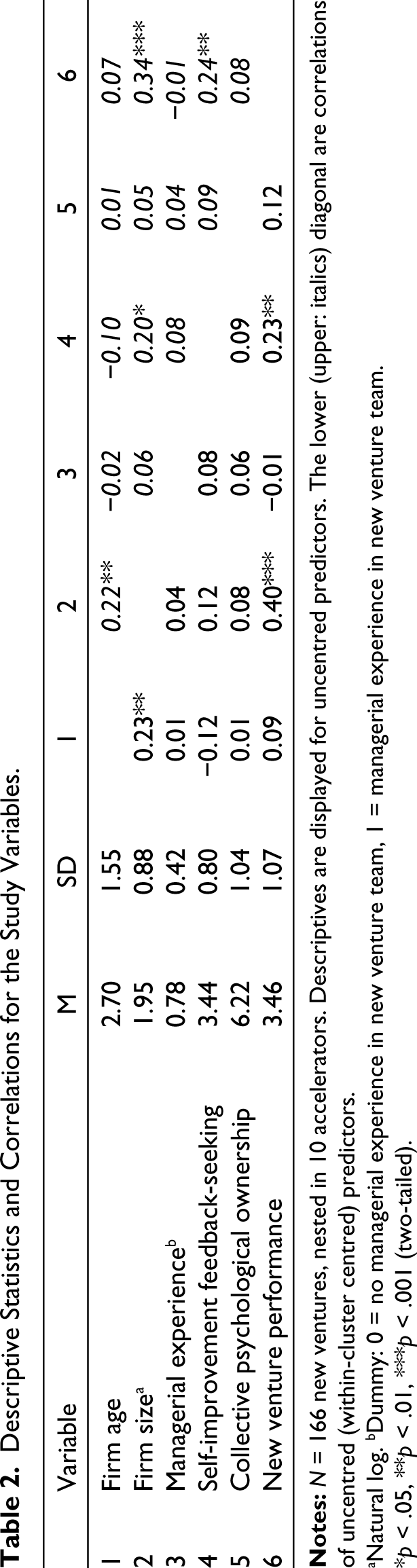
aNatural log. bDummy: 0 = no managerial experience in new venture team, 1 = managerial experience in new venture team.
*p < .05, **p < .01, ***p < .001 (two-tailed).
Linear Mixed-Effect Model for New Venture Performance.
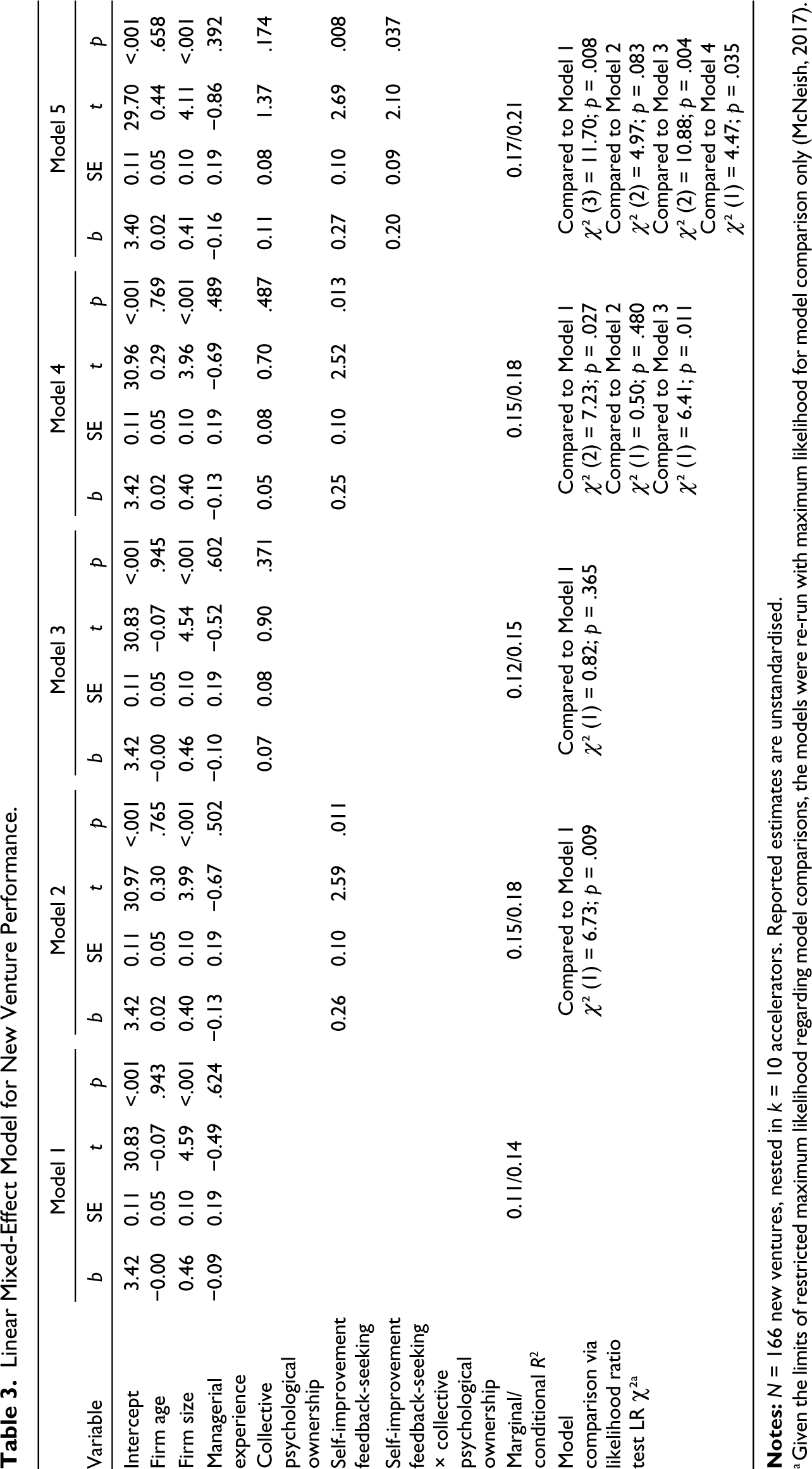
a Given the limits of restricted maximum likelihood regarding model comparisons, the models were re-run with maximum likelihood for model comparison only (McNeish, 2017).
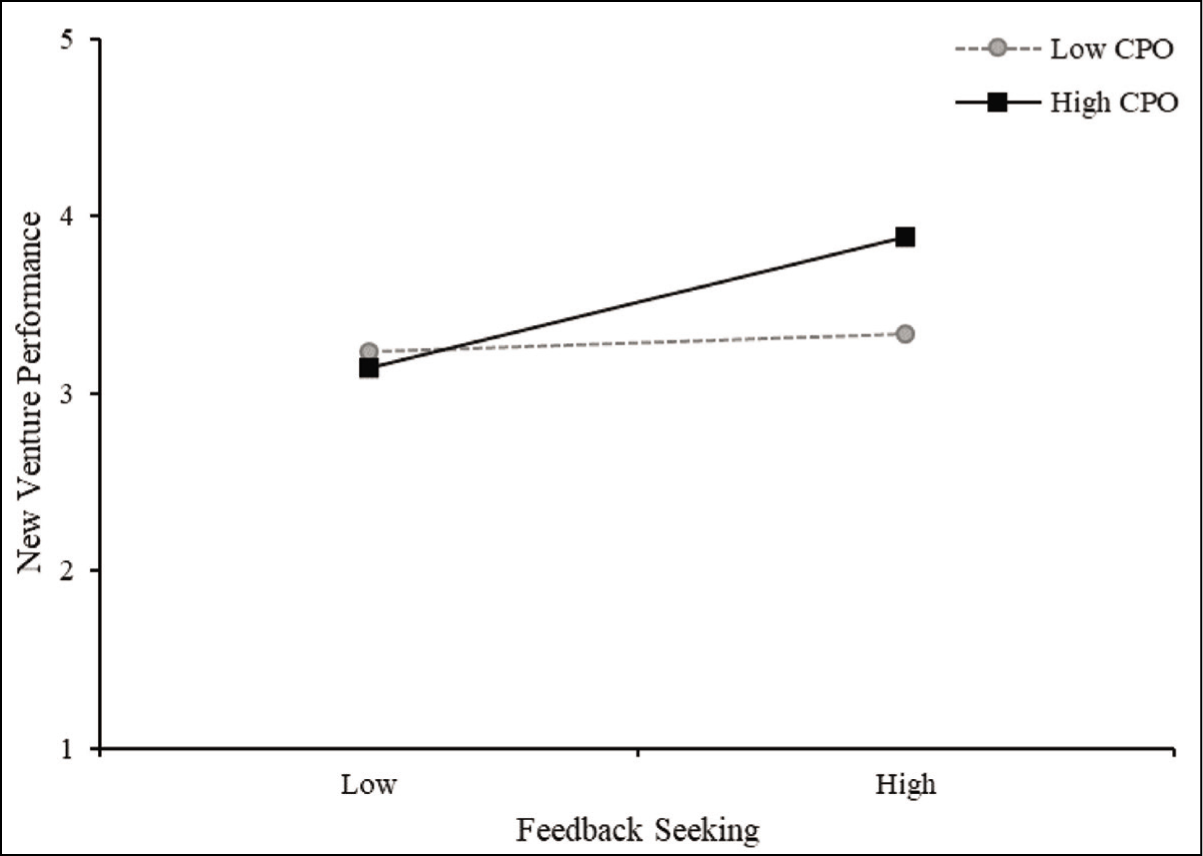
As Model 4 shows, the relationship between SI-FSB and NVP is positive and significant (b = 0.25, p = .013), supporting H1. Although not hypothesised, it is visible that the CPO–NVP relationship is not significant (b = 0.05, p = .487). Further, in line with H2, positing that the positive SI-FSB–NVP relationship is stronger when CPO is high, Model 5 shows a significant positive interaction term (b = 0.20, p = .037). To obtain more nuanced insights, the interaction was probed with the R package interactions (Long, 2021) and plotted, using low/high CPO (±1 SD = −1.01/1.01) and low/high SI-FSB (±1 SD = −0.78/0.78). As shown in Figure 3, the slope for SI-FSB on NVP is significant if the level of CPO is high (b = 0.47, p < .01), but not if it is low (b = 0.07, p = .60), further supporting H2.
Moderation of CPO (Collective Psychological Ownership) on the Effect of Self-improvement Feedback-seeking on New Venture Performance.
Discussion
Seeking self-improvement feedback is crucial for NVP but comes with signalling and processing costs, begging the question of how to best leverage such efforts. The present study, involving 166 NVs, shows that NVTs’ CPO over their venture is a valuable boundary condition that strengthens the positive SI-FSB–NVP relationship. Thereby, the study’s findings contribute to nascent FSB research in the NV context.
First, this study underlines recent insights on FSB’s beneficial role for entrepreneurial performance (Shepherd et al., 2022; Uy et al., 2024; Xu et al., 2023), as the findings indicate a positive relationship between SI-FSB and NVP. This enriches understanding of how these teams engage with their environment (Shepherd, 2015) and of learning behaviours that may help to attain entrepreneurial outcomes (Fang He et al., 2018). Second, in this study, it is acknowledged that SI-FSB remains costly for NVTs in both sending signals and processing feedback. By introducing CPO as a relevant moderator, it extends entrepreneurial research that so far has valuably illuminated FSB antecedents, consequences or FSB as a moderator itself (e.g. Collewaert et al., 2016; Deng et al., 2019; Uy et al., 2024), arguing that CPO helps to handle SI-FSB challenges and thus to maximise related benefits.
This study also extends previous research on psychological ownership’s role in the NV context. Scholars have investigated its antecedents and outcomes (e.g. Gray et al., 2020; Hong et al., 2021; Zhu et al., 2018). In contrast, in the present study, it was hypothesised that CPO acts as a moderator, and findings suggest that it strengthens the SI-FSB–NVP relationship, showing its value for NVTs as moderating resource. Although a direct CPO–NVP relationship was not hypothesised, given the study’s focus on FSB’s boundary conditions, it is interesting that it was not significant. On the one hand, this fits the introduced perspective of CPO being a moderator. The lack of a significant main effect of CPO on NVP concurs with methodological moderation analysis considerations (Baron & Kenny, 1986; Memon et al., 2019). Further, it fits the provided theoretical arguments on how CPO helps make the most out of SI-FSB efforts, which suggests a more subtle moderating rather than a direct effect of CPO on NVP. Specifically, as it is associated with responsibilities, rights and positive emotions (Pierce & Jussila, 2010), CPO can help send the right signals to feedback sources and create a manageable situation in which to enact feedback. These CPO advantages seem to be adequate for amplifying the SI-FSB–NVP relationship. Yet, they may either not be strong enough to propel NVP directly, or CPO exerts more complex effects that cannot be captured in a direct effect. For instance, Chen et al. (2023) similarly did not find any direct or total indirect effect of individuals’ job-based psychological ownership on job performance. However, they found both a positive and negative indirect pathway through nuances of territoriality (i.e. behaviours to claim, protect or enhance a target as a resource; Brown et al., 2005; Chen et al., 2023) and information sharing. Considering territoriality may thus illuminate the CPO–NVP relationship in the future, while it also resonates with the present study’s moderator-role perspective: protective territoriality as instilled by psychological ownership (Brown et al., 2005) could help NVTs to distinguish valuable from distracting elicited feedback, and thus to invest resources wisely.
On the other hand, the present study’s finding counters Gray et al. (2020) positive CPO–team performance effect. While NVs in the present study were already founded, Gray et al. (2020) studied NVTs forming and collaborating during three days in an entrepreneurial competition. In such a short-term context with performance benefits like winning prizes (Gray et al., 2020), CPO potentially aids performance directly through CPO advantages (Pierce & Jussila, 2010)—while later, regarding actual NV performance, CPO might play other performance-related roles (i.e. strengthening SI-FSB effects), or its performance-relationship may become more complex (Chen et al., 2023). Future research could investigate whether and how CPO’s role regarding NVP changes over time.
More closely in relation to feedback (seeking), this study’s findings further show that the target of psychological ownership might be relevant. While Grimes (2018) found that keeping strong psychological ownership over the NV idea following elicited feedback made entrepreneurs reluctant to implement substantial changes, the present study finds that high psychological ownership over the NV reinforces the positive effect of SI-FSB on NVP. This might be because the NV is a broader target than an idea, incorporating the team, idea, prototypes, relationships and physical location. This might allow NVTs to adapt some parts after elicited feedback while keeping others—thus not threatening but enhancing the target. Moreover, Grimes (2018) focused on founders’ individual ownership, while this study focused on NVTs’ collective feelings. Compared to individual psychological ownership, CPO additionally satisfies the need to be understood as part of the group that psychologically possesses the target (Pierce & Jussila, 2010). To maintain membership in that NVT, the NV itself needs to be retained, which may help overcome resistance to elicited feedback. Future research might incorporate multiple psychological ownership levels and targets into a single feedback-related NV study.
Practical Implications
This study’s findings suggest that seeking self-improvement feedback from collaboration partners is beneficial for NVP. Thus, NVTs may be encouraged to leverage relationships with collaboration partners frequently for SI-FSB. Complementary, while accelerators may already promote FSB through mentoring (Cohen et al., 2019a), they could train NVTs to seek feedback from their collaboration partners as well.
The present insights further suggest that high CPO over their NV can help NVTs get the most out of their SI-FSB efforts. NVTs may thus benefit from developing and retaining a strong CPO over their NV. CPO emerges from conjoint deep knowledge of the NV as well as joint control, effort (Pierce & Jussila, 2010) and creation (Yttermyr & Wennberg, 2022). By leveraging their educational function (Cohen et al., 2019b), accelerators may sensitise NVTs regarding CPO’s benefits and ways to develop it.
Limitations and Future Research
This study has certain limitations. First, causal conclusions cannot be drawn because this survey study employs a cross-sectional design. Future research may leverage experiments or longitudinal designs to underline the findings. An entrepreneurial business game (Biga-Diambeidou et al., 2021) could be used with manipulations of SI-FSB and CPO. Further, NVTs could be surveyed repeatedly in an incubator to capture SI-FSB and its relations to performance over time, combined with CPO interventions.
Second, subjective perceptions of NVP were captured, which could result in overestimations of performance (Meier & O’Toole, 2013). Further, if the same source that rated performance also rates other constructs, this might induce common source bias, in which case a relationship may be significant regarding subjective—but weaker or non-existent regarding objective-performance (Meier & O’Toole, 2013). However, gaining such objective, comparable financial performance data is a persisting difficulty in the NV context, as related information is rarely publicly available (Anwar et al., 2023; Chandler & Hanks, 1993; Wang et al., 2017). To inspect the accuracy of the gained subjective NVP ratings, nevertheless, it was checked if they resonate with another objective performance indicator, namely firm survival—showing that surviving NVs had rated their NVP significantly higher than non-surviving NVs. Still, future research may aim to access externally developed databases to obtain objective data on NVs’ return on assets/sales or revenue growth (Ensley et al., 2006; Souitaris & Maestro, 2010). Alternatively, they may measure the predictor and outcome variables via different sources (Podsakoff et al., 2012): by situating a study within a single programmme, programme judges could rate NVP indicators such as business plans (e.g. de Mol et al., 2020).
Third, the sample includes only the NVs that had participated in one of the 10 recruited European accelerators. This neglects NVs who were not able to succeed early on (i.e. survival bias), leaving open if the found relationships also hold for struggling NVs. Further, accelerators might have selected NVs with promising performance prospects that might already be somewhat savvy in leveraging FSB, potentially playing into the SI-FSB–NVP link. The generalisability of the findings could be tested with early-stage non-accelerated startups. Moreover, the European-centric approach in this study may raise questions of geographical generalisability. Given the identified positive FSB–firm performance link in an American–European sample (Ashford et al., 2018) and FSB’s benefits for entrepreneurial performance in the Asian context (Uy et al., 2024; Xu et al., 2023), it is expected that the found FSB–NVP link holds across contexts. However, the moderating role of CPO may be even stronger in the East. Collectivism associated with Eastern countries (Minkov et al., 2017) may render CPO-instilled, group-oriented aspects of processing feedback internally stronger and/or the CPO cues more salient to feedback sources. Research could test this in geographically broader NV samples.
Fourth, while this study focused on the relation between SI-FSB and NVP to introduce CPO as a moderator, underlying mediators (e.g. NVTs’ actual feedback-quality perceptions and their subsequent activities like experimenting) could be investigated. Distinct types of conflict (Jehn, 1995) may play different moderating roles in such mediation.
Conclusion
NVs are often encouraged to seek feedback. In line, entrepreneurship studies explicated FSB benefits (Collewaert et al., 2016; Shepherd et al., 2022; Xu et al., 2023). On the one hand, the present study concurs with this beneficial FSB view and finds a positive association with NVP. On the other hand, this study acknowledges that FSB comes with external and internal costs for NVTs. This resonates with recent entrepreneur- ship research that complements the beneficial view on FSB with a perspective on FSB costs and challenges arising for entrepreneurs (Drencheva et al., 2021, 2024). Such a perspective begs the question of what boundary condition may help NVTs leverage the value and bear the costs of FSB to render their SI-FSB efforts effective for NVP. Offering related answers seems especially relevant since FSB is resource-intense (Drencheva et al., 2021), while NVs’ resources are limited (Freeman & Engel, 2007). The present study introduces CPO as a valuable NVT-internal condition that can help them deal with FSB-associated costs while facilitating its beneficial effects, showing that it strengthens the positive relationship between SI-FSB and NVP. Thereby, it augments understanding of FSB as important NVT behaviour and hopes to inspire further research on core boundary conditions.
Footnotes
Declaration of Conflicting Interests
The authors declared no potential conflicts of interest with respect to the research, authorship and/or publication of this article.
Funding
The authors received no financial support for the research, authorship and/or publication of this article.
Appendix A
‘For the last 12 months, compared to your competitors, where would you put your start-up in terms of overall performance?’ Rating: from 1 (lowest 20%) to 5 (top 20%). ), and new venture performance was assessed with a single global perceptual item in comparison to competitors, with a specified timeframe (i.e. last 12 months), formulating the item as:
‘In the last 12 months, we, the top-management team, asked our collaboration partners for feedback to learn how we can improve performing our work’ (adapted from Janssen & Prins, 2007, p. 242
1
). Rating: from 1 (never) to 5 (very frequently).) was adapted. Specifically, the items were adapted to capture the collective level (i.e. the top management team, using ‘we’ instead of the original ‘I’), the timeframe as also specified in the dependent variable (i.e. the last 12 months), and collaboration partners as a feedback source. A sample item is:
‘We (my team members and I) collectively agree that this is OUR start-up’ (adapted from Pierce et al., 2018, p. 785
2
). Rating: from 1 (strongly disagree) to 7 (strongly agree)) was adapted. Specifically, the ‘start-up’ was specified as the target of collective psychological ownership. A sample item is: