



Abstract
The purpose of this research article is to explore the determinants of entrepreneurial behaviour among university students in the Kurdistan Region of Iraq. The study uses a novel approach of fuzzy-set qualitative comparative analysis (fsQCA) to depart from traditional assumptions that causal mechanisms apply equally to all individuals within a group. The study examines how shared characteristics may influence entrepreneurial behaviour. The study contributes to the theory of planned behaviour (TPB) literature by identifying different configurations of factors that lead to entrepreneurial behaviour. The study finds that these configurations vary depending on the student’s gender, personal valuation of entrepreneurship, self-evaluation, and perceived support from their environment. These findings suggest that the context in which students are situated plays a crucial role in shaping their entrepreneurial behaviour, highlighting the importance of considering within-sample variations when studying entrepreneurial intentions. This research article uses a novel approach, fsQCA, to explore the factors that influence entrepreneurial behaviour. It departs from traditional assumptions that the same causal mechanisms apply to all individuals within a group, and instead examines how shared characteristics may influence entrepreneurial behaviour.
Keywords
The study of entrepreneurship has gained significant attention in recent years due to its perceived role in driving economic growth (Baumol, 1993; Lumpkin & Dess, 1996; Reynolds, 1999) and performance through job creation, innovation, and productivity (van Praag & Versloot, 2007). Scholars have employed various frameworks, such as the theory of planned behaviour (TPB) to predict entrepreneurial behaviour (Ajzen, 1991; Fishbein & Ajzen, 1975). These frameworks posit that entrepreneurial intention (EI) is a key antecedent to actual entrepreneurial behaviour (Krueger & Carsrud, 1993). Despite this, there have been only a few studies that have tested the full TPB model by examining both intentions and behaviour (Kautonen et al., 2013). This research aims to investigate the causal patterns that explain entrepreneurial behaviour based on the TPB model (e.g., Kautonen et al., 2013, 2015).
This study investigates the multifaceted nature of entrepreneurial behaviour among university students, particularly in the complex context of the Kurdistan Region of Iraq. Traditional quantitative approaches, such as linear regression and structural equation modelling, have limitations in addressing the intricate and interdependent factors influencing entrepreneurial behaviour, often leading to prediction inaccuracies (Kumar et al., 2022; Pappas & Woodside, 2021). By adopting a fuzzy-set qualitative comparative analysis (fsQCA), this study transcends these limitations, enabling a deeper exploration of entrepreneurial behaviour in a transitioning economy. The fsQCA approach acknowledges the heterogeneity within a homogeneous group, such as university students, and accommodates the unique dynamics of transitional economies. This methodological shift is pivotal in understanding the different causal conditions and configurations that foster entrepreneurial behaviour, considering the diverse subgroups of students and the complexity of their contextual environment.
The use of fsQCA in entrepreneurship research, as evidenced in the works of Patrício and Ferreira (2023), Huang et al. (2023) and Zhang et al. (2022) showcases its wide applicability across various entrepreneurial contexts. These researchers have applied fsQCA to explore innovation in higher education, e-commerce opportunities in rural China, the role of personality and motivation in academic entrepreneurship and factors influencing green EIs among students. Additionally, Douglas et al.’s (2020) contribution in using fsQCA highlights its ability to capture the complex, asymmetric nature of entrepreneurial behaviour, which is often oversimplified by traditional correlational methods. Together, these studies underline fsQCA’s capacity to provide a more nuanced, comprehensive understanding of entrepreneurship, paving the way for innovative theoretical and practical insights in the field.
This study, therefore, employs a fsQCA to explore the following research questions:
How do various configurations of individual and contextual factors influence entrepreneurial behaviour among university students in the Kurdistan Region of Iraq? In what ways do the interactions of these factors differ across student subgroups within this transitioning economy? How does the application of fsQCA provide deeper insights into entrepreneurial behaviour compared to traditional quantitative methods?
The article is organised as follows: the next section provides the theoretical background and explains why it is important to account for heterogeneity in the population. Section three delves further into explaining EIs and entrepreneurial activity in a transition economy from a configuration perspective. In section four, the QCA and fuzzy set QCA methods are introduced and their application in entrepreneurship research is examined. The dataset, consisting of a two-wave survey of final-year university students in three cities in the Kurdistan Region of Iraq is described in section five The results of the QCA analysis are reported in section six, and the findings are discussed and concluded in section seven.
Entrepreneurial Behaviour and the Theory of Planned Behaviour (TPB)
What makes people engage in entrepreneurial activities? Academic research documents various theories explaining the reasons why people opt for entrepreneurship and the factors that drive behaviours. Entrepreneurship scholars have developed theories that have their roots in economics, psychology, anthropology and sociology to explain entrepreneurial behaviour (Simpeh, 2011).
Building on Bygrave and Hofer (1992) and other studies, entrepreneurial behaviour can be considered as a kind of planned behaviour that is preceded by EI (Bird, 1988; Kolvereid, 1996). 1 In this line of reasoning, the development of EI may lead to an evaluation of (the opportunity costs of) entrepreneurial options and as such form a key condition for explaining entrepreneurial behaviour (Krueger et al., 2000). So, what determines EI? From the social-psychological perspective, the TPB (Ajzen, 1991) is one of the most widely adopted behavioural theories, and it provides a useful framework for understanding EIs and behaviour (Krueger et al., 2000).
The TPB was first developed by Ajzen (1991). This theory proposes three main factors that determine an individual’s intention towards a specific type of behaviour. These factors are beliefs about the advantages and disadvantages of performing the behaviour (attitudes towards behaviour), perceived social pressure to perform—or not perform—the behaviour (subjective norms [SN]), and individual perceptions of being able or capable of performing the behaviour (perceived behavioural control [PCB]). The TPB further proposes that the type of behaviour under study is a function of intention and PCB. Hence intention enables a link between the three above-mentioned conditional factors (entrepreneurial attitude [EA], SN and PCB) and subsequent behaviour. Thus, in the TPB, the behaviour is directly predicted by intention and PCB.
Studies have suggested that demographic factors such as age, gender and socio-economic background are important when it comes to explaining entrepreneurial behaviour (Misra & Kumar, 2000). In this article, the traditional TPB conditions (EA, SN, PCB and EI) are included, along with other relevant demographic conditions, to elucidate the causal link between these conditions and entrepreneurial behaviour.
The existing literature on gender and entrepreneurial behaviour suggests that women tend to have a lower preference for entrepreneurship than their male counterparts (Blanchflower et al., 2001; Schwarz et al., 2009). Ferri et al. (2018) argue that this preference is not due to a greater capacity of one compared to the other but rather to the difficulties and barriers that women often meet in their entrepreneurial activity. Furthermore, the result of the longitudinal study of students carried out by Joensuu et al. (2013) shows that women have lower intentions to start a business, and their EIs decrease during their studies. Different factors influence the participation of women in entrepreneurship, however, ‘the gender differences in entrepreneurship are not directly dependent on women’s characteristics but are related to the contexts in which the entrepreneur operates’ (De Vita et al., 2014).
Further, evidence from entrepreneurship literature has suggested a relationship between family background and entrepreneurial behaviours. Several studies have highlighted that individuals whose parents were either self-employed or business owners are more likely than others to become entrepreneurs (Dunn & Holtz-Eakin, 2000; Krueger, 1993; Matthews & Moser, 1996). Joseph (2017) argues that families with a business background encourage and motivate other family members to be involved in entrepreneurial activities. Nonetheless, the importance of self-employed parents may vary with the phase in the entrepreneurial process (Verheul et al., 2012).
Explaining Entrepreneurial Behaviour from a Configuration Perspective
Even though a wealth of empirical studies, mainly in developed economies, have shown the validity of the TPB framework for explaining EI and activity (Kautonen et al., 2013), questions can be raised about the assumed simplicity of linear relationships. Indeed, in a transition economy like the Kurdistan Region, more complex relations can be argued for. Hence, it is necessary to understand entrepreneurial activity from a more complex perspective, for instance, by assessing the different conjunctions of conditions (configurations) that make the outcome possible. A multivariate analysis configuration was used in the previous entrepreneurship research whereby each variable in the model independently explains the variation instead of combinations of variables that lead to various outcomes (Wach & Wojciechowski, 2016). Besides, predicting factors that shape entrepreneurial behaviour is somewhat complex, as the process of entrepreneurship is characterised by a complex interaction of various elements in time. Added to that, the nature of transition economies introduces more complexity to entrepreneurship. Therefore, to better understand entrepreneurial behaviour in such a complex environment, this article argues that a more complex analysis is required.
Unlike conventional statistical methods, which are based on linear algebra, qualitative comparative analysis (QCA) depends on Boolean algebra, which allows much more complex logical statements to be analysed. Hence, even though the TPB framework was adopted as a point of departure, the study relaxed the restrictive linear assumptions and introduced a configuration approach. Causal determinants of students’ entrepreneurial behaviour were identified, contingent on shared characteristics, using a Fuzzy-set QCA (fsQCA) approach. In contrast to regression analyses, QCA focuses on a combination of conditions (variables) where all conditions are considered jointly (meaning that control variables are entered along with independent variables in the analysis). Drawing on this conceptual framework (see Figure 1), the investigation explored how different causal conditions from both the TPB components and demographic characteristics combined to explain entrepreneurial behaviour in transition economies.
Explaining Entrepreneurial Behaviour from a Configuration’s Perspective: A Conceptual Framework.
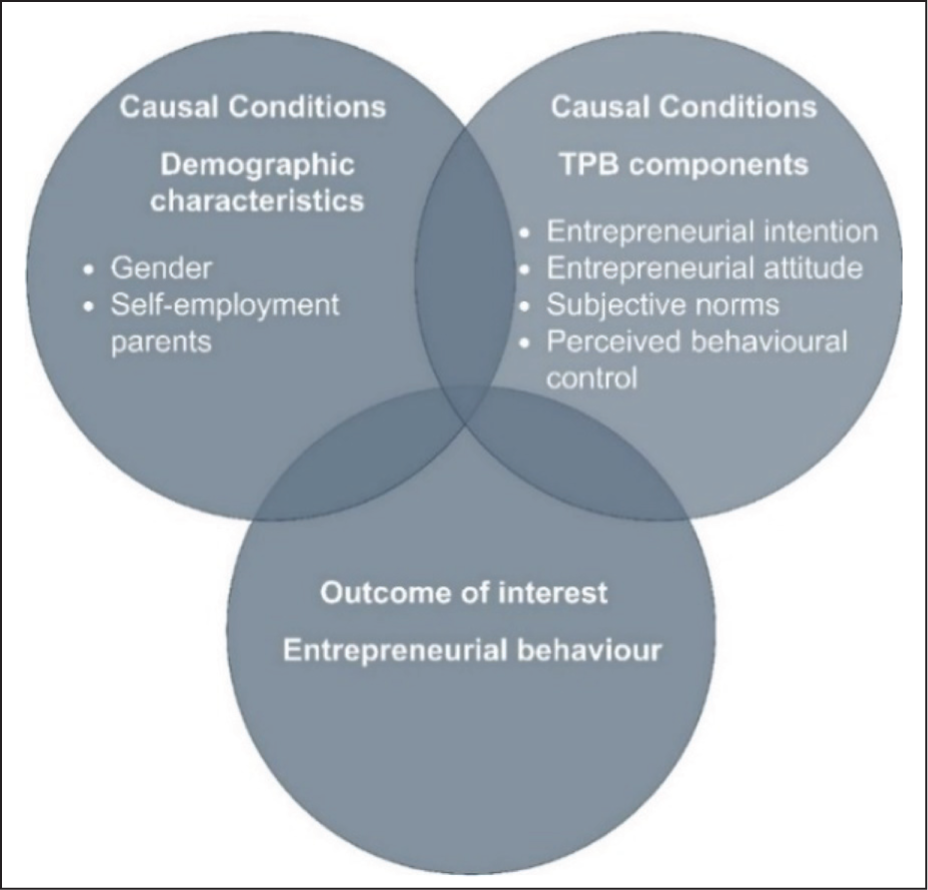
The TPB posits that beliefs about attitude, control and norms cause intention, and that intention functions as a mediating variable between these beliefs and behaviour. From a complex causality perspective, one might further explore the link between TPB components and behaviour and consider different forms of causality.
The traditional approach to studying entrepreneurial behaviour (in this case using the TPB), would be to include variables such as EI and perceived behaviour control along with other control variables in the statistical analysis, and the final net effect will identify the causal effect of the explanatory variables on the outcome. Thus, in contrast to most traditional statistical approaches which are based on the assumption of casual symmetry, QCA does not assume casual symmetry (Ragin, 2008). This means that if the presence of a particular (combination of) causal conditions is relevant for the outcome of interest, its absence is not necessarily relevant for the absence of the same outcome.
The EI could be a necessary yet not sufficient condition for behaviour. That is, students would engage in entrepreneurial behaviour only in situations where they demonstrate an EI . However, other characteristics are also of key importance, and there may thus be students with a high level of EI that does not translate into entrepreneurial action. In addition, a situation could occur where EI serves as a sufficient yet not necessary condition for entrepreneurial behaviour. Here, students may be seen to engage in entrepreneurial behaviour whenever they exhibit EI, but at the same time, there may be students who are engaged in entrepreneurial behaviour even though they did not report any intention to do so.
Another form of causality could be that EI is part of a sufficient combination of conditions without being sufficient or necessary by itself. For example, EI could sufficiently explain entrepreneurial behaviour engagement in conjunction with other factors such as high EAs. This would imply that EI and EAs do not function independently, which is called the ‘INUS condition’ in the QCA language (Mackie, 1965). Finally, EI could serve as a necessary and sufficient condition for entrepreneurial behaviour. In the case of students with EIs, they are consistently found to be engaged in entrepreneurial behaviour. Simultaneously, the occurrence of entrepreneurial behaviour without EI would be inconceivable.
Methods
Qualitative Comparative Analysis (QCA)
The present study employs a QCA approach to systematically examine similarities and differences among the cases under study. Developed by American social scientist Ragin (1987), QCA is a theory-based methodology that combines elements of both qualitative and quantitative research, allowing for an in-depth examination of complex causal relationships. Over the years, QCA has been modified, extended and improved (Ragin, 2000, 2003, 2006a, 2006b; Ragin & Sonnett, 2005), and has been applied in various fields of research.
QCA allows us to test the connections and complexities between the selected independent variables and the observed outcome using set theory and Boolean logic (Fiss, 2007). This approach allows us to identify the necessary and/or sufficient conditions for the outcome, making it an ideal choice for studying the complex and nuanced phenomena of entrepreneurial behaviour. Furthermore, the QCA technique allows us to combine the best features of both qualitative and quantitative methods, providing a comprehensive understanding of the research question at hand (Rihoux & Ragin, 2009).
Qualitative Comparative Approach in Entrepreneurship Research
The QCA method has been widely used in disciplines such as political science and sociology to understand complex causality and association sociology (Rihoux et al., 2013). However, it is an emerging method in the field of entrepreneurship research. Scholars in this field are interested in using QCA to study the complex nature of entrepreneurship. Despite its growing popularity, the application of QCA in the context of the TPB model in entrepreneurship has not yet been fully explored. One example of QCA being applied in entrepreneurship research is a study by Devece et al. (2016), which used a fuzzy-set version of QCA (fsQCA) to identify the essential characteristics and drivers of entrepreneurship that increase the probability of success for new ventures. The study analysed data from two moments in Spain’s economic cycle (the 2008 economic crisis and the economic boom prior to the recession) and found that opportunity recognition is a key success factor during economic downturns, while necessity-driven entrepreneurs may be less effective during such times.
In a study by Xu et al. (2022), crisp-set qualitative comparative analysis (csQCA) was employed to investigate entrepreneurial decision-making logic among a sample of 300 Chinese entrepreneurs. The methodology facilitated the exploration of key factors such as environmental uncertainty, entrepreneurial experience, organisational slack, and centralisation of decision-making in influencing effectuation or causation logic.
Beynon et al. (2020) applied fsQCA to examine total entrepreneurial activity (TEA) and EI in sub-Saharan African regions. The study identified diverse drivers for entrepreneurial activities across different regions, emphasising the importance of broader research coverage and longitudinal studies.
Ferreira and Dionísio (2018) investigated the link between entrepreneurial behaviour and entrepreneurship rates over time. Using qualitative comparative analysis and global entrepreneurship monitor data, the study emphasises the role of both macroeconomic and behavioural factors. The findings, derived from fsQCA, highlight the significance of EIs and positive perceptions about opportunities and capabilities in influencing higher entrepreneurship rates. This research provides nuanced insights into the complex relationship between entrepreneurial behaviour and entrepreneurship rates over time.
In a recent article, Heredia-Portillo and Armas-Arévalos (2023) applied fsQCA to investigate the impact of dynamic capabilities and a global mindset among managers on international opportunity recognition (IOR) in 21 Mexican IT companies. The study underscores the significance of seizing capability and identifies three causal paths to IOR, with seizing and networking consistently emerging as significant factors. Notably, the research highlights the asymmetric causality of IOR and advocates for the promotion of managers’ IOR through the development of dynamic capabilities, self-efficacy, and a global mindset. The findings suggest that policymakers should consider supporting programmes targeting these specific attributes. Despite a smaller sample size, this research contributes valuable insights to the existing literature on manager-level factors influencing IOR.
Another study by Kuckertz et al. (2016) used a configurational approach, specifically, fsQCA, to explore how policymakers might design specific components of economic freedom to most effectively encourage high levels of entrepreneurial activity. The study found that four specific elements of economic freedom are necessary to explain entrepreneurial activity. Kuckertz et al. (2015) used a configurational approach in their study to explore the complex phenomenon of entrepreneurial activity in innovation-driven economies and suggested that this approach is most appropriate for future cross-cultural comparisons in entrepreneurship research. The study identified various necessity-driven entrepreneurship (NDE) and opportunity-driven entrepreneurship (ODE) and proposed a role model for policymakers to secure a high proportion of ODE in a particular economy. Finally, Ye (2017) applied QCA as a viable method for new venture emergence, stating that a simple contingency approach is not sufficient in entrepreneurship research, as venture creation faces multiple contingencies such as the entrepreneur, the opportunity, the context, the process and the outcome, with significant inter-dependence among these contingencies. The study contributed to both theory building and methodology by applying the QCA method to the TPB in the context of entrepreneurship, considering the configurational view that goes beyond the conventional correlational view.
Data
Sample
This research employs a longitudinal design, utilising data collected from a two-wave survey of final-year university students in the Kurdistan Region of Iraq. The initial data collection occurred in 2015, gathering information on students’ attitudes, PCB, social norms, intentions and demographic characteristics from students in the cities of Erbil, Duhok and Sulaymaniyah. Follow-up data on entrepreneurial behaviour post-graduation was collected in 2016, resulting in a final sample size of 111 participants.
Measures
Measures were adopted from key existing studies on EIs and behaviour 2 . Different questions with a seven-point Likert scale were used to measure the variables of the TPB.
The outcome of ‘Entrepreneurial Behaviour’ was addressed at different levels identified by Zwan et al. (2010). Thus, instead of treating the outcome as a binary occupational choice variable, the behaviour was measured by four different engagement levels. According to Kautonen et al. (2013) ‘Operationalizing entrepreneurial behaviour in terms of different engagement levels is in line with the TPB, where behaviour refers to making an effort to start a business rather than achieving the outcome of having started a business’. Hence the outcome is measured using four questions reflecting the effort to carry out an entrepreneurial behaviour, such as, (a) graduates who have not thought about starting a business (not considered starting a business), (b) graduates who thought about it but have not taken action (thinking about it), (c) graduates who have not started a business but have commenced preparations and intend to start up in the near future (taking steps) and finally, (d) graduates who started their business (entrepreneurial behaviour).
The empirical analysis is conducted over six conditions; four conditions from the TPB framework (EA, PCB, SNs and EI) and two demographic conditions (gender and family business background).
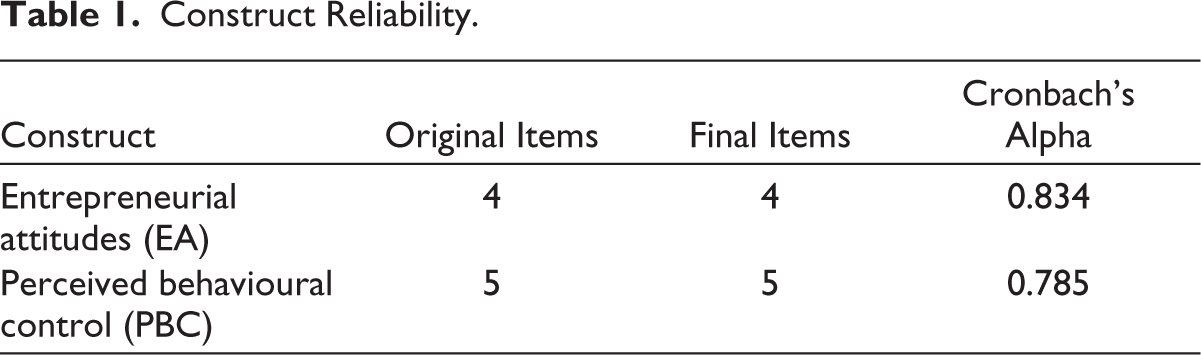
EAs are measured by self-reported items based on four questions on a seven-point Likert scale ranging from 1 (strongly disagree) to 7 (strongly agree). PBC is measured as a composite factor that summarises the perceived availability of five questions scaled from 1 (Strongly disagree) to 7 (Strongly agree). To combine multiple questions into one scale that measures EA and PBC, first, Cronbach’s alpha for all constructs was checked. Table 1 shows that Cronbach’s alpha for both EA and PBC items was higher than 0.70 at (0.834 and 0.785, respectively), which revealed an acceptable level of internal consistency among all items of the scale.
Construct Reliability.
SN was measured by four items; two questions on a seven-point Likert scale ranging from 1 (very negative) to 7 (very positive) dealt with the perceived response of people (parents/other family members and friends/fellow students) around them if they undertake an entrepreneurial activity. Two additional questions captured to what extent students care about these reactions, ranging from 1 (not at all) to 7 (very much). These four items were combined into a single factor defined as a measure of SN. This was achieved by weighing the responses of strong ties in the students’ networks according to the extent to which students care about these reactions. The sum of the weighted items resulted in a new composite variable labelled as SN. The measurement of demographic conditions was conducted as follows: the gender of the respondents equalled 1 for males and 0 for females, while the parents’ business background equalled 1 if one or both of the parents are self-employed, and 0 if neither of the parents is self-employed.
Results
Calibration
Set calibration is the initial step of fsQCA; this process consists of transforming the original data into set membership scores, with a value range of 0–1 (i.e., transforming the original Likert scores into fuzzy-set scores) (Ragin, 2008). The direct method of calibration developed by Ragin (2008) was employed, utilising three qualitative anchors to structure the calibration process, which determines the level at which a case belongs to a set. For the calibration of PBC and EA, three qualitative anchors were defined (1.0 = full membership, 0 = full non-membership, and 0.5 = the crossover point or the point of maximum ambiguity). Standard practices were adopted, setting the first anchor for full membership at value 7, the threshold for full non-membership at value 1, and the value for the crossover point at value 4 for both PBC and EA. The calibration process for SN was less straightforward. As previously explained, the item measuring SN values ranged from 2 to 98. However, using 32 as a middle score instead of 49 was considered logical, as any score above 32 indicated a positive SN, while any score below 32 contributed to a negative SN. Consequently, the first anchor for full membership was set at a value of 98, the threshold for full non-membership at a value of 2, and the value for the crossover point at a value of 32.
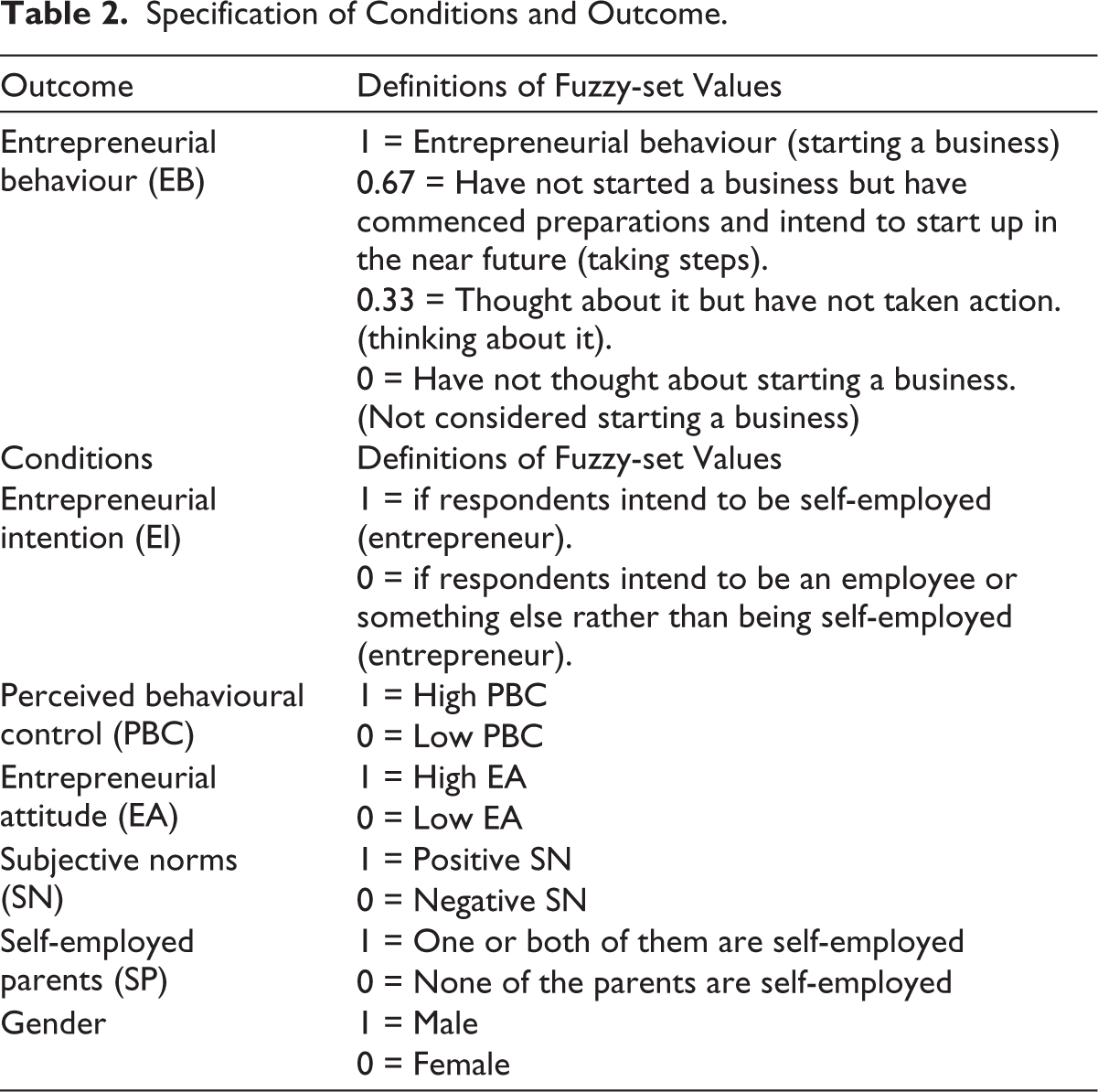
Following Ragin’s (2008) recommendation to avoid, if possible, using the 0.5 membership score and to ensure that no cases are dropped from the fuzzy set analyses, a constant of 0.001 was added to conditions below a full membership score, in accordance with recommendations from the literature (Fiss, 2011). The outcome of interest is EB, which measures the degree of membership in the set of cases with entrepreneurial behaviour. Four qualitative anchors have been set to define the membership in a set. The four numerical values were 0 (fully out of the set—no entrepreneurial behaviour), 0.33 (more out than in—thinking about it), 0.67 (more in than out—taking steps) and 1.0 (fully in the set—entrepreneurial behaviour). Finally, the demographic conditions were dichotomous by nature; thus, no calibration is necessary in this case. The gender condition takes a value of 1 for males and 0 for females, and parents’ business background has a value of 1 if one or both of the parents are self-employed, and 0 if none of the parents is self-employed. Table 2 provides a specification of the outcome and conditions.
Specification of Conditions and Outcome.
Necessary Causal Conditions
Once all of the conditions are calibrated, the next step is to address which conditions (or combinations of them) are necessary and/or sufficient to produce an outcome of interest using two goodness-of-fit measures, consistency and coverage.
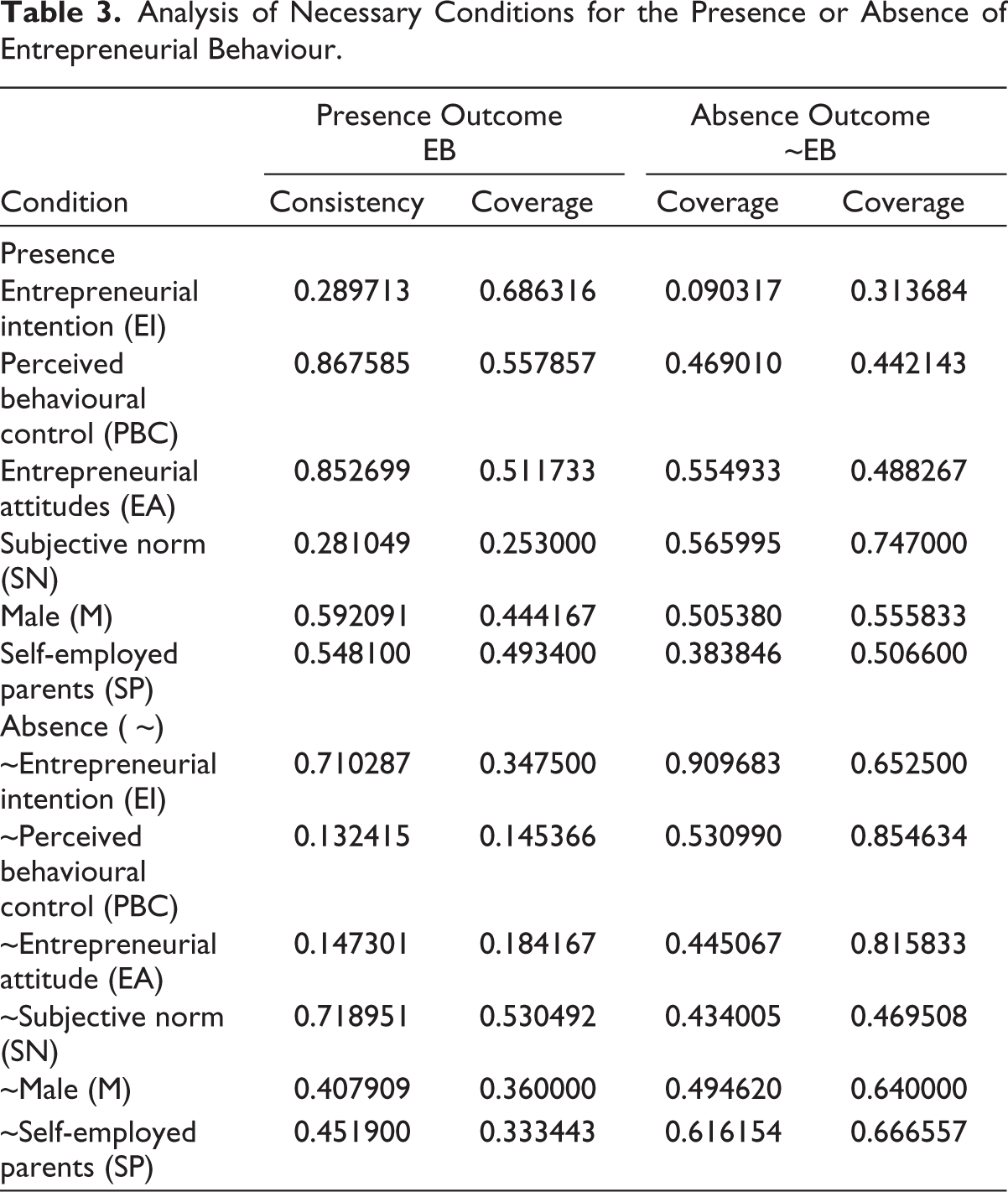
The analysis of necessity was conducted to assess whether the causal conditions were necessary for the occurrence of the outcome. Necessary conditions are those conditions that are always (or almost always) present when the outcome of interest occurs, and from a set-theoretic point of view, necessary conditions can be defined as any condition that is a superset of the outcome. The strength of the findings on necessary and sufficient conditions is assessed through two measures: consistency and coverage. In the QCA literature, it is recommended to use the cut-off point of (0.90) and (0.50) for necessity consistency and coverage, respectively (Ragin, 2008). Necessity consistency indicates how often a condition (or combination of conditions) is present when the outcome occurs, while, the necessary coverage indicates how often a condition (or combination of conditions) is absent when the outcome does not occur (Ragin, 2006b).
Table 3 presents the conditions deemed necessary for the presence and absence of entrepreneurial behaviour. In this study, a threshold of 0.9 consistency score was set for accepting a condition as necessary (refer to Table 3; conditions above the threshold of 0.9 are highlighted in bold). Notably, no conditions were found to be necessary for the presence of entrepreneurial behaviour (EB) at this threshold (0.9). Conversely, for the absence of the outcome, the absence of entrepreneurial intention (~EI) was identified as a necessary condition for the absence of entrepreneurial behaviour (~EB) among students.
Analysis of Necessary Conditions for the Presence or Absence of Entrepreneurial Behaviour.
Sufficient Causal Conditions
In the next step, a sufficiency analysis, specifically examining subset relationships, was conducted to assess whether various configurations are linked to entrepreneurial behaviour (EB) among students. This analysis was carried out utilising the truth-table algorithm (Ragin, 2008). The truth table displays the conditions, configurations and the number of cases in each configuration set. The number of rows in the Truth table can be computed with the formula 2 k (where k is the number of causal conditions). This study has 26 = 64 rows representing all logically possible combinations of the study’s causal conditions (see Appendix A). To minimise the data into solutions, a frequency threshold of (≥5) and a consistency threshold of (≥0.75) 3 is set to the data. This means all Truth table rows with fewer than five cases will be classified as a logical remainder (i.e., when some logically possible combinations of conditions remain without empirical cases), and thus, will be excluded from the final solutions.
QCA analysis offers three types of solutions: complex, intermediate and parsimonious. Each of these solutions presents configurations of causal conditions corresponding to the outcome of interest. However, the three types of solutions differ in their treatment of generalisations (to the extent to which logical remainders were used for minimisation) (Ragin, 2008). In the parsimonious solution, all logical remainders are potentially considered without prior assessment, whether they are empirically plausible or not. In contrast, in the complex solution, logical remainders are not taken into consideration. While, in the intermediate solution only some logical remainders are included, namely, logical remainders that make theoretical sense based on the researcher’s assumptions (Ragin, 2009).
Table 4 presents the results of the fsQCA analysis of the presence of entrepreneurial behaviour among the students. In the QCA analysis, it is common to report the intermediate solutions, which are considered to be superior to both the complex and the parsimonious solutions.
Consequently, the main solution considered in this study is the intermediate solution. Table 4 reveals that two distinct intermediate solutions (configurations) were identified for the presence of entrepreneurial behaviour, indicating the presence and absence of both peripheral and core conditions. Compared to core conditions, which are present in both intermediate and parsimonious solutions, peripheral conditions are present only in the intermediate solution (Fiss, 2011). Study results present equifinality across solutions, which means that there is potentially more than one configurational path to one outcome (Ragin, 2008), in this case, it means that there is potentially more than one path to achieve entrepreneurial behaviour among students.
Causal Configurations for Entrepreneurial Behaviour.
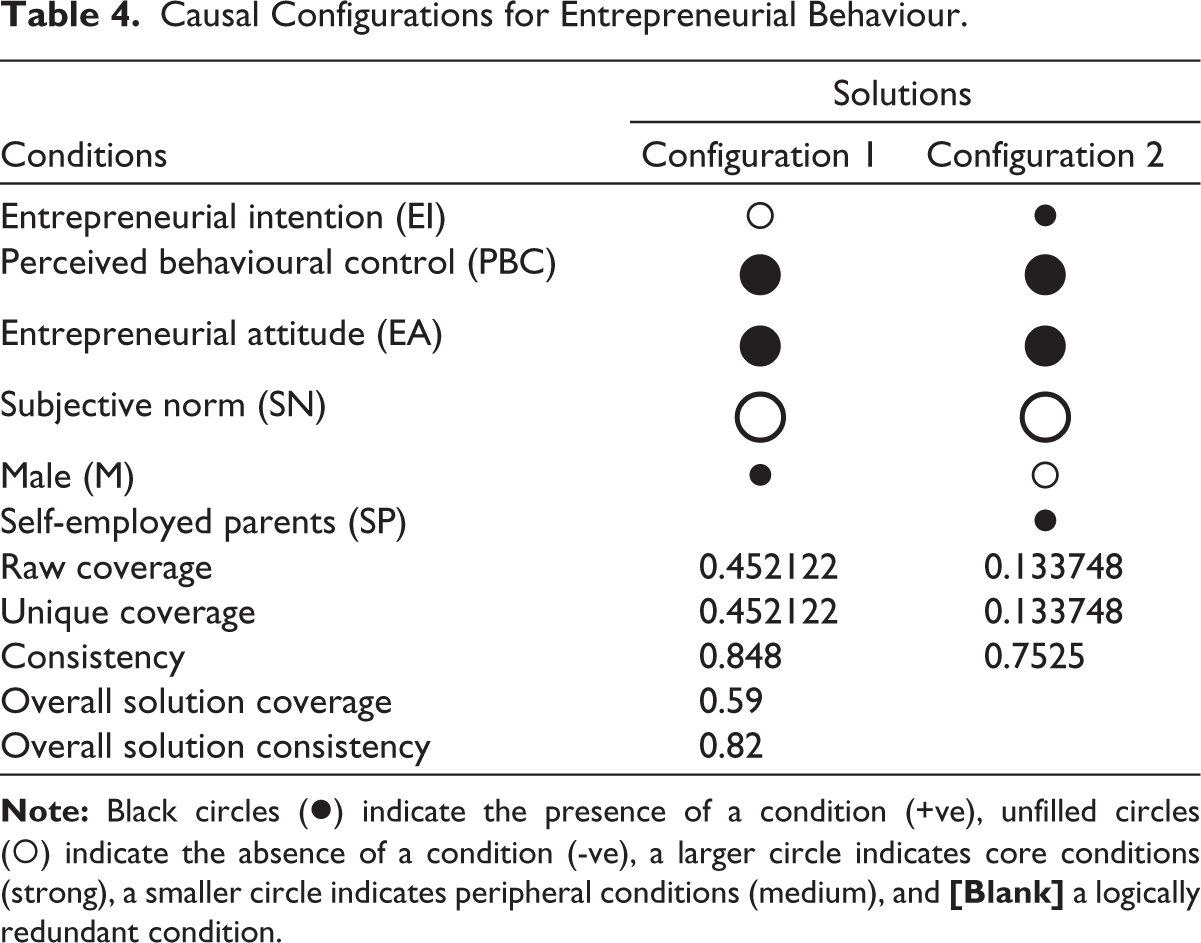
The overall solution consistency (combined consistency of the configurations) is 0.82, which indicates that the identified combinations represent highly consistent solutions to explain entrepreneurial behaviour. The solution coverage (the proportion of outcome cases that are covered by all the configurations) is 0.59, indicating that these two configurations explain about 59% of the likelihood of achieving entrepreneurial behaviours among students.
The first configuration has the highest consistency (a score of 0.84) and includes all male students who perceive ease of performing entrepreneurial behaviour, have a more positive personal valuation about being an entrepreneur and do not perceive social support for being an entrepreneur from their family and friends. This configuration suggests that both PBC and EA (strongly positively connected) and SN (strongly negatively connected) are core conditions, and gender (being male) is considered to be a peripheral condition meaning that the condition is not as strongly associated causally with the outcome but has a medium effect along with other conditions. An alternative configuration with lower consistency (a score of 0.75) would include female students who have an EI, have self-employed parents, perceived ease of performing entrepreneurial behaviour, have more positive personal valuation about being an entrepreneur and do not perceive social support. This configuration shows that PBC, EA and SN are core conditions while EI and SP are peripheral conditions.
Next, an analysis was conducted to identify sufficient conditions for the absence of entrepreneurial behaviour. In QCA research, and due to the asymmetric nature of QCA, it is often recommended to analyse the absence of the outcome in addition to its presence. Table 5 illustrates the configurations leading to the absence of entrepreneurial behaviour, and only two configurations were obtained.
Causal Configurations for the Absence of Entrepreneurial Behaviour.
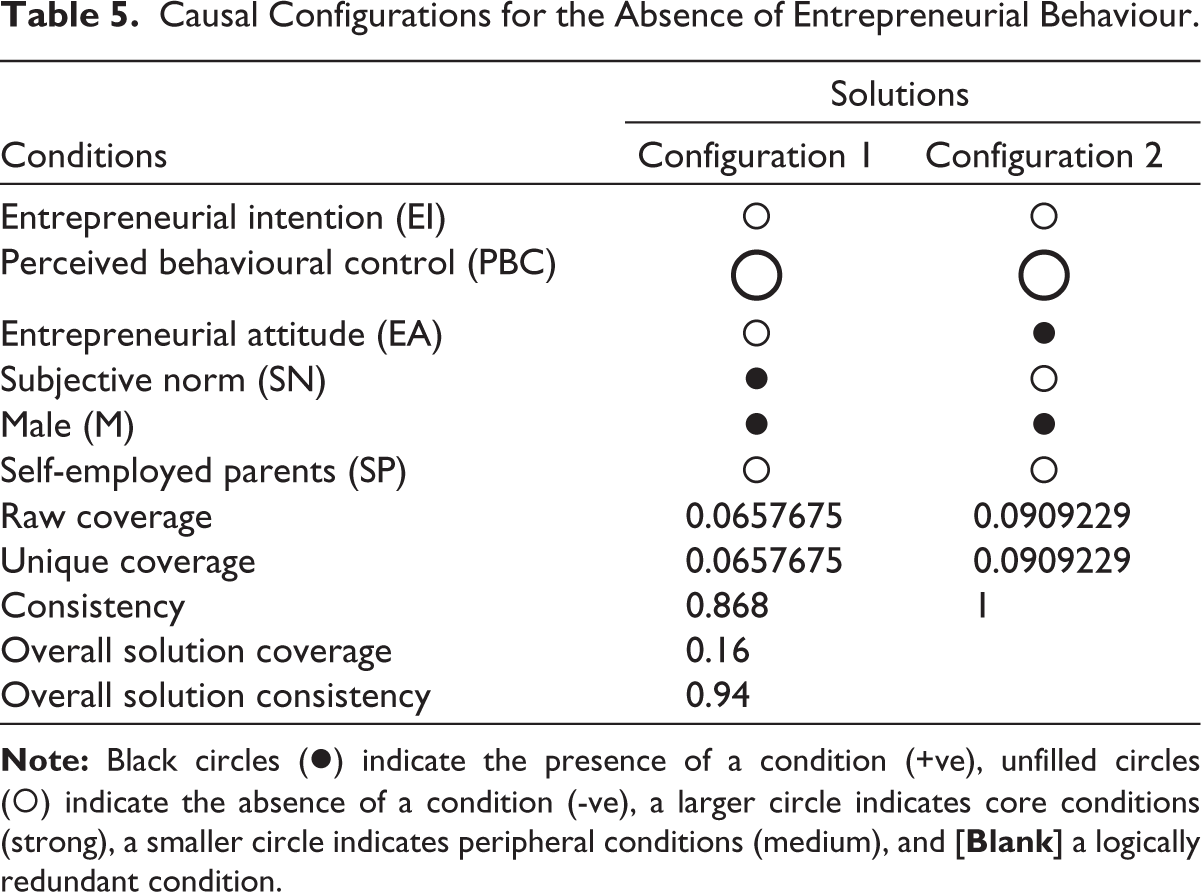
The overall solution consistency and solution coverage are 0.94 and 0.16, respectively. These configurations indicate that female students without self-employed parents, who perceive difficulties in performing entrepreneurial behaviour and have no EI are highly likely not to engage in entrepreneurial behaviour. These results suggest that the absence of the core conditions PBC (strongly negatively connected) with the absence of other peripheral conditions gender (being male), SP, and EI lead to the absence of entrepreneurial behaviour among students.
Discussion and Conclusions
This article aimed to explain entrepreneurial behaviour from a configurational perspective to provide a deeper understanding of the complex mechanisms that can be connected with entrepreneurial behaviour. Entrepreneurship is complex in nature, and entrepreneurial behaviour is the result of a combination of factors (reflecting both demographic and motivational factors—TPB components) that affect entrepreneurship. Existing studies on entrepreneurial behaviour have almost without exception employed traditional data analysis methods (such as regression analysis or structural equation modelling), which are typically based upon linear and symmetric relationships between variables of interest and assume causal mechanisms to apply equally to all individuals in a given group, for example, a group of students. Besides, these traditional statistical analyses (e.g., linear regression) assume independence between the factors predicting entrepreneurial behaviour. However, the study posits that factors influencing entrepreneurial behaviour are likely to be interdependent and cannot be viewed in isolation. Therefore, the argument is made that entrepreneurial behaviour can be explained by different configurations built on non-linear functions. In light of this, the current article relaxes the restrictive assumption and introduces fsQCA to identify determinants of students’ entrepreneurial behaviour, contingent on shared characteristics.
The findings show that there are no necessary conditions for the presence of entrepreneurial behaviour (EB). At the same time, the results suggest that the absence of entrepreneurial intention(~EI) can be considered a necessary condition for the absence of entrepreneurial behaviour (~EB) among students. This suggests that students with an entrepreneurial intention (EI) will never result in (~EB). Looking into the sample, indeed only 2% of students with an EI reported entrepreneurial behaviour one year afterwards, in comparison to 57% reporting entrepreneurial behaviour without having an EI. As regards those who showed no entrepreneurial behaviour, 15% of students signalled an EI compared to 26% who did not. These characteristics of the sample might explain why the (~EI) is a necessary condition for the (~EB). This connects with the context of KR, where the majority of young people do not opt for entrepreneurship as their first option; instead, their preference is for a (solid) job in public administration. Thus, in the context of KR and possibly other transition economies, youth might engage in entrepreneurial behaviour without forming an explicit intention. Accordingly, one could argue that the TPB might be less applicable to predicting behaviour through intention in similar contexts.
Furthermore, the fsQCA analysis uncovers two distinct configurations that collectively account for approximately 59% of the likelihood of students achieving entrepreneurial behaviours. Both PBC, and EA are present in these two configurations and are core conditions (strongly connected to the outcome). These two conjecturally sufficient combinations suggest that taking the TPB framework, PBC and EA are the essential criteria for the recipes of entrepreneurial behaviour among students. In other words, students intend to conduct entrepreneurial behaviour if they hold positive beliefs about the presence of resources and opportunities, have a positive perception of their ability to perform entrepreneurial behaviour and have a favourable assessment of the entrepreneurial activities. However, PBC and EA are only sufficient (relevant) in combination with other conditions.
The first configuration suggests that students will exhibit entrepreneurial behaviour when they possess a combination of three attributes: high PBC, high EA, and being male. While, the second configuration proposes that students will exhibit entrepreneurial behaviour when they possess a combination of five attributes: high PBC, high EA, having the intention to perform entrepreneurial behaviour (EI), having a self-employed parent (SP) and being female. From the above results, it is clear that behavioural intention does not always lead to actual behaviour, the two causal recipes of entrepreneurial behaviour show that for female students to carry out entrepreneurial behaviour more conditions need to be present.
From this perspective, the QCA method offers key advantages for analysing the study. First, it is better suited than regression for exploring complex causal configuration situations. In regression analysis, causal configurations are observable via interaction terms, which typically require large sample sizes to yield precise results, while QCA can capture conjunctural causation in small or medium data sets. Secondly, in contrast to the traditional quantitative techniques (e.g., correlation and regression) which assume a single explanatory path to the outcome, QCA allows researchers to link multiple pathways to the same outcome, which is particularly useful when the cases under study are different ways to achieve the outcome rather than a single solution. Thirdly, QCA embraces causal asymmetry, where the set of causal conditions leading to the presence of a given outcome may be very different from the set of conditions leading to the absence of the same outcome.
This study’s implications for entrepreneurship among university students are significant for researchers and policymakers. The findings from fsQCA analysis offer insights into fostering entrepreneurial behaviour. Notably, EI is not universally required for entrepreneurial behaviour; the absence of such intention does not necessarily deter students from starting businesses. To cultivate entrepreneurial behaviours in students, focusing on mechanisms that influence perceived behavioural control and attitude becomes pivotal. Particularly, for female students, those with self-employed parents and a strong intent for entrepreneurship display vital traits for entrepreneurial behaviour. Methodologically, QCA’s configurational approach emerges as suitable for unravelling complexities in phenomena such as entrepreneurship, with its foundation in individual case insights and adeptness in capturing intricate causality.
While this study offers significant insights, it is important to note its regional focus on the Kurdistan Region of Iraq. The socio-economic, cultural and educational landscape of the region may influence the applicability and generalisability of the findings to other contexts. Future research should, therefore, extend to diverse geographical settings to provide a more comprehensive understanding of entrepreneurial behaviour across different cultural and economic backgrounds.
However, the study is subject to two main limitations that motivate future research. First, the study relies on two-wave data, with a time gap of one year between data collection, which may have resulted in changes in intention and subsequent behaviour. Second, the fsQCA technique helps to identify the different configurations that led to entrepreneurial behaviour but does not provide information about the relative importance of the conditions within the configurations. Therefore, future research can benefit by using QCA as a complement to other statistical techniques to examine the individual effect of the factors within a configuration.
Finally, to enhance entrepreneurial behaviour among university students, policies should focus on educational initiatives that build EI and attitudes, mentorship programmes emphasising perceived behavioural control, and promoting diverse entrepreneurial success stories to shift SNs. Special support networks and targeted programmes are necessary for female students and those without self-employed parents, to provide tailored guidance and insights. Additionally, creating forums where students with entrepreneurial family backgrounds can share experiences would leverage these influential networks, encouraging a broader entrepreneurial mindset across the student body.
Footnotes
Declaration of Conflicting Interests
The authors declared no potential conflicts of interest with respect to the research, authorship and/or publication of this article.
Funding
The authors received no financial support for the research, authorship and/or publication of this article.
Appendix
Truth Table of the Boolean Configurations for Entrepreneurial Behaviour.
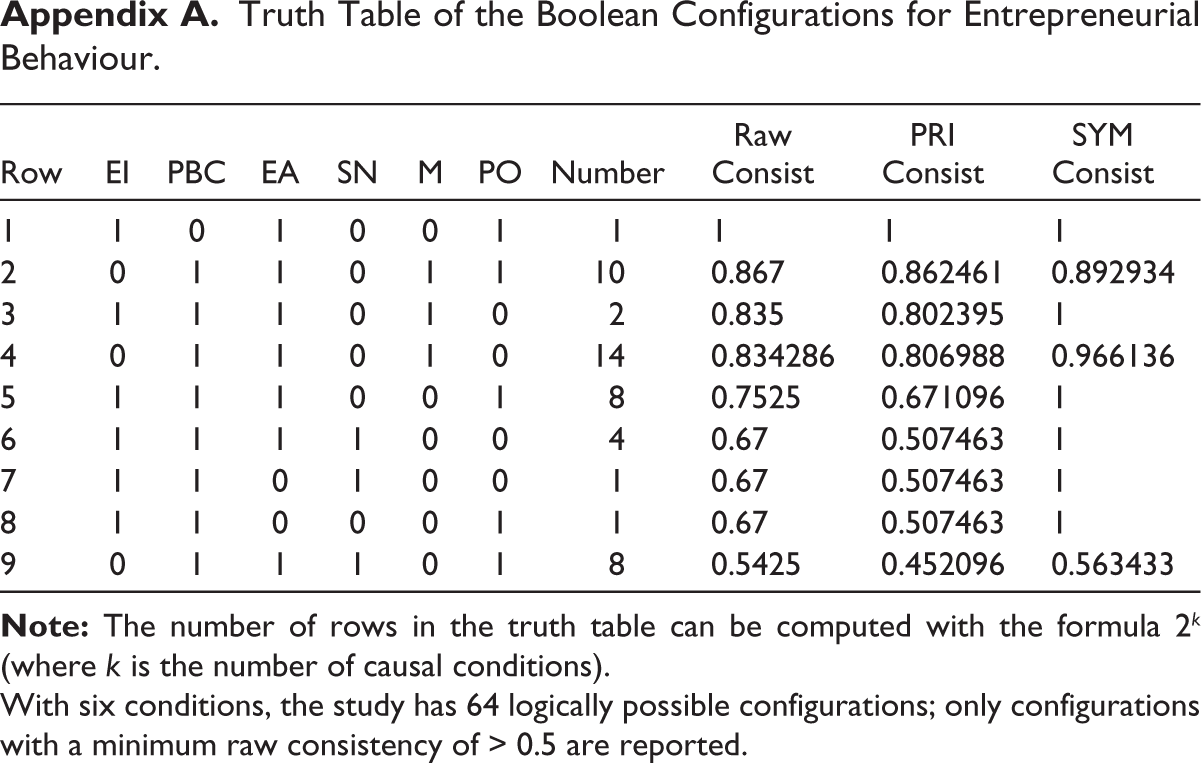
| Row | EI | PBC | EA | SN | M | PO | Number | Raw Consist | PRI Consist | SYM Consist |
| 1 | 1 | 0 | 1 | 0 | 0 | 1 | 1 | 1 | 1 | 1 |
| 2 | 0 | 1 | 1 | 0 | 1 | 1 | 10 | 0.867 | 0.862461 | 0.892934 |
| 3 | 1 | 1 | 1 | 0 | 1 | 0 | 2 | 0.835 | 0.802395 | 1 |
| 4 | 0 | 1 | 1 | 0 | 1 | 0 | 14 | 0.834286 | 0.806988 | 0.966136 |
| 5 | 1 | 1 | 1 | 0 | 0 | 1 | 8 | 0.7525 | 0.671096 | 1 |
| 6 | 1 | 1 | 1 | 1 | 0 | 0 | 4 | 0.67 | 0.507463 | 1 |
| 7 | 1 | 1 | 0 | 1 | 0 | 0 | 1 | 0.67 | 0.507463 | 1 |
| 8 | 1 | 1 | 0 | 0 | 0 | 1 | 1 | 0.67 | 0.507463 | 1 |
| 9 | 0 | 1 | 1 | 1 | 0 | 1 | 8 | 0.5425 | 0.452096 | 0.563433 |
With six conditions, the study has 64 logically possible configurations; only configurations with a minimum raw consistency of > 0.5 are reported.