




Abstract
An important challenge for franchisors is to find individuals with strong intentions to become franchisees that they can actively support in this ambition. We contribute to franchising research by developing and testing a model to explain individual intentions to become franchisees as a specific type of entrepreneurial intention (EI). We combine Achievement Motivation Theory (AMT) with the Theory of Planned Behaviour (TPB) to propose inverted U-shaped associations between individual motivations (i.e. need for achievement and risk-taking propensity), their cognitive assessments of franchising (i.e. attitude towards franchising and perceived behavioural control), and their EI regarding franchising. Our survey of 666 individuals demonstrates that need for achievement impacts attitude towards franchising and perceived behavioural control regarding franchising following respectively inverted U-shaped and declining positive relationships, and they partly mediate the relationships between need for achievement and EI regarding franchising. We find a negative linear association with attitude towards franchising.
Keywords
Introduction
Both practitioners and academics acknowledge the importance of franchisee recruitment by franchisors (Jambulingam and Nevin, 1999; Watson et al., 2016, 2019) Franchisors need new franchisees to fuel franchise network growth; however, recruiting the ‘wrong’ franchisees can lead to performance issues. Despite its importance and challenges, franchisee recruitment has received relatively little attention in academic literature (Watson et al., 2016). Some studies adopt the franchisor’s perspective analysing the selection criteria (Jambulingam and Nevin, 1999) and rhetoric (Watson et al., 2016, 2019) that franchisors adopt in recruiting franchisees, whereas others focus on the prospective franchisee perspective exploring expectations and network entry decisions (Bastié et al., 2016; Bennett et al., 2010; Peterson and Dant, 1990). Our research extends analyses of the prospective franchisee perspective and enhances knowledge on antecedents of individual intentions to become franchisees. Such knowledge helps franchisors in a crucial step of franchisee recruitment: building a pool of interested candidates from which they can select individuals whom they can support in becoming franchisees. In building this knowledge, we consider individual intentions to become franchisees as a specific type of entrepreneurial intention (EI). 1 We are aware there have been critiques of the study of EI as a main dependent variable given barriers that may cause individuals with high EI to refrain from engaging in actual entrepreneurial behaviours (Meoli et al., 2020; Van Gelderen et al., 2015, 2018). However, this ‘intention-behaviour gap’ is less problematic in our study as franchisors can reduce barriers by actively supporting individuals with high EI regarding franchising, for example, by helping them with regard to finance and renting unit locations.
Relatively few analyses have explained individual intentions and decisions to become franchisees (exceptions being Bastié et al., 2016; Bennett et al., 2010; Kaufmann, 1999; Peterson and Dant, 1990; Watson and Stanworth, 2006; Williams, 1998). These studies have typically adopted economic or strategic perspectives to study a range of antecedents of individual EI regarding franchising as compared to becoming fully independent entrepreneurs, such as risk and expected utility (Kaufmann and Stanworth, 1995; Williams, 1998), expected financial or strategic benefits (Kaufmann, 1999; Peterson and Dant, 1990), intellectual capital resources (Watson and Stanworth, 2006) and the availability of human, social and financial capital (Bastié et al., 2016). Moreover, some include demographic characteristics, such as gender and education (Bastié et al., 2016; Williams, 1998). However, franchising research has not yet included motivational traits in explaining individual EI regarding franchising, whereas research in other EI contexts has argued and/or found that individual motivations form an important antecedent to EI (Carsrud and Brännback, 2011; Shane et al., 2003; Zellweger et al., 2011). We build on insights on the role of motivations in other EI contexts to develop our theoretical model for individual EI regarding franchising. We apply a theory of human motivation: Atkinson’s Achievement Motivation Theory (AMT; Atkinson, 1957, 1964); based on AMT, we include need for achievement (NFA) and risk-taking propensity (RTP) as main motivational traits. However, EI research has so far found mixed empirical findings on the effects of individual NFA and RTP on EI. Some have found direct positive effects, but this is not consistent (see Brandstätter, 2011; Frese and Gielnik, 2014; Rauch and Frese, 2007, for reviews). Hence, there is an ongoing discussion in the EI literature on whether motivations directly, or indirectly, affect EI. Relatedly, our article accounts for two important considerations informing specific contributions to franchising research.
First, one explanation for the abovementioned mixed findings may be in the shape of the proposed associations between individual motivations and their EI. Research typically considers linear associations between motivations and EI; we are not aware of other EI studies exploring or reporting non-linear associations. In several EI contexts, non-linear associations may not actually make theoretical sense, but we argue that – given the specific characteristics of franchising – such non-linear relationships between individual motivations and EI regarding franchising may be present in the form of inverted U-shaped curves. Our first contribution to franchising research is thus, that we account for NFA and RTP as relevant motivations in explaining individual EI regarding franchising, and, in so doing, we propose inverted U-shaped associations.
Second, we account for a common explanation for the abovementioned mixed findings on individual motivations and EI. Analyses of EI have explained the absence of direct effects by arguing that some motivations are too distal to directly explain EI (Frese and Gielnik, 2014; Rauch and Frese, 2007). Relatedly, it has been argued that motivations may not translate into EI if an individual cognitively assesses the respective act as neither desirable nor feasible (Carsrud and Brännback, 2011; Krueger et al., 2000). It has been stated therefore, that motivations and cognitions must be integrated into one model to fully explain EI (Fini et al., 2012; Shane et al., 2003). The main argument being that motivations affect individual interpretations and also, how specific behaviours are valued (Atkinson, 1957, 1964; Elliot and Covington, 2001). Our second contribution to franchising research therefore, builds upon these arguments. Our theoretical model complements Atkinson’s AMT as a motivational framework with the Theory of Planned Behaviour (TPB) as a cognitive framework. TPB (Ajzen, 1991, 2002, 2011) is an influential model for predicting individual behavioural intentions and behaviours in a wide range of contexts, including small business and entrepreneurship (Liñán et al., 2016; Schlaegel and Koenig, 2014; Shinnar et al., 2018; Tornikoski and Maalaoui, 2019). Franchising research rarely adopts AMT or TPB to explain individual EI regarding franchising; for an exception, see Kaufmann (1999) regarding TPB.
Theoretical backgrounds and hypotheses
EI regarding franchising as a specific EI context
EI refers to an individual’s conscious state of mind that directs attention towards a specific entrepreneurial behaviour and is, therefore, a crucial predictor of such behaviour (Gunia et al., 2021; Krueger et al., 2000; Liñán et al., 2016). Analyses of the antecedents of EI comprise a large body of research (Fayolle and Liñán, 2014; Schlaegel and Koenig, 2014) that is fragmented in the following three broad ways: (1) it adopts a range of theoretical perspectives with different types of antecedents, (2) it aims to explain different types of EI with different forms of operationalisation, and (3) it aims to explain the EI of different types of individuals.
Regarding the theoretical perspectives and types of EI antecedents, cognitive perspectives comprise the most prevalent, including, for example, the Theory of Planned Behaviour, the Entrepreneurial Event Model, or Social Cognitive Theory (Hsu et al., 2019; Schlaegel and Koenig, 2014). Building on such perspectives, many have focused on individual self-efficacy as a major EI antecedent (Hockerts, 2017; Schmutzler et al., 2019). Contemporary research has called for an integration of cognitive perspectives with other theoretical perspectives, such as personality traits, motivational, social or institutional perspectives, to obtain a better understanding of EI (Schmutzler et al., 2019; Wiklund et al., 2017). We respond to such calls by including both the motivational and cognitive antecedents of EI regarding franchising.
Regarding the types of EI and related operationalisation, there are many facets of this broad term of which starting new ventures is the most popular (Gunia et al., 2021; Hsu et al., 2019). Other types include intentions regarding taking over an existing business (Block et al., 2013), re-entering after an entrepreneurial exit (Hsu et al., 2017), engaging in social entrepreneurship (Dickel and Eckardt, 2021) or engaging in corporate entrepreneurial behaviours (Fini et al., 2012). Such EI types differ in terms of required investments and degree of risk (Block et al., 2013; Thompson, 2009), prompting calls for a more ‘contextual perspective’ for studying EI antecedents (Fayolle and Liñán, 2014; Schlaegel and Koenig, 2014). Moreover, EI research has adopted differing forms of operationalising intentions; for example, the likelihood of engaging in entrepreneurial behaviours; a conscious plan to start a business; an abstract desire to start a business, or as a combination of all three (Douglas and Fitzsimmons, 2013; Thompson, 2009). Researchers should precisely define and operationalise EI so that empirical results can be compared across contexts.
EI in the context of franchising is a specific form that has received relatively little research attention, especially when considering the role of motivational traits. We consider franchisees as entrepreneurs as they take the risk of exploiting opportunities by running their own businesses under a franchisor business format in a specific local market with no guarantees of positive outcomes (Dada et al., 2010; Ketchen et al., 2011; Patel and Pearce, 2019). However, the peculiarities of franchising make the existence of inverted U-shaped relationships between individual motivations, cognitive assessments of franchising and EI regarding franchising, plausible.
Third, regarding the types of individuals under consideration, most EI studies use student samples, resulting in data from a relatively homogeneous group with specific demographic characteristics and, therefore, limited validity and generalisability (Hsu et al., 2019; Schlaegel and Koenig, 2014). A much smaller number of EI studies have collected data from practising entrepreneurs (Holland and Garrett, 2015) or from employees with, or without, entrepreneurial experience (Yen Ng and De Clercq, 2021). We study the intentions of individuals without prior entrepreneurial experience (‘non-entrepreneurs’); our theoretical model is based on this starting point. We delineate these categories as entrepreneurs, and non-entrepreneurs, may differ in their cognitive assessments of alternative career opportunities (Williams, 1998; Zellweger et al., 2011).
Figure 1 clarifies the overall structure of our argumentation. However, before developing our hypotheses, we first discuss the basic assumptions of AMT and TPB and how the two perspectives can be integrated to explain EI.
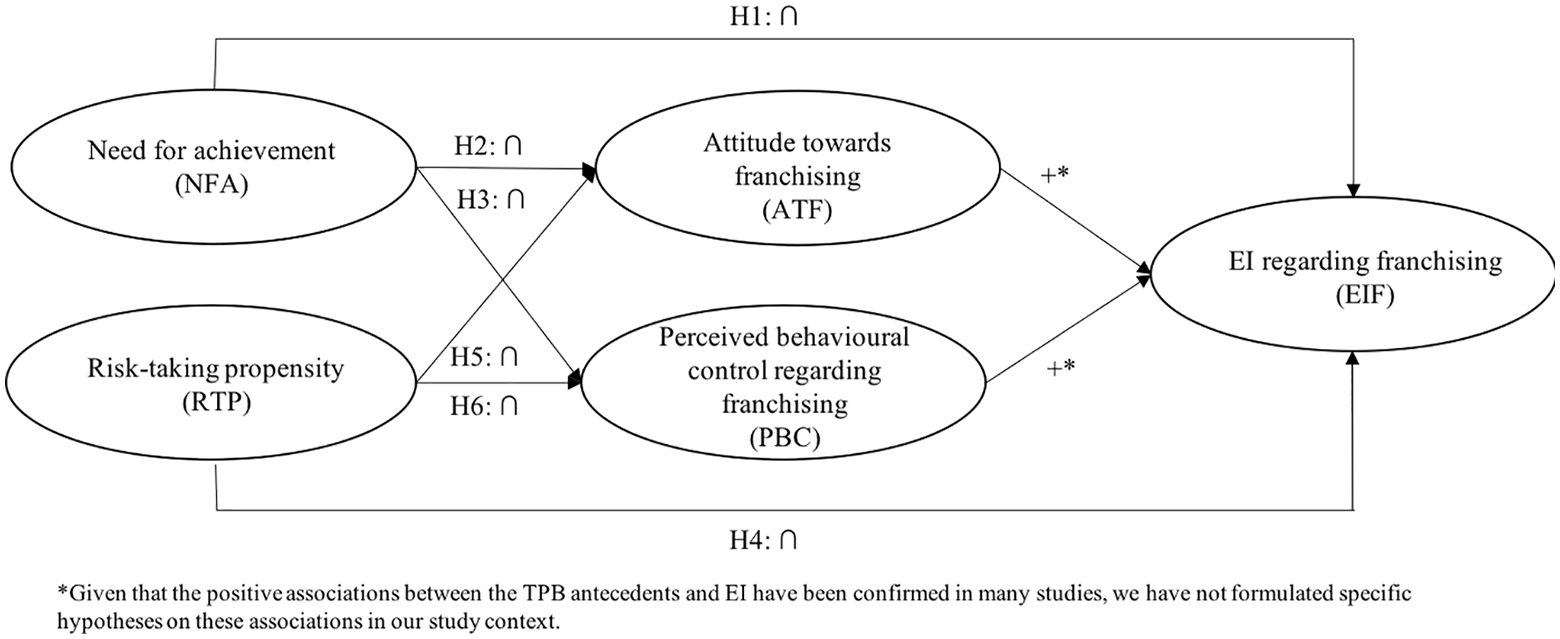
Theoretical model.
Achievement motivation theory (AMT)
Human motivation comprises a wide range of individual traits that explain why individuals respond differently to the same stimulus (Carsrud and Brännback, 2011; Shane et al., 2003). Motivation theory is a very broad concept regarding human motivation including notions such as McClelland’s (1961) theory of achievement motivation, self-determination theory (Ryan and Deci, 2000), and Atkinson’s(1957, 1964) AMT. A core premise of Atkinson’s AMT is that the following two fundamental types of motivational traits affect individual intentions to engage in ‘risk-taking behaviours’: achievement motivation and avoidance motivation (Atkinson, 1957, 1964). Achievement motivation refers to an individual’s natural tendency to seek success, whereas avoidance motivation is the natural tendency to avoid or minimise failure or loss. Both motivation types reflect separate types with different direct, or indirect, effects on intentions to engage in risky behaviours.
EI researchers have pointed at the potential relevance of Atkinson’s achievement-avoidance motivation distinction in explaining EI (Shane et al., 2003). Several EI studies have included individual motivational traits closely related to the achievement-avoidance motivation distinction (Rauch and Frese, 2007; Shane et al., 2003): NFA (i.e. achievement motivation) and RTP (i.e. the reverse of avoidance motivation). In line with AMT, we include NFA and RTP as motivations. Need for achievement reflects the desire to be successful and engage in activities with a high degree of individual responsibility (Collins et al., 2004; Eisenberger et al., 2005; McClelland, 1961; Stewart and Roth, 2007), whereas RTP is an inclination to take risks (Block et al., 2013; Stewart et al., 1998; Zhao et al., 2010). The entrepreneurship literature is inconsistent in defining the concept of motivation in general (Carsrud and Brännback, 2011), and in defining ‘need for achievement’ and ‘risk-taking propensity’ as distal, or proximal, factors (for discussions, see Frese and Gielnik, 2014; Sitkin and Weingart, 1995). Reflecting AMT research (Atkinson, 1957, 1964; Elliot and Covington, 2001), we consider NFA and RTP as distal motivational traits. As noted, EI researchers have found mixed empirical results on the direct effects of NFA and RTP on EI, and we deal with this issue by including hypotheses on inverted U-shaped associations and by complementing AMT with TPB.
Theory of planned behaviour (TPB)
TPB belongs to a group of closely related cognitive theories to explain human intentions and behaviours, such as the theory of reasoned action, the theory of goal pursuit, or the theory of trying (for critical discussions, see Ajzen, 1991; Bagozzi, 1992; Bagozzi and Warshaw, 1990). It is beyond the scope of this article to discuss all the theoretical varieties so we favour TPB as suitable for addressing behaviours that are under the individual’s partial volitional control and so, account for perceived behavioural control (PBC) regarding the behaviour under scrutiny (Ajzen, 1991; Bagozzi, 1992). This accounts for the efficacy of TPB to generate explanatory power in EI research (Karimi et al., 2017; Krueger et al., 2000; Schlaegel and Koenig, 2014).
We focus on the element of TPB explaining behavioural intentions. Intentions play a central role in TPB as they reflect individual cognitive readiness to perform a given behaviour (Thompson, 2009). Generally, the stronger an intention to engage in a specific behaviour, the more likely is the actual enactment of such behaviour (Ajzen, 1991; Krueger et al., 2000). A further core TPB assumption being that three main TPB antecedents affect individual intentions to engage in a specific behaviour (Ajzen, 1991, 2002, 2011): the individual’s attitude towards the behaviour, subjective norms, and PBC regarding the behaviour. The more favourable the attitude and subjective norms with respect to a behaviour, and the higher the PBC regarding the behaviour, the higher is the intention to perform that behaviour. These three main TPB antecedents reflect individual knowledge, experiences and beliefs and may vary across situations. These cognitive antecedents thus, comprise proximal factors that are ‘closer’ to intentions than distal factors that are relatively stable across situations, such as personality and motivational traits (Kautonen et al., 2013, 2015; Krueger et al., 2000).
Despite the power of TPB in explaining EI, researchers have argued that it must be integrated with other theories to deal with the complexity of explaining EI and to further increase its explanatory power (Fini et al., 2012; Kautonen et al., 2013; Santos et al., 2016). Studies in other TPB contexts, such as that by Bagozzi and Warshaw (1990), also point at the possibilities of including relatively distal antecedents of individual attitudes, such as attitudes towards success (cf. AMT’s achievement motivation) or attitudes towards failure (cf. AMT’s avoidance motivation). 2
Integrating AMT and TPB to explain individual EI regarding franchising
Complementing AMT with TPB potentially results in a novel and more powerful theoretical model offering a valuable contribution to franchising research. For an effective integration, some commonality among theories is required while there should also be differences that make the integration valuable. As Table 1 shows, a main commonality among AMT and TPB is that both theories aim to explain individual behavioural intentions and actual behaviours. An important difference, however, is that the antecedents of the former are motivational and relatively distal, whereas those of the latter are cognitive and relatively proximal. The proximal cognitive antecedents generally form a good EI predictor, but we need a more in-depth understanding of the factors affecting these variables (Fini et al., 2012; Pfeifer et al., 2016). We therefore, hypothesise that the motivational AMT constructs are antecedents of the cognitive TPB constructs (Karimi et al., 2017; Kautonen et al., 2013), and that the cognitive constructs mediate the relationships between the motivational constructs and EI regarding franchising. As the empirical relevance of cognitive constructs in explaining individual behavioural intentions has been demonstrated, see Armitage and Conner (2001) and Schlaegel and Koenig (2014), for meta-analyses, we do not elaborate in our hypotheses regarding the mediating roles of cognitive antecedents (Hypotheses 2b, 3b, 5b and 6b).
Comparing AMT and TPB.
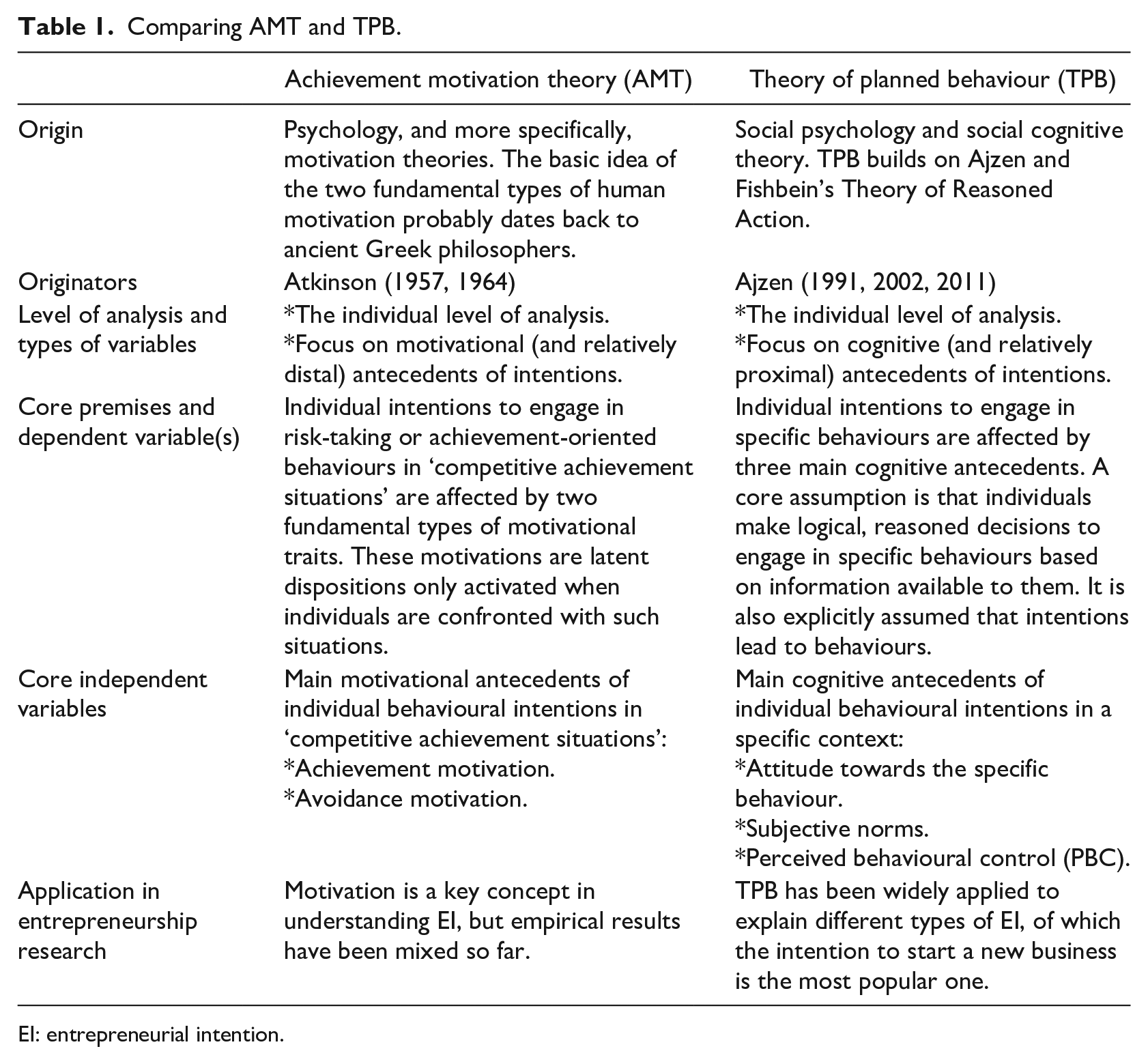
EI: entrepreneurial intention.
Theoretical model: hypotheses
Non-linear effects of motivations: need for achievement and risk-taking propensity
Our hypotheses include both the non-linear effects of NFA and RTP on EI regarding franchising, and their non-linear effects on attitude towards franchising (ATF) and PBC regarding franchising. In line with Fini et al. (2012) and Karimi et al. (2017), we do not expect effects of NFA and RTP on subjective norms (as the third main TPB antecedent). This is because subjective norms depend on individual perceptions of the attitudes of those deemed influential, and not on an individual’s own motivations. For our reasoning on the non-linear relationships, we build on the ideas of Haans et al. (2016) by arguing that the inverted U-shaped relationships in our study result from two countervailing forces, namely individual expected benefits (or advantages) and expected costs (or disadvantages) of becoming a franchisee. These benefits and costs relate to each other in an additive way, whereby the expected benefits follow a linear curve and the expected costs follow an exponential curve (see the first option in Table 1 of Haans et al., 2016).
Need for achievement
Achievement-oriented individuals feel energised in competitive achievement settings as they derive satisfaction from striving for success (Atkinson, 1957, 1964). They base their self-regard on the successful exploitation of talents and skills preferring to take individual responsibility for task outcomes (Eisenberger et al., 2005; McClelland, 1961). It is, therefore, likely that achievement-oriented individuals positively value entrepreneurial careers; research has demonstrated positive linear relationships between NFA and EI (Brandstätter, 2011; Collins et al., 2004; McClelland, 1961; Stewart and Roth, 2007).
However, when considering franchising as an entrepreneurial career, we expect an inverted U-shaped association between the NFA and EI of non-entrepreneurs regarding franchising. With increasing levels of NFA, non-entrepreneurs expect linearly increasing benefits from franchising. Becoming a franchisee provides achievement-oriented non-entrepreneurs with the opportunity to utilise their own talents and skills and to have individual responsibility for success through adopting a tried-and-tested business format and benefitting from franchisor support (Hing, 1995; Ketchen et al., 2011; Williams, 1998). Becoming a franchisee may help non-entrepreneurs in achieving successes as the business format is typically known in the market and able to attract customers with the support of the franchisor (Kaufmann and Stanworth, 1995; Peterson and Dant, 1990). However, at the same time, non-entrepreneurs may also expect costs to becoming a franchisee because adopting a business format and using franchisor support constrains individual entrepreneurial autonomy and the possibilities to utilise one’s own skills (Dada, 2018; Pizanti and Lerner, 2003; Williams, 1998).
These constraints may lead to relational tensions and conflicts in the franchise relationship (Blut et al., 2011; López-Bayón and López-Fernández, 2016). Particularly, for achievement-oriented individuals, the expected costs of franchising due to franchisor restrictions and relational tensions and conflicts may be extremely high. More specifically, the individual expected costs of being a franchisee may increase exponentially with increasing needs for achievement. At a certain level of individual NFA, that is, the tipping point (Haans et al., 2016), the expected costs begin to outweigh the expected benefits of becoming a franchisee, resulting in an inverted U-shaped curve between individual NFA and their EI regarding franchising. Hence,
Hypothesis 1. Individual NFA is associated to EI regarding franchising through an inverted U-shaped curve.
The same countervailing forces of benefits and costs may apply to the relationships between an individual NFA, and respectively, attitudes towards franchising and also PBC regarding franchising. Regarding attitudes towards franchising, we expect that an increase in NFA by non-entrepreneurs will linearly enhance favourable ATF. For those reasons mentioned earlier, achievement-oriented non-entrepreneurs value the possibilities of utilising their own talents and skills and having individual responsibility through adopting a tried-and-tested business format, while receiving franchisor support (Hing, 1995; Ketchen et al., 2011; Williams, 1998). However, at the same time, non-entrepreneurs with high needs for achievement will devalue the core attributes of franchising at an increasingly higher rate because of the expected costs resulting from constraints to entrepreneurial autonomy, and relational tensions with the franchisor (Dada, 2018; Williams, 1998). Combining the linear and exponential curves for these expected benefits and costs thus, we expect that there will be a tipping point after which individual expected costs of franchising will outweigh the expected benefits which will negatively affect their ATF. Hence,
Hypothesis 2a. Individual NFA is associated to ATF through an inverted U-shaped curve.
Hypothesis 2b. Attitude towards franchising mediates the association between individual NFA and EI regarding franchising.
Regarding the links between NFA and PBC, it is argued that the energy that achievement-oriented individuals gain from competitive achievement settings (Atkinson, 1957) generates the confidence they can be successful in such contexts (Eisenberger et al., 2005; Gist and Mitchell, 1992). The same reasoning applies to entrepreneurial contexts; due to their energy, achievement-oriented individuals may have more confidence in their entrepreneurial capabilities. This positively affects perceptions of the ease of starting and running a business (cf. Boyd and Vozikis, 1994) and their PBC (Karimi et al., 2017). The positive and linear effects of a non-entrepreneur’s NFA on PBC regarding franchising are also likely to be present. Achievement-oriented individuals may have more confidence in their entrepreneurial capabilities, which may also positively affect their perceived ease of starting and running a franchised business (cf. Boyd and Vozikis, 1994; Karimi et al., 2017). However, at the same time, the expected costs, or difficulties, of becoming a franchisee are likely to increase at an exponential rate with increasing NFA. In particular, achievement-oriented individuals might anticipate considerable constraints upon their effective functioning due to limited entrepreneurial autonomy leading to relational tensions and conflicts with the franchisor. Achievement-oriented individuals may anticipate such conflicts and expect that these will hinder their capabilities to conduct tasks and attain success; this, in turn, reduces their PBC regarding franchising. Again, the combination of these countervailing forces of expected benefits and costs, or difficulties, leads to a tipping point after which higher levels of NFA begin to lower levels of PBC regarding franchising. Hence,
Hypothesis 3a. Individual NFA is associated to PBC regarding franchising through an inverted U-shaped curve.
Hypothesis 3b. PBC regarding franchising mediates the association between individual NFA and EI regarding franchising.
Risk-taking propensity
Risk-averse individuals experience stress in competitive achievement situations as they want to avoid failure or loss; risk-prone individuals, however, are likely to feel more comfortable, or even energised, in such situations (Atkinson, 1957, 1964; Bacq et al., 2017; Elliot and Covington, 2001). Moreover, risk-prone individuals may assess the same situation as less risky than risk-averse individuals and so, may overestimate the probability of gain relative to the probability of loss (Coelho, 2010; Sitkin and Weingart, 1995; Zhao et al., 2005). Entrepreneurship is risky as entrepreneurs must make investments for where there is considerable variation in financial outcomes, including the possibility of positive outcomes (Stewart et al., 1998; Stewart and Roth, 2001). Accordingly, the extant literature has found positive linear relationships between individual risk-taking propensities and EI (Brandstätter, 2011; Frese and Gielnik, 2014; Stewart and Roth, 2001).
However, we propose inverted U-shaped relationships between individual risk-taking propensities and EI regarding franchising. With increasing levels of RTP, non-entrepreneurs expect increasing benefits from franchising as it enables them to achieve attractive financial outcomes, particularly in comparison to salaried employment. However, at the same time, for risk-prone individuals, the expected costs of franchising increase exponentially if they anticipate severe growth restrictions. As noted, entrepreneurship has diverse financial outcomes (Stewart et al., 1998; Stewart and Roth, 2001), but this variability may be lower in franchising contexts, especially at the high end of the outcome scale. Compared to fully independent entrepreneurs typically, franchisees face more growth restrictions and thus, fewer possibilities to achieve higher financial returns. Individuals typically start as ‘single unit-franchisees’ (Grünhagen and Mittelstaedt, 2005) bound to one unit in a specific geographic location. Even though franchisees may have opportunities to open additional units in other locations and thus, become ‘multi-unit franchisees’ (Grünhagen and Mittelstaedt, 2005), such growth processes take time with no guarantees that a franchisor will grant further rights to open additional units (Gillis et al., 2011). For risk-prone individuals, these growth restrictions may lead to pejoratively high costs of franchising. More specifically, the expected costs of being a franchisee may increase exponentially with increasing risk-taking propensities. The combination of these countervailing forces of benefits and costs leads to a tipping point after which higher levels of individual risk-propensity start to lead to lower EI regarding franchising. Hence,
Hypothesis 4. Individual RTP is associated to EI regarding franchising through an inverted U-shaped curve.
The same countervailing forces of benefits and costs may apply to the association between individual risk-taking propensities, on one hand, and attitudes towards franchising and PBC regarding franchising, on the other hand. Analyses of generic entrepreneurship demonstrate that individuals with different risk-taking propensities attach different values to income variability as a core attribute of entrepreneurship (Stewart and Roth, 2001). As such, they have differing attitudes towards entrepreneurship (Karimi et al., 2017). Risk-prone individuals feel comfortable with outcome variability as they are less anxious about the possibility of losses (Atkinson, 1957) focusing more upon potential positive than negative outcomes (Sitkin and Weingart, 1995). Generally, risk-prone individuals have a more favourable attitude towards entrepreneurship than those of risk-averse individuals (Karimi et al., 2017). However, we propose an inverted U-shaped relationship between individual risk-taking propensities and attitudes towards franchising. With increasing risk-taking propensities, non-entrepreneurs will positively value franchising as a form of entrepreneurship as it enables them to achieve attractive financial outcomes. However, given the limited possibilities of attaining rapid growth and higher financial returns, we argue that for non-entrepreneurs with increasing risk-taking propensities, the expected costs of franchising increase exponentially. Thus, at one level of individual RTP (the tipping point), the costs of franchising begin to outweigh the benefits, which then negatively affects individual ATF. Hence,
Hypothesis 5a. Individual RTP is associated to ATF through an inverted U-shaped curve.
Hypothesis 5b. Attitude towards franchising mediates the association between individual RTP and EI regarding franchising.
Finally, it has been argued that risk-oriented individuals may have a higher PBC regarding entrepreneurship (cf. Bacq et al., 2017; Karimi et al., 2017; Zhao et al., 2005). Risk-oriented individuals are more comfortable with competitive achievement situations (Atkinson, 1957, 1964; Elliot and Covington, 2001; Sitkin and Weingart, 1995); accordingly, they feel more confident about their entrepreneurial capabilities (Bacq et al., 2017; Boyd and Vozikis, 1994; Zhao et al., 2005). As such, they have a higher PBC regarding entrepreneurship reflected in a linear relationship between RTP and PBC regarding entrepreneurship. We again hypothesise an inverted U-shaped association between RTP and PBC in a franchising context because of the additive effects of a linear curve regarding expected benefits of franchising and an exponential curve regarding expected costs of franchising. With increasing levels of RTP, non-entrepreneurs increasingly perceive franchising as a viable option to gain financial returns. However, regarding expected costs, individuals with high risk-taking propensities will see franchisor control as restrictive upon effective management of their own unit(s) and possibilities for higher financial returns (cf. Paik and Choi, 2007; Pizanti and Lerner, 2003). These countervailing forces of expected benefits and costs lead to a tipping point where higher levels of RTP start to lead to lower levels of PBC regarding franchising. Hence,
Hypothesis 6a. Individual RTP is associated to PBC regarding franchising through an inverted U-shaped curve.
Hypothesis 6b. PBC regarding franchising mediates the association between individual RTP and EI regarding franchising.
Research design
The sample
We collected data through a survey of visitors to four entrepreneurship and franchising exhibitions in France. Collecting the data was a deliberate choice because of the abovementioned critique on using student samples in EI research. A total of 975 visitors completed our survey. Of these 975 respondents, 309 had prior entrepreneurial experience, whereas the remaining 666 respondents did not. Since mixing individuals with entrepreneurial experience with individuals without entrepreneurial experience may cause confusing results, we only used the data from the 666 respondents without any prior entrepreneurial experience (‘non-entrepreneurs’) in our empirical analyses.
We tested for possible non-response bias by applying the extrapolation method of Armstrong and Overton (1977). We compared the first-third of our 666 respondents with the last-third in terms of age, gender, education, NFA, RTP and EI regarding franchising and found no differences at a 95% confidence level. For our quadratic variables, we used mean-centred versions. Multicollinearity tests revealed no serious concerns; all variance inflation factors were below 2.0, which is well below the commonly suggested cut-off value of 10 (Hair et al., 1998).
Measures
Table 2 presents all our item descriptions. EI research has used a wide variety of measures for EI, which has led to critical reviews saying that EI measures should reflect the strength of an individual’s voluntary and conscious wish to engage in a clearly specified entrepreneurial behaviour (Krueger et al., 2000; Thompson, 2009). We accounted for these criticisms and used a scale adapted from Krueger et al. (2000) to measure our dependent variable: the strength of an individual’s EI regarding franchising (EIF).
Confirmatory factor analysis (n = 666).
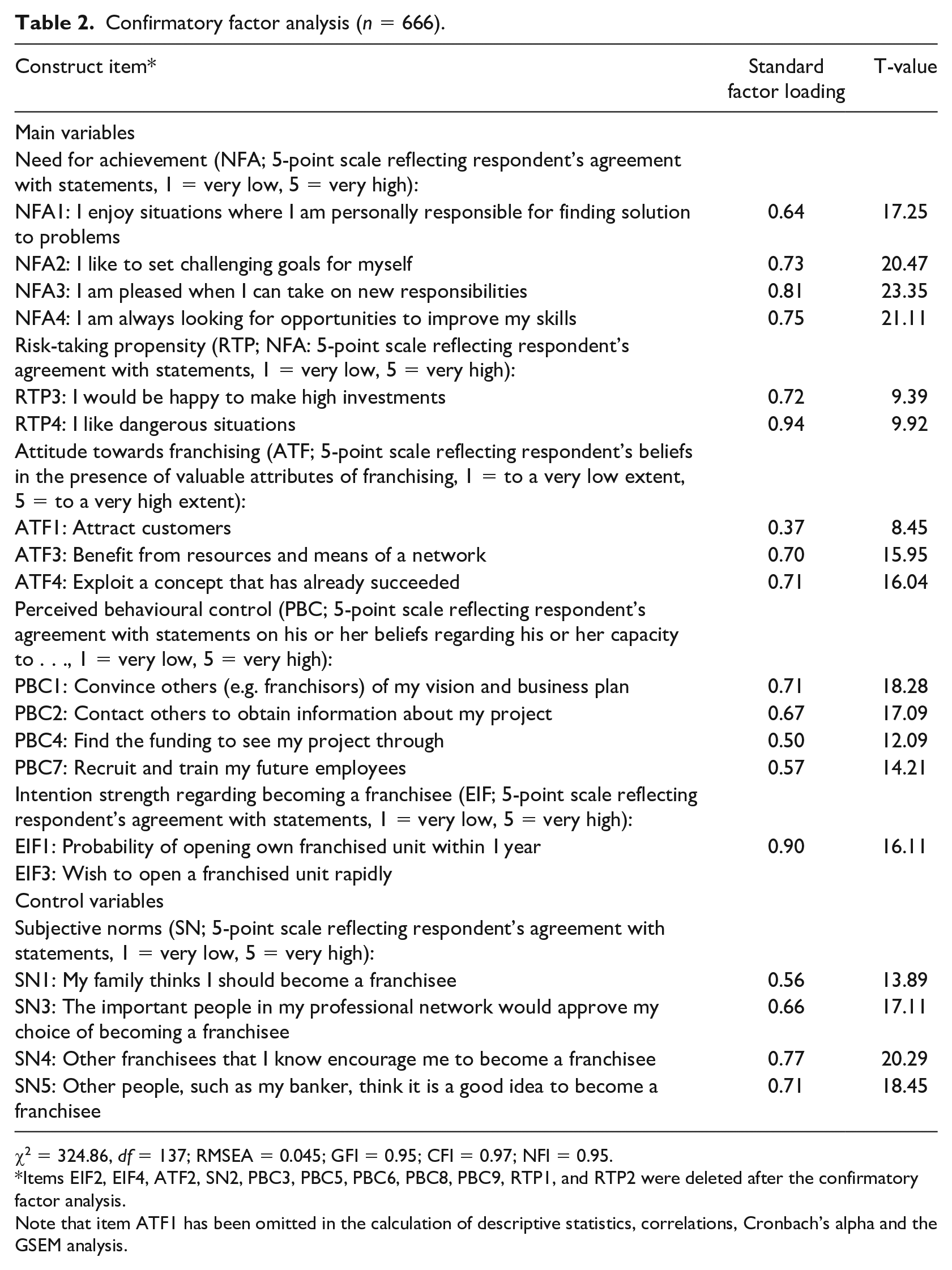
χ2 = 324.86, df = 137; RMSEA = 0.045; GFI = 0.95; CFI = 0.97; NFI = 0.95.
Items EIF2, EIF4, ATF2, SN2, PBC3, PBC5, PBC6, PBC8, PBC9, RTP1, and RTP2 were deleted after the confirmatory factor analysis.
Note that item ATF1 has been omitted in the calculation of descriptive statistics, correlations, Cronbach’s alpha and the GSEM analysis.
We measured NFA by items adapted from Eisenberger et al. (2005), and we measured RTP by items based on Stewart et al. (1998). These measures consider motivations as relatively distal personal traits, which fits with AMT (Atkinson, 1957, 1964, Elliot and Covington, 2001). Regarding our cognitive TPB-based antecedents, we note that the measures for such variables in EI (and other TPB) research have differed widely (Liñán and Chen, 2009; Schlaegel and Koenig, 2014). As our cognitive variables need the same level of specificity as our intention variable, and there are no clear measures yet available for measuring individual cognitive assessments of franchising, we built on extant EI research and in-depth interviews with 10 prospective franchisees and franchisees who were beginning to develop the cognitive measures. Our scale for ATF reflects individual beliefs that the specific behaviour leads to certain outcomes or attributes that they evaluate positively (cf. Schlaegel and Koenig, 2014). Our PBC scale reflects individual beliefs about control of potential outcomes and capabilities to accomplish specific tasks (cf. McGee et al., 2009; Schlaegel and Koenig, 2014). We built our specific PBC scale based on McGee et al. (2009) by framing PBC as an individual’s beliefs in his or her capacity to fulfil tasks relevant in a franchising context.
Based on earlier EI studies, we included the following control variables: subjective norms (SN, as the third main TPB antecedent), age (Sieger and Monsen, 2015), gender (Pfeifer et al., 2016), education (Bastié et al., 2016), and family experience with franchising (Williams, 1998). We measured subjective norms with a scale adapted from Krueger and Brazeal (1994).
Analysis and robustness checks
We first conducted a confirmatory factor analysis for the independent variables and the dependent variable through Maximum Likelihood estimation in Lisrel 8.8. We evaluated each construct and deleted items that caused a bad model fit, making use of the modification indices in the Lisrel programme. The final measurement model shows a good fit (χ2 = 324.86, df = 137; RMSEA = 0.045; GFI = 0.95; CFI = 0.97; NFI = 0.95, Hair et al., 1998). Table 2 shows the item descriptions for the constructs and the factor analysis results.
All loadings on respective constructs were highly significant (p < .001), while all standardised loadings apart from two that were greater than 0.50, demonstrating that the measurement scales have convergent validity (Fornell and Larcker, 1981). As no inter-factor correlations had a confidence interval that contains the value of 1 (p < .01), we also conclude that our scales have discriminant validity. In addition, we undertook robustness checks on our data. We first tested for common method bias performing Harman’s single-factor test (Podsakoff et al., 2003), forcing all constructs in a one-factor model in the confirmatory factor analysis. The χ2/df = 13.81 indicates a bad fit that is significantly worse (Δχ2 = 1773.57, Δf = 15, p < .001) than the fit of the measurement model presented in Table 2. However, as this is a very conservative test (Podsakoff et al., 2003), we also did a more fundamental test. We calculated the method correlation between independent and dependent variables based on the original equation of Podsakoff et al. (2003):

where Rx,y is the observed correlation between variables x and y, true Rti,tj is the true correlation between trait i and trait j, tx and ty are the percentage of trait variances of measures x and y, true Rmk,ml is the true correlation between method k and method l and mx and my are the percentage of method variances of method k and l. To determine Rx,y, we used the Pearson correlations between variables x and y. To estimate √tx, √ty, √mx and √my, we used confirmatory factor analysis results with models of two traits and one method (so √mx = √my) (Bagozzi et al., 1991). In the Podsakoff et al. (2003) equation, there are two unknown variables, true Rti,tj and true Rmk,ml of which the significance of Rmk,ml is important for common method bias. To determine the two unknown variables, we needed two equations with these unknown variables. Therefore, we split our database into two partial databases by either only taking the even id numbers the odd id numbers. In this way, we could calculate the true Rmk,ml for the relationship between ATF, subjective norms, PBC, and EI regarding franchising. The method correlations varied between 0.00 and 0.02 and all were insignificant (p > .68). Thus, we conclude that our data do not suffer from common method bias.
Next, we undertook a reversed causality check to be confident that we can rule influences (inflated) by reversed causality. We used another variable in our database as an instrument (i.e. the respondent’s agreement on a 5-point Likert-type scale with the following statement: ‘Franchisors help new franchisees in finding the financial resources to start their franchised units’). This variable is correlated with the ATF (r = .11, p < .01), subjective norms (r = .14, p < .001) and PBC (r = .23, p < .001) and not correlated with EI regarding franchising (r = .00, p = .98). Making use of this variable as an instrument and applying the Durbin-Wu-Hausman test (Greene, 2012), comparing 2SLS instrumental variable regression with ordinary least squares (OLS) regression results, we were well below the χ2 thresholds. With a probability of 98%, the 2SLS model does not deviate from the OLS regression. Thus, we can rule out an endogeneity effect.
For further analysis, we removed the first item of ‘attitude towards franchising’ as it had, by far, the lowest factor loading (0.37); the Cronbach’s alpha considerably improved when deleting this item. Table 3 displays the descriptive statistics, Cronbach’s alphas and correlations for the constructs. The Cronbach’s alphas ranged from .67 to .82, all but one within the acceptable range (Nunnally, 1978).
Means, standard deviations, correlations and Cronbach’s alphas (n = 666).
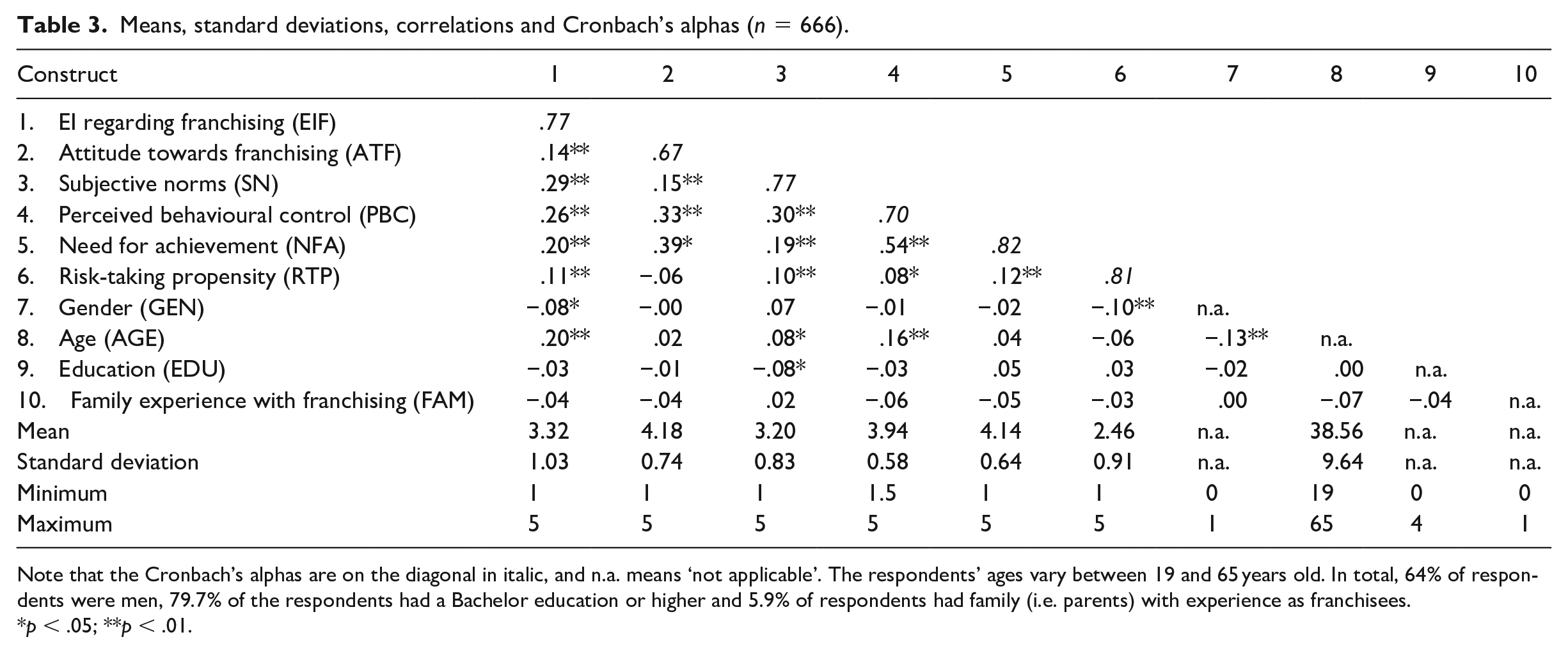
Note that the Cronbach’s alphas are on the diagonal in italic, and n.a. means ‘not applicable’. The respondents’ ages vary between 19 and 65 years old. In total, 64% of respondents were men, 79.7% of the respondents had a Bachelor education or higher and 5.9% of respondents had family (i.e. parents) with experience as franchisees.
p < .05; **p < .01.
To test the hypotheses, we used a path model in generalised SEM (GSEM) making use of Stata 16 as we wanted to show plots of predicted values for the endogenous variables and GSEM in Stata 16 offers the opportunity to make plots in which potential quadratic terms are recognised and considered.
Results
Figure 2 presents most empirical results for our theoretical model, and Figure 3 depicts plots of the predicted values of the endogenous variables. Table 4 presents indirect and total effects to conclude about any mediation effects.
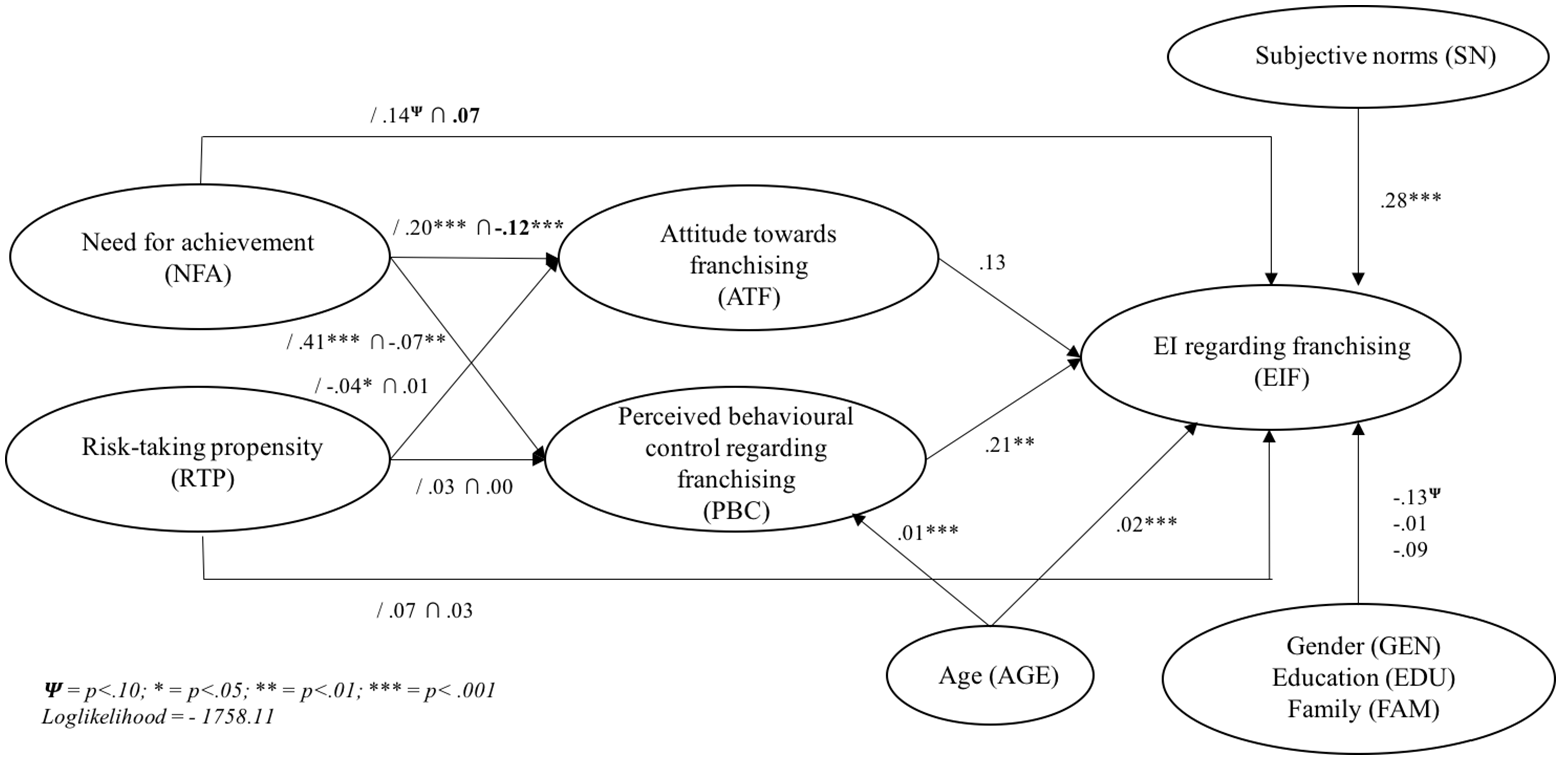
Empirical model: non-standardised GSEM results in Stata 16.
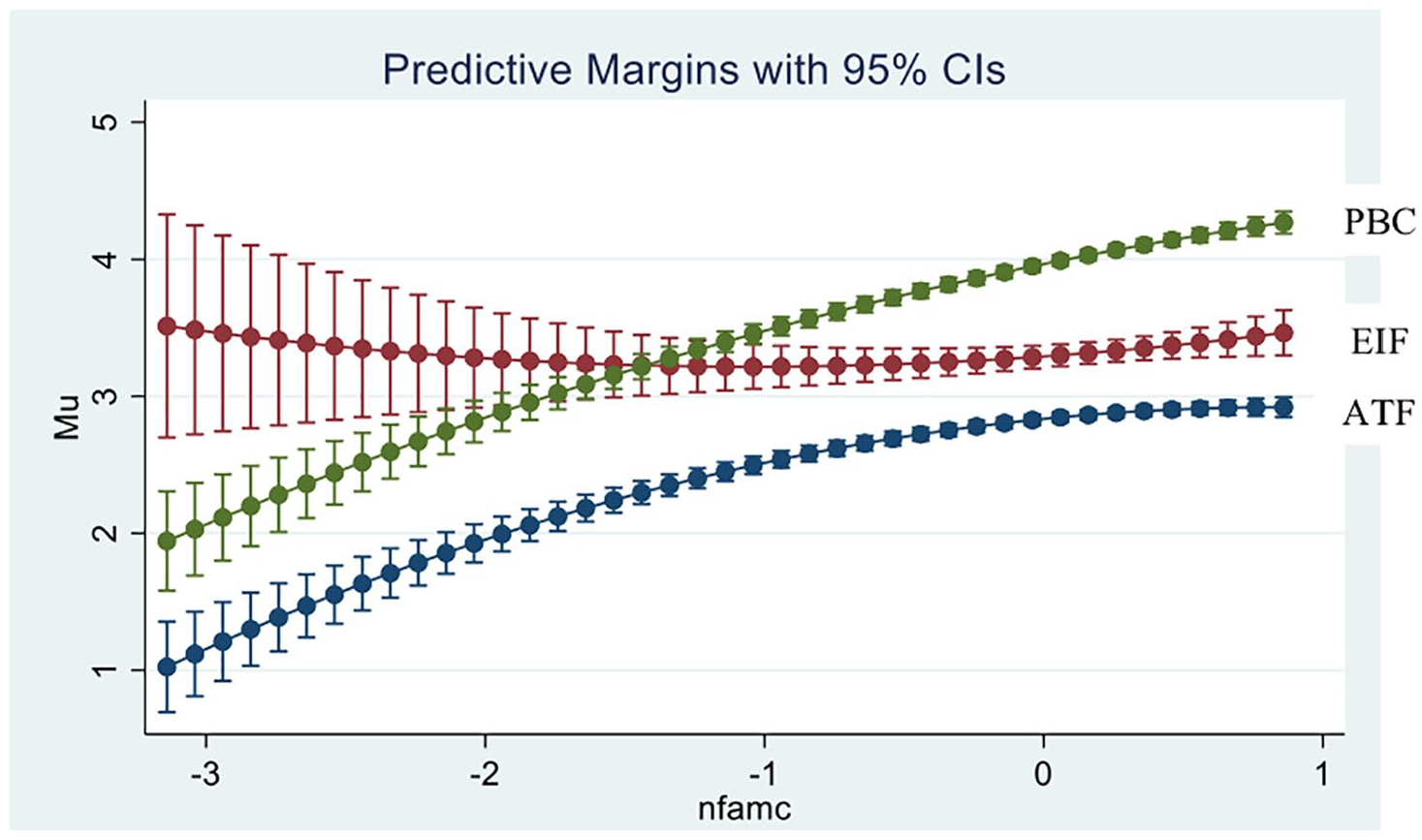
Plots of the predicted values of the endogenous variables; the exogenous variable is the mean-centred version of need for achievement.
Indirect and total effects of need for achievement and risk-taking propensity on EI regarding franchising.
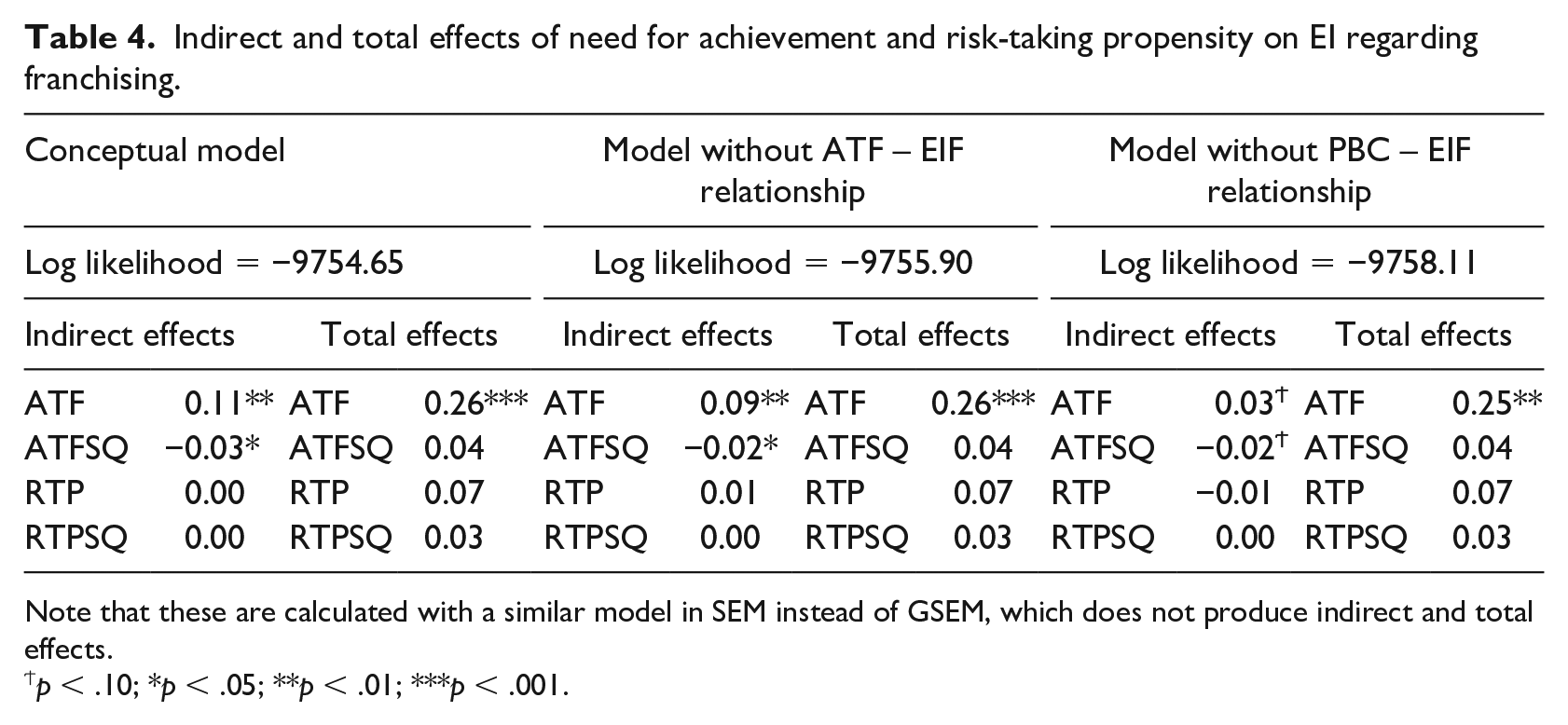
Note that these are calculated with a similar model in SEM instead of GSEM, which does not produce indirect and total effects.
p < .10; *p < .05; **p < .01; ***p < .001.
Hypotheses 1 and 4 focus on the associations of respectively NFA (H1) and RTP (H4) to EI regarding franchising through inverted U-shaped curves. Our results show a weak significant linear positive association between NFA and EI regarding franchising (coefficient of 0.14 with p < .10) but no significant quadratic association, which leads to the rejection of Hypothesis 1. We find no significant linear or quadratic associations between RTP and EI regarding franchising, so we also reject Hypothesis 4.
Regarding the hypotheses on the associations between individual motivations and their cognitive assessments of franchising, Hypotheses 2a and 3a propose that NFA has inverted U-shaped associations with ATF (H2a) and PBC regarding franchising (H3a). Only H2a can be confirmed, the positive coefficient is 0.20 (p < .001), and the squared coefficient is −0.12 (p < .001), while the tipping point is at 4.97, meaning that about 88% of our data is left from the tipping point and 12% (all individuals scoring the maximum of 5 on the NFA scale) is right from the tipping point. H3a first seemed to be confirmed with a positive coefficient of 0.41 (p < .001) and a squared coefficient of −0.07 (p < .01), but the tipping point appears to be at 7.07, meaning that 100% of our data is left from the tipping point. With the declining positive relationship, we find that H3a is not confirmed. From the indirect and total effects in Table 4, we can see that the relationship between NFA and EI regarding franchising is partly mediated by ATF and PBC regarding franchising. It is also shown that PBC regarding franchising is the strongest mediator. Therefore, Hypotheses 2b and 3b are confirmed.
Hypotheses 5a and 6a propose that RTP has inverted U-shaped associations with ATF (H5a) and PBC regarding franchising (H6a). Both Hypotheses 5a and 6a cannot be confirmed. We only find a negative linear association of RTP with ATF (coefficient of −0.04 with p < .05). In Table 4, we can see that there is no mediation effect of ATF and PBC regarding franchising in the relationship between RTP and EI regarding franchising. Thus, Hypotheses 5b and 6b cannot be confirmed either.
Similar to research findings in other EI contexts, we find that PBC regarding franchising is positively associated with EI regarding franchising (coefficient of 0.21, p < .01). Surprisingly, there is no significant association between ATF and EI regarding franchising. Finally, among the control variables, subjective norms and age are positively associated to individual EI regarding franchising, while men have higher intentions to become franchisees than women. The results also show a positive association between age and PBC.
Discussion
Theoretical implications
We contribute to franchising research by enhancing scientific knowledge on the antecedents of individual intentions to become franchisees as a specific type of EI. Whereas, previous studies have shown the relevance of economic, strategic, and demographic variables in explaining individual EI regarding franchising (Bastié et al., 2016; Watson and Stanworth, 2006), our study demonstrates that motivational, and cognitive, variables are also relevant. The adoption of AMT, in combination with TPB, has proven fruitful in our study as our analysis of primary data on 666 individuals (‘non-entrepreneurs’) shows non-linear associations between motivation, on one hand, and cognitive assessment of franchising or EI regarding franchising, on the other hand.
More specifically, in addition to a weak linear and positive association between NFA and EI regarding franchising, we find non-linear associations between individual NFA and their cognitive assessments of franchising. Our results confirm our hypothesis that there is an inverted U-shaped association between NFA and ATF; non-entrepreneurs consider both the expected benefits and costs of franchising. We also find that as need for achievement increases, there is a tipping point after which the expected costs of franchising outweigh the expected benefits. Thus, individual attitudes towards franchising become less favourable. Moreover, within the range of our NFA data, we find a declining positive relationship between NFA and PBC regarding franchising. Future franchising research should study whether there is indeed, a declining positive relationship or whether it turns into an inverted U-shaped relationship. In sum, for franchising research, our results imply that NFA is an important motivational trait that should be recognised in explaining individual cognitive assessments of franchising, and ultimately, EI regarding franchising.
Regarding RTP, we find a linear and negative association between RTP and ATF, whereas we find no association between individual RTP and PBC regarding franchising and EI regarding franchising. These results may arise from different views, ‘risk views’ that our respondents may have regarding the risks of franchising, regardless of their risk-taking propensities. Some may view franchising as a low risk-strategy compared to being a fully independent entrepreneur as they consider the tried-and-tested business format and franchisor support as risk-reducing aspects (Stewart et al., 1998; Watson and Stanworth, 2006). Those adopting such views would typically focus on the marketing benefits of franchising: adopting a tried-and-tested format would result in a well-known brand image and thus, competitive advantage in the market. Given the linear and negative association between RTP and ATF, this view emerged as dominant among our respondents. However, individuals may also view franchising from an economic perspective and see it as a high-risk strategy when compared to being a fully independent entrepreneur. Relatively few studies have built upon this economic view. Rather, it has been empirically demonstrated that franchisees must make large investments in intangible and transaction-specific assets and face the risks of moral hazard by the franchisor, causing higher failure rates (Bates, 1995) or costly litigation procedures (Grünhagen et al., 2017), and higher defaults on third-party loans (Patel and Pearce, 2019). Future franchising studies could delve deeper into these different risk views that individuals may have, and how – together with their risk-taking propensities – these affect their cognitive assessments and EI regarding franchising.
Overall, our study demonstrates the relevance of adopting AMT to analyse individual motivation and also, how this affects cognitive assessments of franchising or EI regarding franchising. The inverted U-shaped and declining positive associations for individual NFA and their attitude and PBC regarding franchising are relevant since – to the best of our knowledge – no previous studies in franchising, or other EI contexts, have considered or empirically demonstrated such non-linear relationships. Our study shows that complementing AMT with TPB is fruitful when studying the impact of individual NFA on cognitive assessments of franchising, which partially act as mediators in the motivation-EI regarding franchising relationship.
Finally, even though contributing to EI research, in general, was not a main aim of our study, we confirm the need for a contextual perspective on EI (noted by Block et al., 2013; Fayolle and Liñán, 2014; Schlaegel and Koenig, 2014) as we find non-linear relationships between individual NFA and cognitive assessments of franchising. Future studies in other EI contexts may consider such associations, although their relevance may depend upon the context under study. For example, when considering EI regarding new business creation as a fully independent entrepreneur, many studies have already established positive linear relationships between individual NFA and EI (see Brandstätter, 2011; Frese and Gielnik, 2014). However, when considering EI in more ‘restricted’ entrepreneurial contexts, such as taking over an existing business, as opposed to starting a new one (Block et al., 2013), or engaging in corporate entrepreneurial behaviours (Fini et al., 2012) the relationships between NFA, cognitive assessments of behaviour and ultimately, EI may take non-linear shapes.
Practical implications
Given the scarcity of suitable franchisee candidates (Bennett et al., 2010), our findings can help franchisors in building a ‘pool’ of individuals with high EI regarding franchising from which they can select suitable individuals whom they can support in pursuing their franchising careers. It may be difficult for franchisors to manage the relatively distal individual motivations (cf. Frese and Gielnik, 2014; Rauch and Frese, 2007), but they can use knowledge on motivations to manage individual cognitive assessments of franchising. Our findings imply that if franchisors aim to attract achievement-oriented individuals, they can reduce concerns regarding expected costs of relational conflicts, for example, by emphasising possibilities for becoming a multi-unit franchisee (Grünhagen and Mittelstaedt, 2005) or for engaging in local adaptation (Dada, 2018; Dada et al., 2010). Of course, franchisors must decide whether such approaches fit with their overall strategies (Watson et al., 2016). Finally, regarding individual RTP, it is hard to provide practical implications to franchisors regarding franchisee recruitment. Future research should first delve deeper into different risk views that individuals may have regarding franchising and how these – combined with their risk-taking propensities – affect their entrepreneurial career choices.
Limitations and suggestions for future research
Most EI studies have adopted cross-sectional research designs, an important limitation in such research (Fayolle and Liñán, 2014; Schlaegel and Koenig, 2014). Even though we conducted statistical tests to rule out problems resulting from our cross-sectional design, future research will benefit from research designs, such as longitudinal designs, that facilitate the establishment of causal linkages. Relatedly, we already pointed out that researchers have increasingly criticised the use of EI as a sole dependent variable because of the barriers that can cause individuals to refrain from engaging in entrepreneurial behaviour (Delanoë-Gueguen and Fayolle, 2019; Van Gelderen et al., 2015, 2018). We agree that studying the intention-behaviour link is an important next step, as relatively few studies in entrepreneurship have done so (recent exceptions are Kautonen et al., 2015; Meoli et al., 2020; Van Gelderen et al., 2018). Future research should open the ‘black box’ of franchisee recruitment processes, including the role of franchisor selection criteria and franchisor–franchisee interactions. Such research should adopt a longitudinal, process-based view and include longer term outcomes, such as franchisee satisfaction or unit performance. Another promising method for studying EI regarding franchising is fuzzy-set qualitative comparative analysis (fsQCA) since this method may provide a finer-grained understanding of the complexities of entrepreneurial phenomena, such as individual EI as argued and demonstrated by Douglas et al. (2020). A final limitation is that we did not account for EI regarding franchising of independent entrepreneurs; we only focused on individuals without prior entrepreneurial experience (‘non-entrepreneurs’). Studying EI regarding franchising of individuals with entrepreneurial experience could be another fruitful research area as this group of individuals may yield different findings.
Conclusion
This article contributes to franchising literature by developing and empirically testing a model to explain individual intentions to become franchisees as a specific type of EI. Overall, we demonstrate the relevance of adopting AMT to explain individual cognitive assessments and ultimately their EI regarding franchising, and the necessity of accounting for non-linear relationships when doing so. Moreover, we show that complementing AMT with TPB is fruitful when studying the impact of NFA on individual cognitive assessments of franchising, and ultimately, EI regarding franchising. These insights provide an appropriate starting point for further investigations into the complex roles of individual motivations and cognitive assessments in explaining individual intentions to become franchisees.
Footnotes
Funding
The author(s) disclosed receipt of the following financial support for the research, authorship and/or publication of this article: This work was supported by the French Franchise Federation.
