



Abstract
Social enterprises (SEs) strive for the fulfilment of a social mission based on an elaborated income strategy. Consequently, they are largely conceptualised as hybrid enterprises combining logics of traditional non-profit organisations (NPOs) and for-profit enterprises (FPEs). This is sound on the organisational level; however, it remains unclear to which extent the perception of SE leaders on the personal level mirrors this hybridity as previous studies are limited in scope and methodology. Our work examines perceived personality traits, work-related values, leadership styles and leader attributes of SE leaders compared to FPE and NPO leaders. Using a vignette-based, comprehensive experimental design with a sample of business students (N = 170), we find that whereas notable differences in personality and leadership comparing SE and FPE leaders exist, SE and NPO leaders were perceived as not different. Based on our findings, theoretical and practical implications are discussed.
Keywords
Traditionally, for-profit enterprises (FPEs) and non-profit organisations (NPOs) are considered different, at times even opposing organisational forms (Justo et al., 2010). Whereas the former rely on innovativeness and an elaborated business plan to generate profit for the entrepreneur and his/her stakeholders, the latter have a clear focus on offering solutions to existing, yet, largely unaddressed social, economic, or environmental problems (Moore, 2000). Doing so, NPOs are usually dependent on governmental funding or private donations, as they do not generate their own income (Dupuy et al., 2016). Apart from financial aspects, differences also emerge in personality and leadership attributes. Lukes and Stephan (2012) found that whereas the motivation to be independent and generate income was dominant amongst leaders of FPEs, NPO leaders stated that helping others and a meaningful work were their most important drivers. Regarding leadership, a comparative analysis of FPEs and NPOs in the UK revealed significantly higher levels of transformational and transactional leadership in the former (Megheirkouni, 2017).
Starting in the 1980s, a new organisational form coined ‘social entrepreneurship’ (SE) blurred the boundaries between FPEs and NPOs (Young, 1983). Social enterprises build on innovative concepts targeting the alleviation of their beneficiaries’ problems, for example, poverty or social marginalisation, by creating social value (Perrini et al., 2010). This can either be done in a donation-financed non-profit environment (Borzaga & Santuari, 2003) or as a so-called ‘hybrid enterprise’ fusing SE’s social mission with an elaborated income strategy (Kruse et al., 2021). Particularly the latter type of social enterprises is theorised to bridge the gap between traditional FPE and NPO logics and range ‘in-between’ both organisational forms (Justo et al., 2010).
However, empirical evidence supporting this assumption is scarce due to three reasons. First, the scope of previous studies is limited, as they focus either on a comparison of FPEs and NPOs or FPEs and SEs (Smith et al., 2014; Thach & Thompson, 2007). Second, the vast majority of data is generated using self-report leader surveys. From a methodological perspective, however, such surveys are known to suffer from several biases and considered unsuitable to draw causal conclusions from (Hsu et al., 2017; Kruse, 2020b). Third, neglecting the external perspective, that is, how others outside the organisation assess the leaders’ characteristics, results in an incomplete picture. Thus, the extent to which self-reported leader differences are mirrored in the outside world remains unclear.
Our study addresses these limitations and jointly investigates perceived personality and leadership differences of hybrid SE leaders compared to FPE and NPO leaders. Doing so, we build on a sample of N = 170 business students and apply a comprehensive experimental design that enables us to avoid self-report biases and draw causal conclusions.
After conceptualising FPEs, NPOs and hybrid SEs, we theoretically derive our hypotheses and research questions, describe the study’s methodology and present the empirical results. Subsequently, our findings are discussed and implications and limitations outlined.
Theoretical Background
Delineating FPEs and NPOs
FPEs and NPOs are ‘stable associations of persons engaged in concerted activities directed to the attainment of specific objectives’ (p. 239) and fulfil the definitional criteria of an organisation (Bittner, 1965). Furthermore, both have the central target to dedicate their organisational resources to the generation of value (Moore, 2000; Thach & Thompson, 2007). However, the kind of value created is different. On the one hand, FPEs apply innovation and breakthroughs, to respond to new needs in a financially lucrative and growth-oriented market (Austin et al., 2006). Thus, FPEs are challenged to spot one of the rare opportunities to earn money in a competitive atmosphere. On the other hand, NPOs have the mission to address long-standing basic needs in society without the prospect of revenue generation (Thach & Thompson, 2007). Serving poor and socially disadvantaged groups they raise funds and resources from donors to improve their target groups’ lives (Dupuy et al., 2016). Consequently, while FPEs aim at creating financial value, NPOs target social value. As a result, several differences can be derived. According to Fottler (1981), FPEs and NPOs provide different incentives for their employees and have a different susceptibility to external constraints. FPEs’ human resource systems rely on financial and career incentives. However, these are either inadequate or completely absent in NPOs which are driven by volunteers and a merit-based work (Perry & Porter, 1982). Thus, FPEs rather satisfy their members’ financial and power needs (Blau & Scott, 1962), while NPOs build on altruism and benevolence (Ring & Perry, 1985). As previous research shows, this makes NPOs particularly vulnerable to suffer from detrimental external influences like political or social crises and increases failure rates (McCaffrey, 2018; Self, 1977). Another notable difference lies in the quantification of outcomes. For FPEs, success measurement can be done applying widely acknowledged parameters like Earnings before Interest and Taxes (ebit) or Return on Investment (ROI). In contrast, assessing the social value created by NPOs is challenging and, to date, no generally accepted measure has emerged (Rawhouser et al., 2019).
In the light of these differences, there is a consensus that the organisational cultures of FPEs and NPOs, that is, their shared patterns and values, are different (Schein, 1991). Given that organisational cultures (a) selectively attract people with similar values and characteristics (Kristof-Brown et al., 2005) and (b) are guidelines for decisions of leaders socialised in the organisation (Schneider et al., 1995), one would expect leaders of FPEs and NPOs to differ in their personality and leadership style. In line with this reasoning, Lukes and Stephan (2012) found that the motivation and goals driving FPE and NPO leaders, that is, their individual work-related values, differ significantly. As an example, FPE leaders considered financial independence and the aspiration to generate income their most important drivers. In contrast, NPO leaders stated that they are motivated by the possibility to help others and the meaningfulness of their work. Other findings largely support these results (Tan et al., 2005; West, 2017). Regarding leadership, differences emerged in leadership visions and styles. Comparing 156 for-profit and non-profit leaders, Ruvio et al. (2010) could show that FPE leaders emphasise flexibility whereas NPO leaders focus on inspirational visions. Furthermore, NPO leaders considered their visions more realistic. Data by Megheirkouni (2017) suggests higher levels of transformational and transactional leadership in FPEs which was later supported by Newman et al. (2018) who claim that these leadership styles are not effective in the social sector.
To sum up, previous research yields that in addition to the formal organisational differences of FPEs and NPOs, there is also acknowledgeable variance regarding their leaders’ personal characteristics and leadership attributes.
Hybrid Social Enterprises
In contrast to FPEs and NPOs, social enterprises (SEs) are a relatively new organisational form. In 1983, Young was the first to scientifically outline the possibility to pursue a social mission with entrepreneurial means and coined the term ‘social entrepreneurship’. Subsequently, a great variety of sub-types of SEs emerged (for a typology, see Crossan et al., 2004). Whereas all SE sub-types share their aspiration to create social value for their beneficiaries and high innovativeness, from an organisational perspective, what differentiates SEs is mainly rooted in their business model. Non-profit SEs focus on acquiring private or political donations to alleviate social problems (Borzaga & Santuari, 2003) while for-profit SEs combine social value creation with an elaborated business plan generating profit (Kruse et al., 2021). For-profit SEs, also referred to as hybrid SEs, combine logics of traditional NPOs and FPEs.
Over the years, a large proportion of research has been dedicated to identifying similarities and differences comparing (hybrid) SEs with FPEs and NPOs (Sassmannshausen & Volkmann, 2018). One notable step was taken by Austin et al. (2006) in their comprehensive theoretical examination of commercial and SEs. Key findings include similarities like the ability to spot opportunities, mobilise resources, or gain access to capital as well as differences primarily attributed to the entrepreneurial mission. Widening the scope, Tracey and Phillips (2007) and Justo et al. (2010) focused on hybridity. According to the former, hybrid SEs’ uniqueness originates from their ‘double-bottom-line’ combining the creation of social value and the generation of financial profit independent from donations. Building on this reasoning, Justo et al. (2010) postulated a model in which hybrid SEs are considered a distinct organisational form ranging ‘in-between’ traditional FPEs and NPOs.
In sum, reviewing the organisational literature yields remarkable differences between the organisational logics and features of hybrid SEs compared with FPEs and NPOs. Thus, from here on, we will refer to SEs as hybrid SEs.
Comparing Personality and Leadership Attributes of Social Entrepreneurs and FPE Leaders
Adding to the acknowledgeable progress made in the conceptual delineation of SEs and FPEs through the organisational lens, there is increasing evidence for differences also in personality and leadership characteristics. Personality, defined as a relatively stable set of individual differences in patterns of thinking, behaving and feeling (Kazdin, 2000) serves as a guide for everyday and professional decisions. One of the most wide-spread personality taxonomies is the Big Five personality model by Costa Jr and McCrae (1992), featuring five distinct traits. Openness describes the extent to which one is willing to make new experiences and prepared to try unconventional and innovative ways of problem solving. Conscientiousness refers to a person’s reliability, perseverance, persistence and motivation to achieve one’s goals. Extraversion is expressed by high levels of energy, sociability and positive emotions. Agreeableness describes a prosocial tendency and characteristics like trust in others and compassion. Finally, neuroticism refers to the ability to manage one’s own emotions and emotional stability. In general, empirical evidence suggests that entrepreneurs show particularly high levels of openness and extraversion, score high on conscientiousness and rather low on agreeableness and neuroticism (Brandstätter, 2011; Rauch & Frese, 2007; Zhao & Seibert, 2006). Driven by the growing interest in what makes SEs unique, scholars explored differences comparing the personality of SE and FPE leaders. While some stress the similarities of both entrepreneurial types given their overlapping (entrepreneurial) tasks (Martin & Osberg, 2007), empirical evidence increasingly yields notable differences (Cohen et al., 2019; Nga & Shamuganathan, 2010; Smith et al., 2014). Regarding openness, social entrepreneurs are considered to be more open than their commercial counterparts due to two reasons. First, social entrepreneurs’ hybrid business models demand extraordinarily high levels of innovativeness and trail-blazing when combining the social mission with a working income strategy (Ip et al., 2017). Second, as social entrepreneurs realise social problems and the possibility to generate income, their awareness is considered higher (İrengün & Arıkboğa, 2015). A recent study on Israeli social and commercial entrepreneurs provides empirical backing for this assumption (Cohen et al., 2019). Regarding conscientiousness SE leaders should outscore FPE leaders given the hardship social entrepreneurs experience due to (a) the generally lower profitability (Austin et al., 2006), (b) the difficulty to attract investors in the light of hard-to-quantify social value (Rawhouser et al., 2019) and (c) the looming danger of mission drifts (Grimes et al., 2019). Consequently, studies emphasise particularly high levels of conscientiousness amongst nascent social entrepreneurs (Nga & Shamuganathan, 2010; Prabhu et al., 2017) and qualitative evidence by Yitshaki and Kropp (2011) showcases how highly focused social entrepreneurs set and achieve their goals. Regarding extraversion, Leadbeater (1997) outlined the importance of social networking skills particularly for social entrepreneurs. Considering the relative novelty of SE, he argues that social networks need to be wider and more diverse in order to gain personnel, money and ideas. This assumption was empirically supported in different economic and cultural contexts (Bauer et al., 2012; Dufays & Huybrechts, 2014; Spear, 2006). As the ability to network with others is highly influenced by one₹s sociability and positive energy, SE leaders should show higher levels of extraversion than FPE leaders. Concerning agreeableness, SE leaders should score higher compared to FPE leaders given their social mission and dedication to improve other people’s lives. The high levels of altruism attributed to social entrepreneurs (Tan et al., 2005) as well as empirical evidence by Nga and Shamuganathan (2010) support this view. Lastly, neuroticism should be lower in SE. As high levels of neuroticism are related to risk-averse behaviours and considering that the risk of failure amongst social entrepreneurs is extraordinarily high (Chipeta et al., 2022; McCaffrey, 2018), one would expect lower neuroticism levels among SE leaders. A study on Peruvian social entrepreneurs supports this notion (Farber et al., 2015).
The above evidence originates from leader self-descriptions and is thus limited to an inward perspective. We argue that the innate differences in SE and FPE business models also affect leaders’ personality perception by people outside the enterprise. The Attraction-Selection-Attrition-Model by Schneider (1987) postulates that only people with high levels of person-organisation-fit, that is, whose personality and goals are compatible with organisational attributes and goals will succeed in an organisation. Applying this to SE and FPE leaders, one would expect that only people whose personality is in line with SEs’ and FPEs’ organisational culture will reach a leadership position due to two reasons. First, following Schneider, people with an incompatible personality will drop out of the organisation soon due to low person-organisation fit. Second, people in leadership positions are representatives of their enterprise and should showcase central aspects of organisational culture like a social mission or a commercial orientation. Consequently, we argue that people outside the enterprise consider SE and FPE leaders representatives of their respective enterprise and its underlying business model and attribute personality traits accordingly (Berry & Frederickson, 2015). Following this reasoning, we derive the following hypothesis:
In addition to Big Five traits, personal values, that is, relatively stable and action-guiding central goals people strive for (Schwartz, 1992), are also an element of an individual’s personality. Yet, unlike the Big Five traits, they are more goal-directed and can vary in different contexts like private or working life (Cable & Edwards, 2004). In fact, values have already been shown to distinguish between SE and FPE leaders (Sastre-Castillo et al., 2015) and a more social or commercial orientation in entrepreneurial nascence (Kruse et al., 2019). According to Schwartz (2003), four integrated dimensions of personal values exist. Self-enhancement (SEH) combines power and achievement and describes the aspiration to make a successful career, become a powerful leader and live a financially independent life. Self-transcendence (ST) consists of universalism and benevolence. People scoring high on this dimension are considered altruistic, caring and eager to help others. Openness to change (OTC) is composed of stimulation and self-direction. People with high scores highly value free thinking, are prepared to take risks, and innovative. Conservation features tradition, conformity and security. Consequently, high scores indicate that people want to keep the status quo and live in line with existing norms and rules. Schwartz conceptualises SEH (focus on personal interests) and ST (focus on others’ interests) as well as OTC (focus on liberty and independence) and conservation (focus on conformity and security) as opposing poles on two value continuums. Previous research suggests notable differences in all dimensions comparing SE and FPE leaders. Social entrepreneurs are prepared to accept lower revenues and deal with the challenging quantification of social value. While this altruistic aspiration is in line with ST, FPE leaders’ behavior focusing on the generation of revenue as a clearly measurable target and a powerful leading position in a competitive market are closer to SEH. Thus, one would expect that SE leaders score higher in ST and lower in SEH. Indeed, a recent meta-analysis by Kruse et al. (2021) empirically backs this assumption in the context of entrepreneurial intention formation. Whereas the state of research regarding OTC and Conservation is more ambiguous, there are indications that nascent social entrepreneurs are more open than nascent leaders of commercial enterprises (Kruse et al., 2019, 2021). From a conceptual perspective, Estrin et al. (2016) highlight that social entrepreneurs require additional skills and knowledge to spot an opportunity to generate social and financial value. Thus, levels of innovativeness and opportunity-alertness should be higher amongst SE leaders (Zahra et al., 2008). Furthermore, several scholars stress the high risk of SE failure which is opposing the security values encapsulated in the Conservation value dimension (Chipeta et al., 2022; McCaffrey, 2018; Perrini et al., 2010).
In the light of this evidence and the previously outlined reasoning that SE and FPE business model differences will be mirrored in the perceived leaders’ attributes, we derive the following hypothesis.
Considering the different foci of SEs and FPEs, the degree of materialism, that is, the personality trait responsible for inter-individual differences in the importance to accumulate material wealth like money, goods or property, should be perceived higher among FPE leaders. In fact, previous studies suggest that a higher degree of post-materialism (i.e., the unimportance of materialism) negatively impacts commercial entrepreneurial activity, both on a national (Uhlaner et al., 2002) and on an individual level (Morales & Holtschlag, 2013). For SE, Stephan et al. (2015) could show that low levels of materialism in a national culture spur SE activity. On the individual level, more socially minded entrepreneurs show lower levels of materialism compared to aspiring commercial entrepreneurs (Jayawarna et al., 2013).
On the basis of this evidence and the reasoning that SE and FPE leaders are considered representatives of these business model differences, we derive the following hypothesis:
Going beyond personality, there is also increasing evidence for differences concerning leadership styles. Leadership, defined as the capability to influence a group towards goal accomplishment (Robbins et al., 2013) serves as a key variable for solving problems (Waddock & Post, 1991) and improving social and economic performance (Alvord et al., 2004). Initial research has shown that unique aspects of leadership qualities are differentially related to SE and FPE leaders (Austin et al., 2006; Bacq et al., 2013; Lukes & Stephan, 2012; Muñoz et al., 2020). In doing so, prior work relied on four key leadership styles: transformational leadership, transactional leadership, servant leadership and entrepreneurial leadership. Transformational leadership is defined as a process through which subordinates are inspired to do more than originally expected (Antonakis et al., 2003; Den Hartog et al., 1997). This leadership style is multi-faceted and encompasses four sub-dimensions: idealised influence, inspirational motivation, intellectual stimulation and individualised consideration (Bass & Riggio, 2006; Geier, 2016). Transactional leadership, in contrast, is expressed by a give-and-take-relationship between leaders and followers, such as providing rewards if followers’ behaviour is in line with leaders’ expectations (Burns, 1978). Transactional leadership includes two sub-dimensions: contingent reward and management by exception (Bass & Avolio, 1995). Servant leadership refers to leadership behaviours in which leaders put subordinates’ interests ahead of their own interests and act in a caring, humble and serving manner (Bao et al., 2018; Van Dierendonck, 2011). Finally, entrepreneurial leadership means motivating and guiding subordinates to investigate and exploit entrepreneurial opportunities (Mehmood et al., 2021; Renko et al., 2015). In essence, empirical evidence suggests that SE leaders show higher levels of transformational and servant leadership and lower levels of transactional and entrepreneurial leadership. First, SE leaders should score higher on transformational leadership given their focus on employees’ interests and wellbeing, as well as the developing trust in the leader–follower relationship (Bass, 1985; De Cremer & Van Knippenberg, 2005). The high consideration of social goals and value attributed to social entrepreneurs (Tan et al., 2005) and recent studies further support this view. For example, Chang and Jeong (2021) found that transformational leadership enhances leader trust and the social impact in SE. Second, regarding transactional leadership, SE leaders should be outscored by FPE leaders due to FPE leaders’ concentration on (a) resource exchange and (b) monitoring and controlling subordinates through economic means (Bass, 1985; Stephan & Drencheva, 2017). Hence, scholars suggest that FPE leaders make more use of transactional leadership (Egri & Herman, 2000) which is also backed by empirical evidence (Afsar et al., 2017). Third, regarding servant leadership, SE leaders should score higher given their focus on morale, values, social responsibility and subordinate’s wellbeing (Bao et al., 2018; Martin & Novicevic, 2010). Empirically, research found higher levels of empathy, trust, integrity and altruism as central elements of servant leadership among SE leaders (Chang & Jeong, 2021; Newman et al., 2018; Petrovskaya & Mirakyan, 2018). Lastly, FPE leaders should score higher in entrepreneurial leadership due to their risk-taking and flexible behavior targeting continuous growth and increasing revenues through product or process innovations (Kruse et al., 2021; Newman et al., 2018). In contrast, for SE leaders, scaling is less desirable, as (a) their business models are often rooted in the local community and not easy to adapt to other circumstances (Perrini et al., 2010) and (b) entrepreneurial growth may increase the risk of mission drifts leading to commercialisation of the enterprise (Grimes et al., 2019).
Similar to the above reasoning regarding personality traits, we argue that people outside the enterprise attribute the innate differences in organisational goals to features of SE and FPE leaders, in this case, their leadership style. Consequently, we derive the following hypothesis:
Leadership attributes, that is, relatively stable and coherent traits (Zaccaro, 2007) that play an important role in driving leadership (Zaccaro et al., 2004), complement rather behaviour-focused leadership styles and allow to attribute perceived leader differences to distinct characteristics. In line with Offermann et al. (1994), six dimension of leader attributes exist, namely sensitivity (i.e., compassionate, sensitive), dedication (i.e., dedicated, motivated), charisma (i.e., charismatic, dynamic), tyranny (i.e., dominant, selfish), strength (i.e., strong, bold) and masculinity (i.e., male, masculine). Prior work suggests notable differences in all leadership attribute dimensions comparing SE and FPE leaders (Gupta et al., 2019; Nichols & Cottrell, 2014; Yan et al., 2018). Along these lines, Dinh and Lord (2012) stated that in competitive environments (e.g., FPEs), leader attributes centre more on individual, dominant traits, while in cooperative environments (e.g., SEs), leader attributes centre more on cooperation. Hence, leadership traits such as sensitivity, dedication and charisma should prevail more than tyranny, strength and masculinity (Epitropaki & Martin, 2004). Indeed, previous research has shown that SE leaders yield higher affiliation and cooperation characteristics such as caring about others’ concerns and interests and lower self-regarding traits such as independence, autonomy, achievement and power (De Hoogh et al., 2005; Kuratko et al., 1997; Lukes & Stephan, 2012). In line with our above reasoning we expect that these differences will be mirrored in the perception of leaders by people outside the enterprise and derive the following hypothesis.
Comparing Personality and Leadership Attributes of Social Entrepreneurs and NPO Leaders
Whereas the examination of FPE leaders’ personality traits has a long tradition and recent studies showed an increasing interest in SE leaders’ traits, empirical research on the personality of NPO leaders is ‘scarce to non-existent’ (Lukes & Stephan, 2012, p. 47). One notable exception is the work by Lukes and Stephan (2012) that compared FPE and NPO leaders applying the Big Five model of personality. While the results yielded no differences between the two groups, the authors themselves note that these findings should not be generalised due to the restricted sample composition. Slightly more evidence has been provided on the values of NPO leaders with a clear focus on what differentiates them from leaders of commercial organisations (Frumkin & Andre-Clark, 2000). A study by Miller-Stevens et al. (2018) showed notable difference, for example, in altruism (in favour of NPOs) and effectiveness (in favour of FPEs). Furthermore, Reinhardt and Enke (2020) found creativity, humbleness, passion for the course and risk-aversion as important virtues attributed to NPO leaders. Yet, a study comparing personality traits or values of NPO leaders and social entrepreneurs is, to the best of our knowledge, non-existent.
Clearly, there is a dearth of research; but, we formulate the following exploratory research question (RQ).
Whereas there is a notable body of research on leadership in NPOs, particularly, regarding differences from FPE leadership (Megheirkouni, 2017; Ruvio et al., 2010), Newman et al. (2018) rightly state that literature combining leadership and SE is ‘underdeveloped’ (p. 2905). Consequently, findings are scarce and to the best of our knowledge, no study to date searched for leadership differences comparing NPO and SE leaders. However, considering the conceptualisation of SEs as hybrid enterprises combining entrepreneurial logics and a social mission, one could expect leadership differences compared to donation-financed NPOs. Thus, we derive our second research question as follows.
Methods
Sample Choice, Sampling Procedure and Sample Composition
As the central goal of our study was the investigation of leader perceptions from outside to shed light on how SE, FPE and NPO leaders are perceived by others. University students studying business or related subjects were chosen as respondents due to two reasons. First, in general, university graduates are often recruited by commercial and social start-ups or NPOs and are thus very likely to start their working career in one of these organisations (Nyström, 2021). Consequently, and as university graduates’ perception of leaders might influence their decision on which organisation to join (Rudic et al., 2021), this population was considered relevant for our study. Second, in contrast to university students in other field, students studying business and related subjects usually have a more profound knowledge about different organisational forms. Consequently, we judged them as the most suitable population of university students considering their background knowledge.
To acquire participants for our study, we applied two central strategies. First, the study was advertised in business lectures covering a broad range of students from different business-related study programs like business administration, business psychology or business communication. Second, we requested members of different student councils at the Faculty of Business to share and post our study advertisement in student forums and chat groups. As no restrictions were made concerning the participants apart from their business background, a convenience sampling technique was used. The whole acquisition process took roughly six weeks.
The sample recruited for our study consisted of N = 170 university students studying business or related subjects at a German university. The sample was composed of 119 female students (70%) aged 17–42 years (M = 25.94; SD = 10.10) and 51 male students (30%) aged 19–41 years (M = 28.27; SD = 10.48). The overall mean age of our sample was 26.64 years (SD = 10.24). The most frequently studied subject amongst our participants was business administration (42%), followed by business psychology (26%), business communication (12%), business law (9%), marketing (6%) and business informatics (5%). The participants were almost equally distributed between our three experimental groups (FPE: n = 57; NPO: n = 57; SE: n = 56).
Study Design
To examine our hypotheses and research questions, we used an experimental vignette methodology (Aguinis & Bradley, 2014). Participants were invited to fill in an online survey and requested to rate personality and leadership characteristics of a typical person working either as an (a) FPE leader, (b) NPO leader or (c) SE leader. Each participant was randomly assigned to one of the conditions and had no knowledge about the existence of the two other conditions. In every condition, participants read a short description of the central features of FPEs, NPOs or SEs. The descriptions based on already validated vignettes used in previous studies (Kruse et al., 2019; Wach et al., in press) and were composed of two sections. The first section featured a description of the core features of the business model rooted in scholarly literature. In the second section, a sample organisation was described to illustrate central organisational goals and how they are intended to be achieved. After reading the vignettes, participants went through a manipulation check and were asked about basic information regarding the respective business model in their condition. This way, we secured that all participants had a common knowledge base and were attentive. Furthermore, only participants who reported to have completed the survey in a concentrated manner and in an undisturbed environment were included in our final sample.
Measures
To measure our dependent variables, we relied on a set of previously validated and widely applied scales of personality, values and leadership styles and attributes. All scales either have official German translations validated in the context of German university students or were originally crafted in Germany. To additionally secure that all scales used have a high internal consistency, Cronbach’s alpha was calculated based on our sample and is reported in every scale description. Unless otherwise stated, all scales are seven-point Likert scales (1 = ‘strongly disagree’, 7 = ‘strongly agree’).
Personality Traits
In line with Kazdin (2000) and as previously outlined, we consider all variables personality traits that are relatively stable over time and represent rather general individual differences in patterns of thinking, behaving and feeling. In our study, we build on the most widespread taxonomy of personality traits, the Big-Five model by Costa Jr and McCrae (1992).
Perceived personality traits were measured using the German short form of the Big Five Inventory (BFI) with ten items (John et al., 1991; Rammstedt et al., 2014). Openness, that is, the degree to which people enjoy new experiences and behave innovatively was measured with two items (α = 0.69), for example, ‘This person considers him/herself as someone who has an active imagination’. Conscientiousness, that is, a person’s reliability, perseverance, persistence and motivation to achieve one’s goals was measured with two items (α = 0.75), for example, ‘This person sees him/herself as someone who does a thorough job’. Extraversion, defined as the extent to which a person is rather outgoing, sociable, and has positive emotions was measured with two items (α = 0.74). An example item was ‘This person considers him/herself as someone who is outgoing, sociable’. Agreeableness, that is, the tendency to show trust and prosocial behaviour was assessed with two items (α = 0.77), for example, ‘This person considers him/herself as someone who is generally trusting’. Neuroticism, that is, the ability to manage one’s own emotions and general emotional stability was assessed with two items (α = 0.70), for example, ‘This person considers him/herself as someone who gets nervous easily’.
Work-Related Values
Following the definition of Schwartz proposed in his Basic Human Values Theory (1992), values are considered the central goals people strive for in their lives. As the current study was interested in the perception of work-related values of organisation leaders and not their values in general, we decided on acquiring work values, that is, the central goals people strive for in their working lives (Cable & Edwards, 2004).
The perceived values were measured with the German version of the Work Values Survey (Cable & Edwards, 2004) by Hirschi (2011). The scale was composed of 24 items. For each item, participants were instructed to indicate how important certain job features were to the person described in their condition. Self-enhancement, defined as the degree to which personal career-related interests like pay and power are pursued was measured with six items (α = 0.88). As an example, participants rated how important ‘the amount of pay’ was to the leader described. Self-transcendence, that is, the extent to which one is benevolent, altruistic and eager to help others was assessed with six items (α = 0.92), for example, by rating the importance of ‘being of service to society’. Openness to change, that is, the aspiration to work independently, on different things, and in a creative way was measured with six items (α = 0.85). As an example, participants rated the importance of ‘doing something different every day’ for the leader described. Conservation, defined as the importance of security and clarity in one’s working life was assessed with six items (α = 0.88), for example, the importance of ‘being certain to keep one’s job’ had to be rated.
Materialism
Materialism, that is, the degree to which one highly values and is focused on gaining money, property and wealth is not explicitly included in the Big-Five model. Yet, it can also be considered a personality trait, as an individual’s materialism is a consistent pattern of thinking and remains relatively stable over time (Jaspers & Pieters, 2016). Materialism was measured with a scale by Scherhorn et al. (2014) consisting of ten items (α = 0.93). An example item was ‘This person often thinks about how nice it would be to live a more luxurious life’.
Leadership Styles
As mentioned in the theoretical background, we define leadership in line with Robbins et al. (2013) as the capability to influence a group towards goal accomplishment. There are different leadership styles, that is, specific behavioural patterns to lead groups or individuals that can be shown. Some of the most widespread leadership styles were included in our study: Transformational leadership was assessed using the 16-item transformational leadership scale from the German version (Felfe & Goihl, 2002) of the Multifactor Leadership Questionnaire Form 5X (MLQ 5x-short) (Bass & Avolio, 1995). The scale consisted of five items pertaining to idealised influence (e.g., ‘this leader is a symbol of success and accomplishment’; α = 0.77), four items pertaining to inspirational motivation (e.g., ‘this leader talks optimistically about the future’; α = 0.81), three items pertaining to intellectual stimulation (e.g., ‘this leader gets me to look at problems from many different angles’; α = 0.68) and four items pertaining to individualised consideration (e.g., ‘this leader treats me as an individual rather than just a member of the group’; α = 0.87). Transactional leadership was measured using the seven-item transactional leadership scale from the German version (Felfe & Goihl, 2002) of the Multifactor Leadership Questionnaire Form 5X (MLQ 5x-short) (Bass & Avolio, 1995). The scale encompassed four items pertaining to Contingent Reward (e.g., ‘this leader discusses in specific terms who is responsible for achieving performance targets’; α = 0.72) and three items pertaining to management-by-exception (e.g., ‘this leader keeps track of all mistakes’; α = 0.74). Servant leadership was measured with a 14-item scale developed by Ehrhart and Naumann (2004). A sample item was ‘this leader spends the time to form quality relationships with employees’ (α = 0.94). Entrepreneurial leadership was examined using the eight-item questionnaire developed by Renko et al. (2015). A sample item was ‘this leader wants me to challenge the current ways we do business’ (α = 0.75).
Leader Attributes
In contrast to the more behavior-focused leadership styles, leader attributes refer to stable and coherent traits that play an important role in driving leadership (Zaccaro et al., 2004). Thus, they complement leadership styles: Leader attributes were assessed with a widespread German version of Offermann et al.’s (1994) 36-item scale (Vogel & Werkmeister, 2021). The scale is composed of seven dimensions of leader attributes, namely sensitivity (6 items, e.g., understanding; α = 0.92), dedication (4 items, e.g., disciplined; α = 0.80), tyranny (10 items, e.g., domineering; α = 0.93), charisma (3 items, e.g., inspiring; α = 0.83), masculinity (2 items: masculine; α = 0.80) and strength (4 items, e.g., powerful).
Controls
Age and gender were included as control variables as recent research suggests a potential influence on the perception of different entrepreneurial business models (Chipeta et al., 2020; Kruse, 2020b).
Statistical Analyses
Analysing our data, we followed a two-step procedure. First, we checked for outliers using Mahalanobis distance (D2) and variance homogeneity as an essential pre-condition for further analyses with a Levene test. Second, a multivariate analysis of co-variance (MANCOVA) based on the general linear model was applied to investigate overall and group differences regarding our dependent variables caused by the business model as an independent variable. In contrast to other approaches like t-tests, MANCOVAs have three central advantages (Field, 2018). (a) The general linear model allows to include all variables of interest in one single model. Thus, instead of conducting single t-tests for all dependent variables, one statistical model can accommodate all variables preventing alpha-error-inflation. (b) MANCOVA allows to include several control variables. Concerning our study, age and gender were relevant as they may affect the perception of organisational leaders. Thus, it was important for our statistical model to include them as control variables. (c) MANCOVAs based on the general linear model enable to conduct post-hoc analyses to determine not only the existence of significant differences but also where these differences emerge. As, in our study, the independent variable ‘business model’ has three conditions (SE, FPE, NPO), this is essential to test our hypotheses and research questions. Consequently, after examining the general effect of our independent variable on the dependent variables, we ran a post-hoc analysis with a simple contrast to identify condition-level differences comparing (a) SE leaders and FPE leaders and (b) SE leaders and NPO leaders. For all calculations, the program SPSS Statistics 27 was used.
Results
Pre-Analyses
Investigating outliers in our data, we calculated Mahalanobis distances (D2). As none of the observations violated the assumption of equidistant scores based on the sample-size-adapted thresholds proposed by Penny (1996), no participant was excluded. To check whether our data fulfilled the condition of variance homogeneity, we applied a Levene test for all dependent variables. Results yielded no indication of variance heterogeneity. Thus, all variables were suitable to be included.
General Effects
Computing MANCOVA, we found a significant general effect for the business model (F (2, 167) = 2.09; p < 0.01; η2 = 0.39). According to Cohen (1988) the effect size indicates a medium effect. No significant effects were found for the control variables gender (F (1, 168) = 1.44; p = 0.13) and age (F (31, 138) = 1.00; p = 0.51). Regarding effects of the business model and the control variables on our dependent variables, several significant differences in leader perception based on the business model emerged as can be seen in Table 1. Concerning the Big Five personality traits, a significant effect for agreeableness occurred (F (2, 167) = 16.67; p < 0.01; η2 = 0.28). For work value dimensions, significant effects for self-transcendence (F (2, 167) = 21.76; p < 0.01; η2 = 0.33), self-enhancement (F (2, 167) = 17.16; p < 0.01; η2 = 0.28) and conservation (F (2, 167) = 17.60; p < 0.01; η2 = 0.29) emerged. A significant difference was also found for materialism (F (2, 167) = 16.08; p < 0.01; η2 = 0.27). Regarding leadership styles, the MANCOVA yielded significant differences in the transactional leadership facet management by exception (F (2, 167) = 7.47; p < 0.01; η2 = 0.15), the transformational leadership facets idealised influence (F (2, 167) = 4.71; p < 0.05; η2 = 0.10) and individualised consideration (F (2, 167) = 3.53; p < 0.05; η2 = 0.08) as well as servant leadership (F (2, 167) = 12.39; p < 0.01; η2 = 0.22). Finally, significant differences for the leader attributes sensitivity (F (2, 167) = 17.33; p < 0.01; η2 = 0.29) and tyranny (F (2, 167) = 4.45; p < 0.05; η2 = 0.09) emerged. The effect sizes ranged from small to medium.
Summary of Business Model Influences.
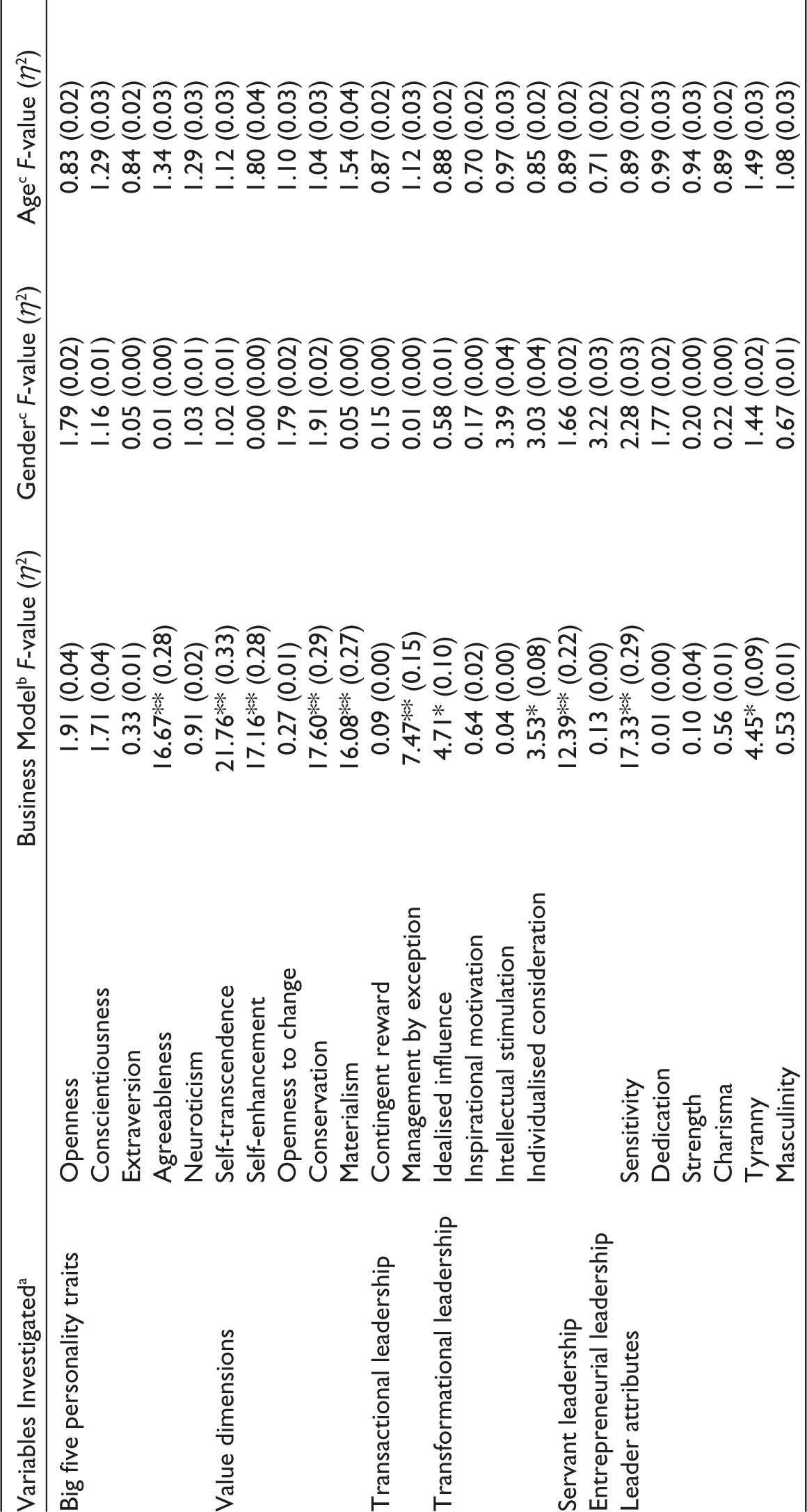
However, as the scope of our study covers distinct differences comparing SE leaders with FPE and NPO leaders, general effects alone are not sufficient to check our hypotheses and research questions. Thus, post hoc analyses were required.
Investigating Hypotheses and Research Questions: Post Hoc Analyses
To check our hypotheses, we conducted a post hoc analysis based on a simple contrast and found several significant effects. H1 suggesting that SE leaders are perceived as scoring higher in openness, conscientiousness, extraversion and agreeableness and lower in neuroticism compared to FPE leaders received mixed support (Table 2). Whereas in line with H1, agreeableness was perceived higher amongst SE leaders (ΔM = –1.54 [SE = 0.28; p < 0.01]), no significant effects were found for openness (ΔM = –.29 [SE = 0.28; p = 0.31]), conscientiousness (ΔM = 0.31 [SE = 0.25; p = 0.22]), extraversion (ΔM = –.16 [SE = 0.27; p = 0.54]) and neuroticism (ΔM = 0.11 [SE = 0.26; p = 0.68]). H2 proposed that SE leaders are perceived to score higher in self-transcendence and openness to change and lower in self-enhancement and conservation compared to FPE leaders. The results shown in Table 2 support our hypothesis for self-transcendence (ΔM = –1.73 [SE = 0.29; p < 0.01]), self-enhancement (ΔM = 1.01 [SE = 0.26; p < 0.01]) and conservation (ΔM = 1.14 [SE = 0.28; p < 0.01]). However, no significant effect for openness to change was found (ΔM = –.07 [SE = 0.21; p = 0.81]). Regarding H3 claiming that SE leaders are perceived to score lower in materialism compared to FPE leaders, we find full support (ΔM = 1.57 [SE = 0.29; p < 0.01]).
Summary of Post Hoc Analyses for Personality.

H4 suggesting that SE leaders are perceived as scoring higher in transformational leadership (in terms of idealised influence, individualised consideration, intellectual stimulation, inspirational motivation) and servant leadership and lower in transactional leadership (in terms of management-by-exception and contingent reward) and entrepreneurial leadership compared to FPE leaders received mixed support (Table 3). In line with H4, servant leadership (ΔM = –1.03 [SE = 0.26; p < 0.01]), idealised influence (ΔM = –1.03 [SE = 0.26; p < 0.01]) and individualised consideration (ΔM = –.90 [SE = 0.31; p < 0.01]) were perceived higher amongst SE leaders. No significant effects were found for inspirational motivation (ΔM = –.01 [SE = 0.27; p = 0.98]) and intellectual stimulation (ΔM = 0.05 [SE = 0.29; p = 0.86]). Supporting H4, management-by-exception was perceived higher amongst FPE leaders (ΔM = 1.11 [SE = 0.31; p < 0.01]). However, no significant effect for contingent reward (ΔM = –.13 [SE = 0.26; p = 0.63]) and entrepreneurial leadership (ΔM = 0.09 [SE = 0.19; p = 0.61]) was found.
Summary of Post Hoc Analyses for Leadership Styles.

H5 suggesting that SE leaders are perceived as scoring higher in sensitivity, dedication and charisma and lower in tyranny, strength and masculinity compared to FPE leaders received partial support (Table 4). In line with H5, sensitivity (ΔM = –1.29 [SE = 0.26; p < 0.01]) was perceived higher among SE leaders. In addition, tyranny (ΔM = 0.80 [SE = 0.32; p < 0.05]) was perceived higher amongst FPE leaders. However, no differences were found for dedication (ΔM = 0.06 [SE = 0.23; p = 0.79]), charisma (ΔM = 0.09 [SE = 0.29; p = 0.75]), strength (ΔM = 0.49 [SE = 0.29; p = 0.09]) and masculinity (ΔM = 0.11 [SE = 0.35; p = 0.75]).
Summary of Post Hoc Analyses for Leader Attributes.

Investigating our research question RQ1 on whether the perceived personality traits, work values and degrees of materialism differ comparing SE and NPO leaders, no significant effects emerged. The same result was found for RQ2 (Tables 2–4).
Discussion
While the conceptualisation of SEs as a distinct, hybrid organisational form combining elements of FPEs and NPOs is theoretically sound and convincing, empirical research trying to underpin this reasoning suffers from several limitations. As previous studies (a) never compared SEs to FPEs and NPOs simultaneously and (b) relied on self-report data of respective leaders only, their scope and methodological quality is limited. Our work addresses these limitations and builds on a sample of 170 business students comparing personality traits, work values, leadership styles and leadership attributes of SE leaders to FPE and NPO leaders applying a comprehensive experimental design.
Comparing Perceived SE and FPE Characteristics
Testing our first H1 on differences in personality traits, we found that SE leaders were rated higher in agreeableness. In contrast to revenue-centred FPEs, SEs have the primary objective to create social value (Austin et al., 2006). Per definition, this encompasses the disposition to act in a prosocial manner matching central agreeableness elements (Tan et al., 2005). However, notably, no differences were found comparing the other four personality traits. Whereas this result seems bewildering at first glance, one can presume that it originates from the conceptual similarities of SEs and FPEs. Despite the different primary objective (social value vs. financial revenue) both apply entrepreneurial means to achieve their goals. Thus, the basic success factors in securing competitiveness on the free market should be similar (Gupta et al., 2019). Accordingly, both SE and FPE leaders should be open for new chances and resources to be exploited (openness), hard working and focused (conscientiousness), communicative and outgoing (extraversion) and emotionally stable (low neuroticism). Consequently, it could be that the entrepreneurial aspect of FPEs and SEs was dominant in the leader perception of our subjects and, with the exception of agreeableness, mirrored in the personality ratings. The same reasoning can be applied to perceived differences regarding work values investigated in H2. As predicted, SE leaders scored higher on self-transcendence and lower on self-enhancement and conservation. Finding no differences in openness to change values, one can suspect that openness value is another construct believed to be equally required by both leaders (Jeraj et al., 2015). In contrast, H3, yielded significantly higher scores in materialism among FPE leaders which is congruent to their revenue focus. Regarding differences in leadership characteristics, in line with H4, SE leaders were perceived higher in servant leadership and two components of transformational leadership (idealised influence and individualised consideration). This provides additional support for the perceived importance of ‘doing good’ in SE that includes social value creation and implies a caring attitude towards one’s own staff (Battilana et al., 2018). Furthermore, social entrepreneurs are sometimes referred to as ‘heroic individuals’ (Matsushima & Kijima, 2019) explaining their higher scores in idealised influence. In contrast, FPE leaders were perceived higher in the transactional leadership component management by exception. In line with the focus on efficiency and cost-minimisation to remain profitable, monitoring mistakes seems more important compared to SE. Finding no differences in the other components is an indication that some leadership aspects are perceived more context-dependent than others. This backs the assumption of Lord and Maher (1991) who highlight that ‘some traits may be useful and desired across several leadership positions’ (p. 97), whereas also ‘the specific context […] dictates what traits are necessary for success’ (p. 97). Finally, comparing leadership attributes in H5, SE leaders were rated as more sensitive and less tyrannical while no differences occurred in the other attributes. Thus, dedication, charisma, strength and masculinity were seen as equal amongst both leaders, that is, aspects of rather business model independent entrepreneurial leadership attributes.
Comparing Perceived SE and NPO Characteristics
For both research questions RQ1 and RQ2, no significant differences were found. Thus, SE and NPO leaders were seen as not different comparing personality and leadership characteristics. This is in stark contrast to the theoretical differences postulated in corresponding conceptualisations (Justo et al., 2010). One reason for that could be that both SEs and NPOs pursue social missions. This shared feature could have triggered a halo effect in which the social objectives of both organisational forms are so dominant in perception that innate differences, like the financing, are neglected (Gibson et al., 2016).
Implications for Research and Practice
Drawing from our results, the following implications can be derived:
First, regarding the conceptualisation of SE as a hybrid organisational form, this assumption was only partly mirrored in the perception of our subjects. While several differences were found compared to FPEs, no NPO differences emerged. Thus, while established theoretical models make use of the social mission and organisational financing to delineate the three organisational forms, social goals seem to be dominant in the perception of organisational leaders. This could hint towards a social halo effect and should be examined further.
Second, despite several significant differences comparing the perception of FPE and SE leaders, a notable set of equally attributed personality and leadership characteristics like openness and entrepreneurial leadership emerged. This supports the assumptions that (a) both entrepreneurial forms have a common core of ‘entrepreneurial traits’ that are deemed necessary to be successful and (b) there is a context-dependency of personality attributes and leadership behavior in which attributes are perceived as more or less feasible depending on the primary objective of the enterprise (Dinh & Lord, 2012; Lord & Maher, 1991). Future research should further consolidate these initial findings and elaborate more on the role, different cultures and socio-economic factors can play.
Third, as the current study shows, experimental designs have the potential to yield important insights complementing survey-based research. To put empirical evidence in SE on a more solid basis, we encourage SE scholars to consider experiments as a legitimate and promising way to extend and solidify our knowledge-base (Kruse, 2020b).
Fourth, and from a practitioners’ perspective, our findings provide important information on the perception and ultimately the expectation of personality and leadership attributes of SE leaders by people outside the enterprise. These insights can help SE leaders get a more detailed understanding of their public image compared to FPE and NPO leaders and contribute to the identification of misperceptions like a social halo effect and their alleviation in direct interactions with potential employees, investors or beneficiaries.
Limitations
Our study has the following limitations:
First, we used a convenience sample of German business students. Thus, our findings cannot be generalised. Furthermore, cultural aspects and the socio-economic situation in Germany could have influenced the results. While using a sample of business students is not uncommon, more experienced subjects like managers could have increased the validity of our findings.
Second, the sample investigated in our study is composed of 70% females. Despite including gender as a control variable and calculations yielding no significant general or dependent variable effects, future studies should pay more attention to acquire gender-balanced samples.
Third, in contrast to FPEs and NPOs, SEs are still a rather unknown organisational form in Germany. While providing a vignette in all three experimental conditions to secure a common knowledge-base, this unfamiliarity could have biased our results.
Fourth, the personality and leadership characteristics investigated represent only a small selection of a large body of constructs. Consequently, the investigation of other personality traits like core self-evaluations (Judge et al., 2005) or leadership styles (e.g., ambidextrous leadership; Rosing et al., 2011) is necessary for a more nuanced picture.
Finally, SE is not the only entrepreneurial form combining two different missions. While examination of other forms like environmental entrepreneurship (Dean & McMullen, 2007) was beyond the scope of this study, it is required to further explore how context-specific the perception of entrepreneurial personality and leadership attributes is.
Conclusion
Using an experimental design and a sample of business students, the current study explores the extent to which the theoretically sound conceptualisation of SEs as hybrid enterprises ranging between traditional FPEs and NPOs is mirrored in the perception of respective leaders’ personality traits and their leadership styles and attributes. The results of a MANCOVA suggest that while notable differences in personality and leadership perception comparing SE and FPE leaders emerged, SE and NPO leaders were perceived as not different. This suggests that in contrast to theoretical conceptualisations, the perceived difference of SE leaders compared to FPE leaders is way stronger than perceived differences in the SE/NPO leader comparison. While reasons for our findings could lie in a halo effect triggered by the social mission of SEs and NPOs, it is also remarkable that SE and FPE leaders seem to be attributed a common core of ‘entrepreneurial’ personality and leadership characteristics. Future research should consolidate our findings and examine the effects of culture and socio-economic circumstances on the perception of SE, FPE and NPO leaders using a broader range of personality and leadership facets.
Footnotes
Declaration of Conflicting Interests
The authors declared no potential conflicts of interest with respect to the research, authorship and/or publication of this article.
Funding
The authors have received no financial support for the research, authorship and/or publication of this article.