



Abstract
The present study investigated the effects of intermarriages versus intramarriages on intragroup and intergroup relationships in terms of evaluation, perceived similarity, social distance and social contact. For this purpose, data were collected from 200 members of the Ertushi and Pinyanishi Kurdish tribes living in Hakkari, Turkey who practiced intramarriage (n = 108) or intermarriage (n = 92). Results show that intermarried participants assessed both tribal identities not only positively but also similar to themselves, whereas intramarried participants assessed their tribe more positively and similar to themselves than the other tribe. Also, intermarried participants were significantly different from intramarried participants in terms of contact frequency with ingroup, contact frequency and quality with outgroup and social distance towards outgroup. These findings imply that social identity acquired through marriage affects one’s perception and attitude towards members of that identity positively, as well as reducing social distance and increasing contact frequency/quality with them.
Keywords
Until recently, groups encouraged their members to practice intramarriages, and they would rarely welcome intermarriages, meaning marrying a person from a different cultural, ethnic or religious group (Clark-Ibanez & Felmlee, 2004). Over the last four decades, however, intermarriages between different ethnic and cultural groups (Batson et al., 2006; Qian & Lichter, 2011) and different religious groups (Lee et al., 2017; Sherkat, 2004) have been dramatically increasing.
The majority of studies have investigated the consequences of intermarriages in terms of social integration, intergroup attitude, behaviour and perception within the framework of the assimilation theory, which suggests that intermarriages cause identity assimilation and wear down ethno-racial boundaries, which result in the absence of prejudice, discrimination and conflict. There are, indeed, several findings indicating that intermarriages increase social integration and diminish the ‘we-they’ opposition between groups (Carol, 2013; Dribe & Lundh, 2011; Giorgas & Jones 2002). However, some researchers working in this field have recently contested the link between intermarriage and integration (Rodríguez-García et al., 2016; Safi & Rogers 2008; Song, 2009; Törngren et al., 2016), claiming that intermarriage does not necessarily decrease ethno-racial divisions or prejudice and discrimination against other groups (Herman & Campbell, 2012). For example, a study conducted in France by Safi and Rogers (2008) indicates that the relationship between intermarriage and integration is positive for most European groups but negative for other groups (e.g., Portuguese and Asians), whereas there is no relationship between these two variables for some groups (e.g., Tunisians). Rodríguez-García et al. (2016) investigated prejudices and spousal preferences expressed by intermarried people towards their own group, the Spanish community and other groups. By analysing narratives from 58 immigrants of 7 different origin countries, they concluded that ethno-racial prejudices also exist among intermarried couples and that prejudiced couples see themselves as members of different identities rather than the same identity.
As seen in the above studies, it is not clear how intermarriages affect intergroup relations, and more research is needed to reveal the consequences of intermarriages, especially on the topics of identity affiliations, perceptions, attitudes and social inclusion/exclusion processes (Rodríguez-García, 2015; Rodríguez-García et al., 2016). Social Identity Theory (SIT) and the Crossed Categorisation Model (CCM) in social psychology suggest that the positivity of a person’s perceptions, attitudes and behaviours towards other people depends on whether the people in question are members of the same group (i.e., category) as themselves (Mullen et al., 2001). Based on this theoretical approach, we suggest that an important reason for the inconsistencies in the literature on assimilation regarding the consequences of intermarriages on intergroup relationships might be due to not taking into consideration the intermarried individuals’ identity affiliations (belonging and identification) based on their original group and the new group they joined after marriage. One of the main objectives of the present study is to investigate the effects of intermarriages versus intramarriages on intergroup relationships in terms of evaluation, perceived similarity, social distance and social contact on the basis of the SIT and CCM.
Social Identity Theory
The SIT assumes that people define themselves in terms of social category memberships to a great extent, and they are in search of driving a positive social identity on the basis of social categories. This positive identity results from perceiving their own category (‘Us’) to be more positive than other categories (‘Them’) (Hewstone & Greenland, 2000). According to SIT, if we arrive at an opinion that our group is superior to other groups based on a certain criterion, we automatically conclude that we are also superior to all the people in those groups, leading to negatively prejudiced attitudes towards outgroups (Tajfel & Turner, 1979).
The Effects of Crossed Categorisation on Intergroup Relations
Researchers who study reducing intergroup prejudice have suggested that actions that reduce the prominence of ingroup–outgroup distinctions would also reduce prejudice (Deschamps & Doise, 1978). Therefore, when intergroup boundaries fade or are downplayed, the prejudice created by categorisation will also decrease accordingly (Hewstone et al., 1993). The crossed categorisation context is one in which intergroup boundaries are downplayed. In this context, the representation of categories at the mental level takes the form of intersecting categories rather than a simple opposition (Mullen et al., 2001). In the case of crossed categorisation, when one looks through a certain dimension, he/she sees himself/herself in a certain category, whereas when he/she looks through another dimension, he/she perceives himself/herself as a member of another group (Crisp & Hewstone, 2007).
Research on CCM is a field of interest mainly for European social psychologists who have been influenced by the social identity tradition (Nicolas et al., 2017). According to these researchers, what really determines intergroup attitudes in the crossed categorisation condition is how the categories in question (ingroup versus outgroup) are related to a person’s social identity (Nicolas et al., 2017). Individuals and groups that are considered ingroup along a certain dimension are regarded more positively than those with whom such a relationship cannot be established (Hutter & Crisp, 2005). In the case of crossed categorisation, since a person perceives himself as a member of both groups at the same time, both groups are part of himself. According to the findings obtained from a large number of studies on this topic, attitudes of people in the simple categorisation condition were positive towards ingroup and negative towards outgroup, whereas the attitudes of people in the crossed categorisation condition towards both groups were more positive (Crisp & Hewstone, 2007; Mullen et al., 2001).
According to researchers working in the field, for people in the crossed categorisation condition to favour both groups to a similar degree, they need to identify with both and assign equal psychological meanings to both (Brown & Turner, 1979). It is also important to perceive these two groups as groups that are structurally similar and equivalent to each other in a social context. Some studies have indicated that intergroup bias does not decrease under conditions where one of the cross-categories is more dominant than the other. On the contrary, it increases in some cases (Hewstone et al., 2002).
The Effects of Ingroup Identity and Crossed Categorisation on Evaluation, Perceived Similarity, Social Distance and Social Contact
Research findings show that ingroup identities lead to a variety of outcomes, including solidarity, trust (Cruwys et al., 2020), support (Alfadhli & Drury, 2018), positive attitude, comfort (Neville et al., 2020) and social contact between group members (Reicher et al., 2016). Identity increases perceived similarity among ingroup members, followed by attraction and bonding, which frequently lead to physical contact (Mentser & Nussinson, 2020). Moreover, individuals trust people with the same identity as themselves more, perceive them as less dangerous and feel less negative emotions such as disgust towards them. This brings about approaching them (reducing social distance) and being in contact with them (Cruwys et al., 2020; Reicher et al., 2016).
Positive attitude, perceived similarity and social contact can also occur between members of different groups based on overlapping memberships as a result of crossed categorisation. For example, intermarriages among members of different tribes are known to constitute special ties between these tribes and establish a close relationship between them (Beşikci, 1968, p. 224). Affinities formed through intermarriages bring these tribes closer and even serve to resolve disputes like feuds (Özer, 2003, p. 115).
The Kurdish Tribal System
The tribal system, which is still a widespread form of social organisation and a central part of public life among Kurds, especially those living in Hakkari, Turkey, is a social/political union that develops through blood ties and is kept alive by customs and traditions. A tribe is a community of relatives based on the father’s lineage. The origin of members of a tribe is based on a common ancestor (Yalçın-Heckmann, 2012). Blood ties, the feeling of ‘us’, and degrees of kinship are the values that are considered important and therefore kept in the foreground in relations between and within the tribes. These values become law-like social norms that strictly guide the social relationships and daily practices of tribes (Özer, 2003). Tribalism ideology—which obliges the tribe members to act together in difficult times—can cause insignificant issues between tribes or a situation between two members of different tribes to become a bloody conflict between groups, leading to armed conflicts, raids, counter-raids, looting and even blood feuds (Tekin, 2005).
Ertushi and Pinyanishi Tribes
It is known that both Ertushi and Pinyanishi tribes have approximately 200.000 members around the cities of Hakkari, Van and Şırnak. In addition to being the same in terms of ethnicity (Kurdish) and religion (Muslims), there is no obvious difference between them in terms of social status and ideology, apart from their tribal identities. In general, both tribes have positive relationships with state agencies and also have their representatives in the Kurdish political movement (Oktay, 2014). The relationships between these two tribes have been shaped as a result of the conflicts they have experienced with each other and the political alliances they have established over the years (Bruinessen, 2003). These long-standing political unions and divisions are revived in cases of conflict between tribes (Yalçın-Heckmann, 2012). A historian and writer, İhsan Çölemerikli, taking his surname from the Kurdish name of Hakkari, states that there has been a 430-year-old enmity between the Ertushi and Pinyanishi tribes (Oktay, 2014). This hostility flared up at the end of the 1920s (Tekin, 2005). The conflict and rivalry between these two tribes show themselves in different areas (especially in political election periods) today (Tekin, 2005). For example, a fight between these two tribes in Hakkari in 2014 grew so much that the state authorities had to declare a 48-hour curfew in the whole city and close all the main roads in order to control the fight. In short, these two tribes are very effective social organisations that organise the many aspects of social life in the region, ranging from politics to daily matters. Although intermarriages were rarely welcomed in the past, the number of intermarriages between these two tribes has recently been drastically increased (Bruinessen, 2003; Özer, 2003).
Intra- and Intertribal Marriages
A tribe is a body of affinities, formed especially through marriages (Özer, 2003). There are two types of marriages, according to sociologists’ analyses. One of these is intramarriage, which means a marriage that is within a tribe. The other is intermarriage, which takes place between tribes. Whereas intramarriages make the tribe homogeneous, intermarriages among different tribes constitute special ties between these tribes and establish a close relationship between them (Beşikci, 1968). According to field studies performed by sociologists, affinities formed through intermarriages serve to resolve disputes like feuds and bring these tribes closer together (Özer, 2003). In addition, intermarriages give a person a second tribal identity, enabling him or her to have a double tribal identity (Özer, 2003).
The Present Study
There are controversial explanations and findings in the assimilation literature on whether intermarriages diminish the ‘we-they’ opposition and result in a decrease in prejudice and discrimination (Carol, 2013; Dribe & Lundh, 2011). Recently, a growing body of studies has challenged the assimilation theory and pointed out that intermarriage does not necessarily reduce ethno-racial divisions or prejudice and discrimination against other groups (Herman & Campbell, 2012; Rodríguez-García et al. 2016; Safi & Rogers, 2008). An important reason for the contradictions in the literature regarding the results of intermarriages seems to be the overlooking of possible effects of belonging on social identity acquired through marriage (Rodríguez-García, 2015). One of the main aims of the present study is to investigate the effects of intermarriages versus intramarriages on intertribal relationships in Hakkari district in terms of perceived ingroup (own tribe) and outgroup (other tribe) characteristics, perceived similarities to ingroup and outgroup characteristics, social distance and social contact in the context of CCM by using both quantitative and qualitative data. By targeting the characteristics assigned by participants to both ingroups and outgroups, this study aimed to examine the positivity levels of these characteristics as forms of ingroup favouritism and outgroup derogation. Also, the perceived similarities of these characteristics to participants’ selves were used as a measure of the level of overlap between the self and the ingroup/outgroup.
Existing research done in the context of SIT showed that, as the identification with the ingroup increases, the perception of the ingroup changes positively (i.e., ingroup favouritism increases). Therefore, regardless of the type of marriage, we expected that individuals’ perceptions of their ingroups would be more positive as their identification levels with the ingroup increased.
H1: Levels of identification of all participants with their tribal groups correlate positively and significantly with the levels of positivity of the characteristics that they assign to them.
Since intramarriages homogenise the tribe and isolate it from other tribes, the group membership of the participants practicing intramarriages constitutes a simple categorisation situation and presents only one social identity. Therefore, for intramarried participants, their tribe is in the position of the ingroup, and the other tribe is in the position of the outgroup.
H2: Intramarried members will rate the characteristics they use to describe their own tribes more positively than the characteristics they use to describe the other tribe.
H3: Intramarried members will rate the characteristics they use to describe their own tribes as more similar to themselves than the characteristics they use to describe the other tribe.
The intermarriages examined in the present study provide the person in question with a second tribal identity (acquired identity). These dual tribal identities (inherited and acquired tribal identities), which are assumed to have the same psychological meaning, are structurally similar to each other, constituting the overlapping memberships of the crossed categorisation situation. Therefore, intermarried participants were expected to have similar positive perceptions towards the both tribal groups and find their characteristics similar to their own.
H4: Intermarried participants will rate the characteristics they use to describe both tribes in a positive manner.
H5: Intermarried participants will rate the characteristics they use to describe both tribes as similar to themselves.
Another aim of this research is to examine the effects of intermarriage versus intramarriage on individuals’ social contact and social distance with the outgroup. Previous experiments indicated that sharing the same social identity reduces social distance and increases social contact between members of different/rival groups.
H6: Intermarried participants will score higher in terms of social contact with outgroups and lower in terms of social distance towards outgroups compared to intramarried participants.
Method
Participants
A total of 200 participants (102 women and 98 men) living in Yüksekova district of Hakkari in Turkey and expressing themselves as members of the Ertushi or Pinyanishi tribe participated in this study. Of the participants, 108 were selected from among people practicing intramarriages, and 92 were from among those practicing intermarriages. Table 1 shows the distribution of participants according to gender, tribe and marriage type.
Means and Standard Deviations of the Present Study Variables.
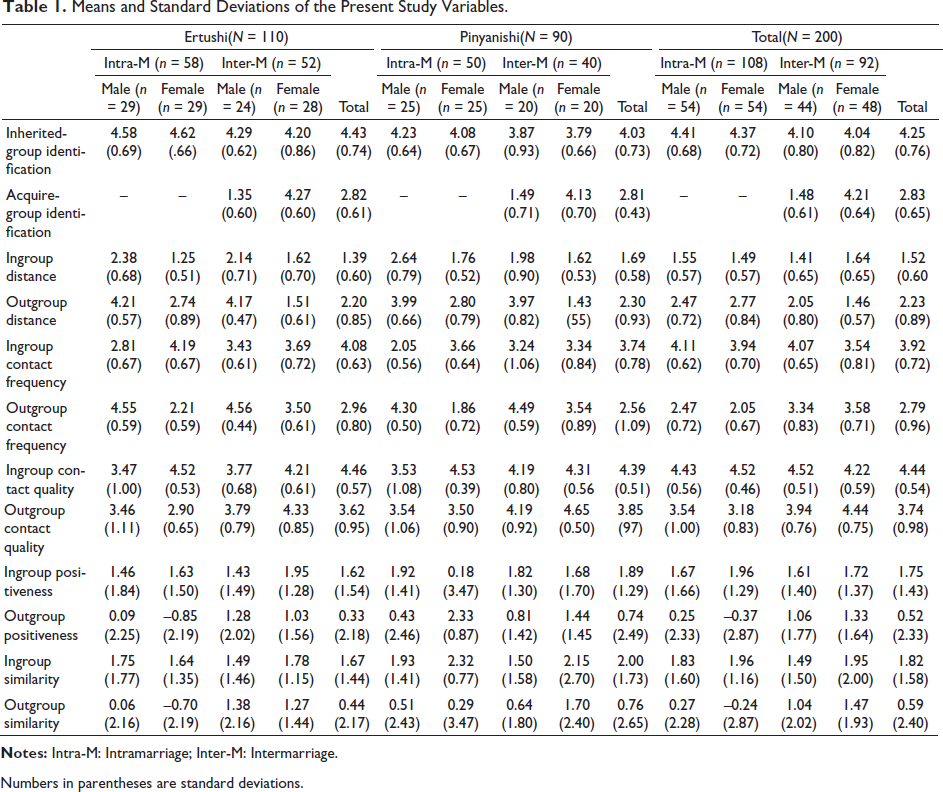
Numbers in parentheses are standard deviations.
Instruments
Data collection in this study was carried out using questionnaires, including measurement tools with the following psychometric properties in the order given:
Demographic Information Form
This form includes questions about age, gender, educational background, duration of marriage, the clan and tribe the person belongs to, occupation, average monthly family income and religious orientation in order to obtain general demographic information about the participants.
Social Identity Inventory and Measurement of Favouritism and Similarity
The social identity inventory developed by Zavalloni (1973) and translated into Turkish by Bilgin (1995) makes it possible to measure how participants perceive and assess people in their own group and other groups by using both qualitative and quantitative methods. This inventory consists of three stages. In the first stage, the participants write the characteristics that best describe their own group and other groups—three characteristics for each group. In the second stage, participants return to the beginning of the inventory, and they evaluate each characteristic they have written before on a scale of 7 (–3 = very negative; 3 = very positive). In the final stage, the participants indicate how much the characteristics they have written for groups define their selves on a scale of 7. In this way, a person qualitatively (written adjectives for defining characteristics of ingroup and outgroups) and quantitatively (ratings of the adjectives on a scale) evaluates both the ingroup and outgroup and himself/herself as an individual with regard to the characteristics that she/he wrote for both groups. The score of ingroup favouritism (positivity scores) was created by subtracting each participant’s score on the characteristics describing the other tribe (outgroup) from the score on the characteristics describing his/her own tribe. For example, an Erthushi member’s level of ingroup favouritism would be derived by subtracting her/his score on characteristics of the Pinyanishi tribe from their score on characteristics of the Ertushi tribe. The perceived similarity, on the other hand, was measured by each participant’s evaluation of how much the characteristics he/she has written for tribes reflect himself/herself as an individual on a scale of 7.
Group Identification Scale
This 10-item scale (1 = strongly disagree to 5 = strongly agree) measuring one’s identification level with his/her group was developed by Kirchler et al. (1994) and adapted into Turkish by Hortaçsu (2000). This scale was used in the present study to measure the strength of tribal commitment and the awareness of tribal membership (sample items: ‘I identify with my tribe’, ‘I feel close to my tribe’ and ‘my tribe is very important to me’). Participants practicing intermarriage responded to this scale separately for both their previous tribe before marriage and the tribe that they belonged to after marriage. Reliability of this scale was 0.93 in the present study.
Social Distance Scale
This scale was originally developed by Bogardus (1925) to measure the level of willingness of people from different religions and ethnic origins to establish relationships with each other, such as friendship, neighbourhood and marriage. An 8-item (1 = strongly disagree to 5 = strongly agree) version of the scale was adapted into Turkish by Akbaş (2010). This scale was used in the present study to measure how distant the participants felt from the other tribe (sample item: ‘I attend a social event with people from this tribe’). Reliability of the scale in the present study was 0.91.
Social Contact Frequency and Quality Scale
This two-dimensional and 10-item scale (1 = strongly disagree to 5 = strongly agree), developed by Islam and Hewstone (1993) and adapted into Turkish by Akbaş (2010), was used to measure the frequency (five items) and quality (five items) of the social contacts that the members of the Ertushi and Pinyanishi tribes established with ingroup and outgroup members (sample items: ‘How often do you interact with people from this group as friends?’ and ‘Do you satisfy with your relationship with people from this tribe?’). Reliability of the scale was 0.91 in the present study.
Procedure
The data collection process was completed within 2 months in the Yüksekova district of Hakkari in Turkey after the ethics approval was received in February 2015. The participants were reached using the ‘Snowball (Chain) Sampling’ method. Each of the participants who volunteered to participate in the study was given an informed consent form individually. A total of 78 questions that were on the forms were asked by the interviewers, and the participants’ responses to each question were recorded by the interviewers by marking the relevant places in the survey form. The administration of the questions to each participant took an average of 35 minutes. Three interviewers took part in the data collection process. Two of the three interviewers (one male and one female) are members of the Pinyanishi tribe, and the other one (a female) is a member of the Ertushi tribe. Each interviewer applied the surveys to the participants in their own tribe.
Research Design
Our quasi-experimental study consists of four different conditions resulting from the cross of the two tribes (Ertushi/Pinyanishi) and marriage types (intermarriage/intramarriage). Each participant takes part in only one of the four conditions (intramarried Ertushi members, intermarried Ertushi members, intramarried Pinyanishi members and intermarried Pinyanishi members) and has to evaluate two tribes (Ertushi and Pinyanishi). We considered the tribe to which the participants belonged (the inherited tribe they had born into and lived in for years before marriage) as an ingroup and the other tribe as an outgroup. These four groups were compared to examine the effect of the type of marriage (intermarriage or intramarriage) on participants’ perceived positivity, similarity, social distance and social contact scores in terms of ingroup and out group.
Results
The Relationship Between Study Variables
Separate Pearson correlation analyses were performed for the intra- and intermarried participants from both tribes to investigate the relationships between the study variables (perceived positivity, perceived similarity, social distance and social contact; see Table 2). Results showed that, contrary to our H1, identification with the ingroup was not associated with the positivity levels of the characteristics assigned to the ingroup among both groups (intra- and intermarried participants).
Correlations Between the Present Study Variables.
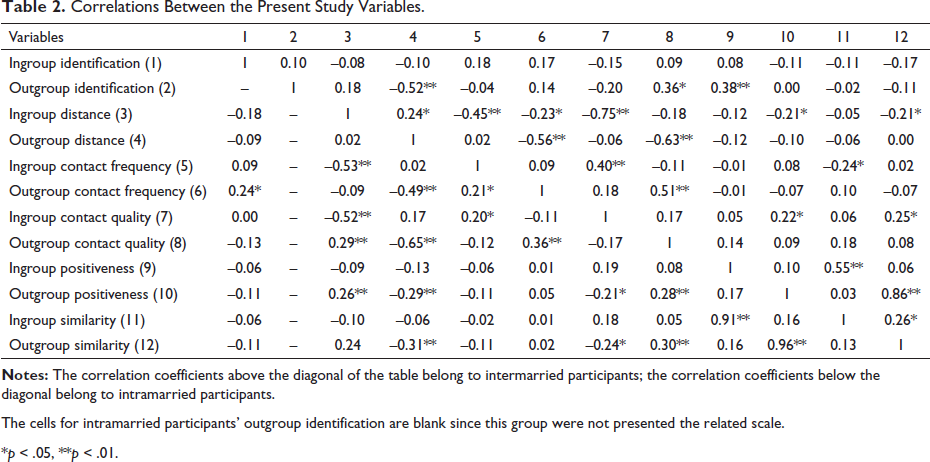
The cells for intramarried participants’ outgroup identification are blank since this group were not presented the related scale.
*p < .05, **p < .01.
Analyses of Intra/Intergroup Positivity and Perceived Similarity
With a 2 (group type: ingroup and outgroup) × 2 (gender: female and male) × 2 (marriage type: intramarriage and intermarriage) × 2 (tribes: Ertushi and Pinyanishi), mixed-design (the marriage types variable is ‘repeated measures’, while all other variables are ‘between Ss variables’) ANOVAs were conducted to investigate participants’ positivity and perceived similarity with the Ertushi and Pinyanishi tribal groups (see Table 1). The ingroup/outgroup factor was formed based on the tribal memberships (Ertushi or Pinyanishi) of the participants. We also included the tribes (Ertushi and Pinyanishi) as a separate factor in the analysis to explore whether the tribal group in which the person grew up has any specific effect on participants’ attitudes based on socio-economic characteristics of the tribes.
Intra/Intergroup Positivity Evaluations
Results of ANOVA showed that the main effect of group type on ingroup favouritism was significant, F (1, 192) = 44.02, p < .001: The participants rated the characteristics they assigned to their ingroups (M = 1.75, SD = 1.43) significantly more positively than those assigned to the outgroups (M = 0.51, SD = 2.33). Similarly, marriage type was also found to have a significant main effect on positivity (F [1, 192] = 6.89, p < .01), showing that the intermarried participants (M = 1.43, SD = 0.15) rated their ingroups more positively than did the intramarried participants (M = 0.90, SD = 0.14). On the other hand, neither gender nor tribe membership has a significant main effect on participants’ positivity evaluations.
The only significant interaction effect is between marriage type and group type, F (1, 192) = 16.14, p < .001: Intramarried participants rated the outgroup (M = –0.06, SD = 2.62) less positively than the ingroup (M = 1.81, SD = 1.48). On the other hand, those practicing intermarriage were found to rate the ingroup (M = 1.66, SD = 1.38) and the outgroup (M = 1.20, SD = 1.70) positively to a similar extent. These findings support H2 and H4 of the study. As expected, the attitudes (in the form of assigned characteristics) of those practicing intermarriage (but not those practicing intramarriages) towards outgroups are rather positive, and they rated those groups as having positive characteristics as their own group.
Perceived Similarity
Results of the ANOVA for perceived similarity showed that the main effect of group type on participants’ similarity assessments was significant (F [1, 192] = 40.93, p < .001), indicating that participants rated their ingroup (M = 1.82, SD = 1.58) significantly more similar to themselves than their outgroup (M = 0.59, SD = 2.40). Likewise, the type of marriage had a main effect on the perceived similarity (F [1, 192] = 5.66, p < .05), showing that the perceived similarity of intermarried members with the two tribal groups (M =1.49, SD = 0.16) was significantly higher than the perceived similarity of intramarried members with the two tribal groups (M = 0.98, SD = 0.15). There were no main effects for gender and the tribes on participants’ evaluations of similarity towards tribes (for gender, F [1, 192] = 0.49, p > .05; for tribes, F [1, 192] = 1.91, p > .05).
There was only one significant interaction effect between the type of marriage and group type in relation to the perceived similarity (F [1, 192] = 14.20, p < .001), showing that participants who had an intramarriage rated the outgroup (M = –0.01, SD = 2.59) less similar to themselves than the ingroup (M = 1.89, SD = 1.39), whereas the participants who had intermarriage rated both the ingroup (M = 73, SD = 1.78) and outgroup (M = 1.26, SD = 1.97) as similar to themselves. Overall, these findings supported H3 and H5. As expected, intermarried (but not intramarried) participants rated the characteristics they use to describe the outgroup as similar to themselves.
Analyses of Intra/Intergroup Relationships and Ingroup Identification
A multivariate variance analysis (MANOVA) was conducted by using ingroup identification, distance from ingroup, distance from outgroup, ingroup contact frequency, outgroup contact frequency, ingroup contact quality and outgroup contact quality as dependent variables and marriage type (intramarriage/intermarriage) and gender (female/male) as the independent variables (for means and standard deviations, see Table 1). Results showed that both marriage type groups (F [7, 177] = 26.34, p < .001, Wilk’s Lambda = 0.49) and gender groups (F [7, 177] = 2.61, p < .05, Wilk’s Lambda = 0.91) were significantly different from each other.
Results revealed that those practicing intramarriage had significantly higher scores than those practicing intermarriage in terms of ingroup identification (F [1, 183] = 9.74, p < .01), distance from outgroup (F [1, 183] = 63.95, p < .001), ingroup contact frequency (F [1, 183] = 6.33, p < .05), outgroup contact frequency (F [1, 183] = 140.41, p < .001) and outgroup contact quality (F [1, 183] = 46.91, p < .001). These findings support H6, suggesting that tribal identity will increase social contact and decrease social distance towards people belonging to the outgroup (other tribe). On the other hand, there were no significant differences in terms of distance from ingroup and ingroup contact quality. For gender groups, there was only one significant difference in seven dependent variables: females score higher than males in terms of ingroup contact frequency (F [1, 183] = 14.39, p < .001).
Discussion
This study was designed to determine the effects of intermarriages versus intramarriages on intra/intergroup relationships in terms of the positivity of intra/intergroup evaluations, perceived similarity, social distance and social contact. First, the effects of these two marriage types on intergroup evaluation were investigated, and it was found that the intramarried members of both the Ertushi and the Pinyanishi tribes not only assessed their tribe positively but also assessed the other tribe very negatively. Considering their own tribe (‘Us’) to be more positive than the other tribe (‘Them’) confirms the view that categorising people into two different groups leads them to display ingroup favouritism and outgroup rejection. However, the participants who had intermarriages evaluated both the Ertushi and Pinyanishi tribes on similar levels of positivity. This finding was in line with the basic claims of the CCM (Deschamps & Doise, 1978). Accordingly, the participants who had intermarriages did not feel the need to favour one tribe over the other, as they were members of both at the same time, and they assessed the identity they acquired by marriage (after adolescence) to have almost the same importance as the inherited (original) identity they had lived in for years before marriage. Therefore, for a more positive self, it is important that both tribes’ memberships are assessed positively (Nicolas et al., 2017).
The above-mentioned findings were also supported by a set of qualitative data. When the content of adjectives that were used to assess the groups the most frequently was examined, it was seen that the participants who had intramarriages used statements that distinguished their tribe from the others, made their tribe sound more positive and claimed their tribe to be as unique as possible. For example, it is seen that the intramarried participants who were members of the Ertushi tribe defined their group as ‘honest, chivalrous, ancient (deep-rooted), brave, responsible, cultured and talented’ very frequently, whereas they rarely used these adjectives in describing the other tribal group. These findings confirm the assumption of SIT about the need to bring to the forefront the positive distinctiveness of the ingroup containing the self in order to reach a more positive self (Abrams & Hogg, 2017). Referring to the other tribe, participants used a few positive adjectives such as ‘agreeable, ancient and understanding’, but much more negative statements such as ‘quarrelsome, bigoted, arrogant, hellraiser, malicious, greedy and selfish’. A very similar pattern was also found in the adjectives presented by the Pinyanishi tribe’s intramarried members. On the other hand, the participants who had intermarriages used mostly positive adjectives to describe both tribes. For example, the members of the Pinyanishi tribe who had intermarriages frequently used adjectives such as ‘generous, hospitable, rational, reliable and understanding’ to describe the Ertushi tribe. Similarly, the members of the Ertushi tribe who had intermarriages frequently used adjectives such as ‘well-meaning, loyal, sensible, humble and respectful’ to describe the Pinyanishi tribe. Moreover, as evidenced in quantitative measures of the positivity and the similarity of the adjectives, the intermarried participants perceived both tribal groups as similar to themselves, whereas the intramarried participants perceived their ingroup as more similar to themselves compared to the outgroups. These results show that social identity also has a strong effect on perceived similarity, as well as the positive assessment of the ingroup members. It should be noted that gender and the tribe of the participants had no effect on these results.
Furthermore, the results of the correlation analyses showed that the above-mentioned findings could be extended to other social psychological variables such as identification levels with ingroup and outgroup identities, social distance and social contact levels. Specifically, identification with the outgroup is associated positively with outgroup contact quality and negatively with outgroup social distance for intermarried participants: As identification increases, the quality of contact with members of this group increases and social distance with them decreases. Moreover, evaluation (positiveness) has a positive association with perceived similarity for both ingroup and outgroup among intermarried participants: The more the participants perceive both the ingroup and outgroup as similar to themselves, the higher the tendency to evaluate the ingroup and outgroup positively. For intramarried participants, evaluation of outgroup is associated positively with social contact quality with the outgroup, but negatively with social distance towards outgroup and contact quality towards ingroup. Moreover, the results of the direct comparisons of intermarried and intramarried participants produced a consistent set of findings with the correlational findings by showing that, in comparison to the participants who had intermarriages, those who had intramarriages had higher levels of identification with the ingroup and a higher distance from the outgroup. Also, intra- and intermarried participants differed based on their level of contact with the outgroup and social distance towards the outgroup. The findings—as expected—showed that those who had intermarriages had more frequent and higher-quality contact with and had less social distance towards the outgroup. These findings are in agreement with the view that marriages between groups create a special form of social bond among these groups (Paterson et al., 2015).
To sum up, the comparison of the intermarried with intramarried participants indicates that participants evaluated the members of the same tribe more positively and more similarly to themselves. Results also show that they have less social distance and more frequent and quality social contact with them compared to people not belonging to the same tribe as themselves. Our findings are different from the findings in the relevant literature, claiming that ethno-racial prejudices exist among intermarried couples themselves (for example, Rodríguez-García et al., 2016) and have the potential to shed light on the contradictory findings in the literature that depend on the assumptions of the assimilation theory. As mentioned above, some findings suggest that intermarriage has positive effects on intergroup relations, while others claim that it has negative effects, and some studies claim that it has no effect at all. This uncertainty in the existing literature might be due to not taking into consideration the intermarried individuals’ identifications with their inherited identity and acquired identity (former outgroup identity). For example, in the study of Rodríguez-García et al. (2016), the reason for the persistence of the prejudiced attitudes of the intermarried people could be not identifying with the acquired identity and still perceiving the partners’ group as an outgroup. Indeed, the findings of the present study showed that intermarried individuals’ evaluations of the outgroup (i.e., the acquired identity group) was more positive than intramarried participants’ evaluations of the outgroup. These results support the CCM-based predictions that the attitude of the perceiver towards others varies based on whether they are perceived as belonging to the same group (i.e., category) as the perceiver or not. By analysing the possible consequences of intermarriages through social identity affiliations (belonging and identification) and measuring the identification of intermarried spouses with both their inherited (original) and acquired identity (through marriage), our study was able to contribute to the literature on intermarriages, which assimilation theory dominated for a long time.
Another important aspect of the present study is the unique nature of its sample, which allowed for testing the basic hypotheses proposed by the CCM regarding simple/crossed categorisations. It is known that studies conducted in the context of the CCM have been criticised on the ground that the groups they use are either virtual ones created in the laboratory, or real groups that do not have equal psychological meaning for the participant. Tribal groups used in the present study, in contrast, are known as having equal psychological significance for their members and are structurally similar and equivalent to each other in a wider social context. In this respect, the current study, which is the first one that examines the effects of intermarriage and intramarriage in the context of the CCM, has a research design that may overcome some of the shortcomings of the research in this literature.
However, this unique nature of the sample also seems to limit partially the generalisability of the findings. The relatively closed lives of the tribes may both increase negative attitudes of intramarried individuals towards the other tribe and increase positive attitudes of intermarried members towards the acquired group by limiting contact with the other tribe. Another shortcoming is that the questionnaires applied by the interviewers who belonged to the tribes may have made it difficult to control the social desirability effect. Answering the questions about their tribe, participants may have acted with the motivation to produce a positive impression on the interviewer, who was also a member of that tribe. Perhaps the most important limitation is that the quasi-experimental nature of the present study did not allow the researchers to reveal the direction of causality, an aim that can only be investigated by longitudinal research designs.
Footnotes
Declaration of Conflicting Interests
The authors declared no potential conflicts of interest with respect to the research, authorship and/or publication of this article.
Funding
The authors received no financial support for the research, authorship and/or publication of this article.
