




Abstract
The main purpose of this study is to caution the Indian banking sector about the possible risks involved during environmental, social and governance (ESG) risks by navigating through them. This article cautions the banks about the certain possibilities of risks that will stake their financial health and growth due to their unfruitful ESG risk decision, which leads to their exposure to various ESG risks. The approach of this article is based on various risks associated with ESG. It has examined the configuration, which is enlightening through the best available literature as a base for this study. Considering current moving patterns, this article identifies the various ESG risks that arise from inappropriate ESG-related decisions taken through the banking sector by utilising previous literature as their explanation base. This research article also suggests that the significant outcome of this study includes ESG-related risks. The first one is environmental risks, which incorporate dangers such as extreme climate conditions influencing borrowers’ assets and transition risks because of administrative changes affecting enterprises with carbon emissions. The second one includes the social risks involving human rights and local area influence, prompting reputational chances assuming banks put resources into organisations with poor practices. The last one, connected with a bank’s governance, risks its consistency with ESG principles, possibly causing lawful questions and reputational harm. This study helps to understand these risks, by which banks ought to coordinate ESG factors into their risk management framework by implanting ESG into their product design and pricing decisions for considering ESG to take a chance in different cycles such as mergers and disclose ESG risks to the stakeholders for transparency. By taking a holistic approach to ESG risks within risk management, financial institutions can enhance their sustainability and resilience in the face of evolving market demands and regulatory pressures.
Introduction
The ideas of responsible banking, responsible investing and sustainable finance have become increasingly well-known globally during the last 10 years. The worldwide threats of climate change, environmental degradation and other issues have created a new drive for sustainability and accountability (La Torre et al., 2021; Shobhwani & Lodha, 2024). This requires addressing all economies’ environmental, governance and social challenges.
This is why environmental, social and governance (ESG) concerns are becoming increasingly prominent in work on banking business models as new and exciting paradigms for corporate management (Desai, 2024). ESG risks include two groups. The first consists of those related to the environment, society and governance, which can impact banks’ liquidity and profitability (Baron et al., 2011; Kalfaoglou, 2021). This increased pressure from shareholders and other stakeholders motivates banks to consider ESG problems more when making decisions, especially in lending and investing (Świeszczak, 2020).
The second group, which includes customers, investors, companies, employees and governments, is affected by various ESG-related situations. As usual, this also happens as shareholders are drawn to ESG practices that can potentially increase their financial worth (Aboud & Diab, 2018; Barnea & Rubin, 2010; La Torre et al., 2021). For example, international organisations and governments rely on banks to play a significant role in national development to promote sustainable economic growth since they choose investments and manage risks. Sustainable growth might be achievable if banks were prepared to include ESG factors in their investment strategy (Baron et al., 2011; Malliaropulos et al., 2021).
With all the above factors, ESG risks constitute a new source of risks for the banking sector that should be identified, evaluated, monitored and managed. The extant body of research underscores the significance of this matter, specifically stressing the necessity for banks to incorporate ESG risks into their risk management procedures and tactics (Aboud & Diab, 2018; Barnea & Rubin, 2010). Nowadays, ESG risks have acquired huge consideration, with banks progressively integrating ESG factors into their investment strategies. However, ESG risks involves a few risks that monetary investment must explore. One of the critical dangers related to ESG risks in banks is the possible effect on their P&L (profit and loss) and liquidity. Environmental risk including natural dangers such as environmental change and biodiversity loss can prompt extreme climate changes such as floods, fires and hurricanes, making borrowers default on their advances and influencing the banks’ monetary performance (Roy, 2023). Social risk includes work practices and human rights infringement and can also affect banks’ standing and client base, prompting decreased liquidity. Governance risk involves the ack of poor decision-making and transparency. These risks often result in financial mismanagement, legal actions, erosion of stakeholder confidence and potential legal and regulatory issues, which are additional risks. As ESG considerations become increasingly prevalent in the financial industry, financial institutions may face increased scrutiny from regulators and possible legal action from partners if they fail to adequately handle ESG issues in their investment strategies.
Some risks associated with ESG investing in banks, including potential impacts on P&L (profit and loss), liquidity, social risks and legal and administrative risks, are the most significant concerns for banking institutions. Banking institutions must carefully address these risks to ensure that their ESG risk strategies contribute to a manageable course of events and not endanger their financial stability.
This research is important as it provides a nuanced understanding of ESG risks in the Indian banking industry, an industry that is becoming increasingly prominent in light of worldwide sustainability issues. Utilising a descriptive approach, it fills an essential research vacuum where a majority of research studies are dependent on statistical or regression analysis, tending to disregard in-depth contextual inquiry. Descriptive research is crucial for charting intricate risk environments, particularly in lower-middle income countries such as India. This study contributes by presenting organised insight without predictive modelling, thus helping policymakers, banks and investors to identify and manage ESG weaknesses through qualitative and thematic transparency instead of numerical relationships. So, this study adopts a descriptive methodology, systematically analysing ESG risks in the Indian banking sector. By navigating various risk dimensions, the article provides critical insights into potential threats and mitigation strategies. The descriptive approach ensures clarity and depth, making the findings highly relevant for stakeholders. This research utilises the descriptive research approach to study ESG risks in the Indian banking system systematically using various previous studies. The study aims to determine the ESG risks that banks encounter and comprehends how these risks affect the stability of their finances. Furthermore, the study will examine how ESG issues affect investors’ decision-making, emphasising the causes and incentives that support or undermine ESG risks in banks. The results of this study will help investors and financial institutions better understand how to manage the opportunities and risks associated with ESG in the banking sector.
The primary motivation behind this study is a combination of variables reflecting the evolving nature of contemporary finance, which drives the investigation of risks related to ESG investing in banks. The increasing importance of ESG factors in investment decisions necessitates a thorough understanding and evaluation of the risks associated with these methods. This incentive stems from the realisation that investors are beginning to prioritise socially and environmentally responsible activities. In addition, incorporating ESG factors into decision-making necessitates carefully analysing any obstacles to coordinating investment plans morally and responsibly. Environmental, social, and governance (ESG) issues are vital elements that influence the financial results of banks, making close consideration of related risks of the banks is essential in determination of the sustainability and resiliency of long-term operations of banks.
Controlling ESG risks in banks is effective. These risks can significantly impact a bank’s activities, earnings and reputation. Financial institutions can enhance risk management by integrating ESG factors into their business plans. This can lessen financial losses, safeguard long-term survival and promote sustainable development. Furthermore, banks must increasingly handle ESG risks due to legal frameworks and stakeholder expectations, making it an essential component of risk management.
The remaining part of this article follows a pattern: the first section is a ‘Review of Literature’, in which previous related literature has been mentioned; the second section is the ‘Methodology’ used in this article; then comes the ‘Discussion’ section, which is the crux of this article; and at last is the ‘Conclusion’ section.
Review of Literature
As per Devinney (2009), despite the wealth of literature on the connection between operational risk and reputation in the financial industry, more research is needed on the combined effects of ESG pillars and firm controversies. This problem is notably reported in financial institutions, even though ESG scores are relevant to athletic performance (Cummins et al., 2006; Perry & de Fontnouvelle, 2005). According to Roy (2023), environmental and climate-related physical and transaction risks are defined. They also describe the operational, liquidity, market and credit risks impacted by these shifts. The disruption of banking activities due to property damage to individual branches and data centres is one reason linking operational risk to climate change (Alexander & Fisher, 2018; Dmuchowski et al., 2023). A bank’s market stakeholders may also be impacted by operational risk resulting from climate change and environmental challenges. They could be held liable for disputes stemming from funding environmentally damaging operations, which could damage the bank’s brand (Dmuchowski et al., 2023).
The impact of the transitions on credit, market, operational and liquidity concerns is also covered. Operational risk is associated with climate change because of worries about the disruption of banking activities resulting from property damage to individual branches and data centres (Shah et al., 2025). Furthermore, market stakeholders of banks may be impacted by operational risk resulting from climate change and environmental challenges since they may be subject to liability and reputational risks due to disputes arising from the funding of ecologically destructive operations (Świeszczak, 2020). Houston and Shan (2022) demonstrate how banking connections support corporate ESG policies. Specifically, banks are more willing to lend money to borrowers with ESG profiles that align with their own, enhancing the borrowers’ future ESG performance. When borrowers depend on banks for their financial stability, and banks have considerably higher ESG ratings than borrowers, their effect becomes more noticeable (Dobrick et al., 2025; Бортніков & Любіч, 2022).
Moreover, Gillet et al. (2010) broaden the scope of reputational risk assessment to examine the impacts of many variables. Furthermore, they contend that various factors might give rise to reputational difficulties, including bank risk exposure, viability, capitalisation, bank size and business models. Exposure to ESG risk is associated with increased market visibility in the banking industry. As a result, certain institutions are relatively more vulnerable to the detrimental consequences of non-adherence to ESG standards. The effects are pertinent to the reputation of the middleman. Hence, banks need to control, keep an eye on and reduce the risks associated with ESG (Barnea & Rubin, 2010; Baron et al., 2011). Recent studies (Chaudhry et al., 2025; Cummins et al., 2006; Houston & Shan, 2022) have examined ESG in banking. The attitude of managers towards ESG elements to limit reputational risk primarily justifies banks’ long overdue attention to ESG issues, which began with the recent crisis regarding sustainability. ESG concerns have just recently come to suggest improving economic success. The ‘ESG regulatory pressure’ on the banking industry is also current. Ever since December 2015, when the Paris Climate Agreement was internationally and legally ratified, research that appears to be more narrowly focused on the ESGP–CFP link in the banking industry has begun to pick up steam. The Paris Climate Agreement outlines the requirements for financial advisors and market players to include ESG risks and opportunities in their operations (Belasri et al., 2020; Friede et al., 2015).
Danisman and Tarazi (2024) examine the effects of sustainable practices, primarily in non-financial organisations. However, several studies have stressed that extra research is needed beyond financial performance because of banks’ role in distributing money and promoting economic growth (Broadstock et al., 2020). However, there is increasing evidence that sustainable practices positively affect banking profitability and whether and how ESG activities affect bank risk is still being determined (Houston & Shan, 2022).
The current research emphasises the substantial influence of physical and transitional climate-related risks on banking activities, liquidity, market stability and credit exposure. Past research has made associations between climate change and operational risks, including interruptions due to property loss and reputational risks from lending to environmentally risky projects. Nonetheless, there has been a missing link that explains how these risks precisely influence the Indian banking system, especially in mitigating ESG-related issues. This research seeks to fill the missing link by critically analysing the specific vulnerabilities of Indian banks and offering solutions on how to effectively manage ESG risks to promote financial stability and sustainability.
Methodology
This study used the approach to examine the risks related to ESG concerns in the banking industry. It utilises the descriptive research approach to study ESG risks in the Indian banking system systematically. Instead of applying statistical models or regression analyses, the study relies on existing literature and structured investigation of different dimensions of ESG risks. It starts with a thorough analysis of the body of research to provide a strong basis for comprehending the ramifications of decisions about ESG. Through an examination of current trends and patterns, the report pinpoints a number of ESG risks that could result from making bad decisions in this situation. The knowledge acquired from earlier studies provides a crucial foundation for explanation, enabling a thorough analysis of the potential effects of these risks on banking operations and sustainability. Through a critical examination of available literature, the research seeks to offer an elaborate overview of the nature, extent and implications of ESG risks within the Indian banking environment. The descriptive design enables a thorough exploration of major risk factors as well as their potential effects, offering insightful information regarding emerging issues and potential mitigation plans. This methodology guarantees conceptual distinctiveness and contextual applicability, and the results are thus most useful to policymakers, regulators and financial institutions. The fact that there is no empirical or regression-based analysis strengthens the focus of the study on interpretation and synthesis over prediction, and aligns with its aim to guide and advise stakeholders through an elaborate risk landscape evaluation.
Discussion
Unveiling the Descriptive Outcomes
ESG Risks in Banks
ESG investment in banks implies different risks that can easily affect the bank and its clients. These dangers include environmental risks, such as ecological change and regular asset consumption; social risks, such as work practices and local area relations; and management risks, such as board diversity and moral business lead. ESG dangers can prompt deal changes, unique opportunities, production disruptions and higher default rates, as shown in Figure 1. This study suggests that banks should adjust their investment strategies in line with their business system and focus on risk emerging from complicated interrelationships across different ESG risk strategies within the foundation.
Factors Involved in ESG.
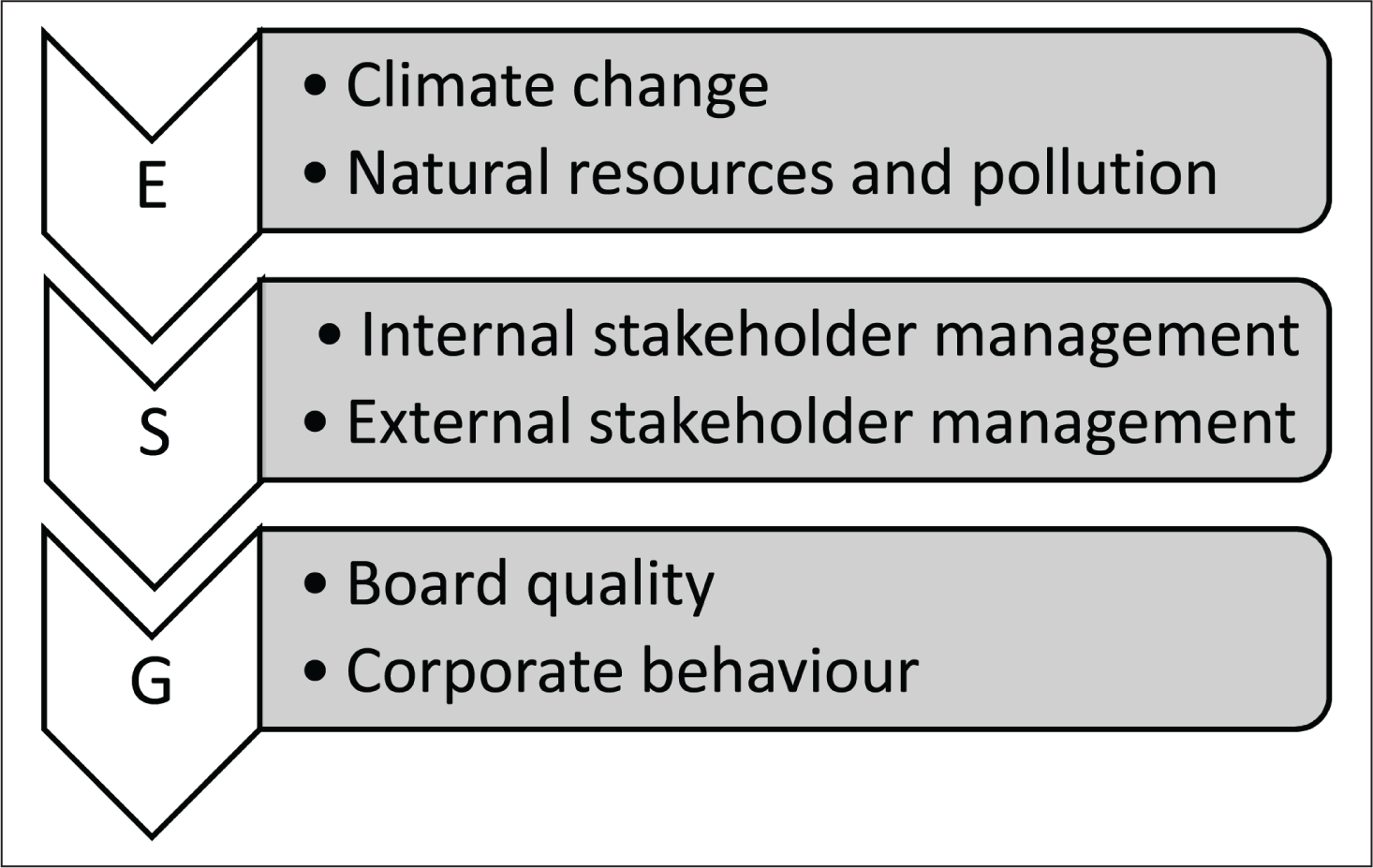
ESG risk can influence a bank’s productivity and liquidity, prompting reputational harm, administrative examination, legal liabilities and financial losses. Proactively overseeing ESG opportunities is vital for banks and economic institutions to guarantee long-term sustainability and contribute to sustainable development.
ESG risks can influence banks in two distinct ways. First, the immediate weakness comes from one’s tasks; for instance, a bank could depend on functional risk if a branch is in a high-risk flood region. The considerable climate risk thus turns into the ESG structure’s environmental cornerstone. The second, or indirect, openness originates from jobs that include lending and donating. A bank lending money to a counterparty that disregards workplace health and safety policies is an example of this; later, an incident increases the likelihood of credit default by endangering one’s reputation and driving away clients (Broadstock et al., 2020).
In this manner, credit risk becomes the social risk mainstay of the ESG structure. Besides, a bank could place cash into a counterparty’s protections and critical extortion is tracked down in that counterparty’s bookkeeping records. Benefit, credit, market and liquidity risk become the governance mainstay of the ESG system (Malliaropulos et al., 2021). Thus, customary risk classes should be obtained from each ESG support point.
Banks should research reasonable channels for transmission, as these are how environmental change may happen and cause monetary risk. Macroeconomic and microeconomic channels exist. The microeconomic channels straightforwardly mirror the impacts of ecological change on banks’ activities and individuals, organisations and state-run administrations into which they loan or put resources. Macroeconomic factors like these influence the transmission impacts.
For instance, an expansion in credit risk for a bank could emerge from (a) the pay impact, which is a reduction in borrowers’ ability to take care of obligations; (b) the abundance impact, which is the misfortune coming about because of home loan–supported advance default when the worth of the security declines; (c) the change impact, which is the ascent in the openings’ likelihood of default and misfortune given default demand and supply for work, expansion, financial development and market factors such as financing costs and ware costs, inside ventures or districts helpless to the shift to a low-carbon economy or (d) the sovereign impact, which is the impact of being close to countries where environment-related crises are also expected (Friede et al., 2015).
The cost impact is the sudden decrease in the worth of monetary resources and items because of negative cost changes in situations where environment risk has not yet been remembered for costs, or through an unpredictability impact—that is, the vulnerability around the area, timing and power of future climatic occasions—that could make monetary business sectors more unstable. The chance of misfortunes from abandoned resources is likewise remembered.
Recognising credit, market and other financial risks that could have unfavourable effects increases the risk of liquidity problems and their impact on the liquidity hole and security, which is the decreasing capacity to obtain capital from national bank offices or the market due to unsatisfactory insurance that is sensitive to environmental events (Świeszczak, 2020).
ESG Risks Associated with the Environment Pillar: ‘E’
The environmental risk connected with ESG interest in banks encompasses a scope of difficulties that financial institutions must address. These dangers incorporate actual dangers, such as biodiversity loss and the increased risk of extreme weather conditions such as floods, fire and tropical storms. These occasions can directly influence banks by harming their structures or, by implication, influencing clients, prompting changes in deals, opening unique doors and creating disturbances, possibly bringing about higher advance defaults. Besides, the progress risks related to environmental change can likewise present enormous difficulties for banks. For example, banks that loan to or put resources into organisations contributing to biodiversity loss might face reputational risks. Moreover, a bank’s non-ESG-consistent behaviour can prompt legal questions and expand legal risks due to a stronger ESG mindfulness among partners.
To address these inherent risks in ESG endeavours, banks must carefully integrate ESG considerations into their investment strategies. This includes considering environment stress testing for risk appraisal, coordinating ESG, taking a chance into credit risk investigation at different levels and revealing ESG dangers to partners directly. By proactively tending to these environmental risks and integrating them into their investment strategies, the board rehearses, banks can improve their flexibility and maintainability despite advancing ESG challenges.
The support of environmental risk involves two classifications of chance: (a) dangers related to environmental change, for example, those welcomed by or associated with it (e.g., outrageous or persistent climate occasions), and (b) natural dangers, which are perils, welcomed by or influenced by biological system loss and ecological debasement (e.g., water contamination and freshwater shortage). The two risks are connected and cross over one another. Environmental disintegration, including biodiversity misfortune, can likewise be welcomed by ecological change. Nonetheless, some of its causes are modern spills that sully water irrelevant to environmental changes (Kalfaoglou, 2021).
Environmental and climatic dangers fundamentally show up through progress risks and actual risks. Climate occasions brought about by environmental change can bring about real gambles, which are the deficiency of existing resources, regular capital and living souls, which can reduce creation. Actual perils can be either severe or gentle, welcomed by outrageous atmospheric conditions, including heat waves, dry spells, floods and so forth, or constant, coming about because of consistent changes in environmental patterns. For example, ocean levels are expanding, mean temperatures are climbing and sea fermentation is increasing (Dmuchowski et al., 2023). Progress gambles are those welcomed by the transition to a low-carbon economy, which attempts to hinder the speed increase of environmental change.
Progress perils are caused mainly by these three variables: (a) temporary estimates about ecological change, similar to the burden of carbon valuing; (b) changes in innovation, especially those that help the energy progress and affect the overall expenses of fuel sources; and (c) adjustments to financial backer and shopper mindset or changes in market drifts that might raise the reputational risk. These climatic dangers could make critical full-scale and miniature impacts, with input circles influencing the counterparty, the economy and banks and having the ability to deliver significant and intermittent monetary misfortunes through a few cascading types of influence. Besides, notwithstanding that it is an overall issue, the effect of environmental change and the subsequent economic misfortunes contrast (Friede et al., 2015; Köhler, 2015).
In most of the studies, it is found like (a) the actual area, since numerous areas have novel climatic examples and improvement stages, and (b) the sorts of tasks, corporate designs and worth chains that an organisation takes part in risk channels connected with progress and actual viewpoints are linked (Alexander & Fisher, 2018).
There are four motivations behind why resources become abandoned. The first is the need to manage carbon, which has been deserted since, supposing that temperature targets are fulfilled, just a part of the petroleum derivative stocks should be utilised. Since certain speculations made in the petroleum product business will become obsolete once the economy moves to an environmentally friendly power, the subsequent source is connected with capital that has been deserted. The other two sources manage abandoned resources that are both expected and genuine. The previous one is driven by changes in the cost of petroleum product resources, which might happen long before establishing environmental strategies that influence these resources’ valuation.
ESG Risks Associated with the Social Pillar: ‘S’
The social risks associated with ESG interest in banks encompass several issues financial institutions should tackle. These risks include reputational risks resulting from a bank’s non-ESG-compliant behaviour, which might lead to legal discussions because partners have a more grounded understanding of ESG issues. Social hazards can also affect a bank’s reputation and customer base, affecting its liquidity and financial performance. Furthermore, banks may have to take reputational risks that affect their market standing and performance due to external ESG enhancements.
When combining ESG risks into their board structures, financial foundations must consider social elements such as common freedom violations and work practices. Banks must work with supportability experts, consider industry emphasis areas in precise locations and integrate ESG considerations across their credit or speculating cycles to effectively manage the social risks associated with ESG initiatives. Despite emerging ESG challenges, banks can increase their adaptability and supportability by taking proactive measures to address these social risks and integrating them into their risk management strategy.
Social supportability is an idea that should be all the more outright and reliable. This powerful thought shifts across existence, and the issue is what makes a blissful life and a decent society. Specific individuals view social manageability as an independent point of support associated with monetary development, particularly from natural and financial maintainability concerns. According to particular frameworks, social capital development serves as the rationale behind the other main areas of support, where it is seen as a need to advance the economy and the climate and a motor of extension (Alexander & Fisher, 2018).
Social maintainability is progressively seen as a free manageability factor instead of only a part of the supportable turn of events, steadily growing over the long run. Taking into account two unmistakable strategies for handling cultural worries overall and partner prosperity is plausible. Since corporate citizenship is widely and extensively perceived, organisations should focus on broad cultural issues over everyday freedoms, work concerns, well-being and security in the working environment and the quality and well-being of items.
Another critical issue is divulgence. Even though organisations have made fantastic progress in uncovering their natural effect, administration standards, cultural impacts and execution are exceptional. This is primarily normal given areas of strength that practice cut across regions and associations and because ecological impacts regularly result from quantifiable and extensive recognised guidelines (Friede et al., 2015). Some well-established organisation models will battle in this new reality, yet another agreement has advanced over the business environment in society.
The social pillar of ESG highlights serious dangers related to social exclusion and discriminatory lending practices in the context of Indian banks. When banks apply biased criteria that disproportionately impact marginalised groups, like women, those with lower incomes or particular ethnic communities, discriminatory lending practices may take place. This prevents these people from attaining economic mobility and adds to their social marginalisation by restricting their access to credit and exacerbating social inequality (Albastaki, 2024). A lack of representation in financial services can also result from the reinforcement of systemic biases caused by using conventional metrics to evaluate creditworthiness. Due to stakeholder demands for inclusive and ethical banking practices, these behaviours not only hurt the impacted persons but also put banks’ reputations in jeopardy. In order to create a more equal financial environment in India, where everyone has the chance to fully engage in the economy, these problems must be resolved (Nguyen et al., 2025).
ESG Risks Associated with the Governance Pillar: ‘G’
Governance risks connected with ESG interest in banks allude to the potential dangers related to the administration and oversight of ESG-related activities within financial institutions. These dangers can influence a bank’s profit and loss (P&L) and liquidity, as well as its standing and administrative consistency. One of the critical administration gambles is the absence of straightforwardness and responsibility in ESG reporting. Banks might confront difficulties in precisely estimating and uncovering their ESG execution, which can prompt reputational harm and administrative examination (Shah et al., 2025).
Another administration risk is the potential for irreconcilable circumstances between the bank’s monetary advantages and its ESG goals. For instance, a bank might put resources into organisations that contribute to biodiversity loss, which could adversely influence its standing and client base. To oversee administration chances connected with ESG ventures, banks need to lay areas of strength for our designs and cycles. This incorporates setting precise ESG approaches and targets, directing regular ESG risk evaluations and engaging with partners to ensure transparency and accountability.
Moreover, banks should consider integrating ESG factors into their credit risk examination and uncovering ESG dangers to suitable partners. By tending to these administration gambles proactively and coordinating them into their gamble, the board rehearses, banks can improve their strength and supportability notwithstanding advancing ESG challenges (Liu et al., 2025).
Bank administration is a well-established issue inspected according to different points of view and drawn nearer from both a consistent and a moral perspective. Everyday administration worries in the broader sense, similar to illegal tax avoidance, know-your-client approaches, client onboarding and so forth, as well as issues in the more unambiguous sense, identical to the capability of the directorate, the cosmetics of the board, the nature of the board, the inside control framework and so on, are tended to by current guidelines, business lead and consistence necessities.
If satisfactorily thought of, the bank borrowers’ administration concerns could impact and work on the maintainability of any business with solid strategies and cycles. Their thoughts and extension go past regular functional and monetary issues and feature the need to address business leads and works concerning social and ecological problems. The organisation, especially the board, is still responsible for the far-reaching plan and execution of the standards, featuring a few primary regions for considering ESG-related gambles. The standards indicate that the directorate should integrate natural and social variables (Malliaropulos et al., 2021).
There are three methods for incorporating governance worries in an ESG examination:
Banks’ own functional administration and authoritative perspective; Administration instruments laid out to manage and execute the banks’ natural and social gambling system; and Administration of the counterparty’s bank loan.
In this way, it takes work to consider them separated from the common principles for sound corporate administration. Hence, the type and profound quality of the board are significant. There are different viewpoints on board quality. The variety on the board is a critical element, and it tends to be separated into two classifications: task-related variety and instruction or utilitarian foundation, as well as variety irrelevant to tasks, including orientation, age, variety or ethnicity (Chaudhry et al., 2025).
They all affect the board’s administrative role, especially concerning maintainability and promoting remembering ESG navigation considerations. To follow guidelines, this consolidation has a consistent aspect. It likewise has an essential element of the scope of ESG models to change mentalities from the present moment, pioneering conduct to long-term thinking and laying out an economic organisation (Świeszczak, 2020).
A change in conduct is expected before consolidating ESG subjects because few practices energise short-termism, for example, the emphasis on quarterly financial results, variable compensation based on annual results, marking to market of investments or treatment of illiquid assets. The timeline is an essential worry since risks typically take shape outside the extent of many present organisations’ arranging initiatives. Second, the inclusion of these risk drivers in the system and the risk management structure of the organization demonstrates systemic issues, mostly the longer-term focus on the ESG implications as opposed to the shorter-term one of critical strategic planning (Sun et al., 2024).
The governance pillar of ESG in Indian banks draws attention to serious dangers related to corruption, fraud and a lack of transparency. Financial institutions’ integrity may be seriously compromised by these problems, which could have serious negative effects on their reputations and regulatory outcomes. Fraudulent practices can undermine stakeholder trust and cause significant financial losses, such as falsifying financial statements or manipulating loan approvals (Chaudhry et al., 2025). The lack of transparency in governance processes exacerbates these risks, as inadequate disclosure of practices and decision-making can obscure potential misconduct and hinder accountability. As stakeholders’ demands for ethical governance and strong risk management frameworks grow, Indian banks must prioritise transparency and integrity to effectively mitigate these governance-related ESG risks. Additionally, corruption within banking operations can foster an environment where unethical practices flourish, further complicating compliance with regulatory standards (Dobrick et al., 2025).
Implication of This Study
For many stakeholders, the report on ESG risks in the Indian banking industry has significant implications. Reputational harm from bad governance procedures could undermine trust, and customers may encounter service interruptions and restricted credit availability if banks cannot adequately manage ESG risks. For risk management frameworks to be operationally resilient and transparent and to avoid monetary losses and damage to their reputation, managers must incorporate ESG factors (Sain & Kashiramka, 2024). Policymakers must establish strong rules and incentives to promote sustainable banking practices and monitor compliance to reduce systemic risks. The report emphasises the importance of assessing banks’ ESG performance when making investment decisions because inadequate ESG risk management can result in reduced returns, financial instability and abandoned assets. Stakeholders can work together to address these implications and build a more robust and sustainable banking system in India (Saini et al., 2023).
Conclusion
The main inference of this article includes integrating ESG risks into banking operations, which is crucial for long-term sustainability and risk mitigation. Neglecting these risks can lead to reputational damage, regulatory scrutiny, legal liabilities and financial losses. ESG risks encompass ESG factors that can significantly impact a bank’s operations and economic health. These risks include transition (policy and legal, technology, market, reputation), physical (acute, chronic), social and governance risks. Banking institutions play a vital role in society by allocating capital and facilitating economic activities, exposing them to various ESG risks through lending, investment and insurance activities. Proactively managing ESG risks is essential to protect long-term viability and contribute to sustainable development.
By understanding the complexities of ESG risks, adopting best practices and collaborating with stakeholders, banks can effectively navigate the changing landscape and unlock opportunities for growth and positive societal impact. ESG risk management has become imperative for banks and financial institutions as investors increasingly demand sustainable products and regulatory bodies emphasise the need for ESG considerations in risk management frameworks. The focus on ESG issues will continue to drive transformative change in the banking sector, presenting significant opportunities for institutions to support green finance initiatives. However, these opportunities come with substantial risks related to disclosure and conduct that require careful management. In conclusion, addressing ESG risks in banks is not only an ethical imperative but also an economic necessity. By incorporating ESG considerations into their strategies and risk management frameworks, banking institutions can enhance risk management practices, attract socially responsible investors, improve profitability, foster innovation, strengthen stakeholder relationships and enhance brand reputation. Proactively managing ESG risks ensures long-term viability while contributing to a sustainable future.
It is a fact that in this research article there is no empirical or regression-based analysis on the different metrics of financial performance of banks such as ROA, ROE, NPA and Tobin’s Q that may strengthen the focus of the study on interpretation and synthesis over prediction and an elaborate risk landscape evaluation. But the descriptive design enables a thorough exploration of major risk factors as well as their potential effects, offering insightful information regarding emerging issues and potential mitigation plans. This article’s methodology guarantees conceptual distinctiveness and contextual applicability, and the results are thus most useful to policymakers, regulators and financial institutions. This study will become the base for future quantitative studies on ESG risk and its individual component effect on the financial performance metrics of banks and firms. By incorporating ESG risks in banking, there remain practical impediments—such as data unavailability, regulatory uncertainty and resistance within institutions. Lack of standardised ESG risk disclosure frameworks aggravates these impediments. They need to be overcome through regulatory harmonisation, data-sharing protocols applicable to the industry and building capabilities at banks. This research is merited since it identifies essential gaps in the integration of ESG, providing a platform for policy and operational reforms. Yet, its weakness the dynamic nature of ESG standards and a dependence on presently disparate data. Future studies must address the development of coordinated disclosure models and the empirical testing of ESG integration results with different factors.
Footnotes
Declaration of Conflicting Interests
The authors declared no potential conflicts of interest with respect to the research, authorship and/or publication of this article.
Funding
The authors received no financial support for the research, authorship and/or publication of this article.