




Abstract
The paper investigates the experiences of women IT professionals in India from two groups: the first group comprises women experiencing differences in work–life balance (WLB), inequalities and challenges of equal rights when they are working on different IT projects with a Swedish or US client. The second group of women comprising activists who have initiated to set up solidarity network groups on social media to ensure better WLB and equal rights. An interpretive research approach with 150 semi-structured interviews with IT professionals and an inductive analysis was adopted for this study. Findings highlight how equality, diversity and inclusion policies from the West are transformed in the Indian context, and how this has implications for women’s WLB and retention in transnational organizations in India. The importance of women’s activism in IT is highlighted as it contributes to creating solidarity networks providing unique bonding space and comfort for women IT professionals.
Introduction
Historically when women collectively become more involved in activism, the awareness of their oppression, discrimination and inequality become more visible to society. Be it from the Chipko movement in the 1970s, where women demanded increased involvement in local decision-making and large numbers of women became interested in local politics, or from women in Bundelkhand (UP), organizing a Gulabi Gang, a lower-caste women’s organization in 2007 and gaining international media attention for their provocative public attacks on abusive men. Or be it from the Dadis of Shaheen Bagh or the mothers of Manipur protesting the Citizenship Amendment Act in 2019.
Earlier, gender roles in society did restrict women’s collective movement, and patriarchal norms were just as prevalent then as now, with the main difference that more and more women have entered the labour market, and some have secured good positions in high-end professional and technical roles. And yet, the struggle for equality continues. Women were initially at the forefront of the IT industry, when technical roles were considered menial and such jobs were low for-paid. But ever since the IT sector grew and developed to become a more profitable sector, it has been ruled, dominated and shaped by masculine biases and patriarchal norms. For instance, Amazon’s AI facial recognition software has trouble identifying female and darker-skinned faces, whereas AI recruiting technology tends to favour male candidates, due to the way it has been designed and tested. On the other hand, academic studies (Dhar-Bhattacharjee & Richardson, 2018) have also found that IT workplaces have been designed with male employees and their recreational needs in mind; hence, the construction of gymnasiums, cricket pitches and football fields on office campuses, before the building of onsite crèches. In India, the Factories Act, 1948, requires crèches to be constructed in factories employing more than 30 women workers. But in reality, very few of the IT companies employing more than 30 women workers comply with this.
Increasingly, organizations offer work–life benefit programmes (WLBPs) to make it easier for individuals to manage the often-conflicting worlds of work and family. In recent years, the adoption of WLBP has become the hallmark of a progressive, innovative and human resource-oriented workplace, considered an absolute necessity to ensure high levels of employee commitment. The findings from job-satisfaction studies and surveys have revealed that employees’ productivity, performance and effectiveness are enhanced when they have work–life balance (WLB) (Esther & Catherine, 1988). Research in the domains of organizational behaviour, management and human resource development has explicated that organizations which provide a befitting environment for WLB are able to maintain employee retention, enjoy goodwill and record higher growth in the long run (Bakker & Schaufeli, 2008). WLB is conceptualized as an individual’s orientation across different life roles with satisfaction, leading to a healthy and productive life with a minimum of role conflict (Judge & Ilies, 2004). In order to increase the productivity and efficiency of the employees, organizations have been introducing a spate of policies to facilitate WLB. Under the aegis of NASSCOM, IT companies in India have introduced measures enabling temporal and operational flexibility to give workers some autonomy on when and from where to work, maternity leave, paternity leave, childcare leave along with provision of nurseries and crèche at the workplace. From an inclusion perspective, flexible and work-from-home policies have been seen as one of the best ways of retaining women in the workforce when they tend to drop out after childbirth (Chung & van der Lippe, 2018).
Earlier research shows that organizations do vary in their implementation of WLBP provisions. Several factors contribute to this, such as size, type and gender composition of the workplace. However, studies also reveal that more women than men are concerned about negative career consequences because of taking up WLBP, for fear of being perceived as less committed than their male counterparts. This has discouraged female employees from utilizing WLBPs (Allen, 2001).
New rights and entitlements have been introduced in the welfare societies over the last decade including a growing popularity of the six-hour workday in Sweden which comes with challenges. But there remains an agency and capabilities gap in the possibilities of utilizing the rights and entitlement options which varies across countries (Hobson, 2015) and this article addresses how this agency gap is dependent upon the differences in transnational customer–provider relations in IT outsourced work from the West to India. The article discusses how this agency gap is mediated through the IT workplace and translated into an individual’s quality of life and well-being.
There are traditionally two main approaches to cross-national studies, the ‘indicators’ approach’ and the ‘societal approach’. The ‘indicators approach’ focuses on advancing theory by establishing similarities among and between countries, seeking evidence of relationships that occur in more than one country. The ‘societal approach’, on the other hand, aims to explain the differences with regard to the social, cultural, historical and political features of each country. Our goal is to provide a synthesis of both the ‘indicators approach’ and the ‘societal approach’, to understand how the implications of WLB vary depending on differences in transnational customer–provider relations in high-end IT outsourced work from Global North in Sweden to Global South in India, and finally, to discuss the role of women’s collective bargaining for WLB and equal rights, and the consequences for the lack of it. The article draws inspiration from Hammer et al. (2022), Hill (2001) and Olsen (1998) to situate global narratives in the specific social and economic contexts of developing and emerging economies like India due to the impact of technology on the future of work.
Work–Life Balance
Most of the research on WLB draws on the ‘demands and resources approach’, in which demands from one domain (e.g., work) compete with demands from another domain (e.g., home), resulting in a conflict. Work–life conflict (WLC) is a result of a situation where work demands make it difficult to cope with demands in the private life or the reversed; when demands in the private life render it impossible to manage a full-time job (Voydanoff, 2005). The conflict is linked to the employers’ demands based on the traditional work ideal in the labour market that depicts an ideal employee as someone who works long hours and is mobile and accessible anytime and anywhere (Peterson, 2005). The other aspect of WLC is linked to family and care responsibilities and is, therefore, most often associated with parents of young children and a problem of immediate relevance to women, as they usually take on the main care responsibilities for children and elderly relatives (Maume, 2006). Lately, WLC has become the concern not only of employees but also of employers in companies with high attrition rates. To attract and retain employees, the companies aim to manifest a ‘family-friendly’ attitude and implement work–life policies (Felstead et al., 2002; Todd & Binns, 2010).
Different types of corporate work–life policies help facilitate a WLB for the employees. Many of these WLB policies involve different aspects of flexibility for the employee; for example, working from home, flexitime (flexible start and finish times), reduction of working hours and various other types of arrangements. Flexibility at work, thus, entails a temporal aspect, for example, that it is not important when the employees are working. Instead, all that matters are the results and what the employees accomplish. Flexibility here also involves a spatial aspect, for example, that where the work is performed is of less interest to the employer. Work could be located in non-standard workplaces, for example, work at home (Peterson, 2011).
The IT sector constitutes an interesting setting for a study of WLC and WLB. Companies in the IT sector are especially associated with work ideals that promote overwork and long hours, dedicated employees, and a blurred boundary between work and other parts of life (Peterson, 2011). However, IT has also been suggested to be able to support different kinds of flexible work arrangements, potentially reducing conflicts between work and family (Adam et al., 2006, Chesley, 2005; Roman & Peterson, 2011).
As Chandra (2012) points out, the way work and family are viewed is different in Eastern and Western countries. These differences in perspective also have consequences for how WLC and WLB are considered and understood. Generally, Western companies rank higher in global rankings of best practices in WLB than Eastern and Asian companies. As per Organisation for Economic Cooperation and Development (OECD, 2020 1 ). Some of these differences have been ascribed to the varying degree that national gender equality setting supports organizational and corporate WLB policies. It is, thus, important to contextualize an analysis of WLB within a framework of cultural traditions, family structures and social institutions (Lyness & Kropf, 2005).
This article concerns WLB policies in the corporate context in India, but the Swedish policy context is highly relevant due to the studied organizations’ base and background in Sweden. Sweden is a country often referred to as a good practice case when it comes to WLB policies. The Swedish welfare system distinguishes the country from, for example, the United States and the UK, in that it supports the reconciliation of parenthood and professional life through structural measures such as paid parental benefit (a total of 480 days per child), public childcare, child allowance and temporary parental benefit for care of children in case of sickness (Duvander & Ferrarini, 2013). When it comes to vacation, the minimum is five weeks each year. This is a context where national policies and government programmes support and encourage corporate WLB policies (Lyness & Kropf 2005). This constitutes a different national gender equality setting compared to the Indian context.
Radhakrishnan (2008, 2009), for example, illustrates that many Indian women, even in the ICT business, idealize the life of a housewife and that the staying at home to take care of husband, children and in-laws is still very much a norm in India (cf. also D’Mello, 2006). This is very different from the dual-earner norm that permeates the Swedish society. The position of work in the individual’s life is also different. According to Chandra (2012), some of the differences between the West and East concern a lack of acceptance of negotiating for shorter work hours in Asian countries as working long hours is seen as a commitment to the job. Hours worked is one important aspect to consider for WLB. Glass door 2 ranking of hours worked by country shows that India tops the statistics with 2400 hours compared to the UK with 1673 hours, the United States with 1972 hours and Sweden with only 1564 hours. Comparing Sweden and India thus illustrates that people in Sweden generally only work 65% of the hours people work in India (Chandra, 2012).
Chandra (2012) also shows that there are significant differences between WLB policies between American and European multinational companies and Indian companies. The American and European policies focus on facilitating flexibility between work and life outside of work for the employee. The Indian companies instead target employee welfare with their policies, including cultural, recreational, health and educational programmes. They also include socializing after working hours as an important part of WLB, something that is rarely at the core of WLB policies in Western companies.
Further, WLB policies in transnational companies are interesting to investigate further due to the process of transformation or translation in the local context. Gertsen and Zølner (2012) highlight how corporate values, including WLB policies, in a Danish multinational company become recontextualized in the context of one of its subsidiaries in India. Here the WLB policy about flexible working hours presupposed that the employees had a task-oriented perspective, i.e., that they planned their work and completed their tasks on time. However, the employees seemed to interpret the policy as allowing them to always leave work at 5.30 pm.
Thus, this article focuses on a definition of WLB that includes working hours and overtime, (spatial and temporal) flexibility and vacation and holidays. These were aspects of WLB that were mentioned in interviews in all organizations, and by nearly all interviewees. The article now continues with outlining a preliminary analysis of the different aspects of WLC and WLB that the interviewed employees discussed when they were asked to describe the corporate WLB policies they used to balance paid work and private life.
Methodological Considerations
This article draws on interviews done with two groups of respondents. The first group of interviews was done with three ICT firms all employing professional IT workers with a higher education background in Sweden and India. The firms were based in Bangalore, India. The second group of interviews was conducted with women IT professionals who were members of networking circles. Two networking circles of women in IT were identified for the study, namely, Lean In, Bangalore Circle and Kool Kanya.
This section discusses the three organizations studied in detail. Their names have been changed to retain confidentiality and anonymity. Initially, several IT organizations were approached who were working with outsourced IT projects through researchers’ personal contacts. Of the three organizations studied, two are start-ups and the other is a well-established large multinational.
Avicom is a small start-up IT organization set up by the Swedes in India. It comprises fewer than 100 employees in India and only works with Swedish clients. The projects are mainly outsourced from Sweden, which involves high-end IT programming. Organizations B and C are subsidies of large multinational IT companies headquartered in the UK and France.
Betex is a multinational IT company headquartered in the UK. They entered the Swedish market by acquiring a previously Swedish-owned company and gradually expanded its operation worldwide. This is a big organization compared to Avicom, and the employees here work in different offshoring projects serving various clients from Europe, the United States and the UK.
Citaz is a multinational company headquartered in France. They work with several European and non-European clients, have worldwide operations and provide a range of professional services including IT, outsourcing and consulting.
The interviewees were selected after initial discussions with senior management in each company. Several issues were discussed with these organizations: data collection procedures, gaining access to employees working with Swedish projects, anonymity and confidentiality of data collected, publication of data and ethical considerations. The researchers had to sign an agreement with Betex and Citaz that none of the employees would be asked any questions relating to pay or attrition. Data were collected by face-to-face interviews with senior managers, project managers and expert employees and from the members of sisterhood networks. The interviews were conducted in Sweden and India. Most of the interviews were face to face. The researchers mostly conducted the interviews in Stockholm and Gothenburg in Sweden. In India, the interviews mainly took place in Bangalore.
In all, 150 people participated in this study. Of these, 40 were in HR/senior management. Fifty-five people were interviewed from each organization, and both women and men were interviewed. 20% of the interviewees were women. The majority of the interviews were conducted in the respective offices in their meeting rooms. Senior management in liaison with different project managers initially selected the candidates who were interviewed. However, as time went on, several interviewees recommended and suggested others who were then interviewed. Thus, this followed a snowballing effect (Table 2).
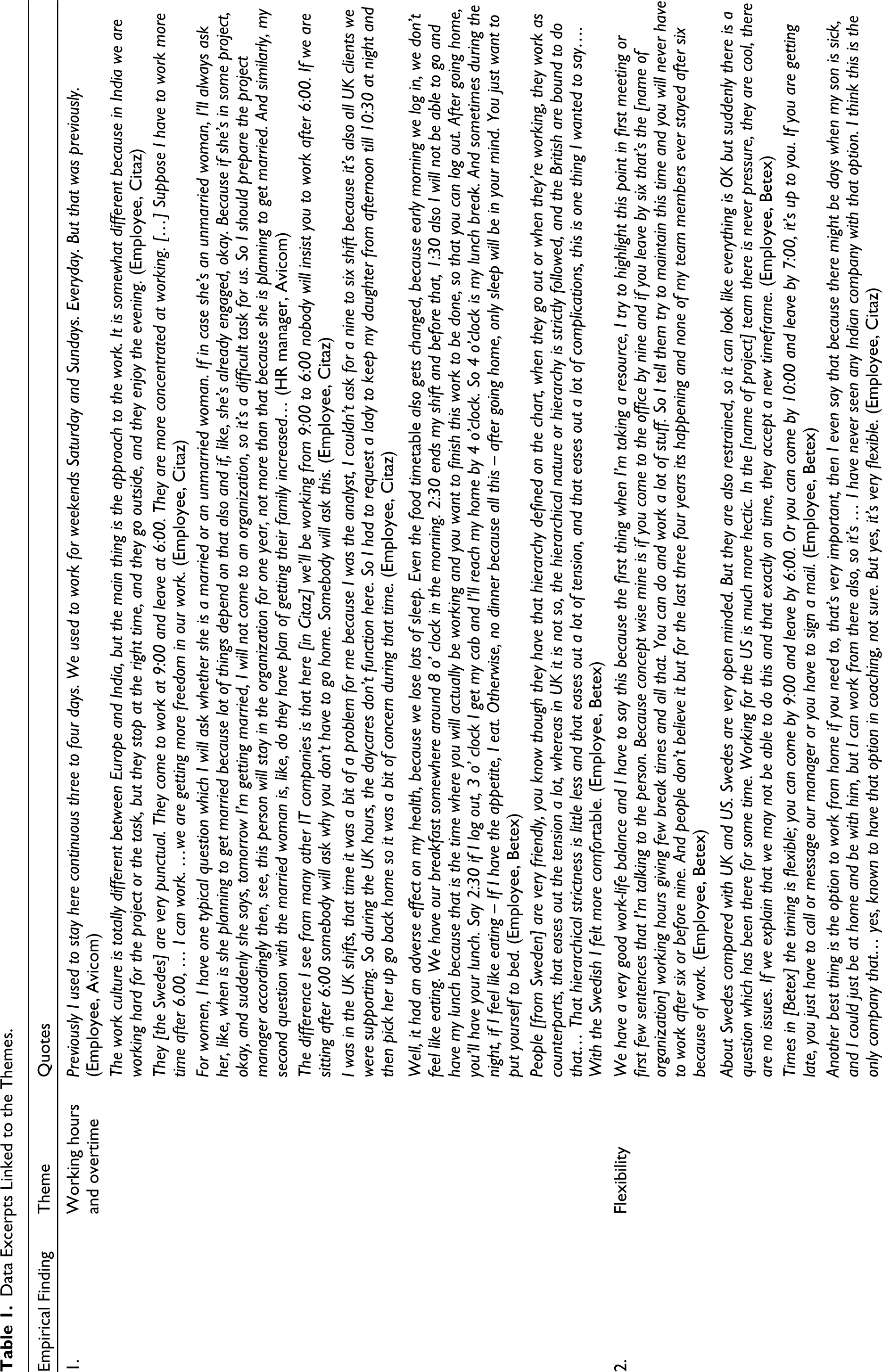
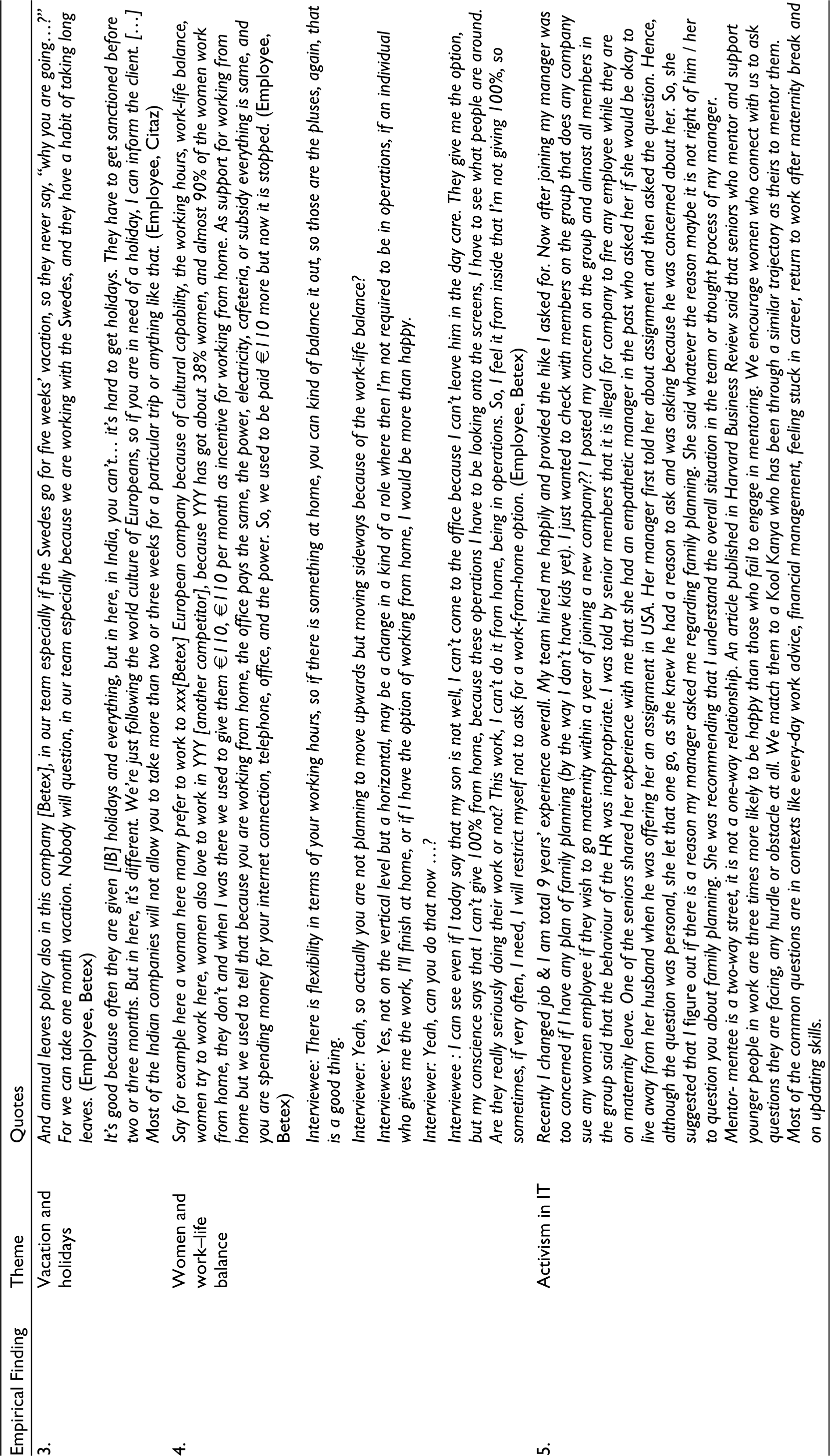
Data Excerpts Linked to the Themes.
Respondent Demographic Profile.

Each interview lasted between 30 minutes to an hour and a half. Almost all the interviews were recorded and transcribed.
The interviews were semi-structured, and an interview guide was used for expert employees and a separate one for senior/HR managers/women networks, although not always applied the same way in all interviews, instead allowing for flexibility and specific follow-up questions. The employees were asked questions about their background, position, work tasks, communication procedures with the client, WLB, cultural differences between Swedish and Indian managers, differences in organizational cultures between Sweden and India and differences in working with different clients and customers other than Swedish and Indian. They were also asked to comment on their educational background and previous work experiences, their current working conditions, relations with colleagues, managers and customers and career aspirations. Interviews also explored the reasons why women professionals had joined the solidarity networks and how they had benefitted from the membership.
The senior/HR managers were asked how the initial cooperation between the foreign subsidiaries started, how the managers put together a team to manage and deliver the projects, initial phases of the project and challenges regarding the setting up of communication procedures. They were also asked to comment on the cultural differences that affected everyday work, failures in communication and delivery, WLB and differences in organizational cultures between the different foreign subsidies and India that influenced cooperation. The interviews were analysed using the qualitative data analysis software ATLAS.ti. As a complement, they were also analysed using traditional content analysis and coding (Fereday et al., 2006; Finfgeld-Connett, 2014). The coding involved a combination of inductive techniques. Our aim was to understand, interpret and represent the subjective viewpoints of the interviewees without any preconceptions to capture the qualitative richness of the phenomenon.
The method used to collect the data could possibly have some limitations. First, since the interviews took place within the organization, it is possible that some interviewees were not able to freely express themselves. The interviewees in all three organizations were also initially selected by the senior management in liaison with project managers who briefed them about the research, and anonymity and confidentiality issues. Likely, this could possibly have intimidated some interviewees into taking a critical stance to their responses.
Empirical Findings
Working Hours and Overtime
Within a ‘new age’ management model, the employees in Avicom were encouraged to promote a ‘self-work ethic’, motivate and identify themselves with the organization (Table 1). The first employees who were recruited in this company worked round the clock initially to set up the reputation of the organization. Some stayed overnight in the office continuously for a couple of days to satisfy the clients (Swedish). The employees discussed how the employees and the management worked as a group, almost like a family, to satisfy the client. Although this meant carrying on working at non-contracted hours (weekends, evenings and all night), the employees were not paid overtime. The first batch of employees who were recruited in this organization I spoke to were all young men, mostly fresh graduates, who did not mind the unpaid overtime in anticipation of travelling abroad to the client site. One of them explained:
Previously I used to stay here continuous three to four days. We used to work for weekends Saturday and Sundays. Everyday. But that was previously. (Employee, Avicom)
The next set of recruits in the same organization talked about the nature of the work and compared it with their previous experience of working with other European and US clients in other organizations. The work pressure was intense in Avicom, yet relatively few stayed overnight or worked weekends to finish a job. They compared their individual WLB with other companies and felt they were better off working here.
A similar work ideal, involving overtime and long hours, was described by some of the employees in Citaz. Here this kind of work ethic of Indian programmers was emphasized as a positive aspect of the competitive market (cf. Chandra, 2012). One of the Indian employees explained:
The work culture is totally different between Europe and India, but the main thing is the approach to the work. It is somewhat different because in India we are working hard for the project or the task, but they stop at the right time, and they go outside, and they enjoy the evening. (Employee, Citaz)
Another employee, a woman, in Citaz was asked if she had experienced any differences in approach or attitude to work between Swedish and Indian employees. She replied by describing that the Swedes were strict when it came to working hours and not staying late in the office, something that also affected the work culture in India:
They [the Swedes] are very punctual. They come to work at 9:00 and leave at 6:00. They are more concentrated at working. […] Suppose I have to work more time after 6.00, … I can work. …we are getting more freedom in our work. (Employee, Citaz)
However, this dedicated employee who longs to work long hours was a work ideal that appealed to the organizations in India and is reflected in how the recruitment process was described. The recruitment manager (an Indian woman) at Avicom mentioned how efficiently they were able to recruit the right people for the right job. She explained in detail how she managed to enquire details about a candidate’s personal life (married/single, siblings/caring responsibilities) through informal discussions with them while accompanying them from the waiting room to the interview room. She explained scrutinizing candidates (informally) and getting an insight into their lives gave her an edge in making decisions on selection and recruitment. Although the senior management in this organization wanted to imbibe the consensus Swedish organizational culture in the Indian context, there were obvious leaks which hindered this as the local manager (unknowingly or not deliberately) stopped this from happening. It is also illegal in many countries to make recruitment and selection decisions based on a candidate’s personal circumstances (marriage, childcare responsibilities, disabilities, etc.), yet the local manager here tries to gather this information in an informal setting and turns this into a selection strategy. This clearly shows how local managers can transform policies from the West into local contexts.
For women, I have one typical question which I will ask whether she is a married or an unmarried woman. If in case she’s an unmarried woman, I’ll always ask her, like, when is she planning to get married because lot of things depend on that also and if, like, she’s already engaged, okay. Because if she’s in some project, okay, and suddenly she says, tomorrow I’m getting married, I will not come to an organization, so it’s a difficult task for us. So I should prepare the project manager accordingly then, see, this person will stay in the organization for one year, not more than that because she is planning to get married. And similarly, my second question with the married woman is, like, do they have plan of getting their family increased… (HR manager, Avicom)
The IT industries are known for a 24/7 working hours culture, overseas travel on short notice and women than men have mobility issues. Women have more domestic responsibilities and childcare commitments and, hence, this explains why they are vertically segregated in the workplace (Tattersall et al., 2007). The informal selection strategy explained by the senior manager above gives an insight as to how recruitment and selection currently take place where the obvious preference weighs more towards a single individual ideally without caring responsibilities available 24/7.
However, in Citaz, the programmers’ WLB was also described as the concern of the managers and as part of the organizational culture. One of the Indian employees in Kochi explained, as he compared his organization with other IT companies in India:
The difference I see from many other IT companies is that here [in Citaz] we’ll be working from 9:00 to 6:00 nobody will insist you to work after 6:00. If we are sitting after 6:00 somebody will ask why you don’t have to go home. Somebody will ask this. (Employee, Citaz)
Employees from Betex and Citaz had a wider experience of working with different clients and they were able to compare their WLB while working with Australian, the United States, the UK and Swedish clients. They explained how working with Australian, the United States or the UK clients meant late night working and tight deliveries, whereas working with Swedish clients meant normal working hours. An employee from Citaz explained how much she struggled to cope with her family life when she worked for a client based in the UK:
I was in the UK shifts, that time it was a bit of a problem for me because I was the analyst, I couldn’t ask for a nine to six shift because it’s also all UK clients we were supporting. So during the UK hours, the daycares don’t function here. So I had to request a lady to keep my daughter from afternoon till 10:30 at night and then pick her up go back home so it was a bit of concern during that time. (Employee, Citaz)
Another employee from Betex explained how working unsociable hours for the Australian and US clients took a toll on her health. She had to take a three-month unpaid break as she started suffering from depression:
Well, it had an adverse effect on my health, because we lose lots of sleep. Even the food timetable also gets changed, because early morning we log in, we don’t feel like eating. We have our breakfast somewhere around 8 o’ clock in the morning. 2:30 ends my shift and before that, 1:30 also I will not be able to go and have my lunch because that is the time where you will actually be working and you want to finish this work to be done, so that you can log out. After going home, you’ll have your lunch. Say 2:30 if I log out, 3 o’ clock I get my cab and I’ll reach my home by 4 o’clock. So 4 o’clock is my lunch break. And sometimes during the night, if I feel like eating – If I have the appetite, I eat. Otherwise, no dinner because all this – after going home, only sleep will be in your mind. You just want to put yourself to bed. (Employee, Betex)
Although Sweden and India fall within different time zones, employees working on Swedish projects do not seem to have stretched themselves to the point of being stressed, instead interviewees mostly agreed to be comfortable.
People [from Sweden] are very friendly, you know though they have that hierarchy defined on the chart, when they go out or when they’re working, they work as counterparts, that eases out the tension a lot, whereas in UK it is not so, the hierarchical nature or hierarchy is strictly followed, and the British are bound to do that… That hierarchical strictness is little less and that eases out a lot of tension, and that eases out a lot of complications, this is one thing I wanted to say…. With the Swedish I felt more comfortable. (Employee, Betex)
The employee from Betex here raises the issue of how the client/customer (Swedes) try to imbibe a consensus culture in the Indian setting, and this is successfully working in terms of how the employees informally interact with senior managers to discuss various issues. These informal interactions are often rare in other hierarchical organizational settings where a formal distance is encouraged and maintained between an employee and a manager.
Having examined the organizations and having seen how policies from the West are transformed in local contexts, this has implications on an individual’s WLB. The three multinational organizations studied certainly have policies that encompass WLB policies, yet what really makes a difference to an individual’s WLB depends on the specific project that the software developer is currently involved in. In these instances, the customer–provider relation becomes more relevant which contributes to a better WLB for the individual and not policies at the organizational level.
Flexibility
Measures that involve different kinds of flexibility for the employees are often central for corporate WLB policies. They can relate to the scheduling of work, for example, flexi time or teleworking, or to the duration of work, for example, part-time work and reducing working hours. The interviewees in all three organizations mentioned these kinds of WLB policies and appreciated them. However, the policies were different in the different organizations, and the possibilities for the employees to use them were sometimes limited. The employees in Betex clearly had experience working on different projects. Yet in their opinion, the WLB was better when they worked with Swedish clients. One interviewee explained:
We have a very good work-life balance and I have to say this because the first thing when I’m taking a resource, I try to highlight this point in first meeting or first few sentences that I’m talking to the person. Because concept wise mine is if you come to the office by nine and if you leave by six that’s the [name of organization] working hours giving few break times and all that. You can do and work a lot of stuff. So I tell them try to maintain this time and you will never have to work after six or before nine. And people don’t believe it but for the last three four years its happening and none of my team members ever stayed after six because of work. (Employee, Betex)
The interviewees in Betex also talked about the work culture in different projects and compared it with other British and American clients.
About Swedes compared with UK and US. Swedes are very open minded. But they are also restrained, so it can look like everything is OK but suddenly there is a question which has been there for some time. Working for the US is much more hectic. In the [name of project] team there is never pressure, they are cool, there are no issues. If we explain that we may not be able to do this and that exactly on time, they accept a new timeframe. (Employee, Betex)
The employees in Avicom mentioned how they had restrictions in terms of flexible working procedures. Flexible working arrangements were only possible for employees who reached a certain seniority within the organization (only product manager and above). Anyone employed below PM was closely monitored and exceptions were only made on an individual basis. The employees in Avicom had a limited number of annual leave per annum with no provision of paid sick leave. If unwell, the employees had to sacrifice their annual leave.
However, in comparison to Avicom, in Betex the flexible working conditions were explained to apply to all, irrespective of position and hierarchy:
Times in [Betex] the timing is flexible; you can come by 9:00 and leave by 6:00. Or you can come by 10:00 and leave by 7:00, it’s up to you. If you are getting late, you just have to call or message our manager or you have to sign a mail. (Employee, Betex)
One of the women working for Citaz described a form of spatial flexibility; to be able to work from home, as something unique in the Indian labour market. According to her, this was not common in Indian companies and to her, this was a great advantage:
Another best thing is the option to work from home if you need to, that’s very important, then I even say that because there might be days when my son is sick, and I could just be at home and be with him, but I can work from there also, so it’s … I have never seen any Indian company with that option. I think this is the only company that… yes, known to have that option in coaching, not sure. But yes, it’s very flexible. (Employee, Citaz)
Flexibility seems to be certainly better for an individual if they are working for a Swedish client compared to the others and in these instances, customer–provider relations seem to override the policies even at the organizational level.
Vacation and Holidays
Vacations and holidays are important parts of the WLB, and the conditions differed between the different companies also when it came to this aspect. Although the organization does not allow taking more than two weeks’ leave at a time, employees working with Swedish clients were able to negotiate longer annual leaves in Betex:
And annual leaves policy also in this company [Betex], in our team especially if the Swedes go for five weeks’ vacation, so they never say, “why you are going…?” For we can take one month vacation. Nobody will question, in our team especially because we are working with the Swedes, and they have a habit of taking long leaves. (Employee, Betex)
An employee in Citaz explained that there were differences between Swedish and Indian working culture and was asked to elaborate on his experiences of the Swedish working culture and replied as follows:
It’s good because often they are given [IB] holidays and everything, but in here, in India, you can’t… it’s hard to get holidays. They have to get sanctioned before two or three months. But in here, it’s different. We’re just following the world culture of Europeans, so if you are in need of a holiday, I can inform the client. […] Most of the Indian companies will not allow you to take more than two or three weeks for a particular trip or anything like that. (Employee, Citaz)
Transnational customer–provider relations seemed to override policies with regard to not only working hours and flexible working but also vacation and holidays.
Women and Work–Life Balance
WLB issues are important to consider from a gendered perspective as women to a higher degree than men experience so-called combination pressure since women often have the main responsibilities for domestic tasks and children (cf., e.g., Maume, 2006). One coping strategy that women frequently use to balance work and family is to leave full-time employment for part-time employment. Women, and especially mothers, work part-time to a much greater extent than men and fathers do (Plantenga & Remery, 2005; Reynolds, 2005).
The women employees especially preferred to work with Swedish clients for better WLB. One employee left the organization and returned simply because the WLB was better at working with Swedish clients. She explained:
Say for example here a woman here many prefer to work to xxx[ Betex] European company because of cultural capability, the working hours, work life balance, women try to work here, women also love to work in YYY [another competitor], because YYY has got about 38% women, and almost 90% of the women work from home, they don’t and when I was there we used to give them €110, €110 per month as incentive for working from home. As support for working from home but we used to tell that because you are working from home, the office pays the same, the power, electricity, cafeteria or subsidy everything is same, and you are spending money for your internet connection, telephone, office and the power. So, we used to be paid €110 more but now it is stopped. (Employee, Betex)
Although part-time working opportunities are available in most of the organizations, few avail it (Dhar-Bhattacharjee & Takruri-Rizk, 2011). This woman from Betex explained the nature of her dilemma and how she copes:
Interviewee: There is flexibility in terms of your working hours, so if there is something at home, you can kind of balance it out, so those are the pluses, again, that is a good thing. Interviewer: Yeah, so actually you are not planning to move upwards but moving sideways because of the work-life balance? Interviewee: Yes, not on the vertical level but a horizontal, may be a change in a kind of a role where then I’m not required to be in operations, if an individual who gives me the work, I’ll finish at home, or if I have the option of working from home, I would be more than happy. Interviewer: Yeah, can you do that now …? Interviewee: I can see even if I today say that my son is not well, I can’t come to the office because I can’t leave him in the day care. They give me the option, but my conscience says that I can’t give 100% from home, because these operations I have to be looking onto the screens, I have to see what people are around. Are they really seriously doing their work or not? This work, I can’t do it from home, being in operations. So, I feel it from inside that I’m not giving 100%, so sometimes, if very often, I need, I will restrict myself not to ask for a work-from-home option. (Employee, Betex)
Previous research by Dhar-Bhattacharjee (2013) shows that parent organizations based in Europe tend to be more devolved and, therefore, offer a better WLB for their employees, whereas if the parent organization was based in the United States, a greater standardization was expected to be maintained across the offices globally where even the basic structure of the performance management system could not be altered. This study shows how differences in customer–provider relations can affect retention or attrition for employees, especially women.
Activism in IT
The 1991 economic reforms in India introduced the era of liberalization, privatization and globalization which nestled the growth of the IT industry. The narrative of liberalization positioned labour market flexibility as a prerequisite for economic growth. In this discourse, trade unions were seen as obstructions to growth, and any form of collective mobilization of employees was stifled. Employees were disciplined into ‘professionalism’ as they were socialized in the IT work culture with long hours of work, commitment to deadlines, rigorous training, competence, strict monitoring and accountability (George & Sinha, 2017). While IT has fuelled the Indian growth story, the labour market flexibility awarded to the IT sector for its growth has stamped upon the rights of its workers witha marked absence in the regulation of work policies (George, 2017).
Karnataka IT Union (KITU) is an outcome of the efforts to address the labour rights violations in IT. KITU became the first registered trade union in 2017 in the state of Karnataka which hosts the city of Bengaluru, the IT hub of India. Before this, the one in Maharashtra was exclusively for graphic designers and another union in Kerala for the employees of the government’s IT programme. KITU provides a broad base as it covers IT and ITeS sectors, spanning all segments of the industry. This was the first big breakthrough for IT employees grappling with prospects of job loss and retrenchments (Dwivedi, 2018). Since its inception, KITU has been taking issues related to illegal retrenchments, gender pay gap, sexual harassment and delayed or cancelled joining; however, the efforts to address the same have been unable to yield effective outcomes. This is on account of the absence of mass participation from the employees who worry about blacklisting from IT companies and organizations if they enrol as a members of the union. At the same time, the plea submitted to the government departments for redressal of the issues got embroiled in red-tapism, in loopholes of labour laws or got sacrificed for the privileges given to IT companies on account of special economic zones.
While it is interesting to note that collective bargaining in the form of an organized trade union has remained ineffective in this space, women have been organizing themselves on various social media platforms and reaching out for alternative means of support. Lean In Circles, JobsForHer and Kool Kanya are examples of such solidarity groups. These networks have emerged as sisterhood circles where women connect to support each other through their experience, journey and resources (Dwivedi & Mukherjee, 2021). Women across career levels and hierarchy connect on these platforms to guide, mentor, share career opportunities and help each other navigate through the constraints and challenges faced by their peers. These circles are unique in that they are not circles of political activism but a unique bonding space and comfort zone where women confide with ease and place a high degree of trust in their peers sharing their personal struggles and seeking mentorship.
One interesting thread of conversation in the circle was around a very personal question asked by a member in her interview. The respondent was asked by HR regarding her family planning. She posted this on the group, and this started a chain of suggestions which she shared:
Recently I changed job & I am total 9 years’ experience overall. My team hired me happily and provided the hike I asked for. Now after joining my manager was too concerned if I have any plan of family planning (by the way I don’t have kids yet). I just wanted to check with members on the group that does any company sue any women employee if they wish to go maternity within a year of joining a new company? I posted my concern on the group and almost all members in the group said that the behaviour of the HR was inappropriate. I was told by senior members that it is illegal for company to fire any employee while they are on maternity leave. One of the seniors shared her experience with me that she had an empathetic manager in the past who asked her if she would be okay to live away from her husband when he was offering her an assignment in USA. Her manager first told her about assignment and then asked the question. Hence, although the question was personal, she let that one go, as she knew he had a reason to ask and was asking because he was concerned about her. So, she suggested that I figure out if there is a reason my manager asked me regarding family planning. She said whatever the reason maybe it is not right of him/her to question you about family planning. She was recommending that I understand the overall situation in the team or thought process of my manager.
Kool Kanya organization runs a special mentorship programme that helps to connect women who are at different levels in their careers. The founder of the organization explained:
Mentor–mentee is a two-way street, it is not a one-way relationship. An article published in Harvard Business Review said that seniors who mentor and support younger people in work are three times more likely to be happy than those who fail to engage in mentoring. We encourage women who connect with us to ask questions they are facing, any hurdle or obstacle at all. We match them to a Kool Kanya who has been through a similar trajectory as theirs to mentor them. Most of the common questions are in contexts like every-day work advice, financial management, feeling stuck in career, return to work after maternity break and on updating skills.
These solidarity networks are distinct as the aim is not to unite for political activism or confrontation but learning from their peers on how to manoeuvre through patriarchy and resist it. Previous publications by Acker 2008 have shown the importance of a feminist social movement as a source of support. Experienced and senior women professionals who have been through similar experiences in their career journey provide inputs on how one can negotiate with patriarchal constraints that manifest themselves in the form of discrimination in pay, promotion, onsite opportunities or maternity benefits. The circles also provide a medium where women connect deeply on issues of personal well-being related to physical and emotional health apart from career concerns. Women shared that it was an empowering experience to be able to assist and mentor their peers along with a sense of belonging that they developed with the community as their personal issues, challenges and fears found recognition with others.
Concluding Discussion
This article discusses the experiences of women IT professionals from two groups: first group of women who are not part of any solidarity network circles but experiencing differences in WLB, inequalities and challenges of equal rights, and the second group who are part of a solidarity network group, who have been organizing themselves on various social media platforms and reaching out for alternative means of support to ensure a better WLB and equal rights.
For the first group of women, the article analysed three different aspects of WLB—working hours and overtime, flexibility, vacation and holidays and the findings reveal how the structural (policies, entitlements and regulations) and relational (organizational practices and people’s attitudes) encompass agency inequalities for IT professionals achieving a WLB. Our findings indicate that both men and women IT professionals in India face greater agency equality when working for a Swedish client.
The WLB was restricted by customers and limited by the work pressure in the specific project discussed at Avicom. The study highlights the critical role of the customer–provider on the possibilities of the employees to utilize WLB corporate policies. The critical role the customers had for WLB became apparent in the interviews. The customer had prerogative over companies’ policies concerning, for example, working hours and flexibility. The workload of each employee also varied according to the different customers. Further, the interviewees suggested that there were country-specific differences between customers from Australia, Sweden, the United States or other European countries. Working for a Swedish customer limited the workload and increased an individual’s well-being.
However, gendered norms operated at the firm level even though the organization was set up by a Swede in India. Gendered effects mirrored the agency and capabilities for WLB as expressed by employees at Citaz, where workplace organizational culture and work demands were factors restraining the employee’s agency and capabilities, especially where employers working with non-Swedish clients wanted a continuous annual leave for three weeks or more.
The study relates to the questions of how equality diversity policies from the West are transformed in local contexts and how this has implications for WLB in transnational organizations. The analysis highlights how these implications vary depending on differences in transnational customer–provider relations and the different types of knowledge transfer in the three companies. The findings also highlight how WLB for software developers can differ not only depending on whether they work in a Swedish or US-based company. The working conditions that influence WLB can also differ greatly within the same company depending on the specific project that the software developer is currently involved in. The project management, that is, the customer, thus decides on the working conditions for their projects, and can disregard policies in the company and instead give priority to finishing the project fast. The results support the argument that transnational companies operating in India are well-advised to take cultural aspects into consideration (cf. Chandra, 2012). They should also be aware of how customer–provider relations affect WLB for their employees.
Although findings indicate greater agency equality for IT professionals when working for Swedish clients, a deep scepticism presides over Indian IT professionals’ sense of entitlement to make a claim for WLB. With the lack of a prominent organized trade union presence in the sector which could potentially provide a more dignified workplace with freedom of association and the effective recognition of the right to collective bargaining on the one hand and the recent developments of inserting chips in individuals in a Swedish organization to increase individual’s agency and capability in WLB, may raise a key question—is WLB a baloney—a neo-Tayloristic improvisation to increase efficiency?
Our findings reveal that the WLB was better when the interviewees worked with a Swedish client compared to a US or a UK one. When making the choice to stay in a company, women IT professionals in India also take into consideration whether they will be able to work with customers that support their WLB. European countries have fewer working hours and a more generous amount of annual leave than their counterparts in the United States or Asia. And results show that WLB in larger companies is better than smaller start-ups, and it is even better if the customer is Swedish compared to an Australian, American or British. The WLB policies offered affect companies’ retention of employees. Findings from the first group show that differences in customer–provider relations can affect retention or attrition for employees, especially women who normally bear the responsibilities, of balancing domestic tasks and children in India.
Changes in typical Indian family structure have increased pressure on both men and women to manage work and family as more and more families have moved from extended family support systems to nuclear families. Attrition in this sector is also very high with mostly more women leaving the sector than men. Interesting to note that there is a lack of women’s collective bargaining, and although an organized trade union could have provided a legitimate framework for the employees to voice their grievances, the trade union is completely dominated by political parties which continue to wield its power and navigate the unions to their political advantages. Although earlier research (Jagannathan et al., 2009) suggests that trade unions have found roots in the industry and most of the employees are in favour of organized trade unions, there is a need for support from NASSCOM for supporting union activities as unorganized unions, cannot safeguard the interest of the employees.
Previous research by Adam et al. (2006) has highlighted the asymmetric power relations in organizations and to let silenced voices be heard and how women use their agency to assert notions of femininity in technical careers (Kenny & Donnelley, 2020). The second group of women who are part of Lean In Circles, JobsForHer, Kool Kanya has, however, successfully empowered themselves by supporting one another in mentoring, sharing experiences of their journey and have managed to find a confidential virtual safe space to discuss their worries, concerns to establish their rights for a better WLB and equal rights, independent of the implications of the differences in customer–provider relations, for example, whether they are working for a Swedish or a US client. Although there is greater agency equality in the first group when working for a Swedish client than an American one and although there were country-specific differences between customers from Australia, Sweden, the United States or other European countries, the second group of women has emerged as successful solidary network sisterhood circles, and this only shows the importance of women’s activism in the IT sector in India.
Footnotes
Declaration of Conflicting Interests
We have no conflict of interest to declare for this research paper.
Funding
The authors received no financial support for the research, authorship and/or publication of this article.