




Abstract
The article asks ‘where are we’ in the study of work–life balance within Industrial Relations and ‘where to next’ if we are to identify levers for positive change in workplace gender equality as technology brings the potential for smoothing or disrupting how women and men from different class groups work and care. It first shines a classed lens on the mainstream work–life balance agenda to pinpoint limitations in its heavy focus on the time squeezes reported by financially secure middle-class workers and its neglect of money matters. Then, via an enhanced conceptualisation, the article considers the ramifications of the growth in gig work for work–life balance. Gig work is promoted as offering flexibility and autonomy, enabling carers to work and care, but it is performed without the safety nets that are more common in formal employment. It can bring unpredictability in both work-time and income, work intensification and financial hardship that all impact work–life balance. ‘Where to next’ is developing a more inclusive approach that recognises gender, class and other types of diversity in order to lever workplace gender equality for all.
The article brings fundamental topics within Industrial Relations (IR): work, care, flexibility and technological change, together with inequalities of gender and class. To address the overall focus of this Special Issue on workplace gender equality, it asks ‘where are we now’ with the well-known work–life balance concept that is central to many campaigns to promote gender equality measures in the workplace. It reflects on ‘where to next’ in the face of rapid technological changes impacting working lives with gendered and classed implications.
The nature of work and its ramifications for IR are continually changing, stated Cooper and Townsend (2017: 118). This article was stimulated by their argument that, while change in achieving gender equality in work and care can feel ‘glacial’, the pace of change in the growth of digitally enhanced working is rapid, creating challenges for scholars and practitioners in keeping up with such fast developments (e.g. the rise in gig work and the impact of social media on the employment relationship). Technology has long been vaunted as holding the potential to either improve working lives or intensify their degradation, with diverse ramifications for different social groups. There has been a growing focus in recent decades on the possibilities (and threats) that new technologies might bring specifically for work–life balance matters (Wajcman et al., 2008). At the same time, developments within the global digitally enhanced economy, especially the growth of gig or platform work, stimulate equally split forecasts on the opportunities offered up by technological change for working lives as a whole (Wajcman, 2015), but there is little attention to work–life balance in the gig literature. This article’s focus was thus also inspired by the Special Issue of this journal on the gig economy that called for research into the broad parameters of gig work and its implications for society (Kaine and Josserand, 2019).
The article brings together two currently siloed topics in IR: the work–life balance framework (where the study of gender inequalities is pivotal) and gig work (where the study of gender inequalities is nascent, Foley et al., 2020). Its overall focus is workplace gender equality but, crucially, the article brings in class too to consider whether the conventional work–life balance agenda can lever gender equality across the class divide in the contemporary world of work.
Where are we now? Workplace gender equality and work–life balance
Work–life balance is fundamental to debates around workplace gender equality. The work–life balance concept is in widespread use across the many disciplines that study how work is intertwined with other life spheres, and gender inequalities here (Crompton and Lyonette, 2006). Positively, work–life balance forces researchers of work to look beyond only the paid workplace. Its emergence fit with, and helped develop, the recognition of the essential interconnections between all forms of work, paid and unpaid, undertaken inside and outside the home, and the deep gender inequalities that become even more apparent when work is viewed holistically (Craig, 2020). Work–life balance is also at the heart of campaigns for, and policies around, levering workplace change to reduce gender inequalities. The business case for work–life balance is well established (Kossek et al., 2010), promoted as good practice for gender equality by such leading organisations as the International Labour Organisation, the European Union and the Chartered Institute of Personnel and Development (CIPD). Organisational support for employees’ work–life balance has ‘win–win’ effects: both improving working lives and boosting organisational performance. Effective support for work–life balance helps organisations to attract and retain employees (including women with caring responsibilities), enhances employees’ experiences and improves their commitment to the firm, all contributing to the success of the organisation (see the review in Kelliher et al., 2019).
Yet the work–life balance agenda has limitations. The concept itself soon grew contentious, and debate over its validity continues. Criticism is directed at the main terms involved and the relationship between them. Does ‘Life’ include only family: what about friends and communities too? Does ‘Work’ also incorporate its non-waged forms? Is ‘Balance’ a useful analogy or are reconciliation, articulation, interference, strain or other terms better employed to link the two domains together (Fagan et al., 2012)? Limitations also emerged in the range of workers who became core to work–life balance studies and policies: the needs of women living in a heterosexual couple and with young children are the heaviest focus (Crouter and Booth, 2004; Ozbilgin et al., 2011). Kelliher et al. (2019) thus argued that firms need their HR policies to broaden out the work–life balance focus to respond to the needs of the full, and increasingly diverse, workforce.
In IR specifically, the mainstream understanding of work–life balance has been criticised for heralding a narrative of ‘positive flexibility’ and for a narrow and managerialist basis (Findlay and Thompson, 2017). For Loudoun and McDonald (2014), IR has two major limitations in its approach to work–life balance. The first is a dominant focus on individuals and their work-lives that problematically places the responsibility for reconciling work and non-work responsibilities firmly on the shoulders of individual (likely female) workers. The second limitation, at the level of organisations and policies, is a focus that tends too much towards an evaluation of a restricted number of isolated strategies (e.g. paid parental leave or part-time work, both most heavily used by women). This article is stimulated by both limitations that Loudon and McDonald identify. Regarding isolated work–life balance strategies, we argue that the major policies promoted to support work–life balance are partial: they focus too heavily only on issues of time and, more narrowly still, on time squeeze. Regarding individual-level work–life balance solutions, we argue that work–life balance problems are rooted in financial strain too but those problems are left firmly on the shoulders of individual workers in work–life balance debates.
Where are we now? Time matters and the work–life balance agenda
‘Where we are now’ is that both academic debate and policy solutions customarily centre around a narrow understanding of work–life balance as only about having enough hours free from work and work-spillover. To be clear, this is not to state that attention to time-squeeze is not vital: studies that focus on the problems with ‘too many’ hours in a job have usefully identified such negative outcomes as poor health and too little time to spend with families, friends and communities (Pedersen and Lewis, 2012). Rather, we argue that a too heavy ‘too many’ hours focus limits our understanding of work–life balance.
How much time a job takes, time strain, being pressed for time/squeezed/rushed all feature routinely in the conceptualisation and measurement of work–life balance. The Australian Work and Life Index, for example, uses five items to measure work–life (Skinner and Pocock, 2011), two of which tap directly into time pressure (time strain and feeling pressed for time). Netemeyer et al.’s work-conflict scale (adapted by Loudoun and McDonald, 2014), has six items, two directly on amount of time spent in a job. Time pressures dominate the work–life balance policy-scape too. The most widespread work–life balance solutions available at national and firm levels are such time-focused options as time off work (via maternity, paternity and parental leave), reduced work time (e.g. part-time working) and various flexi-time possibilities. Most of these options are taken up by women rather than men. In the UK and Australia, time underpins the successful and hard-won fights for the ‘Right to Request’ to work flexibly. In the UK, employees who have worked for their employer for at least 26 weeks can apply for flexible working, where this includes e.g. reducing their hours to part-time, varying start and finish times, working compressed hours. In Northern Ireland, the law is promoted specifically as ‘Flexible working and work–life balance’ (NI Direct Government Services, 2020). In Australia, the Fair Work Act 2009 legislated that parents/carers (of pre-school-aged children or a child under 18 with a disability) could apply for similar flexi-time options. In all these examples, men are less likely to request flexible work than are women.
Time now so dominates work–life balance strategies that, we argue, a time squeeze has transitioned from being viewed as a ‘personal trouble’, for the workers to solve alone, into a ‘public issue’, to use sociologist C Wright Mills' (1959: 9) influential distinction. Mills stated that the solution to a ‘public issue’ is not to be found ‘within the range of opportunities open to any one individual’. Because time squeeze is the prevailing ‘public work–life balance issue’, working too many hours has successfully gone beyond the first limitation of the IR approach to work–life balance (placing responsibility for reconciling work and non-work responsibilities onto the shoulders of individual workers).
Work-time squeeze should certainly be a public work–life balance issue, not left to individuals to solve alone and with women making most of the adjustments. But a time squeeze does not matter equally for all groups of workers and nor is it the only work–life problem that workers can face. Instead, time squeeze is a partial understanding that prioritises the work–life challenges reported more often by the most financially secure among middle-class workers. Lewis et al. argued in 2007 that the core group in work–life discourses are: ‘relatively affluent professional and white collar workers… who have difficulty in finding time for personal life because of the all-encompassing nature of many contemporary forms of work’ (Lewis et al., 2007: 361). Yet the still dominant time-squeezed work–life balance narrative underplays the concerns of less financially comfortable middle-class workers (Wilkinson et al., 2017), while barely touching upon the work–life priorities of many of those employed in working-class jobs.
The time-squeezed account persists despite the fact that a number of innovative studies do address diverse class inequalities in work–life balance. They have shown, first, that there are additional temporal dimensions of work–life balance that impact more heavily on the working-class than does time-squeeze, and second, the financial struggle to make ends meet can be as much if not more of a concern for working-class workers, with heavy pressures on women to manage squeezed family finances and on men to earn breadwinner wages.
Critiquing a heavily time-squeezed middle-class work–life balance focus is not to argue that time demands are unimportant for working-class work–life balance. Workers in manual jobs, men especially, are indeed likely to work long weeks, albeit for financial matters rather than the career reasons that are cited more by professionals/managers, as the Warren (2015) and Crompton and Lyonette (2008) show. Yet these workers are also at heightened risk of being impacted by work-time underemployment (not having enough paid work) and fears about working too few hours (see e.g. Warren, 2016, 2017; Lyness et al., 2012).
There is also a welcome growing awareness of the classed impact on work–life balance of the timing of hours (are they during the day, at weekends?), the predictability of work schedules (are any changes to schedules planned enough in advance?), the tempo of work (is it well-paced, monotonous or frantic?) and work-time autonomy (what say do workers have over their work-time?) (Warren, 2016; Loudoun and McDonald, 2014). In terms of hours schedules and their predictability, unsocial working can desynchronise the time schedules of workers from those of their family and friends (Lesnard, 2008), particularly acutely when shifts rotate or are erratic (Williams, 2010), impacting work–life conflict (Kelly et al., 2014) and well-being (Schneider and Harknett, 2019). Working-class employees are over-concentrated in jobs that are marked by unsocial work-time (Eurofound, 2016; Perry‐Jenkins and Gerstel, 2020; Presser, 2004). In the UK, they are most at risk of having their working hours cut at short notice, causing real anxiety, and they are also more likely to be required to work very hard, and to operate at very high speed and to tight deadlines, women especially, report Felstead et al. (2020). Working-class workers are less able to control when, where and how they work than are senior employees, with their working days more likely to be rigidly controlled and with little flexibility (Warren, 2016). In the USA context, Kossek and Lautsch (2018) found scant flexibility over work location and scheduling for lower level workers (and see Gerstel and Clawson, 2018; Henly and Lambert, 2014) while Williams (2010) noted how they could be fired for being a few minutes late or ordered to work overtime in the middle of a shift.
These crucial findings on the assorted temporal work–life balance pressures faced by working-class workers are rather scattered throughout the literature. This article brings them together in Figure 1. We argue that if ‘where we are now’ is with a dominant understanding of work–life imbalance as largely about time and, more narrowly still, about time squeeze then ‘where to next’, in order to lever workplace gender equality and across the class divide, must be developing a more holistic understanding of work–life balance that also frames the temporal troubles reported by working-class employees as public issues that require public work–life balance solutions.
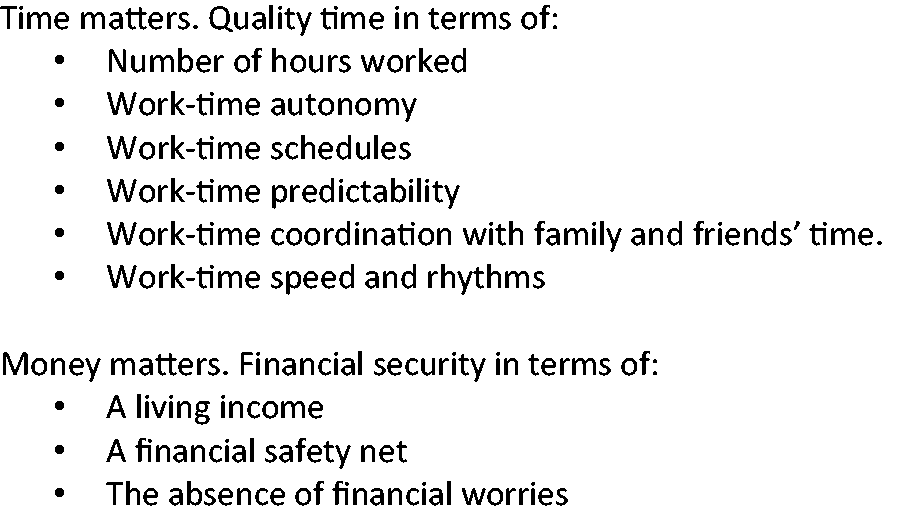
The temporal and monetary dimensions of work–life.
Where to next? Money matters and the work–life balance agenda
The class-blinkered mainstream work–life balance agenda is becoming even more redundant in the face of mounting precariousness among the workforce, heaviest among the working-classes. As Bessa and Tomlinson (2017) argued, while insecurity and precarity have accelerated to eclipse other debates in the study of flexible working arrangements, the study of work–life balance in IR has been slow to pick up on such deep challenges. This article’s standpoint, drawing on Warren (2015), is that work–life balance is also put at risk when workers are experiencing, or living in fear of, financial hardship. Financial security is not something separate to work–life balance; instead it is core to both sides of the work–life balance set of scales: work and life. Promoting a good quality of ‘Life’ means reducing money troubles that we know can bring poor housing; inadequate diet; scant leisure opportunities; stress, anxiety and poor physical health. Promoting financial security in terms of paid ‘Work’ is crucial to eliminate the financial impetus to e.g. work very many hours, perhaps with multiple employers in low quality jobs that are patch-worked together, causing time pressures and stresses in coordinating numerous demands.
We know from select work–life balance studies that money matters are crucial to work–life balance for working-class workers. When asked about their work–life balance, for example, working-class workers are more likely to mention financial concerns than are people in middle-class jobs. In the UK, Fagan et al. (2008) found that, when probed about work–life balance, working-class participants talked about working for the financial reasons that many more of the middle-class took for granted (e.g. housing costs and to afford an annual holiday). In research with UK working-class workers, the Warren et al. (2009) found interviewees, female and male, reverted repeatedly to monetary work–life balance challenges, even when they were being asked specifically about time pressures. In the USA, intense financial pressures have also been shown to destabilise the work–life balance of working-class workers, lone mothers especially (Crouter and Booth, 2004). As Williams (2010: 42) stated: Professional/managerial women are not the only Americans affected by work-family conflict. In fact, they are the lucky ones. They can afford high-quality child care and can outsource much of the housekeeping. Or they can afford to stay home to ensure high-quality care.
Money and time are linked, of course. Financial security can safeguard workers from having to spend too much time in their job or from searching for additional jobs in order to make ends meet, both starkly classed phenomena. In sum, we argue that money matters must also be framed as work–life balance public issues, in addition to time, to challenge the class-biased work–life balance framework (Figure 1). Without a buffer against financial hardship, the balance between work and the rest of life is shaky. A precarious balance can easily be lost and, once lost, very difficult to regain.
Where are we now? Gig work and the potential for work–life balance
This section considers the potential of gig work for workplace gender equality via easing (or intensifying) both temporally- and financially-rooted work–life imbalance. Work–life balance and gig working are almost siloed academic literatures and debates, the former dominated by gender inequalities while the latter rarely addresses gender; so here we review the gig literature and apply a work–life balance lens to the findings.
First, what do we mean by gig work? Also known as platform, sharing and on-demand work (Duggan et al., 2019), gig work has been defined in research for the UK government as ‘the exchange of labour for money between individuals or companies via digital platforms that actively facilitate matching between providers and customers, on a short-term and payment-by-task basis’ (BEIS, 2018a: 9). Gig work covers a diverse range of work opportunities and there is huge variation in rates of pay and the skill level demanded (Kässi and Lehdonvirta, 2018). This complexity has created challenges in assessing the amount of gig working and its rates of growth. The UK is estimated to have the highest incidence of gig work within Europe (Eurofound, 2017) but figures are imperfect. Indeed the Office for National Statistics (ONS) is still consulting on how to better measure the ‘sharing economy’. It has collected data on whether people use the internet to ‘sell goods or services’ as part of the ‘Options and Lifestyle Survey’ for some time. Figure 2 shows a rise during the fallout of the great recession in 2008–2009, a drop in 2013–2016, and then a peak at 29% in 2019. Table 1 shows trends by age and sex: by the final year of data available more men than women (34% vs. 24%) reported selling goods/services, with a fairly even age spread (apart from 65+ year olds who were not likely to be involved). For full details of ongoing plans to include gig work in UK official statistics, see ONS (2017).
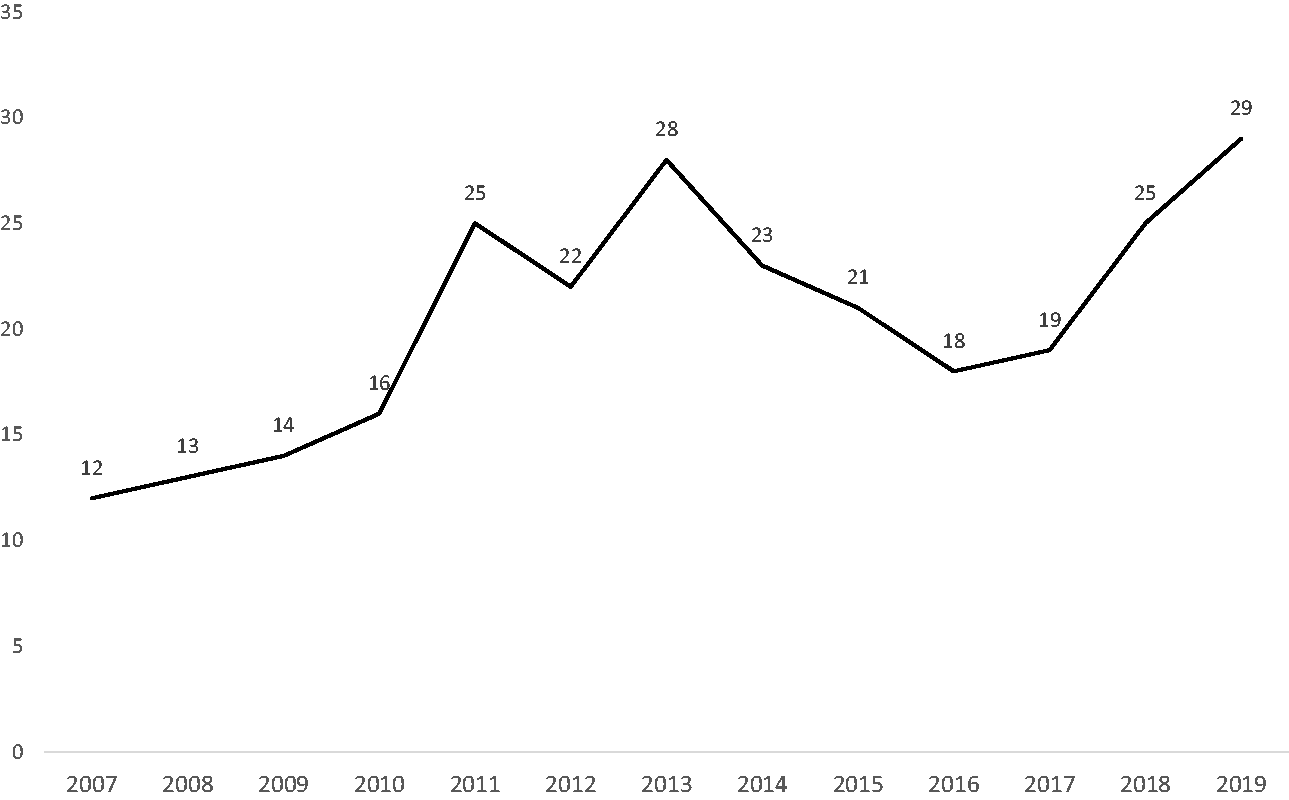
Percentage selling goods or services over the internet (in the last 3 months).Source: ONS. ‘Opinions and Lifestyle Survey’: Internet activities. Re/ease date 12 August 20 1 9. Adults (aged 16+) in Great Britain.
Percentage selling goods or services over the internet (in the last 3 months), by age and sex.
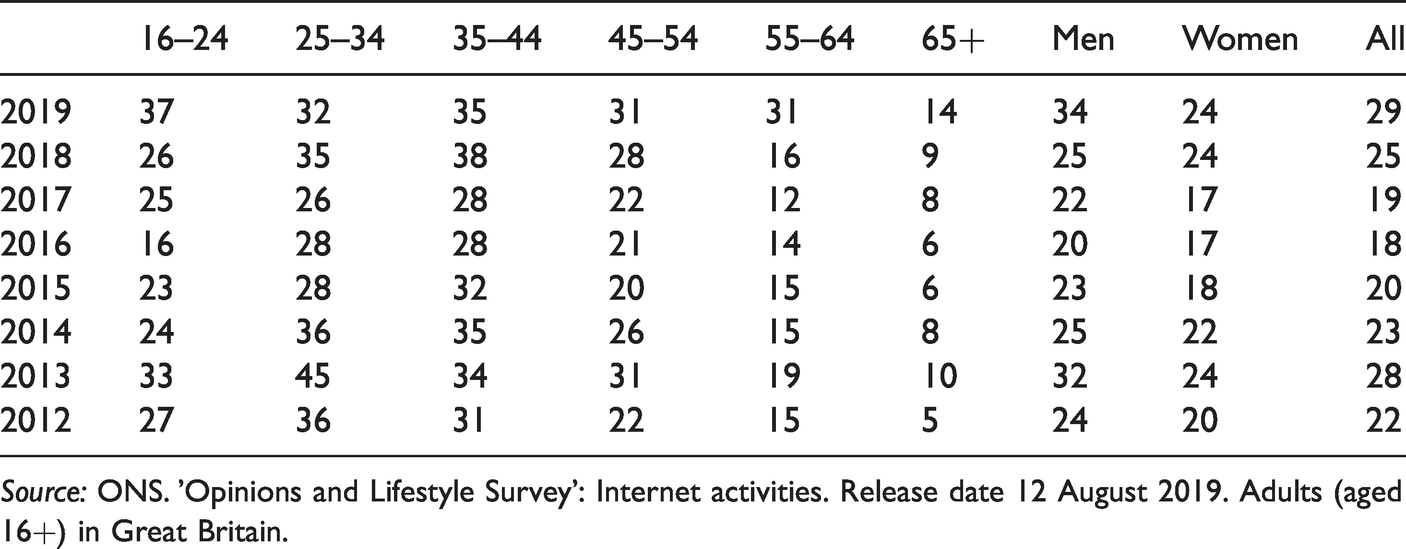
Source: ONS. 'Opinions and Lifestyle Survey': Internet activities. Release date 12 August 2019. Adults (aged 16+) in Great Britain.
The evidence base around the actual experience of gig working is patchy in general. We know even less about gigging and work–life balance. For the work–life balance focus of this article, then, we looked to see how gig work is pitched to workers by platforms. One of the main advantages promoted is work-time flexibility (core to years of campaigning to achieve better work–life balance for workers). Rather than being heavily constrained by employer demands (Sutherland et al., 2020), gig workers are offered the prospects of choosing if to work, what work to do, how much work and when to carry it out, where to do it, for how much money and how long to stay with any one work-provider. These much-vaunted benefits are marketed to working-class women and men, not only to professional workers, and different platforms have quite different worker profiles. Taskrabbit, for example, that offers ‘handyman’ services such as assembling furniture, general DIY and help with moving house, advertises that becoming a ‘tasker’ allows you to ‘Make a schedule that fits your life’ (https://www.taskrabbit.co.uk/become-a-tasker). Uber’s profile is mostly working-class men (see Churchill and Craig, 2019, on Australia), often from migrant backgrounds. Uber attracts drivers with the pitch that you can ‘Fit driving around your life, not the other way around’: ‘Set your own schedule. You’re in charge’. UberEats, providing local food delivery, states: ‘Your vehicle, your time. Take to the streets and deliver whenever you want – for an hour, a weekend, or throughout the week’ (https://www.uber.com/gb/en-gb/deliver/). Peopleperhour, that focuses upon professional freelancers in the UK, calls on workers to ‘Start living your work dream’ (https://www.peopleperhour.com/). Airtasker, originating in Australia, directly references work–life balance, flexibility and autonomy: ‘Choose the tasks that you would like to complete for the people that you’re happy to work with. You’re in control of your own schedule and creating your flexible work–life balance’ (https://www.airtasker.com/uk/earn-money/).
How does this positive sell of flexibility to workers, and autonomy, square with how gig work is promoted to employers and work providers? Platforms market gig workers as an on-demand and cheap workforce (Ellmer et al., 2019), providing firms with access to a large supply of labour, less restricted by geographical limitations. Organisations do not have to pay for worker training or their development, keeping costs down. The crowdsourcing marketplace Amazon M-Turk, for example, advertises that work ‘requesters’ can use Turk workers to: ‘Optimise efficiency’, ‘Increase flexibility’ ‘Reduce cost’. Outsourcing microtasks ‘ensures that work gets done quickly, while freeing up time and resources for the company – so internal staff can focus on higher value activities’. The ‘Upwork’ freelancing platform similarly offers firms the ability to ‘Get more done. Do more with your existing budget by leveraging from a ready-to-go, global pool of talent’ (https://www.upwork.com/solutions/startups/). It is well known that the specific flexibility needs of organisations for a ‘just-in-time’ workforce can clash with, and overrule, the flexibility needs of workers to have more autonomy over their work-time and their broader ways of working (Rubery et al., 2016). Is gig work a case of a mutually beneficial flexibility instead (Goods et al., 2019)?
Time and gig work
What do we know about gig work and time? How might this feed into the article’s interest in workplace gender equality and work–life balance? Positively, the virtual world of work has been lauded by gig scholars for offering workers opportunities for flexible work-time and improved time-autonomy (Ravanelle, 2019), both of which are core in work–life balance debates and so could potentially support the work-lives of gig workers and their families. Gig work, we are told, can reduce time-squeeze by removing travel time, freeing up time for non‐work activities. It can play a part in providing a challenge to rigid, male-centric norms of a ‘9–5’ work day and a ‘full-time present’ worker and, in this way, gig work could potentially support people to combine work and care (Altenreid, 2020), easing gender inequalities in working lives (Piasna and Drahokoupil, 2017). We argue instead that the findings on gig working raise serious concerns over the intensification of already time-pressured work-lives, problematically further blurring the boundaries between paid work and non-work, causing intense spill-over from work to non-work, and reducing rather than enhancing workers’ autonomy over their ways of working. The lauded flexibility and autonomy over work-time might come hand-in-hand with unpredictability in hours, and hence income insecurity, potentially leading to work intensification and financial hardship that both impact work–life balance and undermine workplace gender equality.
What we know about the reality of gig work is that there are some highly dissimilar verdicts from an emergent and complex evidence base. In the UK, for example, it is perhaps unsurprising that the Department for Business Energy and Industrial Strategy (BEIS) paints a picture of many positives. Asked their reasons for working in the gig economy, the most prevalent responses workers gave in a survey were indeed the flexibility of the work (to fit around e.g. caring or studying) and greater control over work-time. The BEIS (2018a) report optimistically summarises: ‘Overall, more than half of those involved in the gig economy were either very or fairly satisfied with their experience of providing services on websites and apps (53 percent)’. It also notes that independence and flexibility were the two most satisfactory aspects (58% and 56% were satisfied) followed by the number of hours worked (47% were very/fairly happy). Yet, looking at those results another way, clearly around half of respondents were not even ‘fairly satisfied’ with their gig experience overall and, actually, a majority (53%) were not satisfied with their hours worked.
What about control over work-time? In a BEIS qualitative study (BEIS, 2018b: 59), respondents generally reported that they were in control over what work they did and how and when they did it (e.g. some reported controlling their time schedule via accepting or refusing jobs, others said that they could work very hard for a period of time and then take time off). Others, however, reported far less time autonomy, with workers saying that they had to take on as much work as possible in order to make enough money. Autonomy was also impacted because work offers often came in at the last minute, or were cancelled with no notice, and so workers had to rapidly change their plans. Workers found it hard to refuse work for fear of exclusion from future offers. In the BEIS survey (2018a: 40) when asked which one aspect of work in gig economy they would most want to improve, the most common response was more regularity and predictability of work (18% mentioned this). We know that a lack of regularity/predictability severely undermines workers’ own work–life balance, impacting negatively on family members too.
Much other research into gig working similarly reports that the workers experience work intensification, long and unpredictable hours, work-time underemployment and fragmented hours (Fleming, 2017; Sutherland et al., 2020; Wood et al., 2018a). Yet these valuable studies either do not refer directly to work–life balance at all or they touch upon it only briefly, and nor do they draw upon the established work–life balance literature. Here, then, we again review findings from studies on gig work through our work–life balance lens to consider the implications for workplace gender equality. Crucially for work–life balance, rather than more temporal freedom for workers, gig work brings new and more extreme forms of control of their work-time (see Grimshaw, 2020), especially via apps. Ellmer et al. (2019) discuss how Upwork, for example, monitors workers via a ‘Freelancers Work Diary’: the app takes screenshots of freelancers’ screens at 10 minute intervals, keeping a detailed log of their work-time and job progress. Platforms can harry workers rather than ease time pressures, e.g. global positioning systems track drivers’ locations and monitor their time within strictly prescribed windows for each task. Deliveroo riders notoriously have a very short period in which they can accept an order or else they lose it, and they cannot turn down too many jobs without being locked out of the platform. What this means is that complex decisions, that take into account the size and type of job and the amount it pays, have to be made very rapidly (CIPD, 2017; Goods et al., 2019). Feedback and reputation systems further time-discipline workers: gig workers report doing unpaid overtime and/or working at unsocial hours to meet clients’ demands and to avoid bad ratings (Broughton et al., 2016). Finally, and not least, waiting and search times for work can be lengthy: the ILO estimated that M-Turkers spend 18 minutes in every hour searching for work (Berg, 2016). This unpaid time pulls down the amount earned per hour of work done (to only US$3.29 in 2017; Berg et al., 2018).
Gig work has been charged with creating time pressures, heavy information overload, and stress and burnout but, as stated, there is sparse if any reference to the specific ramifications for gender equality and/or work–life balance in the gig literature. Looking at these findings anew, we cast doubt on the potential for gig work to smooth the time pressures that undermine work–life balance. There are also deep risks to temporal-based work–life balance in the form of exclusion from social and employment protection that provides paid time off from work. Gig work does not provide paid maternity or parental leaves, nor time off for carers, with severe negative ramifications for gender equality (Altenreid, 2020). Even when the state makes provision, taking leave can be risky as workers can be removed/deactivated by platforms for absence, and access to work depends on reputation, with good ratings essential on recently finished jobs (Goods et al., 2019; Ravanelle, 2019). This can seriously destabilise the work–life balance of workers depending on gigs.
If gig working raises so many warning flags around temporal-based work–life balance, with resultant challenges to workplace gender equality, what are its potential ramifications for workers’ money-based work–life balance?
Money and gig work
We know that money is crucial in any analysis of gig work. Gig working has expanded so significantly because it brings financial efficiencies for firms. We outlined above the ways that M-Turk, Upwork, etc. market their platforms to organisations (M-Turk: ‘you can significantly lower costs…’; Upwork ‘Do more with your existing budget…’). These cost efficiencies are built upon a tight financial model for gig workers. For the workers themselves, studies show that money is actually the main reason why workers gig. The UK’s Trades Union Congress (TUC) found gig workers increasingly trying to patch an income together from multiple sources, platform and non-platform. In a 2019 online survey, it (TUC, 2019) found that the majority said that they gigged to top-up earnings. In Australia too, Churchill and Craig (2019) found income to be the strongest motivating factor (followed by flexibility). The International Labour Organization (ILO) also reports that substantial numbers (a third) of workers on digital platforms did this work in order to complement pay from other jobs with a further third reporting that gig work was their main income source (Berg et al., 2018).
Given the financial impetus behind gigging, many studies in the gig literature raise worrying concerns for our consideration in this article of the potential of gig-work to contribute to money-based work–life balance and in so doing enhance workplace gender equality. The TUC survey reported that many more people were looking for gig work than were finding it, signalling financial pressures among those workers unable to find enough or even any gigs. In a 2016 survey of 5000 adults in the UK, with follow-up interviews with gig workers in 2017, the CIPD found that 60% of gig workers said that they were not getting enough work on a regular basis to meet their needs, and this figure rose to 79% of those who said they were in financial difficulties. Even the BEIS (2018a) report had discovered that the main disadvantages mentioned by gig workers were a lack of security in finding work and unsatisfactory hours and pay (followed by a lack of employment rights such as access to sick and maternity pay). Dissatisfaction levels were also highest for work-related benefits and income.
Studies targeted at specific groups of workers reaffirm that gig work can go hand in hand with financial insecurity. Goods et al. (2019), for example, found ride-sharers (their sample was mostly male Deliveroo riders) were earning far less than they would working in casual employment and that pay was even falling with competition from expanding numbers of gig workers. Economic insecurity came in multiple forms for the ride-sharers: with threats to pay, income variability and broader economic risks. Gig workers face serious economic risks because firms’ core overheads are outsourced to them. For example, drivers need to purchase, maintain, and run their vehicles; couriers provide their own bikes, safety equipment and mobile phone contracts, while online workers pay for their own computing facilities including internet costs. Furthermore, because platforms can remove workers, this limits workers’ ability to find enough (or indeed any) work. Minter’s (2017: 445) analysis of Airtasker notes that, because Airtasker is the national leader in on-demand labour services, when it blocks a worker it effectively forces them out of the task-based market.
Rather than a route to improved workplace gender equality via enhanced work–life balance, because of the much-hyped improved work-time (flexibility, autonomy, etc.) and extra income source that platforms market to prospective giggers, there are serious doubts about the potential of gig working for both time and money based work–life balance matters. There are class divisions among gig workers too. Palier (2018) contrasts the emergence of an internationalised ‘creative class’ of gig workers who live in the heart of global urban centres with a class of people whose gig work directly supports the creatives. This includes the latter class taking care of children and elderly relatives, serving in hospitality, transporting in taxis, and carrying out maintenance on the homes of the creative class. Through our work–life balance lens again, working-class gig workers are directly supporting the work–life balance of the creative class, often to the detriment of their own. Many traditional working-class jobs (e.g. housecleaning, taxi driving, house maintenance) have also been pushed into the gig economy, with negative consequences for jobs of the working-class and, we add, their work–life balance too.
Where to next? Gig work and the potential for work–life balance
This last section asks about tactics to support gig workers. It outlines key strategies being developed to try to improve their work conditions. We argue that these have strong overlaps with the strategies that are core in the far more established battle to promote work–life balance for workers, a battle shaped by the gender equality agenda. The two movements are largely disconnected yet the same stakeholders that have been fundamental to successes in promoting equality in work–life balance are crucial in drives around gig work: the state, organisations and worker voice. What insights from work–life balance might feed into evolving tactics for gig workers, and lead to overall improvements in workplace gender equality?
The state
Some of the most well-known examples of positive strategies to promote work–life balance are those that have made it into state and even cross-national agreements. Perhaps the most notable example, that shows just what is achievable, is the EU Work–life Balance Directive (EU, 2019). Even though its recommendations are purely time-based, they aim to provide a solid floor for workers’ work–life balance rights across the EU and to support and encourage men’s roles in caring too (e.g. paternity leave at least 10 working days; strengthening existing rights to parental leave; 5 carers' leave days per year; the extension of the right to request flexible working arrangements).
Given that the state can clearly play a crucial role in supporting work–life balance to better promote workplace gender equality, what is its potential for supporting gig workers? Unfortunately, gig work has generally been performed without state-level safety nets, and real challenges persist at this level. Indeed, the successful labour regulations and laws around work–life balance assume the standard employment relationship (Den Dulk et al., 2013) whose absence is a well-recognised problem for gig workers. The battle over whether Uber drivers are employees, workers or independent contractors is a key example of complications, but it highlights opportunities too. Uber has brought to the fore concerns around the employment status of gig workers (Foley et al., 2020; The Guardian, 2021; Todolí-Signes, 2017), stimulating an ongoing debate over, for example, whether a new category of worker (e.g. ‘dependent contractor’) is the best way to bring greater protections and rights to gig workers. Devising a new category like this does bring risks that employers would re-classify employees, to reduce their protections, and so a more radical alternative is to expand state rights and benefits towards all workers. The UK TUC (2017), for example, argues for a new more inclusive ‘worker’ definition, with rights for all that would also promote workplace gender equality (e.g. statutory redundancy pay, parents able to return to their substantive job following maternity, paternity or adoption leaves) in order to keep pace with changes in the contemporary labour market. Graham et al. (2017: 156) also recommend a more inclusive definition of employment so that gig work is included within the ‘norms and moral economies’ of material labour markets, rather than being seen as something else and in need of different provision. A linked state-level option to support gig (and other) workers is stronger welfare support for the unemployed to reduce the desperation for gig (and other) workers to seek just any income source. Churchill and Craig (2019) argue that the gig economy presents the same sort of challenges as precarious work in general, and so gig workers should be supported in comparable ways to other workers.
A final challenge at state-level is that national regulations can be problematic because, as Graham et al. (2017) note, gig work is often transacted across borders and so it can be unclear which nation’s regulations should apply. Their solution is that since only a small number of high income countries account for the major demand for gig work, they offer valuable ‘strategic points’ to make significant progress around regulation (e.g. setting minimum hourly rates), and so the state can still play a key role. Pursuing state-level protections that cover gig and all workers equally, that, ultimately, lead to cross-national agreements (such as the EU Work–life Balance Directive), is the target.
Organisation
The battle for workplace gender equality via better work–life balance has also been fought, with some success, at the organisational/employer level. Good work–life balance policies are promoted to help enhance employee recruitment, turnover and progression – reducing costs to the firm of replacing workers and re-training new staff; developing worker health, commitment and job satisfaction; with increased worker performance and firm productivity. As we stated, the business case for work–life balance and its role in promoting workplace gender equality is well established (even though its focus is largely on time squeeze).
Can campaigns to support gig workers learn from work–life balance initiatives? Unfortunately, many of the victories achieved in establishing organisational work–life balance strategies are rooted in a model of the firm investing in and retaining its valued workers. In marked contrast to this work–life balance approach, platforms promote their services as a way for firms to protect valued staff via outsourcing ‘low value’ activities to gig workers. M-Turk, for example, markets as one of its benefits: ‘…internal staff can focus on higher value activities’. Attaining support for gig workers is complicated further because, as Kelliher et al. (2019) argue, organisational policies are additionally built on the assumption that the employee has a single employer. As we saw in the UK’s TUC study, gig workers report many sources of work income. When the relationship between the worker and a work provider is fleeting, why would firms care about the gig workers? One encouraging point, again from the work–life balance literature, is that initiatives have also been successfully adopted by firms as a way to promote their reputations and as part of the corporate social responsibility agenda. Indeed, firms can face severe reputational risk if they use workers poorly: Sports Direct, Amazon and Uber have all become infamous for appalling employment practices (TUC, 2017).
There are ongoing campaigns at the level of the organisation around gig work. These are targeted both at platforms themselves to provide better terms and conditions for gig workers (the ridesharing platform Juno, for example, offers drivers the chance of equity ownership, CIPD, 2017) and at firms to develop good practice in their use of flexible workers. Certainly, firms could be encouraged to work only with unionised gig workers.
The ongoing but fruitful fight for work–life balance policies at the organisational/employer level, in order to promote workplace gender equality, provides some encouragement that firms can be persuaded by sustained campaigns to improve practices. This links us to the importance of worker voice, to end.
Worker voice
Worker voice, including via trades unions, has long been core to the achievement of better employment conditions for workers, including narrowing gender inequalities. There is also some evidence of successful union engagement to improve work–life balance specifically, albeit with great variety by country and sector (Gregory and Milner, 2009; Rigby and O’Brien-Smith, 2010). Where unions are not or are barely involved in work–life balance campaigns, explanations put forward include that work–life balance has been largely seen as a ‘woman's issue’, particularly by male‐dominated unions (Brochard and Letablier, 2017) and, because mainstream work–life balance measures are commonly focused on promoting flexible work-time, unions have seen these as employer-imposed threats that undermine employment rights (Gregory and Milner, 2009). Of course, sectors of the labour market that fare very poorly in terms of work–life balance are also often marked by low levels of unionisation (Milner, 2016). Yet many positive examples of unions embracing the inter-linked gender equality and work–life balance agendas do exist: the UK TUC, for example, guides reps on how to help members seek to improve work–life balance (although, again, it focuses solely on the work-time options that are taken up mostly by women, TUC, 2021).
Turning to worker voice and gig work, the nature of gig work does make collective bargaining difficult (Grimshaw, 2020). Many trades unions have learned to organise outside so-called standard work norms in order to address issues of equality, diversity and inclusion, with e.g. long-standing efforts to unionise the female-dominated low-paid part-time workforce (Walters, 2002), but gig work brings new challenges. As Altenreid (2020: 151) states: ‘Dispersed across the globe, isolated from and in competition with each other and hardly protected by labour legislation, crowdworkers’ possibilities for collective action appear quite limited’. For Graham et al. (2017) too, labour rights strategies for gig workers are hampered not only because the workers do not know each other but also because they recognise that if they withdraw their labour (for example), other workers, across the globe, will quickly replace them. Yet there are some positive examples, even with these serious challenges, ranging from informal online forums set up by gig workers to efforts to create formal transnational unions. Wood et al. (2018b) show how internet‐based communities have developed to share information and support each other, even when workers are highly geographically dispersed. Gig workers have come together successfully to protest their work conditions and campaign for improvements (Graham and Woodcock, 2018), often building upon their insights into digital ways of operating. The Turkopticon is a well-known example. It was set up by M-Turk gig workers to rate the requesters: it ‘helps the people in the “crowd” of crowdsourcing watch out for each other – because nobody else seems to be’ (https://turkopticon.ucsd.edu/). Lehdonvirta (2018) refers to these online communities as creating valuable ‘new structures of working life’ but still concludes that ‘old’‐style union activities are more effective in equalising opportunities.
Established trades unions thus have a key part to play in regulating gig work. Unions in France, for example, though they were part of initial protests against Uber went on to help mediate around improved conditions for the drivers. The GMB union in the UK has also supported drivers in their fight to secure rights to the national minimum wage, holiday pay and daily breaks (Duggan et al., 2019), as has the independent App Drivers and Couriers Union (ADCU, 2021), while the Transport Workers Union in Australia was involved with cases against Deliveroo and UberEats (Foley et al., 2020). German, Austrian and Swedish unions launched the online review platform Fair Crowd Work (2016) to provide reviews and ratings on working conditions at different online labour platforms. It also promotes ‘The Frankfurt Declaration on Platform-Based Work’ that calls on stakeholders to work together to bring democracy to new digital workplaces. If gig workers are to benefit from advances in employment protection, then collective mechanisms to channel worker voice are critical.
Conclusions
The article asks ‘where are we’ in the study of work–life balance within IR and ‘where to next’ if we are to identify levers for positive change around workplace gender equality as technology brings the potential for smoothing or disrupting how women and men in different classes work and care. The article brings together two overly siloed topics in IR: work–life balance, where gender is central, and gig work, where there is currently little attention to gender inequalities. The article utilises a re-working of the orthodox work–life balance model: it brings money matters in to the ordinarily time-based approach. It then uses this more holistic understanding of work–life balance to consider the potential of gig work, and its risks, for work–life balance, time and money. Lastly, the article considers whether the battle to improve gig work can learn from the more established fight to progress workers’ work–life balance and promote workplace gender equality.
‘Where we are’ is with a dominant work–life balance agenda that was established with standard employment relationships in mind, its policies targeting mainly women with young children, and with the time-squeeze that is more prevalent among middle-class workers viewed as the main work–life balance challenge. The article argues, drawing upon C Wright Mills, that work–life balance campaigners have succeeded in transforming time poverty from being viewed as a ‘personal trouble’, for the workers to solve alone, into a ‘public issue’ that requires intervention at the level of state, organisation and worker voice. Yet other temporal challenges such as work-time underemployment and the interlinked low pay and financial insecurity have been overly neglected by academics and policy makers who work under the work–life balance umbrella: a narrow understanding of the work–life balance concept has left financial hardship as the ‘problem of individuals’ (Mills, 1967: 534). If it makes no direct interventions around this problematic, the work–life balance agenda in effect ‘slip(s) past structure to focus on isolated situations’. This article’s alternative position, building upon pioneering studies of the working-class and work–life balance, is that money also matters for work–life balance. When employers pay too low a wage and/or provide too few hours to their workers, these are absolutely ‘public work–life balance issues’ too, not personal problems, and the solution to financially-based work–life balance must accordingly be sought beyond ‘the range of opportunities open to any one individual’.
The article applied this enriched understanding of work–life balance to gig work because gigging is promoted by platforms specifically to improve workers’ time and money: it is upheld both as a way to provide workers with work-time autonomy and flexibility and as a valuable income source. If realised, the capacity of gigging to improve time and money matters could seriously buttress work–life balance for workers and so promote workplace gender equality. After considering the still-emergent evidence base in the gig literature, we conclude instead that the reality for many gig workers is actually one of work–life imbalance due to temporal problems, money problems, or both.
Far more research is needed into the specific and gendered work–life balance experiences of gig workers, bringing together insights from currently siloed debates around work–life balance (where gender is seen as pivotal) and gig work (where gender is under-researched). Pertinent research questions include the household contexts of gig workers’ gendered working lives and the gendered household ramifications of their ways of working. These are key themes in the study of gender inequalities in the workplace and work–life balance but they are yet to be embedded into the growing literature around gig working.
Lessons can also be learned for action around gig work from the successful transition of time squeeze from a personal trouble into a public work–life balance issue, as part of the broad campaign to promote gender equality measures in the workplace. Work–life balance has been promoted effectively because key stakeholders agreed on and worked with the same work–life balance concept: the time-squeezed work–life balance narrative cuts through state legislation, organisational policies and worker campaigns, uniting the stakeholders and strengthening the case being made. The pace of technological change and the diversity of non-standard forms of employment, including in the expanding gig economy, provide real challenges to leveraging for gender equality. This disruption is also an opportunity to step back to re-evaluate and overhaul the limited and increasingly obsolete understanding of work–life balance as largely about a time-squeeze, and to better include the work–life challenges facing all workers. ‘Where to next’ to promote gender equality measures in the workplace in the uncertain times ahead is building upon a more inclusive understanding of work–life balance that recognises gender, class and other types of diversity. This endeavour requires a close dialogue between IR researchers, workers, employers and policy makers in order to lever workplace gender equality for all.
Footnotes
Declaration of conflicting interests
The author(s) declared no potential conflicts of interest with respect to the research, authorship, and/or publication of this article.
Funding
The author(s) received no financial support for the research, authorship, and/or publication of this article.
