




Abstract
Estimation of stature and sex from footprints is an important aspect of forensic identification, especially in cases involving mutilated remains and mass disasters. Footprints are easily obtainable and provide valuable anthropometric data. Population-specific standards are necessary due to regional and ethnic variations. To assess the relationship between bilateral footprint lengths and stature, evaluate metatarsal width for sex determination, and formulate sex-specific regression equations for stature estimation in the Telangana population. A cross-sectional study was conducted at Malla Reddy Institute of Medical Sciences, Hyderabad, from December 2022 to October 2024. The study included 150 healthy participants (75 males and 75 females) aged 16–25 years. Inked footprints were recorded on A4-sized sheets, and measurements from the heel to each toe were taken using a vernier caliper. Stature was measured with a stadiometer, and metatarsal width was recorded. Statistical analysis included correlation and linear regression analysis, performed separately for males and females. A statistically significant positive correlation was observed between footprint length and stature in both sexes. The coefficient of determination (R²) ranged from 0.123 to 0.642, indicating good predictive accuracy. The 95% confidence intervals for regression coefficients ranged from 2.0 to 4.2, with a mean estimation error within ±3 cm. Metatarsal width exhibited significant sexual dimorphism (p < .001), with males showing a higher mean width (9.056 cm) compared to females (8.243 cm). Footprint length and metatarsal width are reliable anthropometric parameters for stature estimation and sex determination. The sex-specific regression equations derived in this study provide useful population-specific tools for forensic identification in medico-legal investigations and disaster victim identification.
Introduction
Footprints have long been recognized as a vital tool in personal identification due to their uniqueness; no two individuals share identical footprints or palm prints. This method, steeped in historical significance, is now being incorporated into modern biometric systems to identify individuals. Footprint-based identification holds particular medico-legal importance, especially in underdeveloped regions where many people walk barefoot due to socioeconomic constraints.
Stature estimation plays a crucial role in forensic investigations, particularly in cases involving unidentified remains from mass disasters like bombings, fires, building collapses, train accidents, or plane crashes. In such scenarios, the stature of individuals can be estimated from dismembered body parts using linear regression models. Variations in stature can be influenced by factors such as posture, diurnal changes, malnutrition, and age. For example, an individual’s height is 1–2 cm greater when lying down compared to standing, owing to muscle relaxation. Height decreases throughout the day due to reduced elasticity of intervertebral discs 1 and declines with malnutrition or advancing age due to gradual atrophy and loss of disc elasticity.
Leonardo da Vinci’s Vitruvian Man 2 (1490) provides an illustrative guide to human body proportions, as described by Vitruvius. According to this work, human measurements are proportionally distributed: Four fingers equal one palm, four palms equal one foot, six palms equal one cubit, and four cubits equal a man’s height. Notably, the span of outstretched arms corresponds to one’s height.
Footprints, defined as impressions of the plantar surface of the foot, are commonly found at crime scenes on surfaces such as waxed floors, freshly cemented areas, and in materials such as dust, oil, paint, or blood. 3 When offenders remove their footwear for stealth or grip, footprints become critical evidence. Estimating height from footprints is particularly valuable when they are the only evidence available at a crime scene.
The aim of the study is to estimate the stature of individuals from footprint measurements in a specific population and to assess the potential of footprint dimensions for sex determination, with the objective of measuring various footprint dimensions in male and female participants, to develop and validate regression equations for estimating stature from footprint measurements. To evaluate the degree of sexual dimorphisms in footprint dimensions and assess their utility for sex determination, and to provide population-specific anthropometric data to enhance forensic identification protocols in medico-legal and disaster victim identification scenarios.
Materials and Methods
A cross-sectional study was conducted to estimate stature and determine sex from bilateral footprint dimensions among individuals from the Telangana population. The research was carried out at the Department of Forensic Medicine and Toxicology, Malla Reddy Institute of Medical Sciences, Hyderabad, over a period from December 1, 2022, to October 31, 2024. Informed written consent was obtained from all participants before data collection. Chronological age was verified using official birth records. Participant identities were anonymized to maintain confidentiality and ensure ethical compliance.
Study Population and Sampling
A total of 150 healthy participants (75 males and 75 females), aged between 16 and 25 years, were included in the study. Participants were selected based on the following inclusion criteria: Absence of foot deformities, injuries, congenital or developmental abnormalities, and nutritional disorders. Individuals falling outside the specified age range or exhibiting any of the above conditions were excluded from the study.
Data Collection Procedure
Participants were instructed to wash and thoroughly dry their feet before the procedure. An ink pad was used to apply a uniform layer of ink to the plantar surface of each foot. Footprints were obtained by having the participants stand in an erect posture and press their inked feet onto A4-sized white paper placed on a flat, level surface.
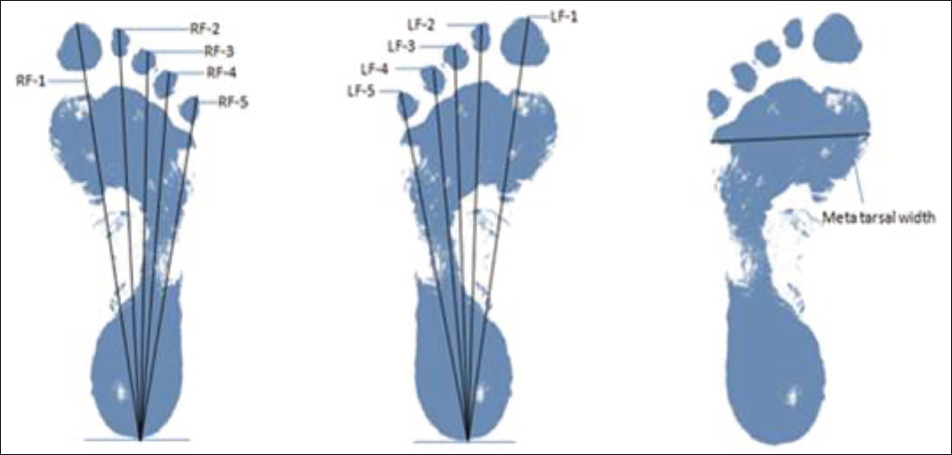
Footprint length: Measured from the most posterior point of the calcaneum (heel) to the tip of each toe (T1–T5) using a vernier caliper. Metatarsal width: Measured as the maximum transverse distance between the heads of the first and fifth metatarsals as shown in Figure 1. Stature measurement: Recorded with a wall-mounted stadiometer. Participants stood erect, barefoot, with heels together, arms by the side, and the head positioned in the Frankfurt horizontal plane. Stature was measured from the vertex of the head to the heel. All measurements were recorded bilaterally (both left and right feet).
Statistical Analysis
The collected data were organized and entered into Microsoft Excel 2019 for initial management and preprocessing. Statistical analyses were conducted using Jamovi version 2.6.15, SPSS version 16.0, and OpenEpi version 3.01.
Linear regression analysis was employed to establish predictive equations for estimating stature based on various footprint lengths. The strength and reliability of the regression models were assessed using the coefficient of determination (R²), p values, and 95% confidence intervals. A p value of <.05 was considered statistically significant. The analyses were performed separately for males and females to develop sex-specific regression models and to assess the degree of sexual dimorphism in footprint parameters.
Showing the Details of the Right and Left Foot Print Dimensions.
The linear regression formula for estimating the height is y = a + (bx), where y = dependent variable (height), a = constant, b = independent variable coefficient, x = independent variable, that is, the length of the footprint.
Results
Cross-sectional study on stature estimation from footprint length in the population of Hyderabad, Telangana. The study population consists of 150, which includes 75 males and 75 females. Study showing the following results: The mean height of the study group was 165.69. The median height was 166, the standard deviation was 8.033, and the standard error was 0.6559 as shown in Table 1.
Statistical Details of Right and Left Footprints for the Total Population.

Regression Equation for Right Foot Print Male and Female Populations.

Regression Equation for Left Foot Print Male and Female Population.

Statistical Data of Metatarsal Width in Both Male and Female Population.

Study statistical results R² values ranged from 0.123 to 0.642, indicating a good model fit with the highest predictive accuracy observed for footprint types RF1 to RF5 and LF1 to LF5. Additionally, the 95% Confidence Intervals for the regression coefficients ranged between 2 and 4, which signifies a relatively narrow range. A narrower confidence interval suggests greater precision in the estimated regression coefficients, enhancing the reliability of the stature estimates derived from the footprint measurements.
Discussion
The present cross-sectional study aimed to estimate stature from footprint length and assess sexual dimorphism using metatarsal width among the Hyderabad population, comprising an equal number of male and female participants (n = 150). The findings demonstrate a statistically significant and positive correlation between footprint dimensions and stature, reaffirming the established forensic principle that foot morphology is a reliable indicator of body height. This strong relationship can be explained by the proportional growth of the human skeleton, where the foot development is comparable to that of the long bone development and stature. The foot is a primary load-bearing structure; therefore, its morphology is affected by body height, making footprint dimensions a dependable parameter for stature estimation.
The regression models derived in this study showed good predictive accuracy, with R² values ranging from 0.356 to 0.642. The highest coefficient of determination (R² = 0.642) was observed for right footprint RF1, indicating that the length from the heel to the great toe RF1 is the most reliable predictor of stature in this population. Similar observations have been reported in Indian studies by Sharma et al. 4 Kanchan et al. 5 and Rastogi et al. 6 who documented strong correlations between footprint length and stature in North and South Indian populations, respectively. The narrow 95% confidence intervals (approximately 2.0–4.2) observed across different footprint variables suggest robustness and precision in the regression coefficients. This consistency enhances the reliability of footprint-based stature estimation, as also noted by Patel et al. 7 and Kumar et al. 8
Distinct regression equations were derived for males and females, reflecting inherent sexual dimorphism in foot dimensions and overall body proportions. For instance, the regression equation for RF1 length in males was Y = 92.978 + 3.157(X), while in females it was Y = 90.499 + 2.393(X), suggesting a stronger linear association between footprint length and stature in the male study group as shown in Tables 2 and 3. These findings are consistent with earlier Indian studies by Singh and Phookan, 9 Meena and Mathur, 10 and Verma and Pathak 11 and Krishan et al. 12 all of whom emphasized the necessity of gender-specific models to improve stature estimation accuracy.
The predictive accuracy of these regression equations was within ±3 cm, suggesting that footprint length can be reliably used to estimate stature. These findings are consistent with previous studies conducted in Bangladesh, Egypt, Ghana, Nigeria, and India, where similar correlations between footprint length and stature were reported by Asadujjaman et al., 13 Fawzy and Kamal, 14 Addai et al. 15 Kanchan et al. 16 Suleiman et al. 17 Moorthy and Sulaiman, 18 and Sen and Ghosh. 19 The minor variations in regression coefficients across populations highlight the importance of developing region-specific models, as genetics, ethnicity, nutrition, lifestyle, and environmental factors influence foot morphology.
An important contribution of this study is the evaluation of metatarsal width as a parameter for sex determination. The mean metatarsal width for males (9.056 cm) was significantly greater than for females (8.243 cm) as shown in Table 4, with a p value < .001. This finding highlights marked sexual dimorphism in foot breadth and corroborates earlier Indian studies by Meena and Mathur 10 who reported that transverse foot dimensions are particularly useful for sex differentiation. This makes metatarsal width especially useful in forensic cases where the lower part of the footprint may not be available due to partial, distorted impressions. Similar results were also reported by Nanayakkara et al. 20 in Sri Lanka, Hemy et al. 21 in Western Australia, Krishan 22 in the Gujjar population of North India, Singh 23 in Uttar Pradesh, Awais et al. 24 in the Punjab population of Pakistan, and Krishna Sagar et al., 25 Kumar et al. 26 , (2023) in the South Indian population, and Jakhar et al. 27 , 2010 in Haryana.
The results of this study have significant implications for forensic investigations, particularly in cases involving partial remains or scenes where only footprints are available. The regression equations derived in this study provide a reliable method for estimating stature with an acceptable margin of error of ±3 cm, while metatarsal width measurements assist in sex determination, thereby enhancing personal identification.
While the study provides valuable region-specific data, certain limitations must be acknowledged. The sample size was limited to 150 individuals, and although gender distribution was balanced, broader age stratification and inclusion of additional ethnic subgroups within Telangana would improve generalizability. The use of footprint measurements rather than direct foot dimensions may introduce variability related to pressure distribution and footprint acquisition techniques. Future studies with larger sample sizes, inclusion of different age groups, and use of advanced techniques such as digital footprint analysis could further enhance the accuracy of footprint-based stature and sex estimation.
Conclusion
This study confirms a strong and statistically significant correlation between footprint length and stature in the Hyderabad population. The regression models developed herein are reliable and can be effectively used for stature estimation in forensic contexts. Additionally, the significant difference in metatarsal width between males and females highlights the potential of using this metric for sex determination. Overall, this study provides valuable regression models and demonstrates the utility of footprint dimensions in forensic identification, contributing to more accurate and reliable methods for stature estimation and sex differentiation in forensic investigation.
Footnotes
Acknowledgment
We sincerely thank the Chairman of Malla Reddy Institute of Medical Sciences for his constant support and encouragement.
Declaration of Conflict of Interests
The authors declared no potential conflicts of interest with respect to the research, authorship, and/or publication of this article.
Ethical Clearance
Yes, obtained from the Institutional Ethics Committee, Malla Reddy Institute of Medical Sciences (Ref No. MRIMS-DHR-IEC-10/2022; dated October 11, 2022).
Funding
The authors received no financial support for the research, authorship, and/or publication of this article.
Informed Consent
Respondents gave written consent for review and signature before starting interviews.
