




Abstract
Sexual dimorphism is crucial in forensic anthropology, differentiating between males and females. The potential role of digit ratios, especially 2D:4D, has been proposed in predicting sexual dimorphism due to hormonal influences during fetal development, but many studies also contradict its universal acceptability. This study aims to find the reliability of both digit lengths and ratios in sex estimation in the Haryanvi population. The digit lengths of 215 participants (M = 113; F = 102) aged 18–50 years were measured using a digital vernier calliper, and digit ratios were calculated using it. Significant sexual dimorphism was found in digit length, but digit ratios demonstrated relatively poor results. The single best variable for percentage sexing accuracy in digit lengths was found for 2DL(L) (79.5%), and the best combination was given by 2DL(L), 1DL(L), and 4DL(L) (83.7%). However, none of the ratios showed good classification accuracy for sex estimation for this population. The research underscores the need for caution in relying solely on digit ratios for sex estimation in forensic investigations. Instead, a multifactorial approach considering ethnic diversity should be used. The findings contribute to the discussion regarding the reliability of digit ratios as a universal indicator of sexual dimorphism.
Introduction
Sexual dimorphism, the differentiation of male and female physical characteristics, has been of interest in forensic anthropology. 1 Several fields, such as forensic investigation, medical diagnosis, and genetic studies, can benefit from the use of biological markers to determine gender. 2 The digit ratio (2D:4D) refers to the relative lengths of the index (2nd digit) and ring (4th digit) fingers, typically measured from the bottom crease where the finger joins the hand to the tip. This ratio is believed to exhibit sexual dimorphism in humans, with males generally having a lower 2D:4D digit ratio than females; that is, in men, the ring finger is typically longer relative to the index finger compared to women. 3 This characteristic is believed to be established due to distinct exposures to sex hormones during early development. 4 But lately, many studies have been done in various regions of the world stating that digit ratio, particularly 2D:4D, is an inappropriate universal forensic marker to check sexual dimorphism in the population.5–8 Mclyntyre and associates (2005) observed that 2D:4D decreased between ages 6 and 8 in a longitudinal sample and was a far more inconsistent sexually dimorphic indicator than 3D:4D among ethnic groups, indicating that 3D:4D could serve as a better predictor of prenatal sex differences. 9 The sexual dimorphic trait of the finger ratios is governed by HOX genes and influenced by oestrogen and testosterone concentrations in utero.3, 10–12 HOX genes are a family of genes that play a crucial role in development and are responsible for the regulation of the body plan during embryonic development. determining the anterior-posterior (head-tail) patterning of the developing embryo, segmentation identity and developmental timing in the embryo. 13
Therefore, the inspiration for this study came from these two facts: First, the high popularity of the digit ratio for sex determination6, 14–17 and second, the recently strengthened opposition to the use of these digit ratios as sexual dimorphic markers.3, 5, 10, 18–20
Hence, this study aims to explore the forensic applicability of digit lengths and ratios as sexually dimorphic indicators in the Haryanvi population, potentially highlighting variations across ethnic groups and contributing to the broader literature on digit ratios, addressing the uncertainties surrounding their reliability and validity among different populations.
Materials and Methods
Participants
This study was a cross-sectional study conducted in the Haryana state of India. 215 individuals (113 males and 102 females) were randomly selected for the study within the age range of 18–50 years, and informed consent was taken from each individual. Participants with any deformity in the hand, disease or injury were excluded from the research study.
Procedure
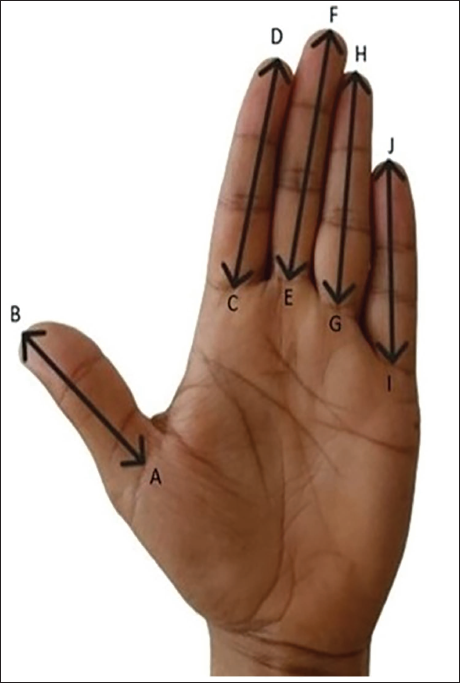
The measurements of the left and right hands were taken by the first author. The palms of the participants’ hands were made to face upward on a horizontal flat surface, and the forearms were aligned with the middle finger. Fingers should be maximally extended and close together (Figure 1). Digit length is defined as the measure of the distance between the finger’s respective tip and the proximal flexion crease. 14 Using Weiner and Lourie’s 21 standardised technique, the participant’s digit length was measured (in mm) directly using a standard digital vernier calliper (least count of 0.01 mm) on both hands. Sex, age, and height were also recorded for each individual.
Length of Thumb 1D (A to B); Length of Index Finger 2D (C to D); Length of Middle Finger 3D (E to F); Length of Ring Finger 4D (G to H); Length of Little Finger 5D (I to J).
Measures
Morphometric Measurements
The measurements recorded were: Thumb length (1DL): It is the distance between the tip of the thumb and the palm’s border crease (A to B). Index finger length (2DL): It is the distance between the tip of the index finger and the palm’s border crease (C to D). Middle finger length (3DL): It is the distance between the tip of the middle finger and the palm’s border crease (E to F). Ring finger length (4DL): It is the distance between the tip of the ring finger and the palm’s border crease (G to H). Little finger length (5DL): It is the distance between the tip of the ring finger and the palm’s border crease (I to J).
Digit Ratio
This ratio was calculated by taking the ratio of the length of the fingers.
Sectioning Point
It is defined as the average of the respective digit ratio for both left and right hands for both sexes. Based on this sectioning point for the digit ratios, the percentage accuracy for sex determination was determined on the study population.
Cohen’s d Value
It is to calculate the effect size of two independent populations by subtracting the means of the populations and dividing by the pooled standard deviation. In the context of sexual dimorphism in digit ratios, Cohen’s d can be used to quantify the difference in digit ratios. 22
Formula for Cohen’s d:
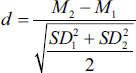
Where, M1 = Mean (Group 1); M2 = Mean (Group 2); SD1 = Pooled standard deviation (Group 1); SD2 = Pooled standard deviation (Group 2); Interpreting Cohen’s d: Small effect size = 0.2; Medium effect size = 0.5; Large effect size = ≥0.8. 23
Statistical Analysis
For statistical analysis of the data, SPSS 21.00 was used. Descriptive statistics for 2D and 4D lengths were calculated. Student’s t-test was used for studying male-female differences for the variables (at p < .05). Discriminant analysis for percentage classification accuracy was also performed.
Results
Digit Length
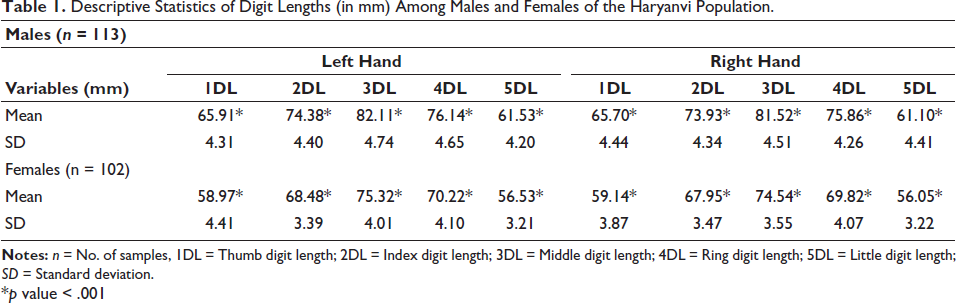
The descriptive statistics for all the digit lengths of both hands for the entire population are represented in Table 1. The differences between the mean digit lengths were found to be statistically larger in males (p < .001). Except for 1DL being larger on the right side in females, all left-side digit lengths were larger in both sexes. The digit length in both sexes and in respective hands followed the order:
Descriptive Statistics of Digit Lengths (in mm) Among Males and Females of the Haryanvi Population.
*p value < .001
3D>4DL>2DL>1DL>5DL
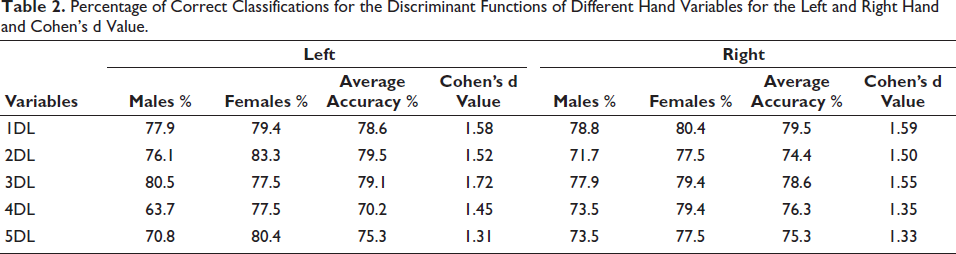
The discriminant function analysis for the digit lengths to calculate classification accuracies and Cohen’s d value to study effect size is reported in Table 2. Maximum sexing accuracy for the left and right hands was shown by 2DL and 1DL, respectively. 3DL (left) and 1DL (right) variables showed the highest Cohen’s d value. Therefore, for the right hand, variable 1DL excelled in both accuracy and Cohen’s d value. But left-hand values differ, as the Cohen’s d value focuses on the magnitude of the difference between group means, whereas classification accuracy does not consider the size of the effect but rather the overall correctness of predictions. Therefore, considering both the methods, variables 1DL and 3DL performed well to study correctness in predictions and differences between groups.
Percentage of Correct Classifications for the Discriminant Functions of Different Hand Variables for the Left and Right Hand and Cohen’s d Value.
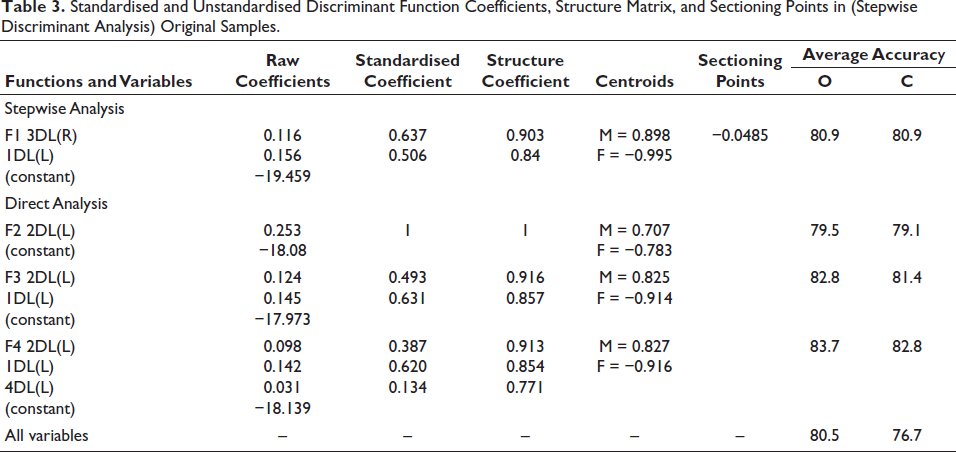
The stepwise discriminant function analysis is tabulated in Table 3. In stepwise analysis, 3DL and 1DL (F1) together classified sex up to 80.9% accuracy. 2DL(L) (F2) performed best in direct analysis with 79.5% accuracy. Better accuracy was given by 2DL(L) and 1DL(L) (F3), with 82.8% and finally, in F4, adding 4DL(L) with F3 showed the best accuracy of 83.7%. But a combination of all variables did not perform better than F3 and F4, suggesting F4 as the best combination for sex estimation.
Standardised and Unstandardised Discriminant Function Coefficients, Structure Matrix, and Sectioning Points in (Stepwise Discriminant Analysis) Original Samples.
Digit Ratio
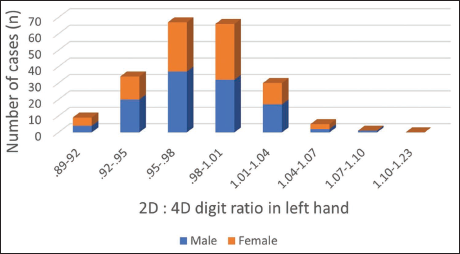
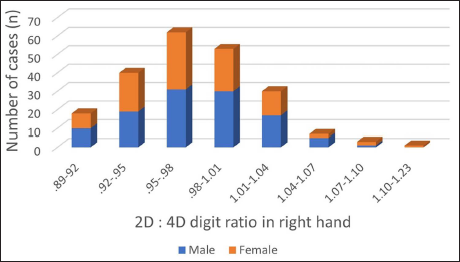
Table 4 represents descriptive statistics, the standard deviation of all the digit ratios derived from the digit lengths, percentage classification accuracies and Cohen’s d value for both hands and for both sexes. The digit ratios showing significant sexual dimorphism are 1D:2D L, 1D:2D R, 1D:3D L, 1D:3D R, 1D:4D L, 1D:4D R, 1D:5D L, 1D:5D R, 2D:1D L, 2D:1D R, 3D:1D L, 3D:1D R, 4D:1D L, 4D:1D R, 5D:1D L, and 5D:1D R, with the highest being 1D:2D R with 61.9%. But none of the digit ratios showed good classification accuracy, which can be used for sex estimation for this population. All the ratios also showed low values of magnitude to study the effect size. In addition to this, the sex-wise distribution based on the 2D:4D digit ratio of the participants is depicted in Figures 2 and 3.
Left-hand 2D:4D Digit Ratio Distribution of Participants Across Sexes.
Right-hand 2D:4D Digit Ratio Distribution of Participants Across Sexes.
Descriptive Statistics of all the Digit Ratios Among Males and Females of the Haryanvi Population, Their Percentage Classification Accuracy and Cohen’s d Value.
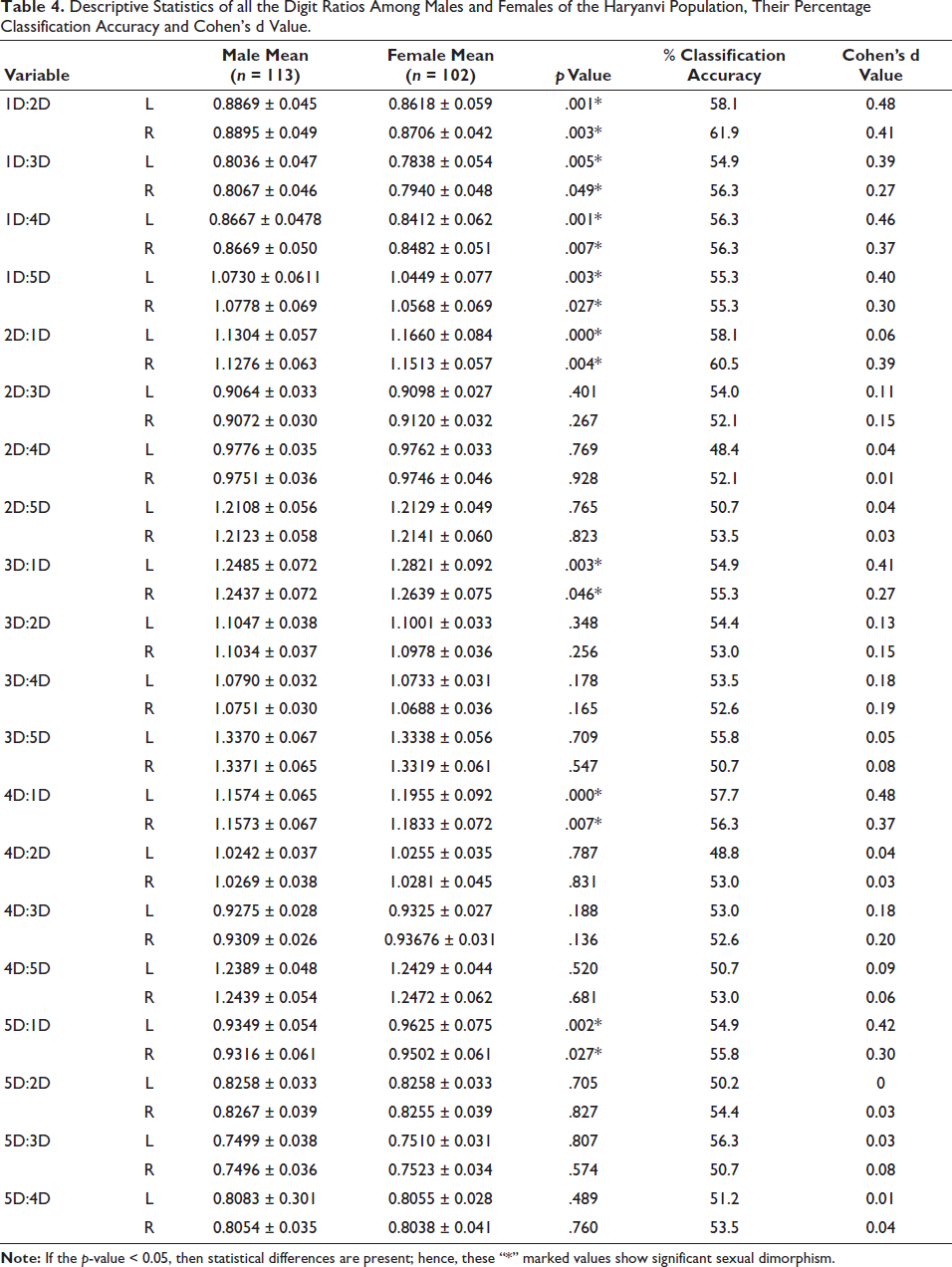
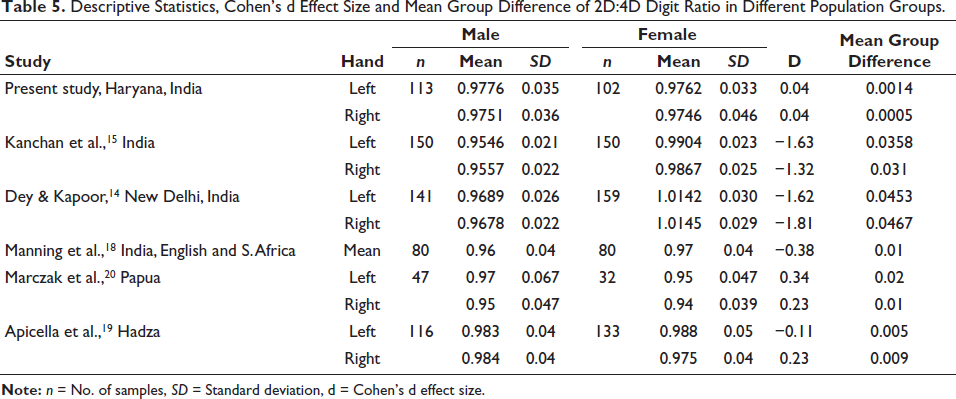
Table 5 represents the descriptive statistics and Cohen’s d values of adult males and females in six population groups. In the present population, minimal sex differences were observed, similar to Manning et al. and Apicella et al.8–19 Contrarily, Dey and Kapoor (2016) reported sex classification in the range of 84%–93% using digit ratios and a considerable sex effect size (d= −1.81). 14 Kanchan et al. also found pronounced sex differences and high effect sizes. 15 Whereas Marczak et al. (2017) in their study found varying statistical differences between sexes for digit ratios and the effect sizes. 20 The findings collectively underscore the complexity and variability of the digit ratios across various populations and the importance of considering both mean group size and effect size for analysis.
Descriptive Statistics, Cohen’s d Effect Size and Mean Group Difference of 2D:4D Digit Ratio in Different Population Groups.
Discussion
In forensic investigations, the most important task of the investigator is the identification of the body. There are several cases where mutilated bodies are found, and biological profiling has to be done. For this purpose, sex estimation plays a pivotal role, being one of the ‘big four’ of anthropology. 24 Hence, the present study also aims to estimate the sexing accuracy for digit lengths and ratios.
The digit lengths performed better than the digit ratios in the present study. Several kinds of research have been done lately to find which hand dimensions perform better for sex estimation. Hafez and Shahin (2020) found that hand dimensions could predict sex with better accuracy than using digit ratios in the Egyptian and Malaysian populations. 25 Similar results, where the performance of digit lengths was more accurate than the ratios, were encountered by Banyeh et al. (2022) and partially by Sarkodie et al. (2023).26, 27 The possible reason for the sexing accuracy of the digit ratio performing extremely poorly could be that small sexual dimorphism in one variable and correspondingly greater sexual dimorphism in the second variable may have higher prediction accuracies of the ratios. Contrarily, equal values of sexual dimorphism in both values of the ratio would result in ineffective sex estimation and therefore imply that it should not be used for the predictions.
One of the digit ratios, 2D:4D ratio, is considered by a few researchers to be sexually dimorphic. Few studies favoured the use of 2D:4D ratio as a forensic marker for sexual dimorphism,6, 14–17 while others (including the present study) contradicted the use of this indicator.3, 5, 10, 18–20 The interpretations are done from Cohen’s d effect size values instead of p values (Table 5).
In previous studies, Kanchan et al. 15 and Dey and Kapoor 14 found large group differences in the means of 2D:4D between sexes and a low standard deviation, whereas other studies (including the present study) showed very low values of group differences and larger SD, suggesting no overlap.18–20 When the mean group difference is large, and SD is low, higher values of d are obtained, and vice versa yield lower values of d. On comparing Cohen’s d value for group comparisons, the values between 0 and 0.20, around 0.50, and around 0.80 or larger show small, medium, and large effects, respectively. This fairly shows the reason why the values obtained by these two studies14, 15 show a larger size effect, and the other four studies18–20 show a small or negligible effect.
In the present study, the sex differences in 2D:4D hover around 0.5 d values corresponding to a small to medium-sized sex effect, suggesting distributional nonoverlap of 2D:4D between sexes, resulting in poor performance of the 2D:4D digit ratio. Moreover, the digit ratios on the left and right hands were not sexually dimorphic in the Haryanvi population and did not depict the typical human digit formula where 2D>4D. 14 The exact reasons for this anomalous trend cannot be pinpointed; it could be due to a large sample size (low standard deviation), overlap between sexes, within sex variability due to age, 28 ethnicity, hormonal fluctuations, 29 postnatal factor influences, 30 different methodology of measurement, etc. 6
Voracek employed logistic regression analysis and the receiver operating characteristic (ROC) technique in an Austrian population; however, neither produced striking findings. 5 This study was conducted using discriminant function analysis and Cohen’s d value, which produced unsatisfactory findings and further contradicted the use of digit ratios for sex determination. In an Austrian population, Voracek used logistic regression analysis and the ROC approach, but could not obtain impressive results either (Voracek, 2009). This study was done based on discriminant function analysis and Cohen’s d value, yielding unsatisfactory results, which further contradicts the use of digit ratios for sex determination.
There are several reasons why this may not be an appropriate method for sex determination in medico-legal investigations. First, the method for measuring digit ratio is not standardised and can vary substantially among researchers, impacting the precision of sex determination. Second, while there is a correlation between digit ratio and gender, there is a substantial overlap between male and female ratios. This indicates that a substantial proportion of individuals may be misclassified if the digit ratio is used as a sex indicator. In addition, the digit ratio can be affected by a variety of factors, such as race, age, and hormonal imbalances. In some cases, conditions such as polycystic ovary syndrome can alter the digit ratio, resulting in masculinisation of the female digit ratio. 31 Considering these concerns, it is evident that the digit ratio alone should not be used as a sex determination indicator in medico-legal investigations; rather, other established methods, such as digit lengths, morphological examination and DNA analysis, can be used.5, 32, 33
Conclusion
Digit lengths can serve as a tool for individual sexing with reasonable accuracy in the Haryanvi population, but understanding the discrepancies of using digit ratios for sex determination is pivotal in forensic investigation. The digit lengths over the ratios predicted better, as evident from our study. While the method using ratios shows its use due to the hypothesised link to prenatal hormone exposure, its applicability in medico-legal investigations is constrained. Ultimately, the most accurate method for determining sex is likely to be a multifactorial approach that considers a variety of biological and environmental markers.
Footnotes
Declaration of Conflicting Interests
The authors declared no potential conflicts of interest with respect to the research, authorship and/or publication of this article.
Ethical Approval
None.
Funding
The authors received no financial support for the research, authorship and/or publication of this article.
Informed Consent
The informed consent has been obtained from the participants for the study.
