




Abstract
Any unnatural death among children is a worrying issue in any society. The present study describes the profile of unnatural deaths in children at a tertiary care hospital in Northern Haryana, India. This retrospective study evaluated 48 autopsy cases from January 2019 to December 2023 of unnatural deaths among various age groups from infants to 18 years of age. The postmortem examination reports, police inquests, and other available hospital and investigation records were used for data collection. Male predominance was observed with 33 (68.7%) cases. According to age group (in years), most deaths, 19 (39.6%), were observed in 16–18, followed by 13 (27.1%) deaths in 13–15, and the least, two (4.2%) in 10–12. The frequent manner of death was accidental deaths, 36 (75%), and the remaining were suicides, 12 (25%) deaths. No homicidal deaths were found among the children in this study. Road traffic accidents, 13 (27%) deaths, followed by nine (18.8%) deaths due to drowning, and eight (16.7%) deaths due to hanging were the major modes of these deaths. The major cause of death was asphyxia in 18 (37.5%), followed by head injury in 13 (27%). This study highlights significant patterns of unnatural child deaths according to their modes, manner, and causes. To reflect upon the magnitude of the occurrence of unnatural child deaths, maintenance of the medicolegal case register and further studies to determine the pattern of child deaths in other regions of India is essential.
Introduction
Unnatural deaths among children are a global public health issue and are caused by external factors, such as accidents, poisoning, drowning, and other external causes. Childhood spans birth to adolescence and is a period up to 18 years of age. 1 According to the National Crime Records Bureau 2021 report, in India, 11,396 children died due to accidents, suicides, and other unnatural causes. 2 Unnatural deaths constituted 35.5% of deaths among children and adolescents between 0 and 19 years of age in India. 3
The study primarily analyzed the pattern of unnatural deaths in children (18 years or less) reported for postmortem examination at a center in the Ambala district of Haryana, India. The study intended to find out the vulnerable age groups of children and their relation to unnatural deaths. The study recommends steps toward interventions to reduce the impact of such child deaths.
Materials and Methods
The study was retrospective and included cases aged 0–18 years who died due to unnatural causes and were brought for postmortem examination from January 2019 to December 2023 at a center in the Ambala district of Haryana, India. Unknown or unclaimed dead bodies, decomposed bodies, and even an alleged history of suspected foul play, but autopsy findings suggested otherwise, were excluded. Data such as age, gender, domicile, education, school, place of incident, manner of death, and cause of death were collected. The age group (in years) was divided into five categories: 0–3, 4–6, 7–9, 10–12, 13–15, and 16–18. This age categorization was made based on developmental milestones, medicolegal relevance, and for evaluating age-specific vulnerability patterns, risk factors, and manner of death based on previous studies on child deaths. The manner of death was divided into three categories: Accidental, suicidal, and homicidal. The postmortem examination reports, police inquests, histopathology, and chemical analysis of viscera reports were used for data collection. The obtained data were tabulated in Microsoft Excel 2021, and descriptive statistics were analyzed using International Business Machines Statistical Product and Service Solutions (IBM SPSS) statistical software version 26.
Results
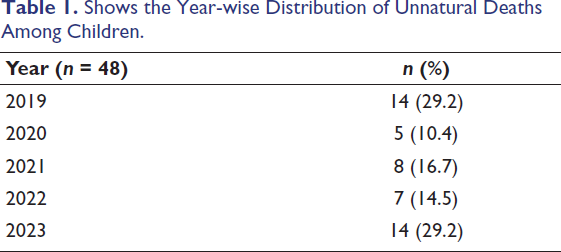
During the study period of five years from 2019 to 2023, of the 837 autopsies conducted, 48 (5.7%) were unnatural child deaths aged up to 18 years. The higher frequency, 14 (29.1%), was observed in 2019 and 2023. The least with five (10.2%) deaths were seen in 2020 (Table 1). The majority of these deaths occurred in the monsoon or rainy season (July–September), with 21 (43.8%) cases, followed by 11 (22.9%) deaths in autumn (October–December), 10 (20.8%) in Winter (January–March), and least in summer with six (12.5%) deaths.
Shows the Year-wise Distribution of Unnatural Deaths Among Children.
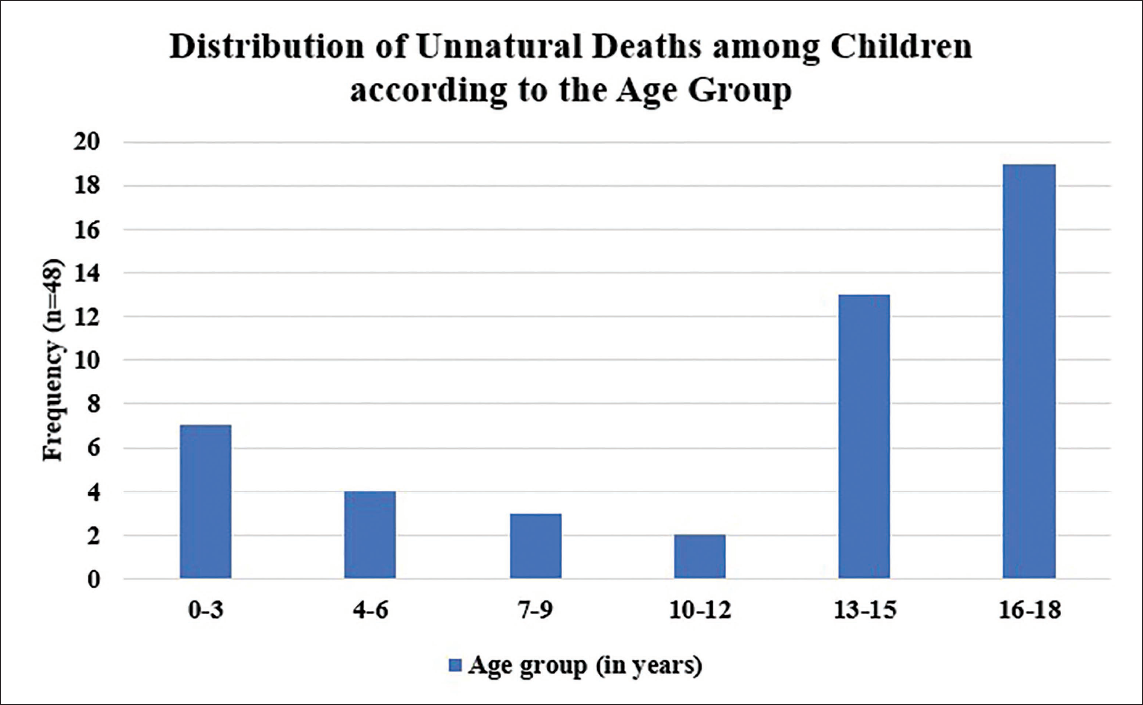
The distribution of deaths according to age groups (in years) showed that most deaths, 19 (39.6%), were observed in the 16–18 years, followed by 13 (27.1%) deaths in the age group 13–15, seven (14.5%) observed in 0–3, four (8.3%) in age group 4–6, three (6.3%) in the age group of 7–9 and two (4.2%) were observed in the age group 10–12 (Figure 1). Most were male, 33 (68.7%), and females accounted for 15 (31.3%) cases. The majority were from rural areas, 40 (83.4%), and only eight (16.6%) were from urban areas. Most incidents, 27 (56.2%), occurred in public places, and the remaining 21 (43.8%) occurred at their residence.
Shows Age Group-wise Distribution of Unnatural Deaths Among Children.
Among the 48 deaths, the education status of the children was observed, and 26 (54.2%) were school-going. The educational status was not known in eight (16.6%) cases. Seven (14.6%) children worked as daily wage workers; the remaining seven were children below four years, that is, not of school-going age.
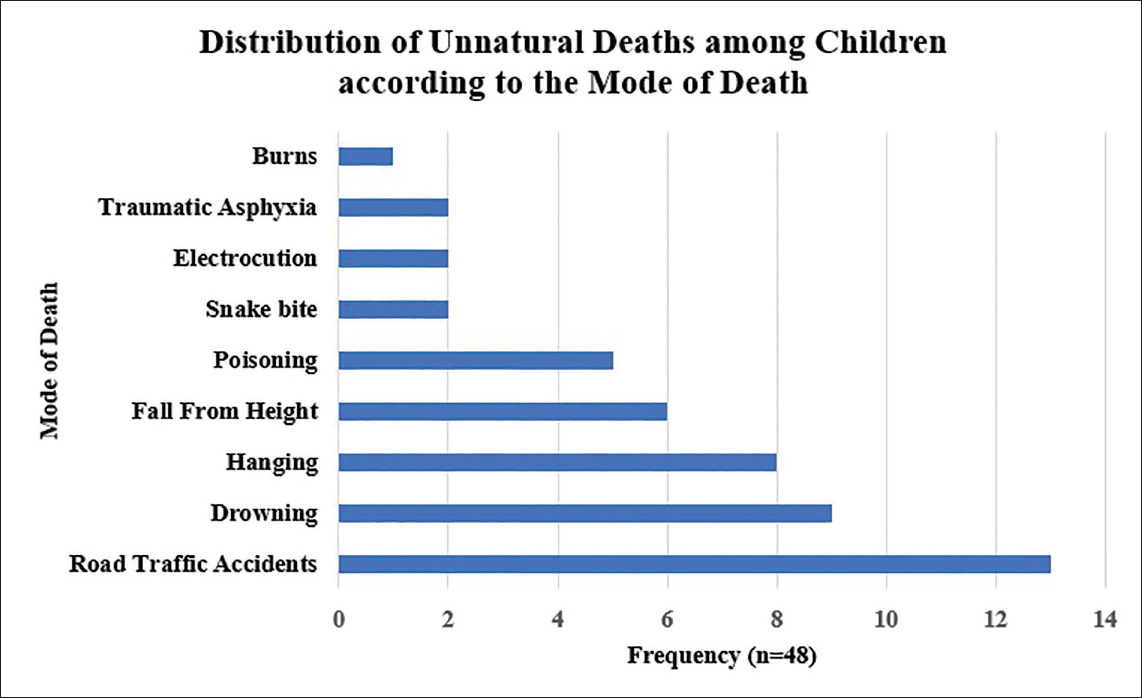
Among the 48 deaths, 32 (66.7%) were declared dead on arrival at the hospital, and 16 (33.3%) cases were hospitalized before death. According to the manner of death, most of them were accidental, 36 (75%), and 12 (25%) were suicides. No homicidal deaths were observed in this study. The road traffic accidents (RTAs) were the most common mode of death, 13 (27%), followed by nine (18.8%) deaths due to drowning, hanging accounted for eight (16.7%) deaths, fall from height cases six (12.5%), five (10.4%) deaths were due to poisoning, two (4.2%) cases were of traumatic asphyxia, one of this was due to fall of grain bags over the body and another due fall of ceiling wall, further two (4.2%) cases each of electrocution and snake bite were observed, and one (2%) case of burn was seen. In all eight cases of hanging, the manner was suicidal. Of the five cases of poisoning, four were due to deliberate consumption, and one was accidental (Figure 2).
Shows the Mode of Death of Unnatural Death Among Children.
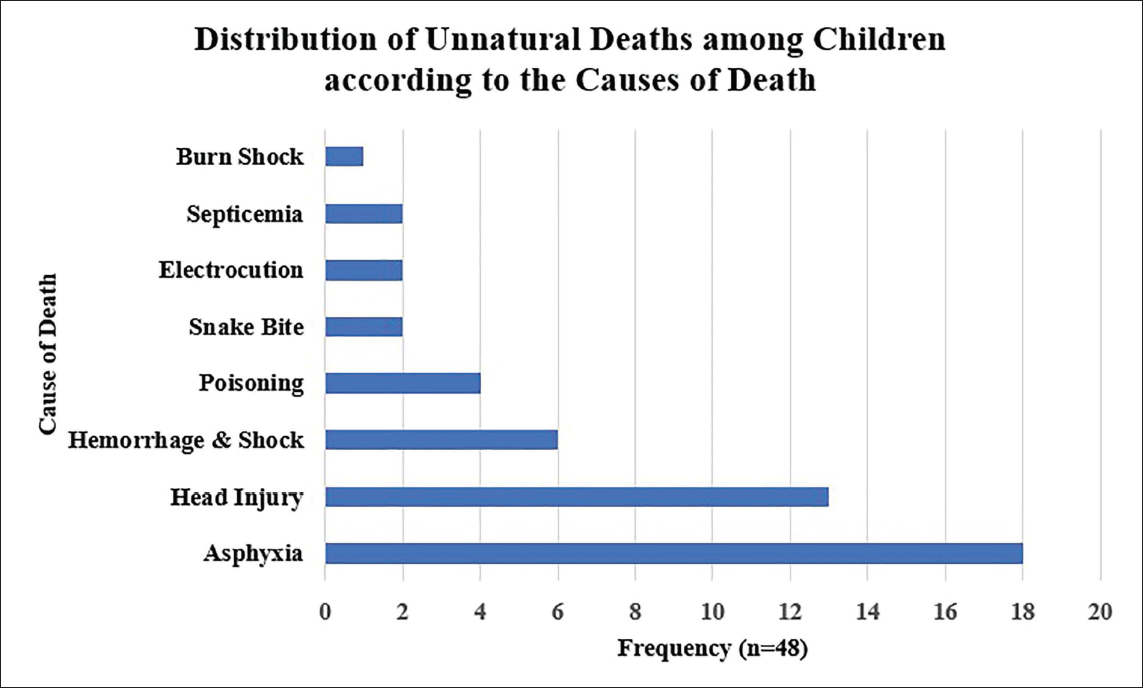
Among the causes of death, 18 (37.5%) were due to asphyxia, 13 (27%) were due to head injuries sustained, six (12.6%) were due to hemorrhage and shock, four (8.3%) deaths were due to poisoning, two (4.2%) each were due to snake bite, electrocution, and septicemia. Among the two deaths due to septicemia, one was poisoning, and the other was drowning. One (2%) child brought to the hospital with extensive burns was declared dead on arrival at the hospital, and the cause of death was opined as a shock as a consequence of 80%–85% of dermo-epidermal burns sustained (Figure 3).
Shows Causes of Death in Unnatural Deaths Among Children.
Discussion
Among the medicolegal postmortem examinations conducted during the study period of five years, from 2019 to 2023, unnatural deaths of children aged up to 18 years constituted 5.7% of autopsies. Whereas in other studies, these autopsies constituted more than 6% and up to 16% of total autopsies conducted.4–6 Majority of these children were male, accounting for more than two-thirds of the unnatural deaths among children. The study done by Panda et al. also showed that in Haryana, male predominance in unnatural death occurs among all age groups. 3 Most of the other studies on unnatural deaths among children also showed male preponderance.4–7 Whereas, in the study conducted by Debata et al. female deaths were more common among children. 8
The study’s most common age group was 16–18 years, accounting for over one-third of the overall child deaths. This finding is similar to other studies conducted on pediatric age group deaths.4, 5, 7, 8 In contrast, the studies by Çekin et al. and Bhat et al. observed most deaths in the 0–6 age group.9, 10 The study by Parkkari et al. showed that most deaths were in the 10–14 age group. 11 In the study by Mrunalini et al. the age group under five years was more common. 12 Most of the deaths were in rural areas. Similarly, Bhat et al. and Mrunalini et al. also observed that most of the children died unnaturally in rural areas.10, 12 However, Panda et al. showed that unnatural deaths in urban areas were more common for all age groups. 3 Most deaths were observed in the monsoon or rainy season. Most of these deaths in monsoon months were attributed to drowning as monsoon increases exposure to open water bodies, flooded water pits, and agricultural fields, followed by fall from height cases due to slippery surfaces in the rain. The studies by Bhat et al. Mrunalini et al. and Sever et al. showed a higher frequency of pediatric deaths in summer.10, 12, 13 Whereas, Gündüz et al. observed a maximum number of children’s deaths in winter. 14
Accidents were the most common cause, with three-fourths of deaths. Similarly, other studies have observed a higher frequency of accidents among children.4–8 However, Athani et al. and Varma et al. found suicidal deaths more common.5, 15 The suicide was the second most common manner in this present study. A similar finding was observed by Shrigiriwar et al. in their study on unnatural deaths among children and adolescents in the Yavatmal region of Maharashtra. 16 No homicidal deaths were observed in the present study. Whereas other studies on pediatric autopsies conducted in other regions of India observed homicidal deaths.4–8, 16–19
In the present study, RTAs were the major mode of death, followed by hanging and drowning. The studies by Athani et al. Ph et al. and Khamele et al. also showed RTAs as the common mode of death among children.5, 6, 18 The study by Singh and Aggarwal on fatal RTAs among children less than 16 years showed a significant 13.1% mortality due to RTA among young children of the total autopizes. 20 In the study by Debata et al. burns were the major cause, and in the study by Mrunalini K et al. accidental poisoning accounted for most cases.8, 12 The study by Pathak on the female children’s deaths showed burns being more common than RTA. 21
Asphyxia accounted for more than one-third of the deaths, head injury (27%) being the second most common cause. Vaddi et al. also found asphyxia as the common cause of death in their study of unnatural deaths in the adolescent age group at Hyderabad, Telangana. 22 This result contrasts with the study by Ph et al. which showed head injury, and Duchania et al. who observed head injuries, combining both cerebral and craniocerebral damage, as the most common cause.6, 23 In our study, suicide constituted 25% of cases. The highest risk profile for suicidal deaths was female children aged between 16 and 18 years. Suicides are most often in victims’ residences, with hanging representing the most common means of suicide. Similarly, Abderrahim et al. also observed hanging as the common means of suicide in cases in a pediatric population. 24
In this study, about two-thirds of the victims were declared dead and brought to the hospital. The remaining one-third succumbed during treatment. However, the studies by Duchania et al. and Punia et al. observed that most children were hospitalized before death.23, 25
Conclusion
This present study provides the trends of unnatural deaths among children in Northern Haryana, India. The prevention of unnatural deaths among children requires effective strategies and their proper implementation. The major manner was accidental deaths which are mostly preventable. Therefore, the parents and caregivers have an immense responsibility to reduce such mishaps. RTAs were the major cause of death. Therefore, strict traffic measures, safe road conditions, and road safety education are required. One-fourth of the deaths were due to suicide. Children should be sensitized about mental health, and mental health education should be integrated with the teaching curriculum of schools. The teachers and family members should be trained to identify and approach mental health issues with sensitivity. Further profiling of pediatric unnatural deaths is required from various states in India to create an action plan for preventing the various factors related to such unnatural deaths in children.
Limitations of the Study
The study involved a relatively small study population of 48 cases, the findings cannot be generalized. This was a single-center retrospective study. Therefore, the trends in this study cannot be representative of other regions. The present study was primarily dependent on available inquest papers and postmortem examination reports. The other factors, such as psychosocial background and circumstances resulting in death, could not be assessed due to the retrospective data limitations. The future studies should be multicenter, prospective, and involve larger populations to validate the findings and recognize region-specific risk factors for unnatural deaths among children.
Footnotes
Acknowledgment
The authors would like to thank the office staff and mortuary assistants of the Department of Forensic Medicine and Toxicology, Maharishi Markandeshwar Institute of Medical Sciences and Research (MMIMSR), Mullana, Ambala, Haryana, India, for their help in accessing the medicolegal autopsy records.
Authors’ Contributions
All authors have contributed equally to the study and approved the final draft of the manuscript.
Declaration of Conflicting Interests
The authors declared no potential conflicts of interest with respect to the research, authorship, and/or publication of this article.
Ethical Approval
The ethical approval for the study was obtained from the Institutional Ethics Committee, MMIMSR, Mullana, Ambala, Haryana, India (IEC-3156).
Funding
The authors received no financial support for the research, authorship, and/or publication of this article.
Informed Consent
The study was conducted over the dead bodies brought for medicolegal postmortem examination & identity of the individual was not revealed. So informed consent from the next of kin was not required.
