




Abstract
The well-being of infants, children, and adolescents and their physical, mental, and psychological development is taken into consideration in a branch of medicine known as pediatrics. Pediatric forensic autopsy is useful to evaluate the natural and unnatural childhood deaths, their reasons, steps for prevention, and their management, which is useful to the branch of forensic medicine and medical researchers. A 1-year retrospective study was conducted in the Department of Forensic Medicine and Toxicology in the Medical College, Indore, from January 2023 to December 2023. In our study, a total of 271 cases belonging to the pediatric age group were studied. Out of 271 cases, the maximum number of cases were male (170, 62.90%), and the maximum number of cases belonged to the age group of 12–18 years. The most common cause of death among the pediatric age group was road traffic accidents (RTA). The analysis of pediatric deaths was an effort to elucidate the various aspects of pediatric death and establish the profile. This study helps us to interpret the general profile of pediatric deaths and the various factors affecting the death rate.
Introduction
Taking care of the well-being of infants, children, and adolescents and their physical, mental, and psychological development comes under the branch of medicine known as pediatrics. 1 The pediatric age group includes children up to 18 years of age (infant, toddler, preschool, school, and teen). Childhood mortality is a reliable indicator of the healthcare facilities of a country and its development. 2
To find out the cause of death in children and whether it is a natural or unnatural death is the need of the hour. India is rapidly moving toward becoming a developed country, but there are still cases of female infanticide, illegal abortion, premature delivery of children, and children’s deaths due to pneumonia, diarrhea, and other causes. Determine the cause of death, age in case of unknown, and whether live-born or stillborn is very challenging for an autopsy surgeon. There were also cases of deaths of children due to assault; in such cases, examining the pattern of injuries and giving an opinion about the cause and manner of death is again a very challenging task for an autopsy surgeon. Nowadays, we are seeing an increase in the number of suicide cases among adolescents because of unstable mindsets, which create undue pressure and stress on the child, starting from strained relationships between the parents, high-performance expectations in academics, comparison with other children, a sense of self-neglect, and other contributing factors. The pattern of deaths has changed from infections to social etiologies during the last 10 years. 3 Due to the emerging effects of social, physiological, economic, and medical issues, injury and violence are one of the major killers of children and young adults under the age of 18 years throughout the world. 3
Objectives
The objective of this study was to determine the pattern of deaths in the pediatric age group, which will contribute to the establishment of a database for the formulation of national and international policies helping to lower the mortality rate in the pediatric age group.
Material and Methodology
The present study is a retrospective study of autopsies in the pediatric age group performed in the Department of Forensic Medicine and Toxicology at the Medical College, Indore, from January 2023 to December 2023, and a total of 271 pediatric cases were analyzed. No objection certificate has been obtained for this study from the institutional ethical committee as per the guidelines. Information regarding the deceased’s age, sex, incident duration (month-wise), and cause of death was collected from the department records, police inquest papers, and postmortem reports. A pro forma has been formed to collect data. The collected data was compiled on an Excel sheet, observed, and the results were drawn.
Results
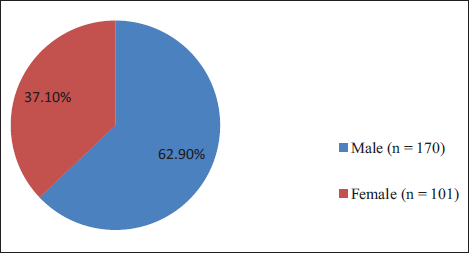
During this study period, a total of 271 pediatric cases were brought to our department for post-mortem examination, out of which 170 cases (62.90%) were male and 101 cases (37.10%) were female (Figure 1).
Gender-wise Distribution of Cases (n = 271).
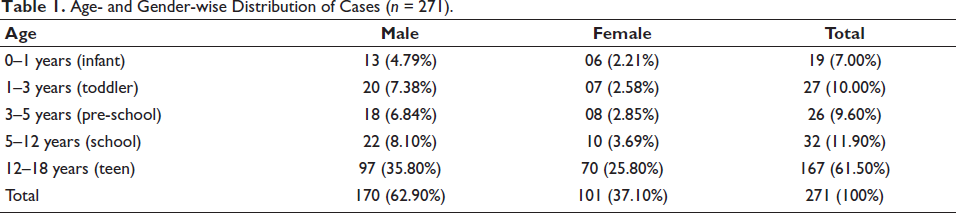
Taking the age group into consideration, the maximum number of male cases, 97 (35.80%), were in the age group of 12–18 years (35.80%), followed by the 5–12 years of age group with 22 cases (8.10%). Similarly, in females also, the 12–18 years age group has the maximum number of cases, that is, 70 cases (25.80%), followed by the 5–12 years age group with 10 cases (3.69%). The least number of males was 13 cases (4.79%) belonging to the age group of 0–1 year (4.79%), and the least number of females was 6 cases (2.21%) belonging to the same age group as males. Considering the overall population, the 12–18-year age group had the maximum number of cases, with 167 cases (61.50%), whereas the 0–1-year age group had the lowest number with 19 cases (7.00%) (Table 1).
Age- and Gender-wise Distribution of Cases (n = 271).
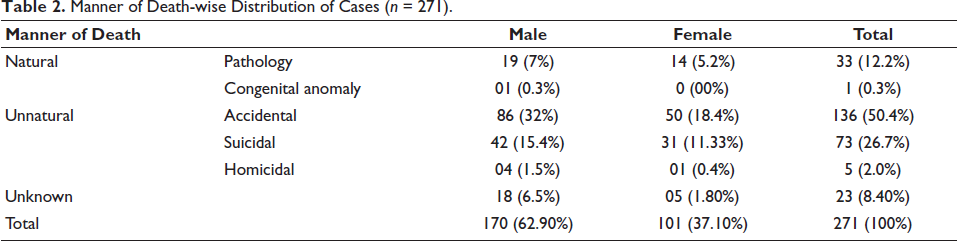
Among all the 271 cases in the present study, natural death cases were 34 cases (12.50%), which includes death due to pathological cause and congenital anomaly, and unnatural death cases were 214 cases (78.9%), Out of 214 cases of unnatural deaths, the maximum number of cases were of accidents, 136 cases (50.4%), followed by suicide, 73 cases (26.7%), and the least number of cases were homicidal, 5 cases (2.0%). In 23 cases (8.40%), the manner of death could not be determined (Table 2).
Manner of Death-wise Distribution of Cases (n = 271).
In the present study, unintentional deaths were present in 170 cases (62.90%), which included deaths due to road traffic accidents (RTA), burns, electrocution, drowning, pathology, and congenital anomaly. Intentional deaths were present in 78 cases (28.70%), which included deaths due to hanging, poisoning, assault, and firearm cases. Intention could not be determined in 23 cases (8.40%) (Table 3).
Intentions-wise Distribution of Cases (n = 271).

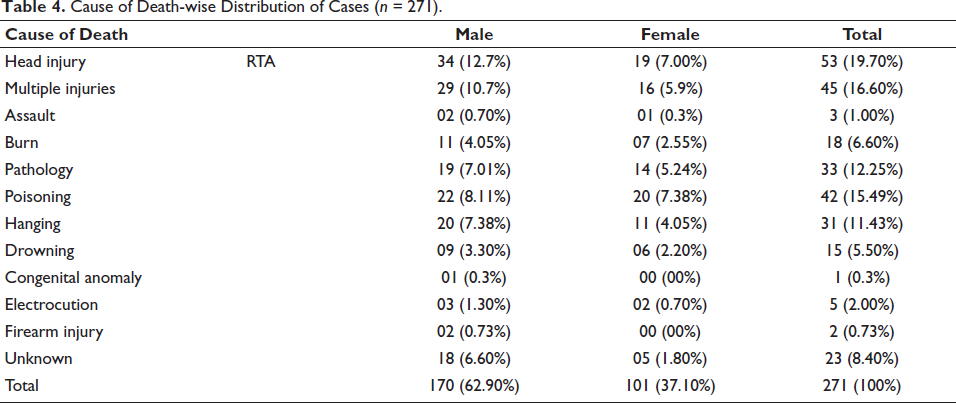
In our study, it was observed that RTA was the most common cause of death in the pediatric age group, involving 98 cases (36.10%), in which death due to head injury was found in 53 cases (19.70%), and death due to multiple injuries was found in 45 cases (16.60%). The second most common cause of death in the pediatric age group was poisoning in 42 cases (15.49%), followed by pathological deaths in 33 cases (12.25%) (including cardiac pathology, lung pathology, and brain pathology). Deaths due to hanging were seen in 31 cases (11.43%). Deaths due to burns were found to be present in 18 cases (6.60%) (including thermal burns and scald burns). Deaths due to drowning are present in 15 cases (5.50%), while 5 (2.00%) children died due to electrocution. Death due to assault was also present in 3 cases (1.00%), including stab injuries, and multiple injuries over other parts of the body. Deaths due to firearm injuries in the pediatric age group were found in 2 cases (0.73%). There were 23 cases in which the cause of death could not be determined during the time of autopsy (8.40%) (Table 4, Figure 2).
Cause of Death-wise Distribution of Cases (n = 271).
Cause of Death-wise Distribution of Cases (n = 271).
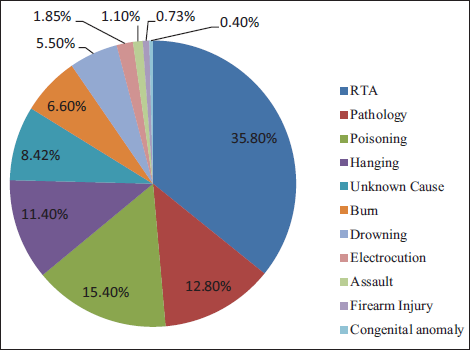
In males, the most common cause of death was RTA (44.70%), followed by poisoning (8.11%), and in females, the most common cause of death was poisoning (7.38%), followed by RTA (7.0%). The least common cause of death in males was death due to congenital anomaly, present in 1 case (0.3%), followed by death due to assault and firearm injuries with 2 cases (0.73%) each. In females, the least common cause of death was assault, present in 1 case (0.30%), followed by electrocution in 2 cases (0.70%) (Table 4, Figure 2).
Discussion
In the present study, out of 271 cases, 170 (62.90%) were male and 101 (37.10%) were female, indicating male predominance. This similar finding of male predominance was observed in various other studies conducted in the pediatric age group, such as the study done by Punia et al. 1 who studied 65 cases, out of which 40 cases (61.54%) were male and 25 cases (38.46%) were female; Rathod et al. 2 with 55.9% males; and Khanna et al. 4 with 56.4% males. The reasons contributing to male predominance, especially in the teenage group, are their greater involvement in outdoor activity as compared to their female counterparts, making them more vulnerable to accidental deaths. Males in the teenage group were also more involved in violent activity, crimes, and substance use, such as drugs and alcohol, making them more prone to accidental, suicidal, and homicidal-related deaths.
In our study, the most common age group involved in all the cases and in both sexes was 12–18 years, which involved 167 cases (61.50%), followed by 5–12 years with 32 cases (11.90%), which is consistent with the study conducted by Rathod et al. 2 showing the most common age group is 12–17 years with 106 cases, but the second most common age group in their study was 0–3 years with 62 cases. Similar findings were also seen in various other studies conducted in the pediatric age group, such as Varma et al. 3 showing 82.2% of cases belonging to the 12–18 years, and the study by Pathak A.K. 5 with 71.7% of cases in the 11–19 years of age group. These findings are inconsistent with the study done by Khanna et al. 4 in which the most common age group affected was 5–10 years. Children in the 12–18 years of age group were frequently involved in outdoor activities such as going to school, attending tuition, playing sports, going camping, and taking trips, which make them more vulnerable to accidental deaths. Also, children of the 12–18 years age group were involved in love affairs, drug or alcohol addiction, and their more competitive behavior, which may affect them physically and psychologically, resulting in committing suicide and homicide.
In our present study, natural deaths were seen in 34 cases (12.50%) and unnatural deaths in 214 cases (78.9%). Among the unnatural deaths, accidental deaths were the most common, seen in 136 cases (50.40%), followed by suicidal deaths in 73 cases (26.7%), and the least common were homicidal deaths, which occurred in 5 cases (2.0%). Similar findings are observed in the study conducted by Rathod et al. 2 Varma et al. 3 and Kumar et al. 6 The unnatural deaths in children indicate the developmental status of a country. These deaths are avoidable by proper education and awareness among the parents, and also by the implementation of strict legislation. Unnatural deaths are common in children because of many reasons, such as improper care and guidance of the children by parents and elders, not following the traffic rules because of improper or incomplete knowledge and training, improper safety measures near the construction sites and roads in residential areas, and many more.
In this study, observations were also done on the basis of intentions. Out of the total 271 cases, an unintentional pattern of death was found in 170 cases (62.90%), and an intentional pattern was found in 78 cases (28.7%). This finding is consistent with the study done by Punia et al. 1 and Sonawane et al. 7 in which unintentional deaths were seen in 49 cases (75.3%) and 55 cases (70.5%) respectively. But in contrast to our study, Varma et al. 3 study showed intentional death (60%) was more than unintentional deaths (40%). The majority of unintentional deaths can be prevented by properly guiding and communicating with children about the safety and preventive measures, and also by improving healthcare facilities and promoting routine vaccination. Intentional death can also be prevented by healthy routine communication of teachers and parents with children and making them aware of the pros and cons of their unhealthy behavior toward themselves or toward others, also by supporting and motivating them in their bad situation, such as failure in exams, love failure, and many more. by proper guidance. We also need to improve our behavior toward children by stopping blaming them for their mistakes. Instead of blaming the children for their mistakes, we should try to teach them to correct them, reduce the restrictions, and lessen the burden of studies. Stop putting an overbearing burden of study on them, and also stop putting too many restrictions on their daily activities.
In the present study, the most common cause of death was RTA, accounting for 98 cases (36.1%). The second major cause of death was poisoning in 42 cases (15.49%), followed by hanging in 31 cases (11.4%), and burns in 18 cases (6.60%). The least common cause of death is congenital anomaly, 1 case (0.3%), followed by firearm injury, 2 cases (0.73%). Similarly, in other studies done by Punia et al. 1 Rathod et al. 2 and Khanna et al. 4 RTA accounts for the major cause of death. RTA was the major cause of death in males, which can be due to rash driving by adolescents and not following traffic rules and regulations. Whereas, deaths due to poisoning and hanging indicate an increase in the number of suicidal deaths, and are helpful for us to know that children are getting ideas of suicide because of easy access to social media, which influences them to take such steps. Parents and caretakers must give utmost importance to paying attention to their child, what their child is doing, and if using a mobile phone, they must keep an eye on the content watched by children and try to explain to them the harmful effects of social media.
Conclusion
The analysis of pediatric deaths was an effort to elucidate the various aspects of pediatric death and establish the profile. This study helps us to interpret the general profile of pediatric deaths and the various factors affecting the death rate. As we observed, the male population is more prone to RTA deaths, which are caused by rash and negligent driving by adolescents, not following the traffic rules and regulations, and not using proper safety precautionary measures. So, steps must be taken to give knowledge to adolescents and their parents about road safety rules, and by strengthening and reinforcing legislation in time to avoid deaths due to RTAs. It was also observed that female children, especially teens, are more prone to commit suicide by either consumption of poison or by hanging, which indirectly indicates the social and mental pressure faced by females in day-to-day life, which can be avoided by comforting her, and a friendly environment should be generated by parents so a girl child can express her emotions and incidents that happened with her. Children are more eager to explore their environment, which in turn makes them more vulnerable to injuries. Their risk perception is very much limited; hence, they are more prone to accidental deaths (RTA, burns, drowning, and electrocution). Parents must explain to their children the importance of life and also should assure them and provide them with the security and safety needed.
Recommendations
As in our study, accidental deaths were major in number, and among them, the major cause of death was RTA, so to reduce such types of deaths, the government should focus more on strict implementations of rules for the pediatric age group and start various programs and courses in schools to teach them about the importance of traffic rules and the employment of safety methods regarding the same.
Similarly, in our study, the second most common manner of death is suicide, so to reduce suicidal deaths, schools should start the mentor-mentee program so that the students can comfortably share their problems with their respective mentors. Also, various social programs should be started by the government to teach parents how to create a child-friendly environment at home and deal with problems related to the adolescent age group.
As we also see in our study, the number of pathological deaths was also high, so to reduce such kinds of deaths, the government should be focusing on linking various pediatric age group health programs with multiple government schemes; for example, parents have to attend the pediatric age group health programs compulsorily, to avail the advantages, and benefits of various government schemes.
Footnotes
Declaration of Conflicting Interests
The authors declared no potential conflicts of interest with respect to the research, authorship, and/or publication of this article.
Ethical Approval
None.
Funding
The authors received no financial support for the research, authorship, and/or publication of this article.
Informed Consent
Authors declare consent for publication.
