




Abstract
In medico-legal forensic entomology, the minimum postmortem interval (PMI) is calculated from the development of fly larvae on cadavers. However, the time lapse from natural exposure to egg laying (oviposition), referred to as the pre-oviposition period (POP), is often overlooked. The present study highlights the seasonal variation in POP in the hot and humid tropical climatic conditions of Kolkata, West Bengal, India. In this study, a prototype human body farm set-up (crime scene [CS]) was prepared with unclaimed human body remains. A total of 33 sets of experiments were done with neonatal remains and amputated body parts. For each set of experiment the site was observed once a day at a fixed time to record the day and time of oviposition. The ambient temperature and relative humidity in CS were recorded using an electronic temperature–humidity logger. The maximum POP was recorded in the winter season (80.8 hours) and the minimum in summer (20 hours). In winter, with every drop in ambient temperature, POP increases. This track of POP is extremely important in the context of total PMI estimation through entomological evidence. The data presented in this work is the first of its kind generated from a “body farm” study in India. The generated data could be used as a standard for PMI estimation from outdoor decomposition of human remains in the climatic conditions of the tropical regions of the world.
Introduction
Medico-legal forensic entomology is concerned with the estimation of postmortem interval (PMI) from the development of fly larvae (maggots) on a cadaver. 1 The term PMI refers to the period from death to the discovery of the body through forensic examination. 2 The development of maggots refers to the total time frame from laying of eggs (oviposition) to the stage (larval instar 1, 2, or 3) collected from the crime scene (CS). 3 However, the time elapsed between environmental exposure of a cadaver to fly oviposition remains inconclusive and varies depending on some factors. 4 The most important abiotic factor responsible for this variation is the seasonal changes in outdoor temperature and humidity. 5 Pre-oviposition period (POP) is referred to as the time lapse between natural exposure of a cadaver to the laying of fly eggs on it.4, 6 In homicidal deaths, the calculation of PMI by the entomology method may culminate in potential error, as the preceding time before egg laying is absolutely beyond the knowledge of the examiner. In a suspicious death, despite the age of fly larvae being calculated appropriately, the period for which the cadaver was exposed to natural conditions before laying of eggs remains inconclusive.
Previously, Hans et al. (2019) observed the oviposition pattern of two calliphorid species, Phormia regina Meigen and Lucilia sericata Meigen on fetal pig carcasses and reported that temperature has a positive influence on oviposition. 5 In this study, the duration of time until the first oviposition event was calculated and preferred sites for oviposition were recorded by using five different temperature treatments ranging from 15°C to 35°C. 5 It was observed that with a gradual rise in temperature, oviposition occurred faster. 5 Earlier, several methods were used to calculate the age of maggots to reflect the development of insects in terms of time.6, 7 Unfortunately, the preceding “time escape” remains inconclusive in all these cases. In all forensic entomology studies, the focus was primarily on how much development has taken place in maggots, and that is retrospectively analyzed to answer the possible time since death by evidence analysis.6, 7 However, it is important to get a proper history on where, how long, and in what condition the cadaver remained before fly infestation.6, 7 Therefore, it is a prerequisite to understand the oviposition dynamics in flies with its forensic context in the estimation of PMI.
The concept of the human body farm was introduced in forensic research by William Bass in the early 1980s. In most of the developed countries, the taphonomic research facilities mandatorily contain a body farm set-up.8, 9 Unfortunately, in India, there’s no such human body farm available or set for anthropological research facilities, until this work presents a prototype.
With this background, the present experimental work is designed with a body farm set-up to investigate the time of POP in hours. The investigation was done with all the variations according to the seasonal changes in the tropical climatic conditions of Kolkata, West Bengal, India. The impact on the calculation of PMI by the entomological method was also taken into account.
Material and Methods
Study Site
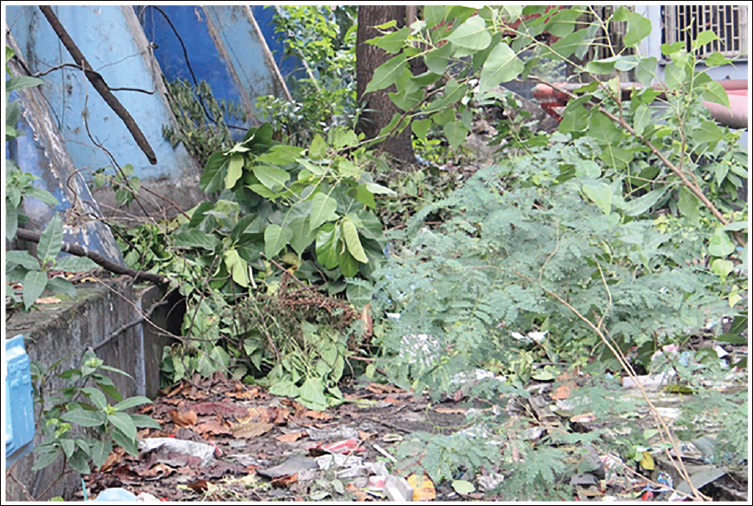
A prototype human body farm was created with unclaimed bodies or body parts, the first of its kind in India, with approval from the Institutional Human Ethics Committee (Letter No: NRSMC/IEC/12/2022). For the body farm, an appropriate study site was selected at the back of the mortuary of Nil Ratan Sircar (NRS) Medical College, Kolkata, India. The site was untidy, silent, and isolated from human interference, and it is a sort of waste dumping ground (Figure 1). It was a vacant, abandoned area with few trees and bushes. It was not a true dumping ground with access to the general public. The study site comprised an area of approximately (20 × 10) meters and was located behind the Department of Forensic Medicine and Toxicology (FMT) building. On one side of the site is the FMT building, and the other three sides have high boundary walls. The site has one entry side gate under the control of the FMT department. Only the principal investigator, co-investigators, and mortuary attendants (domes) had access to the site.
The Study Site (Mock Crime Scene).
Study Design
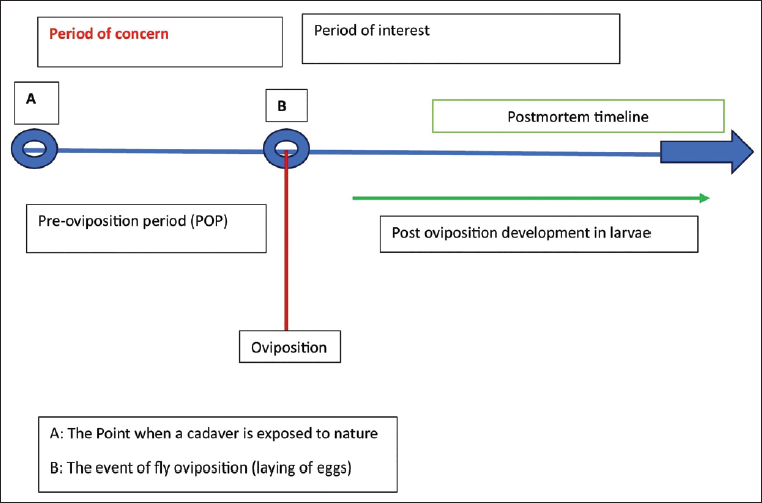
Daily observation was done throughout the period of the experiment, and observations were descriptively recorded. The experiment is categorized as observational, descriptive, and longitudinal type, and was carried out from April 2022 to August 2023, simulating terrestrial decomposition in an urban habitat. Time of oviposition is recorded in hours. A diagrammatic representation of the postmortem timeline is provided (Figure 2), where point A represents the time when a cadaver is exposed to nature and point B represents the first oviposition event. The time lapsed from point A to B is referred to as POP, and from point B onwards, as the development starts, it is referred to as the post-oviposition development period for larval stages (Figure 2).
Diagrammatic Representation of Possible Entomological Events at the Crime Scene. (A) The Point When a Cadaver is Exposed to Nature; (B) The Event of Fly Oviposition (Laying of Eggs).
Since the set-up was a prototype body farm, only amputated body parts and neonates less than three kgs of weight were used for the study. Amputated body parts consist of surgically amputated upper and lower limbs in road traffic accident cases that were sent for autopsy by the police. In these cases, written consent was provided by the patient or relatives for disposal, as they did not want to cremate the body parts. Such amputated limbs were then selected for the purpose of the study with permission of the investigating police officer (IO) of the case. Similarly, unclaimed neonates were those that were unidentified and brought for autopsy by the police. After autopsy and preservation of relevant samples for deoxyribonucleic acid (DNA) typing, the remains were preserved for seven days in a mortuary cooler for any claimant. Subsequently, those neonates that remained unclaimed were used for the study with permission from the police. After completion of experiments, the remnants were disposed of, maintaining standard biomedical waste disposal guidelines. Human remains were collected immediately after post-mortem examination. Suspected or known cases of poisoning, drowning, and chemical burns were excluded from the study. In this study, 33 human remains consisting of 16 amputated limbs and 17 neonatal remains have been used.
Cages of dimensions (18 × 18 × 18 inches) with solid iron mesh size (2.5 × 2.5 cm) containing fresh human remains as substrate for fly oviposition and breeding were placed at mock CS to prevent large carnivore interaction.
Adult flies were spontaneously allowed to reach the carcass throughout the period of study. However, predation from ants and rodents scavenging could not be restricted, as it is an integrated biotic component of the human necrobiome.
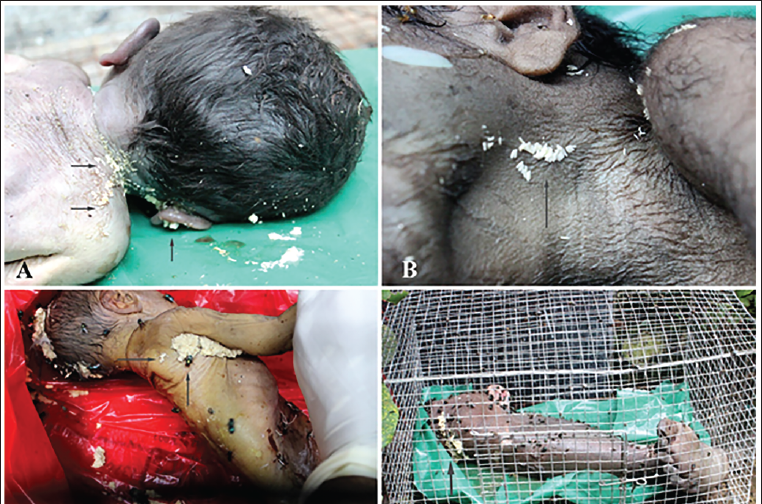
Each of the human remains was placed in the above-mentioned iron cages at 4:00 pm and recorded as day one of the experiment. Subsequent data were recorded once daily at 12:00 noon to minimize physical disturbances. 10 Shortest interval was 20 hours, followed by 24 hours interval each day till the end of the experiment. The termination of each experiment was characterized by the observation of fly eggs on the cadaver substrate (Figure 3A–D).
(A) Fly Eggs (Indicated by Arrows) Noted After Flipping of the Corpse. (B) Fly Eggs Around Neck of Neonatal Remain; (C) Fly Eggs in the Sodden Regions of the Armpit, When the Corpse was Flipped Over; (D) Fly Eggs in the Exposed Part of Amputated Limb.
Data on daily observations were collected from the field, and temperature (°C) and relative humidity (RH) (%) of the CS were recorded by an electronic data logger (make Hygro Thermometer Clock (HTC)-2) to get the environmental data of the experimental site. Our study followed the principle of minimal physical disturbance with once daily observation, photography, scene record, and sampling of entomological evidences.10, 11
For identification of necrophagous flies, egg-hatched larvae were collected by fine brush on consecutive days and raised to adults. The adults were then identified following suitable taxonomic literature and methods.
Results
Prototype body farms were set-up within the specified area, and 33 sets of observations were carried out using unclaimed amputated body parts and neonates. The seasonal variation in POP (in hours) was recorded and analyzed.
The value of POP in each case, as observed during different seasons, is presented in Table 1.
Values of POP in Each Case Observed During Different Seasons (Summer: March–June; Monsoon: July–October; Winter: November–February) of the Study Period.
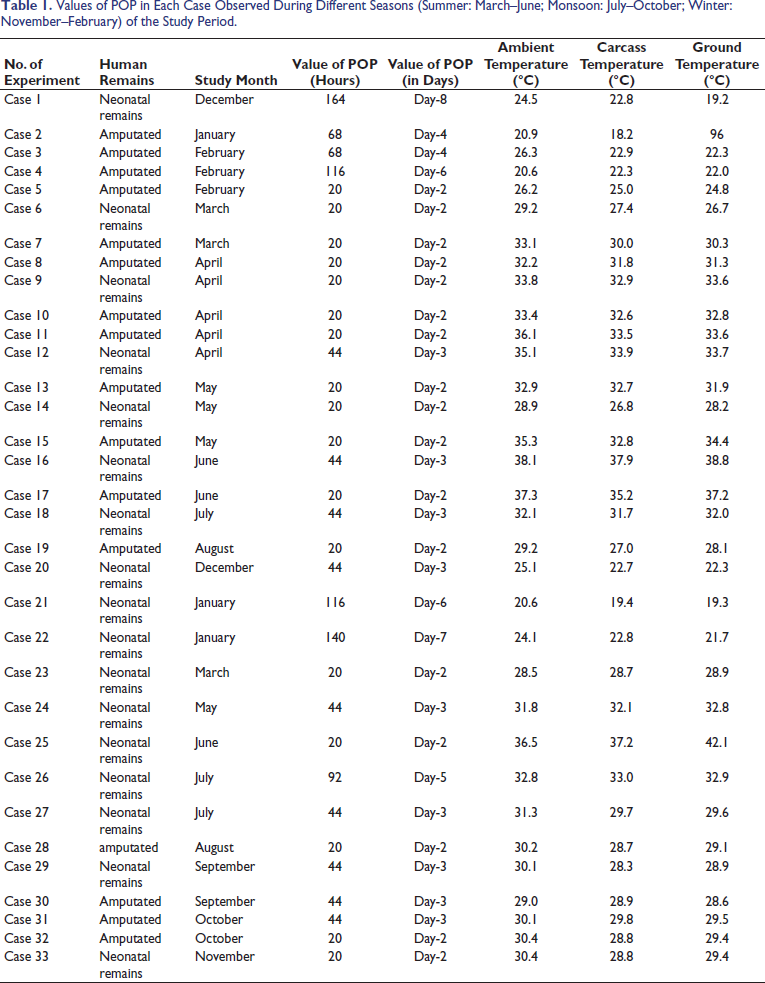
In winter (December), eggs were found not before a range of day six (116 hours at 20.6°C, 54% RH) to day eight (164 hours, 22.8°C, 60% RH) since natural exposure. In summer (March–June), oviposition was recorded early at 20 hours, with a faster decomposition rate at ≥32.9°C, 82% RH. However, in the rainy season time of oviposition varied from early 20 hours to 68 hours, at 29°C, 85% RH, with rainfall of 2.2 mm.
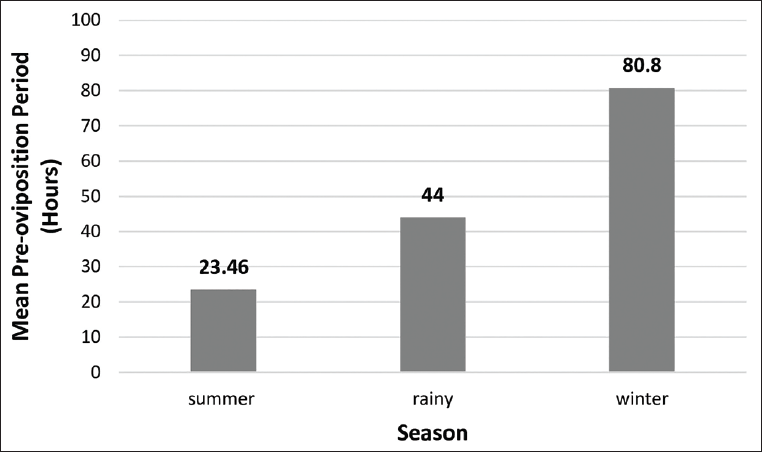
Maximum mean POP (80.8 hours, i.e., 3.36 days) was recorded in winter, at a mean temperature of 24.5°C, RH 43%. The mean POP is observed as 23.46 hours in the summer climate, at a mean temperature of 33.2°C, and RH 76%. In monsoon with seasonal rainfall, the mean POP is 44 hours at a mean temperature of 30.7°C, RH 91% (Figure 4). However, this POP value is not fixed in each case; instead, it indicates a range of delay in the time for oviposition.
Seasonal Variations of Pre-oviposition Period.
As observed in our study, amputated limbs are more preferred by flies and show early oviposition compared to neonatal remains, due to their exposed flesh. Oviposition was noted at both orifices and moistened regions. As with the pattern of decomposition, in the tropical climate of Kolkata, all body parts do not decompose in the same manner. Regions of a corpse that are moist and sodden tend to decompose earlier. The underside of the corpse showed sodden regions compared to the upper surface, even in winter months. Those sites were preferable for early fly eggs, as observed in our study when the corpse was flipped over. Eggs were found in the armpits of neonatal remains as well (Figure 3C).
In all cases, eggs were found in clusters in one or more batches, strongly adhered to the epidermis of human remains or exposed flesh in amputated regions.
Adult flies were identified as Sarcophaga harpax Pandellé, 1896 (Diptera: Sarcophagidae). Flesh flies commonly deposit larvae on breeding medium (viviparous); however, occasional eggs of flesh flies (Sarcophagidae) are well documented in literature, as also observed in the present study. 12
Limitations of the Study
The data derived from the present study would be applicable as regional data. Variations of temperature, humidity, and other factors across different regions of the country may alter the findings and results of the study.
Discussion
Oviposition is highly influenced by seasonal and climatic factors. 13 During our study, maximum POP was recorded in winter months, where the mean air temperature drops to around 24.5°C at the RH of 43%. Again, the shortest period was recorded in the summer months, where temperature rises to more than 33.2°C at the RH of 76%, with prevailing hot and humid conditions. However, a moderate period was observed in the monsoon season with disproportionate rainfall that influences laid fly eggs. The site did not receive uniform rainfall patterns throughout the monsoon.
In a few cases, it is observed that a heavy shower of rain washed away the cluster of eggs deposited above the cadaveric surface, in contrast to eggs beneath the corpse or body parts. The maximum mean POP was recorded in winter (80.8 hours), that is, approximately 3.36 days, indicating a matter of concern in medico-legal cases. This shows that, in particular, during the winter period with an increase in POP, there can be a maximum chance of error in the estimation of PMI.
Apart from this observation, the influence of the scavenging interaction of rodents and ants also plays a significant role in oviposition dynamics. 14 Rodents expose flesh in cadavers that facilitates early oviposition (preferred sites for laying eggs), as demonstrated by some authors and also observed during this study. 14 Ant activity was observed more on summer days and before the liquefaction of decomposing substrate. They were observed to carry eggs in their mouth, thus physically interrupting spontaneous development, as an integrated part of the biotic interaction of the human necrobiome. The science of taphonomy principles is difficult to understand, as it varies from case to case. Therefore, forensic professionals should be competent enough to identify fly eggs on a cadaver and give their importance as entomological evidence. Apart from natural orifice, the surface under the corpse must not be overlooked, as this can also be a site for preferred oviposition due to a moist environment, as was observed in our study.
In our opinion, estimation of total PMI by entomological evidence for a terrestrial decomposing body is quite difficult, especially in the winter period. As observed in the present study, a good amount of “time escape” occurred in cold days with a drop in ambient temperature.
In support of our field observation, the importance of POP is newly referred to here as “period of concern” in contrast to post-oviposition development as “period of interest” (Figure 2). The result of both can give a preliminary direction on an estimation of total PMI. Most forensic entomology literature highlights the period of interest, by calculating the age of maggots by various methods, but there is a dearth of data on research for the “period of concern.”15–17
Tomberlin et al. (2011) guided a roadmap for the Daubert standard of forensic taphonomy research with an emphasis on entomological evidence, where the importance and understudying of the pre-colonization interval, as referred to as POP in the present study, is highlighted. 18 Michaud et al. (2012) highlighted that proper and appropriate sampling increases the strength of inference in forensic entomology; otherwise, it will be just samples of flaws. 19 However, many flaws have been demonstrated in that study, which puts the scientific validity of entomological evidence in the court of law under question. 19
Galoria et al. (2024) reported a case series on entomological evidence, along with postmortem changes in forensic investigation. 20 In this work, the authors suggested that maggot development helps in estimating the time since death in badly decomposed bodies. The study focused only on the stages of development of maggots, but the circumstances of POP were not addressed. 20 Thus, how much time elapses in the deposition of fly eggs remained inconclusive. 20 In our study, this paradox related to oviposition dynamics has been clearly addressed, which can give direction toward the precise estimation of total PMI.
It is really a difficult task to estimate PMI in badly decomposed bodies.21–24 Conventional methods are insufficient to estimate time since death precisely, in bodies infested with maggots.21, 22 A detailed entomological study on such a cadaver warrants appropriate postmortem comments. 21 Studies have shown that the synchronous use of diatoms and maggots as legal evidence can effectively aid in making inferences. 25 Calculation of insect age plays an important role toward right direction in death investigation.25–27
Kulshrestha and Satpathy (2005) indicated that environmental factors (temperature and humidity) play an important role in entomological cases. 28 In an analysis of a case in Karnataka, differences of opinion between decomposition-dependent autopsy findings and entomological assessments were pointed. 28 The period of availability to flies for egg deposition has been indicated as an important consideration therein. 28
Considering observations from this study, it is hypothesized that entomological evidence analysis, particularly by estimating developmental stages of flies, remains inappropriate to the forensic context of total PMI calculation, as long as the POP is not properly tracked.
This hypothesis is new to science, as it is shown experimentally in an outdoor decomposing environment on human remains, in a tropical climate of terrestrial decomposition of urban habitat, where POP varies significantly with seasonal changes, particularly in the winter period.
Human neonatal remains and amputated limbs that have been used in this study can be relatable to real casework of child or newborn murders and an increasing number of incidents of mutilations and the disposal of adult body parts.
However, it is necessary to reproduce this type of study at different geographical barriers to understand and generate baseline data on POP variations and species diversity for that location.
Conclusions
A significant variation on POP that is observed in the present study, particularly in winter months, may lead to potential error in the estimation of total PMI by entomological evidence examination. CS examiners should remain conscious at the time of sample collection. Fly eggs are important to CS evidence analysis, as they can be an indicator for the earliest entomological evidence associated with decomposition, and the duration can indicate a more precise time of death and circumstances of exposure in terrestrial taphonomy.
Time of fly oviposition is an important factor in the estimation of PMI. This period of time is not fixed in each case; however, a range of time is presented in this study. More precisely, the winter period with maximum delay in the laying of eggs is the matter of concern and should be taken into account during a real CS investigation.
Footnotes
Acknowledgment
The authors are thankful to the Vice-chancellor of the University of Kalyani, Principals of NRS Medical College and Calcutta National Medical College, Kolkata, and the Head of the Department of FMT, NRS Medical College, Kolkata, for infrastructural and administrative support to carry out the research work. Subhankar Kumar Sarkar is thankful to Government of India (GOI), erstwhile Department of Science & Technology- Science and Engineering Research Board (DST-SERB), for sanctioning the project (SUR/2022/001485, dated 11 October 2023) and the Vice-chancellor, University of Kalyani, for Personal Research Grant (PRG) 2024–2025 and 2025–2026.
Authors’ Contribution
Somasish Ghosal: Conceptualization, body farm set-up, field experiments, data collection, data analysis, writing the original draft, and reviewing the final draft. Saurabh Chattopadhyay: Supervision, conceptualization, ethical clearance, body farm set-up, experiment design, data analysis and interpretation, and reviewing the final draft. Soumeek Chowdhuri: Conceptualization, body farm set-up, experiment design, data analysis and interpretation, and reviewing the final draft. Subhankar Kumar Sarkar: Overall supervision, conceptualization, experiment design, data analysis and interpretation, and writing and reviewing the final draft.
Consent to Participate
Not applicable.
Consent for Publication
Not applicable.
Data Availability Statement
No such data was used in the study.
Declaration of Conflicting Interests
The authors declare no potential conflict of interest with respect to the research, authorship, and/or publication of this article.
Ethical Approval
Institutional Human Ethics Committee approval (Letter No. NRSMC/IEC/12/2022). Unclaimed body parts and neonates used in the study were taken with permission from the IO.
Funding
The authors disclosed receipt of the following financial support for the research, authorship, and/or publication of this article: The research work is funded by ANRF, erstwhile DST-SERB, Government of India (Sanction No. SUR/ 2022/001485, dated 11 October 2023).
Informed Consent
Informed consent from patient/family members was taken regarding the amputated body parts, along with police permission, and for the unclaimed neonates, permission from the IO was taken.
