




Abstract
Suicide by hanging is a prevalent method of death in India, yet distinguishing between antemortem and postmortem hanging remains a significant forensic challenge. This study evaluates the diagnostic value of two internal vital signs: hemorrhage at the origin of the sternocleidomastoid (SCM) muscle and thoracolumbar intervertebral disc hemorrhage (Simon’s sign). The objective was to estimate the frequency of these hemorrhages and assess their reliability as ancillary signs of antemortem hanging. A prospective cross-sectional study was conducted over 18 months in which 200 cases of death by hanging were studied in tertiary care centre. Of the 200 cases analyzed, 96% involved complete suspension. The majority of victims were male (64.5%), with the highest prevalence in the 21–30 year age group. Sternocleidomastoid muscle hemorrhage was observed in 28.5% of cases, exclusively at the clavicular origin. Intervertebral disc hemorrhage was present in 26% of cases, predominantly in the lumbar region. A significant correlation was found between complete suspension and the presence of these hemorrhages; neither sign was observed in cases of incomplete suspension. Furthermore, the frequency of disc hemorrhage decreased with advancing age, likely due to degenerative spinal changes. Both signs occurred simultaneously in only 9.5% of cases. Hemorrhages in the SCM muscle and intervertebral discs serve as useful ancillary signs of antemortem hanging, particularly in cases of complete suspension. However, they are not sensitive or specific enough to be used as solitary diagnostic criteria.
Keywords
Introduction
In India, suicide by “hanging” (58.2%) is the most common mode as per the latest National Crime Records Bureau (NCRB) data. Hanging is a type of mechanical asphyxial death caused by the compression of the neck as a result of the suspension of the body by ligature, where the constriction force is the body’s weight. However, full suspension of the body is not always required to cause death due to hanging. 1 Unless proven differently, all hanging cases are assumed to be suicide. Homicidal and accidental hangings are rare. 2
Distinguishing between antemortem and perimortem hanging is extremely difficult. However, based on the history, ligature mark, and certain signs, we can determine which of the two it is.
The most essential sign of hanging is the ligature mark, which is typically oblique, non-continuous or continuous, and located high on the neck between the chin and the larynx. The base of the ligature mark is usually hard, yellow, and parchment-like. The ligature mark may not be evident if a soft, broad ligature material is used, or if anything like a long beard or clothing intervenes between the skin and the ligature, or if the point of suspension is very low. The internal postmortem findings in cases of hanging may include fractures of the larynx and hyoid, hemorrhages at the origin of the sternocleidomastoid (SCM) muscle, intimal tears of the carotid artery, hemorrhages in the subcutaneous tissue and other neck muscles, and hemorrhages on the front of the intervertebral discs. Out of these vital signs, this study focuses on SCM muscle hemorrhage and intervertebral disc hemorrhage, which may have additional importance when drawing conclusions regarding antemortem hanging.
Aims and Objectives
To estimate the frequency of SCM muscle hemorrhage and thoracolumbar vertebral disc hemorrhage in cases of death due to hanging.
Material and Methodology
Study Design
Prospective study.
Place of Study
Department of Forensic Medicine, Tirunelveli Medical College.
Study Duration
A period of 18 months.
Study Population and Sample Size
A total number of 200 cases with a history of death due to hanging, which were studied through postmortem examination during the author’s study period in the Department of Forensic Medicine at Tirunelveli Medical College, Tirunelveli, have been included in this study.
Inclusion Criteria
All cases with a history of death due to hanging which were sent to the department for a postmortem examination during the author’s study period.
Exclusion Criteria
Age more than 60 years.
History of bleeding disorders.
On treatment with anticoagulants.
Decomposed cases subjected to autopsy.
Sample Collection
A proforma was designed to collect preliminary data about the hanging victims. The maximum age of sample collected for this study was fixed as 60 years as the frequency of degenerative changes of the spine after 60 years increases, and that affects the development of an intervertebral disc hemorrhage.
The neck is dissected in a bloodless field. After creating a bloodless field, a layer-by-layer dissection of the anterior soft tissues of the neck is done to look for a SCM muscle hemorrhage.
Hemorrhages into the anterior aspect of the intervertebral discs in the lumbar region, or possibly even in the other regions of the vertebral column, were evaluated macroscopically after the removal of the intrathoracic and abdominal organs. For better transparency, the lumbar muscles and soft tissues in front of the vertebral bodies were removed.
All the information related to the circumstances was collected from the police and the family members of the deceased.
Results
A total number of 200 cases with a history of hanging were included in this study. Among 200 cases, 129 cases were male which accounted for 64.5% of the total sample and 71 cases were female which contributed the remaining 35.5%.
The male to female ratio is 1.8:1.
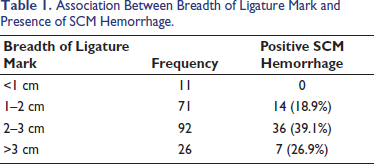
The relationship between the breadth of the ligature mark and the presence of sternocleidomastoid muscle hemorrhage is shown in Table 1.
Association Between Breadth of Ligature Mark and Presence of SCM Hemorrhage.
Out of 200 cases, 26 cases (13%) belong to the “<20 years” age group, 68 cases (34%) belong to the “21–30 years” age group, 52 cases (26%) belong to the “31–40 years” age group, 35 cases (17.5%) belong to the “41–50 years” age group, and the remaining 19 cases (9.5%) belong to the “51–61 years” age group. The maximum number of cases belong to the “21–30 years” age group (34%), followed by the “31–40 years” age group (26%), and then by the “51–60 years” age group (9.5%).
The association between the type of suspension and the presence or absence of SCM muscle hemorrhage and intervertebral disc hemorrhage is shown in Table 2.
Suspension with SCM and Intervertebral Disc Hemorrhage.

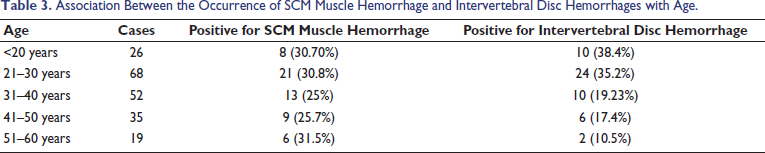
The age-wise distribution of SCM muscle hemorrhage and intervertebral disc hemorrhage is presented in Table 3.
Association Between the Occurrence of SCM Muscle Hemorrhage and Intervertebral Disc Hemorrhages with Age.
In this study, there were 192 cases with free body suspension (complete hanging; 96%) and eight cases with incomplete body suspension (partial hanging; 4%).
The ligature mark was prominent in 159 cases (79.5%) and faint in 41 cases (20.5%). In this study, the breadth of the ligature mark was <1 cm in 11 cases (5.5%), 1–2 cm in 71 cases (35.5%), 2–3 cm in 92 cases (46%), and >3 cm in 26 cases (13%). Faint ligature was noted in cases where soft ligature material was used.
The ligature materials most commonly used to commit suicide by hanging were: sarees in 90 cases (45%), ropes in 71 cases (35.5%), dhotis in 17 cases (8.5%), dupattas in 11 cases (5.5%), lungis in five cases (2.5%), belts in three cases (1.5%), screen cloths in two cases (1%), and a towel in one case (0.5%). The thickness of the material used to encircle the neck is the primary factor that determines the ligature’s breadth.
SCM Muscle Hemorrhage
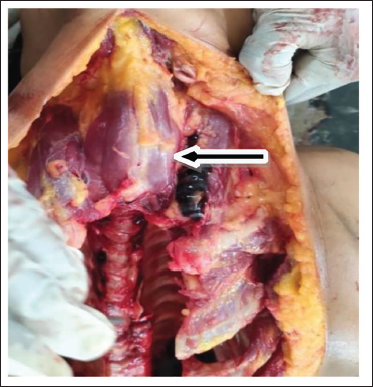
Hemorrhage at the origin of the SCM muscles was found in 57 cases (28.5%). Among them, 34 were males and 23 were females. During the autopsy, the hemorrhages were located exclusively at the clavicular origin of the SCM muscles. Hemorrhages at the sternal origin of the SCM muscles were not detected in any case. All cases with ligature mark breadth greater than 2 cm, in which the ligature material was predominantly rope and saree, showed a higher percentage of SCM muscle hemorrhage. Hemorrhage at the clavicular origin of the sternocleidomastoid muscle is shown in Figure 1.
SCM Muscle Hemorrhage. 47 Years/Female.
Frequency of Intervertebral Disc Hemorrhage
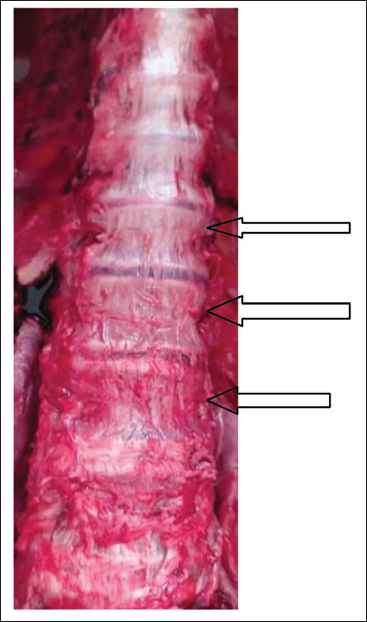
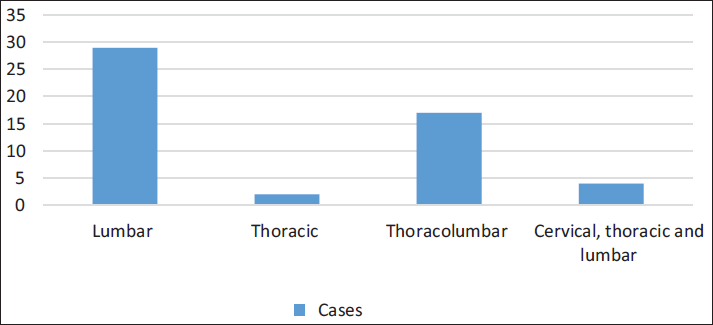
The relative frequency of the occurrence of intervertebral disc hemorrhage was proved to be 26% (52 cases). The finding was present in 32 males (24.8% of all males in the study) and 20 females (28.1% of all females in the study). The male to female ratio of intervertebral disc hemorrhage is 1.6:1. There were 29 cases of lumbosacral intervertebral disc hemorrhage, two cases of thoracic intervertebral disc hemorrhage, 17 cases of thoracolumbar intervertebral disc hemorrhage, and four cases of cervical, thoracic, and lumbar intervertebral disc hemorrhage. Macroscopic appearance of intervertebral disc hemorrhage (Simon’s sign) is shown in Figure 2. The distribution of intervertebral disc hemorrhage according to vertebral level is shown in Figure 3.
Simon’s Hemorrhage. 34 Years/Male.
Frequency of Intervertebral Disc Hemorrhage.
In cases of incomplete suspension, neither SCM muscle hemorrhage nor intervertebral disc hemorrhage were observed.
SCM muscle hemorrhage shows no significant association with age. In our study, however, the occurrence of intervertebral disc hemorrhage decreased as age increased.
In 19 (9.5%) cases, both SCM muscle hemorrhage and intervertebral disc hemorrhage were noted.
Discussion
In our study, male victims outnumbered female victims, and the most common age group was 21 to 30 years. More than 90% of the hangings were complete. The ligature material most commonly used in suicidal hangings was the saree (90 cases; 45%), followed by rope (71 cases; 35.5%). SCM muscle hemorrhage was observed in 28.5% of cases (57 cases), while intervertebral disc hemorrhage was seen in 26% of cases (52 cases). Both types of hemorrhage were predominantly observed in female victims. Intervertebral disc hemorrhage was most frequently found in the lumbar vertebral disc rather than in other vertebral discs. This study shows that prolonged suspension produces intervertebral disc hemorrhage.
Hemorrhages beneath the area of the anterior longitudinal ligament of the intervertebral disks in the lumbar vertebrae were first described in cases of death by hanging by the German forensic pathologist Axel Simon in 1968.3, 4 In his honor, medicolegal literature calls this morphological finding “Simon’s bleedings” (Simon’s sign or symptom).5–8
Males were affected more than females. The most affected age group was 21–30 years, similar to the findings reported by Maheshwari et al., 9 Chithra et al., 10 and Vishwakarma et al. 11 The predominance of young adults reflects psychosocial stresses, occupational pressure, and impulsive behavior which are characteristic of this age group.
The victims preferred soft ligature materials (such as sarees) over hard ligature materials which aligns with the findings reported by Chithra et al., 10 and is also similar to Kandade and Zanjad, 12 who found that soft materials were used in 190 cases (51.91%). The preference of soft ligature materials reflects a regional pattern distinct from the predominance of rope observed elsewhere.
The most commonly adopted method was complete hanging, observed in 192 cases (96%), while partial hanging was noted in eight cases (4%). This finding is consistent with the study by Khana et al., 13 in which complete suspension was predominant and also aligns with the study by Guntheti et al., 14 where complete hanging was reported in 24 cases (75%).
Handbook of Forensic Medicine, edited by Burkhard Madea 15 , states that dissection of the clavicular periosteum will detect hemorrhaging in up to 96% of cases of complete and incomplete hanging (Keil et al., 1995).
A study by Hejna et al. found hemorrhages at the origin of SCM muscles in 62% of the cases. 16 Similarly, hemorrhages were found in the SCM muscle in 16 cases (47.05%) in a study done by Gorchiya et al. 17
When compared with existing studies, the frequency of occurrence of SCM muscle hemorrhages in this study differs significantly. Hemorrhage at the origin of the SCM muscle was identified in 28.5% of cases, exclusively at the clavicular origin. No hemorrhage was detected at the sternal origin in any case. This selective involvement may be attributed to the anatomical and biomechanical vulnerability of the clavicular head, which is subjected to greater tensile and shearing forces during suspension, particularly in complete hanging. As noted in this study, the finding that SCM hemorrhage was more common with broader ligature marks (>2 cm) supports the concept that wider ligature materials distribute compressive forces over a larger surface area, increasing traction on deeper neck structures rather than causing localized skin injury.
In 1968, Axel Simon3, 4 described hemorrhages into the anterior aspect of the intervertebral disks in the lumbar region of the spine on a series of 64 cases of hanging (53 of them showed typical hemorrhages). This observation was confirmed in subsequent autopsy studies: Geserick et al. in 29.2% of 840 autopsy cases retrospectively evaluated; Kleiber et al. in 47% of 222 cases of hanging; and Saternus in 56% of 32 cases of hanging. Therse were no hemorrhages into the anterior aspect of the intervertebral disc in the postmortem experiments of hanging. In a study by Braun et al. at the Institute for Forensic Medicine, Hamburg, the frequency of Simon’s hemorrhage was found to be 70%. 18
In a study by Nikolić et al. Simon’s bleedings were present in 62.8% cases of hanging. 19
In a study by Adamski et al Simon’s sign was identified in 35.2% cases. 20
From the above literatures the frequency of occurrence of Simon’s hemorrhages in this study significantly differs from previous studies except Geserick et al. in which Simon’s hemorrhage occurs in 29.2% of the cases, whereas in this study it occurs in 26% cases.
According to Handbook of Forensic Medicine, the hemorrhages on the front of intervertebral discs are fine streaks of hemorrhage, predominantly found on the ventral surfaces of the intervertebral discs of the lumbar spine. Predominant involvement was found in the lumbar spine intervertebral discs in this study, as well.
In this study, it was found that as age increases the occurrence of Simon’s hemorrhage decreased, which explains the degenerative changes that reduce the intervertebral disc space as age advances.
Simon assumed that the origin of disc hemorrhages in cases of hanging was connected with the overexpansion of the spine because of free suspension of the body3, 4 The findings of this study also support his original hypothesis. Hemorrhages occurred substantially more frequently in situations with free suspension of the victim than in cases with incomplete suspension. Hemorrhages do, however, nevertheless occasionally occur in cases of hanging with partial suspension. It is clear that the body’s free and prolonged suspension contributes significantly to the development of these hemorrhages.
In cases of hanging, Simon’s bleedings most likely occur because of agonal convulsions and forceful movements in the lumbosacral part of the spinal column.
The anterior longitudinal ligament at the level of the lumbosacral joint is softer than its superior counterpart in the lumbar spine. These are the reasons why we considered complete hangings as well as incomplete hangings in standing and kneeling positions—the load was practically sufficient to produce eventual bleeding in the lumbosacral complex. Agonal convulsions in suicidal hangings begin shortly after the onset of hanging and are followed by decorticate rigidity with extension of the trunk and lower limbs. Such specific movements result in strong lateral stimulation of the lumbar spine and consequent ruptures of the vessels originating from the spinal tract of the lumbar artery.
An additional important factor for the appearance of these bleedings in hanging is also the traction of the body as a result of gravity. The occurrence of Simon’s sign in other unnatural forms of death is rare and is most often connected with hyper extensive violence against the spine.
Therefore, these findings support vitality and strengthen the diagnosis of antemortem hanging when present but lack sufficient sensitivity and specificity to be considered pathognomonic. Simon’s bleeding and SCM muscle hemorrhage are not specific to hanging alone.
Conclusion
These results support the view that SCM and intervertebral disc hemorrhages are useful ancillary signs of antemortem hanging, particularly in complete suspension, but they are neither sensitive nor specific enough to serve as solitary diagnostic criteria. Simon’s hemorrhage was present only in younger victims which shows that as age advances the degenerative changes of the spine decrease the occurrence of Simon’s hemorrhage.
Recommendation
In this study, Simon’s hemorrhage is seen in one-fourth of hanging cases. If we perform the study of presence of Simon’s hemorrhage in other cases, like road traffic accidents, falls from heights, drowning, and others where the expected spinal stretch and stress occur, we may acquire more knowledge about the mechanism and patterns of intervertebral disc hemorrhage. An additional point of concern is that select partial hanging cases for both hemorrhage and histopathological examination of vertebral disc and SCM muscle might be highly sensitive.
Footnotes
Acknowledgements
We take this chance to express our deep sense of gratitude and humble thanks to all professors of the Department of Forensic Medicine.
Declaration of Conflicting Interests
The authors declared no potential conflicts of interest with respect to the research, authorship, and/or publication of this article.
Ethical Approval
Ethical approval for the study was obtained from the Tirunelveli Medical College Institutional Research Ethical Committee (TIREC), Tirunelveli (Approval Ref. No. 1895/FM/2021; dated 5 March 2021). Appropriate permissions were obtained from the concerned authorities.
Funding
The authors received no financial support for the research, authorship, and/or publication of this article.
Informed Consent
As this study was conducted on deceased individuals as part of a medicolegal autopsy, informed consent was not applicable. Permission for the study was obtained from the institutional ethics committee and relevant authorities.
