



Abstract
Estimation of stature is an essential aspect of forensic identification and anthropological assessment. In medicolegal investigations involving unknown individuals, decomposed bodies, or fragmentary human remains, the determination of stature provides valuable corroborative evidence for personal identification. Although stature is commonly assessed using long bones, alternative parameters become necessary when only partial remains are available. Hand dimensions, particularly finger lengths, have shown a reliable association with stature. However, limited studies have explored the relationship between index finger and thumb length with stature, especially in specific regional populations. The present study aims to evaluate this relationship and derive regression equations applicable to the Maharashtrian population. A descriptive cross-sectional study was conducted in the department of forensic medicine in a rural government medical college and hospital in Maharashtra from June 2021 to July 2021. The study population included 150 undergraduate medical students (82 males and 68 females) aged 18–25 years of age. The data obtained was analyzed statistically to establish the relationship between a person’s index and thumb finger length and stature. Simple linear regression was calculated to predict height (calculated height) based on index finger and thumb measurements. The test revealed that there was no significant difference between observed and calculated height of both male and female students (p < .05). Based on the present study it can be concluded that the lengths of the thumb and index finger can be used as reliable parameters in reconstructing the stature of an individual.
Background
Personal identification constitutes a fundamental objective of forensic medicine, particularly in cases involving unidentified human remains. Circumstances such as mass disasters, explosions, advanced decomposition, mutilation, or skeletal fragmentation often make conventional identification methods difficult or impossible.1, 2 During the examination of dismembered or skeletal remains, the primary objective is to estimate age, sex, stature, and ancestry to develop a useful biological profile. A biological profile, thus derived, is a circumstantial identification that helps in narrowing down the pool of possible matching profiles. 3
Stature estimation from skeletal remains and body parts is based on the principle that the height of an individual has a definite and linear relationship with various body parts and long bones of an individual. Stature prediction occupies a relatively central position both in anthropological research and in the identification necessitated by the medical jurisprudence or by the medicolegal experts.2, 4 Various studies in the past have established that stature can be reconstructed from various body parts and individual bones with reasonable accuracy. Earlier studies have utilized the skull and cephalo-facial anthropometry, long bones and their fragments, scapula and hip bones, and small bones of the hand and foot for estimation of stature. It has been shown that the estimation of stature is more accurate and reliable using long bones than any other part of the body. Peripheral anthropometry—measurements of hands, feet, craniofacial structures, and digits—has increasingly gained importance because these structures may remain preserved even when larger bones are lost or destroyed.5, 6 Several researchers have demonstrated that finger lengths, hand dimensions, foot length, and percutaneous limb measurements correlate significantly with stature across populations.7, 8 The index finger, located between the thumb and middle finger, is the second digit (2D), which is usually the most dexterous and sensitive finger next to the thumb of a human hand. 9 Although several studies have explored stature estimation using hand and finger dimensions, literature focusing on index finger and thumb length in the Maharashtrian population remains limited.5, 10 The present study attempts to bridge this gap by analyzing the correlation between stature and these digital measurements, and will be helpful in conditions in which only the hand or a part of the hand is available for the identification of a person.
Objective
To determine the relationship between stature and the lengths of the index finger and thumb, and to derive population-specific regression equations for stature estimation in the Maharashtrian population.
Material and Methods
A descriptive cross-sectional study was conducted in the department of forensic medicine at a rural government medical college and hospital in Maharashtra over a period of one month, from June 2021 to July 2021.
The study population comprised 150 undergraduate MBBS students aged between 18 and 25 years. Participants included in the study were apparently healthy individuals without any congenital anomalies, deformities, trauma, or surgical alterations affecting the hands or fingers. Subjects with a history of fractures, amputations, skeletal deformities, or conditions likely to influence anthropometric measurements were excluded from the study.
Prior to data collection, all participants were screened using a brief clinical examination to ensure eligibility. Measurements were taken only from individuals who satisfied the inclusion criteria and consented to participate. Confidentiality of participant data was strictly maintained throughout the study.
Materials Used
Stature was measured using a stadiometer (SECA 213, Germany; precision 0.1 cm). Lengths of the index finger and thumb were measured using a digital Vernier caliper (Mitutoyo, Japan; accuracy 0.01 mm
Measurement Protocol
Stature was recorded with the participant standing barefoot on a flat surface, with heels slightly apart and weight evenly distributed on both feet. The subject was positioned in the Frankfurt horizontal plane, with the head oriented such that the lower margin of the orbit was in the same horizontal plane as the upper margin of the external auditory meatus. The headpiece of the stadiometer was gently lowered to make contact with the vertex, and stature was recorded to the nearest 0.1 cm. 11
The length of the thumb was measured as the straight distance between the midpoint of the proximal flexion crease at the base of the thumb and the tip of the thumb, with the hand placed flat on a horizontal surface and the fingers fully extended. 12
The length of the index finger was measured as the distance between the midpoint of the metacarpophalangeal crease at the base of the index finger and the tip of the finger, with the hand positioned similarly on a flat surface.
All measurements were taken bilaterally. To reduce intra-observer and inter-observer variability, each measurement was recorded twice by two independent observers, and the average of the readings was considered for final analysis.
Statistical Analysis
The collected data were entered into Microsoft Excel and subsequently analyzed using the Statistical Package for the Social Sciences (SPSS) software, version 22.0. Descriptive statistics, including mean and standard deviation, were calculated for stature, index finger length, and thumb length in male and female participants. Pearson’s correlation coefficient was applied to assess the strength and direction of the relationship between stature and finger measurements. Simple linear regression analysis was performed to derive regression equations for the estimation of stature using index finger and thumb lengths as independent variables, with stature considered the dependent variable. Separate regression equations were formulated for males and females to account for sexual dimorphism. The accuracy of the derived equations was evaluated by comparing the actual measured stature with the estimated stature obtained from the regression models. A p value of less than .05 was considered statistically significant for all analyses.
Result
A total of 150 undergraduate students participated in the study, comprising 82 males (54.67%) and 68 females (45.33%). The mean and standard deviation of observed height for males and females were 169.19 ± 5.68 cm and 157.59 ± 5.70 cm, respectively (Table 1).
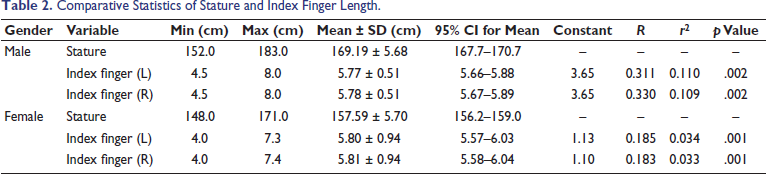
Among male participants, the length of the right and left index fingers ranged from 4.5 cm to 8.0 cm. The mean length of the right index finger was 5.78 ± 0.513 cm, while the left index finger measured 5.77 ± 0.514 cm on average. In female participants, the right index finger length ranged from 4.0 cm to 7.4 cm, with a mean of 5.81 ± 0.94 cm, whereas the left index finger length ranged from 4.0 cm to 7.3 cm, with a mean value of 5.80 ± 0.94 cm (Table 2).
The length of the right thumb in males varied between 3.8 and 7.2 cm (mean 4.87 ± 0.56 cm), whereas the length of the left thumb varied from 3.8 to 7 cm (mean 4.91 ± 0.55 cm). In females, the right thumb ranged from 3.8 to 7 cm (mean 4.80 ± 0.84 cm), and the left thumb from 3.8 to 7 cm (mean 4.82 ± 0.84 cm) (Table 1).
Comparative Statistics of Stature and Thumb Length.
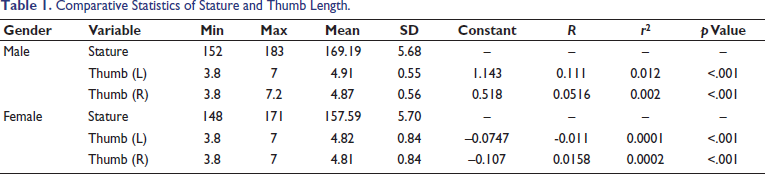
An independent t-test demonstrated a statistically significant difference between males and females with respect to stature, index finger length, and thumb length (p < .05). The mean values of stature and both right and left thumb lengths were greater in males than in females, whereas females showed higher mean index finger lengths when compared to males (Tables 1 and 2).
Comparative Statistics of Stature and Index Finger Length.
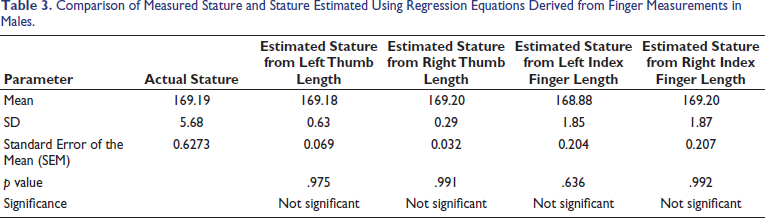
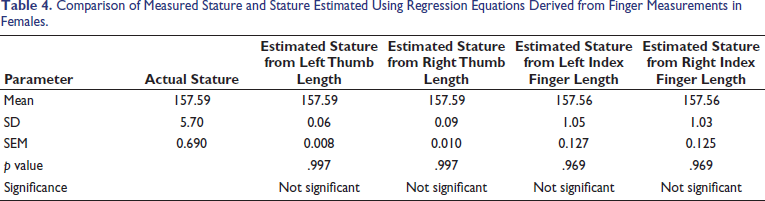
Comparison of the actual height with the estimated height derived from regression equations showed no statistically significant difference for both male and female participants (Tables 3 and 4).
Comparison of Measured Stature and Stature Estimated Using Regression Equations Derived from Finger Measurements in Males.
Comparison of Measured Stature and Stature Estimated Using Regression Equations Derived from Finger Measurements in Females.
The correlation coefficients for both right and left thumb lengths were higher in male participants compared to female participants.
Height = 166.67 + 0.52 × (length of right thumb in male)
Height = 163.58 + 1.14 × (length of left thumb in male)
Height = 158.10 + (–0.11 × length of right thumb in female)
Height = 157.95 + (0.07 × length of left thumb in female)
Correlation coefficient for both right and left index fingers in males and females for stature was >0.3 and >0.1, respectively, so there was a moderate positive correlation between the length of right and left index fingers and the statures of study participants.
Height = 148.09 + 3.65 × (length of left index finger in male)
Height = 148.11+ 3.65 × (length of right index finger in male)
Height = 151.06 + 1.125 × (length of left index finger in female)
Height = 151.17 + 1.10 × (length of right index finger in female)
No statistically significant difference was observed between the measured stature and the stature estimated using the regression equations in male participants.
No statistically significant difference was found between the measured stature and the stature estimated using the regression equations among female participants.
Each regression equation should be interpreted with its corresponding standard error of estimate (SEE) to account for biological variability; exact stature cannot be predicted without an error margin.
Discussion
Estimation of an individual’s stature is a vital component of forensic examinations and anthropological research, as stature serves as an important parameter in the process of personal identification during forensic investigations. The present study demonstrates a significant positive correlation between stature and the lengths of the index finger and thumb in both sexes. Male participants exhibited higher mean stature and thumb length, whereas index finger length was marginally greater in females. Krishan et al. 5 observed that the stature is significantly higher in males than in females.
In the present study, stronger correlations were observed between stature and both right and left thumb lengths in male participants compared to female participants. Similar findings have been reported by Kumar et al. 13 Additionally, the correlation coefficients for the right and left index finger lengths showed positive associations with stature in both males and females, with values exceeding 0.3 in males and 0.1 in females, indicating a positive relationship between index finger length and stature among the study population. Overall, the index finger is considered more reliable in both males and females for estimation of stature of study participants. A study conducted by Tyagi et al. 14 found a positive correlation between stature and finger lengths and has suggested that the index finger was best for the prediction of stature in both males and females. Similar to the findings in the present study, Katwal et al. 15 observed that the Pearson correlation between finger length and stature was higher among males than females. Varghese et al. 16 found that the best finger to predict height in case of males was the left thumb and in females was the right thumb. Ibrahim et al. 17 in Malaysia also reported hand and finger lengths as reliable predictors, with sexual dimorphism paralleling our observations. Alabi et al. 18 in Saudi Arabia confirmed that hand dimensions, including finger lengths, strongly correlated with stature, highlighting applicability across Middle Eastern populations. Although the present study found minimal differences between actual and estimated stature, such near-perfect alignment must be interpreted cautiously. Biological variability in limb proportions typically produces an estimation error of ± 4 to ± 6 cm in most populations. 15 The regression equations formulated in this study showed minimal error, reinforcing the applicability of finger dimensions as predictive tools for stature estimation. However, these equations should be applied cautiously and preferably within the same population group. The regression equation for female thumb length produced a high intercept, restricting its ability to estimate the stature of shorter individuals accurately. This suggests that thumb length alone may not be a robust predictor in female populations.
European and Turkish studies have also supported hand and peripheral anthropometry. Zeybek et al. 4 in Turkey found strong correlations between foot length and stature, which, although based on feet, reinforces the validity of regression-based methods from peripheral body parts.
Taken together, our study demonstrates that thumb and index finger lengths can be used as reliable predictors of stature in young adults. However, differences across populations observed in global literature highlight the importance of developing and validating region-specific regression equations before application in forensic practice.
Limitations
The study sample consisted solely of MBBS students from a single institution, limiting generalizability.
Participants belonged to a narrow age range and a similar socioeconomic background, reducing biological variability.
Finger measurements may be affected by minor postural or technical variations.
Genetic, nutritional, and environmental influences were not separately analyzed.
Conclusion
Based on the present study, it can be concluded that the average stature and thumb length of male participants were higher than those of females, while index finger length was slightly higher in females. There was a positive correlation between stature and thumb length in males, and between stature and index finger length in both sexes. No significant difference was observed between measured and estimated stature using regression equations.
These findings underscore the value of thumb and index finger lengths as reliable parameters for stature estimation, particularly in forensic investigations involving dismembered, mutilated, or skeletal remains where only partial hand structures are recovered. Population-specific regression equations derived from such studies enhance the accuracy of personal identification in medicolegal cases, disaster victim identification, and mass casualties.
Footnotes
Declaration of Conflicting Interests
The authors declared no potential conflicts of interest with respect to the research, authorship, and/or publication of this article.
Ethical Approval
Ethical approval was obtained from the Institutional Ethical Committee. (SRTRGMC/Pharmac/IEC/DMER/86/21/09/2021).
Funding
The authors received no financial support for the research, authorship, and/or publication of this article.
Informed Consent
Written informed consent was obtained from all participants prior to their inclusion in the study.
