




Abstract
Organ donation remains a vital solution to the persistent demand–supply gap in transplantation, yet donation rates in India remain low due to prevalent myths and poor awareness. This cross-sectional survey, conducted in Belagavi between January and December 2020, assessed the knowledge, perception, and attitudes toward organ donation among 490 employees and non-medical college students using a pre-validated questionnaire. The study population was primarily aged 18–30 years (95%) with a 1:2 male-to-female ratio. Findings revealed that only 11% of participants possessed adequate knowledge regarding organ donation. While willingness to donate was expressed by 68% for themselves and 58% for deceased relatives, only 48% were willing to register as donors, and only 35% demonstrated an overall positive perception and attitude. These results indicate that awareness and knowledge remain insufficient, suggesting that targeted awareness programs and curriculum-based education are essential to improve donation willingness within the community.
After I die, if I am buried, I will rot; if I am burnt, I will become ash. But if my body is donated, I will live to give life and happiness to many. —Amit Abraham.
Introduction
In India, 9.5 million deaths occur annually, with 0.5 million dying while waiting for organ transplants. 1 Each day, 15 people lose their lives while awaiting an organ. 2 The chances of receiving an organ on the waiting list range from 10% to 30%. Myths, misconceptions, and factors such as age, sex, and socioeconomic status influence organ donation rates. A report states that 150,000 brain deaths occur annually due to road traffic accidents, and if 20% of those cases donated organs, it would meet the demand. In 2018, 116,000 organs were transplanted globally, with India accounting for only 10,340 transplants. Globally, there were 31,294 cadaver donors in 2018, but only about 875 in India. 3 India lags behind other nations in organ transplantation. The National Organ Transplantation Program, with a 150-crore budget for the 12th Five-Year Plan, aims to promote deceased organ donation. 4 The 1994 Transplantation of Human Organs Act, amended in 2014, regulates organ removal and transplantation while curbing illegal trade. 5 Key challenges include the demand–supply gap, inadequate hospital infrastructure, and low brain stem death certification rates.6, 7 To address these, National Organ and Tissue Transplant Organization (NOTTO) introduced policies and awareness programs under the Transplantation of Human Organs and Tissues Act in 2014. This study aims to assess the awareness, knowledge, and attitudes toward organ donation among non-medical college students and staff in Belagavi.
Objectives
To assess knowledge regarding organ donation among the adult population in an urban area.
To assess the perception and attitude toward organ donation among the adult population in an urban area.
Materials and Methods
A cross-sectional survey was conducted from January to December 2020 to assess awareness, perceptions, and attitudes toward organ donation among employees and non-medical college students in Belagavi. Using formula n = 4pq/d2, where p is the prevalence of awareness, perception, and attitude, q = 100 – p, and assuming a 20% non-response rate among study participants, the sample size was determined by assuming a 50% prevalence of knowledge, awareness, and perception, and an error of 5% (10% of prevalence sample size). The result was 490 with a 5% error.
Participants were randomly selected from non-medical colleges with principal approval. After signing an informed consent form detailing the study’s purpose, rights, privacy, and withdrawal option, they completed a pre-validated questionnaire. The questionnaire included socio-demographic details and questions on awareness, perception, and attitude toward organ donation. Data were entered and analyzed in Microsoft Excel using frequencies and percentages.
Results
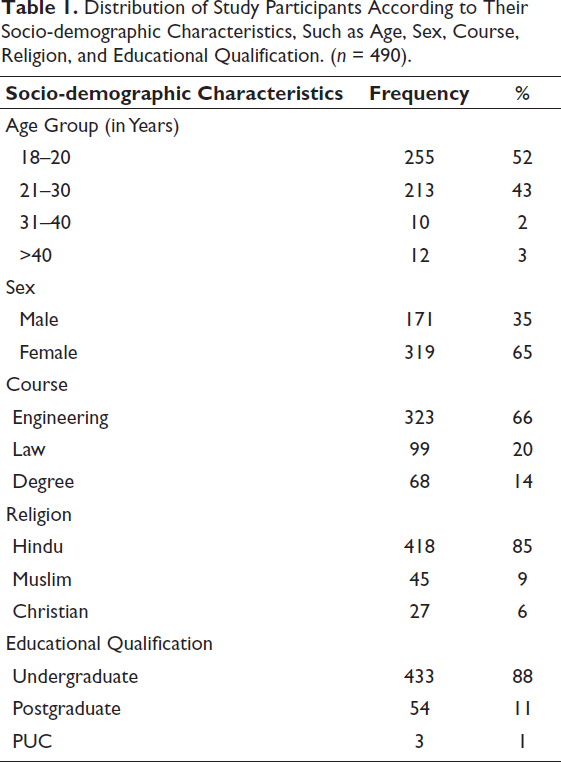
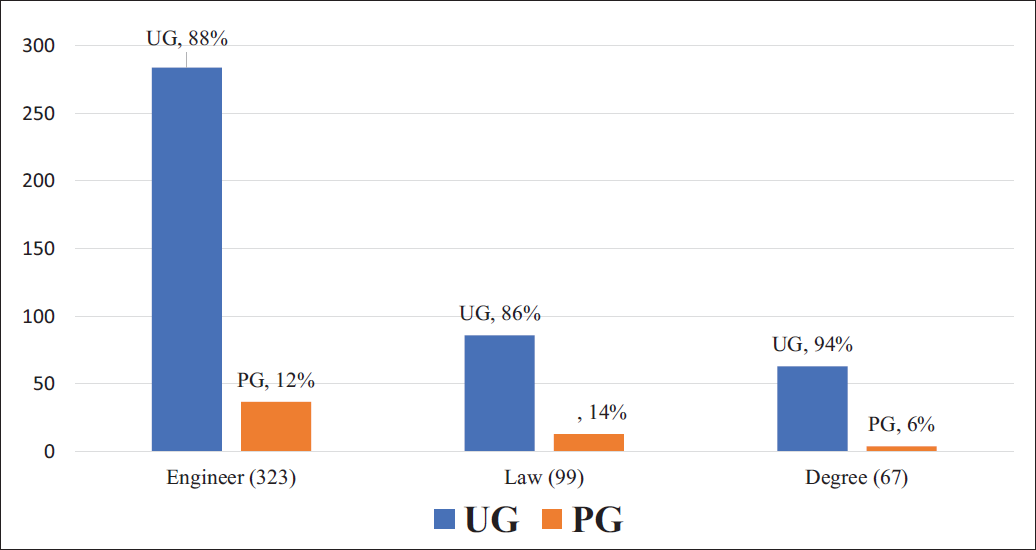
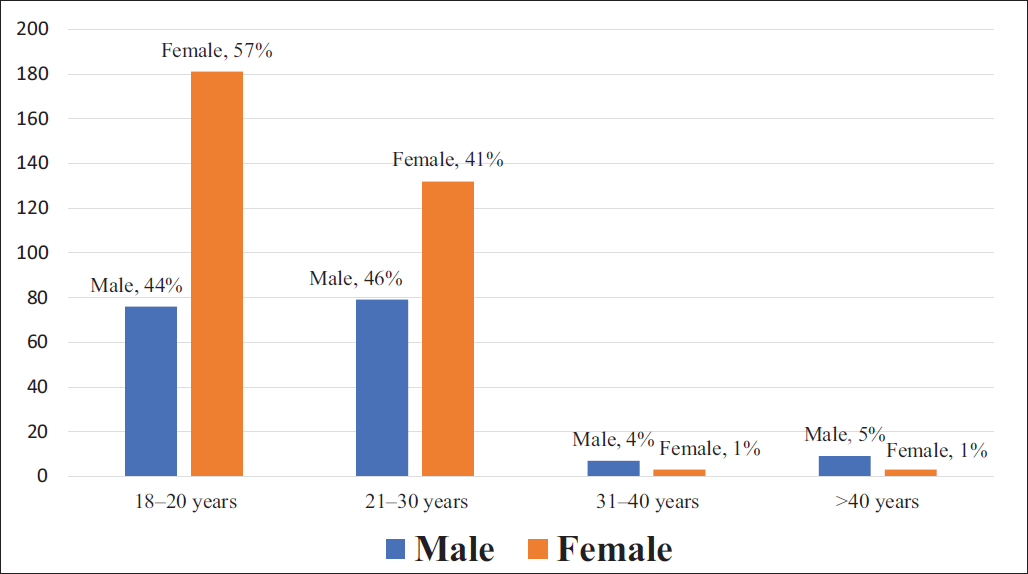
Among the 490 participants, the majority (95%) were aged 18–30, with 65% being female, resulting in a male-to-female ratio of 1:2. Most participants were undergraduates (88%), with 66% studying engineering, and 85% identified as Hindus (Table 1 and Figure 1).
Distribution of Study Participants According to Their Socio-demographic Characteristics, Such as Age, Sex, Course, Religion, and Educational Qualification. (n = 490).
Graphical Representation of Study Participants Regarding Course and Education Level (n = 490).
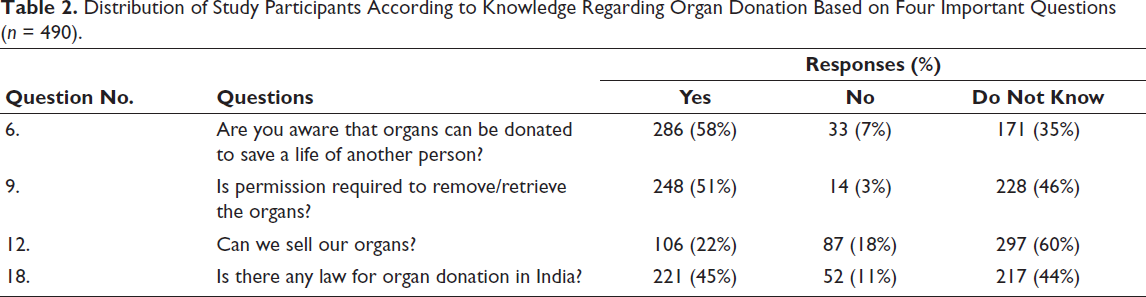
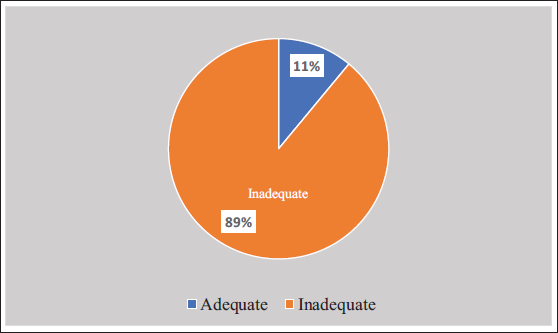
While 58% of participants understood the importance of organ donation, only 52% knew who could donate. The majority were aware that kidneys (83%) and eyes (74%) could be donated, but only 3% knew about other organs. Only 22% knew that organ selling is illegal, and nearly half (51%) were aware of the legal requirements for organ retrieval (Table 2). However, 76% were unaware of the health risks associated with live organ donation. The media was the main source of information for 44%, while 38% cited healthcare-based awareness programs. Only 11% answered all key awareness questions correctly, indicating adequate knowledge about organ donation (Figure 2).
Distribution of Study Participants According to Knowledge Regarding Organ Donation Based on Four Important Questions (n = 490).
Graphical Representation of Study Participants Regarding Knowledge Adequacy on Organ Donation (n = 490).
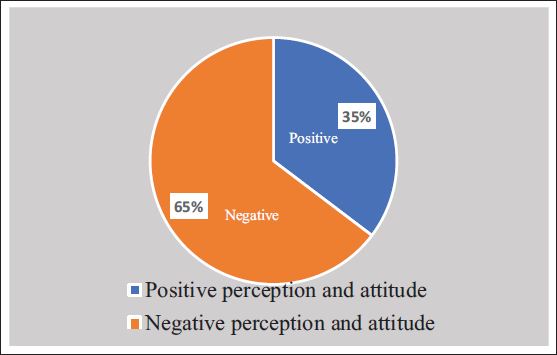
Sixty-eight percent of participants were willing to donate their organs, with 86% motivated by personal reasons. Among the 32% who were not willing, 46% cited family opposition as the main reason. Additionally, 58% expressed willingness to donate their deceased relatives’ organs, and 48% were open to registering as an organ donor. Based on positive responses to these three key questions, 173 participants (35%) had a positive perception and attitude toward organ donation (Figure 3).
Graphical Representation of Study Participants According to Perception and Attitude Regarding Organ Donation (n = 490).
Discussion
In the current study, most participants (95%) were in the 18–30 age group, indicating a predominantly young sample. Among 490 participants, the male-to-female ratio was 1:2 (Figure 4), showing a higher female participation, a trend also observed in previous studies in urban Puducherry (57%), tertiary care centers in Puducherry (60%), and rural Maharashtra (57%). This demographic pattern may reflect higher health-seeking behavior and research engagement among younger individuals and females.
Graphical Representation of Study Participants Regarding Age and Sex (n = 490).
In our study, 73% were aware that organ scarcity could lead to death, consistent with studies in New Delhi 9 and Bangalore. 8 However, despite this awareness, organ donation pledges remain low, highlighting a gap between knowledge and action. This may be influenced by cultural beliefs, trust issues with the healthcare system, and misconceptions about organ donation. Overcoming these barriers is essential for increasing donor registration.
Only 14 participants (3%) correctly identified all organs that can be donated. While most were aware that kidneys and eyes could be donated, knowledge about other organs, such as the heart, liver, and lungs, was lacking. Similar gaps in understanding were noted in studies conducted in Northeast India 10 and at the All India Institute of Medical Sciences (AIIMS), New Delhi. 9 This limited awareness contributes to the persistent organ donation gap, underscoring the need for targeted public education campaigns.
Regarding sources of information, 44% cited media, and 38% mentioned healthcare-based awareness programs. The relatively high number of participants informed by healthcare programs suggests they may have a more substantial impact on educating the public, possibly due to their interactive and personalized nature.
Among participants, 221 (45%) were aware of laws related to organ donation. Awareness was higher in studies in Chennai (54%) 13 and Ahmedabad (74%) 12 but lower in urban Puducherry (29%) and Bangalore (6%). These differences may reflect variations in education levels, access to information, and the effectiveness of local awareness efforts.
The study also evaluated knowledge by asking four key questions: Whether organ donation saves lives, the need for consent, whether organs can be sold, and the existence of laws governing donation. Nearly half of the participants answered three of the four questions correctly, but only 22% knew that organ selling is illegal, leading to an overall adequate knowledge rate of just 11%. Similar findings were noted in studies from urban Puducherry (22%), while rural Puducherry (88%), 14 Northeast India (79%), and Bangalore (53%) showed contrasting results.
In our study, 334 participants (68%) were willing to donate their organs after death, a finding consistent with studies in urban Puducherry (59%), Bangalore (76%), rural Puducherry (70%), Meghalaya (57%), and AIIMS New Delhi (81%). However, willingness was much lower in a study of doctors and medical students (16%) 7 and in rural Maharashtra (48%). 6 Among those willing to donate, 86% were self-motivated, while only 14% were motivated by government programs. This highlights the need for more effective public awareness campaigns.
Last, 32% of participants were not willing to donate, citing family disapproval (45%), misconceptions (36%), and concerns about health impacts after donation (18%). These findings were similar to those of a rural Puducherry study, where 57% were unwilling to donate.
In the present study, the majority of the participants, 286 (59%), agreed to provide their deceased relative’s organ for donation. A similar study was conducted in rural Puducherry, where 78% of them were willing to donate their deceased relative’s organ. 14
In our study, 68% of participants were willing to donate their own organs, 58% supported the donation of deceased relatives’ organs, and 48% were willing to register as an organ donor. However, only 173 (35%) of them had expressed their positive intent for all the above three questions, who were considered to have a positive perception and attitude. A similar study done in urban Puducherry, where 58% of them had positive perception and attitude regarding organ donation, 2 another similar study done in rural Puducherry, 2 where 68% of them were ready to sign a donor card. 14
A Survey Study conducted in 2022 in South India suggests that Government incentives, such as employment and education priority for donor families, encourage legal organ donation. 16
A Tamil Nadu-based study conducted in 2024 reports that although awareness levels are sufficient, entrenched social norms and persistent stigma hinder progress in organ donation. 17
Conclusion
In this study, 580 participants were initially selected, but 90 were excluded because they had previously participated in the transplantation process, which could have influenced their awareness and perceptions of organ donation. The remaining 490 participants were predominantly young, with 95% falling within the 18–30 age group. The study had a 1:2 male-to-female ratio, with 65% females, and most participants were engineering students (66%). The majority (85%) were Hindu.
Surprisingly, only 11% (54 participants) demonstrated adequate knowledge by answering all four key awareness questions correctly. This indicates a significant gap in organ donation awareness, even in urban areas.
Regarding organ donation willingness, 68% of participants expressed a willingness to donate their own organs, 58% supported donating a deceased relative’s organs, and 48% were willing to register as an organ donor (Table 3). Based on positive responses to these questions, 35% (173 participants) showed a positive perception and attitude toward organ donation (Figure 3).
Distribution of Study Participants According to Perception and Attitude Regarding Organ Donation Based on Three Important Questions (n = 490).

The study highlights that the general population’s knowledge about organ donation is insufficient. This study highly recommends that promoting the concept of brain death and raising awareness about organ donation should be prioritized to general population. It is essential for both the government and healthcare sectors to collaborate on further studies and educational initiatives. Regular curriculum-based awareness programs across all educational levels could help increase knowledge and foster a positive attitude in society.
Recommendations
Engaging a younger audience in promoting organ donation, running a campaign to increase awareness, training a health care professional to approach a family regarding organ donation, and educating the corporate sector.
Footnotes
Declaration of Conflicting Interests
The authors declared no potential conflicts of interest with respect to the research, authorship, and/or publication of this article.
Ethical Approval
The ethical clearance has been obtained from the Institutional Ethics Committee.
Funding
The authors received no financial support for the research, authorship, and/or publication of this article.
Informed Consent
Informed consent was obtained from the participants for the conductance of the study.
Supplemental Material

References
Supplementary Material
Please find the following supplemental material available below.
For Open Access articles published under a Creative Commons License, all supplemental material carries the same license as the article it is associated with.
For non-Open Access articles published, all supplemental material carries a non-exclusive license, and permission requests for re-use of supplemental material or any part of supplemental material shall be sent directly to the copyright owner as specified in the copyright notice associated with the article.
