




Abstract
The global surge in drug abuse and trafficking presents multifaceted challenges for forensic laboratories and law enforcement agencies. According to the United Nations Office on Drugs and Crime (UNODC), approximately 296 million individuals used drugs worldwide in 2021, including 13.2 million people who injected drugs, underscoring a growing global health and forensic concern. In India, the Narcotic Drugs and Psychotropic Substances (NDPS) Act serves as the cornerstone for legal proceedings, necessitating robust infrastructure, skilled personnel, and standardized analytical protocols. International bodies such as the UNODC, the Scientific Working Group for the Analysis of Seized Drugs (SWGDRUG), and the World Health Organization have established analytical and procedural frameworks that guide the reliable identification, quantification, and interpretation of controlled substances. Furthermore, national authorities such as the Directorate of Forensic Science Services (DFSS) have emphasized compliance with these standards to ensure scientific credibility and legal defensibility. This article outlines the increasing analytical and administrative burden on forensic laboratories, highlights international guidelines, and emphasizes the urgent need for capacity building, data centralization, and uniform reporting standards. The article advocates for ethical compliance, interagency collaboration, international cooperation, and the implementation of robust quality management systems to enhance the credibility, reliability, and efficiency of NDPS-related forensic analysis.
Keywords
Introduction
The problem of drug addiction is international, and the mafia operates throughout the world. It is a crime against society that must be dealt with firmly. The use of drugs among young people in India has increased. Non-medical use or drug abuse is a threat to humanity, growing globally. Drug use continues to be high worldwide. In the year 2021, one in every 17 people aged 15–64 in the world had used a drug in the past 12 months. The estimated number of users has grown from 240 million in 2011 to 296 million in 2021 (5.8% of the global population aged 15–64). 1 The drugs are being abused to weaken the nation. To deal with this international scourge effectively, a comprehensive legislation on the Narcotic Drugs and Psychotropic Substances (NDPS) Act was enacted. This act is a special law and has a commendable purpose in combating the threat that is an alarming threat to the public and national health. The guilty must be held accountable, and the innocent ones must be protected.
The rapidly evolving field of drug abuse and trafficking presents a new challenge for law enforcement agencies as well as for the testing laboratories. The outcome of the entire proceedings depends on systematic sampling, proper chain of custody documentation, and authentic testing of the seized material. Therefore, it is crucial to develop the world class testing facilities and protocols. To counter the growing threat of drug abuse, it has become imperative to establish well facilitated infrastructure for the identification, quantification, and reporting of NDPS according to the provisions of law. Each seized sample must be tested quickly, precisely, and accurately, as the test report forms the basis for the trial of the accused. Conversely, if the seized substance is not listed under the NDPS Act, a quick and accurate report helps to exonerate those who have been arrested, but the evidence is lacking against them.
While considering the contribution of forensic science, particularly in the field of drug abuse, the primary focus should be on systematic, authentic, and timely examination and identification of different drugs. The need of the hour is to develop a strong and extensive laboratory infrastructure, capable of identifying a variety of drugs abused. Quality analysis is a fundamental requirement in the field of drug testing, and it is equally important to develop skilled manpower equipped with the latest testing techniques.
Current Landscape of NDPS: A Global Concern
Drug abuse is increasing consistently, and now it has become a matter of universal concern. Studies suggest that in 2021, approximately 13.2 million people were administered the drugs in the form of injections. This is a matter of concern as it is 18% higher than last year. Eastern Europe (1.3% of the adult population) and North America (1.0%) are two other sub-regions where the injection mode of drug administration prevails. Further, North America has the highest number of individuals who report injection of drugs, ahead of East and South-East Asia. Abuse of drugs through injection is also a potent source of acquiring HIV. A study suggests that persons who inject drugs are 35 times more prone to HIV infection compared to the general population. 1 Recent studies conducted jointly by international organizations such as the United Nations Office on Drugs and Crime (UNODC), the World Health Organization, the Joint United Nations Program on HIV/AIDS (UNAIDS), and the World Bank indicate that approximately 12% of people who inject drugs—around 1.6 million individuals worldwide (roughly one in every eight users)—are living with HIV.2, 3 Studies further reveal that the most affected regions with the highest prevalence of HIV-positive drug users are South-West Asia (29.3%) and Eastern Europe (25.4%). 3 According to recent global reports, an estimated 39.5 million people suffered from drug use disorders in 2021, but only 20% of those in need received adequate treatment. 4 In the same year, about 5.3% (13.5 million) adolescents aged 15–16 years reported cannabis use worldwide. 5 More than half of those admitted for treatment of drug use disorders in South America were under 25 years of age, while in Africa, 70% of such patients were below 35 years. 4 The recent surge in the production, demand, and seizure of cocaine is attributed to both demand- and supply-side factors. Global data indicate that cocaine cultivation and production reached record levels in 2021, with an estimated 2,304 tons produced worldwide. 6 Both are record highs. On the demand side, the population of cocaine users, estimated at 22 million in 2021, has been growing gradually but steadily, driven by global population growth and compounded by increasing prevalence rates in the last two decades (from 0.32% of the general population in 2004 to 0.42% in 2021). Cocaine seizures have also grown significantly, reaching 2,026 tons (unadjusted for purity) in 2021. In the long-term, the growth in seizures has outpaced that in production, and therefore, to a certain extent, contained the net supply available for consumption. The grievousness of the matter may be assessed from the afore-mentioned brief statistics.
This data is published in the World Drug Report 2023 and represents a broad sketch of the global scenario of drug trafficking and consumption. Similarly, reports and statistics may be available on a national platform, which indicates the alarming condition. Therefore, it is apparent from the above-mentioned that the prime concern should be the prevention of drug abuse, for the preservation of humanity. The realization of human rights requires, as a primary prerequisite, a well-informed and drug-free society. To affirm our dedication to the prevention of drug abuse, we have incorporated Article 47 in our Constitution.
Key Technological Advancements
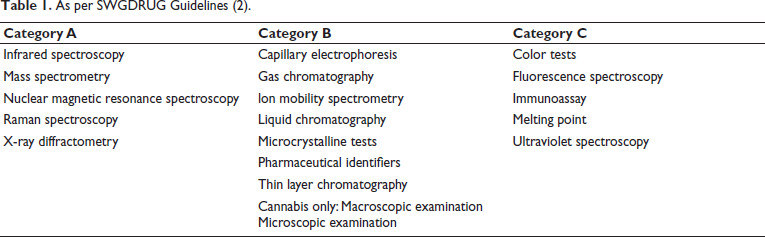
Hence, it has become obligatory to establish an exclusive narcotics division at each forensic science laboratory following the above-mentioned guidelines and criteria. To establish the credibility of the test report in a court of law and to comply with the infrastructure requirement, it has become incumbent to establish the necessary infrastructure facilities. The minimum criteria of analysis for reporting a drug/identifying a compound have been established by the Scientific Working Group for the Analysis of Seized Drugs (SWGDRUGS). 7 Further, the analytical protocols as well as procedures have been defined by the UNODC and the Directorate of Forensic Science Services (DFSS). These protocols emphasize the utilization of reliable and validated techniques such as gas chromatography–mass spectrometry (GC–MS), liquid chromatography–mass spectrometry (LC–MS), thin layer chromatography (TLC), and immunoassay-based screening methods to ensure confirmatory identification and quantification of narcotic and psychotropic substances (see Table 1).
As per SWGDRUG Guidelines (2).
It is noteworthy to mention here that, although the guidelines as well as procedures mentioned above are advisory. But such documents represent the globally recognized principles of quality and transparency. These documents are available in the public domain and released after enormous brainstorming and following the procedures. These advisories may be quoted in court of law, and in case of non-compliance, the entire credibility of the analysis as well as the laboratory, may be questioned. Further, since the quantum of punishment is very high in case of NDPS punishment, it becomes equally important ethically to maintain the highest standards of analysis and to comply with the relevant guidelines.
Policy Recommendations
It is a set principle that the pendency in forensic examination is inversely proportional to the availability of resources. Recently, across the country, Central Forensic Science Laboratories (CFSLs) and State Forensic Science Laboratories (SFSLs) have been engaged in the analysis of exhibits related to the NDPS Act, 1985. There are currently 32 SFSLs and 97 Regional Forensic Science Laboratories (RFSLs) functioning in the country under national forensic-infrastructure schemes. In addition to this network of state-owned FSL set-ups, there are seven CFSLs under the DFSS. It is significant to mention that, out of these multiple laboratory establishments across the country, only a few laboratories have an exclusive narcotics division—for example, the RFSL Thrissur in Kerala, State Forensic Sciences Laboratory, Jaipur where a dedicated narcotics division have been functioning since 2020. Therefore, to develop expertise and establish quality analytical facilities and to cultivate subject-matter competence in the field of NDPS analysis, it has become incumbent to increase the number of narcotics divisions. Further, it is equally important to expand the number of such specialized divisions to handle the surge in NDPS cases submitted to different forensic laboratories, especially given the high backlog/pendency of cases in some states. For example, in Kerala, the High Court flagged over 7,200 pending NDPS cases statewide, detailing the forensic infrastructure and staffing constraints. 8
According to data from the Government of India, the number of cases registered under the NDPS Act across India stood at 144,812 in 2022. 9 On average, approximately 3,000–5,000 cases of NDPS are received in a state per year for examination. 10 The present infrastructure is not suitable to deal with such a large quantum of cases. The outcome is an overloaded analytical system, either with the burden of pendency or forced to cut short the recommended methodology or guidelines. This ultimately result either a delayed analysis or a sub-standard/ compromised analysis. As is evident from the above-mentioned, the seizure of NDPS has increased exponentially in the previous year. The workload related to systematic analysis and reporting of the same has increased drastically. It is quite difficult to cope with the current scenario with the present infrastructure and available human resource whereby the examination report gets delayed.
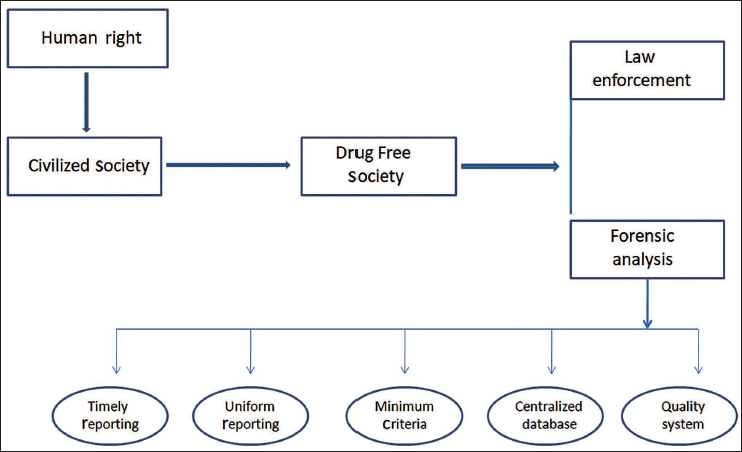
The interaction between human rights, law enforcement, and forensic drug analysis in establishing a drug-free and civilized society is depicted in Figure 1. It demonstrates how upholding human rights is the cornerstone of a civilized society, which helps to create a society free of drugs. By ensuring impartial investigations and evidence-based action against drug-related offenses, law enforcement and forensic analysis play a critical role in advancing this objective.
Integrated Reporting and Dissemination Approach.
It has become frequent that when an honorable court expresses displeasure about the prolonged delay in the forensic examination. This delay in reporting is directly proportional to the deficiency of resources and infrastructure. It has become incumbent to develop laboratory infrastructure to deal with increasing cases and timely reporting.
The credibility and authenticity of a test report are assessed during the court testimony. To withstand scrutiny during court testimony, it becomes very important to be precise, accurate, and decisive for a test report. The report must be drafted considering the pertinent legal provisions. It should include the information about the exhibit and the techniques used in analysis. Although the test reports are drafted considering the requirements of the court of law, the reporting pattern is not uniform across the country. This variation sometimes creates ambiguities that become helpful for the accused to deceive the legal system or delay the conviction. Therefore, the uniform reporting pattern is highly required for improved conviction rate.
The analysis of crime exhibits is a very crucial aspect, on which the entire judicial process is based, especially in the case of NDPS cases. Further, many national and international guidelines are available for the analysis and reporting of an unknown compound. Some of the laboratories dealing with the forensic examination of NDPS abide by the guidelines, but a few do not follow the same. But, for flawless and consistent reporting, it is obligatory to follow the standard protocols. Further, it is very important to select and apply suitable examination technique including the latest instrumentation. It is very important to decide the minimum criteria of analysis to streamline and harmonize the analytical standards at the national level.
There is no scarcity of statistics and databases related to the seizure and trafficking of controlled substances or drugs of abuse. But the issue is of data authenticity and its divergence from the real scenario. Further, the data analysis is a very crucial aspect to evaluate the facts of ground reality. Although many national agencies also publish the data of annual seizures categorically, to date, no real-time national data on such drugs is available. It is significant to mention that once the articles are seized, they are immediately sent to the forensic facility for examination, along with the details of the total seizure amount and other information. The details of cases accepted in different forensic laboratories across the country can be interlinked. This data can be easily organized using e-forensics (ICJS) and utilized to understand the real trends of seizures, regional variations, and related patterns. Availability of a centralized database shall not only be useful for the law enforcement agencies, but it will also assist us in deciding the need for different forensic laboratories, including infrastructure, manpower, and analytical facilities.
The implementation of a quality management system is highly important for ISO/IEC 17025 enables laboratories to demonstrate that they operate competently and generate valid results, thereby promoting confidence in their work both nationally and around the world. The accreditation necessitates compliance with the relevant global standards. This quality management system encompasses detailed guidelines to assess the procedures followed and the quality of analysis. These documents are composed of stepwise provisions, which are capable of evaluating the entire analytical system. Such laboratories deal with the testing of NDPS, and the outcome is rigorous imprisonment. Therefore, it becomes crucial to prove the independent and transparent testing protocol.
Ethical and Legal Considerations
The NDPS Act 11
The NDPS Act 1985 is a very comprehensive document designed to deal with the deadly global menace of drug abuse. This act comprises detailed provisions as well as pertinent procedures. Entire proceedings in the country related to NDPS are governed by this act only.
Seizure, Sampling, and Disposal Guideline 12
To streamline the entire procedure of sampling, sealing, and disposal of NDPS, the Ministry of Finance, Government of India, has issued a guideline. This guideline has been drafted with the objective to increase the transparency in the entire process related to NDPS.
Standing Orders of Central Bureau of Narcotics 13
The Central Bureau of Narcotics, Government of India, is the key organization authorized to regulate the purchase, transport, import-export, and many other aspects of the NDPS. The department has issued many standing orders in this regard, of which the Standing Order Nos. 87 and 88 are of pivotal importance.
Judgments of Honorable Courts 14
The matter related to the NDPS involves long-term rigorous imprisonment. Further, the trafficking of the same is a globally organized nexus, facilitated with resources. Therefore, the matter reaches the apex courts for a decision. The Indian judiciary has passed many remarkable judgments, which are milestones in the field of NDPS procedures and handling, for example: Union of India v. Bal Mukund and Ors., (2009) 12 SCC 161; State of Punjab v. Baldev Singh, (1999) 6 SCC 172; Noufal v. State of Kerala, B.A. No. 1897 of 2024 (Kerala HC, decided on 21 May 2024).
Standard Operating Procedure for Case Opening, Reporting, and Uploading of DFSS 15
In compliance with the judgments of the Honorable Court, recently in the year 2023, DFSS has released a detailed guideline related to the transparency in the process of forensic case examination.
Legal Admissibility of Forensic Reports Under Section 45 of the Indian Evidence Act 16
Under Section 45 of the Indian Evidence Act, 1872 and Bhartiya Sakshya Adhiniyam 2023 the opinions of experts in science or art are legally admissible as relevant evidence. Forensic reports thus gain evidentiary value when issued by qualified experts from accredited laboratories. However, such expert opinions are advisory, aiding the court in reaching conclusions, and must be supported by proper documentation and procedural compliance to be accepted.
Capacity Building and Training
Capacity building in forensic drug analysis is crucial to enhance analytical reliability, procedural compliance, and international cooperation. In India, several initiatives have been undertaken, such as specialized training programs by the National Forensic Sciences University (NFSU) for forensic professionals, law enforcement officers, and judicial personnel on NDPS procedures, forensic toxicology, and analytical instrumentation. 17 Similarly, the UNODC conducts regional and national workshops on drug control, precursor chemical identification, and forensic capacity enhancement under its Global SMART Program. 18 These initiatives collectively strengthen scientific capability, promote harmonized standards, and ensure effective implementation of NDPS-related forensic practices. In alignment with these, capacity building efforts such as systematic laboratory infrastructure assessment, advanced instrumentation setup, and continuous professional training are essential to ensure long-term sustainability and efficiency.
Infrastructural Development
Assessment of the required laboratory design as well as infrastructure should be the preliminary exercise required before the establishment of any forensic laboratory. Considering the expected case receiving, the nature of the analysis, and the establishment of the instrument facility, the laboratory should be designed. Further, it becomes very important in case of a laboratory establishment dealing with NDPS, to design the infrastructure considering the existing as well as possible upcoming relevant statutory guidelines. The infrastructure establishment should have a vision to deal with a workload of at least the next 10 years. The procedure for infrastructure requirement assessment can be adopted form following guidelines:
6.1.1 UNODC. Forensic services and infrastructure, criminal justice assessment toolkit: Policing (2010). 6.1.2 Chapter 5. Forensic analyses and examinations in a laboratory or medical facility, 21–23. 6.1.3. NABL. NABL 113 specific guidelines for accreditation of forensic science laboratories.
Workforce Development
Considering the increasing workload in the field, it has become very important to increase the number of manpower. Many trained and skilled students are generated by NFSU and other institutions. These students need to be trained and deployed in the field of NDPS examination.
Public Awareness Programs
Apart from the other institutional measures taken by the government, our country can only overcome this deadly cancer of drug abuse through awareness and moral education. We need to spread awareness about the drugs and their related effects. Further, the special program may be organized on occasions such as Drug Day to spread awareness.
International Cooperation
United Nations Conventions on NDPS
United Nations Convention 1961–about narcotic drugs
United Nations Convention 1971–about psychotropic substances
United Nations Convention 1981–about trafficking and abuse of drugs.
Participation in UNODC International Collaborative Exercise Program
The UNODC monitors the international activities related to drug trafficking and testing. The UNODC office organizes the exercise of proficiency testing, the International Collaborative Exercise, to assess the analytical capacity of laboratories.
Collaboration and Training of Candidates from Different Countries
International collaboration is required to train the candidates from different countries to understand the global pattern of trafficking and abuse.
Conclusion
The abuse of NDPS remains both a national and global concern, demanding a strategic, technology-driven, and legally defensible approach. This article concludes that India’s forensic response under the NDPS framework must transition from a reactive enforcement model to a scientifically standardized and systemically coordinated model. To this end, it is essential to upgrade forensic infrastructure, establish dedicated narcotics divisions, and adopt globally recognized analytical and quality standards. A critical element in strengthening NDPS-related forensic work is the implementation of a uniform reporting framework across all CFSLs and SFSLs. Currently, reporting formats and terminologies vary widely across laboratories, which can result in inconsistencies during judicial interpretation. Standardizing report structures—guided by UNODC Laboratory Guidelines, SWGDRUG recommendations, and DFSS model formats—will promote inter-laboratory comparability, transparency, and traceability of results. Uniform reports should include mandatory fields for sample provenance, analytical techniques used (e.g., GC–MS, LC–MS/MS, TLC, immunoassay), quality control measures, and measurement uncertainty estimates to enhance credibility and reproducibility.
Moreover, the integration of centralized forensic data management systems and digital case tracking can facilitate automated report generation, cross-verification, and data sharing among laboratories, enforcement agencies, and the judiciary. This will streamline reporting, minimize administrative delays, and strengthen judicial confidence in scientific findings. Sustained investment in capacity building, ethical training, and international collaboration—alongside uniform reporting and quality assurance frameworks—will significantly improve the credibility and efficiency of NDPS-related forensic investigations. Ultimately, adopting a harmonized reporting model aligned with global standards will not only enhance the evidentiary strength of forensic reports but also uphold judicial integrity and human rights within the criminal justice system.
Footnotes
Declaration of Conflicting Interests
The authors declared no potential conflicts of interest with respect to the research, authorship, and/or publication of this article.
Ethical Approval and Informed Consent
Not applicabe.
Funding
The authors received no financial support for the research, authorship, and/or publication of this article.
