




Abstract
The authors reported a case of a body packer death due to heroin leakage in the stomach from a leaked package. The body packer was trying to transport the drug by hiding it in his gastrointestinal (GI) tract. The body was recovered after 6–7 days of the incident. A total of 50 egg-shaped packages were found in the body: 48 similar egg-shaped packages were found in the stomach, out of which one was leaked, one egg-shaped package was in the jejunum and one egg-shaped package was in the descending colon. The total weight of 50 capsules was 468 g. Toxicological analysis of the powder samples from the damaged package and the other 49 packages was performed and found positive for diacetyl morphine (heroin), monoacetyl morphine, caffeine, dextromethorphan and acetyl codeine. This case shows the difficulties during examination of a narcotic deceased postmortem and the importance of the history of the victim before the autopsy, a proper postmortem examination, the findings of toxicological tests and forensic photography. The cause of death was ‘acute drug overdose due to rupture of filled capsule in stomach’, which makes this case special. It indicates that body packing is an existing problem in India.
Introduction
Body packing is one of the most important mechanisms of cross-border drug trafficking and it is associated with significant financial gains. This illegal activity is the concealment of illegal substances such as cocaine, heroin, hashish, amphetamines, ecstasy and others inside the digestive tract for the purpose of smuggling. Body packing was first reported in 1973.1, 2 Body packers, also known as mules, hide drugs in capsules, balloons, condoms, plastic bags or latex gloves in different parts of their body. These can include the mouth, rectum, gastrointestinal (GI) tract, ear, vagina or foreskin. 3
After swallowing drugs, laxatives or enemas are used to remove them from the body. A ‘body packer’ usually carries about one kilogram of drugs divided into small multiple packets weighing between eight and 10 grams each and measuring 2–8 centimetres. 4 Each packet contains a lethal amount of narcotic drugs.5–7 Customs officials find it challenging to identify suspects at airports or national borders.8–10
The appearance of intoxication, a person’s demeanour, their travel itinerary, their destination, any suspicious information regarding their trip or their contacts in the area might all raise suspicions. Interpol occasionally provides pertinent information before the arrival of a suspect. Suspicious circumstances need a physical examination, an enzyme immunoassay urine test and a subsequent abdominal X-ray. 8
The body packers are particularly vulnerable to packet rupture and subsequent toxicity. Additionally, GI blockage may develop and there have been reports of upper GI haemorrhage brought on by the packets’ prolonged pressure on the gastric mucosa. 11
In circumstances where the cause of death is unknown, forensic pathologists may find hidden drug packages during autopsies.8, 11
In the present article, a case of a heroin body packer is discussed whose decomposed body was found in a rented room in Lajpat Nagar, Delhi. Death was due to an acute drug overdose due to rupture of a filled capsule in the stomach, which was detected at autopsy. Autopsy revealed that the body packer was carrying 50 heroin packages in the gastro intestinal tract (GIT), out of which one packet had leaked.
Case Report
Autopsy Finding
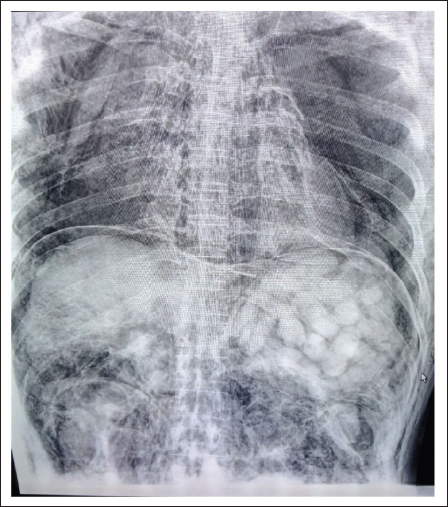
It was the dead body of an Afghan male aged about 33 years, which was found in a decomposed state in a rented room in Lajpat Nagar, Delhi. The body was examined by the authors. An X-ray of the abdomen was taken before autopsy due to a suspicious foreign body. In the abdominal X-ray, multiple egg-shaped packets were seen in the stomach (Figure 1 X-ray abdomen showing multiple egg-shaped packages). The body was emitting a foul smell. It was in an advanced stage of decomposition. No evidence of trauma was evident. There was marked congestion of cerebral vessels, but no intracranial haemorrhage. The brain’s transverse and coronal regions showed no abnormalities. The stomach contained about 800 grams of semi digested food material with 48 egg-shaped packages among that one egg-shaped package was leaked (Figure 2 stomach containing egg-shaped packages) with yellow paste like material comes out.
X-ray Abdomen Showing Multiple Egg-shaped Packages.
Stomach Containing Egg-shaped Packages.
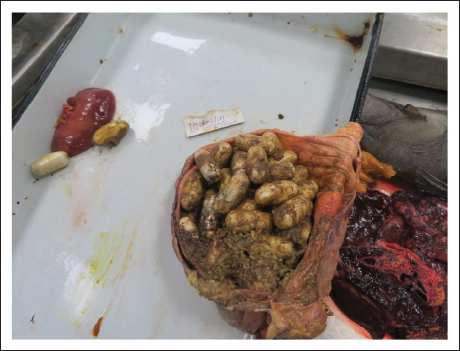
No ulceration was present, but the stomach mucosa was congested. The jejunum contained one intact egg-shaped package and the descending colon also contained one egg-shaped package. The mucosa of the duodenum was congested. There was no evidence of intestinal obstruction.
The lungs were oedematous and softened. Liver, spleen and kidney were found congested. So, from internal examination, it was evident that 48 egg-shaped packages were present in the stomach, out of which one egg-shaped package leaked, one egg-shaped package was in the jejunum and one egg-shaped package was in the descending colon.
Toxicological Findings
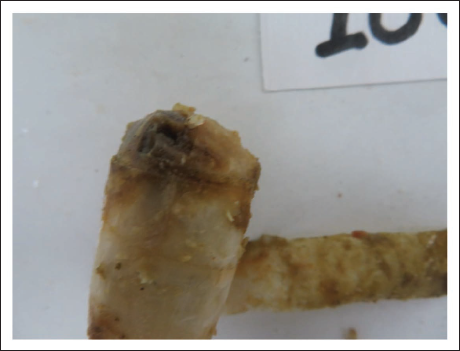
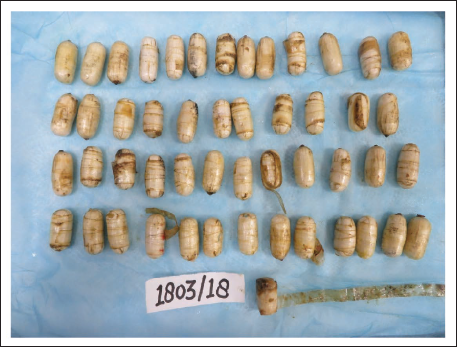
The net weight of all packets (numbered 1–50) was 468 grams, out of which one egg-shaped package was damaged, having an individual weight of eight grams (Figure 3: leaked egg-shaped package). The weight of a single intact egg-shaped package was about 8–10 grams. Packages 1–50 were white in colour and wrapped in multiple layers of cellophane tape (Figure 4: 50 egg-shaped packages). The size of each egg-shaped package was about 4 cm × 1.5 cm.
Leaked Egg-shaped Package.
Fifty Egg-shaped Packages.
Drugs were determined in packets and viscera samples using thin-layer chromatography (TLC) and gas chromatography coupled with gas chromatograph mass spectrometry (GC–MS). The (GC–MS system used-Agilent GC (6890N), an mass selective detection (MSD) (5977A) and an Hewlett-Packard (HP) ChemStation data analysis system, with injections performed using an auto sampler (7683 series).
In the TLC method, two developing solvent systems were used: System A, methanol–ammonia 100:1.5 v/v and system B, chloroform–methanol (9:1 v/v). Each suspected heroin sample (0.5 mg) was dissolved in one ml of methanol and centrifuged. The supernatant clear liquids were separated into clean vials. Five microliters of each sample was spotted on the TLC plates (precoated silica gel plates G 60 F, 20 × 10 cm, 0.2-mm thickness on aluminium from E-Merck). An ultraviolet lamp operating at lambda 254 nm and 366 nm (CAMAG, Switzerland) was used for the location of spots after development in a solvent system. Visualisation of separated spots was carried out after spraying with Dragendorff reagent, followed by acidified potassium iodoplatinate reagent.
Each packet contained diacetyl morphine (heroin), monoacetyl morphine, caffeine, dextromethorphan and acetyl codeine. Stomach, intestine, liver, spleen, kidney and blood contain diacetyl morphine (heroin), monoacetyl morphine, caffeine, dextromethorphan, acetyl codeine, codeine, morphine and fatty acid.
At the crime scene, police also found a yellow plastic bottle on which Mankind Kabz Churn was written and a bottle of lactulose solution.
Discussion
Body packing is more frequently linked to cocaine smuggling. Other drug instances, particularly those involving heroin, have also been documented. 12 A person who attempts to convey illegal substances from one nation to another by consuming condoms, balloons or wrapped bundles containing concentrated cocaine or heroin is known as a body packer or mule. Cathartics are self-administered and the packets are defecated out once they reach the destination. Rectal suppositories and single-use enemas are occasionally employed. Occasionally, the rupture of packets can cause significant poisoning. 13 Similarly, in our case, police found Mankind Kabz Churn and a lactulose bottle from the crime scene and a leakage of one egg-shaped package found from the stomach in the autopsy.
Our report agrees with the literature’s conclusions that a young adult, generally male, in his or her mid-thirties, coming from a nation that produces drugs, fits the ‘typical profile’ of a body packer.5, 14, 15 Similarly, in our case report, a 33-year-old Afghan male came from a foreign country one day ago in India. However, these days, youngsters, the elderly and even pregnant women are members of the network. 5
If a foreign national is found dead in a hotel, the entire digestive tract should be opened to look for intact or burst drug packets. The vagina, anus and anal canal should all be thoroughly inspected. 10 In our case report, a foreign national was found in a friend’s rented room.
Body packers are mostly identified by police, customs through suspicious behaviour. Typically, they are travellers who avoid eating or drinking anything on the plane, skip using the toilet and keep almost completely quiet the entire time.16, 17 Body stuffers typically succeed in passing the eaten packets with the aid of laxatives or enemas, but occasionally it is unsuccessful. Despite the fact that most body packers have no symptoms. 17 medical help is needed if the packages are not passed out or if intoxication occurs due to rupture of the packet inside the body.
In most cases of body packers, packets were found in the stomach. Large foreign bodies may encounter a meaningful barrier in the pylorus. Localised deposits may also be caused by anticholinergic overuse and intestinal paralysis brought on by excessive cocaine and heroin intoxication. The packages may be broken by mechanical movement or chemical digestion of the covering of the packets when they are inside the stomach. 3 In our case, we also found a total of 50 egg-shaped packets, out of which 48 packets were present in the stomach, in one packet had leaked into the stomach.
Ten fatalities and one survivor of attempts to transport cocaine inside the body were investigated by Wetli CV and Mittlemann RE. All the victims had recently taken flights from South America back to the United States. Eight victims had ingested balloons, condoms or plastic bags containing 3–6 g of cocaine, which were later discovered in their GI tracts. They recommended that the body packer condition should be in mind while doing a postmortem of a traveller who passes away unexpectedly, experiences seizures or exhibits any symptoms typical of cocaine toxicity. 18 In our case weight of the intact egg-shaped packet was 10 grams and similar to above above-cited case toxicological finding shows diacetyl morphine (heroin), monoacetyl morphine, caffeine, dextromethorphan and acetyl codeine in each packet.
In November 2000, Barnett JM and Codd G found a dead body associated with a cannabis body packer case. Two days before his passing, the deceased had travelled to northern India. He had 55 cellophane-wrapped bags of cannabis resin discovered after his death in the large intestine. A subsequent police investigation of the apartment turned up the presence of an additional 133 similar parcels in the fridge, indicating that he may have concealed a total of 188 items. The distal large intestine was perforated due to consuming the packages, which led to peritonitis, which was listed as the cause of death. 19 Similarly, in our case, packets were wrapped in cellophane as mentioned in the above case.
Since not all body packers have been captured and only some of them show body packer syndrome signs, it is impossible to confirm the precise number of body packers. A thorough autopsy of a person suspected of being a body packer may disclose detailed information regarding the packaging techniques, precise quantity of packets, type of illicit drug delivered and placement of the packets in the body.
Conclusion
This article describes the body packer death due to accidental drug overdose in Delhi. Autopsy and toxicological analysis revealed 50 heroin-filled packets inside the deceased’s GI tract, with one ruptured packet in the stomach, causing an acute drug overdose. This case highlights the ongoing issue of body packing in India and underscores the importance of thorough forensic examination in such cases.
Footnotes
Declaration of Conflicting Interests
The authors declared no potential conflicts of interest with respect to the research, authorship and/or publication of this article.
Ethical Approval
Not required.
Funding
The authors received no financial support for the research, authorship and/or publication of this article.
Informed Consent
Informed consent was obtained from the relative of the deceased.
