




Abstract
Firearms are dangerous weapons and are often used to commit homicides as well as suicides. Every case of a firearm is unique, and its wound pattern provides insights into the type of weapon used, range of firing and direction of shot. The demise of a 25-year-old male police constable during his duty hours under suspicious circumstances raised the question of whether it was a homicide or suicide. The most important findings were the signature imprint created by the flash suppressor around the entry wound resembling a flower petal pattern, and the trigger position of the right-hand index finger. Injuries produced by flash suppressors are less reported in the literature, so forensic experts should be aware of these patterns of firearm wounds, as they can even mimic multiple entry wounds.
Introduction
Firearms are dangerous weapons, and fatalities resulting from firearms have increased recently. Each case of a firearm is unique, and the pattern and characteristics of the wound greatly describe the type of weapon used and the direction and range of the firing. Flash suppressors are devices that are affixed to the muzzle end of the firearm, and they are a modification of the firearm. 1 Nowadays, flash suppressors are part of the weaponry attached to almost all modern rifles and many civilian rifles as well. The pattern of the wound produced by a flash suppressor gives a characteristic pattern around the entry wound, which marks the signature of the weapon. When a firearm attached to a flash suppressor is fired, the fire and gases that escape from the muzzle end get expelled through the slits or rows of vents situated in the flash suppressor in specific directions. 1 This will produce a peculiar petal-like pattern of burning and singeing around the wound of entry. The number of petals that are produced on the flower pattern depends upon the number of slits present in the flash suppressor, providing clues about the specific firearm used. Also, this burn and searing pattern gives an idea regarding the range of firing as well as the direction of firing.2, 3 However, determining the manner of death in firearm cases presents a significant challenge, requiring thorough evaluation and analysis by forensic experts. 4 This is a rarely documented case of suicidal death by firearm involving a flash suppressor. It has produced a characteristic pattern around the wound of entry, which left the signature of the weapon. Also, the positioning of the trigger finger provided further insight into the manner of the death.
Case Report
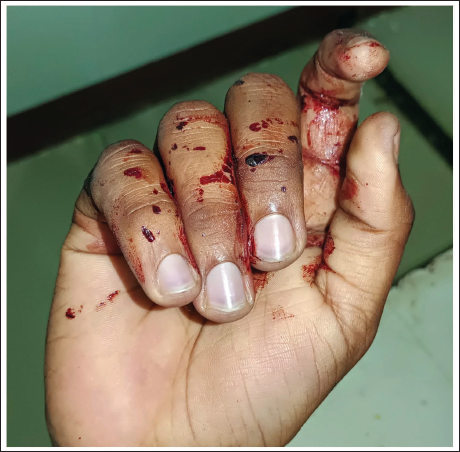
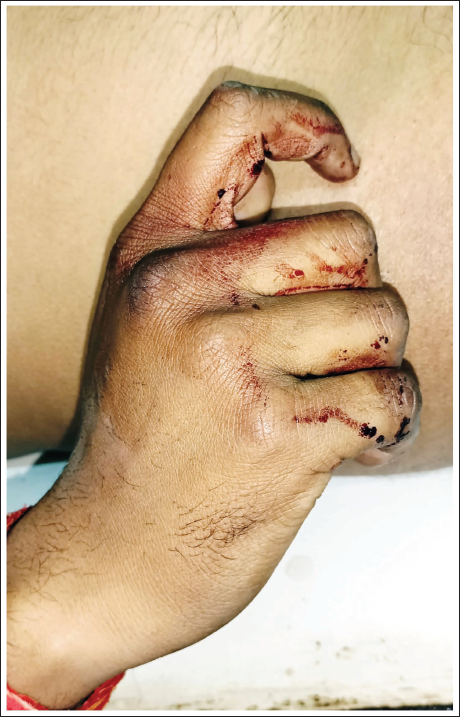
The dead body of a 25-year-old male was brought for medico-legal autopsy to the KGMU mortuary. According to the inquest report, the deceased was a Provincial Armed Constabulary (PAC) Jawan who was found dead lying in a significant pool of blood in the rear seat of a car. He was found in a sitting position. His service rifle, the INSAS 5.56 mm, was recovered from his body in a half-holding position from his hand. This happened during his duty hours, which raised a suspicion of whether the incident was a suicide or homicide. An X-ray of the entire body confirmed that there was no lodged bullet inside. At autopsy, dried blood stains were present around the mouth, nostrils, and both ears. Dried blood stains were present over his right hand (Figure 1), and his right index finger was in trigger position (Figure 2).
Dried Blood Stains Present Over the Right Hand.
Right Hand Showing the Index Finger in Trigger Position, Consistent with Self-inflicted Firearm Injury.
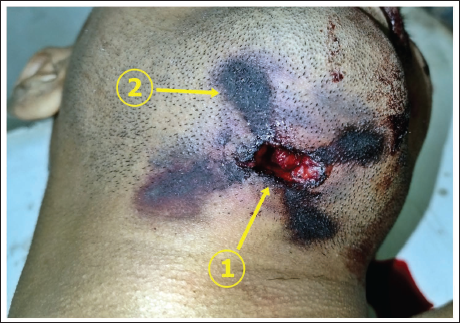
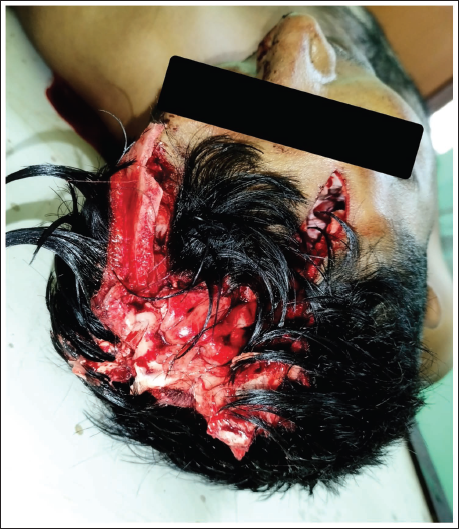
On external examination, a firearm entry wound 2 cm × 1.5 cm × cavity deep was noted at the submental region, 4 cm below the chin, oval-shaped, with inverted and irregular margins. Around the entry wound, four dermo-epidermal burn marks measuring 4 cm × 1 cm were seen resembling flower petals (Figure 3), which were symmetric and had soot deposition over them. Blackening and abrasion of the collar were present around the entry wound. A firearm exit wound of 14 cm × 10 cm is present on top of the head, extending to the forehead (Figure 4) with irregular, everted, and reddish margins.
Firearm Entry Wound Located Below the Chin (Marked as 1), Surrounded by Four Petal-shaped Burn Marks Caused by the Hot Gases from the Flash Suppressor (Marked as 2), Characteristic of Close-range Discharge.
Firearm Exit Wound Over Forehead and Vertex, Measuring Approximately of Size 14 cm × 10 cm Extending into Skull Cavity Deep.
Discussion
Firearm injuries create patterns of wounds that vary from case to case. The pattern of wounds produced by flash suppressors is particularly unique and characteristic. It consists of a cylinder in which there are multiple longitudinal slits running lengthwise or rows of openings or vents. 5 On firing, the fire and gases emerging from the muzzle end of the weapon will create a distinctive pattern of burning and fouling around the entrance wound that will leave the signature of the weapon. The number of slits in the flash suppressor will decide the number of ‘petals’ in the flower around the entry wound and may give one an idea of the type of flash suppressor and model of the weapon used. 6 There are different varieties of flash suppressors, such as cone-shaped and basket-type with several slits, etc., which may vary according to manufacturers and models of firearms. 7
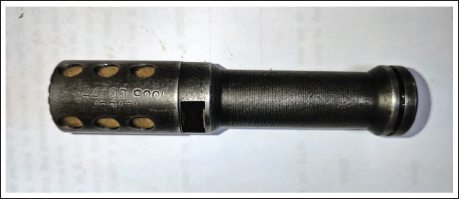
The INSAS 5.56mm rifle in this case has a flash suppressor with rows of slits over four sides. Each row has three circular openings (Figure 5). This has created a characteristic four-petal, flower-like searing and blackening of skin around the entry wound in this case. Because all petals were almost symmetric with similar size, this also confirms that the barrel was perpendicular to the body. The range of firing must have been contact or near contact one. 3
Flash Suppressor of the INSAS 5.56 mm Rifle, Showing Four Rows of Slits, as Observed in the Present Case.
In firearm deaths, another challenge is determining the manner of death. It is not always straightforward. The presence of a trigger finger (the finger resting on or near the trigger at the time of death), along with blood splashes on the hands, is important. If the weapon is firmly grasped in the victim’s hand due to the instantaneous rigor effect (the immediate stiffening of muscles after death), it strongly suggests suicide.2–4 In this case, the trigger finger position of the index finger with the weapon naturally gripped in the right hand, along with the bloodstain over the right hand, points toward suicide, making staged weapon placement unlikely. This confirms the manner of death as well.
Tatiya et al. reported a firearm case of patterned injury due to a flash suppressor in which there were three oval-shaped dermo-epidermal burns present around the entry wound, and they concluded that this pattern of searing and blackening was produced with a flash suppressor SLR rifle that had three symmetrical slits. 6
Naik SK et al. reported a case report of medico-legal aspects of atypical firearm injuries in which a 20-year-old man was injured by a G3 infantry rifle during his military duty hours. The flash suppressor of the same produced an atypical firearm entry wound with six irregular skin burn wounds around the entry wound, which emphasizes entry wound needs to be examined with caution. 8
Koutsaftis S et al. reported a case from Greece that detailed the unusual suicide of a 29-year-old man who used a military-issued G3 automatic rifle. Forensic examination revealed a distinctive injury pattern around the gunshot wound, characterized by soot deposits and seared skin. These marks were arranged in a flower-like configuration, attributed to the close-range discharge of the rifle with a flash suppressor. The burn patterns were consistent with gas and soot expelled through the device’s slits, reinforcing the role of muzzle attachments in altering wound morphology. This case highlights the importance of recognizing atypical features in contact firearm injuries during forensic investigations. 9
Conclusion
The injuries created by the flash suppressor are characteristic “flower petal patterns” that leave the signature of the weapon. We should deal with every case of firearms as unique. Injuries produced by flash suppressors are less reported in the literature, so forensic experts should be aware of these patterns of firearm wounds, as they can even mimic multiple entry wounds.
These unusual features can be misinterpreted in court as evidence of deliberate close-range firing, use of an unusual weapon, or even fabrication of injuries. Such misinterpretations may mislead the judicial process if the forensic basis of these patterns is not properly explained. Hence, awareness of the characteristic effects of flash suppressors is crucial for accurate medico-legal evaluation and testimony.
In the courtroom, such findings serve as objective, scientifically grounded evidence, strengthening the expert’s testimony regarding weapon characteristics and firing distance. When the weapon is fired at close range, these dispersed hot gases may produce a patterned burn around the entry wound, which can mimic tattooing or stippling but is distinguished by its regular, petal-like configuration. These patterns serve as important diagnostic aids in forensic examination, but they are not the sole determinants of the manner of death.
Footnotes
Declaration of Conflict of Interests
The authors declared no potential conflicts of interest with respect to the research, authorship, and/or publication of this article.
Ethical Approval
Not required for case reports as per institutional policy.
Funding
The authors received no financial support for the research, authorship, and/or publication of this article.
Patient Consent
Patient anonymity maintained, consent for publication obtained from next of kin.
