




Abstract
Forensic autopsy is of great importance in various processes of the criminal justice system. The death of a person may be natural or unnatural, and autopsy findings have considerable bearing on the legal implications. Trauma resulting from accidents, assaults, and violent asphyxia fatalities is the primary cause of unnatural deaths in India. This was a prospective descriptive study aimed to analyze the epidemiologic profile of medico-legal autopsies (n = 1510) conducted at a Government Royapettah Hospital, Chennai, during the year 2024. Natural death was seen in 51.58% (n = 779) of cases, with the respiratory system (36.8%) and cardiovascular system (34.7%) involved in most of these cases. Male predominance was observed, and most cases belonged to the age group between 41 and 50 years (n = 587), followed by 31–40 years (n = 291). Among unnatural deaths (n = 731), asphyxia deaths formed the bulk of cases, with 346 cases of hanging and 74 cases of drowning. Other major contributors were road traffic accidents (n = 139), followed by falls from height (n = 41), poisoning (n = 39), and electrocution (n = 27). Deaths due to assault, mechanical injuries, and snakebites formed the rest. The results reflected the prevailing mortality pattern in the region. Respiratory and cardiovascular causes formed the bulk of natural deaths. Among the unnatural deaths, a high frequency was noticed in young married males, attributable to various social stressors, family responsibilities, and work conditions. Such deaths could have been prevented or minimized by creating safety awareness and hazard alertness among the population at risk.
Introduction
An autopsy is performed to find out whether the cause of death was natural or unnatural and, if unnatural, whether it was homicidal, suicidal, or accidental. In medico-legal autopsies, often the clinical history is absent, sketchy, doubtful, or misleading. If an autopsy is not done, the exact cause of death, the presence and extent of injury or disease, and whether there was any pain and suffering become mere speculations. 1 Autopsy also serves as an important epidemiologic tool to identify potential disease outbreaks and establish risk factors for specific infections. Autopsy findings have served to elucidate the pathogenesis of diseases and to establish the manner of causation of injuries. 2
Profiling medico-legal autopsies is a vital cog in the fields of public health and forensic medicine, going beyond just recording details of previous incidents to actively averting further casualties. Though the main purpose is to determine the cause of death, it also helps interpret and relate the facts and circumstances surrounding the death, recover and preserve evidence, reconstruct the manner of injuries, provide accurate medical findings, and assist in addressing the medico-legal aspects of public safety, public health, and criminal court proceedings. 3
WHO’s Global Health Estimates (GHE) provide the latest available data on causes of death and disability globally, by region and country. The world’s biggest killer is ischemic heart disease, responsible for 13% of the world’s total deaths. Since 2000, the largest increase in deaths has been for this disease, rising by 2.7 million to 9.0 million deaths in 2021. Lower respiratory infection ranked as the fifth leading cause of death in 2021. 4 Road traffic accidents (RTAs) cause most of the casualties in India, especially among young people. According to the Ministry of Road Transport and Highways (MoRTH), 168,491 persons died in road accidents in India in the year 2022, and Chennai city recorded 499 fatal accidents, which resulted in 504 deaths in 2023. 5
Different people respond differently to stressful situations, and the responses are determined by genetics, past experiences, personality, social support, access to resources, and cultural background. Life pressures that can overwhelm a person include illness or injury, work pressures or job loss, harassment and traumatic events, financial crises, and family or relationship issues. 6 Suicide by hanging happens to be a top cause of death among youth. As per NCRB data, 1.71 lakh suicide deaths were recorded in the year 2022, indicating an increase of 4.2% over 2021. 7 Not much has been narrated in forensic literature about recent patterns or trends of unnatural deaths in our region. This profiling study enhances the comprehensiveness of mortality statistics by providing important details regarding the cause, age group at risk, manner, and nature of deaths. Monitoring the yearly number and pattern of deaths helps to address the causal factors and adapt health systems to react effectively, triggering responses from multiple sectors.
Aims and Objectives
To establish the demographic profile of autopsied cases in terms of age, gender, manner, and cause of death for a one-year period.
To assess the pattern of deaths and their distribution based on the main system involved.
Materials and Methods
The present study was an analysis of all medico-legal autopsies conducted at the mortuary of Royapettah Government Hospital in Chennai, during the period of one year, from January 1st, 2024, to December 31st, 2024.
Study Design: Descriptive & Prospective.
Ethical clearance was obtained from the Institutional Ethics Committee. (No. 813/2023/1EC/ACSMCH, dated April 10, 2023).
About 1,510 cases, which fulfilled our criteria of selection of study cases among the total 1,527 autopsied in the study period, formed the study material. All the cases were evaluated in detail with a medico-legal perspective on various parameters.
Inclusion Criteria
All cases autopsied at the mortuary in the study period of the year 2024, with the required demographic data retrievable. cause of death ascertainable.
Exclusion Criteria
All dismembered bodies or mutilated or skeletonized bodies.
Highly decomposed bodies.
Unknown bodies with vague history.
Procedure of Data Collection
Preliminary data were collected from the history of the case, and the medico-legal documents, such as the inquest form, first information report, accident register, death report, hospital records/clinical data. Relevant information required for the study was also collected from the investigating police personnel and bystanders of the deceased. The focus of this study was to determine the number and pattern of deaths, their causes, and their distribution age-wise and gender-wise. The type of injuries or pathological lesions, on external/internal organs, if any, their location, size, and number would be noted during autopsy. Based on the history and findings of the autopsy, the cause of death would be determined. Finer details like injury type, the manner of death, and the main organ/system involved (head, neck, thorax and abdomen, and extremities) contributing to the fatality would also be noted in a proforma prepared for the study purpose.
The data was entered in Excel sheets, and statistical analysis was done using IBM SPSS Statistics software version 28.0 to determine the mean, frequency and proportion so that they can be compared with other studies. Cases studied were broadly classified into natural and unnatural deaths, and their individual causes of death were noted down to correlate with the respective case findings.
Observations and Results
Among the study sample of 1,510 autopsies performed during a one-year duration (2024), natural death was observed in 779 (51.58%) of cases, with the respiratory system (36.8%) accounting for the greatest number of these cases. The data is presented in tables as follows.
Table 1 shows the involvement of natural deaths (n = 779), of which 552 (36.5%) belonged to the male category and 15% of cases to the female gender. Among unnatural deaths (n = 731), 595 cases (39.4%) were accounted for by men, indicating the male predominance.
Broad Categorization of Cases According to the Nature of Deaths.

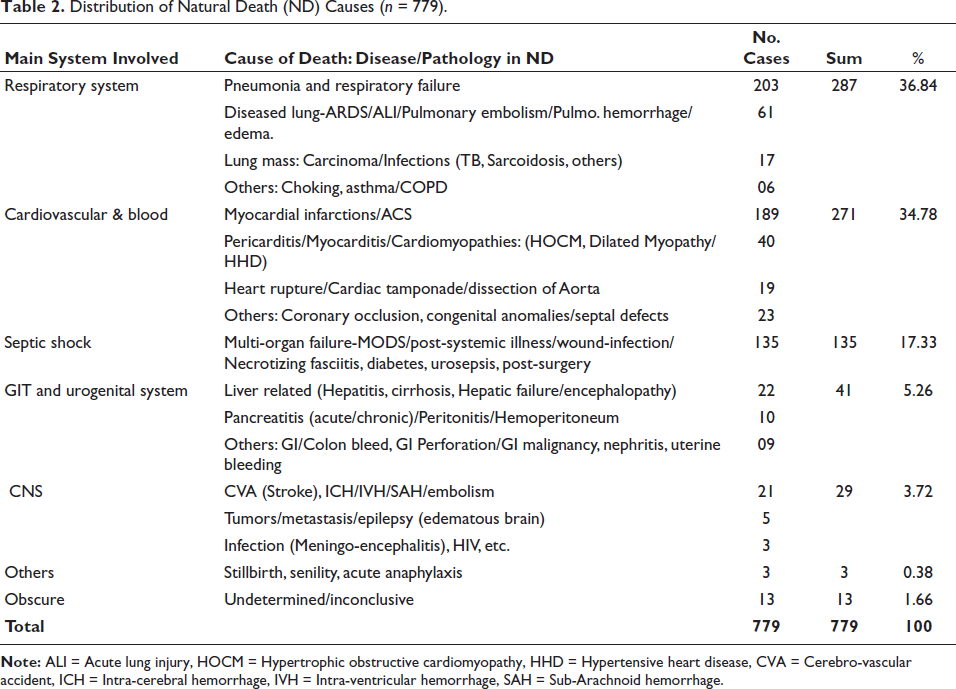
Table 2 comprehensively shows the system primarily involved in natural deaths. Most cases had involved either the respiratory and cardiovascular systems or both, accounting for almost 70% of the natural deaths. The multi-organ failure was the reason in 17% of cases, and 13 cases remained undetermined as obscure autopsies.
Distribution of Natural Death (ND) Causes (n = 779).
Male subjects constituted 75.9% of cases overall, with a male-to-female ratio of 3.25:1. Table 3 shows that the maximum number of cases belonged to the age group of 4th and 5th decades of life. From the study sample, 587 cases were from the age group 41 to 50 years, followed by 31–40 years (291 cases), and males have always outnumbered the females across all age groups.
Distribution of Cases According to Age and Gender (n = 1510).
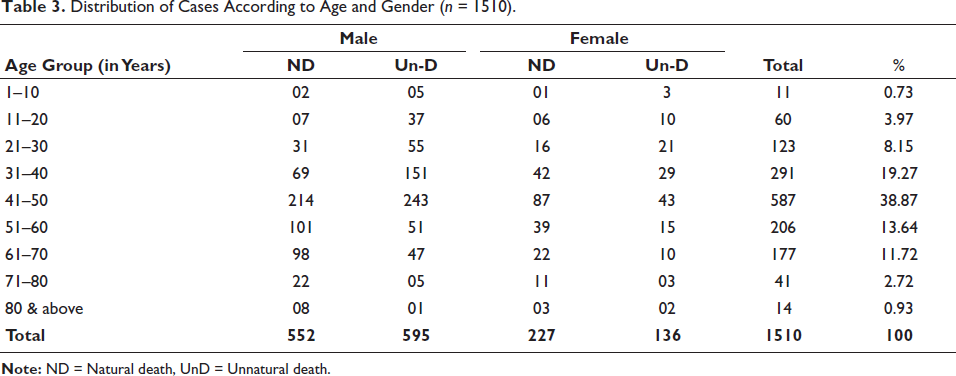
Table 4 shows that asphyxia-related deaths (48%) accounted for maximum deaths, followed by RTAs (19.2%), falls from height (5.6%), and poisoning (5.4%).
Distribution of Unnatural Death Cases (n = 731).
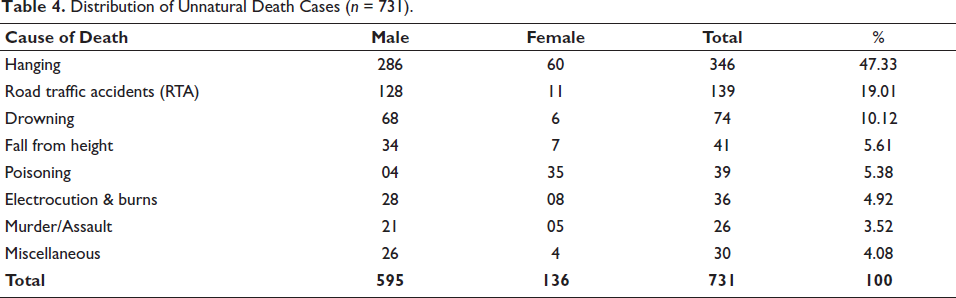
Table 5 shows there were only 10 cases (0.71%) from railway injuries, followed by mechanical asphyxia (n = 5, 0.35%), and only two cases of snake bite and firearm injuries each that were autopsied.
Distribution of Miscellaneous Cases (n = 30).
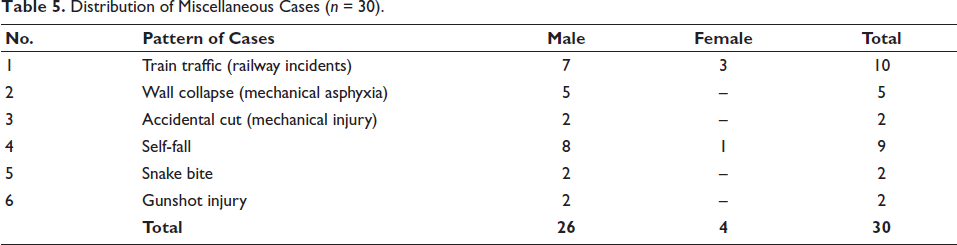
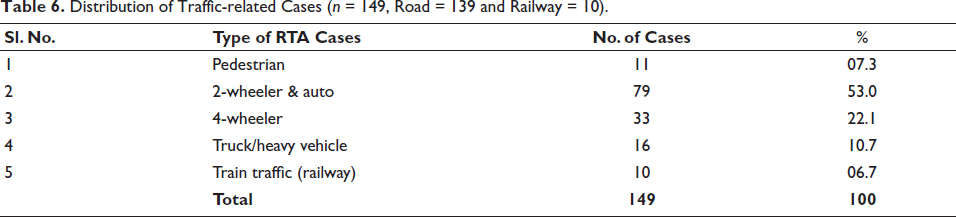
Table 6 showed that the number of traffic-related deaths was 149 (9.8%) of the study sample, and two-wheelers were involved in over 50% of cases of RTA, while four-wheelers were responsible for over 22% of fatalities.
Distribution of Traffic-related Cases (n = 149, Road = 139 and Railway = 10).
Discussion
City of Chennai, often called the “Detroit of India,” is a major industrial hub in India, especially for the automotive industry. It is also known for its software exports, medical tourism, textiles and apparel, petrochemicals, and hardware manufacturing. Thus, it has led to rapid urbanization and migration of workers into the city. Chennai is the third most densely populated city in India, with 26,903 people per square kilometer, 8 which could be one of the reasons behind a high all-cause mortality rate in the region.
In the present study, natural deaths (n = 779) outnumbered unnatural deaths (n = 731). Among the cardiac causes, coronary artery disease/myocardial infarction was the most common cause, while pneumonia and other chest infections were predominantly observed among the respiratory causes. Among the gastrointestinal (GIT) causes, both acute & chronic liver diseases were reported in most cases, followed by pancreatitis and peritonitis. These findings suggest that GIT conditions should be taken seriously, though the patient might look alright and stable. This study contrasted with a study by Patel JB et al., 9 which showed the natural type of death in only 21.65% of cases, with predominance of respiratory system-related deaths.
In the present study, the maximum number of cases was males (75.9%) as compared to females (24.1%). Similar findings were reported by Sundarm et al. 10 and Dayanand et al. 11 This was attributed to the fact that males are more involved in outdoor activities and ambulatory compared to females, which makes them more vulnerable to accidents or injuries. Most cases in our study belonged to the age group of 41–50 years (n = 587) in both genders, followed by the age group of 31–40 years (n = 291). This finding was in slight contrast with a study by Patel et al., 9 which had the maximum number of cases (615, 28.3%) in the age group of 21–30 years, and injury-related deaths were more in number (989, 45.6%). However, a few studies11, 12 differed claiming that many deceased individuals were in their 3rd decade, followed by their 4th decade.
Table 4 shows the magnitude of both natural and unnatural causes of death, inclusive of the various causes and nature of deaths. Regarding the primary cause among natural deaths, most cases belonged to respiratory causes (36.8%) and the cardiovascular system (34.7%), followed by multi-organ failure (17%) in our study. This finding was consistent with a study by Rahul Agarwal et al. 13 in which cardiac and lung pathologies were the major causes, followed by intracranial hemorrhages. People in middle age groups are more exposed to environmental factors because they must go to work for a living, travel, and participate more in sports and outdoor activities.
Regarding causes of unnatural deaths, the maximum number was contributed by hanging (n = 346), trauma in RTAs (n = 139), and drowning (n = 74). Poisoning cases (n = 39), burns including electrocution (n = 36), and train traffic accidents (n = 10) were the other events leading to deaths. The hanging cases proportion was around 10%–12% of the cases in some studies.13, 14 But a study. by Biradar G et al. 15 revealed a higher prevalence of hanging, with 39% of the cases found among the persons aged 31–40 years, and male dominance was observed at 66%. This can be attributed to the observation that female victims tended to suffer from somatic or mental illnesses, whereas male victims were more likely to have financial stresses or experience marital problems. In addition to chronic alcoholism, chronic illness also acts as a major risk factor for suicide in the middle-aged group.
Our study differed from a study from Jaipur, 16 which reported that 47.24% of the autopsy cases in the year 2021 were related to RTAs. Among them, 85% of cases were male victims, and most of them were between 21 and 40 years of age. Almost 25% of them were brought dead when they arrived at the emergency department within 6 hours of the event. Our study found that two-wheelers accounted for more than 50% of cases, while four-wheelers contributed to about 22% of road fatalities. This finding was in accordance with Saini et al. 16 and Sahu et al. 17 The deaths due to RTAs were 82 (52.5%), followed by natural death with 27 cases (17.3%) in their study. But our study contrasted with the study by Pati et al., 18 which attributed only 13.1% of deaths to RTAs in Brahmapur, and 75% of them had died of head injuries.
Drowning is the third leading cause of unintentional injury death worldwide, claiming about 236,000 lives each year. Drowning cases (10.2%) in this study, too, kept third place in the table of unnatural deaths, which has been reflected in many studies in South India. But a study in Jammu 19 found a greater number of drowning cases in lakes/rivers (n = 60), 24 in house tanks, than in wells and swimming pools (n = 12 and 4). Drowning was more frequently observed in men than women, except for suicide, where there is not much of a difference between genders. India is a vast country having plenty of water bodies like rivers, ponds, lakes, wells, house tanks, septic tanks, swimming pools, etc. Proper fencing of pools and the use of life jackets can prevent drowning during water activities, especially boating and swimming. It is noteworthy that, in a study by Patel JB 9 thermal injuries accounted for 12.5% of cases, followed by poisoning (8.5%), which contrasts with our study, where both burns and poisoning accounted for about 5% of cases each. Only two cases of death from gunshot injuries and snake bites were brought for autopsy.
In the present study, 39 cases (5.38%) of poisoning were found, and most of them had consumed pesticides and rodenticide poisons, which are common household poisons. This finding matches the study of Goswami et al. 20 who found that organophosphates (OP) were the main compound found in 151 (61.9%) fatal cases, followed by carbamate in 45 (18.4%) cases. But a few studies in India have shown a prevalence of 10%–15% of fatal poisoning cases among the overall autopsies. Gunjan NK et al. 21 in Delhi identified that most patients died within 2 hours of poison consumption (60.31%); only 6% survived for more than 24 hours. Most cases were suicidal (77.7%), and organophosphorus (54.76%), aluminum phosphide (28.57%), and alcohol (8.73%) were the common poisons noted in chemical analysis reports. Pesticides are the leading cause of poisoning in India due to factors such as an agriculture-based economy, poverty, unsafe practices, illiteracy, and ignorance. They are frequently utilized as suicide tools owing to their easy accessibility, affordability, and deadly properties. Less than 2% of cases (n = 26, 1.72%) were homicidal in nature in our study, which aligns with a study in Ambala (n = 18, 2.24%) by Mann GR. 22 This indicated a relatively lower murder rate in these regions when compared to the study in Nellore, Andhra Pradesh, 23 which had 39 homicides (4.32%) among the 902 cases autopsied in 2019.
Conclusion
Profiling of the autopsies plays an important role in assembling mortality-related statistics, which bear social and legal implications. An autopsy surgeon is expected to be aware of the pattern and quantum of regional medico-legal cases and deaths, as he needs the skill and knowledge to differentiate between natural deaths and unnatural fatalities. This research tried to analyze the various types of medico-legal autopsy cases that occur in a region of Chennai city. Accidental deaths, followed by suicidal deaths, have become the primary causes of mortality among today’s adolescents and youth. Natural deaths continue to be the leading cause in the middle-aged and elderly populations. In the present study, lung infections and coronary syndromes were identified as the two major contributors to natural deaths, while hanging and RTAs were the leading causes among unnatural fatalities. It is regrettable to observe that a high number of fatalities were caused by RTAs and in the form of suicides, which were largely and practically preventable deaths.
Hanging, drowning, and poisoning should be considered major public health problems in India. Awareness programs about the risk factors of accidents and suicides, and strict enforcement of law and order, will help in reducing unnatural death rates. Employing evidence-based strategies like restricting access to lethal methods and recognizing depression, both at the individual level and the population level, should be the main emphasis of suicide prevention. Our study findings offer insights to policymakers and administrative authorities, prompting them to examine the specific elements of these cases and implement measures that benefit the community and the public at large.
Footnotes
Declaration of Conflicting Interests
The authors declared no potential conflicts of interest with respect to the research, authorship, and/or publication of this article.
Ethical Approval and Informed Consent
The study had obtained an approval from the Institutional Ethics Committee (No.813/2023/IEC/ACSMCH, dated 10/04/2023) and faced no issues with informed consent.
Funding
The authors received no financial support for the research, authorship, and/or publication of this article.
