




Abstract
Forensic ballistics involves the examination of firearms and related evidence and their interpretation for judicial procedures. When reconstructing a crime scene, forensic ballistics can help determine the shooter, the weapon used, the range, and the approximate time of the incident. In spite of its contemporary literary connotations, forensic ballistics has been practiced for decades. Black powder and gunpowder predate forensic ballistics. Forensic ballistics is a combination of various scientific disciplines such as physics, mathematics, statistics, computers, photography, forensics, and medico-legal. This is a unique and practical field that is used in the scientific and judicial investigation of offenses related to weaponry. Its contributions to legal and medico-legal studies are widely recognized. Although there is a wealth of information available about the development of forensic ballistics worldwide, there is a dearth of information and substantial gaps in the literature. To describe the development and dissemination of forensic ballistics throughout India, this review study consults outdated but useful literature. This review may be helpful to criminal investigators, prosecutors, and anyone interested in comprehending firearm evidence and legal investigation, since forensic ballistics is of importance to the legal, social, and scientific sectors. Researchers and students who are interested in the subject can learn more about the development and dissemination of forensic ballistics in India from this review.
Keywords
Introduction
Justice is as old as civilized society, and crime is as old as humanity. To help the judicial system fully illuminate a crime scene, forensic experts systematically collect and examine the visible evidence. To determine if a crime is true or not, forensic science is essential to legal investigations since it manages and retrieves evidence from crime scenes using the right scientific methods. Consequently, it would be true to state that the use of forensic science has changed the general public’s trust in the criminal justice system. One of the many subfields of forensic science is forensic ballistics. It relates to using the principles of physics and ballistics to aid legal matters. The term “ballistics” originates from the Greek word “ballista,” also known as “ballein” or “ballo,” which described a type of ancient military siege engine used to launch stones. Ballistics understands the laws that apply to all projectiles, regardless of their type. Ballistics is the study of projectile behavior in relation to weapons, including in the air, inside a gun, and at the moment of contact. Physics and ballistics are closely related scientific disciplines since ballistics is a naturally occurring subset of engineering physics. Ballisticians design and develop new kinds of weaponry using a multidisciplinary approach and physics principles. Applying knowledge of firearms, ammo, and bullets to legal matters is known as forensic ballistics. 1
Forensic ballistics combines two meanings to provide the judicial system with practical knowledge. 2 The Oxford Advanced Learner’s Dictionary defines the terms “forensic” and “ballistics” respectively as “the scientific study of things that are shot or fired through the air, such as bullets and missiles,” and “connected with the scientific tests used by the police when trying to solve a crime.”
The word “firearms forensic examination,” a 20th-century scientific term, was utilized early on in both Europe and the United States as well. Still, based on technical considerations, “forensic ballistics” has gained more traction. 3 Ballistics research is still undervalued since non-specialists prefer to enjoy and use firearms in the ways they are familiar with, blissfully ignorant of the specifics. However, those who are interested, particularly academics, may find it incredibly intriguing to learn about firearms’ development, operation, and forensics. People of different academic levels have studied ballistics and its history for centuries. Literature advocates that medieval China developed guns first. The Chinese blacksmiths then constructed a tube robust enough to withstand explosions caused by gunpowder. Early constructed guns used a ramrod-powered muzzle-loading method to operate. Weapons technology’s rapid and progressive growth reached a turning point in the 19th century. By creating a far better ignition system known as the percussion cap in 1807, Alexander John Forsyth (1768–1843) eliminated the drawbacks of the flintlock mechanism. The change from flintlocks to percussion cap guns in armament was made possible by technical advances in firearm and ammunition design. The percussion cap included mercury fulminate as a primer to burst the primary charge loaded and filled at the breech end. The projectile, a round lead ball, began to assume beautiful cylindrical geometries and was occasionally spitzer and jacketed. This significant development in weapon technology improved the accuracy of gunfire. It paved the way for the current breechloading guns and self-contained metallic cartridges.
Additionally, the 20th century saw a similar progression in gun propellants. In the weapon cartridges, nitro-based single and double powders replaced the traditional black powder and cordite. Computer and digital technologies added another creative twist to forensic ballistics by creating cutting-edge automated software and computational ballistics.1, 4
Development of Forensic Ballistics in India
The literature on Indian forensic ballistics is scanty, but it was initiated during the British Empire. No thorough coverage has been done since the subject’s inception in India. Therefore, the present article has included the birth and extension of forensic ballistics in India. India has always put sincere efforts into the advancement of science and technology. In the late 1950s, India focused on “experimental sciences” under its National Science Policy to conquer scientific self-reliance for industrial development. 5 Forensic science is an array of several scientific fields. Ever-changing and advancing scientific tools and techniques keep providing forensic science with new working wings. Forensic experts also monitor these scientific developments and try to deliver their reliable and robust knowledge in laboratories and judicial proceedings. 6
The Government of India has also been diligent in ensuring the establishment and development of forensic science. It started in 1952 with the establishment of the first state forensic science laboratory in Kolkata (then Calcutta) and is still going on with the establishment of the world’s first National Forensic Science University (NFSU) in Gandhinagar, Gujarat, in the year 2020. India has, to date, established seven Central Forensic Science Laboratories (CFSLs), 32 State Forensic Science Laboratories (SFSLs), and a large number of Regional Forensic Science Laboratories (RFSLs). All these scientific set-ups and a few other investigative agencies, including the National Investigation Agency (NIA), Central Bureau of Investigation (CBI), and Intelligence Bureau (IB), have been working day and night to help law enforcement agencies tackle and solve crime cases. All forensic domains have been constantly progressing over time. Forensic ballistics has also shown great promise in combating firearm-related crime in India.
Indian Gun Laws and Initial Introduction of Forensic Ballistics: It might be an unblemished portrayal of the technological facilities for bolstering forensic ballistics-based R&D work in India. How far today’s India is from such scientific expansion comes to our minds with the requirement of a swift address. However, if someone wants to understand the forensic ballistic strategies involved in solving crimes in Europe and the USA, a basic understanding of ballistics advancements and their comparison with practices employed in India becomes a vital topic. It is evident from the literature that Mughal and British artillery in India used different types of firearms, especially the muzzleloader. In the mid-1800s, the British colonial government was more attentive to trends and legal regulations on firearms for some important reasons. 7 Martial, hunting, and self-defense were legal grounds for keeping and using firearms, but criminal conduct was never far away. These malicious activities pushed the creation of modern police forces and a stringent Arms Act. The Indian Arms Act 1878, during the headship of Lord Lytton, Viceroy of British India, made the act of holding an unlicensed gun a punishable act with a fine and imprisonment for a given period. There were several such cases and movements involving illegal weapons when the fight for freedom was on the rise in the British Raj. The Arms Act, enacted in 1878 during the British Raj and later post-independence, was replaced by the Arms Act 1959 of the Parliament of India. It was an attempt to curb illegal weapons and violence in India. It followed the enactment of the Arms Rules 1962, which banned unauthorized or illegal manufacturing, selling, possessing, acquisition, import-export, and transport of firearms and ammunition in India. The Arms Act (1959) saw several amendments in the past. The last Arms (Amendment) Act, 2019, was published by the Legislative Department, Ministry of Law and Justice, vide Gazette of India (E) Part-II Section-I No. 72 on 13 December 2019. Literature also reveals a strong bond between medico-legal and forensic science in India. On the recommendation of the William Bentinck committee in 1833, the first medical college, known as “Medical College Kolkata,” was established on January 28, 1835.8, 9 Observing the 1857 revolt, the British in India established the Indian Police Act in 1861 to regulate the police departments in the country. However, again, socio-political chaos forced the British administration to establish a ballistic laboratory under the Calcutta Police Department in 1930 to examine firearms. In the mid-1930s, different states’ Criminal Investigation Departments also established scientific sections and minor ballistics laboratories to assist the police in criminal investigation. 10 However, the scientific analysis of legal evidence had already commenced in the British Empire. Keeping in view the medico-legal problem of poisoning cases, the first Chemical Examiner Laboratory (for examining commercial and civic articles sent by the state excise and prohibition department), under the Department of Health, was set up on October 30, 1849, at Madras (now Chennai) under the control of the Medical Board, Fort St. George, Department of Health. Later, in 1929, this laboratory became entitled to perform medico-legal and chemical-legal analysis. Ballistics and explosive divisions came into being for the first time in India. Literature also points to the initiative taken by Lieutenant Colonel C. Newcomb, Principal of Madras Medical College and Chemical Examiner, to the Government of Madras, to introduce a technique for identifying the fired cartridge cases and bullets. 11 Later, the British government established three other chemical examiner’s laboratories at Kolkata (1853), Agra (1864), and Bombay (1870) that covered a similar scientific pattern of analysis.
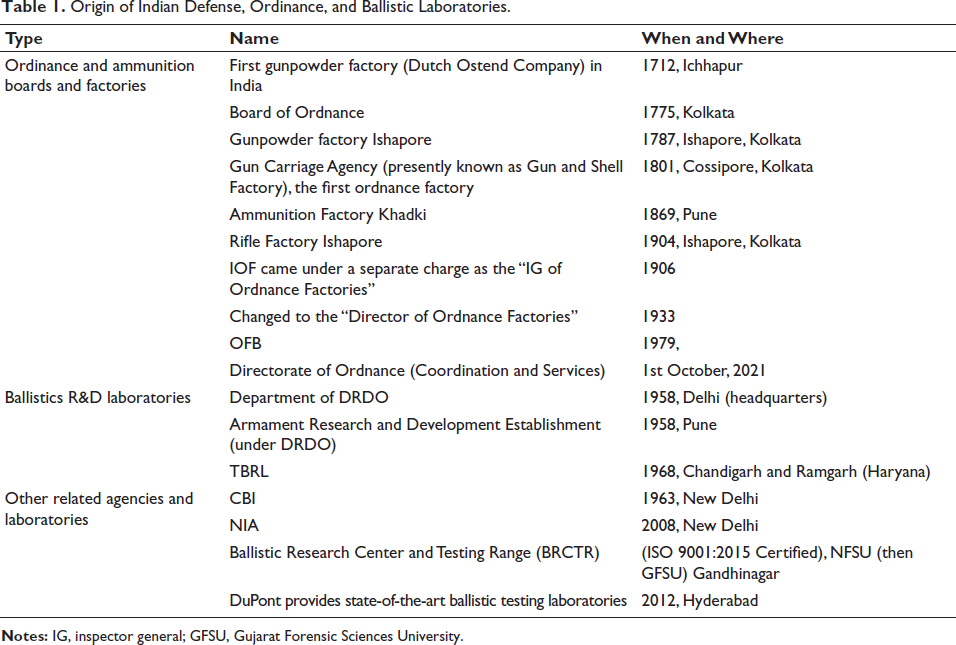
Fundamental Ordinance and Ballistics Set-ups in India: India has several specialized Army Ordinance and ballistics laboratories that are mostly research-oriented. They are generally unaffiliated with central, state, or RFSLs. The ready availability of ammunition is a breath of fresh air in the Army’s overall preparedness, particularly during wartime. Indian Ordnance Factories (IOF) are the oldest and largest industrial structures governed by the Ordnance Factory Board (OFB), primarily to achieve self-reliance in equipping the armed forces. The official beginning and administration of the Army Ordinance in India started during the British reign. The purpose of establishing ordnance factories was to aid in some military-related work. Therefore, to strengthen the military infrastructure, they accepted establishing a Board of Ordnance at Fort William, Kolkata, in 1775, and the first official foundation of the Army Ordnance originated in India. It followed the establishment of a Gunpowder factory (1787) and a Rifle Factory (1904) in Ishapore. The first industrial establishment of ordnance factories was established in 1801, and it is now known as the Gun and Shell Factory in Cossipore. In India, the Director General Ordnance Service at Army Headquarters is the apex authority for the overall procurement and management of ammunition in the Army. Most of the ammunition for the Army is procured from the OFB. Before 1950, India had only 19 ordnance factories. India now has 41 operational ordnance factories. In a breakthrough development, the Government of India has also decided to form a Directorate of Ordnance (Coordination and Services) under the Department of Defense Production (DDP) with effect from 1st October 2021, as a replacement for the current OFB (1979) Headquarters. OFB has been dissolved and converted into seven Defense Public Sector Undertakings (DPSUs) from 1st October 2021. The DPSUs include Munitions India Limited, Advanced Weapons and Equipment India Limited, among others, governing several ordnance factories in India.12, 13 The DDP deals with several matters related to defense production and the planning and control of departmental production units of the OFB and DPSUs. Another milestone in intensifying the Indian defense system was the establishment of the Department of Defense Research and Development Organization (DRDO) in 1958, following the amalgamation of the Technical Development Establishment of the Indian Army and the Directorate of Technical Development and Production with the Defense Science Organization (DSO). Initially, DRDO was a functional unit of 10 laboratories, but it has expanded to a network of more than 50 laboratories. DRDO is an internationally recognized and esteemed institute of R&D in various disciplines, including instrumentation and ballistic missile systems. DRDO focuses on scientific aspects of military equipment and logistics, and formulating R&D plans for defense equipment. Terminal Ballistics Research Laboratory (TBRL), as the name suggests, is an arsenal laboratory based on terminal ballistics. The DRDO took the initiative to establish its TBRL in Chandigarh in 1961. TBRL entered operation in 1967 but was officially introduced in 1968. Its center is in Chandigarh, and its experimental facilities, including a shooting range, are located in Ramgarh (Haryana). The goals behind the opening of this laboratory were the development of specialized instrumentation, range technology, and advanced weapon systems. 14 The Standardized Testing and Quality Certification Service of the Government of India’s Department of Information Technology certifies laboratories according to the international quality management system standard ISO 9001:2008 in 2014. Table 1 shows the overall progress of the Indian Defense and Ballistics Research Institute.
The Inception of Ballistics in Forensic Science Laboratories: One of the oldest cities in East India, Kolkata (formerly known as Calcutta), was the center of a colony developed by the British East India Company. Calcutta developed rapidly during the British Indian Empire in the 19th century. The British turned it into the capital of the British Indian Empire until 1911, as it was the center of India’s trade and police administration. The establishment of similar departments had begun in the early 19th century. Still, after independence, the first forensic science laboratory was established (July 1, 1952), followed by the first central forensic science laboratory in Kolkata (then Calcutta) in 1957, as an outstation subordinate office of IB, Union Ministry of Home, Government of India. According to the literature, CFSL started operating with Ballistics, Biology, Chemistry, and Physics Divisions, while the scientific services of FSL Kolkata extended with the addition of the Ballistics Section in 1973. 10 The Bureau of Police Research and Development (1970) also regulated the CFSL until 2002. Later, in 2002, the Directorate of Forensic Science Services (DFSS) was set up by the Government of India on the recommendations of “The National Human Rights Commission” and “Padmanabhaiah Committee on Police Reforms” by the Ministry of Home Affairs vide its Order No. 25011/41/2001-GPA.II/PM-II on December 31, 2002. DFSS was established exclusively to administer CFSLs, except CFSL Delhi, which was then under the CBI, the foremost investigating agency of India. The Ballistic Division is an integral segment of CFSLs and State SFSLs in India, but seldom operates conjointly under the Physics Division in India. It will not be long before the RFSLs have a full-fledged ballistics section/division.
Legendary Indian Forensic Experts/Ballisticians: Since developing forensic laboratories, India has produced some recognized pioneers in forensic ballistics. Despite their good native contributions, the international literature does not have considerable written records of their impact. B.R. Sharma, former Director of CFSL, Chandigarh, and one of the great Indian forensic scientists. He is an ever-spoken and respected Indian forensic expert. He has written several books on the fundamentals of forensic science. His book, “Firearms in Criminal Investigation and Trials” (1990), contains beneficial forensic information about firearms, ammunition, and court proceedings. J.K. Sinha (former Deputy Director of CFSL, Chandigarh) wrote a book entitled “Forensic Investigation of unusual firearms.” The late Mohan Jauhari, Head of the Ballistics Division of CFSL, Calcutta, made a few good research contributions mainly in the field of velocity and estimation of the range of firing in wound ballistics. His manual entitled Identification of Firearms, Ammunition and Firearm Injuries, Bureau of Police Research and Development. The Government of India (1980) contains beneficial forensic ballistic information. It is also pertinent to mention the contributions of Dr. Narayan Pandurang Waghmare (currently working as a Director of the Forensic Science Laboratory, Panaji, Goa). His primary field of expertise is forensic ballistics. He has also published several research papers on ballistics studies in journals of international repute. J.K. Modi, former Deputy Director (Ballistics), National Institute of Criminology and Forensic Science, Delhi (now known as NFSU, Delhi Campus), and Mr. K.C. Varsheny, Deputy Director (Ballistics, FSL, Government of NCT, Delhi), have made great efforts in the infrastructural developments of forensic ballistics in India.
Hi-Tech Developments in Forensic Ballistics in India: The Ballistics and Forensic Institute holds the mandate for R&D work. These laboratories occasionally conduct projects based on testing bulletproof vests, helmets, and armored vehicle equipment. Indian academic institutions are also starting to take an interest in developing a forensic ballistics facility internationally. NSFU, Gandhinagar, has a fully functional BRCTR. The establishment of the BRCTR in 2016 is one of the new initiatives in the research and development field of forensic ballistics by the NFSU of Gujarat. BRCTR is focused on the application and advancement of cutting-edge technology in forensic ballistics for beneficial purposes, including studying terminal ballistics and creating cutting-edge procedures for criminal investigations involving firearms. BRCTR of the School of Forensic Science, NFSU provides services and R&D developments on ballistics material testing services to the defense, police, other security agencies, and industries dealing with security-related materials. The area of terminal ballistics, which is utilized in a variety of weapons, ammo, and materials, has a broader scope as far as research in this field is concerned. 15 The US-based engineering conglomerate DuPont recently unveiled its first integrated ballistics center in Hyderabad in 2012. DuPont has state-of-the-art ballistic testing facilities to support the development of body armor, helmets, vehicle armor, and tactical plates for law enforcement and the military. The center is dedicated to developing local ammunition solutions tailored to India’s security needs.
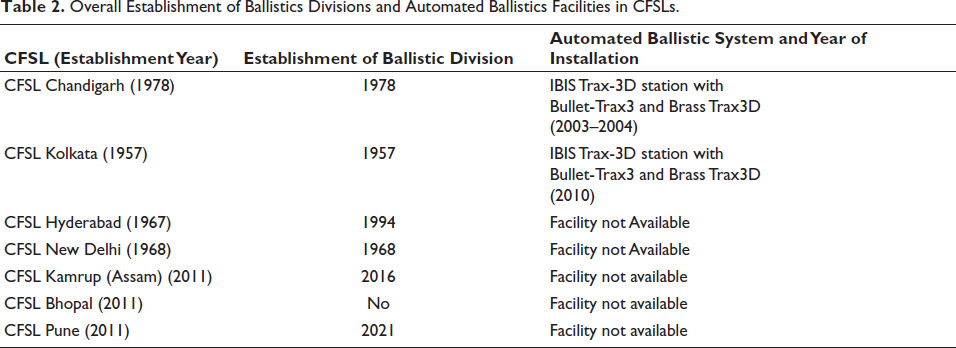
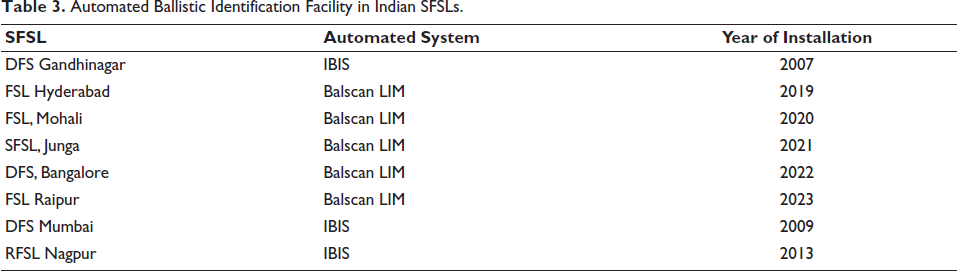
Status of Automated Ballistic Systems in India: The CFSL, under the administration of the DFSS, has made many advances in analysis and research. In 2002, as one of the earliest advancements, the DFS, Ministry of Home Affairs, Government of India, labeled the CFSL Chandigarh Center of Excellence in Physical Sciences. Of course, the Ballistics and Physics Divisions were significant working units in achieving this honor. The first installation of the Integrated Ballistic Identification System (IBIS) was at CFSL in Chandigarh in 2003–2004. It was an IBIS Trax-3D workstation consisting of separate Bullet Trax3D and Brass Trax3D workstations for hit point analysis and a data concentrator for comparing bullets and cases, respectively. Similarly, CFSL Kolkata’s Ballistics Division was upgraded in 2010 with an IBIS Trax-3D workstation consisting of Bullet Trax3D and Brass Trax3D workstations for match point analysis and a data concentrator. As per official records, the remaining five CFSLs (Delhi, Hyderabad, Pune, Guwahati, and Bhopal) do not have any such facility. The Ballistics Division (occasionally conjoined with the Physics Division) is integral to SFSL/DFS in India. There are fewer automated installations of IBIS/Balscan in Indian SFSLs, as only a few have been updated. Table 2 shows the overall establishment of Ballistics Divisions and automated Ballistics facilities in Indian CFSLs, whereas Table 3 presents automated ballistics identification facilities in Indian SFSLs.
Hurdles Associated with Automated Ballistic Identification System (ABIS), Especially in India: Gun-related crime in India seems to continue despite gun control laws being portrayed as very strict. Firearms crime, in general, remains slightly higher in India. Law heavily regulates the possession and issuance of firearms, so criminals are developing alternatives using homemade or improvised guns. Illegal use of domestically manufactured weapons is severe in some parts of India. The joint responsibility of state and central authorities is to seriously consider this matter, which is a grave security concern. Additionally, forensic analysis of improvised firearms can be more complex than that of standard firearms. Like other criminal cases, firearms-related cases are reported to the local police station and processed and investigated by the Indian Forensic Laboratories. Today, IBIS has become a tool for law enforcement and forensic laboratories, especially for quickly matching cases and bullets to other firearms or specific firearms. Several factors have hampered the movement of Indian forensic institutions toward ABIS over the years. Let’s examine such factors:
Exiguous databases: The AFIS system lacks an extensive firearms signature database. Regardless of phase, such signatures must be entered into a national database accessible to all forensic and law enforcement agencies. Functional integration between different forensic laboratories is required. Lack of cooperation between different forensic laboratories can lead to poor forensic performance within a country. The Indian legal trend to record and share signatures on firearms at every step is a significant obstacle to the effective operation of the ABIS in India. The ballistics evidence database generated through IBIS is installed on the central server hub in Canada. The server integrations of such databases could be complex to access when the technical fault is so minor.
The problem of improvised firearms: India has stringent laws on issuing standard weapons and ammunition. Nonetheless, the use of firearms is one of the preferred methods of crime. Domestically produced, cheap firearms generally have smooth bores rather than rifle bores. According to the National Crime Record Bureau (2021), 45,847 cases were registered during 2021. Of these, 45,492 (99%) arms belong to the category of unlicensed, crude, or country-made improvised. Several localities of Uttar Pradesh, Bihar, Rajasthan, Madhya Pradesh, Haryana, West Bengal, and Delhi carry a considerable burden of cases registered under the Arms Act. 16 If such firearms continue at the same rate across the country, the implementation and maximum benefit of advanced ballistic systems such as ABIS can encounter matching problems.
Cost and maintenance issues: Installation and annual subscription fees for integrated ballistic information systems commonly cost hundreds of millions. Since these systems are imported, several factors contribute to the higher initial cost. Additionally, grants allocated to forensic laboratories vary according to state policy. Therefore, its affordability can be uncertain everywhere. States with high firearm crime rates should pay special attention to installing advanced forensic ballistic facilities. The information obtained reveals that CFSL’s AFIS/IBIS hub is not yet operational. Such services are operational on multiple SFSLs. Also, the recurring cost is a massive burden in the maintenance of such systems.
Suggestions For Improving the Usage of Automated Ballistics Identification Systems in India: India spends most of its budget on modernizing its defense sector. Budgets were freed up in the name of police modernization to develop the criminal justice system and police enforcement. The forensic institute will receive part of this funding for modernization. Recently, the Indian government initiated a forensic improvement process focused on crimes against women under the “Nirbhaya Fund” and declared 2010 the Year of Forensic Science. Many FSLs and CFSLs in India have yet to be upgraded to high-tech automatic firearms identification facilities. Forensic laboratories already using this feature face technical challenges despite proper implementation. Available set-ups still do not meet national and international standards, especially regarding collaboration and integration. Therefore, to strengthen the field of forensic ballistics, the afollowing points should be addressed:
Reassessment of the Arms Act can help in tightening the criminal nexus more rigorously. For example, governments must implement a mandatory database of all standard or licensed firearms in the country.
States with high shooting incidents should be given priority and additional funding for further development of ABIS technology.
Several ABIS systems (IBIS, Evofinder, Balscan, Aresenal, Drugfire, etc.) are available worldwide, but they are not compatible with each other. Therefore, a common platform should be provided for interconnection. Mandatory technical integration at the state, federal, and international levels by forensic and other law enforcement agencies could be a significant achievement for AFIS.
Establishing a single regulatory body in the country for the ABIS hub, such as the National Crime Records Bureau (NCRB), can store all the data. In addition, the data should be comparable within countries. Even NCRB can act like a company by expanding its services, especially in data security management.
Data security issues and issues related to such systems should be addressed immediately and kept in audit mode. These systems with software and hardware need to be updated regularly. Therefore, better Automated Match Candidates (AMCs) and Congruent Matching Cell (CMCs) must be designed so that such systems can operate for a long time at a low cost. Recruitment and regular training of experts to operate ABIS should be the responsibility of relevant laboratories and authorities.
National laboratories should work together to conduct interdisciplinary research in forensic ballistics. Prioritizing ABIS’s research and development work will ensure that such systems remain operational and enable us to solve future analytical problems based on firearm identification. Hiring research-oriented staff helps. Governments should encourage research and development activities in forensic ballistics by funding researchers.
Academic institutes collaborating with FSLs and defense agencies should establish specialized research facilities and make firing ranges readily available to researchers interested in forensic ballistics.
Relevant subjects’ curricula should be updated with the topic of forensics. Academic institutes should also establish a forensic ballistics museum.
Researchers should ensure that high-quality forensic ballistics research is published only in top-quality journals with a reputation for using valid and error-free methods.
Origin of Indian Defense, Ordinance, and Ballistic Laboratories.
Overall Establishment of Ballistics Divisions and Automated Ballistics Facilities in CFSLs.
Automated Ballistic Identification Facility in Indian SFSLs.
Conclusion
The evolution of forensic ballistics in India is a compelling narrative of scientific perseverance, institutional development, and legal reform. From the foundational efforts during the British era to the modern advancements exemplified by high-tech installations such as IBIS and the establishment of institutions such as the NFSU, India’s journey reflects its dedication to enhancing scientific methodologies in crime investigation. While significant strides have been made through the expansion of forensic laboratories, the formulation of firearm regulations, and the contributions of pioneering experts, challenges persist—particularly in terms of automation, infrastructure, integration, and analysis of improvised firearms. Despite these hurdles, India’s forensic ballistics system has shown remarkable potential. Addressing the gaps in automated systems, standardizing national databases, ensuring inter-agency cooperation, and fostering research and academic integration are the next crucial steps. With focused investment, technological modernization, and strategic policy reforms, India is well-positioned to not only strengthen its forensic ballistic capabilities but also emerge as a global leader in the domain of forensic science.
Limitations of the Study
It is important to note that forensic ballistics or forensic identification of firearms is a broader scientific field, but given the length of this article, the reviewed literature is limited to India. To make such an article a complete compendium of forensic information on ballistics and firearms research, the remaining relevant and useful literature across the world needs further assessment.
Footnotes
List of Abbreviations
ABIS: Automated Ballistic Identification System
AFIS: Automatic firearm identification system
AFK: Ammunition Factory Khadki
AHQ: Army Headquarters
AWEIL: Advanced Weapons and Equipment India Limited
BRCTR: Ballistic Research Center and Testing Range
CBI: Central Bureau of Investigation
CFSL: Central Forensic Science Laboratory
CMC: Congruent Matching Cell
DDP: Department of Defense Production
DFSS: Directorate of Forensic Science Services
DGOS: Director General Ordnance Service
DIT: Department of Information Technology
DPSUs: Defense Public Sector Undertakings
DRDO: Defense Research and Development Organization
DSO: Defense Science Organization
DTDP: Directorate of Technical Development and Production
FDR: Firearm Discharge Residue
GSR: Gunshot Residue
IB: Intelligence Bureau
IBIS: Integrated Ballistic Identification System
IBIS: Integrated Ballistics Identification System
IOF: Indian Ordnance Factories
IPA: Indian Police Act
MIL: Munitions India Limited
NFSU: National Forensic Science University
NIA: National Investigation Agency
OFB: Ordnance Factory Board
RFSL: Regional Forensic Science Laboratory
SEM: Scanning Electron Microscopy
SEM-EDX: Scanning Electron Microscopy-Energy Dispersive X-rays
SFSL: State Forensic Science Laboratory
SFS-NFSU: School of Forensic Science-National Forensic Sciences University
STQC: Standardized Testing and Quality Certification Service
TBRL: Terminal Ballistics Research Laboratory
TDE: Technical Development Establishment
Acknowledgements
The authors would like to express their heartfelt thanks to the RTI officers of CFSLs in India for providing us with useful information as presented in the article. We would also like to thank the eminent experts who gave us interviews on the topic. We would also like to acknowledge all the national and international, government and private online sources and platforms used to extract information to compile this article.
Authors’ Contribution
In an effort to normalize the practice of transparency in the preparation of this work, the specific contributions of all authors are described as follows: Study Design–Uttam Singh, Rajvinder Singh; Data Collection–Uttam Singh; Analysis–Uttam Singh, Sandeep Singh Sahota; Writing–Rajvinder Singh, Sandeep Singh Sahota; Editing–Sandeep Singh Sahota.
Availability of Data and Material
The data was collected through questionnaires, personal interviews, research articles, and through the web.
Consent for Publication
The publisher is hereby provided with the rights to publish our review article. It is also stated that this review article has not been published anywhere else or has not been sent to any other publisher.
Declaration of Conflict of Interests
The authors declared no potential conflicts of interest with respect to the research, authorship, and/or publication of this article.
Ethical Approval and Informed Consent
Ethical approval was not applicable for this article, as this is a review article drafted from various research and review articles available on the web.
Funding
The authors received no financial support for the research, authorship, and/or publication of this article.
