




Abstract
The use of various firearms and tools to commit a crime is on the rise. Tool marks play a major role in cases where there is the involvement of weapons. Narrowing down such tools and comparing them help narrow down the type of weapon used. It is not always necessary that the tool/weapon be found at the Scene of Crime (SoC). In such cases, the only evidence to link the weapon is by documenting the wounding phenomenon. Gelatin block helps to measure bullet penetration, deformation, fragmentation and even the path of the projectile. This makes an ideal model in forensic science to study wound ballistics parameters. While examining the injury, it becomes important for investigators to narrow down the possible types of tools used in the crime. Photographs are taken for the same purpose; however, there are a few disadvantages concerning photography techniques. Using photographs, proper comparison is not always possible, as in terms of the curved surface, only one side measurement is accurate. Moreover, while photographing the impression, different lighting techniques are used, which may obscure the marks. Casting, therefore, has more importance and is advantageous over photography since casting can be used in the long run and remains a permanent record. It can last while the body is undergoing post-mortem and decomposition. Thus, the casting technique allows one to positively identify the weapon used even after several years. This study aims to make a cast of the cavity formed using various casting materials like Plaster of Paris, dental stone and alginate, which would make the comparison easier. It was found that alginate tends to clump very quickly, and Plaster of Paris and dental stone did not form a cast due to various associated factors.
Introduction
Forensic science is the branch of science that uses the application of science in the legal arena to prove that a crime has happened, and a forensic expert is responsible for analysing the evidence found at the crime scene. Evidence can be any form of information or objects that are used to determine a fact. Locard’s Principle of Exchange holds great importance in forensic science. It states that when two objects come in contact with each other, they leave a trace. 1 Impression plays an important role in forensics, where one object leaves its trace on another due to the force acting on it. The impression left can either be two-dimensional (2D) or three-dimensional (3D). 2 Three-dimensional impressions are usually on a softer surface where the length, width and depth can be measured and can be replicated using casting materials. The cast acts as a permanent record for future purposes. 3
Gelatin blocks can be used to examine the wounding phenomenon of the various tools. Comparison can be drawn on the entry wound formed in the body and the gelatin, and the dimensions can help investigators determine the likely weapon used. 4
However, there are a few drawbacks to using a gelatin block—it tends to melt, and if it is kept for a longer duration, there is microbial growth, and the depth of penetration increases. 5 Therefore, it is important to make a negative replica of the weapon. This process can be achieved using various casting methods, where the cast can be used in the future as a reference to determine the possible type of weapon. The presence of casts of the possible weapons makes it easier for the experts, as they provide intricate details as well as the depth and shape of the weapon as compared to the photographs. It is found that casts are reliable and have higher precision. 6 Plastico Moulage and Plastico Posmoulage are very useful types of casting material used to cast tool marks. This casting matter picks up all the fine details. 7
Projectiles with high velocity produce extensive tissue damage, even when they are shot far from the target. Therefore, the medicolegal significance of wound ballistics and its observations helps in determining the possible firearm. 8
It was also found that the rate-dependent formulation for gelatin affects the target resistance. This is dependent on both penetration velocity and projectile diameter. The model achieved excellent data only when the range of the velocities was up to 2,229 m/s and the sphere diameter was between 2.38 mm and 6.35 mm. 9 Alginate, an irreversible hydrocolloid casting material, can help copy impressions with great accuracy, if it is done following a precise procedure. 10
Mikrosil is preferred over Silone and Xantopren as it gives fine details and a good contrast while observing under a microscope. It does not take long to set, and at room temperature it normally sets in about six to eight minutes. It can release on its own and does not need any releasing agent. Swedish National Laboratory of Forensic Science (SKL) firearm specialists found that the cast from Mikrosil was better and easier to compare under a comparison microscope. 11
Estimating velocity, kinetic energy and injuries is possible if the type of weapon and bullet is known. 12 Low-velocity guns cause penetration to paths of tissue planes with the least resistance. Whereas high-velocity missiles penetrate deeply, where the damage is due to compression of the tissue. 13
A study found that out of 225 cases, 71% of the weapons used to commit the crime were known. The most commonly used weapons were knives. The length of the weapon did not determine the severity of the wound. The usage of knives to commit serious and violent crime is on the rise. 14
It is essential to choose good casting material when it comes to casting impressions. Silicone has been used for casting, but it lacks adaptability and is expensive. Ceramic plaster provides the best results compared to that of dental plaster. It is easy to use, has the easiest setting time and gives maximum details. 15
Gelatin blocks are considered the closest simulant that can be used in terminal ballistics for experimental purposes. The effect of high-velocity missiles (a Russian AK-74 Assault rifle, 5.45 mm) in a gelatin block can be studied. The missile path can be visualised using a TV camera ultra-speed shutter, and the cross-section of the temporary cavity can be measured. 16
Studying the information which is involved in wound profiles and their reference can help in understanding the basic principle of wound ballistics. The wound profile helps in filling the element that is missing during a test firing. 17
The interaction of projectiles in gelatin blocks is a very dynamic process in nature. When the projectile is rapidly decelerating, it creates a temporary cavity. Afterwards, when the projectiles pass, there is the formation of a permanent cavity. However, measuring a temporary cavity is challenging, and therefore, for comparison purposes, permanent cavity measurements are taken into consideration. 18
Gelatin blocks not only substitute human tissue but also help in solving reconstructive ballistics questions. 19
Contact wounds using gelatin blocks can also be studied under different conditions, such as hard contact, loose contact and angled contact at 10℃. 20 Gelatin block also helps to measure bullet penetration, deformation, fragmentation and even the path of the bullet. 21
In ballistics, gelatin has been used for a long period as a tissue simulant. Its translucent nature helps to identify the wound channel. It can also measure the accurate placement of bullet fragments. Moreover, it can be used to examine injuries concerning bone and internal organs. Though it is really difficult, it is possible in the case of gelatin block and impossible in the case of soap. 22
An alternative method to cast tool marks is the use of jewellery modelling or carving wax, which gives fine details of the class characteristics and is safe to work with. 23 Some of the widely used materials for casting impressions are Crime Cast, Traxtone, Castone (dental stone) and Plaster of Paris. A well-made cast preserves impression details better than a photograph, ensuring a more thorough and conclusive examination while minimising the risk of evidence loss. 24 Tool marks can be cast using conventional casting materials like dental stone and silicone rubber. 25
The cast can be kept as evidence for a longer period to use for further reference. However, castings are photographed as well using oblique light to get a detailed photograph. 26
Wound ballistics helps in the reconstruction of the crime scene. It helps in determining the distance at which the firearm was shot. It helps in determining whether it was an accidental, suicidal or homicidal case. 27
Wound ballistics injuries are commonly studied using computed tomography (CT), which provides an accurate representation of the injury along with 3D imaging of projectile destruction. 28
Among the most widely used gelatin simulants are ballistic gelatin and glycerine soap. Glycerine soap offers several advantages, including ease of use, storage and handling. It also maintains its shape without deformation. However, its opaque nature prevents the wound channel from being visible from the outside. 29
Hexahedral–tetrahedral finite element (FE) models are widely used in wound ballistics research to analyse and estimate the energy transfer to tissue during impact. Understanding this energy transfer is crucial in assessing the severity of injuries caused by different projectiles. 30
While air guns are classified as lower-power firearms, they can still inflict serious injuries if misused, highlighting the importance of studying wound ballistics to evaluate potential risks accurately. 31
Alginate is also one of the widely used casting materials for producing dental/bite casts. It is easy to use, economical and has a good acceptability. However, the drawback of using alginate for casting is that it tends to shrink, so it needs to be photographed as soon as possible. 32 Dental stone and Plaster of Paris are the widely used casting materials for 3D impressions. 33
Virtual casting provides higher image resolution and allows better individualization of tool marks 34 Stab wounds from serrated blades are generally similar to those of non-serrated blades. A pig skin model was used to study the similarities and differences seen in such cases. The use of vinyl polysiloxane dental impression material for casting helped in better documentation and comparison. However, fixation shrank the tissue but did not show any significant difference in individualising the tool marks. 35
The amount of energy transferred determines the severity of the injury and the damage to the tissue. This energy transfer depends on the mass of the projectile and velocity. The other factors that affect energy transfer are the density and rigidity of the tissue. Due to this, injuries are usually divided into high-energy injury and low-energy injury. 36 Gelatin blocks can also be used to study extensive destruction to the tissue in a temporary cavity caused by modern firearms. 37
Earlier, soap was used as a tissue simulant, allowing direct measurement of the temporary cavity with remarkable results. However, due to its lack of elasticity, gelatin became the preferred alternative. Despite this, analysing the temporary cavity in gelatin posed challenges, as it would collapse quickly after impact, requiring immediate sectioning of the block for accurate measurement. 38 A simple and effective technique used to replicate foot impressions found in bloody surfaces is by using alginate. It gives more significant and minute details and even has less background disturbance. 39
Traditionally, to know the behaviour of projectiles, the model used was an animal because its tissue is similar to that of the human body. Porcine tissues were widely used as it was highly available, and it was believed that the retardation of bullets in porcine tissue is similar to that of human tissue. However, the use of animal models was ethically wrong, so to reduce animal testing, experts started using ballistic gelatin. A study was carried out to compare the retardation of North Atlantic Treaty Organization (NATO) standardised fragment simulating projectiles (FSPs) in 20% ballistics gelatin and compare it with a porcine tissue. It was found that gelatin was suitable to be use as a human tissue for experimental purposes. 40
To study the impact of bullet incapacitation and its penetration, tissue simulant is widely used. This simulant helps determine the potential wounding phenomenon of small arms ammunition. Ballistic gelatin is used worldwide to study permanent cavity. 41
Gelatin has also been used repeatedly to study the impact of bullet penetration. However, the repeatable study can only be done at a relatively low velocity. It is found that the threshold velocity of penetration depends on the concentration of the gelatin. From the penetration depth and the diameter, one can narrow down the type of projectile. 42
When a bullet penetrates the gelatin, it occurs in four stages, namely the bullet’s smooth attenuation stage, when the bullet does not roll due to instability, is found at the front of the gelatin block along a quasi-cylindrical narrow channel. The bullet’s rolling stage, when the bullet rolls due to instability, the velocity sharply drops, and the kinetic energy is quickly transferred to the gelatin. The full penetration stage, in which the bullet completely penetrates the gelatin while in a rather steady backswing posture. The expansion and contraction stage, in which the temporary cavity in the gelatin keeps expanding before contracting. 43
Wound ballistics helps in finding the trajectory, terminal behaviour of the projectile and the wounding effects. Wounds due to ballistic injuries are categorised as penetrating, perforating and avulsive. In penetrating, the projectile strikes the soft tissue and remains inside the body. In perforating, the projectile exits the body with a slight loss of tissue. In avulsive injury, the projectile leaves the body with large tissue loss. 44
While examining the injury, it becomes important for investigators to narrow down the possible types of weapons used in the crime. Using photographs, a conclusive comparison is not always possible as the scale in terms of curved surface is only accurate on one side. Moreover, while photographing the impression, different lighting techniques are used, which may obscure the marks. At times, the photographs are not focused properly as well. Casting, therefore, has more importance and is advantageous over photography since casting can be used for the long run and remains as a permanent record. It can last while the body is undergoing post-mortem and decomposition. Thus, the casting technique allows for positively identifying the weapon used even after several years. 45
A study comparing dental impression materials and special elastomeric impression materials for forensic use found that dental impression materials were more effective for casting tool marks at crime scenes. They were easier to use, offered better dimensional accuracy, and provided better quality results. 46
In wound ballistics, the interaction of the bullet with the tissue is described in three phenomena—first, the formation of a permanent cavity, then the temporary cavity, followed by the shock wave. This shock wave does not create any sort of damage to the tissue. The appearance of the wound is mainly related to the shape of the projectile, which helps in determining the type of projectile used. 47
Impressions like footwear marks are valuable evidence in criminal investigations. Photographs are not capable of measuring the depth of the impression. Moreover, the photograph quality, type of film used and presence of shadow can lower the usefulness of the evidence. These problems can be overcome using a physical cast. 48
The most common gelatin used in ballistics is ballistics gelatin (e.g., Perma Gel) and collagen gelatin. Although both materials provided reliable impressions and were east to prepare, they do not accurately replicate the complexity of human skin. 49 4℃/10% wt. Gelatin is reasonable to substitute for biological tissue as it could help in giving significant results in terminal ballistics and reduce the use of animal models. 50
Gelatin helps in determining similar penetration depth and permanent damage, which are observed in human tissues. This can be compared and documented using high-speed video, X-rays and CT scans. Physical dissection, photography and measurements help in knowing the penetration depth. 51
A study on sharp force trauma created by a knife was carried out and focused on documenting it for various classes and individual characteristics. It was analysed using various microscopic and scanning techniques, where no specific technique has high inter-individual variability. 52
In a study conducted to compare the mechanical behaviour of stabbing and shooting, it was found that the behaviour of stabbing was quite good and similar to that of human tissue. Whereas in the case of shooting, the behaviour was comparatively different. 53 High-speed video recording can be implemented to find out the size of the temporary cavity. 54 Injuries due to sharp forces have been a major cause of deaths and trauma. The impact of the rifle bullet into a gelatin study shows that the temporary cavity profiles of the gelatin and the cavity in the human tissue were close.55–59
In this study, the wound cavity was cast using different materials. Comparison of the cavity is easier with the help of casting material, where it gives a clear image of its depth and shape, and finer details which can be easily overlooked by the investigator.
Materials and Methods
The present original research was approved by the Institutional Ethics Committee. A gel block was prepared to study the impact of the weapons of the same calibre at various ranges, which meets the Federal Bureau of Investigation (FBI) protocol for calibrating ballistic gelatin to match the human tissues. Each combination of weapon and pellet with range was repeated thrice to ensure consistency in the results. Gelatin blocks were prepared using 120-bloom gelatin. Gelatin blocks were prepared in 20% concentration using 80 cc of water for each box of size 6” × 4” × 3”. Gelatin powder of 20 gm was dissolved in 180 cc of distilled water to prepare an aqueous solution. The blocks were kept in the refrigerator for 48 hours to settle well for use.
To have a proper setup for the experiment, a table was placed against a wall support. Then, the table was cleaned using ethanol to place the gelatin block. Then, the weapons were cleaned using ethanol and then subjected to manual force simulating stabbing on the gelatin block. Then the prepared cast was taken in a syringe and put into the gelatin block. The cast was then photographed using a Canon EOS 200D camera in manual mode with a shutter speed of 1/60 sec and with f/5.6.
The nature of the track and depth of the cavity were examined. Examination of the track was done by fixing the American Board of Forensic Odontology (ABFO) scale from the start to the end of the track. The nature of the track was measured and documented through casting.
Result
This study aimed to study the wounding phenomenon of the tools in gelatin block and make a cast using various casting materials. A gelatin block was used, which simulates the soft tissue of a human body. This also helps determine how a particular weapon forms the wound track. The block was kept at a constant distance of 0.5 metres throughout the experiment. The angle at which the weapon was kept throughout the experiment was kept parallel to the floor. Different casting materials such as Alginate, Plaster of Paris and dental stone were used.
It was found that alginate molecules polymerise within a few seconds, as alginate is a simple polymeric material which is very sensitive to depolymerisation, and it decomposes at pH above 5, which makes it difficult to inject through a syringe.
Plaster of Paris forms a smooth but highly porous surface, which increases the friction between Plaster of Paris and the gelatin, making it difficult to travel in the wound cavity.
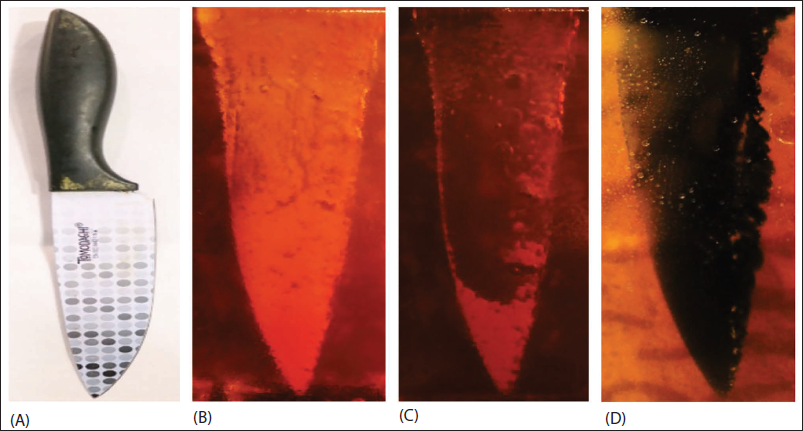
In cases of knives, it was found that dental stone travelled further in the cavity than that of Plaster of Paris. Similar results were found in the case of the claw hammer. This could be because dental stone is much finer and smoother compared to that of Plaster of Paris. In cases of screwdrivers, it was found that Plaster of Paris travelled further compared to that of dental stone.
The conventional method of studying depth in wound ballistics is by using a dye. Therefore, food-grade blue colour dye was utilised to study the depth of the weapon. The results obtained from the dye were better compared to those of the casting materials to study the depth. This could be due to the reason that dyes are less viscous and can travel a longer distance compared to the casting material. However, the fine details of the wound cavity are not properly visible due to the colour.
It is, therefore, suggested that a close-up photograph of the cavity before adding the dye should be taken. This would facilitate the study of the wounding phenomenon for measuring the depth of the wound cavity (see Figure 1A–1D).
(A) Knife and Cast Made in the Gelatin Block Using (B) Dental Stone, and (C) Plaster of Paris (D) Cavity Injected with Dye.
Discussion
Wound ballistics is the branch of forensic ballistics that deals with the study of the wounding phenomenon. It is concerned with terminal ballistics, which deals with how a projectile behaves while entering a tissue or how a projectile creates a wound that destroys the tissues. Wound ballistics majorly deals with four elements: the nature of the target, velocity of the projectile, constructional features of the projectile and the range. When a projectile enters the human body, it depresses and compresses the human tissue, and tends to create an entry and exit hole. When the velocity of the projectile is less, it usually does not create an exit hole. In such cases, it is always easy to get the bullet and narrow down the type of firearm that has been used. However, when the projectile has a higher velocity, and the projectile exits the target, it is usually difficult to determine the type of firearm used. While examining such cases, the type of firearm used can be narrowed down by analysing the wounds.
Since the use of various tools as weapon is enormously increasing, it is important to know the wounding phenomenon of tools as well. It is not always necessary that the crime scene has the suspected weapon. Moreover, it is not possible to determine which firearm produces a particular wounding effect or which tool can give that kind of wound. When tools like a knife or screwdriver are used as weapons, they tend to form wounds which might replicate the shape of the tool. In simple terms, a tool may leave its tool mark in the tissue. In the field of ballistics, to study the wounding phenomenon, gelatin blocks are used, which represent human tissue. To study the wounding effect, a gelatin block is prepared, and then the projectile from the firearm is shot at the gelatin block. The dimensions of the wound created in the gelatin are then compared with the dimensions of the wound in the body. Gelatin blocks can also be used to examine the wounding phenomenon of the various tools. Comparisons can be drawn on the entry wound formed in the body and the gelatin, and the dimensions can help investigators determine the likely weapon used.
Dental impressions can be used to study the characteristics of weapons that were stabbed in porcine cartilage and can be compared with results given by a virtual cast made using a micro-CT scanner. The resolution is better in the virtual cast image. 34 Vinyl polysiloxane dental impression material can also be used to study stab wounds in pig skin models, where the cast helps in better documentation and comparison. 35
The casting materials do not form a cast in the gelatin, as gelatin is needed to keep in the refrigerator throughout the experiment. Changing the consistency of the gelatin and water was not helpful due to the moist environment of the gelatin. For the formation of the cast, the water should evaporate from the casting material to harden.
This study indicated that the casting material path length depends on the wound cavity. If the wound cavity is larger, the casting material travels a further distance; when the wound cavity is small, the casting material travels the least distance. The distance travelled by the casting material is also dependent on its porous nature, as when the casting material becomes porous, the friction between the casting material and the gelatin increases, making it difficult to travel further in the cavity. The distance travelled by the casting material is also dependent on its viscosity. This indicates that if the casting material is more viscous, it does not travel further. If the viscosity of the casting material is lower, it travels further.
Conclusion
Ballistics gelatin is considered the closest simulant of human tissue. It can be used to study wounding phenomena to narrow down the type of weapon or firearm used. In most cases, the weapon may not be present at the Scene of the Crime, which makes it difficult to narrow down the type of weapon used. However, proper measurement of the wound cavity would help narrow down the type of weapon used. If the weapon is not found at the crime scene, the use of ballistic gelatin during test firing aids in narrowing down the weapon used. A study of the wound cavity can give a proper idea of the weapon’s shape and dimensions. Comparison of this can be easier with the help of casting material, which gives a clear image of its depth and shape, and finer details, which can be easily overlooked by the investigator. Dental stone can be preferred in cases where a knife is utilised as a tool for committing a crime. However, Plaster of Paris can be preferred in the case of screwdrivers. This may help to save time and resources in criminal investigations where photographs or other methods of documentation may pose a drawback. The medicolegal experts may adopt this study to understand the wound cavity and provide a perfect simulation of the type of tool/weapon used for the commission of a crime. In cases of complete or partially decomposed bodies, the measurement of wounds may pose difficulty. However, if the cast is prepared at an early stage, comparisons can be drawn which might help solve the case.
Limitation
The force applied to the weapon was not measured since the same person applied the moderate pressure. However, force will always remain as a variable factor at the Scene of Crime. The study focused on only three casting material types: Alginate, Plaster of Paris and dental stone. Type 120 gelatin was used for the preparation of the gelatin block. The casting materials were only compared based on the distance they travelled in the cavity. The depth of the cavity formed and the depth of the casting material can be compared to ensure the casting material entirely occupies the dimension created by the tool/weapon used. However, this factor may vary in case of multiple stabs to the same part of the body. Therefore, the simulation of the depth of the cavity may not yield accurate results.
It is not always possible to find the murder weapon then and there at the crime scene; in such scenarios, narrowing down the type of weapon used can be difficult and time-consuming. Thus, this study will help to get a model of various types of weapons, which can help narrow down the type of weapon used. It can also help to get the proper dimensions of the weapon/projectiles. It will help the expert to know how a particular weapon behaves on a human body.
Future Prospects
This study would help forensic scientists and medicolegal experts to know about the wounding phenomenon from different tools since the commission of crimes using different tools is on the rise due to their availability. This would help narrow down the type of weapon used whenever the weapon is not found at the crime scene. Maintaining standard force and using other casting materials may help in better understanding the wounding phenomenon and obtaining a proper cast, which would greatly help in the future to understand the wounding phenomenon of all kinds of weapons. However, force will always remain a variable at the crime scene. Highly complex tomography instruments can also be used to have a better understanding of the wounding phenomena, the class and individual characteristics of the weapon and to understand the penetration depth.
Footnotes
Acknowledgement
The authors would like to acknowledge Dr Asha Rajiv, Director, School of Sciences and Internal Quality Assurance Cell, for her constant guidance and support.
Author’s Contribution
Pema Wangmo and Manashree Mane compiled the data. Pema Wangmo performed the conceptualisation and writing of the manuscript. Manashree Mane reviewed and structured the manuscript. Pema Wangmo and Manashree Mane read and approved the final manuscript.
Declaration of Conflicting Interests
The authors declared no potential conflicts of interest with respect to the research, authorship and/or publication of this article.
Ethics Approval and Informed Consent
No ethical consent was needed from any participant.
Funding
The authors received no financial support for the research, authorship and/or publication of this article.
