




Abstract
An accident is an unintentional and unplanned event which may lead to physical damage. Falls constitute the second leading cause of unintentional deaths due to injuries; after road traffic accidents. Injuries sustained due to a fall lead to significant morbidity and mortality, and put undue strain on healthcare infrastructure and the national economy at large. This study was conducted to analyse and prepare a demographic profile of victims and types of injuries sustained by the victims of fatal falls from heights in cases brought for autopsy in a tertiary care hospital in the Haryana region. Findings from the autopsy of 70 cases of fatal falls were incorporated and analysed in the present study. Important findings of the study showed that males were invariably more involved, especially in the working age group of 31–40 years with the brain being the most common organ injured in fatal fall cases. The study also emphasizes the need for workplace safety and the role of alcohol in cases of unintentional falls.
Introduction
A fall is defined as an event that results in a person coming to rest inadvertently on the ground floor or other lower level. An estimated 684,000 fatal falls occur each year, making it the second leading cause of unintentional injury death, after road traffic injuries. 1 International Classification of Disease (ICD-10) has codified Y30 as the code for morbidity and mortality associated with falls as an external factor which includes falling, jumping, or being pushed from a high place. 2
Deaths due to falls from height are more common in urban settings due to multi-story buildings, hard concretized ground surface and other factors. Among occupational hazards, it is the most common type of accident. Builders, electricians, miners and painters are particularly at risk. It is also a major cause of unintentional harm; especially for the children and the elderly, which leads to partially avoidable morbidity and mortality. Other risk factors include alcohol or substance use, socioeconomic factors including poverty, overcrowded housing, underlying medical conditions causing loss of balance and unsafe working environments. Fall from height can be classified into (a) high fall and (b) low fall depending on the height of fall. This may also be classified as intrinsic and extrinsic based on the causative factors involved. Intrinsic factors involve some event or condition which may affect the postural control while in extrinsic factors; the environment is the main contributing reason for the fall. 3
Fall from height is a major public health concern and a significant cause of morbidity and mortality. It is the second leading cause of accidental or unintentional injury deaths worldwide after road traffic accidents. Each year an estimated 646,000 individuals die from falls, globally, out of which over 80% are in low and middle-income countries. Adults, older than 65 years of age suffer the greatest number of fatal falls. 4 Elderly also face the highest risk of fall-related mortality.
From the above discussion, we can see that there are multiple factors which are involved in fall from height and varied outcomes once the incident has occurred. A demographical analysis of the factors will help us better understand the mechanisms involved and prepare targeted policies to reduce the incidence of mortality and morbidity associated with falls from height. Hence, we conducted the present study with the aim of preparing a demographic profile of factors involved and injuries sustained in cases of fatal fall from height in the Haryana region.
Materials and Methods
We conducted the present prospective cohort study in the Department of Forensic Medicine at an apex institute of Northern Haryana, on cases brought to the mortuary of the department for autopsy with death due to a history of fall. Findings from a total of 70 cases were analysed which were brought to the mortuary from December 2019 to March 2021 (15 months).
The information regarding the circumstances and demographic profile of the fall was gathered from relatives/friends, police officials/police inquest papers and persons accompanying the deceased to the mortuary of the Forensic Department at an apex institute of Northern Haryana. After recording the information, relevant details were noted on a proforma especially designed for the study and subsequently, the demographic profile of the victims and injuries was prepared in a scientific and systemic manner with regards to general population traits, type and nature of injury, etc., to reach a conclusion.
Results
During the study, 70 fatal cases of known history of fall from height were studied which were brought for autopsy to the department. Our study showed that, out of the total 70 cases studied; 59 victims or 86% cases belonged to male gender and rest 11 cases were female. A maximum number of cases were reported during the summer season, that is, 26 (37.14%) cases, 21 (30%) cases were reported in winter season, followed by 11 cases in monsoon season and 12 cases in autumn. Another important finding was that in most of the incidents, 49 out of the total falls (70%) of the falls occurred during daylight hours, that is, 6:00
Discussion
Injuries due to falls from height remain a significant cause of morbidity and mortality in our day-to-day lives. Fall from heights is one of the most common causes of traumatic death all over the world. The pattern and distribution of injuries sustained during a fall are dependent on a number of variables such as age and sex of victims, height of fall, type of surface, site of primary impact, etc. All people who fall, are at risk of injury, however, the age, gender and health of the individual can affect the type and severity of injury. In the present study, male victims were more as compared to female victims, that is, 59 (86%) males and 11 (14%) females. The preponderance of male victims is probably due to males being outside the house for work, while the females stay back in their homes for household work. The higher rate of fatality in men has been ascribed to men taking more risks than women, consumption of alcohol (30% cases) and working in dangerous employment sectors like construction. However, in the majority of the cases (47.14%) no associated risk factors were observed. After the consumption of alcohol a person’s ability to judge and react to a situation accordingly is reduced and hence leading to fatal falls. The involvement of alcohol as a contributory factor was also observed by Ola G. Haggag et al. 5
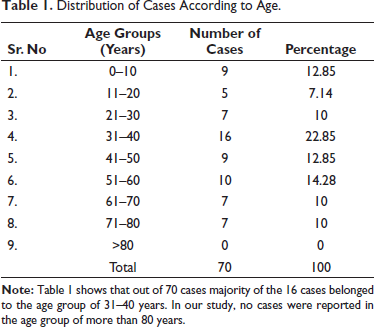
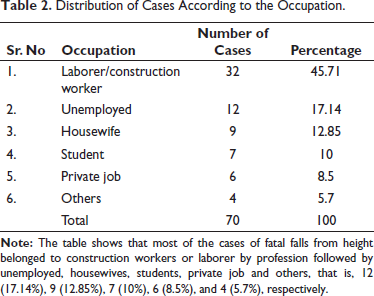
Age is another risk factor as observed in the study that the maximum number of cases of falls from height was seen in the age group 31–40 years, comprising 22.8% of all cases of fall from height, which is similar to the results of a study conducted by Manoj K and Munawwar H. 6 The youngest victim was a two years old child and the eldest was 80 years old. These results are in contrast with the study conducted by Roopak SN and Jagannatha SR in 2015 who observed that the most common age group involved was 21–30 years followed by 31–40 years (Table 1). 7 The difference observed in both the studies with regards to the most common age could be due to differences in society wherein average age of engaging in manual labor could be older or better awareness levels due to increased social media exposure. The maximum number of cases of fatal falls from height was quite understandably laborers or who were construction workers by occupation comprising 32 cases of fatal fall from height constituting 45.72% of total cases followed by unemployed amounting 17.14%, that is, 12 (Table 2). The construction workers and laborers belong to the lower economic strata and are forced to work in unsafe environments putting their lives in danger. Workplace safety guidelines to be followed at construction sites are in place but are seldom followed due to widespread neglect and lack of awareness among those involved. Maximum cases occurred during daylight hours since economically it is the most productive time when people are engaged in their vocations.
Distribution of Cases According to Age.
Distribution of Cases According to the Occupation.
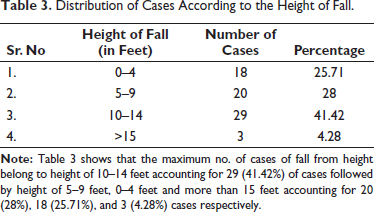
With regard to height of fall, most of the cases fell from a height ranging from 10 to 14 feet (41%) followed by 28% of cases between heights of five to nine feet. Fatality in such cases is strongly dependent on the height of the fall (Table 3) and due to the semi-urban setting of patient base and lack of multi-story buildings in our setting, similar studies in metro cities will lead to different results and could be a source of a future similar study. Urban settings were more prone to fatal fall incidents as compared to rural households (44 and 26 cases, respectively) due to the lack of high-rise buildings in rural settings. Summer seasons were more prone to fatal incidents (37%) as compared to other seasons; probably due to longer days, exhaustion and people sleeping on the roof to escape the heat at lower levels.
Distribution of Cases According to the Height of Fall.
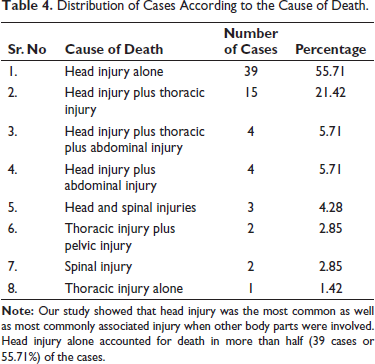
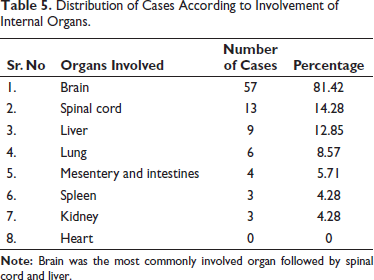
In the present study, the most common cause of death was head injury alone accounting for 39 (55.71%) cases followed by head injuries coupled with thoracic injuries accounting for 15 cases (21.42%), head injury combined with thoracic and abdominal injuries accounting for 4 (5.71%) cases and head injury combined with abdominal injury accounting for 4 (5.71%) cases and head injuries combined with spinal injuries seen in 3 (2.85%) cases. Overall, it was observed that the fatal head injury was present in 65 (92.85%) cases. Isolated spinal and thoracic injuries were the cause of death in 2 and 1 case, respectively (Table 4). The head is the most susceptible part of our body in cases of free fall from height and any injury involving the head may lead to injury to the brain and any trivial injury over the brain may prove to be fatal. Similar findings were observed in a study performed by Ismael Aunnon Martin et al. 8 Since the head is the most common body part involved in such cases, the most common injured organ was observed to be the brain, that is, in 57 (81.42%) cases, followed by a spinal cord in 13 cases (18.57%) cases. Similar findings were observed by V. Prathapan et al., Ramesh C et al., and Saritha SR and Sreedevi CS (Table 5).9, 10, 11
Distribution of Cases According to the Cause of Death.
Distribution of Cases According to Involvement of Internal Organs.
During the course of our study, we observed a few limitations in the form of lack of population variability and lack of environmental factors such as high-rise multi-story buildings and hills and mountains. The results and observations in different settings could offer new insights into the issue and an opportunity for fellow researchers to study the topic in different settings.
Conclusion
Our study shows that individuals of age 31–40 years age, male gender, laborer by occupation and residents of urban areas are more prone to fatal falls. The head is the most common part to be involved with the brain being the most common internal organ injured. In view of our findings and other similar studies, safety guidelines should be framed to decrease mortality associated with fall-related deaths. Multipronged prevention strategies should emphasize creating awareness through social media and otherwise, safer workplace and home environments among other interventions to bring down the number of cases.
Footnotes
Declaration of Conflicting Interests
The authors declared no potential conflicts of interest with respect to the research, authorship and/or publication of this article.
Ethical Approval
The study was commenced after obtaining clearance from Institutional Ethical Committee (vide letter No IEC/TH/18/Forensic/04 dated 8/11/2019).
Funding
The authors received no financial support for the research, authorship and/or publication of this article.
Informed Consent
The informed Consent has been obtained for the study.