




Abstract
Identification of disaster victims becomes difficult to perform if only certain body parts of the dead are found. Some certain circumstances where the skulls or jaws are the only part left, odontometric examination is carried out to help the identification process. Teeth can be an option to identify individuals, since no one is similar by their tooth. Moreover, it is also one of the hardest tissues of our body allowing its resistance from damage. The aim of this study is to determine the percentage of success in estimating body height (BH) in odontometric measurement using the Carrea index for Bataknese students aged 18–25 years. Thirty males and 30 females were selected and their BH was assessed using a staturemeter. The estimated height was obtained by measuring the teeth on the model using a digital caliper according to the stipulation of the Carrea index. The average height and estimated height of males were significantly higher than females. Estimation between right and left height for each sex did not show a significant difference. The percentage of success in estimating height using the Carrea index for males (66.7%) was higher than for females (63.3%), but the result showed no significant difference (P > .05). The correlation between height and estimated height was analysed using the Pearson Correlation test exhibiting a moderate correlation (r = 0.430–0.459). It concludes that the percentage of success using Carrea index in this study showed a good correlation to estimate height for both males and females in the Bataknese.
Introduction
Forensic identification aims to assist investigators in determining the unknown victims that need to be identified. 1 Identification of victims becomes less difficult to do if they can be identified physically or even if their fingerprints can be probably performed. In cases of natural disasters such as tsunamis, volcanic eruptions, and non-natural disasters, such as transportation accidents, industrial accidents, mutilations, bomb explosions, and other cases where only the remains of the victims are found, the identification process becomes more complicated. 2
In the condition, where the body remains only the head and oral cavity, odontometric examination is one of the options. Height measurement is an important parameter for determining a person’s identity since this data is comparable to their antemortem data helping to simplify the identification process.3–5
Teeth can be considered as a means of identification since there is no exact same condition of teeth between one individual and the other in the oral cavity. In addition, the tooth is the hardest tissue preventing it from damage.6, 7 The odontometric parameter used to estimate height is the measurement of the mesiodistal dimension of the six maxillary anterior teeth. There was a positive correlation between the six maxillary anterior teeth and height, while the highest correlation was shown by the canines, and the regression equation was obtained. However, these equations vary depending on the population or ethnicity of the subject studied so they can only be applied to the same specific population. 8
Some researchers selected a method with a formula called the Carrea index by measuring the mandibular anterior teeth. Several studies have been conducted to estimate height using this formula. It is easier to apply in different populations.9, 10
Ethnic diversity affects the dimensions of the teeth. 11 The Bataknese is the largest group in North Sumatera. However, no study has been conducted on the estimation of height using the Carrea index in this ethnicity. 12 Therefore, the aim of the study was to estimate the height using the Carrea index on Bataknese students at Universitas Sumatera Utara.
Materials and Method
This research was a descriptive–analytic study with a cross-sectional design. Sixty Bataknese students from Universitas Sumatera Utara were used in the study, which consisted of 30 males and 30 females obtained by purposive sampling.
Inclusion Criteria
Two generations of Bataknese males and females, aged 18–25 years, with complete mandibular anterior teeth without any abnormalities. The subjects were also willing to become research subjects.
Exclusion Criteria
Teeth with caries or filling affecting mesiodistal dimensions, mobility, attrition on the surface, undergone orthodontic treatment, and growth abnormalities such as gigantism or dwarfism were excluded from the study.
Methodology
After the subject received an explanation and signed an informed consent, the height was measured using a stature meter. Body height (BH) was measured from the heels to the top of the head in an upright standing position, the Frankfort plane parallel to the floor, the shoulders relaxed, the arms at the sides of the body, and the feet flat on the floor. The position of the head, back of the shoulders, arms, buttocks and heels against the wall where the stature meter was installed.
Next, the mandibular anterior teeth were cast using alginate and filled immediately with a dental stone. After hardening and obtaining a mandibular teeth cast model, measurements were taken using a digital caliper, consisting of:
Arch: sum of each mesiodistal width of teeth I1, I2, and C on one side of the mandible from the labial direction. Chord: measure the distance from mesial I1 to distal C in the lingual direction.
The measurement results were calculated using the Carrea index to determine the estimated minimum and maximum height. The calculation results were obtained in millimeters and then converted into centimeters.
Carrea Index Formula
10


Estimated minimum and maximum height obtained based on the Carrea index, then compared with the actual sample height, with the following requirements:
Successful estimation: If the sample’s actual height was within the range of estimated minimum and maximum height Unsuccessful estimation: If the sample’s actual height was not within the range of estimated minimum and maximum height
Data were analysed using the SPSS 20.0 program, consisting of an independent t-test to analyse the difference in average height and the difference in average estimated height between males and females, one way ANOVA test to analyse the difference in average estimation of height using the Carrea index between the right and left sides of the mandible for each sex, Chi-square test to determine the percentage of success of estimating height using the Carrea index between males and females, and Pearson Correlation test, to analyse the correlation between height and estimated height using the Carrea index.
Results
Table 1 shows the average and standard deviation of height between males and females in the Bataknese. Males have an average height higher than females. Males height (169.41 ± 5.38 cm) and females height (158.93 ± 4.44 cm) were analysed using the independent t-test showing that there was a significant difference with a P value = .000 (P < .05).
Difference of Average Height Between Males and Females in Bataknese.

Table 2 shows the mean and standard deviation of estimated height, namely the maximum and minimum heights on the right and left sides of the mandible in males and females. The maximum height of the right males (171.17 ± 6.37 cm) was lower than the maximum height of the left males (171.92 ± 6.52 cm), but there was no significant difference with a P = .651 (P > .05). Likewise, the minimum height of the right males (163.44 ± 7.39 cm) is lower than the minimum height of the left males (163.49 ± 6.02 cm), but there was no significant difference with the P = .979 (P > .05). The maximum height on the right of the females (166.55 ± 6.48 cm) was lower than the maximum height on the left of the females (167.82 ± 6.64 cm), but there was no significant difference with a P = .455 (P > .05). Likewise, the right minimum height of females (157.70 ± 7.70 cm) is lower than the left minimum height of females (159.18 ± 7.70 cm), but there is no significant difference with a P = .460 (P > .05).
Difference of Average Height Estimation Using the Carrea Index Between Right and Left Sides of Mandible for Each Sex in Bataknese.
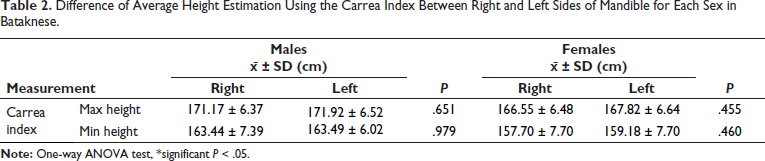
Table 3 shows the mean and standard deviation of estimated height, namely the maximum and minimum heights for males and females. The maximum height for males (171.54 ± 6.33 cm) is higher than the maximum height for females (167.19 ± 6.52 cm), analysed with the independent T-test showing that there is a significant difference with the P = .011 (P < .05). Likewise, the minimum height for males (163.47 ± 6.32 cm) is also higher than the minimum height for females (158.44 ± 7.67 cm), analysed by independent T-test showing that there is a significant difference with a P = .007 (P < .05).
Difference of Average Height Estimation Using the Carrea Index Between Males and Females in Bataknese.

Table 4 shows the distribution of success and unsuccess in estimating height between males and females in the Bataknese. Of the 30 male subjects, 20 subjects (66.7%) showed success, while 10 subjects (33.3%) showed no success. From a total of 30 female subjects, 19 subjects (63.3%) showed success, while 11 subjects (36.7%) showed unsuccess. Based on this, it can be seen that the percentage of success in estimating height for males is higher than for females, but there is no significant difference (P = 1.000). Of the total successful subjects 39 subjects (65%), while 21 subjects (35%) were unsuccessful.
Successful Distribution of Height Estimation Using the Carrea Index Between Males and females in Bataknese.
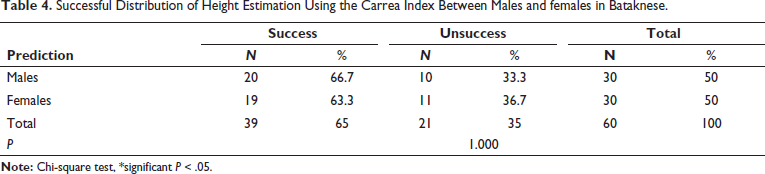
Table 5 shows the results of the correlation analysis or correlation between height and estimated height, namely the maximum height and minimum height obtained using the Carrea index on the right and left sides of the mandible in the Bataknese. There is a significant correlation between height and right maximum height with a P = .000 and a correlation coefficient of r = 0.459. There is a significant correlation between height and minimum right height with a P = .000 and a correlation coefficient of r = 0.441. Likewise, there is a significant correlation between height and left maximum height with a P = .000 and a correlation coefficient of r = 0.441, while on the left minimum height, there is a significant correlation with height with a P = .001 and a correlation coefficient of r = 0.430. According to Colton, the strength of the correlation between the two variables can be divided into four areas, namely r = 0.00–0.25 indicating no correlation/weak correlation; r = 0.26–0.50 indicates a moderate correlation; r = 0.51–0.75 indicates a strong correlation; and r = 0.76–1.00 indicates a very strong correlation. 13 Therefore, the four estimation variables for height, namely right maximum height, right minimum height, left maximum height, and left minimum height show a moderate correlation for height.
Correlation Between Height and Estimated Height Using the Carrea Index in Bataknese.

Discussion
In this study, the average male height was 169.41 ± 5.38 cm, while the average female height was 158.93 ± 4.44 cm. There is a difference in the average height of 10.48 cm between the males and females who were sampled in this study. The results of the study were analysed using an independent t-test showing that there was a significant difference in average height between males and females (P < .05). The current study corresponds to other studies by Rekhi et al. and Putri et al. that found the average height of males is higher than females.9, 10
In general, males tend to be taller than females. Height growth is followed by a distinctive pattern called the growth spurt phase. Males have a faster growth rate at around the age of 12–14 years than females. 14 Furthermore, the closure of the growth plate in females occurs at the age of 16, while in males it occurs around the age of 18.15, 16
An individual height is also influenced by sex chromosomes. In normal circumstances, the Y chromosome affects height more than X chromosome due to the presence of a gene called CYP19 on the Y chromosome. This gene has an influence on the development of the androgen hormone involved in determining male height. 17
In this study, the maximum and minimum mean values of heights between the right and left sides of the mandible in males and females showed no significant difference (P > .05). Other studies also showed no significant difference. 10
There is no significant difference in tooth dimensions between the right and left sides. Basically, the human body has a symmetrical appearance, but when measurements were taken on a large number of corpses or living subjects, it exhibited that the two parts of the human body are asymmetrical. 18 However, the assessment of both sides of the teeth showed the distinction in size, although not statistically significant.19, 20
In this study, males had higher maximum and minimum heights than females, analysed by one-way ANOVA showed that there was a significant difference (P < .05). This is also in accordance with the study conducted by Sruthi et al. which has also shown higher maximum and minimum height for males than females. 21
Our study indicates that males have larger tooth dimensions or sizes than females, which can be attributed to differences in the sex chromosomes of the two. The Y chromosome influences the formation of enamel and dentin, whereas the influence of the X chromosome on tooth growth appears to be limited to the formation of enamel. This difference in the influence of the X and Y chromosomes may explain why males tend to have larger teeth than females. 22
In this study, the percentage of success in estimating height in males was higher than in females, but there was no significant difference (p > .005). It correlates with other studies showing the percentage of success for males (94.03%) is higher than for females (87.5%). 9 Sruthi et al. also found that the percentage of success for males (81.8%) was higher than for females (73.1%). 21 Similarly, a study in a Brazilian population demonstrated a higher percentage of success for males (81.3%) than females (76.0%). 23
This difference in the percentage of success can be caused by differences in the number of subjects and races that were used as research subjects. In previous studies, the number of subjects studied was more than in this study, so the more subjects the higher the percentage of success. Even though there was a difference in the percentage of success with previous studies, overall there was no significant difference (P > .05) so it can be concluded that the Carrea index method can be used for both males and females.
The correlation between height and estimated height was analysed using the Pearson Correlation test (Table 5) showing a positive correlation and moderate strength of the correlation. The P value between height and maximum right height, right minimum height, left maximum height, and left minimum height indicated that these four variables had a significant correlation with height (P < .05). Another study also reported a moderate strength with r-values ranging from 0.409 to 0.455 and P < .05. 10 Sruthi et al. found a strong correlation between height and right and left maximum height with r-values of 0.880 and 0.847 and moderate strength of correlation between height and right and left minimum height with r-values of 0.457 and 0.444 and P < .05. 21
A positive correlation indicates a correlation between height and teeth dimensions, where the taller a person indicates the greater the teeth dimensions. Theoretically, the correlation between height and teeth may be seen based on the similarity of the process of formation or embryology between teeth and long bones. 6 The dentin layer which forms the bulk of the teeth and determines the dimensions of the tooth, originates from the ectomesenchymal layer, while the long bones, which are most often used in measuring height, originate from the mesodermal, these two tissue layers are basically mesenchymal tissue (connective tissue) which have in common in structural composition, namely the organic matrix formed from collagen and the inorganic matrix formed from hydroxyapatite crystals. Although teeth and long bones are both derived from mesenchymal tissue, there are differences in the timing of completion of their growth. This is what might make the dimensions of the dental crown only have a moderate correlation with height.24, 25
Conclusion
Our study demonstrated that the height and estimated height of males and females showed a significant difference, although the estimated height between the right and left sides did not have a significant difference. In addition, the height and estimated height demonstrated a significant correlation and moderate correlation strength (r = 0.430–0.459). It indicates that the Carrea index can be applied in estimating the height to determine the body’s stature for optometry purposes. Further study is required relating to odontometric height estimation using the Carrea index in other ethnic and investigation in a larger population.
Footnotes
Declaration of Conflicting Interests
The authors declared no potential conflicts of interest with respect to the research, authorship and/or publication of this article.
Ethical Approval
The study was approved by Institutional Ethics and Research Committee.
Funding
The authors received no financial support for the research, authorship and/or publication of this article.
Informed Consent
An informed Consent has been obtained from the subject.