



Abstract
Identification in forensic medicine often relies on physical traits to establish an individual’s uniqueness. When complete identification is not possible, partial traits such as race, age, sex, and stature can still be determined. Among these, stature estimation plays a crucial role in narrowing down identity, especially in medicolegal investigations.
Our study explores the relationship between stature and inter-acromial length (IAL) in deceased individuals, aiming to develop a reliable method for stature estimation using IAL. A total of 100 cadavers meeting specific inclusion criteria were examined. Stature was measured from the vertex to the heel in a supine position, while IAL was recorded using a sliding caliper between the lateral borders of the acromial processes.
Statistical analysis was performed using Pearson’s correlation and linear regression, with significance assessed via analysis of variance (ANOVA) (p < .05). The results revealed a strong positive correlation between IAL and stature, leading to the derivation of the regression equation: Height = 121.29 + 1.49 × IAL.
These findings align with existing literature and reinforce IAL’s utility as a dependable anthropometric marker. In forensic contexts where other identifiers may be compromised, IAL offers a practical, non-invasive alternative for stature estimation. Its application can enhance post-mortem profiling and support legal proceedings with scientifically grounded data.
By validating IAL as a predictive tool, this study contributes to forensic anthropology and strengthens the methodology for partial identification in medicolegal cases.
Introduction
The identification of human remains is a critical component of forensic investigations, particularly in cases involving mass disasters, criminal inquiries, or unidentified bodies. Forensic anthropologists play a vital role in this process by analyzing physical traits to establish individual identity. Identification involves confirming a person’s uniqueness through measurable characteristics. When complete identification is not feasible, partial attributes such as race, age, sex, and stature can still be determined to aid in narrowing down identity. 1
Among these traits, stature holds medicolegal relevance as it contributes to reconstructing biological profiles and supports circumstantial evidence. However, stature is not a constant parameter and fluctuates by 1.5 to 2 cm throughout the day due to changes in the elasticity of intervertebral discs and spinal musculature. Additional factors such as malnutrition and aging further reduce stature, with an average annual decline of 0.6 mm after the age of 30. These changes are compounded by postural alterations and disc degeneration. Interestingly, stature increases by 1 to 3 cm when lying down and may extend by approximately 2 cm postmortem due to muscle relaxation, joint loosening, and vertebral flattening. 2
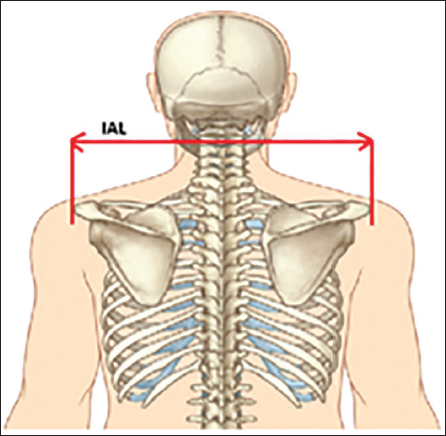
To aid stature estimation, anatomical landmarks must be both reliable and accessible. The acromion, forming the summit of the shoulder and continuing from the lateral end of the scapular spine, is one such landmark. 3 It is prominent, palpable, and structurally consistent. The inter-acromial length (IAL) is the distance between the acromion processes on either side and serves as a stable and measurable parameter 4 (Figure 1).
Inter-acromial Length (IAL).
Given the limited cadaveric data available on IAL, this study aims to establish a statistically significant correlation between IAL and stature in deceased individuals. Developing a dependable regression model for stature estimation using IAL could enhance the identification process, particularly when conventional identifiers are compromised. Such a method holds practical utility in medicolegal contexts, including disaster victim identification, and anthropological reconstructions.
Methods
The present study was conducted in the Department of Forensic Medicine and Toxicology at a tertiary care hospital located in southern Haryana. It was designed as a prospective observational study and was carried out over a period of one year and it was approved by the Institutional Ethical Committee. The study included all medicolegal autopsy cases brought to the mortuary of the institution during the study period that met the predefined inclusion and exclusion criteria. A total of 100 cadavers were included, which constituted a feasible and representative sample size based on the average annual autopsy load of the department. This number was considered adequate to achieve meaningful observations and statistical validity within the available resources and study duration. The sampling technique employed was consecutive sampling, wherein every eligible case was included in sequence as it presented. This method ensured uniformity of selection, minimized sampling bias, and enhanced the reliability and generalizability of the findings.
Inclusion Criteria
All the cases brought to the mortuary of the tertiary care hospital located in southern Haryana for post-mortem examination irrespective of the manner of death and above 20 years of age.
Exclusion Criteria
Cases of age less than 20 years of age.
Cases where one or both the acromion process cannot be appreciated and located.
Cases with spinal deformities and history of spinal surgeries.
Cases where there are bony deformities over the back.
Cases of deep burns and trauma over the deep muscular tissue or bones over the back.
Cases of decomposed bodies.
Anthropometric Measurements
Inter-acromial Length (IAL): The maximum distance between the two bony landmarks, that is, acromial process of scapula on each side. 5
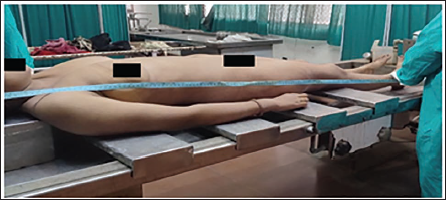
Cadaver Stature (CS): Routinely measured before an autopsy, stature is determined using a measuring tape. It is recorded as the maximum distance from the vertex of the head to the heel of the foot, with the cadaver positioned supine and fully extended on a flat surface 6 (Figure 2).
Measuring the Length of a Cadaver.
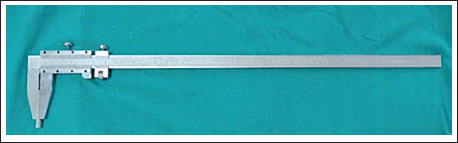
Instruments:
Sliding Caliper (Full View).
Measurement Technique
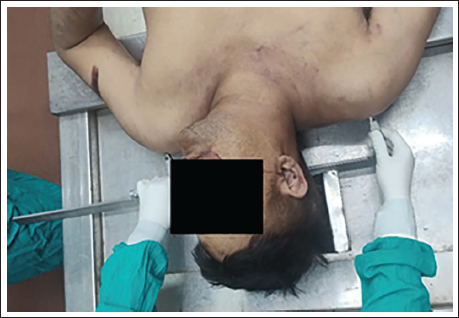
Before taking the measurements, rigor mortis will be broken manually if required. The body will be put in the supine position and the lateral borders of the acromial process will be located by following the spinous process and then will be marked on each shoulder as L for the left acromial process and R for the right acromial process. Then the length between the points L and R will be taken. Measurements will be taken with the sliding caliper (Figures 4 and 5).
Measuring Inter-acromial Length.
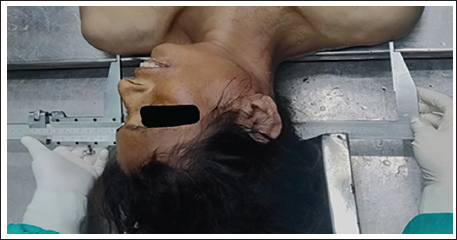
Measuring Inter-acromial Length.
Statistical Analysis
The collected data were entered into a Microsoft Excel Spreadsheet. Mean + SD was calculated for quantitative data. Percentage and proportion were calculated for qualitative data. The Pearson relation coefficient was used to find out the association between IAL and stature. Linear regression equation was used to find out the stature for independent variables from IAL. The ANOVA test was used to find the main difference between IAL and stature using SPSS software. A p value < .05 is considered as statistically significant.
Observation and Result
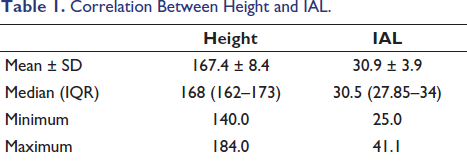
Height and IAL: The ability to estimate height based on measurements like IAL is particularly valuable in forensic investigations, as it assists in identifying unknown bodies when full stature is difficult to determine. This study recorded a mean height of 167.4 cm and a mean IAL of 30.9 cm, with a strong positive correlation between these two measurements (r = 0.686, p < .01). This positive correlation suggests that as IAL increases, height also tends to increase, making IAL a potentially reliable predictor for estimating stature (Table 1 and Figure 6).
Correlation Between Height and IAL.
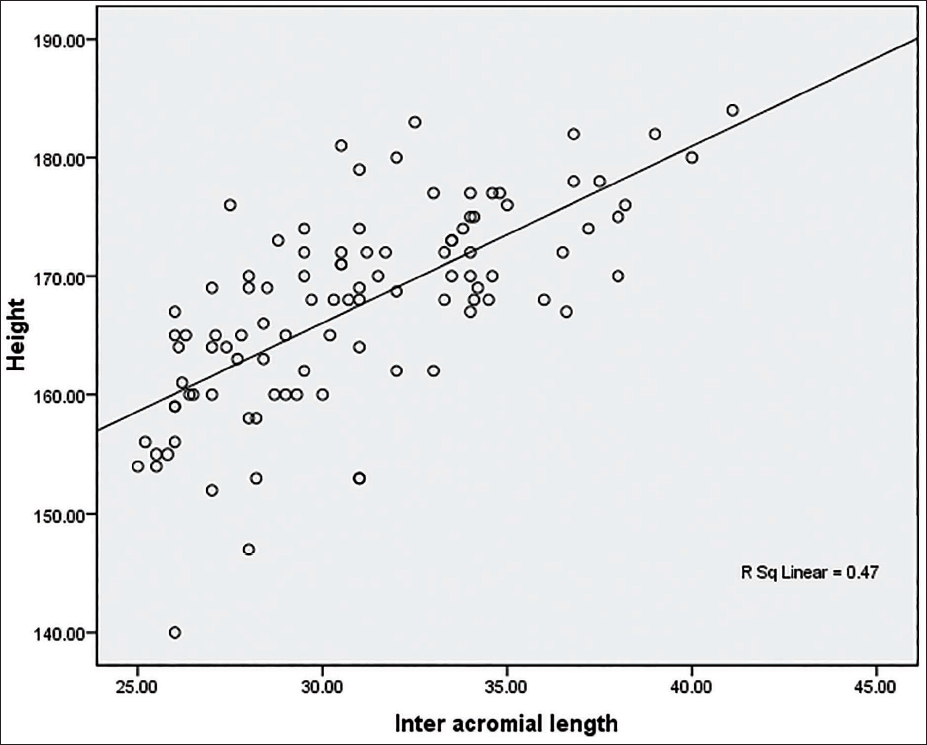
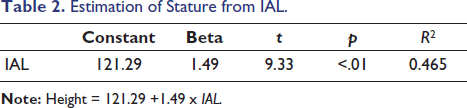
While IAL is useful, it does not fully explain height variability due to factors like genetics, nutrition, and environment. Despite this, IAL remains a valuable metric for forensic stature estimation. The study’s mean height (167.4 cm) and IAL (30.9 cm) reflect sample-specific traits. For accurate forensic applications, population-specific data should be considered, as anthropometric dimensions vary across ethnic and regional groups. Standardizing IAL-based models for height estimation across populations can enhance their accuracy, particularly in countries like India, where there is significant regional diversity (Table 2).
Estimation of Stature from IAL.
Key Findings of the Relationship Between Stature and IAL
Positive Correlation: The study identified a significant positive correlation between IAL and stature, with a correlation coefficient (r) of 0.686, indicating a moderately strong relationship. This correlation suggests that as IAL increases, stature tends to increase proportionally.
Regression Model for Stature Estimation: A linear regression model was developed for estimating stature based on IAL. The model equation, Height = 121.29 + 1.49 IAL, provides a predictive basis for height estimation from IAL measurements.
Explained Variance (R2): The R2 value of 0.465 indicates that approximately 46.5% of the variance in height can be explained by IAL. This shows a moderate predictive power, confirming that while IAL is a significant indicator of stature, other factors also contribute to height variability.
Interpretation of Findings
The IAL demonstrates a positive correlation with stature (r = 0.686), aligning with anthropometric principles that shoulder width scales with overall body size. While height is influenced by multiple factors such as leg and torso length, IAL remains a reliable forensic indicator, particularly when other measurements are unavailable. Its advantages include stability and accessibility, as it can be measured even in compromised remains, as well as simplicity, reducing errors in field conditions. Additionally, the shoulder width to height relationship shows consistency across populations, enhancing its applicability. However, limitations such as age-related changes and lifestyle factors (e.g., muscle development) may introduce slight variations in accuracy. Despite this, IAL serves as a practical tool for stature estimation in forensic anthropology.
Discussion
The present study demonstrated a significant positive correlation between IAL and stature (r = 0.686, p < .01), with the regression equation, Height = 121.29 + 1.49 × IAL, explaining 46.5% of the variance in stature (R2 = 0.465). This confirms that IAL is a useful anthropometric parameter for stature estimation. Nevertheless, the correlation was moderate, indicating that IAL alone cannot account for all height variability. This limitation suggests the value of incorporating other measurements such as arm span, foot length, or limb bone dimensions into predictive models.
Our findings show partial agreement with Bhatnagar et al. 7 (2024), who reported higher correlations between biacromial breadth (BAB) and stature in a homogeneous population, with strong gender-specific regression equations; Stature = 103.97 + 1.71 × BAB for males and Stature = 104.68 + 1.4 × BAB for females. Their R2 values were higher than ours, possibly due to the reduced variation within their study sample and the use of separate equations for each sex, which better accounted for sexual dimorphism. In contrast, our study employed a combined model for males and females, which may dilute correlation strength because of sex-specific anatomical differences.
When compared with Yadav et al. 8 (2023) our correlation values were notably higher. Yadav recorded a moderate correlation between IAL and stature (r = 0.369), especially in males, with weaker values in females. The stronger correlation in our study may be attributable to differences in sampling technique, regional body proportion variations, and standardized measurement protocols, which likely reduced random measurement errors and enhanced statistical reliability.
Similarly, our results appear more predictive than those of Sharma et al. 9 (2022) whose R2 values for BAB were approximately 0.387 across gender-specific equations. Sharma’s methodology of formulating distinct male and female equations emphasized sexual dimorphism but yielded slightly lower predictive accuracy. Our higher R2 values likely stem from the inclusion of a larger sample size collected prospectively over a one-year period, using consecutive sampling that ensured uniformity of data acquisition. However, Sharma’s gender-specific approach does suggest that creating separate regression models for each sex in our population could increase precision further.
Comparison with Singh et al. 10 (2022) reveals that their Tamil population sample produced an R2 of 0.61, considerably higher than ours. This discrepancy may reflect the relative uniformity of body proportions in the Tamil population compared to the greater diversity seen in southern Haryana. Singh’s sample likely benefited from more consistent anthropometric relationships between shoulder breadth and stature, which are affected by genetic, nutritional, and lifestyle factors. The difference underscores the importance of region-specific stature models in forensic application, as population heterogeneity can lower predictive strength.
Beyond shoulder breadth, other upper limb dimensions have also demonstrated utility in stature estimation. Yeasmin et al. 11 (2022) showed that ulnar length had greater predictive accuracy for stature than shoulder-elbow length in a Bangladeshi population, evidenced by higher R and R2 values and lower standard error of estimate. The implication for our study is clear integrating IAL with other upper limb measurements could offset the limitations of using shoulder breadth alone, thereby improving overall predictive reliability.
A closer parallel result is found in Parul et al. 12 (2019) who reported moderate correlations between BAB and stature (R2 = 0.571 combined, 0.492 for males, and 0.313 for females). This pattern mirrors our observation that IAL more strongly predicts stature in males than females, likely due to greater proportional consistency in male shoulder width relative to height. The slightly lower combined R2 in our study may be due to broader population diversity and a higher degree of biological variation across individuals.
The highest predictive strength among the compared studies was observed in Nayak et al. 13 (2019) with a combined correlation coefficient of 0.8163. Their stronger relationship between IAL and stature, particularly among males, likely results from studying an ethnically and environmentally homogeneous population. In contrast, our results reflect the variability inherent to a mixed northern Indian demographic. These differences highlight why population-specific regression equations are critical for forensic stature estimation and why models derived from one region may have limited transferability to another.
Overall, while our findings support the use of IAL as a valid parameter for estimating stature, the moderate correlation and R2 values emphasize the multifactorial nature of human body proportions. Differences in predictive strength between our study and others can be explained by variations in population demographics, geographic region, ethnicity, sex-based morphometrics, sample homogeneity, and the use of sex-specific equations. For forensic applications, integrating IAL with other anthropometric measures and tailoring regression equations to specific populations and genders would increase accuracy.
Limitations and Future Research Directions
Our study demonstrates IAL’s utility in stature estimation but has limitations. The moderate R2 (0.465) suggests additional parameters (e.g., limb lengths, chest circumference, cranial dimensions, etc.) could improve accuracy in a multivariate model. The sample, though representative, may not reflect broader anthropometric diversity. Future studies should include diverse age groups, ethnicities, and regions to enhance generalizability.
Conclusion
This study evaluated the utility of IAL as a predictor of stature in a cadaveric sample from southern Haryana. IAL demonstrated a significant positive correlation with stature (r = 0.686, p < .01), and the regression equation derived, Height = 121.29 + 1.49 IAL and explained 46.5% of the variance in stature (R2 = 0.465). These findings indicate that IAL is a moderate and reproducible anthropometric marker for preliminary stature estimation when more direct measurements are unavailable.
Compared with prior research, our model shows comparatively higher predictive strength than several studies that reported weaker correlations, while remaining below the highest R2 values reported in more homogeneous population samples. Differences in predictive power across studies are plausibly due to population-specific body proportions, sampling strategies, and methodological choices. Homogeneous or regionally restricted samples, sex-stratified models, strict inclusion criteria, and standardized measurement protocols tend to produce stronger IAL–stature relationships. Heterogeneous or mixed samples and varied landmark definitions reduce explained variance. Post-mortem factors such as muscle relaxation further differentiate cadaveric measurements from living subject data and may affect absolute values and predictive performance.
The moderate R2 observed in our study highlights both the strengths and limitations of using IAL alone for stature estimation. As a single parameter, IAL offers practical advantages: it is easily accessible, reproducible on upper body remains, and useful in forensic scenarios involving partial or dismembered remains. However, nearly 53.5% of stature variance remained unexplained by IAL, indicating that reliance on IAL alone may produce substantial estimation error in individual cases.
For enhanced forensic accuracy, IAL should be incorporated into multi-parameter models. Combining IAL with complementary linear measures such as arm span, ulnar length, tibial or foot length can increase explained variance and reduce the standard error of estimate. Development of sex-specific and population-specific regression equations is advisable to account for sexual dimorphism and regional anthropometric patterns. Additionally, standardizing cadaveric measurement protocols and explicitly reporting post-mortem conditions (position and time since death) will improve comparability and applicability of predictive models.
Strengths of the present work include its prospective and consecutive sampling, and standardized measurement technique, which enhance internal consistency. Limitations include a moderate sample size, single center demographic focus, and inherent post-mortem alterations that limit direct extrapolation to living populations and to dissimilar ethnic groups.
In summary, IAL is a useful, moderately predictive indicator of stature within the studied population. Its forensic utility is maximized when used as part of a validated, population-specific multivariate model rather than as a sole predictor. Future research should expand sample diversity, compare cadaveric and living measures, and construct multivariate, sex-specific equations to improve precision and forensic applicability.
Footnotes
Declaration of Conflicting Interests
The authors declared no potential conflicts of interest with respect to the research, authorship, and/or publication of this article.
Ethical Approval
Ethical clearance was taken for this study.
Funding
The authors received no financial support for the research, authorship, and/or publication of this article.
Informed Consent
The informed consent has been obtained from the next of kin of the deceased for the study.
