



Abstract
Regional conditions that smoothen the process of creative destruction and reduce adjustment costs are key transformative features. The aim of this article is therefore to first assess the regional presence of low- and high-demand occupations, and second, to assess the likelihood that workers in low-demand occupations will make productive changes to high-demand occupations in their region. Using matched employer-employee data on Sweden for the period 2015–2019, we calculate the regional relatedness density for all occupations and then assess whether this ‘regional opportunity space’ provides labour market channels for workers to move from low- to high-demand occupations in the region. Our findings reveal stark regional differences in matching between low- and high-demand occupations that transcend the regional functional hierarchy. Subsequent logit regressions support the notion that regions with a high density of related high-demand occupations provide labour market channels that increase the likelihood of productive change among exposed workers. The influence of these structural regional features outweighs that of the mere presence of high-demand occupations as well as both the size and diversity of the labour market.
Introduction
Since the mid 20th century, labour markets have been characterized by an increased international functional division of labour. In many western countries, this period has generally seen wages and living standards rise. However, it has also brought increasing intra- and inter-regional inequalities in incomes and employment opportunities, exaggerated by ongoing structural changes that make the future prospects for a large share of workers subject to increasing volatility (Iammarino et al., 2019). For example, the Organization for Economic Co-operation and Development (OECD) has predicted radical shifts in the future numbers of jobs and types of skills required (Nedelkoska and Quintini, 2018), amplified by demand shocks for green skills (Vona et al., 2018) and supply shortages due to population aging (McCann, 2017).
These general labour market pressures are characterized by stark regional variation due to existing patterns of specialization (Henning and Eriksson, 2021), giving rise to a new geography of opportunities in which workers’ ability to adapt to ongoing labour market realignments are increasingly shaped by the location of their employment (Storper, 2018). The cumulative process of regional divergence creates a strong transformative potential for workers with in-demand skills in a few regions while limiting transformative opportunities for workers with similar skills in less opportunity-rich regions (Feldman et al., 2021). While migration is typically described as a way for workers to adapt to a changing economic landscape, workers in more peripheral labour market segments may lack the resources to seek opportunities in other regions (Ilyés et al., 2023), especially when facing job loss (Eriksson et al., 2018). The feasibility of transitioning from activities in decline to ones that are expanding thus becomes a key transformative feature that could reduce individual adjustment costs (Aghion et al., 2009) while also mitigating the risk of continuous deterioration of productive capabilities and the emergence of regional ‘development traps’ (e.g. Diemer et al., 2022).
This article therefore aims to analyze the regional opportunity structures that condition the likelihood of workers switching from low- to high-demand jobs. We merge matched employer-employee data from Statistics Sweden 2015–2019 with national occupational projections for future labour market demand created by the Swedish public employment agency, enabling us to map regional variation in low- and high-demand occupations. We must also consider the cognitive proximity between different occupations because realized labour flows can be regarded as a proxy for the transferability of skills and experiences between occupations (Neffke et al., 2017). To this end, we construct skill-relatedness matrices between all occupation pairs for the 60 functional labour markets in Sweden during the period 2015–2017. We then estimate the likelihood for workers in low-demand occupations to switch to a high-demand occupation between 2018 and 2019 based on the local concentration of high-demand occupations related to their current low-demand occupation. Finally, the influence of this ‘regional opportunity space’ for workers in low-demand occupations is compared to that of other regional characteristics like labour market size, sectoral diversity and the share of high-demand occupations.
This article addresses calls concerning the need to thoroughly assess how local labour market structures open, or foreclose, the branching of labour from declining to expanding activities (e.g. MacKinnon, 2017). Previous studies have shown that the structure and relatedness of occupations condition the future regional landscape of jobs (Hane-Weijman et al., 2022) and the redeployment opportunities of workers within regional labour market segments (Morkutė et al., 2017), while also channelling upwards career mobility as regions diversify (Elekes et al., 2023). While our approach is mostly related to that of Elekes et al. (2023), we contribute to the broader body of literature in two ways. First, we use a weighted measure of relatedness density to include all activities in the region rather than only those with a revealed comparative advantage (RCA). This allows us to capture better the opportunity spaces in smaller regions, where knowledge about transformative capacity is presumably more urgently needed (Davies and Maré, 2021). Second, rather than addressing structural changes at the regional level or the underlying micro-level processes, we explicitly assess transformative potential by analyzing micro-level mobilities that enable structural change at the regional level. We thereby provide empirical evidence on channels for regional change, as called for by Bathelt and Storper (2023), and show how this ‘regional opportunity space’ influences regional workers’ redeployment potential in otherwise similar regions. We find that worker groups that typically face higher adjustment costs (notably, older and low-educated workers) benefit relatively more from being embedded in more favourable structures. This is important as it highlights the need to consider individual groups of workers in their specific contexts when evaluating their opportunity spaces.
Literature review
Labour mobility is typically described as a key micro-mechanism that enables structural change and long-term economic development. Since regional economies are characterized by economic decline in some sectors and expansion in others, it is often argued that flexible labour markets are needed to let workers move from shrinking to growing activities (Pasinetti, 1981) and regions (Harris and Todaro, 1970). Given the predominantly regional dimension of both voluntary and forced job mobility (Eriksson et al., 2018), the so-called branching process of workers in response to labour market realignments is strongly conditioned by regional opportunities to find appropriate employment (MacKinnon, 2017). Regional reallocation of workers is thus required to smooth the process of creative destruction at the regional scale and reduce adjustment costs for both individuals and society (Aghion et al., 2009) so as to establish new regional growth paths and avoid ‘development traps’ (Diemer et al., 2022).
It is well established that people’s employment and re-employment opportunities are significantly impacted by regional characteristics as well as their individual attributes (e.g. Bluestone, 1984; Dawley et al., 2014; Eriksson et al., 2018; Hane-Weijman et al., 2018; Neffke et al., 2017; Nyström, 2018; Shuttleworth et al., 2005). Efforts to understand the impact of regional factors on reallocation opportunities are typically embedded in the literature on agglomeration economies and discussions of specialization and diversity. In this context, it is argued that denser environments enhance the potential for regional actors to benefit from sharing, matching and learning (Duranton and Puga, 2004), which is assumed to increase with region size (e.g. Puga, 2010). This is because in larger regions, it is more likely that job seekers will find large numbers of employers that desire their skills, while firms will simultaneously have a larger number of workers with suitable skills to choose from.
Others have argued that it is not size per se that causes these positive effects but rather the regional economic structure, which has traditionally been discussed in terms of specialization or diversity. However, Frenken et al. (2007) argue that the distinction between specialization and diversity is excessively crude. Instead, they emphasize that activities with many shared dependencies on specific underlying resources (e.g. human capital) are more related than those with few such common dependencies. From this perspective, it is characteristics along the specialization-diversity continuum that shape the capacity of regional labour markets to re-employ redundant workers (Bluestone, 1984; Dawley et al., 2014). For example, a specialized agglomeration tends to facilitate re-employment during a firm-specific crisis due to the high concentration of similar employers in the local economy (Hane-Weijman et al., 2018) but may also increase a region’s vulnerability to industry-specific shocks (Boschma, 2015). Conversely, a diverse regional mix of economic activities is argued to spread risk and reduce unemployment by providing a broad range of job opportunities (Frenken et al., 2007). However, while diverse regional labour markets may increase the chance of finding a job (Puga, 2010), and thus mitigate unemployment caused by asymmetric shocks, switching to unrelated jobs can cause underemployment in the longer run (Hane-Weijman, 2021) and result in wage loss (Poletaev and Robinson, 2008). This implies that it is job-specific rather than region-specific structures that influence the potential for career mobility, as regional specializations differ in the commonality of their resource requirements (Kuusk, 2021).
This line of argument is important because one of the most prominent features of the world economy is the functional specialization of regions and the corresponding spatial division of labour, as described by Massey (1995). Because co-agglomeration is a recurring feature of regional economies, the industrial structures of regions differ in terms of both structure and content. This implies that the spatial division of labour generates distinct local profiles of redeployment potential that are path-dependent and shape potential labour market mobilities over time (O’Clery and Kinsella, 2022). This is particularly evident when considering occupations (as opposed to industries) because functional specialization means that the skills and occupations used to produce goods and services will vary within an industry across regions (Farinha et al., 2019; Wixe and Andersson, 2017). These regional profiles do not only condition what is produced and how but also the future development trajectories due to the path-dependent character of investments and labour market change. As exemplified by Hane-Weijman et al. (2022), regions are characterized by coherent occupational profiles that strongly condition both their overall development trajectory and the growth of specific occupations due to the recombinatorial possibilities created by the relatedness of different occupations. Because of the modular structure of such mobility networks (O’Clery and Kinsella, 2022), the regional portfolio of occupations conditions local employment reallocation and the extent to which local workers’ skills and experiences can be applied in other activities (Morkutė et al., 2017). Thus, in accordance with the arguments of both Kuusk (2021) and Bathelt and Storper (2023), revealed labour market channels appear to represent the most plausible operationalization of relatedness at the regional level.
A few recent publications have examined the relationship between structural features and individual career opportunities. In their study on how the direction of regional diversification opens or forecloses career opportunities for low-wage workers, Elekes et al. (2023) show that diversification towards high-wage jobs that are related to existing low-wage jobs improves opportunities for occupational shifts towards better-paid jobs for workers in Swedish regions (see also Cardoso et al., 2023 for a Brazilian example). These works approach the variation in redeployment potential among workers in the labour market by evaluating the ability to transition to better-paid, and presumably more productive, jobs based on both supply- and demand-related regional conditions. It is well-established that supply-side factors such as age, gender, education and income influence mobility patterns (e.g. Autor et al., 2003; Eriksson et al., 2018; Oesch and Baumann, 2015; Wooden, 1988). 1 However, Avent-Holt et al. (2020) argue that there is still a scarcity of works scrutinizing the impact of the demand structure (i.e. available jobs) and how demand- and supply-side characteristics jointly condition the potential career mobility of different workers. There is thus a need to further scrutinize the heterogenous opportunity structures facing different groups of workers across space to avoid reinforcing the regional divergence and polarization experienced in recent decades.
Data and methods
The register-based labour market statistics used in this analysis cover every individual in Sweden between 18 and 64 years of age who receives their primary income from employment. The data are of panel structure and capture the 5 years from 2015 to 2019. While data are available up to 2021, the two final years are omitted due to the COVID pandemic, which strongly influenced the labour market. Workers are not represented in the data during years when they received their primary income from sources other than employment, making the panel unbalanced. While the labour market statistics include several socio-economic attributes connected to each worker, the primary data used are the workers’ occupational classification, place of employment (municipality), educational level, birth year, income and sex.
Occupational class is reported according to the 2012 version of the Standard for Swedish Occupational Classification (SSYK), which is equivalent to the European ISCO-08 classification. The three-digit level was used since the four-digit level would produce many occupation-region combinations with too few observations to include in the analysis. Municipalities were aggregated into the 60 functional analysis regions (FA-regions) developed by the Swedish Agency for Economic and Regional Growth. This regional division was chosen to reflect long-term regional functionality in terms of commuting patterns, which represent people’s labour mobility patterns better than the boundaries of administrative municipalities.
To define future low- and higher-demand occupations, publicly available occupational prognosis data were accessed from the JobTech Development data platform provided by the Swedish Public Employment Services. This dataset classifies four-digit occupations as being in low, high or very high demand based on projected national labour market competition for 2026. This dataset was published in November of 2021 and represented the agency’s most recent prognosis at the time of writing. Briefly, the prognosis is based on changes in the age distribution of workers and the educational orientations of the Swedish population as well as digitalization and automation. While such projections naturally come with some uncertainty, the underlying demographics of the workforce (e.g. foreseen retirements) and future supply (current education tracks of the future workforce) have high weights in the prognosis, making it relatively reliable. 2 We assume that high labour market competition (i.e. over-supply) corresponds to lower future demand within an occupation, and vice versa. No prognosis is available for managerial and military occupations, or for occupations with fewer than 3000 employees nationally, so these occupations are excluded from the analysis. 3
Aggregation from four- to three-digit categories was achieved by applying weightings based on the number of employees in each four-digit occupation within a three-digit category; occupations with more employees were assigned greater weights. While this approach may hide some variation at the four-digit level, it simplifies interpretation. By 2026, 25 occupations at the three-digit level are forecasted to be in low demand, while 63 are projected to have high or very high demand. For clarity, the latter are merged in the analysis. ‘Low/high demand occupations’ and ‘declining/growing occupations’ are used interchangeably henceforth.
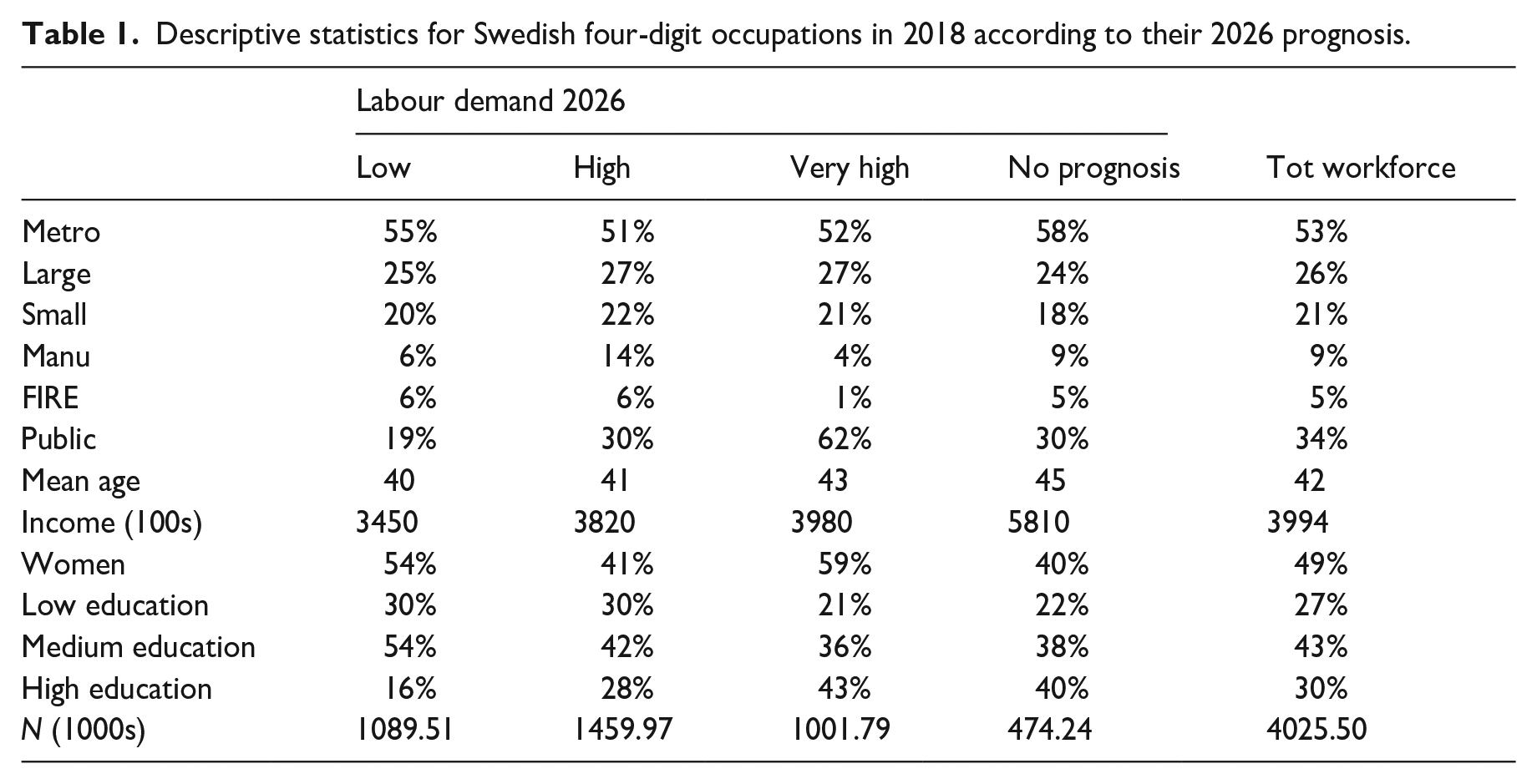
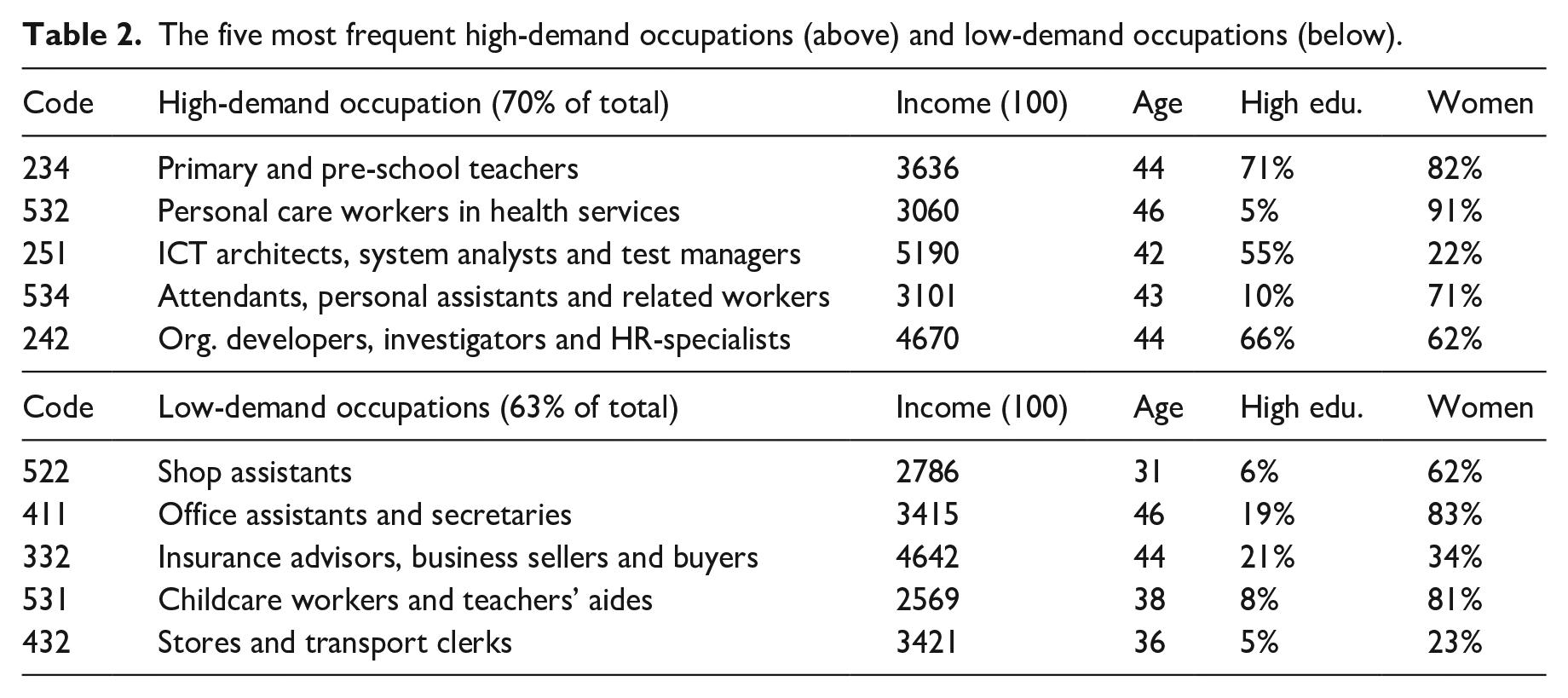
Table 1 shows that low-demand jobs are overrepresented in the three metro regions (Stockholm, Gothenburg and Malmö), while high- and very high-demand occupations are somewhat more frequent in large (second tier) and small regions. There is also a clear underlying demographic structure: the mean age is higher in higher-demand occupations than in low-demand occupations, implying higher future retirement rates in high-demand occupations. Occupations defined as having a higher future demand have better pay than the average occupation (although significantly lower than occupations without prognosis, which include managerial occupations and so on). The higher-demand occupations are also characterized by higher proportions of female and highly educated (holding at least a 3-year university degree) employees. The most common high- and low-demand occupations (collectively representing 70% and 63% of all high- and low-demand occupations, respectively) are shown in Table 2 (for a full list of projected occupations, see Table A1 in the Appendix). Table 2 reveals some notable internal diversity: high-demand occupations tend to be female-dominated but also include Information and Communication Technology (ICT) jobs that employ mostly men. Educational levels and sectoral belonging also vary widely.
Descriptive statistics for Swedish four-digit occupations in 2018 according to their 2026 prognosis.
The five most frequent high-demand occupations (above) and low-demand occupations (below).
Variables reflecting regional opportunity space
To measure the worker-specific local availability of high-demand jobs, an index that could be attached to every individual based on their occupation, region and year of observation was calculated. This index reflects the local labour market opportunities in high-demand jobs for every worker in each year that they were observed.
The first step in building this index is to capture the skill-relatedness of occupations, that is, the likely labour market options based on their current occupation. The method of Neffke et al. (2017) was used to measure the intensity of job switches across each occupation pair, in relation to total job switches. A disproportionately high mobility between two occupations (relative to expected flows) implies similarity in tasks and skill requirements (Poletaev and Robinson, 2008). The skill relatedness between occupations

where

where
A major limitation of this study is that endogeneity problems may arise when analyzing job-switching in relation to an independent variable based on job switches (Cardoso et al., 2023). While there is no immediate way to break this relationship, we used skill-relatedness values based on job-switching between 2015 and 2017 when analyzing the period from 2017 to 2019. 5 While a longer gap between the two periods might have been desirable, changes in the job classification schemes made it impossible to go further back in time to construct the flow data.
As noted previously, the regional opportunity space defined by the relatedness density is not the only regional attribute that may influence the likelihood of making a career move. We therefore include two additional variables. The first is region size (Regional Size), defined as the number of workers in the region excluding the specific occupation, to capture general agglomeration externalities. This is necessary because factors such as absorptive capacity, re-employment incidence and matching quality are assumed to be better in large labour markets and because previous studies have also shown that region size reduces the negative effects of automation on jobs (Crowley et al., 2021) by facilitating career mobilities among other things (Czaller et al., 2021). Career possibilities may also depend on the range of activities in the region as well as the number of jobs because diversity promotes portfolio effects in relation to asymmetric shocks (Frenken et al., 2007; Puga, 2010). The absolute diversity

Here,
Control variables
In addition to regional size and structure, the local size of the source occupation is expected to reduce the probability of switching to another occupation. This indicates internal career opportunities in the present occupations (Neffke et al., 2017). The number of potential employers could also influence regional career opportunities (Morkutė et al., 2017). We therefore included an indicator of the share of small firms (less than 50 employees) in the region. These respective variables are labelled Occupation Size and Small Firm Share.
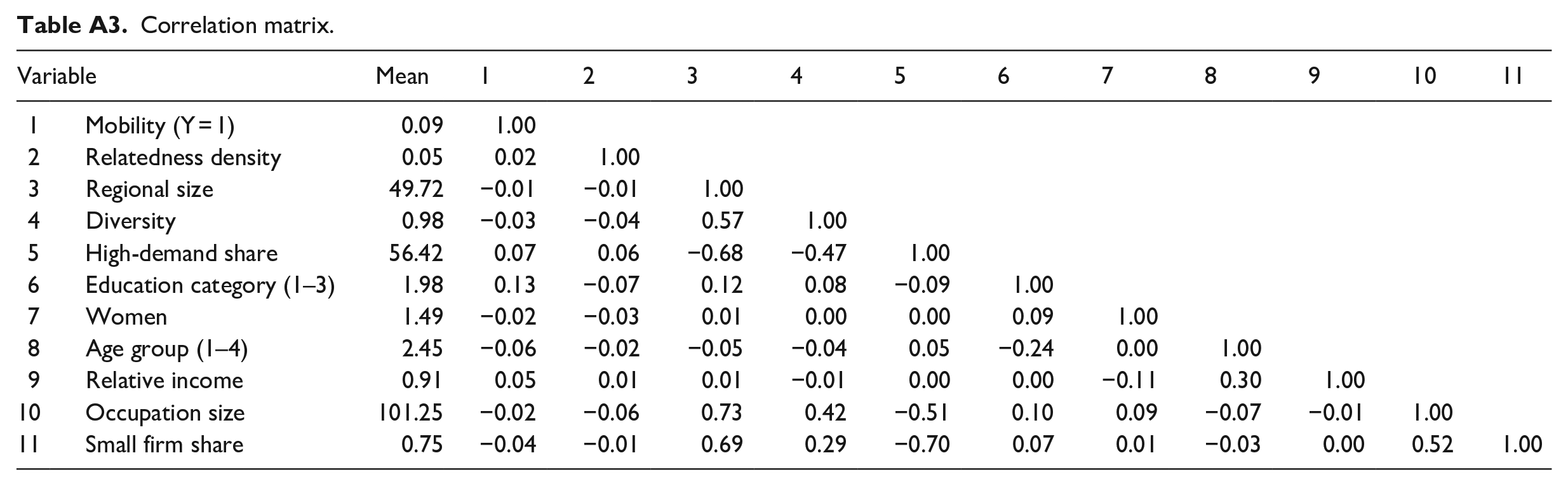
Labour market structures can create barriers or opportunities as demand changes. As a result, some groups may be disproportionately exposed to the risk of being unable to switch to high-demand jobs (Hane-Weijman, 2021; Oesch and Baumann, 2015). To account for this, three dummy variables were included to capture educational level (low, medium and high). Since mobility patterns vary significantly between men and women, sex was also used as a control variable. Moreover, because younger and older workers may be risk groups during times of structural change, four different age groups are considered: 18–29, 30–39, 40–49 and 50+. The final control variable is the worker’s relative income, defined as the observed income divided by the average income of the occupation in that region. This control variable is justified because job switches may be partly motivated by a desire for a higher income (Topel and Ward, 1992), so workers with higher relative incomes are expected to be less likely to change occupation. The definitions and means of each variable are shown separately for job switchers and for workers not changing occupations in Table A2 of the Appendix. The correlation matrix (Table A3 in the Appendix) indicates that there is little multicollinearity between the variables.
Dependent variable and estimation strategy
We define a binary dependent variable taking a value of 1 if the individual has made a job switch to a high-demand occupation between

Since occupation and sector affiliation both likely impact job-switching patterns due to variation in career opportunities, industry-specific wage levels and business cycles, we also included occupational and sector-specific fixed effects (defined based on two-digit NACE, Nomenclature of Economic Activities, sectors). In addition, to account for unobserved regional characteristics such as differing growth paths and absolute location, regional fixed effects were included. It should be noted that the analysis is subject to some limitations originating from the structure of the data and the limited time period it covers. We have an unbalanced panel of 2 years, and the lack of repeated observations at the individual level makes it virtually impossible to control for unobserved heterogeneity in factors such as ability. These limiting factors mean that the results must be interpreted with some caution. Moreover, we have repeated observations within similar regions, so the observations cannot be considered independent. Cluster-robust standard errors at the regional level are therefore added. The model thereby treats observations within the same region as dependent and considers potential spatial patterns that may influence job switches.
Results
Figure 1 shows the regional distributions of labour market size (a), the share of declining occupations (b) and the relatedness density to high-demand occupations (c), each divided into quartiles, with the lowest quartile having the lightest colour, and the highest the darkest. As seen in Figure 1(a), most workers are concentrated around Sweden’s three metropolitan regions (Stockholm in the east, Gothenburg in the west and Malmö in the south), with a belt connecting Gothenburg and Stockholm, as well as relatively large regions along the northern coast (especially in regional centres like Umeå and Luleå). Of more interest is the concentration of low-demand or declining occupations, which does not follow the regional population distribution. There are high concentrations of declining occupations in large regions like Stockholm and Malmö, but also in smaller regions like Arjeplog and Arvidsjaur in the northern inlands, and Kramfors and Haparanda along the northern coast (Figure 1(b)). Apart from these two regions, most northern regions have relatively low concentrations of declining occupations. Instead, southern regions like Halmstad, Värnamo and Borås are in the top quartile.
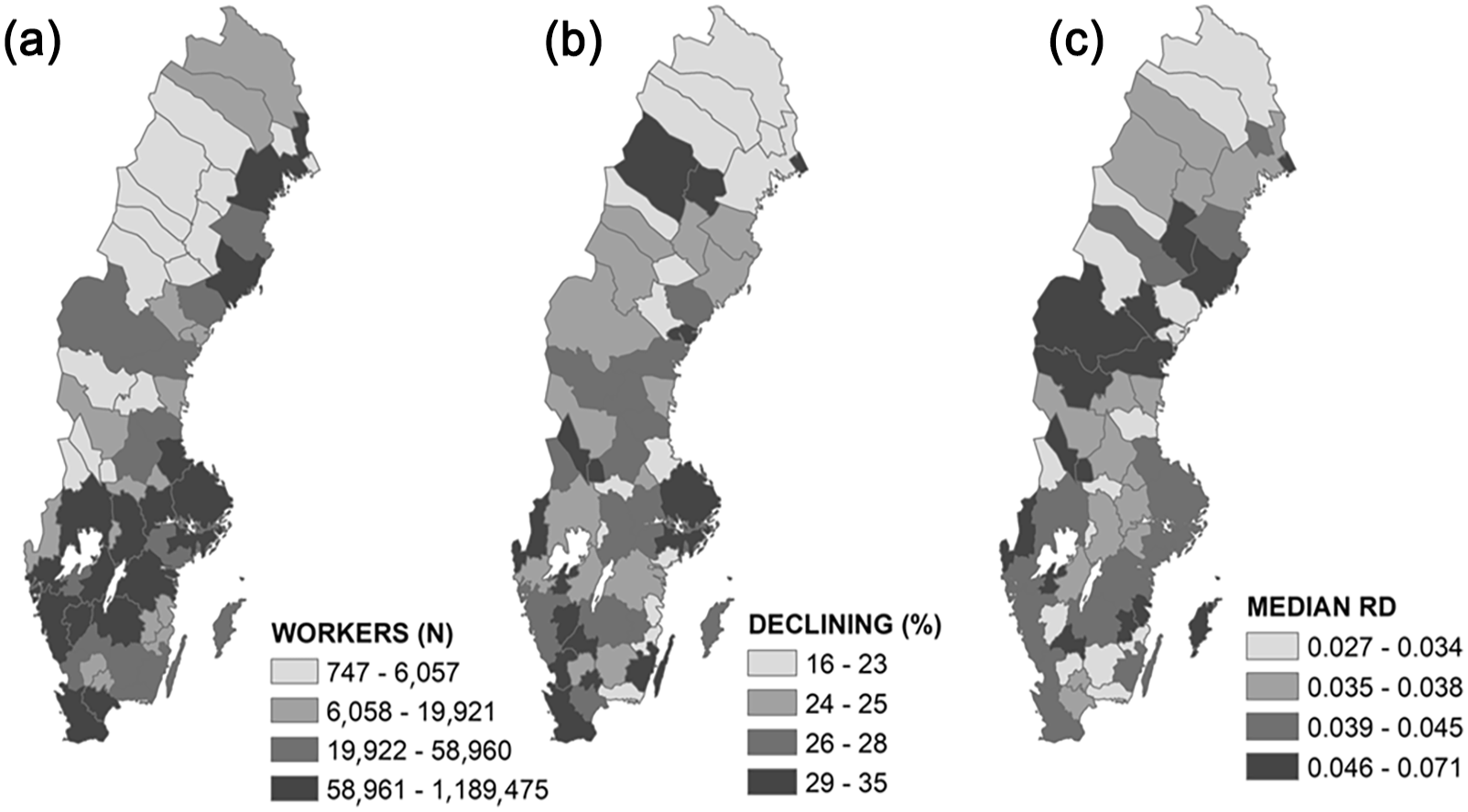
Regional distribution of workers (a), declining occupations (b) and relatedness density to high-demand occupations (c).
Despite this, the regional distribution of opportunities for workers to switch to high-demand (or growing) occupations looks quite different (Figure 1(c)). Although there are relatively few declining occupations in the north, these regions have some of the lowest relatedness densities to growing jobs. This implies that the risk of not finding alternative occupations is higher for the small share of workers in declining occupations in these regions, due to potential skill mismatches. One exception is the small region of Haparanda in the north, which has both a high concentration of low-demand jobs but also a relatively high relatedness density to growing jobs. Otherwise, the northern regions with the highest concentrations of related high-demand occupations (as well as relatively low concentrations of low-demand occupations) are the regional centres of Umeå, Sundsvall further south and Östersund in the northwest.
The opportunity space seems more favourable in southern and western Sweden, with regions like Värnamo and Västlandet having high shares of low-demand occupations but also relatively high concentrations of related high-demand occupations. Notable is also that metropolitan regions such as Stockholm and Malmö have relatively high shares of low-demand occupations without high concentrations of related high-demand occupations. This reflects the segmented structure of urban labour markets, which tend to have high internal diversity while also containing many relatively isolated labour market segments that could limit career mobility, as described by Elekes et al. (2023).
Figure 2 shows more detailed data of four regions in the quartile with the highest shares of low-demand jobs that exemplify these regional differences in opportunities for workers in low-demand occupations. Värnamo and Haparanda have high relatedness density to high-demand jobs, whereas Borås and Kramfors are both in the lowest quartile for this variable. When comparing the opportunity space of these regions, the low-demand occupations (red) in both Borås and Kramfors are less embedded with high-demand occupations (green) than those in Värnamo and Haparanda. A particularly isolated low-demand occupation in both Borås and Kramfors is that of insurance advisor, which mainly has links to other low-demand occupations (e.g. office assistants and client information clerks in Borås). Opportunities to make switches within one’s region are thus likely to vary within the same occupation across space. In Värnamo and Haparanda, the susceptible occupations are either smaller or firmly embedded in the regional occupation structure (e.g. shop staff in Haparanda or rubber and plastic product machine operators in Värnamo).
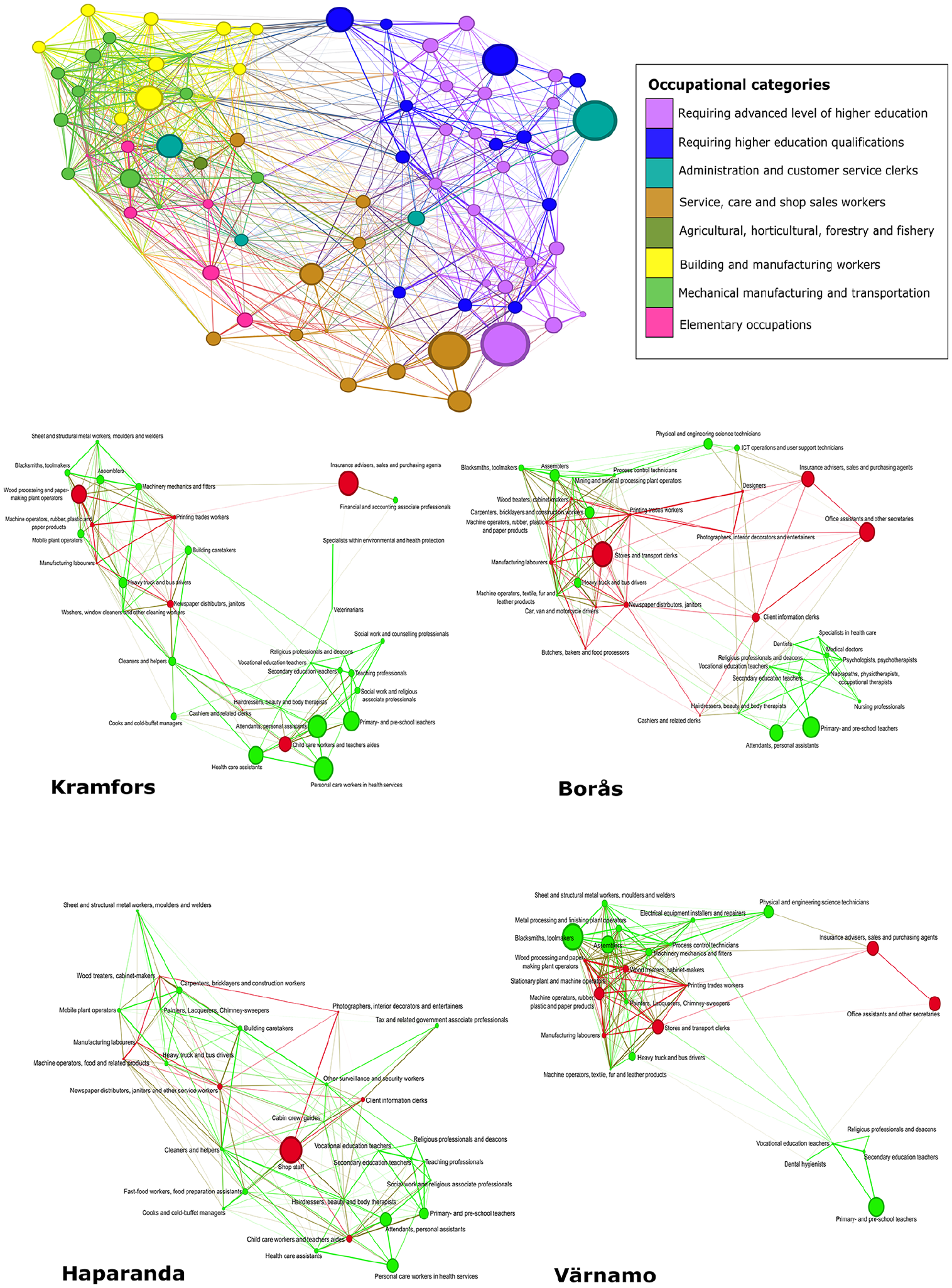
Opportunity spaces for different occupation classes in Sweden (top) and the regional opportunity spaces of selected small- (Kramfors and Haparanda) and medium-sized (Borås and Värnamo) regions with high concentrations of low-demand occupations. Relatedness density is low in Kramfors and Borås (middle panel) but high in Haparanda and Värnamo (bottom panel). Each node represents a three-digit occupation. Red and green nodes represent forecasted low- and high-demand occupations, respectively. Node size represents the number of employees within the corresponding occupation in the region and edges connecting nodes represent links based on related skills. Occupations closer to each other have more shared skill requirements than occupations further away.
To start assessing how these opportunity spaces influence mobility from low- to high-demand occupations, Figure 3 shows the rates of occupational mobility for workers in low-demand jobs across the regional relatedness density distribution. While the total likelihood of occupational change (i.e. to any other occupation) seems to be relatively weakly related to the relatedness density of high-demand occupations (if anything, the relationship seems to weaken slightly in the highest relatedness density deciles), there is a slow but steady increase in likelihood of mobility to high-demand jobs with increasing regional relatedness density. Thus, despite not accounting for other determinants of mobility, these descriptive findings suggest that the presence of related occupations correlated with a broader opportunity space for career mobility.
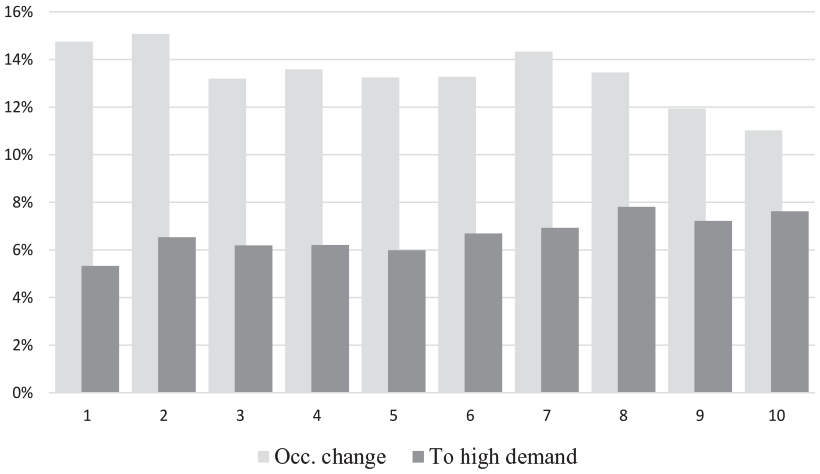
Unconditional probabilities of changing occupation (light grey bars) and changing to a high-demand occupation (dark grey bars) given the relatedness density of high-demand occupations in region.
Table 3 shows regressions on mobility likelihood based on four models of increasing complexity. Model 1 estimates the likelihood of moving from a low-demand to a high-demand occupation based on structural regional factors. Model 2 adds individual and regional control variables, and Model 3 also includes occupation-, industry- and region-specific fixed effects. While Model 1 could be argued to suffer from omitted variable bias because it excludes conceptually relevant controllers at the individual and regional levels, it serves the purpose of highlighting the role of regional size and structure before adding other variables. By structuring the analysis in this way, we capture the general perceived (and realized) opportunities of all workers in low-demand occupations. To account for the possibility of selection effects on movers compared to non-movers (stayers), the final model (Model 4) is a multinominal logit model using a joint regression framework that compares stayers to both movers to other low-demand occupations and movers to high-demand occupations.
Regressions on likelihood of workers in low-demand occupations moving to a high-demand occupation.
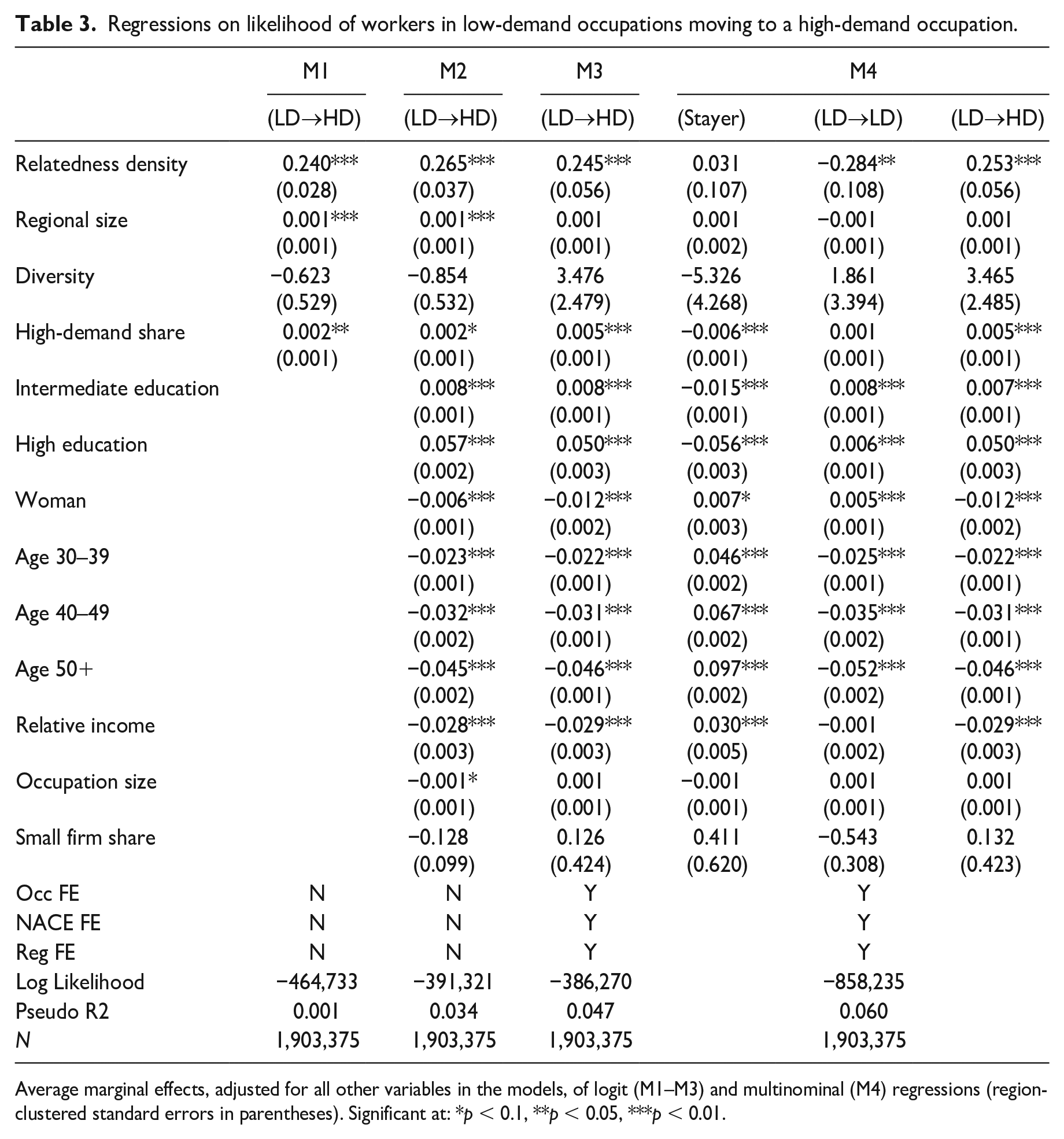
Average marginal effects, adjusted for all other variables in the models, of logit (M1–M3) and multinominal (M4) regressions (region-clustered standard errors in parentheses). Significant at: *p < 0.1, **p < 0.05, ***p < 0.01.
The results for Model 1 suggest that the opportunity space of regional economies does affect the likelihood of transitioning from a low- to a high-demand occupation. This is reflected in both the size variable, suggesting that larger agglomerations are better arenas for career mobility, and on the relative presence of high-demand occupations in regions. However, agglomeration and the presence of high-demand occupations do not provide the full picture: the occupational composition (structure) of the regional economy is also important. While diversity (i.e. the presence of a broad set of activities within the region) is not significant in any model, the density of related high-demand occupations is. This implies that while a diverse economy might withstand asymmetric economic turbulence through portfolio effects that increase the likelihood of finding any type of employment in the region (Frenken et al., 2007), it is not a regional characteristic that reduces individual adjustment costs and facilitates transitions to high-demand occupations. In this sense, our findings support the argument of Elekes et al. (2023) that a high density of related occupations opens career pathways in the regional economy that are unavailable to workers in more isolated occupations.
The inclusion of individual and regional-level controllers in Model 2 does not alter the trends revealed by Model 1, but the inclusion of fixed effects in Model 3 does. When controlling for unobserved occupation-specific (e.g. status), sector-specific (e.g. industry life cycle) and region-specific (e.g. location and distance) characteristics, only relatedness density and the share of high-demand occupations in the region remain significant. This means that potential movements between low- and high-demand jobs are not explained by market size and diversity per se but by the opportunities perceived through revealed labour market channels (i.e. the supply of jobs and their degree of relatedness to the current occupation). While the former is unsurprising given that a lack of high-demand jobs in the region would make a career switch less likely, the latter finding highlights the channels through which such transitions occur.
The control variables behave as expected. Workers with higher education levels typically have more general knowledge and a broader search radius than their less-educated counterparts, both of which increase the likelihood of making a career move. Younger workers have less occupation-specific human capital than older ones and are thus more likely to move to a high-demand occupation, as are men when compared to women. A high income relative to the mean for one’s occupation also reduces the likelihood of changing occupation, indicating that underpaid workers are more likely to change occupation. The share of small firms as such does not influence career mobility. These results are all robust when including fixed effects in Model 3. Only one control variable changes sign and significance across models: the internal occupation-specific labour market size has a negative association with changing occupation in Model 2 (which was expected since it reflects a worker’s ability to advance their career without changing occupation) but becomes non-significant when fixed effects are included.
Since the scales of the key variables differ, it is not straightforward to compare their marginal effects. To facilitate assessment of their economic significance, we computed the marginal effects of Models 1–3 using standardized versions of the variables (Table 4). The results obtained indicate that a standard deviation increase in relatedness density to high-demand jobs (amounting to around 0.03 units, or the equivalent of moving up a quartile group in Figure 1(c)) increases the probability of moving to a high-demand job by 0.5 percentage points. This may seem low, but it corresponds to two times a standard deviation change in the share of high-demand occupations (amounting to roughly 4 percentage points) under Model 1 and five times a standard deviation change under the most conservative model that includes both control variables and fixed effects (Model 3). Relatedness density to high-demand jobs thus seems to capture the perceived opportunities for career mobility among workers in declining occupations better than the mere presence of high-demand jobs. It should be noted that without regional fixed effects, the impact of labour market size (which is partly related to the presence of certain sectors and occupations) outweighs that of density by a factor of 1.5.
Marginal effects on standardized variables for the probability of moving from a low-demand to a high-demand occupation according to models M1, M2 and M3 of Table 3 (with an unchanged variable setup).
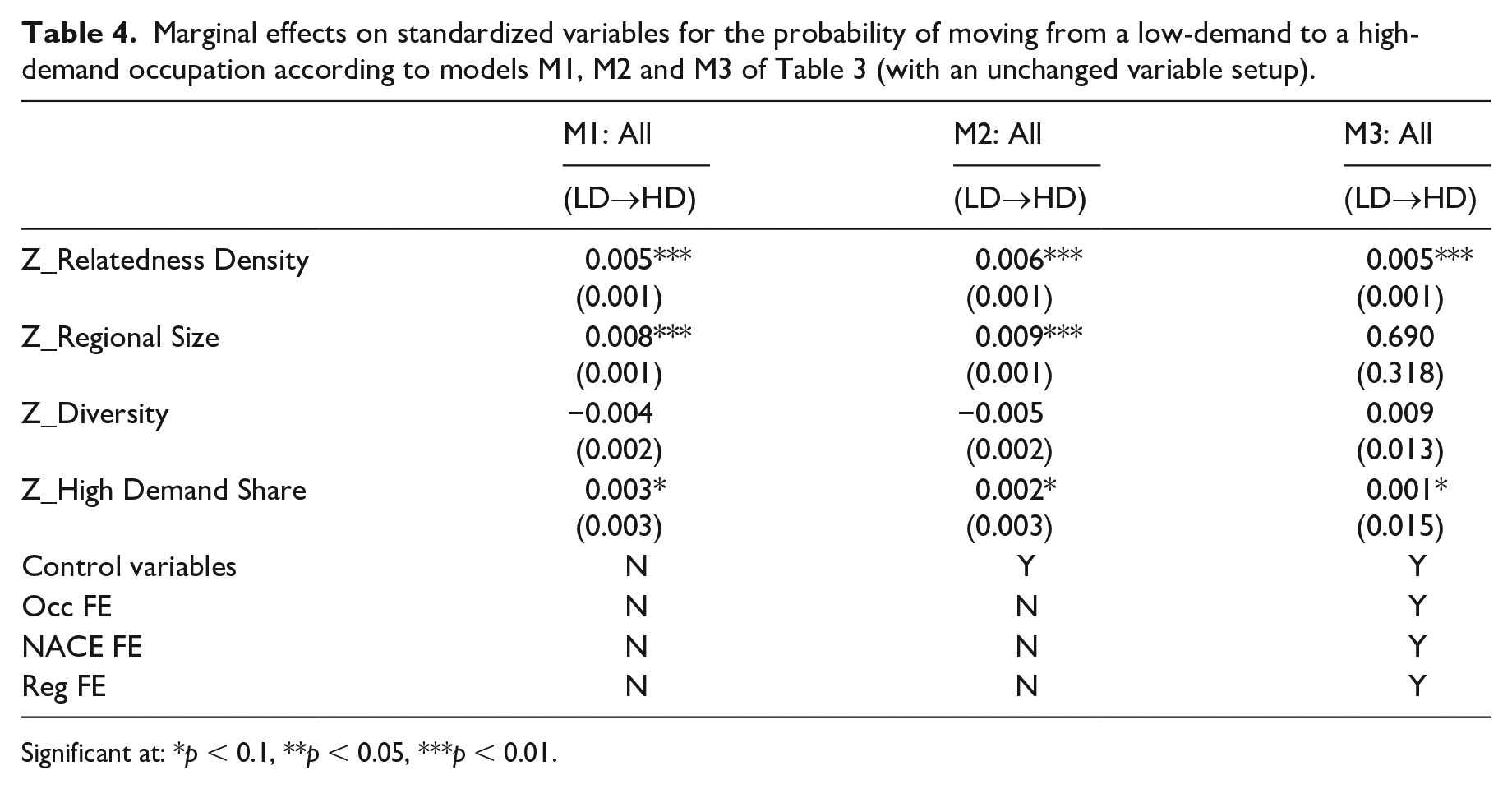
Significant at: *p < 0.1, **p < 0.05, ***p < 0.01.
The results may be biased by selection for movers compared to stayers. Therefore, two additional models were estimated. Model 4 (Table 3) is a multinominal logit model that compares the likelihood of a worker remaining in their present low-demand occupation to that of those changing to another low-demand occupation as well as that of those changing to a high-demand occupation. The main findings concerning the likelihood of changing to a high-demand occupation continue to hold under this model, but some notable additional findings are also obtained. First, as expected, relatedness density reduces the likelihood of moving to another low-demand occupation but does not significantly affect the likelihood of staying in the current occupation. Second, the share of high-demand occupations reduces the likelihood of staying but has no significant association with moving to another low-demand occupation. This suggests that the mere presence of high-demand occupations facilitates career moves and that the number of related occupations in the region can channel moves to high-demand occupations. Women are generally less likely to change occupation, but when doing so, they are more likely to move into another low-demand occupation, whereas men are more likely to make switches to high-demand ones. There is also an educational premium for moving in the sense that higher education in general (and a university degree in particular) facilitates mobility to a high-demand occupation. To assess the potential selection bias, a Heckman model using the probit link was generated by first estimating mobility based on individual income quartiles (to assess whether income influences mobility) and then estimating the likelihood of entering a high-demand rather than a low-demand occupation (this model is not provided here but is available upon request). The main findings obtained with the other models hold even under this model, albeit with slightly weakened marginal effects for relatedness density (0.218) and high-demand occupations (0.003).
Finally, we should expect some group-specific heterogeneity in terms of the role played by the regional opportunity space and the likelihood of changing to a high-demand occupation. We therefore examined the interactions of relatedness density with education, sex and age in the framework of Model 3. We found no significant interaction with sex, implying there is no significant difference in the role of relatedness density between men and women. However, while younger workers always have a higher likelihood of changing occupation, there is a small compensating effect of higher relatedness density for older worker groups (especially those aged 40–49) as shown in the left panel of Figure 4. Thus, for workers who presumably have a higher level of job-specific experience, the presence of a greater number of related occupations increases the likelihood of switching to a high-demand occupation where the worker’s accumulated skills and experience can be redeployed. This compensatory aspect of relatedness density is clearly visible in the right-hand panel of Figure 4, which shows that increasing relatedness density increases the likelihood of changing occupation among workers with an intermediate level of education (e.g. short secondary education) and, to a lesser degree, also for those with low level of education (primary school). Thus, for workers who generally have a narrower search radius when seeking new jobs, a better-perceived opportunity space with greater numbers of related high-demand jobs increases the likelihood of changing employment. Notably, this effect is strong enough that the likelihood of shifting among workers with a short secondary education almost converges with that for highly educated workers.
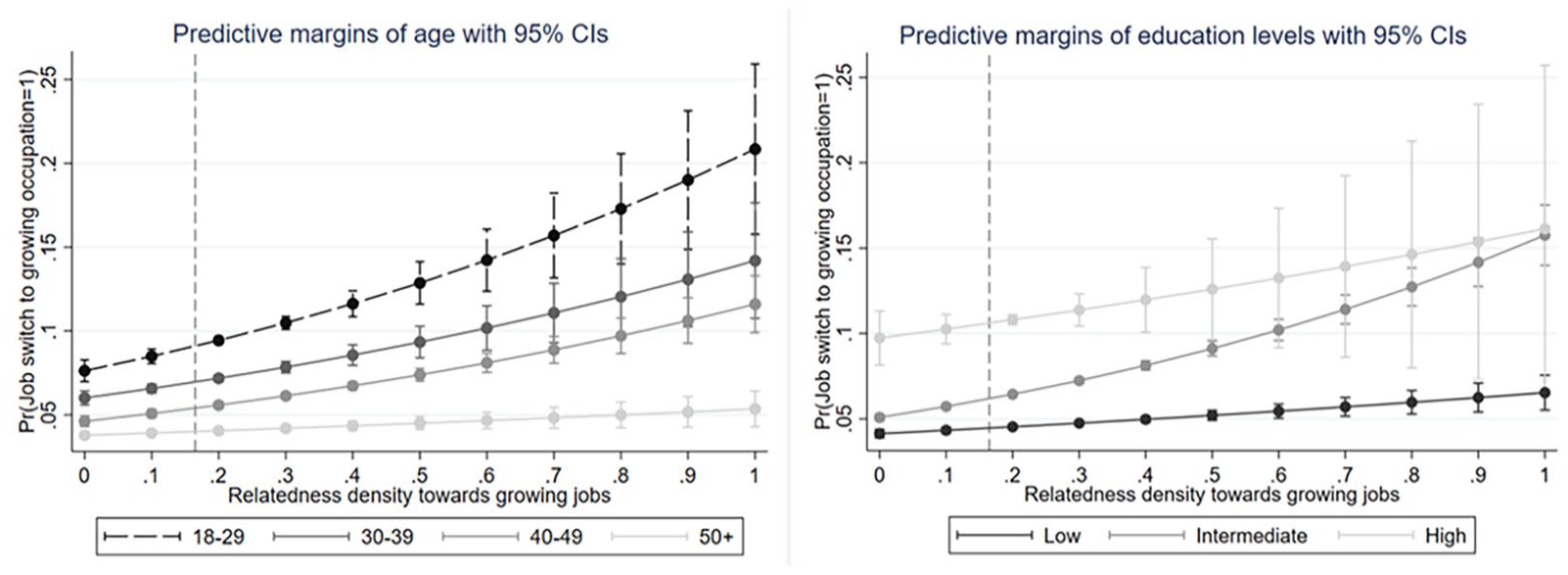
Predictive margins with confidence intervals (CI) for the interactions of age (left) and education (right) with relatedness density (based on Model 3 in Table 3). The median value of the normalized (0–1) relatedness density is indicated by a dashed vertical line in both plots.
Conclusions
The aim of this article was to assess how regional opportunity spaces, defined as labour market structures conditioning worker mobility, can facilitate labour branching from low- to high-demand jobs. We did this by using matched employer-employee data for each of Sweden’s regions between 2015 and 2019 to calculate the relatedness of each low-demand occupation to all high-demand occupations present in the region. The relatedness data were then used to define a regional opportunity space for the movement of workers in low-demand occupations towards more productive employment. The regional opportunity space was used together with data on worker- and region-specific characteristics to regress the likelihood of workers in low-demand occupations moving to high-demand occupations. In this way, we contribute to the growing body of literature arguing that worker mobility must be analyzed within the workers’ regional context (Avent-Holt et al., 2020) in order to properly understand both labour branching (e.g. MacKinnon, 2017) and inclusive diversification (Elekes et al., 2023).
Our findings suggest that the spatial distribution of low-demand concentrations does not perfectly follow the regional population distribution: there are high concentrations of low-demand occupations in both smaller regions and the largest metropolitan regions, while many of the northernmost regions have relatively low concentrations of declining occupations. However, while the prevalence of low-demand occupations in Sweden’s northern regions is low, the ones that do exist are relatively isolated in their regional occupational space, meaning that they exhibit some of the lowest regional relatedness densities to expanding occupations. This suggests that while the current labour market situation may not be troublesome in this part of Sweden, there are large skill-specific distances to high-demand occupations, which may imply the existence of regional bottlenecks and high future adjustment costs. In this sense, the opportunity space and potential to avoid economic marginalization among vulnerable groups of workers seems more favourable in southern and western Sweden than in the north.
In the subsequent regression analysis, we find strong support for the importance of the density of related high-demand occupations when controlling for a range of other region- and worker-specific characteristics. While the size of the regional labour market indeed seems to positively influence labour market redeployment, its significance falls when sector- and occupation-fixed effects are included. Our findings also indicate that a diverse economy can achieve resilience in periods of economic turbulence by offering diverse employment opportunities (Frenken et al., 2007), but the viable options for susceptible groups may be less obvious. In fact, diversity is not significant in any of our models, meaning that industrial variety per se does not capture regional linkages that support structural change from low- to high-demand economic activities. In light of recent critical analyses of what relatedness actually captures in regional economies and which channels of relatedness are important in different types of regions (Bathelt and Storper, 2023; Kuusk, 2021), it is notable that our findings clearly highlight one mechanism based on the redeployment potential of workers in the region that facilitates regional change. Remarkably, the labour market channel seems to be more supportive of regional change than entropy-based diversity. This of course varies regionally due to the functional specialization of regions but has the potential to support the adjustment of workers not usually favoured by economic change. Our analyses also show that the presence of viable career paths seems to be particularly beneficial for workers with intermediate levels of education and, to some extent, also for older groups of workers who presumably have more on-the-job training.
In all, our results suggest that to understand how regions can facilitate productive career mobilities, and thus stimulate micro-foundations for inclusive regional change, it is important to characterize accurately the actual regional opportunities for workers to move into high-demand occupations. We contend that it is essential to combine typical micro-approaches with regional opportunity structures to understand better the evolving labour market demand, as previously argued by Avent-Holt et al. (2020). While such opportunity structures have been assessed previously in relation to re-employment after layoffs in countries including Sweden (Nyström, 2018; Eriksson et al., 2018) and Germany (Neffke et al., 2024), our study offers empirical evidence that the potential for worker redeployment at the regional level depends on the structure surrounding specific regional activities rather than the average regional industry mix. This is important because these structures vary between regions that are otherwise similar and even between labour market segments within a region. The latter finding is consistent with the conclusions of Elekes et al. (2023) concerning the way historical regional diversification conditions income mobility. However, we go beyond previous analyses by adopting a future-oriented approach based on projected changes in demand which accounts for horizontal career moves as well as vertical ones. The resulting analysis further underscores the importance of going beyond aggregated regional indicators to instead consider individual groups of workers in their specific contexts when evaluating their opportunity spaces. This could help regional policymakers to actively avoid negative spirals of labour marginalization and instead aim to open career paths for isolated pockets of workers within specific regions. In a broader sense, we also address some of the shortcomings of previous studies on relatedness noted by Bathelt and Storper (2023) by focusing on revealed mechanisms, that is, identifying specific channels that are important for worker redeployment, characterizing their regional variation and determining which worker groups are impacted most heavily by these channels in relation to other established regional features.
Footnotes
Appendix
Correlation matrix.
| Variable | Mean | 1 | 2 | 3 | 4 | 5 | 6 | 7 | 8 | 9 | 10 | 11 | |
|---|---|---|---|---|---|---|---|---|---|---|---|---|---|
| 1 | Mobility (Y = 1) | 0.09 | 1.00 | ||||||||||
| 2 | Relatedness density | 0.05 | 0.02 | 1.00 | |||||||||
| 3 | Regional size | 49.72 | −0.01 | −0.01 | 1.00 | ||||||||
| 4 | Diversity | 0.98 | −0.03 | −0.04 | 0.57 | 1.00 | |||||||
| 5 | High-demand share | 56.42 | 0.07 | 0.06 | −0.68 | −0.47 | 1.00 | ||||||
| 6 | Education category (1–3) | 1.98 | 0.13 | −0.07 | 0.12 | 0.08 | −0.09 | 1.00 | |||||
| 7 | Women | 1.49 | −0.02 | −0.03 | 0.01 | 0.00 | 0.00 | 0.09 | 1.00 | ||||
| 8 | Age group (1–4) | 2.45 | −0.06 | −0.02 | −0.05 | −0.04 | 0.05 | −0.24 | 0.00 | 1.00 | |||
| 9 | Relative income | 0.91 | 0.05 | 0.01 | 0.01 | −0.01 | 0.00 | 0.00 | −0.11 | 0.30 | 1.00 | ||
| 10 | Occupation size | 101.25 | −0.02 | −0.06 | 0.73 | 0.42 | −0.51 | 0.10 | 0.09 | −0.07 | −0.01 | 1.00 | |
| 11 | Small firm share | 0.75 | −0.04 | −0.01 | 0.69 | 0.29 | −0.70 | 0.07 | 0.01 | −0.03 | 0.00 | 0.52 | 1.00 |
Acknowledgements
The authors are grateful for the constructive comments received on earlier versions of the article by Zoltan Elekes, Jakob Molinder, Kerstin Enflo, Kadri Kuusk, Johan Lundberg, Maria Podkorytova and Martin Henning. Comments by two anonymous referees substantially improved the article. All usual disclaimers apply.
Declaration of conflicting interests
The author(s) declared no potential conflicts of interest with respect to the research, authorship and/or publication of this article.
Funding
The author(s) disclosed receipt of the following financial support for the research, authorship and/or publication of this article: Riksbankens Jubileumsfond (grant M22-0029) and Forte (grants 2019-00152 & 2021-01573).
