




Abstract
The successive crises of the 21st century (2008/2009 global recession, COVID-19) have significantly affected the organisation of work and increased the flexibilisation and precarisation of labour, reflecting the changing needs of capital accumulation. Although employment reorganisation is unevenly distributed across space, the link between labour precarisation and cities or regions has not been studied in depth, with most research efforts focusing on the national scale. This article enriches the emerging literature for composite indices of labour market change by constructing an index of labour precarity at the regional scale. It estimates the very Flexible Contractual Arrangements Composite Index in the NUTS2 regions of the European Union from 2008 to 2020 to provide a comparative analysis of the impact of the global recession of 2008/2009 and the initial implications of COVID-19. The findings highlight a persistent division between peripheral and core regions. High precarity is a persistent feature of less developed regions, although it is also increasing significantly in urbanised, economically advanced regions. As found, the degree of labour precarity of a regional labour market is the complex result of national factors as well as regional characteristics such as specialisation, remoteness, path dependency, and local institutional practises and population dynamics.
Introduction
The post-1980s period saw an important restructuring of the world of work and a shift from standard employment and relatively stable wage arrangements to more temporary, part-time and short-term contracts (Herod, 2017; McGrath et al., 2010). Deregulated work dominated, in the context of the application of the neoliberal project, with flexibility becoming the doctrine against all labour market and welfare imperatives (Barbieri, 2009). Post-industrial employment was accompanied by the destabilization of formal wage labour and the multiplication of flexible, non-standard forms of work, entailing labour precarization (Esping-Andersen, 1990). Flexibility, insecurity and precariousness have worsened working conditions, while deepening socio-economic inequality (Mingione, 1995). This work restructuring is perceived as a reflection of the shifting needs of capital accumulation, while being significantly facilitated by the consecutive crises that occurred at the beginning of the 21st century. In the aftermath of the 2008/2009 global economic crisis, austerity policies implemented to resolve the crisis and restore profit rate led to a new wave of precarization (Gialis and Leontidou, 2016), although profit had not been restored and the crisis was ongoing before COVID-19, which may have driven work towards more insecure patterns (Dore, 2021).
This article attempts a significant contribution to the literature by examining the geography of (very) flexible work that is also precarious across European Union (EU) regions. On the one hand, employment restructuring unfolds unevenly across space, with spatiality being an integral element of work transformation (Herod, 2017). However, the interrelationship between labour market transformation and precariousness at more granular geographical scales remains an under-researched field. While several studies have compiled composite indices (CIs) to analyse new employment forms, work organization and time (Manca et al., 2010; Maselli, 2010), they have applied CIs on the national scale, limiting the analysis to transnational comparisons. Some scholars (Gialis and Taylor, 2016; Graikousis and Gialis, 2019) have employed a work flexibilization CI at the regional level, highlighting that the impact of the 2008/2009 crisis on working conditions was geographically uneven and widened the gap between the core and peripheral regions of the EU. Despite the progress made, much remains to be done to better analyse and document the increasing precariousness of employment.
At the level of definition, it is important to distinguish between flexible and precarious employment relationships, which often overlap, as certain forms of flexible work (e.g. part-time) can be flexible or precarious – or both. Flexible contractual arrangements exhibit ‘adaptability’ in one or more aspects: working hours, duration of contract, place of work or form of employment relationship (e.g. subcontracting). Precarious workers, on the other hand, may lack certain forms of security that ‘typical’ flexible workers have, or are at high risk of losing these forms of security in the near future (Gialis et al., 2018). Precarious work also means “employment instability, lack of legal and trade union protection, and social and economic vulnerability” (Rodgers, 1989: 1). That being said, not all workers who are in flexible arrangements are precarious workers, as they may be, for example, highly paid freelancers. Similarly, a precarious or a very flexible worker is not always – though often – synonymous with a part-time or temporary worker, as many people work full-time but have very precarious working conditions.
In this context, the recently introduced Employment Precarious Scale (Julià et al., 2017; Padrosa et al., 2021; Vives et al., 2010) is a valuable tool for the study of work precarity, based on a six-dimensional questionnaire, although it was “specifically designed for epidemiological studies” (Vives et al., 2010: 548). Moreover, it relies heavily on generating data from primary surveys, which is a costly and time-consuming process (Julià et al., 2017), and is limited to formal employment, neglecting dependent self-employment (Padrosa et al., 2021). Given the importance of the region-specific socio-economic milieu for socio-spatial change (Kapitsinis, 2018), an analysis of labour precarity at the sub-national level could provide valuable insights into precarious work, which is often misunderstood in academic discourse. Indeed, many factors underlying precarisation are not well defined, while the spread of new precarious forms of work is often underestimated. For example, individual self-employment, which often hides wage labour in the gig economy, is usually not taken into account (Dore, 2021). The same is true for temporary work, which is usually captured without distinguishing between voluntary and involuntary temporary workers, the latter usually trapped in precarious employment (Strauss, 2018). To rectify this lacuna, we need a coherent and integrated index that measures and monitors precarity.
We respond to the above calls for new research efforts (Aleksynska and Cazes, 2016) by calculating the very flexible contractual arrangements (vFCA) CI. In doing so, we extend the emerging academic scholarship on work transformation at the regional level (Gialis and Taylor, 2016; Graikousis and Gialis, 2019) through an index that focuses more on precarity while accounting for flexibilisation. Our research question is: What are the regional differences in labour precarity in the EU and how has it been affected by successive crises (2008/2009, COVID -19)? To this end, we calculate the vFCA CI for 205 NUTS2 - a hierarchical taxonomy for categorizing the EU economic territory - EU regions between 2008 and 2020, namely in three subperiods: 2008–2014, when many economies experienced turbulence and recession (Roberts, 2016); 2014–2018, when macro-economic conditions improved (IMF, 2019) and 2018–2020, when territorial economies were initially affected by the COVID-19 crisis. It needs to be added that changes in the work precariousness patterns in 2018–2020 cannot be fully attributed to the pandemic, as government action against COVID-19 did not start until March 2020. Thus, two divergent developments overlapped in the final period of study: expansion during 2018 and 2019, with recession in 2020 due to the COVID-19 initial implications.
Along with that work precarity should be observed at the subnational/regional level (Peck and Theodore, 2007; Storper and Salais, 1997), as stressed above, we argue that the calculation of the CI at the regional level is valuable for the following extra reasons. The 2008 and COVID-19 crises had an uneven impact on socio-economic conditions (Hadjimichalis, 2011; Herod et al., 2022) and the footprint of austerity on labour markets has varied among regions (Fratesi and Rodriguez-Pose, 2016). For example, between 2008 and 2014, the share of part-time workers in total employment increased by 180 per cent in Stredné Slovensko (Slovakia), while it decreased by 32 per cent in Podlaskie (Poland), indicating national patterns of differentiation in working conditions. The latter can also be observed between regions in the same country. The percentage of part-time workers increased by 94 per cent in Açores and 80 per cent in Algarve between 2008 and 2014, but decreased by 5 per cent in Centro (in Portugal). Weekly working hours increased between 2018 and 2020 in Groningen (3 per cent) and Zuid-Holland (1 per cent), while they decreased in Friesland (2 per cent) and Drenthe (4 per cent; in the Netherlands).
Based on these, the main arguments discussed below are that labour precariousness is unequally distributed and follows the patterns of uneven development across EU regions. Its regionally uneven distribution also points to the geographically uneven impact of successive crises. High precarity is a persistent feature of less developed regions, although it is also increasing significantly in urbanised, economically advanced regions. In addition, the degree of precariousness of a regional labour market is the complex outcome of national factors as well as regional characteristics such as specialization, remoteness, path dependence and local institutional practices and population dynamics. We seek to capture this complex interaction by adding estimates of national employment protection to regional variables when calculating the CI.
In what follows, we develop a geographical political economy (GPE) conceptual framework on precariousness and describe the methodology adopted to construct the CI. Then, we analyse the research findings and discuss them vis-à-vis our conceptual framework. Finally, we conclude and offer some policy remarks.
A GPE approach on work precarization
The use of GPE concepts could provide useful insights in the analysis of new working patterns by linking changes in work to the broader dynamics of capital accumulation (Gialis and Taylor, 2016). In the context of the successive crises (2008/2009, COVID-19), the precarisation of labour can be understood as an expression of the crisis-induced shift in the needs of capital accumulation, as labour and capital are the main actors in the reorganisation of socio-economic conditions (Massey, 1995). The profit-oriented management of firms brings with it more flexible and precarious labour, as the organisation of labour takes new paths according to the changing needs of capital accumulation (Herod, 2017). A GPE approach can shed more light on the ways in which socio-spatial relations between capital and labour influence the precarisation of labour, revealing what types of precarious jobs are created where (Massey, 1995). The role of the nation state in the restructuring of labour is crucial. The state reproduces unequal class relations by regulating the labour market towards more flexible and precarious pathways (Jessop, 2014). For example, national governments have pursued austerity policies, albeit to varying degrees, to deal with the 2008/2009 crisis, resulting in worsening working conditions (Hadjimichalis, 2011). For a long period, the ‘varieties of capitalism’ perspective has been at the epicentre of relevant research efforts. Drawing upon the institutional equilibrium argument, the perspective focused on the comparison of formal institutions among countries and categorized capitalist national economies as either coordinated or liberal market economies (Hall and Soskice, 2001). The former have followed a policy of falling wages for low-skilled labour and greater wage inequality, while the latter have focused on the deregulation of atypical work relations for marginal groups, creating a two-tiered labour market (Streeck, 2009). These changes in the world of work have also increased non-employment as many temporary workers are driven into inactivation instead of finding a precarious job (Barbieri, 2009).
In the 1990s, several EU countries (Denmark, the Netherlands) promoted the concept of ‘flexicurity’, which combines flexible work contract arrangements, income support measures and lifelong learning (Maselli, 2010). Thus, they shifted from passive (unemployment insurance schemes) to active labour market policies, assisting unemployed people to find a job and promoting temporary and part-time labour (Barbieri, 2009). Several scholars focused on the possible benefits of such a flexibility for workers, such as working time adjustment according to family duties, and identified ‘good forms of work flexibility’ (Earl and Taylor, 2015; Maselli, 2010). However, flexibility can also bring insecurity and precariousness if workers cannot determine their own working hours or if temporary work is not voluntary, which is often the case in contemporary workplaces (Barbieri, 2009). That is, individuals are forced to accept a temporary job in the absence of permanent employment offers. All these changes have been accompanied by an extension of working hours, promotion of atypical and flexible work contracts and reduction of redundancy requirements and have, in turn, deepened existing socio-economic disparities (McGrath et al., 2010).
Overall, along with the role of new contractual and work time arrangements (Graikousis and Gialis, 2019), the impact of changing institutional frameworks and different types of welfare-states (Andreotti and Mingione, 2016) on increasing work precarity is important (Maselli, 2010). However, there are considerable differences between the welfare state types (Esping-Andersen, 1990). First, the liberal (USA, UK), with state guarantees for private welfare regimes and limited universal transfers. Second, the corporatist (France, Germany, Austria), with limited redistributive effects and rights being attached to social class. Third, the social-democratic (Sweden, Denmark, Finland), with strong universalism principles and guarantees for workers’ full participation in quality of rights. Considering that policy makers see the link between welfare and work and employment protection rules as the main cause of high unemployment in the EU (Barbieri, 2009), it is possible that a strong welfare state could limit precariousness. Apart from national welfare systems, local welfare regimes play an important role (Andreotti and Mingione, 2016). These are ‘dynamic arrangements in which the specific local socioeconomic and cultural conditions give rise to different mixes of formal and informal actors, public or not, involved in the provision of welfare resources’ (Andreotti et al., 2012: 1925). Advanced local welfare regimes have positive effects on labour markets in terms of access to employment, without however limiting precariousness; rather, they often increase precarity through local work placement programmes (Pratschke and Morlicchio, 2012). European countries record important variation in developing local welfare systems, with the Scandinavian states leading the way, while southern and eastern countries fall behind (Andreotti and Mingione, 2016).
Socio-economic diversification cannot be reduced to a black and white perspective (Peck and Theodore, 2007), with Esping-Adersen acknowledging that ‘no single case is pure’ (1990: 113) when it comes to different welfare-states. Socio-economic diversity and increasing work precarity across space can be also understood through the lenses of the variegated capitalism approach. This approach lays the foundation for the study of the multi-scalar manifestations of capitalism and its various political economies (Jessop, 2014). It rejects the liberal vs coordinated market economies dipole, stressing that economic practices take varying and specific forms in each territory, be it a country, a region or a local area. For example, tertiarization is an important driver of precarious work that largely varies across space, as in the case of regional economies that are largely specialized in low-cost services and tourism, thus significantly dependent on seasonal, part-time and atypical work (Hevenstone, 2010).
Succesive economic crises have brought to the front novel forms of work with additional precariousness, promoted through harsh austerity policies (Strauss, 2018). In the aftermath of the 2008/2009 crisis, corporations adopted defensive strategies of internal restructurings to cope with recession, including reduction of labour cost, work restructuring, cuts in investments and redundancies (Kapitsinis, 2018). The outbreak of COVID-19 in 2020 has been transforming socio-economic conditions, although in different ways compared to the 2008/2009 crisis. The nature of the two crises is different, with the 2008 one stemming from the subprime market of the USA (Roberts, 2016), while COVID-19 entailed a health and subsequently economic crisis (Herod et al., 2022). While the effects of the former recession were more or less horizontal, the implications of COVID-19 were much more severe for sectors such as hospitality and trade, due to the high risk of infection and the subsequent harder lockdown measures (OECD, 2020). In the aftermath of COVID-19, individuals with precarious employment positions, such as school teachers and gig workers, have been disproportionately affected (Dore, 2021).
Although these employment changes refer to broader trends in the global economy as a whole, they are differently manifested across regions and countries (Strauss, 2018). While a number of works have highlighted the geographically uneven socio-economic implications of the 2008/2009 crisis (Gialis and Leontidou, 2016; Herod, 2017), the emerging literature on COVID-19 provides evidence that the effects of the pandemic vary considerably across space following the different mitigation strategies adopted (Herod et al., 2022). Most countries initially failed to curb COVID-19 because they prioritised economic order and therefore introduced belated horizontal barriers (Kapitsinis, 2021). Some of these countries have developed strategies to contain the disease by aggressively testing, tracking and isolating COVID -19 cases to limit mortality. Considering that the scope of jobs that can be done remotely varies by industry and sector (Strauss, 2018), the COVID -19 impact on precariousness of work seems important (OECD, 2020).
In summary, the validity of the GPE perspective is that it brings to the fore the importance of region-specific socio-economic contexts in relation to the extent of the impact of crises on working conditions. Local institutions, such as employer asscociations and trade unions, have a crucial influence on labour market conditions, as employers and employees do not act in isolation from their economic, socio-political and cultural context (Peck and Theodore, 2007). Rather, they are embedded in local, regional, national and international networks (Storper and Salais, 1997). In addition to the welfare state, labour regulations developed by extra-regional actors such as the EU and nation states also affect employment standards (McGrath et al., 2010), highlighting the complex interrelationships between the different drivers of labour precarity at different geographical levels.
Structural conditions and idiosyncracies, which interact closely with the institutional framework (Peck and Theodore, 2007), are also crucial for work organization. All regional labour markets are affected by economic crises, although poorer regions, which often experience greater economic decline, may experience greater labour flexibilisation (Gialis and Taylor, 2016). In examining regional labour precarisation, therefore, the regional productive backwardness should be considered in the broader context of uneven geographical development. While labour markets in large metropolises are often seen as more resilient to employment changes (Martin et al., 2016), the higher labour productivity in these areas could often lead to undermining issues of work precariousness. Regional industrial structure is also important, since specialization in services, such as hospitality and tourism, stimulates a low-cost road to work flexibilization (Gialis and Taylor, 2016).
Finally, demographic factors may play a crucial role in the regional diversity of precarious work. For example, young workers are more likely to be in precarious employment (Avagianou et al., 2022), ageing societies may face a shortage of skilled workers that is commonly filled by migrants (Ette et al., 2016; Bouali, 2018), and women are subject to extended precariousness in the context of persistent gender divisions (Barbieri and Sherer, 2009).
Methodology
We construct the vFCA CI to study employment precariousness (Table 1), an extended version of the CI estimated by Gialis and Taylor (2016) to examine work flexibility. We aim to overcome important weaknesses of CIs, such as being over-simplistic and communicating wrong messages, by employing robust methods and adopting a theoretically informed analysis of the vFCA CI, integrated to the GPE conceptual framework, when interpreting the CI values.
Pillars and indices of the vFCA CI.
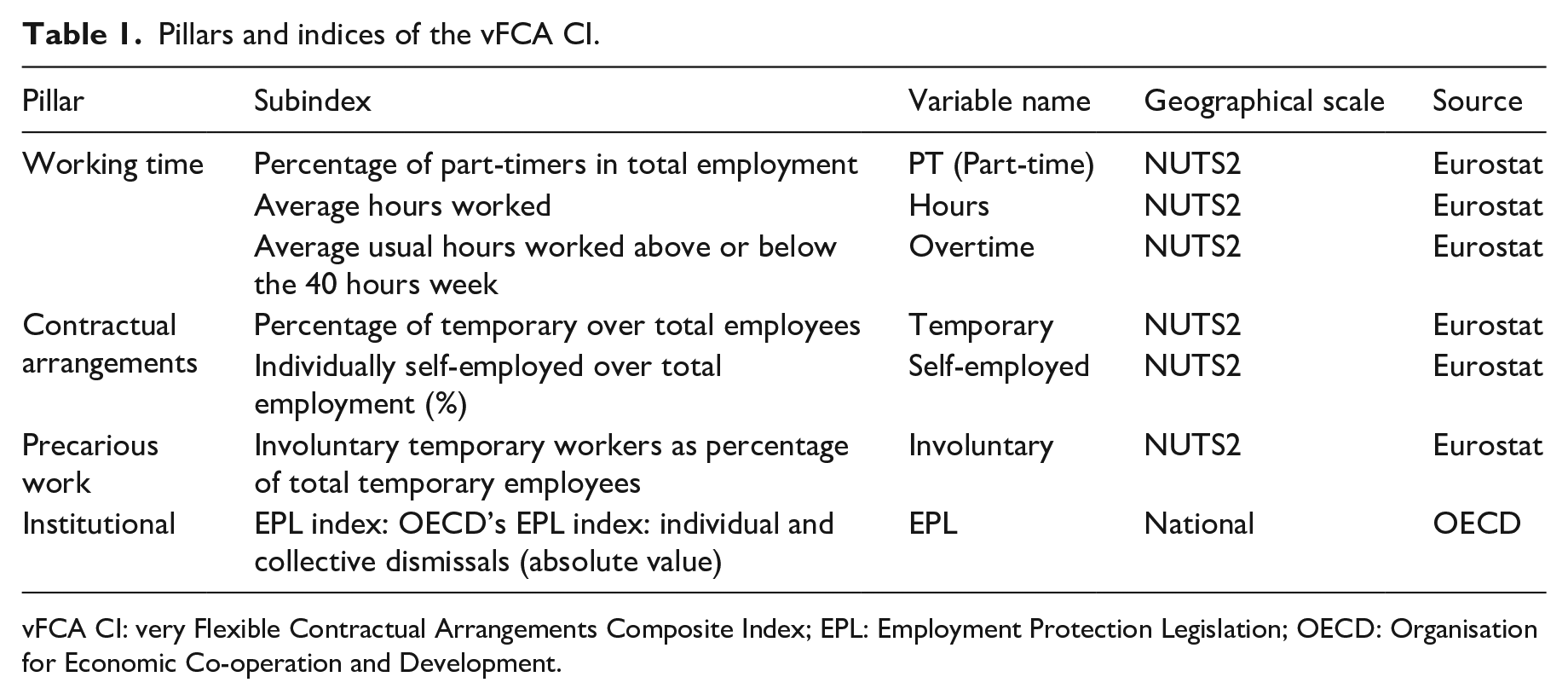
vFCA CI: very Flexible Contractual Arrangements Composite Index; EPL: Employment Protection Legislation; OECD: Organisation for Economic Co-operation and Development.
Avoiding a common shortcoming of CIs, that is, their calculation as ‘a simple ad hoc average of components according to data availability’ (Aleksynska and Cazes, 2016: 17), the pillars and subindices were chosen based on the conceptual framework developed above. The pillars are, first, the working time one, which includes three subindices: percentage of part-timers in total employment, average hours worked and average usual hours worked above or below the 40 hours week, all of them being positively related to work precariousness. Second, the contractual arrangements pillar, with two subindices: percentage of temporary over total employees and percentage of individually self-employed over total employment, an index strongly associated with contract workers. Both subindices have a positive impact on the vCFA CI. The third pillar that significantly differentiates the vFCA from previous relevant CI-based efforts is associated with involuntary temporary work. Flexible work could be beneficial for an employee’s work-life balance (Maselli, 2010), although it is much more common for an individual to be involuntarily employed on a fixed-term contract and not have good employment alternatives (Strauss, 2018). Thus, the share of involuntary temporary workers in total temporary employees is positively related to labour precariousness. Considering the interaction between different scales, the three pillars referring to regional factors were complemented with a fourth national-scale pillar. The pillar captures the institutional aspects of work, through the Employment Protection Legislation (EPL) index produced annually by the Organisation for Economic Co-operation and Development (OECD). This index measures the protection of workers from individual and collective dismissals. Considering that high EPL values signify strong employment protection, the index is the only one with a negative impact on the CI. Although EPL values are calculated based on legal texts and thus its ability to capture institutional insecurity is controversial, it is the most common index to measure the institutional side of employment protection (Gialis and Taylor, 2016). Considering that EPL refers to the national level, we also estimated the CI without EPL, and the results do not show much difference (Appendix 2).
Applying a linear aggregation method, the vFCA CI was estimated for 205 EU NUTS2 regions between 2008 and 2020, with the analysis focusing on 2008, 2014, 2018 and 2020. Data for all the variables were retrieved from Eurostat Labour Force Survey, using complete data series. EPL figures were derived from the OECD. 1 The following regions with limited availability of data were excluded: the five French and two Spanish overseas regions, Warszawski stołeczny, Mazowiecki regionalny, Saarland, the regions of Ireland, Lithuania, Bulgaria, Romania, Croatia, Slovenia and two single-region countries, Malta and Cyprus.
The values of all the subindices were normalized by estimating z-scores, following Maselli (2010), to render the values of subindices comparable. Pearson correlations among the subindices were estimated, to test for multicollinearity issues. The correlation matrix (Appendix 3) did not indicate high correlation (Pearson values above 0.6) among the variables, signifying no biased estimates caused by multicollinearity, apart from the percentage of part-timers in total employment with average hours worked. This is an expected outcome as higher levels of part-timers are associated with lower number of working hours. No subindex was removed, since each of them reflects particular aspects of time-related precariousness.
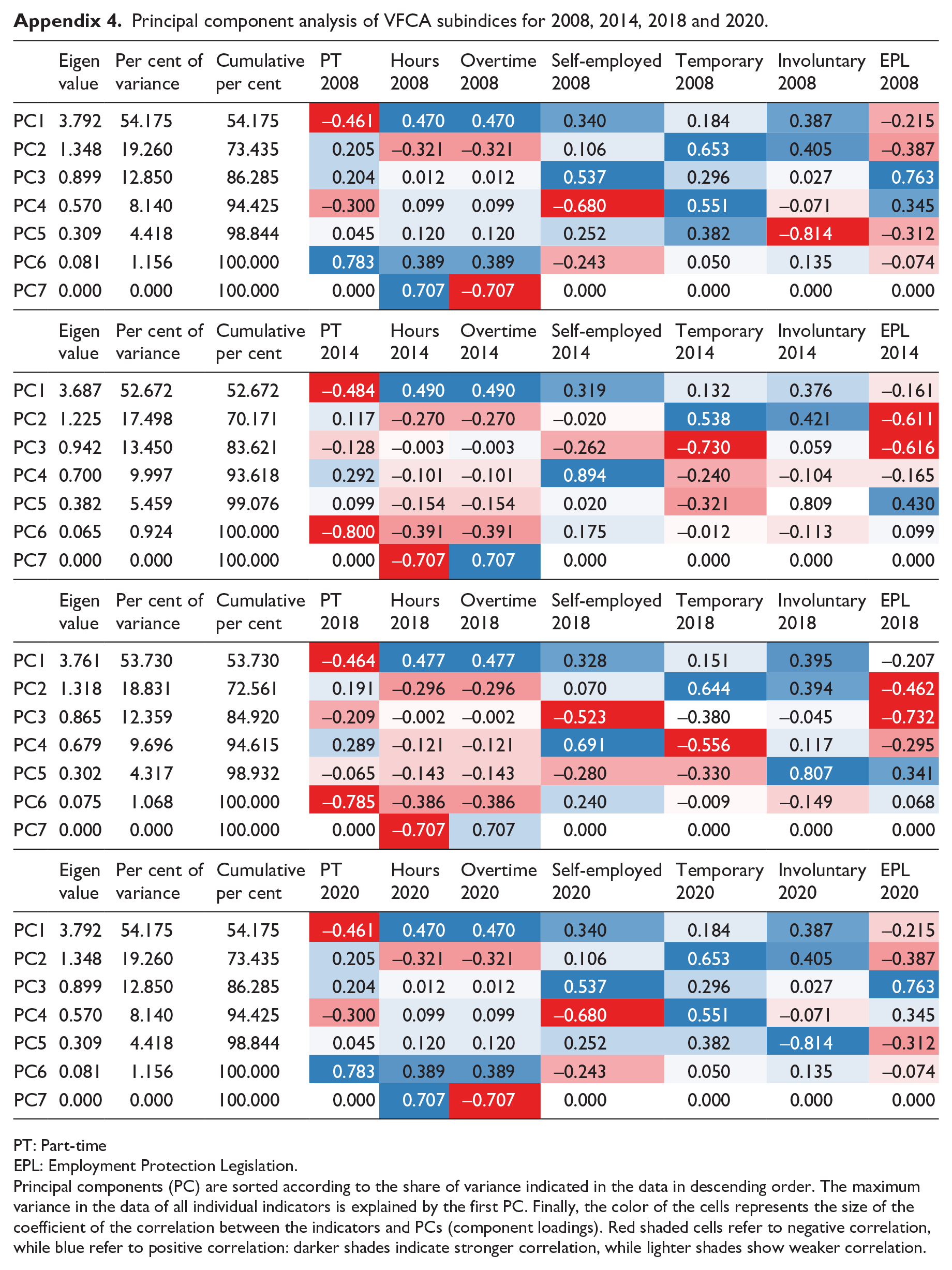
The possible aggregation and redundancy of the initial subindices were tested by carrying out Principal Component Analysis. All the seven subindices have eigenvector values above 0.6 in a single component (Appendix 4), corresponding to a strong or very strong component loading. Therefore, no possibility of dimensionality reduction was recognised and all sub-indices were considered necessary to construct the vFCA CI. Variable weighting is a crucial step in the construction of a CI. Equal weighting is the most commonly used, simplest and ‘a priori legitimate’ method when all numbers are secondary and there are no empirical or statistical criteria for choosing a different scheme (Aleksynska and Cazes, 2016). Thus, following other research efforts (Gialis and Taylor, 2016; Maselli, 2010), all variables were treated as equally significant, having the same weight (Table 2). Finally, to examine the statistical relationship of work precariousness with regional socio-economic features, correlations of vFCA CI were estimated with gross domestic product (GDP) per capita (euro per inhabitant), unemployment rate (UNEMPL), urbanization index (population density) (URBAN), rate of people between 15 and 24 years old that are Not in Employment, Education or Training (NEET), compensation of employees (euro per worker) (COMPENS) and share of regional population above 60 years old (POP60).
Dimension weight and direction and normalized weight of subindices used in vFCA.
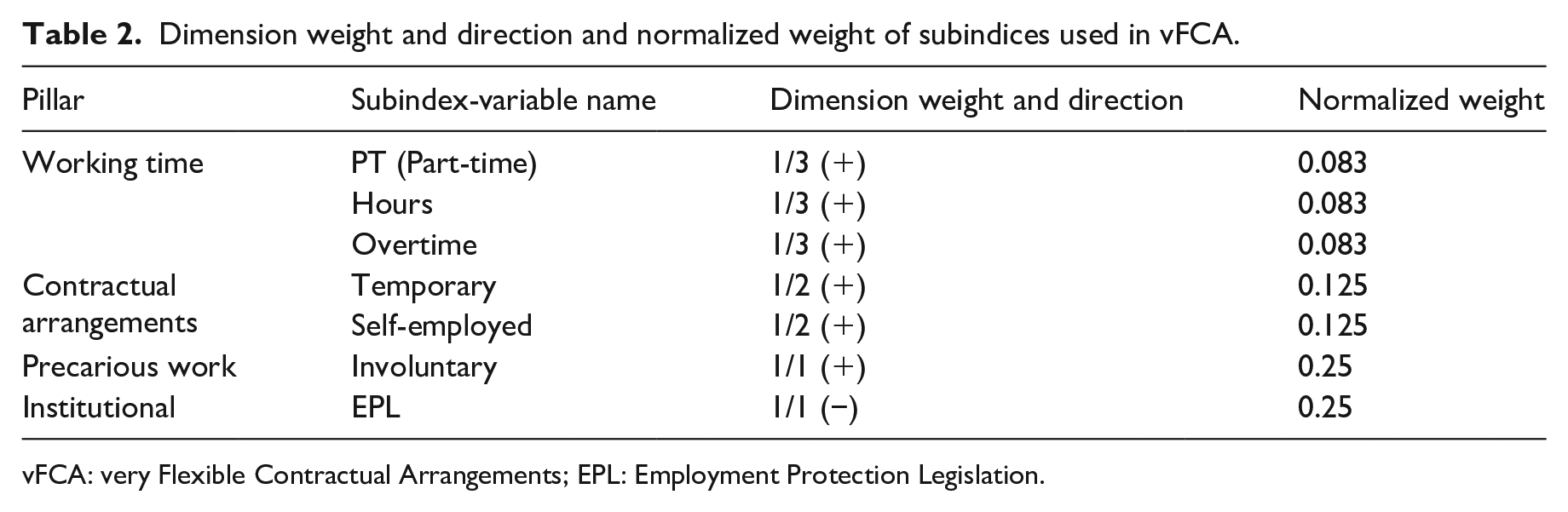
vFCA: very Flexible Contractual Arrangements; EPL: Employment Protection Legislation.
Results
The analysis shows significant regional differences in the development of precarious work in the EU in the decade to 2020 (Appendix 1). Values of vFCA CI close to 1 demonstrate largely precarious labour markets. By contrast, negative values or values close to 0 pertain to protected labour markets. Figure 1(a) demonstrates different patterns of intra-country differentiation of the vFCA. For the purposes of the paper in hand, EU core regions are the ones included in the ‘Blue Banana’ (Faludi, 2015; Hospers, 2003) and the capital regions of central, southern and eastern EU member states, which are largely integrated into the globalized economy (Netrdová and Nosek, 2016). Our results reveal that there are countries where work precarity was highly prevalent with no important regional differentiations in 2008 (Greece, Poland), indicating the importance of the nation-state in work regulation as well as the horizontally homogeneous impact of succesive crises (Streeck, 2009). By contrast, divergent vFCA values across Italy are in line with the country’s North-South divide while France comprises regions with quite diverse values of vFCA CI, signifying spatial heterogeneity of work precariousness within that country (Jessop, 2014).
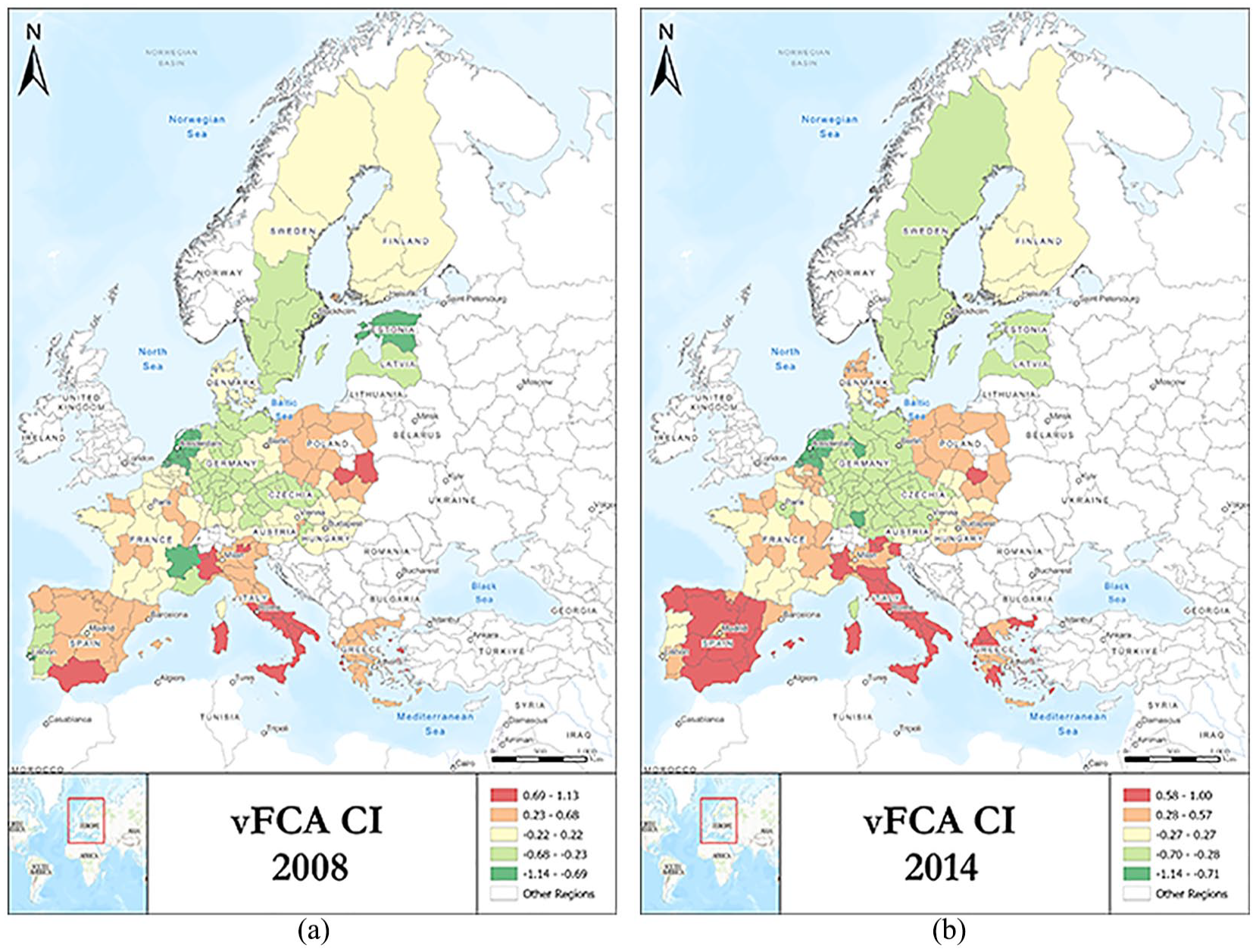
vFCA CI across the study regions (a) 2008 and (b) 2014.
The highest vFCA CI values in 2008 are recorded in the peripheral regions of EU south (Spain, southern Italy, Greece) and Poland. EU South regional labour markets have been historically segmented with largely deregulated, informal and atypical employment and high prevalence of poor modes of work flexibility (Barbieri, 2009). Moreover, they have seen extensive tertiarization, with services being dominated by part-time and temporary employment (Gialis and Leontidou, 2016). By contrast, regions with the lowest values are the EU core regions, such as the ones in the Netherlands and western Germany, where labour markets have been historically more protected (Maselli, 2010). Important here is the role of economic dynamism and regional economic inequalities. The most precarious labour markets tend to link with poor regions, in terms of GDP per capita, at the European level but also within their countries, such as in Italy (Molise, Basilicata, Campania, Puglia), Poland (Lubelskie, Lubuskie, Świętokrzyskie), Greece (Peloponnisos, Dytiki Ellada) and Spain (Andalucia, Galicia). By contrast, wealthier regions are likely to have more protected labour markets (Utrecht, Groningen, Zuid-Holland in the Netherlands and Tübingen, Karlsruhe, Niederbayern in Germany). This is confirmed by the correlation analysis (Table 3), which reveals a negative statistical association between vFCA CI and GDP per capita, suggesting that economically weak regions are more likely to record high work precariousness.
Pearson correlation coefficients R between absolute values of vFCA.
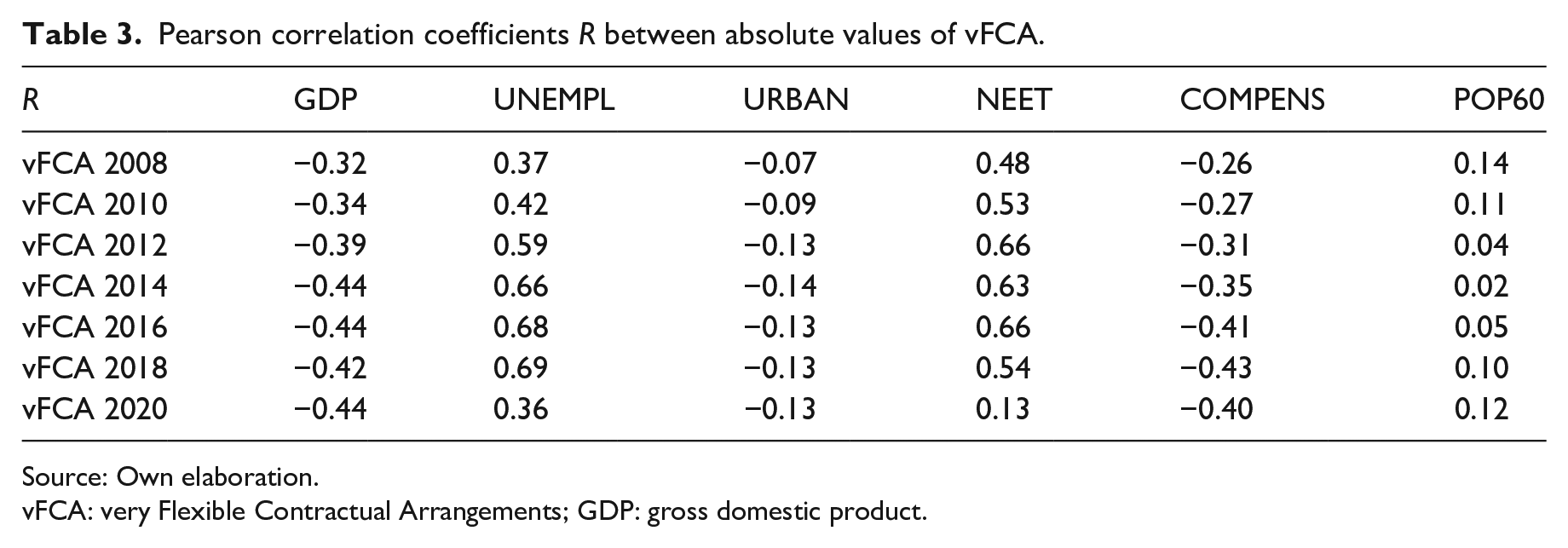
Source: Own elaboration.
vFCA: very Flexible Contractual Arrangements; GDP: gross domestic product.
The spatial division of work precarity between peripheral and core regions deepened in 2014 (Figure 1(b)), highlighting the highly uneven geographical footprint of the 2008/2009 crisis, when many economies, particularly in southern EU, experienced severe turbulence (Roberts, 2016). Peripheral regional labour markets in the EU South (southern Italy, Portugal, Greece, Spain) and East (Poland, Hungary – excluding its capital region) proved again to be highly precarious. Many regions with high vFCA values are rural and tourism-dependent (Ionia Nisia, Sardegna, Sicilia, Andalucia, Extremadura), as these industries exhibit extensive part-time and seasonal work (Hevenstone, 2010). This indicates the importance of the regionally specific context regarding the implications of crisis (Fratesi and Rodriguez-Pose, 2016). Moreover, regions with high vFCA CI values had also high unemployment rates (Calabria, Puglia, Ipeiros, Canarias, Murcia), suggesting a positive correlation between vFCA CI and unemployment rate, which is confirmed in Table 3. Regions with high unemployment may experience extended precariousness, as unemployed people lower their work expectations, thus resorting to precarious jobs (Avagianou et al., 2022). Gender divisions in the labour market may have also played a crucial role for the regional precariousness trajectories. Regions with a high rate of females in total population (above 52%) in various countries (Centro, Liguria, Norte, Észak-Magyarország, Łódzkie) have all exhibited high vFCA CI, as females tend to have the most precarious with limited access to sickness leave, unemployment insurance and other employment benefits (Barbieri and Sherer, 2009).
Many EU core regions proved to have more protected labour markets. Several of these regions are metropolitan and/or have strong manufacturing (Zuid-Holland, Darmstadt, Flevoland, Limburg (NL), Arnsberg), indicating that the regional socio-economic framework plays a crucial role in work conditions (Storper and Salais, 1997). Table 3 suggests a negative statistical association between vFCA CI and urbanization rate. Manufacturing regions recorded low precariousness possibly due to the need for skilled workers (Brixiova et al., 2009), seeking to attract them by having protected labour markets.
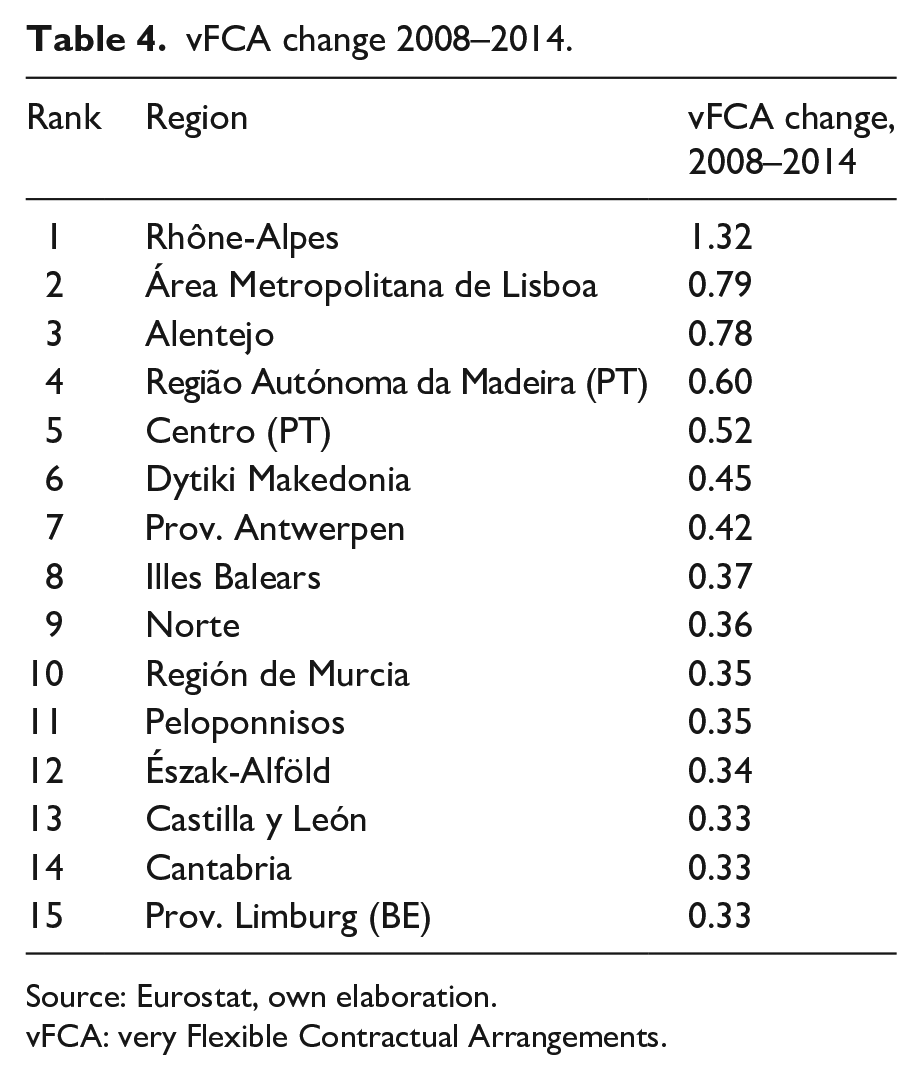
The implications of the 2008/2009 economic crisis are further analyzed in Table 4. French and Belgian regions (Rhône-Alpes, Centre-Val-de-Loire, Antwerpen, Limburg (BE), Namur), some of them considered as peripheral in the EU, and peripheral regions in Portugal, Spain and Greece saw expansion of precarious work from 2008 to 2014. These countries have been significantly affected by stringent austerity policies that led to deteriorated working conditions (Hadjimichalis, 2011). Beyond austerity, it is worth adding that several Greek regions (Dytiki Makedonia, Peloponnisos, Dytiki Ellada) saw increasing precariousness despite the development of local work placement programmes in the early 2010s, connected with local welfare regimes (Andreotti and Mingione, 2016), although with long working hours, with these programmes often increasing precariousness (Pratschke and Morlicchio, 2012). Regions in Germany and Austria recorded declining trends of precarization, with the corporatist type of welfare-state (Esping-Andersen, 1990) and the relatively high EPL playing a crucial role.
vFCA change 2008–2014.
Source: Eurostat, own elaboration.
vFCA: very Flexible Contractual Arrangements.
In 2018, as macroeconomic conditions improved regional trends in labour insecurity follow earlier patterns (IMF, 2019). Notably, regions with the greatest vFCA CI proved to have the highest youth inactivity, measured through the NEET rate (Abruzzo, Campania, Anatoliki Makedonia/Thraki, Kriti, Aragón, Lubelskie). Table 3 shows a positive correlation of the CI with NEET rate, as precarious workers are more possible to shift to non-employment (Barbieri, 2009). Regions with more protected labour markets (Hovedstaden, Hamburg, Île de France, Wien) record high wages at both national and European level. Indeed, Table 3 suggests a negative statistical relationship between vFCA CI and workers’ compensation, meaning that regions with high salaries are expected to have more protected labour markets, attracting high-skilled workers (Floros and Jørgensen, 2020).
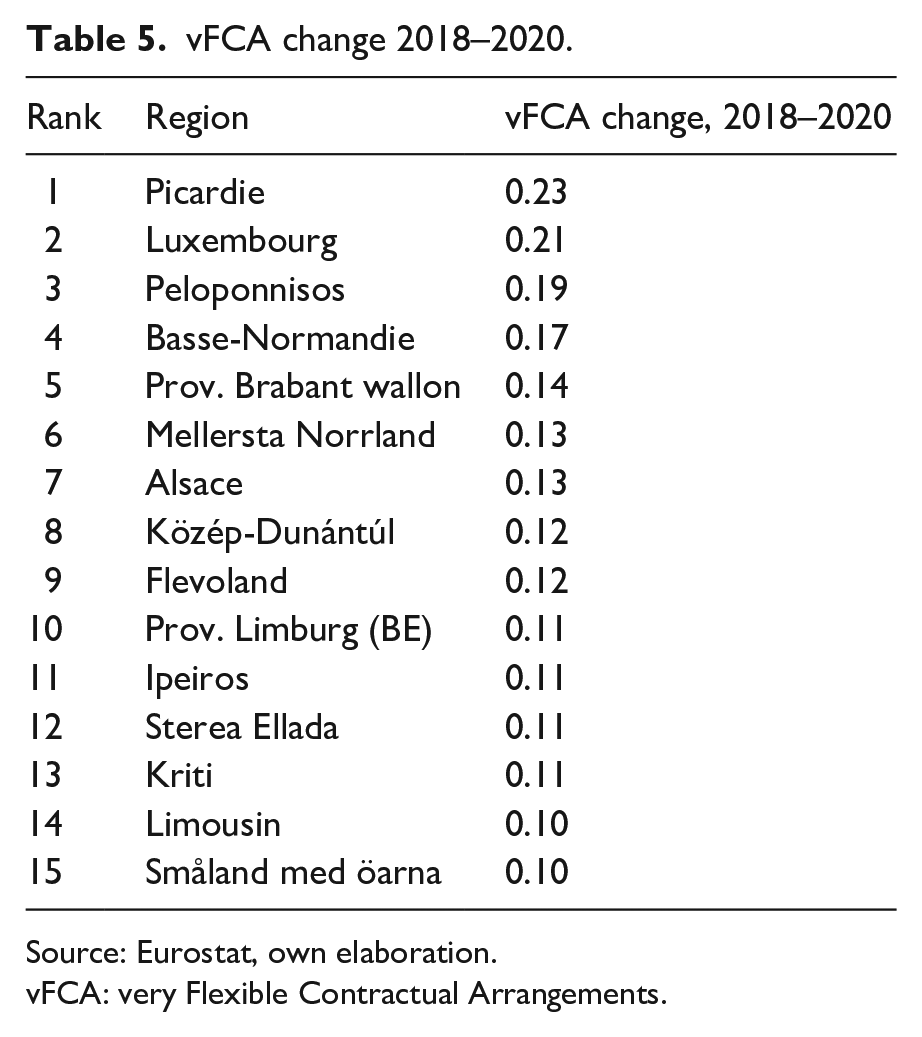
The increase in precarious employment in 2020 was uneven, reflecting in part the geographically variegated initial impact of COVID-19 (Herod et al., 2022) due to differences in industrial structures and differences in the prevalence of remote jobs across EU regions (OECD, 2020). Several regions in France and Belgium experienced among the greatest positive changes of vFCA CI (Basse-Normandie, Bretagne, Brabant Wallon, Limburg (BE)) between 2018 and 2020 (Table 5), highlighting the importance of the national scale in work conditions (Streeck, 2009). However, regions also in the abovementioned countries saw declining work precariousness (Nord-Pas-de-Calais, Midi-Pyrénées, Oost-Vlaanderen, Antwerpen), thus indicating the crucial role of the regional level (Storper and Salais, 1997). Regions with a great dependence on tourism recorded positive growth of vFCA CI (Madeira, Açores, Kriti, Sicilia) as the regional industrial structure is crucial in the context of economic crises (Fratesi and Rodriguez-Pose, 2016), such as COVID-19, with mitigation measures significantly affecting hospitality, in direct contrast with the implications of the 2008/2009 crisis (Herod et al., 2022).
vFCA change 2018–2020.
Source: Eurostat, own elaboration.
vFCA: very Flexible Contractual Arrangements.
While peripheral regions recorded the greatest vFCA increase in 2008–2014 period, from 2018 to 2020, it was both EU core (Luxembourg, Flevoland, Thüringen, Gießen) and peripheral regions (Közép-Dunántúl, Slaskie, Sardegna, Umbria, Ipeiros) that saw great precarization of their labour markets. Several regions with increased vFCA values also experienced a declining population rate with a tertiary education attainment from 2018 to 2020 (Thessalia, Bolzano, Praha, Liguria, Severovýchod), signifying the importance of skills in the COVID-19 era. Regional labour markets with low skills tend to have the most precarious jobs, with lower wages than permanent jobs (Barbieri and Sherer, 2009). Accounting for longer time effects, migration may have been important for these developments. First, in core regions, with the influx of migrants from the periphery, since the mixture of labour regulations and migration laws often implies extended migrant precariousness (Floros and Jørgensen, 2020). The influx of refugees in EU southern regions could have played a crucial role in labour precarization, since refugees are frequently subject to extended precariousness (Cucca and Ranci, 2017). Interestingly, some Polish regions, along the border to Germany (Zachodniopomorskie, Lubuskie), have seen decreasing trends of work precariousness. Commuting and fiercer competition of firms for skilled workers in neighbouring regions could be crucial for this change. Other areas that saw important vFCA reduction from 2018 to 2020 (Pohjois-ja Itä-Suomi, Länsi-Suomi, Åland, Sjælland) include regions in Scandinavian countries with strong national and local welfare-states (Andreotti and Mingione, 2016).
The implications of COVID-19 could be better understood when comparing the 2018 and 2020 maps (Figures 2(a) and (b)). Italian and Greek regions had again the most precarious labour markets in 2020, when remote and flexible work significantly increased, entailing a changing work-life balance (Dore, 2021). Related to demographics, regions with the highest vFCA CI recorded high rates of people above 60 years old (Friuli-Venezia, Piemonte, Ipeiros, Peloponnisos, Asturias, Etelä-Suomi), indicating the importance of age structure in the post-pandemic work arena. Table 3 suggests that regions with ageing societies are likely to face highly precarious employment, since this could entail skills shortages that are filled with migrants (Ette et al., 2016), who are subject to extended precariousness (Bouali, 2018). Similar to previous years, regions with the lowest vFCA CI were core regions in the Netherlands and Germany (Gelderland, Overijssel, Koblenz, Bremen). The high EPL in these countries could have been important to protect working rights in the initial period of COVID-19 (Herrod et al., 2022).
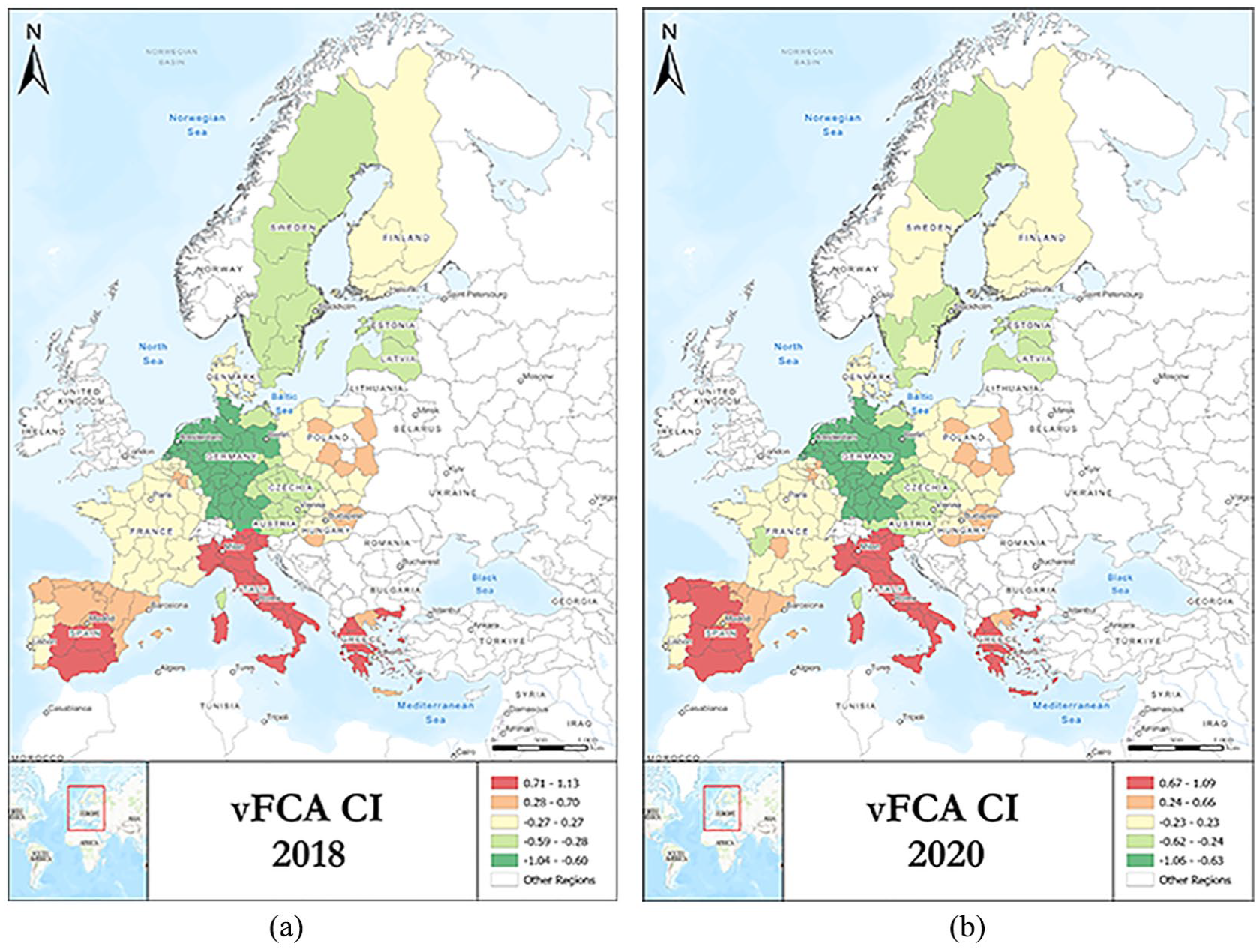
vFCA CI across the study regions (a) 2018 and (b) 2020.
Considering that statistical dispersion indices, such as the coefficient of variation (CV), are not suitable due to the normalized nature of vFCA CI subindices, the CV of four main components was estimated: part-time, self, temporary and involuntary temporary employment. Working time variables were excluded as they present limited variation, while EPL index refers to the national level. Increasing trends of CV indicate divergence. Inequalities among regions in terms of part-time employment slightly declined between 2008 and 2016 (Figure 3), before increasing in 2020, pointing to the regionally uneven impact of COVID-19 on working conditions (Herod et al., 2022). Regional inequalities of self-employed increased from 2008 to 2014, in the aftermath of the 2008/2009 crisis, before gradually declining in the following years. The 205 EU NUTS2 regions under study converged in terms of temporary employment between 2008 and 2014, before diverging, particularly from 2018 to 2020, signifying the initial implications of the pandemic. Chiefly, involuntary temporary employment disparities recorded the greatest change, with the EU regional map becoming largely uneven since 2016. While the CV of involuntary temporary employment remained relatively stable from 2008 to 2016, it rose between 2016 and 2020, indicating an increase of regional inequalities.
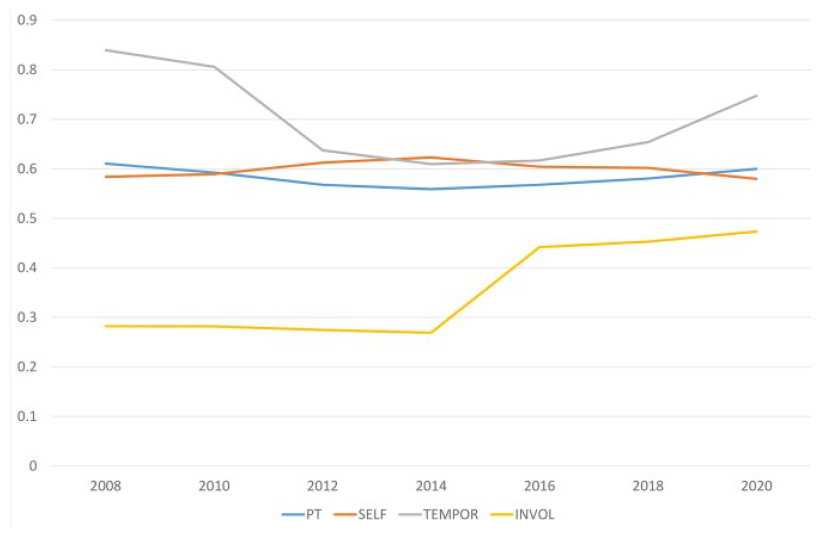
Coefficient of variation of very Flexible Contractual Arrangements Composite Index subindices.
Discussion
The results presented above reveal that there is considerable regional differentiation in labour precarity within and across countries, highlighting the importance of the regional socio-economic context, which deserves further discussion. Second, the spatial distribution of precarious work in the EU deepens following successive crises. However, there are some unexpected patterns, with regional labour markets generally following contingent trajectories, which requires more in-depth discussion. These findings concern aspects of uneven geographical development and socio-spatial inequality, highlighting deep, structural inequalities in production and socio-institutional inequalities, as well as different work cultures.
First, there is a persistent and uneven spatial distribution of precarious work in the EU. Southern and eastern peripheral regions systematically record high levels of precarious work, whereas core regions are those with the relatively more protected labour markets. This highlights the sticky procedure of regional labour market precarization, with regions being locked in trajectories of low and high work precariousness, in a path-dependence process (Martin et al., 2016). The regional variation of work precariousness was intensified in the aftermath of the 2008/2009 economic crisis. Moreover, almost a decade after the global crisis, COVID-19 affected regional labour markets leading both peripheral and core regions to greater levels of work precarity in the initial year of the pandemic. In particular, the comparison of the results of the CI for flexible work (Gialis and Taylor, 2016) with the CI of vFCA shows that the post-crisis period is a transitional period in which the gap between labour flexibility and precarity narrows (Gialis and Taylor, 2016).
Second, the findings highlight that while the COVID-19 emergency has been perceived as a ‘regional crisis’ (Bailey et al., 2021), the reality is more complex. Certainly, specific regions have been ‘left behind’ in the COVID-19 context (Kapitsinis, 2020), due to the different levels of global interconnectedness (Herod et al., 2022). However, the role of metropolises and urban inequality cannot be ignored, as the socio-economic features at the intra-regional level have been crucial in the uneven spread and impact of COVID-19 (Cestari et al., 2021). In addition, the role of nation-state is crucial for the level of work protection, post-pandemic. More widely, labour market deregulation driven by nation-states constituted a cornerstone in the broader transition towards more precarious employment (Herod, 2017). Despite globalization, national capitalist formations and state mechanisms maintain their primary role in the process of production and reproduction of social relations, although important variations of regulatory regimes are still recorded among countries (Barbieri, 2009). Austerity policies sought to satisfy the new needs of capital accumulation by promoting enhanced employability and less rigidity in the labour markets. Relatedly, welfare-state plays an important role in working conditions (Esping-Andersen, 1990). While it can provide a safety net for work based on universalism principles and guaranteeing workers’ full participation, it cannot often restrict work precariousness; rather local welfare regimes may extend it through local work placement programmes (Pratschke and Morlicchio, 2012). Therefore, it is the interlinkages among the urban, regional and national levels that affect the implications of the succesive crises, as these implications evolve unequally within but also among regions and nation-states (Cestari et al., 2021).
Third, the increasing prevalence of work precarity in some EU core regions pertains to the centripetal forces across the Unions labour markets, highlighting the propensity for geographical socio-economic homogeneity and gradual equalization of conditions of production (Hudson, 2003). However, peripheral regions are locked in highly precarious work trajectories, in the decade to 2020, underlining the parallel effect of centrifugal forces and the tendency for geographical diversification and socio-spatial heterogeneity. This uneven spatial division of precariousness is a signifier of the hierarchical relationships among regions (Massey, 1995). In other words, the results illustrate the inherent contradiction of capitalism with its parallel tendencies towards equalization and simultaneous differentiation of the economic space (Hudson, 2003).
Fourth, the position a region occupies in the international division of labour is reflected in the degree of precariousness of labour (Herod, 2017). The socio-spatial relations between labour and capital play a crucial role in labour restructuring (Hudson, 2003). Work transformations are likely to be applied and experimented first in EU core regions that are highly integrated into the global circuits of capital (Strauss, 2018), such as Lombardia, Hovedstaden, Noord-Holland. However, work protection is on average terms better in these regions, particularly when accounting for the role of the EPL framework, compared to areas with an inferior position in the international division of labour (e.g. Basilicata, Puglia, Ionia Nisia) where work precariousness prevails and is largely expanding (Gialis and Leontidou, 2016).
Subsequently, and fifth, the regional diversification of work precarity is also associated with the wider dynamics of uneven capitalist development and the division between core and peripheral regions, with the latter being locked in trajectories of high precarity. The findings reveal particular hierarchies and divisions among the areas under study, according to socio-economic aspects of their regional milieu.
For example, urbanized regions demonstrate limited work precarization relative to rural areas. While the resilience of labour markets in urbanized regions was limited in the post-2008 period in terms of employment contraction (Gialis et al., 2018), they were identified to have more protected labour markets. By contrast, employment in rural and isolated regions proved to be highly precarious during the crisis-ridden decade of 2010s. This division between urban and rural regional labour markets links to the broader trends of uneven geographical development. Labour markets in economically weak and peripheral regions were already largely precarious compared to the ones in wealthy areas. This underlines that economic background matters and that path-dependent patterns of socio-economic organization are important elements of better (or worse) labour conditions’ trajectories (Mingione, 1995). This strongly contrasts the conditions in EU core regions, where work has been historically more protected and better paid (Williams and Padmore, 2013).
The shift towards more precarious local labour markets reflects the different regional specialisation in certain sectors. Despite that the universal tertiarization trends were accompanied by new modes of precarious work (Strauss, 2018), EU regional labour markets highly specialized in tourism tend to have the most precarious labour markets. Tourist industry strongly promotes precarious work, namely low-paid seasonal contracts, part-time employment and overtime labour (Hevenstone, 2010). Regional labour markets specialized in agriculture also demonstrate high work precariousness, and abundant atypical, seasonal and low-skilled jobs (Avagianou et al., 2022). By contrast, regions with a strong manufacturing sector retain a relatively protected labour market, due to their need for skilled labour (Brixiova et al., 2009).
In this context, the weakening of productive structures of peripheral economies recorded due to EU market integration, (Kapitsinis, 2022) has been crucial (Williams and Padmore, 2013). Productive structure re-/deregulation implied expanded precariousness, thus deepening the identified division between core and periphery. Moreover, it has entailed internal and external migration flows to EU core regions, with migrants seeking employment and frequently occupying precarious jobs (Friberg et al., 2014). This, alongside with the recent large refugee movements to the EU (Cucca and Ranci, 2017), may have affected regional precariousness trajectories. The EU guidelines planned and adopted by the nation-states have also contributed to work precarization institutional and regulatory changes in neoliberal fashion (Tangian, 2008).
Beyond the institutional arena, regional structural elements are crucial in explaining the underlying spatial pathways to higher precarity highlighted above. Regional labour markets with high structural unemployment have seen expanded work precariousness. These regions offer insufficient integration of people into the local labour market, leading to greater vulnerability of workers and high levels of precarious work. In terms of working conditions, regions with poorly paid work are also associated with high levels of precariousness, as inadequate remuneration of workers is an essential element of precarious work (Strauss, 2018). Moreover, high youth employment could explain part of a region’s increased work precariousness as youth constitutes the most vulnerable cohort of labour markets (Avagianou et al., 2022). Regions with high rates of inactive youth, reflected on a high NEET rate, demonstrate high precariousness (Barbieri, 2009). All these structural elements pertain to a vicious cycle between low-paid work, precarious labour, unemployment and (youth) inactivity recorded mainly in peripheral regions.
Finally, female-dominated regional labour markets could exhibit greater vulberability, as women are often precariously working (Barbieri and Sherer, 2009). Regions with ageing population are also expected to be more precarious. With the workforce ageing rapidly in many EU countries (Germany, Italy), it is already apparent that shortages of skilled labour negatively affect national and regional economies. These effects are partly mitigated by international migration (Balaz et al., 2004), which is, in turn, subject to high levels of precariousness (Bouali, 2018).
Conclusion
This article seeks to expand state-of-the-art knowledge on divergent work trajectories by shedding light on the spatially uneven mosaic of labour precarisation at the regional level through the vFCA CI. The CI provided valuable insights, namely that the uneven spatial division of precarious work, both within and between EU countries, is persistent and noteworthy, and has been affected by the succcesive crises at the beginning of the 21st century. EU peripheral regions are locked in pathways of high precarity, whereas EU core regional labour markets remain more protected. As has been shown, interpreting the unequal socio-economic impact of crises on work precarity requires taking into account a number of interrelated factors that play out at the urban, regional and national levels (Cestari et al., 2021). The methodology operationalised above is subject to some limitations. First, due to a lack of available data, the focus of the article does not extend to the period before the 2008/2009 crisis and beyond 2020, the baseline year of COVID-19. Second, while we have examined certain factors of regional labour market precarity using correlation analysis, we have not been able to take into account other possible drivers, such as labour skills, gender and migration due to space limitations.
Since forecasting a regional recovery is very risky, this article sheds light on the regional dimension of work precariousness, delivering crucial policy messages. The findings show the urgent need, first, to strengthen shrinking national and regional welfare provisions. Second, that we need regulations that prevent work from becoming more and more precarious. This is best done by promoting permanent and stable full-time employment with higher wages to cover the rising cost of living, especially in the wake of the ongoing energy and climate crisis. The protection of the 40-hour week is crucial, with a subsequent reduction in working hours to match current production capacities. These regulations should increase protection against collective and individual dismissals, thus significantly improving workers’ living standards. Third, specific measures should aim at improving working conditions in sectors affected by precarious work and severely affected by the recent crises, such as tourism and agriculture. In this context, policies should also support workers affected by the digital transition.
Although the calculation of vFCA is not in itself a research objective, we argue that it could be the first step for an in-depth, mixed-method, timely and comparative study of regional patterns of precarity in the EU. Such a research agenda needs to be complemented by, first, specific case studies describing the different forms and factors of labour precarisation in diverse regional socio-economic contexts. Second, by estimating the vFCA CI in different time periods, including pre-2008 and post-2020, and possibly with different sub-periods compared to this article. Third, by including other explanatory factors for regional labour market precarity, such as commuting patterns and digitalisation. Finally, testing the vFCA CI at lower geographical scales, such as NUTS3 regions, could extend the analysis of the geographical diversification of work precariousness. Such future research pathways could provide valuable insights that advance academic research on contemporary labour geographies but also trigger social action against the precarisation of work.
Footnotes
Appendix
Principal component analysis of VFCA subindices for 2008, 2014, 2018 and 2020.
|
PT: Part-time
EPL: Employment Protection Legislation.
Principal components (PC) are sorted according to the share of variance indicated in the data in descending order. The maximum variance in the data of all individual indicators is explained by the first PC. Finally, the color of the cells represents the size of the coefficient of the correlation between the indicators and PCs (component loadings). Red shaded cells refer to negative correlation, while blue refer to positive correlation: darker shades indicate stronger correlation, while lighter shades show weaker correlation.
Acknowledgements
The analysis was based on the work of the ResLab-Observatory ( ). The Observatory and its contents are provided to the public for informative, educational and academic purposes. The maps were designed by Anna Saroukou. Stelios Gialis also acknowledges the contribution of Humboldt University, Berlin and the DAAD – ‘Research Stays for University Academics and Scientists 2022’ (funding programme no. 57588362) scholarships scheme.
Declaration of conflicting interests
The author(s) declared no potential conflicts of interest with respect to the research, authorship, and/or publication of this article.
Funding
The author(s) disclosed receipt of the following financial support for the research, authorship, and/or publication of this article: The authors were funded from the Research e-Infrastructure ‘Research and Development Network of the Aegean Archipelagos: Fostering Regional Innovation, Entrepreneurship and Excellence’ (code number MIS 5046494), which is implemented within the framework of the ‘Regional Excellence’ Action of the Operational Program ‘Competitiveness, Entrepreneurship and Innovation’. The action is co-funded by the European Regional Development Fund (ERDF) and the Greek State (Partnership Agreement 2014–2020).