




Abstract
Previous research on Hungarian right-wing populism has documented how the present government has identified different groups and individuals as threats to innate national interests and values, drawing distinctions between the ‘nation’, illegal migrants, non-heteronormative persons, liberal enemies in Brussels, George Soros and others. At the same time, the Orbán government has exploited the country’s internal divisions which, for example, reflect long-standing contestations between liberal and conservative understandings of national identity and purpose. Employing a critical border studies perspective, this article explores Hungary’s illiberal practices of socio-cultural, spatial and temporal border-making. These are central to Hungary’s project of ‘illiberal democracy’ and the forging of a political environment that marginalizes alternative viewpoints and that extends into the organization of civil society and everyday life. European dimensions of the Hungarian regime’s border politics are also briefly discussed in terms of evoking liberal-conservative divides and Hungary’s claims for greater national recognition as a defender of Europe’s Christian heritage. In the concluding section, the potential significance of Hungarian illiberal politics in terms of an erosion of social cohesion both nationally and within the European Union will be considered.
Introduction
Hadjimichalis (2021) identifies the year 2009, and the global economic crisis that ensued, as a watershed of sorts, marking the end of a long period of relative stability and intelligibility of the European Union (EU) economic and political integration. Although previously no stranger to crises, since 2009 the EU has been challenged by multiple and simultaneous insecurities, such as economic anxieties, fears of undocumented migration, and a perceived loss of control over everyday affairs. While grassroots movements contesting neoliberal economic conditions emerged as political forces, the confluence of various insecurities also coincided with a strengthening of right-wing populism and illiberalism. The rise of illiberalism has in different ways and to varying extents affected the politics of numerous European states. Even traditional social-democratic strongholds, such as the Nordic states, have not been spared as is evidenced by political agendas focused on the construction of crisis and exploitation of anxiety. Within this context, the 2010 electoral victory of Viktor Orbán in Hungary represents a watershed event.
Deftly reading the pulse of a nation suffering the effects of economic crisis and self-doubt, Orbán promised a cathartic break with the recent past and a stronger, more self-confident nation. Since that victory, the regime that Orbán and the Fidesz party have since established is exemplary in terms of rejecting accepted liberal democratic norms and engaging in outright demonization of perceived enemies. In addition to its xenophobia, homophobia and anti-migrant rhetoric, the Hungarian government, as well as its Polish counterpart, have spearheaded a direct assault on deliberative and inclusive forms of democracy and thus the liberal premises upon which the European Union has emerged as a political community (see Sadurski, 2019). At the same time, Hungary has advocated for a political Union that expressly privileges national sovereignty above other ethical concerns. These versions of populism are more than political discourses or opportunistic strategies targeted at winning elections, they are integral projects of nation-building that aim to fundamentally transform democratic societies and the roles of both states within the EU. Particularly with the advent of Hungary’s self-proclaimed ‘illiberal democracy’, the EU’s identity as a political community held together by shared democratic values has been openly questioned. In the case of Hungary, Viktor Orbán and his national-conservative coalition government have sought to create narrative hegemony of a Christian Europe while imposing nativist understandings of national identity that in the case of Hungary are clearly demarcated according to levels of adherence to Orbán’s visions of a ‘united’ country (Kovács and Nagy, 2022).
The burgeoning debate regarding the EU’s future has singled out antidemocratic tendencies as a major threat, underscoring an urgent need to better understand the roots, rationalities and political manifestations of right-wing nationalist populism (Kundnani, 2020). For example, the EU’s perceived democratic deficit (Watt and Andor, 2017), the ambiguities of the EU’s core values (Mos, 2020) and the impacts of neoliberal economic policies (Mamonova and Franquesa, 2020) have been offered as partial explanations. Beyond this, crises and insecurities plaguing European societies since the advent of the new millennium have served to diminish faith in democratic processes and liberal values. In addition to these general trends, however, national contexts are decisive factors in the development of right-wing populism; in Central and Eastern Europe, the historically contingent weakness of liberal democracy and a relative lack of identification with democratic processes have been exacerbated by unresolved tensions regarding national historical memories and identities (Rupnik, 2018; Sztompka, 2010). As Drinóczi (2021) and others suggest in the case of Hungary, this is reflected in ‘collective narcissism’, a sense of victimization and thus a desire for greater recognition that has been exploited by right-wing politicians.
Capitalizing on social and political anxieties, right-wing national populism seeks power through divide-and-rule tactics, and it is here where the exploitation of territorial borders and social cleavages becomes most directly apparent. Recent border studies scholarship has focused attention on the ways in which national borders, as guarantors of sovereignty, security, and identity, have been instrumentalized as resources for right-wing policies (Lamour and Varga, 2020). Critical border studies (CBS) in particular have investigated the ways in which populist border-making (or bordering) practices produce ‘spatializations of fear’ and involve demonstrative reassertions of national sovereignty by ‘taking back control’ of national destinies (Casaglia et al., 2020: 1). CBS has also directed attention to the multiplicity of borders within society and the existential – or ontological – necessity of borders in forging group and individual identities (see Andersen and Aubry, 2022; Scott, 2020; 2016). Cervi and Tejedor (2022), for example, have demonstrated how populist discourse instrumentalizes both physical and socio-cultural borders in narrating a sense of threat to national integrity and identity. Similarly, Osuna (2022) has indicated how right-wing populist border-making processes engage in social norming and discursive othering that legitimize exclusion based on and selective definitions of the ‘people’. The ontological nature of borders, and the sense of security and belonging that it involves, is thus highly susceptible to manipulation. As a result, the political exploitation of borders as signifiers of difference can have stark consequences.
What is at stake is the forging of a political environment that marginalizes alternative viewpoints and that extends into the organization of civil society and everyday life (see Kővér et al., 2021). As part of this construction of an illiberal national imaginary, the Hungarian government has also engaged in a politics of temporal othering in which Orbán’s narrative of national rebirth plays a central role. According to this narrative, only since the epochal shift of his 2010 electoral victory has Hungary reclaimed true sovereignty. Utilizing this notion of rebirth, Orbán has sought to solidify borders between liberals and conservatives, associating the political opposition with a ‘failed’ and humiliating process of transition. European dimensions of the Hungarian regime’s border politics will also be briefly discussed in terms of evoking liberal-conservative divides and Hungary’s claims for greater national recognition as a defender of Europe’s Christian heritage. Evidence of these border-making and border-manipulating practices has been gleaned from primary sources, which include political speeches and official Hungarian government documents, and secondary sources including academic research, media reports and commentary.
Employing a critical borders studies (CBS) perspective, I argue in this article that ‘border politics’ is central to Hungary’s project of illiberal democracy and is not limited to migrants as cultural ‘others’. Practices of socio-cultural, spatial and temporal border-making (or bordering) been mobilized by Orbán and his party in order to impose ultra-conservative understandings of Hungarian national identity. Previous research has documented how the Hungarian government has identified different groups and individuals as threats to innate national interests and values, drawing distinctions between the ‘nation’, illegal migrants, non-heteronormative persons and liberal enemies in Brussels, George Soros and others (Barlai and Sik, 2017; Kovács and Nagy, 2022; Scott, 2020), At the same time, the Orbán government has exploited the country’s internal divisions which, for example, reflect long-standing contestations between liberal and conservative understandings of national identity and purpose (Bozoki, 2015). Moreover, a biopolitical division of society into ‘deserving’ and ‘undeserving’ is a hallmark of Orbán’s social policies and workfare regime (Szombati, 2021; Vidra, 2018). As a result, instead of creating a more robust and ‘proud’ nation, the Orbán regime’s bordering politics have arguably contributed to social disintegration, polarization and the impoverishment of Hungary’s civic culture.
Bordering and ordering as an illiberal project: a critical border studies perspective
Populism poses a serious challenge to the powers that be, injecting political debate with immediacy and social concerns that often contest or disrupt status quo agendas. Undoubtedly, populist movements can contribute to the reinvigoration of democratic processes by introducing new actors that more closely reflect and represent popular sentiment (Liddiard, 2019). However, populism is highly problematic if it involves a repudiation of pluralism and compromise, thus posing serious threats to open democratic societies. Right-wing populisms often essentialize the idea of ‘the people’ in terms of unambiguous national identities and a struggle against distant elites who fail to recognize the said people’s inherent interests. Jan-Werner Müller (2014) also warns of the illiberal tendencies of populism, the most concerning of which is to construct an imaginary of a majority demos at the expense of multivocal concerns. It is for these specific reasons that, in the case of Europe, right-wing iterations of populism have received the most attention. Moreover, while these tendencies have strengthened within the EU as a whole, it is in Central European member states, Hungary and Poland in particular, where illiberal populism has taken the form of concerted and sustained political projects.
In one sense, illiberal challenges to the EU mainstream are manifestations of contested interpretations of national identity and purpose as well as conflicting political claims of legitimacy in representing the ‘nation’ within Europe. Right-wing populism is moreover informed by illiberal notions about what counts as ‘political’. According to Velasco (2020: 21), the populist understanding of politics is intrinsically one that is combative rather than cooperative and ‘rests on a triad: denial of complexity, anti-pluralism, and a personalist approach to political representation’. As a consequence, illiberalism and right-wing populism are always at heart drivers as well as exploiters of socio-economic and political fragmentation; in the name of securing the foundational national community and its internal borders, they are always on the warpath against ‘Schmittian enemies’ (Bunikowski, 2018) while rejecting everyday realities of cultural change, migration and multiculturalism.
As Steele and Homolar (2019: 214) have commented: ‘Boundary-making practices, especially those relating to emotionally charged processes of exclusion based on racism, xenophobia and nationalism, are inevitably implicated in populist politics’. Critical border studies (CBD) has devoted considerable attention to the means through which borders are socially produced, providing detailed analyses of socio-political borders as a nexus of power, identity and culture (Brambilla, 2015; Popescu, 2012). One major contribution of CBS to the research debate is moreover an understanding of territorial borders as parts of a much larger complex of regimes, technologies, practices and narratives that perform various border-making functions (Parker and Vaughan-Williams, 2012; Wassenberg and Reitel, 2020; Wastl-Walter, 2011). Borders are, among others, highly significant as complex assemblages (Sohn, 2016), configurations of cross-border governmentality, (Walters, 2015), networks (Popescu, 2012) as well as extraterritorial instruments of mobility biopolitics (Casas-Cortes et al., 2016). Moreover, CBS is informed by concerns for the impacts of borders on individuals and groups and more specifically with the injustices and inequalities that bordering practices engender. As Van Houtum and Van Naerssen (2002) argue in their seminal article on bordering, borders are constantly created and re-created in territorializing difference – borders can be constructed and instrumentalized in multifarious ways according to specific political and economic agendas. Similarly, CBS has also directed attention to how formal and informal modes of border-making reach deep into the realm of individual identities, bodies and beliefs. Much work along these lines has followed, including that of scholars who have explored relationships between intersectionality, gender, citizenship and exclusionary bordering practices (see Kulz, 2022; Yuval-Davis et al., 2005).
The sensationalization of the 2015 refugee situation as a European crisis was a clear and unsettling example of bordering politics that fed off of popular anxieties and reflected political agendas that exploited these anxieties. Radical political forces profited from this situation as well, building their power bases by appropriating the border security and anti-immigrant positions taken by mainstream political parties (Almustafa, 2022). However, in contrast to the political mainstream, right-wing populists have sought discursive hegemony by essentializing national identities and interests and defying rule-based democracy. Reflecting these concerns, Casaglia et al. (2020: 2) have proposed more direct scholarly engagement with populist political agendas in order to uncover how such agendas and their associated discursive strategies ‘emerge from and produce particular understandings of territory and sovereignty’’. As Casaglia et al. (2020: 7) argue, despite their anachronistic and surreal nature, ‘purified geographies of belonging’ are powerful discursive tools in the national populist playbook. This perspective has been reflected in the work of political geographers who have analyzed the strategic use of borders in securitizing real and imagined cultural differences, and the manipulation of popular anxieties (Vaughan-Williams and Pisani, 2020; Yerly, 2022).
Right-wing populist bordering practices do not only involve the instrumentalization of physical or state borders but more problematically target the bodies and identities of those considered outside of the ‘true nation’. This is evidenced in Agius’s (2022) study of gendered bordering in Trumpian political discourse, indicating how heteronormative and masculinist biases operating within society have been exploited in creating a sense of national ‘we’. In a comparison of two extreme-right parties, Italy’s Lega and the Spanish Vox, Cervi and Tejedor (2022) elaborate how populist discourse instrumentalizes both physical and socio-cultural borders in narrating a sense of threat to national integrity and identity. Similarly, (Osuna, 2022) has indicated how right-wing populist border-making processes are reflected in social norming and discursive othering that legitimize exclusions based on degrees of national ‘authenticity’ and selective definitions of the ‘people’. Moreover, illiberal border-making is not limited to social, spatial and political categories, temporal distinctions are also a means of creating or exaggerating ‘we’ versus ‘them’ distinctions. Temporal othering is manifested in (re)interpretations of historical memory that centre on moments of national rebirth and the transcendence of traumatic events and painful legacies (Rumelili, 2018). Locating elites and other groups on either side of a temporal divide is a highly visible means of marginalizing and discrediting them.
The case of illiberal border politics in Central and Eastern Europe closely follows more general patterns of insisting on and exploiting social, spatial and temporal distinctions. As Anna Krasteva (2020) highlights in her analysis of Bulgarian right-wing and Eurosceptic populism, the idea of post-communism and European integration as a betrayal of national destiny is underscored by drawing civilizational and identitary borders between, for example, cultural authenticity and cosmopolitanism. As will be discussed in greater detail below, the Hungarian case is emblematic of such bordering politics. Hungary’s southern borders have been portrayed as a bulwark against a ‘Muslim invasion of Christian Europe’ (Merabishvili, 2022). At the same time, the construction of border fences has also specifically targeted popular anxieties regarding migration and served to bolster domestic support of Orbán’s government (Pap and Reményi, 2017).
Hungarian illiberalism as a border-making process
In the following, I will illustrate how multifarious bordering processes are implicated in the construction of Hungary’s illiberal regime. The sources of Orbán’s illiberal power involve a weaving together of various narratives of historical memory, national identity and belonging, as well as national purpose and Europeanness within the wider context of political community, epitomized by the declaration, in popular and social media, of Hungary as a ‘proud and strong European country’. 1 Three specific issues will be discussed. The first of these concerns involves a form of temporal othering as a national renewal. The second point relates to the marginalization of ideas, groups and individuals that do not conform to illiberal visions of society. The third point concerns illiberal border-making within the context of promulgating a national-conservative European alternative. As will be argued, these border political strategies reflect attempts to create a new sense of direction and clarity, the overcoming of perceived national weakness and the elimination of ambiguities regarding Hungary’s European heritage and place in Europe.
Temporal othering and narratives of national rebirth
The illiberal project of Viktor Orbán’s government has sought to fill the ‘spiritual vacuum’ left by the political mistakes of post-1989 governments and economic austerity and has sought to unite the country behind a pathos-filled metanarrative of national rebirth. In the case of Hungary, the shift from liberalism, broadly understood, to neo-national illiberalism has been facilitated by the perceived failures of pro-EU governments to address socio-economic inequalities and provide a credible vision of national development within the EU (Krekó and Enyedi, 2018). At one level, Orban’s strategy has involved the exploitation of material insecurities and deep-seated frustrations, consolidating domestic political power by appropriating critical debates on security and creating a hegemonic narrative of ‘national interest’, centred around patriotism, Christianity, family, work and national identity (Scott, 2020). At another level, however, the Hungarian political scientist Dobszay (2021) has argued that Fidesz’s political power has been based on a ‘political religion’ that offers pathos and commemorative spectacle, exploiting historical memory, emotions and pent-up frustrations. Orbán’s messianic and charismatic message has served to fill a perceived spiritual void in the political landscape, offering emotional and popular messages that the EU and more mainstream parties cannot offer.
Nation-building as defined by the present government is premised on a specific set of beliefs with regard to historical memory and the political consequences that can be drawn from historical experience. Beyond the definition of Hungary as a Christian nation based on traditional family values, the conservative canon holds that: (1) the ‘Trianon trauma’, that is, a sense of injustice resulting from territorial losses after World War I, is a defining element of Hungarian identity, (2) that Hungary as a nation is not limited by the formal borders of the state and (3) that complete sovereignty to regulate and control national borders is essential to national survival. Indeed, Hungary has understood itself as a defender of Europe’s borders, a ‘bastion’ of the West against attacks from the East and a fortress (védőbástya) of European Christianity (Glied and Pap, 2016). The self-understanding of Hungary as a civilizational border guard that in turn has never been treated properly by the West is still a living concept in the thinking of many Hungarians (Száraz, 2012). Moreover, the historical narrative of Hungary as a bastion against invasion from the East has been recast within the context of migration and refugee ‘crises’ and Hungary’s border closures since 2015 (see, for example, Rév, 2018).
In a widely circulated book written during his tenure as opposition leader, Orbán (2007) outlined many of the central principles which would later guide his policies as Prime Minister. In this book Orbán appeals to popular pride and sentiment, extolling the organic traditions of Hungarians as an agrarian people who cultivated and developed the Carpathian Basin and thrived despite all historical adversities. He also expands on the strength of a culturalist vision of national identity which, in the sense of Vertovec (2011), involves a conception of the nation as reified, static, and largely homogeneous. A conspicuous feature of Orbán’s treatise is the insistence on the need for a national rebirth, a genuinely new system that redefines Hungary’s role and status in Europe. Alongside his vision of a ‘new politics’ made possible by a new majority,
2
Orbán (2007) also vowed to deliver Hungary from both its external and self-imposed weakness: ‘Our country is today a weak country. Within four years we have gone from being first to last’. Orbán thus signalled the need for the political right to retake the country and end adherence to ‘false principles to which ‘there is no alternative’. He also underscored his will to help create a ‘strong’ country and transcend the shame imposed on the nation by intellectuals who ridicule traditional values: family, work, national pride, Christian faith and who have created a culture of self-hate. Orbán (2007: 93) writes:
Self-contempt, contempt for family, society, nation, religion. Denigrating duty and work. We Hungarians live in a world of systemic hatreds. We feel on our skins the intellectual violence with which we are forced to hate, we need to liberate ourselves from the trap of self-contempt.
Here, temporal othering speaks to national narcissism and a desire for recognition – exceptionalism and a new European agenda. Orbán’s narrative of a ‘strong and proud European nation’ expresses a desire for a more positive understanding of national pasts as well as present and future roles within the European Union. This is reflected in the Fundamental Law of Hungary (2016 amended version) which proclaims that:
We are proud that our nation has over the centuries defended Europe in a series of struggles and enriched Europe’s common values with its talent and diligence. We recognize the role of Christianity in preserving nationhood. We value the various religious traditions of our country. We promise to preserve our nation’s intellectual and spiritual unity, torn apart in the storms of the last century.
As part of this, the narrative of national rebirth involves the ‘temporal othering’ of post-1989 transformation in which the re-establishment of true and legitimate national sovereignty has only been possible with the 2010 victory of Fidesz. According to Orbán in his 2018 speech
. . . I echo the words of a young Hungarian political analyst, who has said that we have been mandated to build a new era. I interpret the two-thirds victory we won in 2010 as our being mandated to bring to an end to two chaotic decades of transition and to build a new system.
The government has thus proclaimed that Hungary is finally able to realize its role as a ‘great culture-building and state-organizing nation’ in Europe, following its own political destiny but within the context of European cooperation (Cabinet Office of the Hungarian Prime Minister, 2016).
In other words, a historical moment of fundamental transformation was declared in which full national sovereignty post-1989 was finally delivered by a truly national government (Pataki, 2013). Sentiments of discrimination, the demonization of ‘un-Hungarian’ transition phase governments, as well as domestic malaise due to economic crisis were successfully mobilized in order to recode the post-socialist experience as an incomplete process of national becoming. Since 2010, Fidesz has sought, both as a means to power and in an effort to subsequently consolidate its hold on society, to infuse its political identity with a sense of epochal change driven by popular will, finally putting an end to indecisive government pandering to external interests (Palonen, 2018). Directly after Fidesz’s spectacular electoral victory in April 2010, the proclamation of a so-called National Cooperation System (NER), indicated that an epochal political as well as cultural shift was underway (Kovács and Trencsényi, 2019; Van Til, 2021). With the NER Fidesz has sought to create a post-political but ultimately clientelist nation-building framework that effectively sidelines ‘uncooperative’ opposition parties and channels resources into the hands of Fidesz elites, conservative foundations, and other allies. Justification for NER can be found in the official English language version of the text (Office of the National Assembly, 2010), where we read that:
They have authorized more than mere adjustment or change; they have authorized us, through the strength of national cooperation, to establish a new political, economic, and social system built on new rules in every area of life.
Moreover, these proclamations of national rebirth and an epochal shift in Hungary’s system of parliamentary democracy have provided an ideational anchor and justification for Fidesz’s challenges to the liberal EU mainstream. On the occasion of the 2014 Băile Tuşnad/Tusnádfürdő Summer Festival (the venue is a Romanian municipality with a Hungarian ethnic majority), Orbán declared that: ‘There is such a thing as illiberal democracy, and we are going to create it’ (Nolan, 2014). Gergely Karácony, who would be elected Budapest mayor in 2019, wrote an apocryphal observation of Orbán’s message (quoted by Nolan, 2014): ‘Something has broken with the prime minister’s latest speech. This was the first time the premier openly spoke about destroying Hungarian democracy and installing an oligarchic system in its stead’. In his analysis of Orbán’s uses of the term ‘sovereignty’, Paris (2022) has identified alongside ‘Westphalian’, ‘popular’, and ‘national’ interpretations, an ‘extralegal’ understanding that transcends traditional constitutionality, legitimizing attempts to monopolize political power. This observation resonates with Palonen’s (2018: 313) comment that Orbán’s claims to legitimacy reveal an ‘idea of exclusive ownership of the nation’.
Boundary-making as culture war: socio-cultural norming and political division
In a recent study, Kerényi and Sik (2022) have shed light on the manipulation of ontological (in)securities as evidenced in the ‘moral panic button’ constantly pushed by government-controlled media in Hungary in order to maintain a high level of social anxiety. Orbán’s moral panic button has served to instil popular fear of refugees and migrants, conflating perceived existential threats with fears about Hungary’s future within the EU (Barlai and Sik, 2017; Palonen, 2018). With regard to the Hungarian government’s heavy investment in national and European identity politics, boundary-making practices are sustained by a culture war in which Schmittian enemies of a political and socio-cultural kind are constantly evoked. Indeed, above and beyond the regularly invoked threat of migrants at the borders, the Hungarian government’s boundary-making practices go deep within domestic society. These practices target, on the one hand, dissenting or non-conforming groups and ideas and involve attempts to fragment and marginalize any form of organized or unorganized opposition (see Pirro and Stanley, 2021). More than just political in the traditional sense, the government’s culture war has particularly targeted feminists, foreign-funded NGOs, and members of LGBTIQ groups.
Tellingly, Orbán himself denies the existence of a culture war in Hungary. In an October 2018 speech, Orban argued that ‘cultural peace exists in Hungary’, and that a culture war – in fact ‘a fight for our own culture’ – is not being fought in Hungary, but in Europe: ‘we are standing up and declaring who we are, and what we think about God, country and family (. . .) if we do not do this, we will fall victim to a creeping pan-European cultural surrender’. 3 The European ‘cultural surrender’ against which Orbán has warned refers to EU mainstream liberal values and in a September 2020 speech, Orbán declared that: ‘Western Europe has given up on (. . .) a Christian Europe, and instead experiments with a godless cosmos, rainbow families, migration and open societies’ (Kőmüvés, 2020). 4
Social bordering processes are also evident in social welfare policies that discipline and punish the ‘idle poor’ (Vidra, 2018). What in practice functions since 2010 as a workfare regime is informed by narratives of poverty as self-inflicted and thus primarily targets those ‘worthy’ of support. Roma populations are clearly most at risk as the workfare regime subjects them to tight bureaucratic control in which local governments not only distinguish between deserving and undeserving poor but also maintain spatial and social boundaries between Roma communities and other local inhabitants (Hungler and Kende, 2021; Virág, 2020). At the same time, The ideological centrality of traditional families is manifested in social policies that target ‘middle-class families with an average or above-average income’ (Pivarnyikv, 2018) and the demonization of same-sex marriages, for example, through legislation that effectively bans them from adopting children. The government campaign against the LGBTIQ community culminated in the July 2021 Child Protection Act that forbids ‘homosexual and transexual propaganda’ and associates paedophilia with gay lifestyles. As Beauchamp (2021) has argued: ‘by declaring LGBTIQ programming [such as popular TV shows] harmful for children, the law dehumanizes queer couples and individuals, legally codifying the notion that their very existence threatens Hungarian society’. Politically and ideologically, these discriminatory practices represent an open challenge to liberal-cosmopolitan understandings of individual rights, prompting the European Commission to take legal action. 5
At another level, the Hungarian government’s boundary-making practices are part and parcel of the imposition of a new political reality in which liberalism and its advocates are either ignored or treated as pariahs. Greskovits (2020) has analysed the reconfiguration of civil society through the organization, mobilization and instrumentalization of conservative-patriotic civil society movements that include the Polgári Körök (Citizens’ Circles), the Civil Összefogás Közhasznú Alapítvány (Civic Alliance Public Benefit Foundation) and numerous local associations. Domestic political views that conflict with the government’s interpretations of what constitutes ‘Hungarianness’ (political legacies, historical memory) have been marginalized in the public sphere and in some cases have faced ostracism, including the public shaming of ‘non-national’ liberals and NGOs that serve ‘foreign’ agendas. At the same time, humanitarian associations, climate change advocates and Europeanist civil society movements have, among others, been branded as ‘parallel societies’ and excluded from the NER framework due to their foreign ties.
6
As the present mayor of Budapest, Gergely Karácsony, has observed:
7
The Hungarian state is not every Hungarian’s state anymore: it excludes those who still believe in democracy. Furthermore, it excludes those NGO workers who are trying to protect the remnants of democracy in this country from Viktor Orbán (quoted by Nolan, 2014).
Since 2010, the Hungarian government has passed legislation targeted at reducing the influence of international NGOs and domestic NGOs that are thematically networked with civil society organizations that deal with ‘undesirable’ social issues such as discrimination, sexism, humanitarian aid to migrants, etc. Significantly, this also extends to EU-wide agendas such as climate action. For example, the Hungarian government follows an agenda that demonizes climate activist Greta Thunberg and effectively forbids state media from discussing Thunberg openly (Bayer, 2020). The Hungarian government’s lack of attention to climate change and even tacit support of climate change denialism (as evidenced in social media blogs that satirize and trivialize global warming) has ideological roots above and beyond oil-based economic interests (Simon, 2019). One such motivation is antagonism towards Green party representatives at national and European levels: politicians such as Daniel Cohn-Bendit, Judith Sargentini, and Rui Tavares have been among the most vocal critics of Orbán’s regime. According to some observers (Hungarian Spectrum, 2019), the Hungarian government interprets the Green movement as a liberal conspiracy targeting national interests and as a last ditch attempt to save the liberal order Europe-wide.
Perhaps the most notorious example of ostracizing civil society organizations is that of the campaign against George Soros and NGOs who have received support from his Open Society Foundation; both have been accused of plotting to undermine Hungarian sovereignty and democracy by facilitating the entry of large numbers of would-be migrants.
8
The 2017 national campaign against a secret ‘Soros-Plan’ not only played with latent anti-Semitic tropes but more generally mobilized xenophobia and fear in anticipation of the April 2018 parliamentary elections (see Figure 1). It is common knowledge but also revealing that Hungary’s government refuses to align with the EU’s position on humanitarian aid. On the contrary, the official Hungarian standpoint is that the prevention of human trafficking is the true humanitarian issue at stake. In this way, the present Hungarian government focuses single-mindedly on border protection and shielding society from direct contact with asylum seekers. Referring to the 2015 refugee situation, Orbán (Hungarian Government, 2016) decried:
(. . .) an absurd coalition which had emerged between people smugglers, dictators pursuing flawed policies in their own countries and Western European civil human rights organizations and NGOs (. . .) Hungarians, working against our own national interests, also play a prominent role in enabling the operation of such networks in this region.
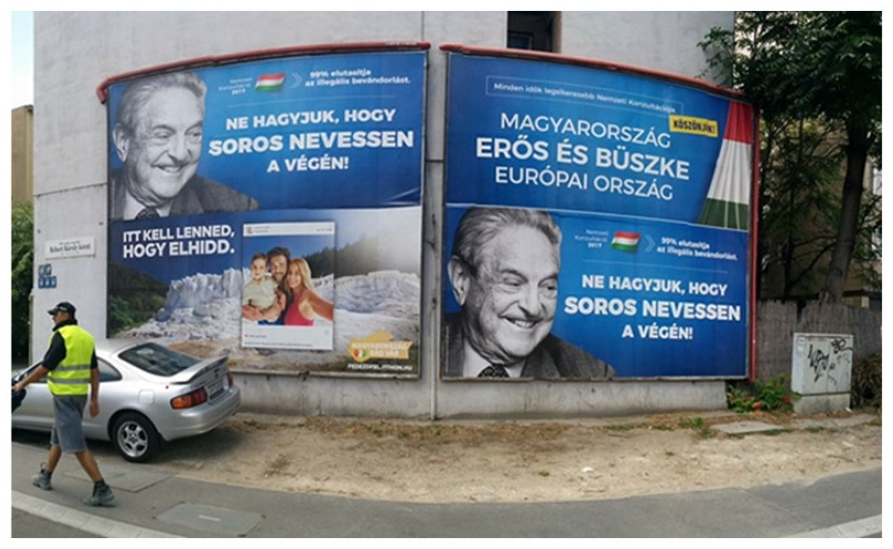
Government campaign poster warning in Fall 2017 of the dangers inherent in the ‘Soros Plan’. An adjacent poster advertises Hungary as a ‘proud and strong European country’. Source: author.
An illiberal European alternative
Hostility towards liberal social values already tangible during Orbán’s first government (1998-2002) have evolved into a pointed contestation of core principles that govern EU membership, including the rule of law and freedom of the press. Indeed, Viktor Orbán is known for demonizing liberal Europe, sometimes in a quite outrageous manner as was reflected in political statements during the 23 October 2021 commemorations of the 1956 uprising against Soviet occupation (quoted in Durach, 2021; Lendvai, 2021):
The high European dignitaries want to bludgeon us to be ‘European’, ‘sensitised’ (towards sexual diversity), ‘liberal’’, he said. But when it comes to ‘defending homeland, family, culture, the freedom of everyday life’, everyone has to do their bit. ‘When the time comes, stand in front of your houses and defend them!
Here again, Orbán evokes a struggle with the EU liberal elite, calling on his fellow Hungarians to barricade themselves in their houses due to an imminent invasion from Brussels. Orbán suggests the EU wants to rob Hungarians of their homeland and culture and ‘threaten freedom, the family and the nation’.
The flip side of this message is one of Hungary representing a centre of new European ideas that more closely adhere to public sentiment. This de-centred interpretation of Europe has been developed in the media via depictions of Hungary as an innovator and an active, rather than passive, member of the EU, supporting a nationally defined Christian Europe and unmasking Brussel’s ‘political correctness’. In mobilizing support for restrictive asylum policies and unilateral border closures, Hungary’s prime minister has proclaimed that ‘illiberal’ values are needed in order to protect national societies and guard against ‘naïve’ understandings of openness and tolerance.
The May 2018 Future of Europe Conference organized in Budapest during Hungary’s presidency of the Visegrad Group was another performative backdrop for Orban’s alternative Europeanist vision:
9
Is the war for Europe’s body and soul a winnable one? Can we defeat censorship, the shaming of those who think differently, the increasing cultural self-hatred in Europe? (. . .) Will Europe become the new melting pot? Shall we, out of cultural guilt or simple calculation, sacrifice Christianity, freedom and our way of life? Or should we retreat to our fortress, defend ourselves and strengthen our values and cohesion within? Is the creation of the New European Man realistic through migration?
In that same year, Orbán (2018) elaborated similarly radical contestations at the July 2018 Summer Open University, again at Băile Tuşnad/ Tusnádfürdő, in which he outlined sharp distinctions between ‘national’ and ‘liberal’ notions of Europe:
[Europe] has rejected its roots, and instead of a Europe resting on Christian foundations, it is building a Europe of “the open society” (. . .) in Christian Europe there was honour in work, man had dignity, men and women were equal, the family was the basis of the nation, the nation was the basis of Europe, and states guaranteed security. In today’s open-society Europe there are no borders; European people can be readily replaced with immigrants; the family has been transformed into an optional, fluid form of cohabitation; the nation, national identity and national pride are seen as negative and obsolete notions; and the state no longer guarantees security in Europe (. . .) In Liberal Europe being European means nothing at all: it has no direction, and it is simply form devoid of content.
The political and ideological ideas of Viktor Orbán’s Fidesz party have signalled a dramatic shift in framing Hungary’s role within Europe; they reflect a national-conservative agenda of nation-building in which Hungary will finally realize its role as a ‘strong and proud European nation’, following its own political destiny but within the context of European cooperation. In order to achieve this, however, Orbán’s government suggests that EU institutions require a profound restructuring. Orbán portrays the European Parliament, for example, as superfluous, a ‘dead end street’ that stands in the way of a new European renaissance (Szábó, 2021). The political attacks against EU institutions are in no small measure prompted by the several legal battles the Hungarian government is facing over the rule of law and misappropriation of EU funds. The Hungarian government has categorized the legal actions taken by the Commission as a witch hunt, and Várga Judit, the Hungarian Minster of Justice openly declared them to be motivated by the thirst for revenge of ‘pro-migration parties (Halmai, 2019).
Orbán has successfully tapped into broader conservative scepticism of multiculturalism and open borders, thus endowing his illiberal project with a civilizational European mission. To put it succinctly, there is a dual message in evidence: one is the provocative statement that Hungary is loath to subject itself to the dictates of another multinational ‘empire’ that denigrates national sovereignty. At the same time, the present Hungarian government argues that a new European Union is needed, one that builds on strong sovereign nation-states and that defends Europe’s historical traditions and intrinsic values. This dual message suggests the prospect of an epochal shift in the fortunes of Hungary and Europe through a ‘revanchist nationalism’ that reclaims traditional values. As mentioned above, this was famously declared in Orban’s July 2014 speech signalling the ‘end’ of the liberal epoch and its replacement by a concerted effort of illiberal state-building. 10 The political strategy of the Fidesz government involves an exploitation of European tensions and contradictions by appealing to populist sensibilities and contestations of liberal vales. Fidesz’s position contrasts starkly with many aspects of more traditional Euroscepticism as it involves a process of re-appropriation of the EU as a political community – giving new meaning to the EU and at the same time redefining the EU as a Union of sovereign nation-states.
Discussion and conclusion: illiberal bordering and European (dis)integration
In this final section, I will make two points that relate to the potential significance of interpreting illiberalism through a critical perspective on bordering. The first point regards CBS as a method. Much of the utility of CBS in analyzing modes of illiberal bordering lies in a comprehensive and holistic perspective that reconstructs the intertwined trajectories of political agendas, discourses and everyday practices, thus productively engaging with the complexity of border-making processes. As this analysis indicates, bordering, and illiberal bordering in particular, is more than territorializations of difference, it is also a socio-spatial, temporal and emotional process of distinction-making. The manipulability of this process provides evidence of what is at stake. Vaughan-Williams (2021) has associated populist bordering with ‘post-truth’ framings of national security, sovereignty and borders that reify foundational understandings of national community and belonging. Such narratives have profoundly influenced public opinion and have limited potential for measured and evidence-based discussion about migration. Along similar lines the ‘hyperreal’ concept of taking back control of national borders is central to right-wing populist narratives, leading in the case of Brexit to disastrous political decisions (Richardson, 2019; 2022). Indeed, the anchorings of illiberal bordering are often incoherent and irrational, reducing the complexity of national identity to singular and unambiguous categories.
CBS also sheds light on the potential consequences of illiberalism and right-wing populism. While the wider European significance of Hungarian illiberalism is unclear, this case indicates that the political instrumentalization of socio-spatial borders might have far-reaching consequences if unchecked. Concretely, they can further erode socio-spatial cohesion and lead to rigid commitments to identity politics that, as Ejdus (2020) suggests, can be deleterious to national economic and political interests. Orbán has forged an effective political majority through processes of exclusion, constitutional manipulations as well as a fragmented opposition. However, the Orbán regime’s bordering practices have exacerbated a sense of political alienation and apathy (Kalan, 2022; Szábó, 2022). Despite Russia’s war of aggression against Ukraine, for example, Orban’s continued openness to Putin and his autocratic values as well as his animosity to Ukraine, have served to isolate Hungary within the EU and damage any sense of illiberal solidarity with Poland. Moreover, instead of unifying the nation, Orbán’s bordering politics have contributed to social disintegration and polarization. As the social psychologist István Szíklaki commented in a recent interview (Szilágyi, 2022), behind the hubristic façade of a ‘powerful and proud European nation’ evidence is accumulating that the regime’s manipulations and politicization of difference has made dialogue between individuals more complicated and has created new divisions between families, neighbours and the various social groups that make up Hungarian society.
The principal long-term threat is therefore one of an erosion of social cohesion to the extent that reasoned democratic deliberation and participation become difficult if not impossible. Orbán’s illiberal regime is exemplary of right-wing nationalist populism in that it is based on a socio-spatial fantasy of a unified nation. While Hungary is particularly at risk, illiberalism and the divisions it exacerbates could strengthen disintegration tendencies within the European Union more generally. Despite the instability of Orban’s illiberal project, at a wider European level Hungarian experience serves as a warning sign of the potential consequences of manipulating popular anxieties and identity concerns through the bordering and othering of difference.
Footnotes
Declaration of conflicting interests
The author declared no potential conflicts of interest with respect to the research, authorship, and/or publication of this article.
Funding
The authors disclosed receipt of the following financial support for the research, authorship, and/or publication of this article: This article is based on research funded by the European Union’s Horizon 2020 research and inovation programm within the scope of the EUARENAS project [grant agreement 959420].
