



Abstract
Critical security studies have shed invaluable light on the diffuse governmental technologies and pernicious effects of the EU’s bordering practices. While scholars have focused upon the experience of precarious migrant groups, this article suggests that extending our critical gaze to include seemingly privileged migrants can further understanding of just how far the insecurity produced by the EU’s migration regime reaches. Focusing on the migration process of international students in Norway, this article inquires into how these migrants experience, theorize and negotiate the EU’s visa regime and its governmental technologies. We show how their subjective understandings of ‘broad’ and ‘narrow’ hierarchies of the visa regime play out in their bureaucratic encounters, influencing their everyday lives. Ultimately, the article shows how the regime’s disciplinary effects extend further than prior critical research has appreciated.
Keywords
Introduction
Migration is a process that neither begins nor ends when one crosses a border. While border control remains the site where the state’s domination over its territory and the bodies of individuals is most physically felt, migration flows in the 21st century have prompted new ‘technologies of control’ and exclusion, which outsource population control to diffuse transnational bureaucracies. 1 Consulates and embassies, security professionals, airlines, among many other public and private agencies, are all imbricated in the functioning of ‘de-bordered’ visa regimes designed to halt ‘undesirables’ long before they reach territorial borders. For instance, border-free travel within the European Schengen area has come at the cost of a securitization of immigration which is perpetuated through an opaque (in)security apparatus which makes fear-production practices part and parcel of the European project. 2 The more recent scholarly focus in critical security studies on everyday migration management at airports, border spaces and immigration offices, 3 complements though not always consciously, an adjacent body of literature in migration studies that focuses on the implications of these practices for migrant (in)security. 4 While this literature has shed invaluable light on the experience of precarious migrant groups, particularly the subjectivities and agency of refugees and asylum-seekers, the extent of the pernicious consequences of the current migration regime even on ‘legal’/authorized 5 migrants has received less attention. 6
This article contends that everyday experiences of authorized migrants that cross borders to study, work abroad or re-unite with their families are important to further our understanding how the current migration regime produces (in)security. Focusing on international students from outside the Schengen area and their experience migrating to Norway, we inquire into what positivists might call a ‘hard case’ for the argument that the EU’s migration regime produces precarity and insecurity. Indeed, by selecting a relatively privileged group – who necessarily have the financial and social capital to study in Europe – the article explores how far the insecurity produced by the contemporary EU migration regime reaches. While Franck and Vigneswaran note that ‘deportability’ is the common denominator uniting migrants in a precarity of a different order than citizens, 7 there has hitherto been little research into the everyday experience of ostensibly more privileged migrants. 8 In other words, how do the seemingly upwardly mobile international students experience the EU visa regime? To what extent does deportability feature in their everyday decisions? What measures do they take to navigate the visa regime’s (in)security apparatus? We posit that answering these questions promises to expand our understanding of both the scope and power of contemporary bordering practices.
Thus, inspired by critical migration studies and feminist thinking, this article inquires into how migrants experience, theorize and negotiate the EU’s visa regime and its diffuse governmental technologies. Such a move extends logically from calls by scholars of critical security studies to recognize that migrants are interpretative protagonists in these processes too. 9 Our main theoretical gambit assumes that the security apparatus (re)produces hierarchical discourses of (in)security, but also explores how knowledge of these filtering technologies ‘loops’ back into the migrants’ local discourses, informing their strategies of migration with unexpected and potentially significant consequences. Therefore, rather than taking a top-down approach that begins with government policy and reads power downwards, in a feminist tradition we treat the personal as political in an effort to ‘read power backwards and forwards’. 10 This approach links the local, personal and everyday with the international, in other words, it allows us to see visa practices and migrant experiences as part of a web that constitutes international relations. This will allow a better understanding of the extent to which contemporary migration regimes impact everyday (in)security: Why might a Brazilian woman avoid flying via Spain on her journey to the EU? What does a student from West Africa mean when he explains that he fears ‘getting sacked’ by the immigration agency? Or more theoretically, how do migrants reflect and act upon the complex and often ambiguous formal and informal hierarchies they encounter with the EU’s visa regime? To answer these questions, and more, requires listening to migrants narrate how they understand the process of planning to move, ‘passing’ across the border and striving to stay within Schengen.
To this end, we conducted 18 in-depth interviews with international students from outside the Schengen Area and invited them to share their experiences of the EU’s visa regime and their migration process to Norway. Norway is an unusually appealing destination for international students: like Norwegians they pay no tuition fees, while many study programs are offered in English. 11 Indeed, since the 2000s, Norway has pursued an ‘internationalization’ strategy in higher education and sought to encourage, facilitate and incentivize foreign students studying in Norway. 12 Yet, as the number of international students has risen, the Norwegian Directorate for Immigration (UDI) has exerted more resources attempting to catch students that it considers in breach of the visa regulations. 13 Moreover, like most of Europe, Norwegian migration policy discourses have taken a rightward turn over the last decade, whereby formerly extreme positions on immigration have become mainstream. 14 Hence, Norway provides an excellent window into the challenges facing seemingly privileged migrants navigating the EU’s visa regime in an era of increasingly securitized migration.
By documenting how international students experience, theorize and navigate the Norwegian flank of the Schengen visa regime, this article seeks to make four contributions to IR scholarship. First, de-bracketing the migrant and their agency reveals that their experiences and impressions of the system varies from exasperation to gratitude, anger to resignation. Some are fearful, others are irritated, some see fairness, others only incompetence. As we show, none of this can be assumed a-priori on the basis of nationality but as we will argue relates to reflection upon and experience of migration-related hierarchies. Second, student-migrants actively theorize the process and formulate strategies for navigating the system based upon assumptions derived from a mixture of experience and knowledge-networks. What emerges from our collective body of interviews, is the picture that the EU visa regime’s effects are seldom experienced as omnipotent, mechanistic or consistent, nor as efficient as is tacitly implied by macro analyses of the EU’s migration discourses. Third, but closely linked to this, our focus on the longue durée process of migration, highlights how even once migrants are allowed to cross the border they often continue to take into account looming, securitized and hierarchical categories of suspicion associated with migrants in the 21st century. Thus, we illuminate how the process of entering the EU tells only a partial story; while seemingly successful in acquiring a student visa and residence permit, maintaining the status of ‘good migrant’ requires persistent labour and self-management. 15 Fourth, more theoretically, by exploring how migrants theorize and navigate the broad and narrow hierarchies constituting the EU’s migration regime, we aim to illustrate how our hierarchy lens can help IR further undermine its ‘norm against noticing’ how racialized and gendered discourses remain embedded within international relations. 16 Taken together, this article contributes to Critical Security Studies and Critical Migration Studies literature by illuminating how the (in)security produced by modern migration discourses informs the strategies and experiences of ‘legal’ and seemingly ‘privileged’ migrants as they navigate the EU visa regime.
EU border regime, migration and the production of insecurity
Free travel within the Schengen area is often celebrated as one of the major successes of the EU. The abolition of internal borders allows EU citizens and visitors to travel without border controls and supports the common assertion that the EU fosters free movement. Yet, at the same time, the creation of the border-free area has led to a tighter management of the 26 Schengen countries’ common external borders. 17 This does not only mean that the territorial borders are secured, but that a common EU visa policy is implemented to manage migration before potential migrants arrive. Indeed, migrants can only access the Schengen area by passing the virtual European ‘paper curtain’ prior to physically entering. 18 Therewith, hierarchical distinctions are made between legitimate and illegitimate travellers to the EU. The criteria underpinning these distinctions are enforced by strict bureaucratic procedures, which have developed into a multilevel governance architecture to manage European immigration. 19 The so-called ‘whitelist’ currently specifies around 60 countries, whose citizens need not apply for a visa to travel or transit to Schengen countries. The ‘blacklist’ on the other hand, demarcates about 135 countries, whose citizens are required to apply for a visa to enter the EU. The effect of this visa regime is that it has become easy for some people to travel between countries, while it has become increasingly difficult for others. 20 Co-constituting the EU’s virtual border, these lists define the identities of would-be-migrants prior to any departure and thus ‘materialise the categories they purport to describe’. 21
It is perhaps not surprising then that since the 1990s, these forms of border practices have become a major issue for critical security scholars who have investigated how the securitization of the EU’s borders is paralleled by an increasing bureaucratization and technologization of (virtual) borders. These early movers within IR drew attention to seemingly banal EU governmental migration practices and problematized how governments have implemented biometric and technocratic systems of surveillance that categorize, exclude and ultimately control and restrict the mobility of individuals under the guise of ‘national security’. For instance, Huysmans showed how securitization processes became embedded in EU bureaucracy, producing and perpetuating the idea of migrants as a threat. 22 Meanwhile, Salter explored how global mobility management manifests and depends upon enforcing a ‘confessionary complex’ upon individuals (demanding routinized ‘obedience, examination, confession’) and targets marginalized and poor groups: so called ‘high risk’ people. 23 These securitizing practices manufacture and reproduce identities based around the EU’s ‘whitelists’ and ‘blacklists’, between ‘wanted’ and ‘unwanted’. 24 Given that the blacklists disproportionately feature developing and Muslim countries, van Houtum argues that the EU perpetuates a ‘neocolonial’ external border regime that constitutes ‘global apartheid’. 25 Ultimately, this scholarship drew much needed critical attention to the subtle yet pernicious effects of today’s border practices and raised vital ethical and practical questions regarding the utility and morality of its migration regimes.
Noticeably however, migrants’ subjective experiences, voices and actions were almost entirely absent in this research agenda, in favour of a focus on discourses and border practices of policy-makers, security personnel and/or bureaucrats. Taking their cue from Foucault, migrants often became mere ‘bodies’, victims to governmental processes. The seminal edited volume, Global Surveillance and Policing: Security, Borders and Identity is illustrative. 26 The editors claimed that the ‘experience’ of borders is one of their chief concerns, 27 yet, none of the chapters relay nor investigate people’s understandings and experiences of borders. Indeed, this is even the case in a chapter that explicitly claims to ‘foreground’ the ‘impact on persons’ subject to the US’s post-9/11 migration registration system and subsequently reveals that the ‘impact on the identities, rights and freedoms of those subject to registration is clear’. 28 Yet, this clarity is ascertained without any evidence derived from the migrants themselves.
Ultimately, as Golunov points out, when critical scholars take a ‘god’s eye view’, it tacitly renders migrants ‘passive objects for surveillance and sorting’ rather than subjects who can and do possess agency and interests in their own right. 29 This is an analytical as well as an ethical problem because excluding these voices may give a misleading and over-simplified picture of how migration regimes function. They may also end up giving state machinery too much credit. In Salter’s seminal work, for instance, he tacitly presumes that governmental systems function efficiently when he claims, ‘the characteristics of the mobile subject are crucial in determining the permeability of an international border, determined by class, nationality and other social scripts’. 30 Yet, these inherent characteristics of the mobile subject may not be determinate: the filtering may not always function as planned. Indeed, as more recent work in migration studies (and our article) suggest, there is leeway for migrants (some more than others) that allow them to negotiate these criteria in a manner unintended by governmental authorities.
While more recently critical security scholars have begun to remedy this issue by zooming in upon the concrete bordering practices in diffuse locales, 31 this approach still ends up bracketing the migrant and thus leaving important questions unanswered. For instance, Moffette shows how the Spanish government bend their own rules and ‘encourage’ irregular migration via a ‘diffuse and flexible regime for governing migration’ – contra the hyper-rational imaginary implied by ‘technologies’. 32 Here, irregular migrants are allowed to enter from Latin America before enduring a probationary period of monitoring, whereby those deemed ‘deserving migrants’ may eventually become authorized. In the meantime, these irregular migrants stand at permanent risk of categorization as ‘undeserving’ and thus getting deported. Complementing this insightful analysis, one might also ask how migrants themselves interpret and act upon the informal hierarchies produced by Spain’s migration regime. How do they negotiate the informal categories of ‘deserving’ and ‘undeserving’ migrant, and adapt their behaviour to maintain their precarious legal status within Spain? Indeed, as our study will suggest, people simultaneously reflect on how their bodies are governed, where they stand in the migration hierarchy, and take measures to manage their identity based on gender, racial and class considerations to compensate. This ‘looping effect’, in which people respond and change behaviour in response to classification, has long been recognized by constructivist scholarship, 33 yet until recently, had seldom been foregrounded within IR’s work on migration. 34 Ultimately, we build upon critical security studies work that has problematized both the EU’s migration regime and its everyday bordering practices, but rather than conceptualize migrants as ‘bodies’, we add to recent trends to pay greater heed to their agency (and minds) too.
De-centring migration: process, protagonists and deportability
Here we pick up recent calls for IR to take inspiration from migration studies and escape the state-centricism plaguing even critical scholarship. 35 As Squire contends, migration studies offer the ethical-cum-methodological disposition to de-centre IR migration scholarship. 36 By focusing on the experience and agency of migrants themselves this work emphasizes how ‘precarity is a produced condition that is unevenly experienced by migrants’, whose dealings with authorities intersect in complex ways with racialized, colonial and gendered discourses of discrimination operating during a given migrant’s ‘trajectory’. 37 As the term trajectory implies, this approach demands that scholars treat migration as a process: an ongoing struggle for (im)mobility that cannot be reduced to a singular event nor ceases when one crosses the border. The experience of prolonged migration management is well described by de Vries and Guild as a ‘politics of exhaustion’ which emerges in the process of migrants needing to constantly navigate contemporary border regimes. 38 Hence, in the analysis that follows, we relay how our interviewees describe their plans preceding crossing the border, their strategizing and experience during their transit and their efforts to remain in Norway.
A second key injunction from critical migration scholars is to engage ‘people on the move’ as not merely objects of knowledge extraction or ‘passive victims’, but as ‘protagonists in their own right’. 39 For instance, Innes’ pioneering ‘de-centered’ approach emphasizes migrants’ unique experience as they ‘negotiate and resist state power [even] as it manages and disciplines them’. 40 In a similar vein, Franck and Vigneswaran show how migrants are able to ‘hack migration control’ by using their networks and sharing for instance which routes to take, how to conceal identities or how to engage with officials. 41 Meanwhile, Schapendonk illuminates how migrants create room for manoeuvre: improvising, hustling and negotiating in their interactions with the migration industry. 42 In short, by beginning inquiries with the migrant rather than the state apparatus (de-centring), these works are able to highlight both the agency of migrants but also how discourses beyond the state inform how migrants encounter and navigate the visa regime – making visible discourses that would remain unseen by state-centric analyses. Indeed, as we show, the official categories animating a migration regime are inevitably imbricated with several other less explicit identity categories to be negotiated, avoided or striven for.
While understandably critical scholars have been drawn to the most ‘extreme’ manifestations of migrant insecurity, the more mundane ‘legal’ migration has received far less attention from critical migration scholars.
43
Not only does this leave ‘the routine problems faced by a vast majority of border crossers’ underexplored,
44
but as Franck and Vigneswaran’s recent corrective suggests, it may have significant analytical costs, too.
45
Focusing on the plight of migrant workers in Malaysia, they show how the boundary between authorized/legal and unauthorized/illegal is seldom static and that migrants consciously move back and forth between categories weighing up their choice depending upon their evolving circumstances. Rather than treating legal and illegal migrants as distinct categories or groups, they contend that the ‘defining characteristic of the international migrant population as a political grouping is “deportability”’
46
and that while
migrants’ experiences of being deportable may vary significantly according to their current circumstances, deportability constitutes a broadly applicable condition that gives migrant politics its specific character and frames how migrants (as contrasted with permanent residents and citizens) relate to political institutions and powerful actors.
47
Hence, including legal migrants under the category of deportable populations alerts us to the precarious position of both authorized and unauthorized international migrants.
Crucially, conceptualizing migrants of all stripes as sharing a common deportability brings into view migrants that would ordinarily not fall under critical scholar’s gaze: whether it be retirees, foreign spouses or the international students, who are the focus of this article. International students are a somewhat particular case of migration as their mobility is seen to be temporary and initially bound to the period of their studies. In Norway, student visas are granted with the requirement that the student will return to their home country after finishing their studies. Student visas are nevertheless often seen to be a steppingstone to permanent residency. Importantly, we limit our focus to international students from outside the EU because deportability does not apply in the same way to EU citizens: as Favell notes, EU states can technically deport EU citizens, but cannot stop them from re-entering moments later. 48
International students are a worthwhile case to explore not only because of the lack of attention, but because they allow us to probe the limits of one of the key arguments of critical migration and security studies: how far does the insecurity produced by contemporary migration regimes reach and to what extent do authorized, ostensibly privileged migrants experience the precarity erstwhile highlighted by critical scholars? Indeed, scholars of privileged mobility have recently highlighted that migrants privileged by citizenship, class or race cannot simply be studied with the term ‘expatriate’. 49 While expatriates are often portrayed as ‘good’ migrants in public discourse, the identity of those migrants is actually more complex and ambiguous than the term might initially suggest. 50 Similarly, international students in Norway face diverse and multifaceted challenges related to their migration, albeit often quite different from those faced by white Western ‘expatriates’ that have been the focus of privileged mobilities research. 51 In our case, international students may come from relatively privileged backgrounds within their home countries – ‘elites’ 52 to some – but are not necessarily able to enhance their quality of life in relatively pricy Norway. They are however economically and socially often better positioned than precarious migrant groups such as refugees or labourers. But does their relative privilege serve to insulate them from concerns about deportation, smoothing their experience navigating migration regimes? Or does deportability still loom large in their lives and migration strategizing? Indeed, although international students do not face the same rules as labourers or refugees, they often face considerable academic and economic demands that should they fail to meet, threaten their ability to remain. In order to begin to explore whether and how deportability and its associated insecurity manifests among this group, this article foregrounds international students’ agency in negotiating the physical and paper border of the EU visa regime.
Migrant hierarchies, theorists and navigators
But how can we conceptualize the bordering practices of the EU and migrants’ efforts to tackle them? The preceding discussion implies we need an inductive and de-centred framework that treats migration as a process rather than an event, that treats migrants as protagonists rather than passive objects of state power and is sensitive to deportability but without assuming its omnipresence. To this end we utilize three concepts that informed our analysis but without determining it: broad/narrow hierarchies, everyday theorizing, and navigation. We will take each in turn.
We find Mattern and Zarakol’s distinction between ‘broad’ and ‘narrow’ hierarchies offers a useful angle to make sense of migrants diffuse and diverse experiences of the EU visa regime. 53 They define narrow hierarchies as involving relationships of legitimate authority, while a ‘broad’ hierarchy defines structures of stratification and inequality – whether ideational or material – that enable dynamics that may cut across or diffuse beyond narrow or formally defined hierarchies of authority. One recurrent theme throughout critical migration research is how security practices (re)produce both narrow and broad hierarchies via their sorting and filtering mechanisms. When official EU policies sort whole countries into ‘black’ and ‘white’ lists they not only (re)produce hierarchies among states but constitute hierarchies among people too. Similarly, when the less institutionalized discourses of ‘desirable’ and ‘undesirable’, ‘good’ and ‘bad’ migrants circulate in public discussions, these hierarchical categories inform both governmental practices and migrant experiences. From this perspective it is consistent to suggest that even where formal authority is wielded over someone or something, broad hierarchies still emerge and inform the workings and operation of narrow hierarchies. Hence, a major advantage of this hierarchy lens is how it is attuned to illuminating the effects of enduring hierarchies of race and/or gender within ostensibly liberal institutional contexts. As such a hierarchy framework is well suited to contesting the ‘norm against noticing [race]’ (and we would add gender 54 ) that has long afflicted IR. 55 For instance, to take a familiar example, racial hierarchies could inform both the practices of border agents and the strategies of migrants without either being formally proscribed within formal legal procedures. Indeed, in this article, we investigate how the narrow hierarchical relationship between migrants and state bureaucracy (which wields the formal authority to deport) intersects with broad hierarchies in which discourses of difference inform the subjectivities and strategies of migrants.
We understand the EU’s visa regime as a narrow hierarchy embedded and co-constitutive of broader hierarchies. But in order to avoid conducting just a structural analysis, we use the concept of ‘everyday theorizing’ to help us de-centre our study and make sense of migrants encounters with the regime. It is an obvious assumption to make at this point that migrants are likely to be keenly aware of their potential positioning within these broad and narrow hierarchies that they encounter upon traversing the border regimes. However, in line with our de-centred approach, we do not assume that we can read how these hierarchies affect migrants’ experiences or strategies from analysing neither state-level discourse nor the bureaucratic practices of bordering agencies alone. Instead, inspired by Zalewski, we treat migrants as theorists; here, ‘theorising is a way of life, a form of life, something we all do, every day, all the time’ 56 : from how to make the perfect cup of tea, or, in this case, how to make it through border control without being singled out for inspection or manage to navigate the jungle of immigration bureaucracy. We contend that conceptualizing migrants as actively engaged in theorizing their migration process both illuminates migrants’ agency to make sense of bordering practices and provides a window into the heterogeneity and specificity of migrants’ trajectories. Specifically, it allows us to explore how migrants’ experiences and know-how inform their theories and thus strategies for navigating the broad and narrow hierarchies imbricated with and operating through the EU’s visa regime. Indeed, a major advantage of centring our analysis on migrant theories of the regime rather than the regime itself, is that it allows us to identify sources of insecurity that do not directly stem from visa regimes official discourse or practice but are none the less salient in migrants experience of the regime. This approach enables us to explore how latent local or global discourses pertaining to ethnicity, gender, and nationality may inform migrants experience and strategies without assuming it a-priori.
The third and final member of our conceptual tripartite describes the action undertaken by migrants on their journey: social navigation. 57 Indeed, theorization without navigation may imply studying merely migrants’ comprehension of what was done to them, when we are specifically interested in the choices and strategies they undertake to proceed; their agency to do things differently and facilitate both moving and staying. Crucially, social navigation captures both short term tactics (e.g. negotiation of one’s identity in a concrete context) and longer-term strategies that animate people’s interactions with an uncertain and shifting environment. Indeed, as Vigh notes, it ‘encompasses both the assessment of the dangers and possibilities of one’s present position as well as the process of plotting and attempting to actualize routes into an uncertain and changeable future.’ 58 Yet, social navigation does not imply pure agency or voluntarism but highlights how humans always ‘move in relation to the push and pulls, influence and imperatives, of social forces’. 59 Hence, social navigation is a concept that illuminates the interface between agency and often powerful social forces. We consider the heuristic – or metaphor – navigation to be particularly apt for conceiving of migration because it can capture improvization, skill, ad-hoc as well as routine decisions, bumpy and smooth journeys, and right and wrong turns. 60 Hence, within our framework, migrants theorize as they navigate the hierarchies constituting the EU’s visa regime.
Case selection, method and background
This article investigates the everyday experiences of international students coming to study from outside the EU. These individuals have to deal with the EU ‘paper curtain’ in order to obtain a visa that allows them to enter and stay in Norway. While Norway is not a member of the EU, as a member of the European Economic Area and the Schengen Area, Norway has to apply the same freedom of movement rules as all other EU member states. We chose to take an explorative approach and interviewed 18 individuals from outside the Schengen Area that were successful in getting into Norway as international students. Half of them were from whitelisted countries, mostly North American; the other half were from blacklisted countries spanning Asia, Africa and South America. 61 In these in-depth interviews, we inductively discerned their respective theories and experience of the EU’s migration regime, and crucially, how they acted upon them. In this way, we seek to ‘foreground ordinary people and their agencies, good and bad, as components of international relations’. 62
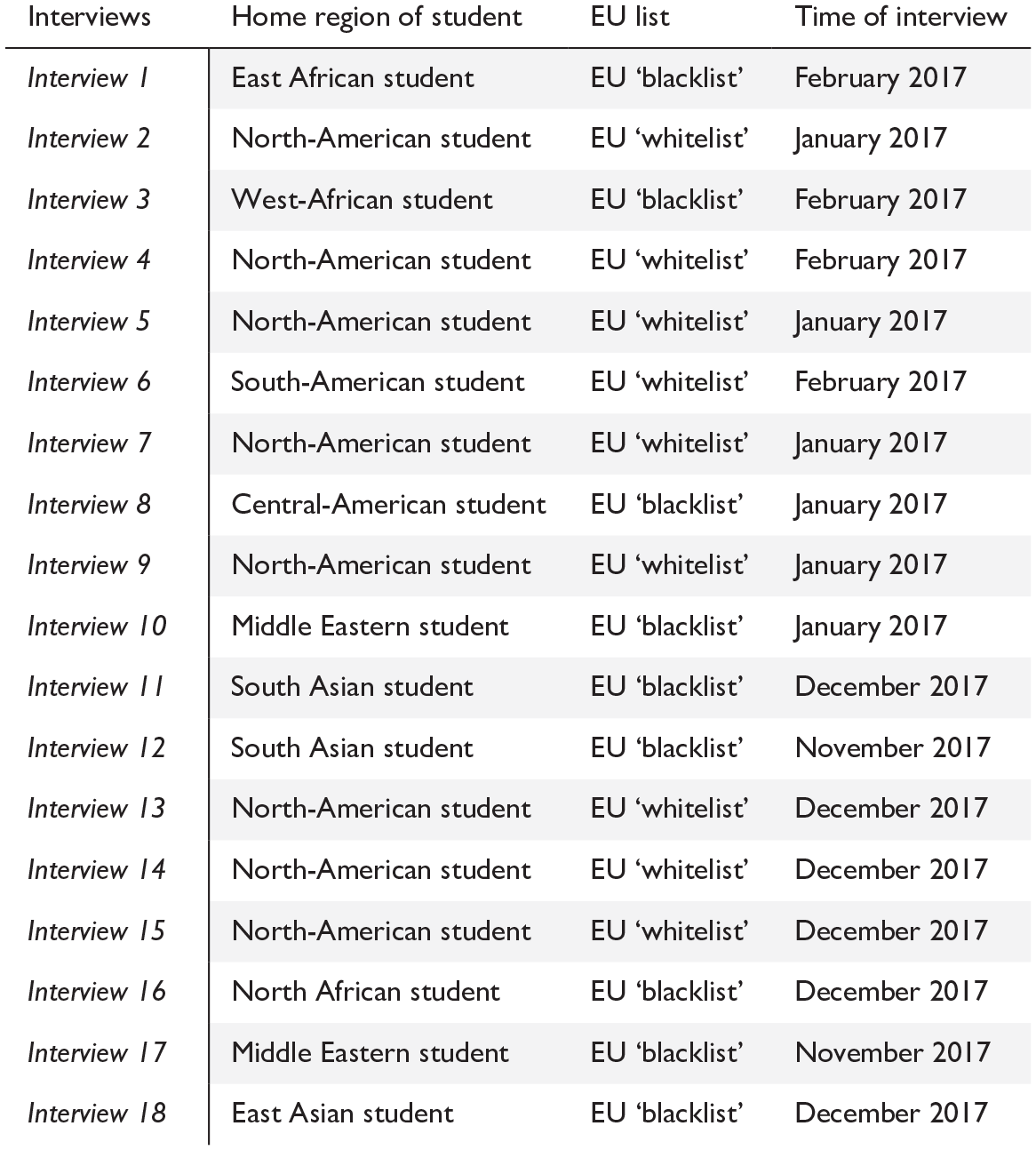
List of interviews conducted.
Working with migrants comes with certain ethical dilemmas: not only are migrants increasingly tired of being the focus of a multitude of Western research projects, they are also particularly frustrated that researchers take their stories which advance their careers without giving any benefits back to their protagonists. 63 Our interviewees are by no means to the same extent vulnerable as for instance refugees but they are still subject to a migration regime characterized by asymmetrical power relations. They have all managed to migrate from outside to inside the Schengen Area in order to undertake higher education. Thus, our exploratory case is based upon those that at a minimum had sufficient social and economic capital to make it through the paper curtain. Yet, while everyone interviewed ‘got in’, they faced heterogeneous obstacles and thus experienced and handled the process of applying, entering and living differently. It was important for us to accurately represent their experiences and make their stories heard. Therefore, we circulated an earlier version of the article to all our interviewees for feedback and asked them to comment whether our interpretation and contextualization reflected accurately and reasonably their experiences. Due to the potential sensitivity around the issues discussed and their vulnerability we anonymized our interviewees.
The following section explores how these individuals negotiated their identity and biometric narrative within the global security regime, and the ‘discourses of danger’ and suspicion that have emerged since the 1980s around transnational migrant flows. 64 As we will explore below, the official institutional screening mechanisms – for instance, the white and blacklists – only tell a partial story of how global hierarchies shape individuals’ migration experiences and inform their migration strategies.
All of our interviewees had to go through the process of applying for a visa, travelling into Norway, and upon arrival, meet a series of bureaucratic requirements in order to live, study and work in the country. Besides two, all interviewees entered with a student visa. In the abstract, the process is ostensibly the same for everyone. First, students must pass the ‘paper border’: Once they have been accepted in a study program at a Norwegian university, they must apply for a student visa, which costs around 3200 NOK in all countries. This process involves sending proof of acceptance to the program, proof of financial independence (which means showing the student has around 100,000 NOK, approximately 10,000 Euros, in their bank account), 65 and proof of identity to the nearest Norwegian embassy for approval. In many, but not all cases, this involves physically visiting the nearest embassy or, if no Norwegian embassy is in the area, a private visa agency that handles the visa application process. Second, once the visa has been granted, the students must physically travel to Norway and enter the Schengen Area. This means all students must pass through border control checks with the authority to question their motives, and with the possibility of refusing them entry. 66 Third, once the students arrive in Norway they must directly apply for a personal social security number, register themselves with the police and apply for a bank account (which while technically optional, is necessary if a student wishes to either work or rent a place to live). Finally, the visas are issued (usually) only for 1 year at a time and most students must reapply at least once during their studies, despite the fact that most Norwegian study programs are longer. This reapplication process costs another 3200 NOK and requires the student to show again 100,000 NOK in their bank account. However, upon re-application, the UDI also makes an additional demand for proof of successful studies. 67 These are the basic formal processes that all non-EU students must undergo in order to migrate to and live in Norway as a student. It is worth noting that 2 years prior to our interviews, UDI introduced ‘new methods’ for investigating whether foreign students were following visa regulations. This led to a tripling in the number of students deported from 3 in 2010 to 34 in 2016. 68 As we shall now discuss, our interviewees highlight how the EU’s visa regime in Norway produced a diverse array of experiences of (in)security, understandings of hierarchies, and indeed strategies of navigation and resistance.
Everyday theorizing and experiences of international students in Norway
During the process of applying for a student visa and then living as a student in Norway, our interviewees underwent various encounters with bureaucracies that led them to reflect, theorize and act upon their position within migration hierarchies. These experiences were frequently informed by an implicit understanding of what these hierarchies are and what they imagine to be ‘normal’. As Goffman observed, ‘the notion of “normal human being” (. . .) seems to provide the basic imagery’ through which people conceive of themselves. 69 However, nobody can meet all the ideals defining ‘normal’ in a given society, hence, everyone can at one point both feel stigma and the need to manage it. 70 Stigma here means an attribute that makes a person potentially ‘discreditable’ to a society; as Goffman notes, even though ‘normal’ identities are never fully entrenched anywhere within society ‘they can cast some kind of shadow on the encounters encountered everywhere’. 71 For our interviewees, their theorizations of ‘the (ab)normal’ and (un)desirable migrants, shaped both their understanding of their migration experience and their migration strategies. The following section will discuss this ‘everyday theorizing’ around migration hierarchies and how it informed the students experience of the EU’s visa regime.
Several interviewees used the baseline of how they imagined ‘normals’ were treated in the various visa processes to assess whether they were receiving equal or fair treatment. Hierarchical discourses – whether racial, gendered, socio-economic, nationality-based, or an intersecting mix – often framed and informed their experience of entering and living in Norway. The process of crossing the border, registering into the Norwegian system and re-applying for residence permits often brought with it challenges and difficulties which the interviewees theorized as discrimination against their potential group identity. For instance, a Middle Eastern interviewee echoes this when he reflected upon a bank employee’s explanation for why he had to wait so long to set up his bank account:
Well, you know, there are just regular processes that we have to do. They’re all regular procedure’ and he was like,
Testing this theory, our interviewee sought to discover if his North American friends had faced the same questions and checks. He reported that he found that they had managed to get a bank account in less than half the time, with no mention of ‘routine security checks’ nor ‘terrorism’. 73 However, almost all respondents from ‘blacklisted’ countries expressed understanding of why these kind of checks were considered necessary. As our North African respondent explained, it is ‘totally understandable if they block a lot of people from Muslim countries . . . because of what is going on, with bombing and all of that’. 74 Although many students theorized this as a discrimination related to their group identity, some still accepted the differentiation between ‘desirable’ and ‘undesirable’ migrants as a necessary and legitimate bureaucratic sorting practice.
The awareness and acceptance of racial and national hierarchies does not mean though that interviewees necessarily thought that it was fair. While a perceived racial hierarchy frustrated our Middle Eastern interviewee, other students were concerned with the assigned identity of being a citizen of a ‘blacklisted’ country. A North African student, for instance, resented that the visa process was unable to differentiate further between migrant groups and suggested that the system does not adequately differentiate between different Muslim countries: ‘It is easy for them to know and to distinguish between the good and bad people, if I might say it like that. It does not make sense . . . They can make it easier for certain nationalities’.
75
One American student, on the other hand, suggested that people from richer countries should not face the same bureaucratic requirements of providing proof of finance as those from less affluent countries, arguing that North American banks are reliable and do not provide forged documents.
76
However, being treated better than ‘normal’ was sometimes theorized as discrimination too. One of our American interviewees, upon cross checking with their friends’ experiences with setting up a bank account, believed that the relative ease with which they navigated the system was likely a result of their white, American privilege.
77
Their sense of preferential treatment was based on their personal interaction with a UDI interviewer, who accepted the application even though documents were missing and our interviewee was technically low on funding, which could result in the denial of their visa application:
I definitely was the only Caucasian person in that UDI room. I just felt different, I don’t know, maybe that’s just in my feelings but I definitely felt a sense of privilege which I was grateful for but also felt very awkward about.
78
Here, the interviewee theorized afterwards that they were not treated as a ‘normal’, but unlike the other cases, the perception is that they received special (good) treatment.
These examples provide a snapshot of the ways that individuals, upon encountering the visa regime and its associated security practices, elaborate diverse theories of how and why migration bureaucracies operate the way they do. As should be clear, these interpretations do not necessarily derive directly from the migration process itself but are also intermeshed with prevailing security discourses among their networks of friends and family. Indeed, similar to how Innes notes that asylum seekers each have a ‘unique experience negotiating structural, legal and circumstantial constraints’, 79 so do international students dealing with the EU visa regime. Whether these theories are well-founded is not investigated here. What can be ascertained is that these feelings of being part of a ‘normal’, privileged or stigmatized group affected their experience of the migration process, and as we will shortly see, informed their strategies and emotions in their encounters with the diffuse security practices of the visa regime.
The theories that our interviewees held about visa regimes co-constituted their emotions as they went through the visa process. Anxiety was one of the most commonly reported emotion present in all parts of the migration process, especially among interviewees that understood themselves as managing a potentially stigmatized identity. It is noticeable that these anxieties were expressed even among students that did not report any formal reason to worry about their migration status. For instance, a Brazilian interviewee reported that when ‘cross[ing] a border, even though you know that you are doing nothing wrong, all your documents are in place, everything is correct, but still people stare at you in a different way, and you get anxious’.
80
However, these anxieties about the authorities do not necessarily cease once migrants enter Norway, as another Middle Eastern interviewee response illustrates:
Every time I see UDI, I feel stressed. I live in Oslo and it’s exactly in front of UDI and every time I’m passing by, I feel like they are analysing and they are processing somebody’s documents, and something like that. I don’t feel very good, honestly. [. . .] So, I don’t care so much, but UDI is something that I’m involved with, something that is my concern every second of my life here.
81
Indeed, this response – of which there were many similar – supports critical scholars’ argument that the visa regime operates as a surveillance technology, which produces insecurity far beyond the border control. However, what is not often emphasized in critical migration scholarship, is how migrants’ negotiation of the EU visa regime has considerable disciplining effects for migrants that extend after crossing the border. For instance, one North American student showed us a thick file of migration related documents they carried around at all times, lest they be required to demonstrate their right to be in Norway. In other words, our interviewee quite literally carried around the burden of deportability. The disciplinary bureaucratic requirements connected to deportability frequently produced emotional distress which is well illustrated with the student whose visa renewal was denied by UDI:
I felt so bad. And also the fact that I was leaving on a note of being sacked. I felt so terrible, and I felt so embarrassed as in like, you know, where I was living there was this feeling that I have been sacked, you know? [. . .] It’s like you don’t belong here. We don’t want you here. The feeling as if you are not part of us, you cannot be part of us, you know? And, to me, I wasn’t leaving Norway on a good note, so it really gave me so much trauma.
82
As our interviewee illustrates, it was not merely the effect on their own life that caused this trauma, it was the public knowledge and embarrassment of ‘being sacked’ that multiplied feelings of shame. Indeed, our interviewees reflect how the negotiation of the visa regime is seldom an individual struggle upon which the benefits of success or costs of failure fall strictly upon the migrant. Rather, as several of our interviewees report, the students’ studies are bound up with family and sometimes community expectations in their home countries to succeed.
However, not all theories of the system produced anxiety. Several interviewees positioned themselves as a ‘customer’ encountering a service. The customer service could be performed well or badly, they could be irritated or pleased by it, but these interviewees did not express fear of the visa system. For instance, several North American students when facing bureaucratic challenges, attributed it to Norway’s inefficient bureaucracy that they theorized was poorly equipped to deal with foreigners entering the system. These interviewees often reported irritation and frustration, but they seldom expressed fear of losing their legal status to stay in Norway. Nor did insecurity about their situation lead to them questioning whether everything would work out in the end. This was a relaxed attitude that we could not observe with most of our ‘blacklisted’ interviewees, who frequently described their state of mind when applying and renewing their visas as ‘nervous’, ‘anxious’ and ‘insecure’.
Navigating migration hierarchies: keeping up with the ‘normals’
Several interviewees made conscious efforts to facilitate their mobility in the present and future, akin to what Goffman termed ‘stigma management’ strategies. 83 Critically for our purposes, stigma management highlights individuals’ agency as they navigate normative hierarchies (stigmatized/normal) in order to ‘pass’ as ‘normal’. While all of the non-EU students ostensibly faced the same – at least in absolute terms – financial and academic requirements for entering the country, some reflected that their respective position in broad international hierarchies put them at risk of additional inspection and potential rejection at the border. Because of this fear, some took special measures to facilitate their passage: altering their appearance to look ‘normal’ or ‘professional’ or by avoiding certain countries that were believed to discriminate against members of their group-identity. For instance, a Brazilian student reported that she avoided travelling through Spain into the EU because she believed that Spanish border control were ‘known’ to arbitrarily reject Brazilian women because they assumed them to be sex workers. In her words, ‘being a black woman you always approach borders with fear, just because you look how you look and where you come from’. 84 She reflected that it was not just her gender and race but the ‘double package of being black and being Brazilian’. 85 As a result, she always felt anxiety even when she had the right documents and took ‘precautions by dressing normal and fashionable [. . .] to help people look at me in a different way’. 86 It becomes clear here, how informal hierarchies of race, gender and nationality intersect to produce both anxiety and inform stigma management strategies. Certainly, just being from a country on the EU’s whitelist, was insufficient to quell these anxieties and remove the fear of stigma.
Similarly, a Middle Eastern interviewee reported concern that his ‘Arab’ identity would make him suspicious and likely to be subject to more border checks than ‘normal’ people. He therefore followed the advice of his family and made sure to shave and dress in formal attire whenever travelling to Europe. However, he did not necessarily have much confidence in this strategy, which he suggested ‘probably does the opposite since most terrorist attacks are done by people who try to look as normal as possible. No terrorist attack on a plane, at least, is done by a terrorist-looking person’. 87 In a reflexive twist that leaves him with no good option, he also worried that complaining about any discrimination would lead to him being seen as a ‘victim’ or a typical ‘sensitive brown person’.
Beyond taking physical measures to help them pass as ‘normal’ through border security, several students reported strategizing about their migration paper trail and the digital imprint of their travels. Indeed, suspecting that their migration biography could be recorded by ‘the system’ and concerned that any problems could make them discreditable in the future, many consciously undertook strategies to avoid risking this eventuality. For instance, several of the interviewees made travel plans to avoid even risking rejections, lest they be recorded in the system thus hinder their future travel options. The idea that an efficient international monitoring system exists, whereby every person’s successful or failed travels are recorded, affected the migration decisions of at least two interviewees. A student from East Africa chose not to risk applying for a visa to the US lest they get rejected and it appeared on official records. 88 Our expelled student reported spending more than 10,000 NOK appealing against UDI’s decision to reject their student visa application, explicitly to avoid a ‘stain’ on their record so they could have the opportunity to travel in the future. 89 This would suggest that knowledge of migration monitoring, even before it has been enacted upon migrants, can ‘feedback’ and inform their behaviour. But it also suggests that even from a ‘weak’ position within a migration hierarchy, individuals can strategize to navigate as best as they can the stigma that may be assigned to their identity. However, this could also be read more ominously as examples of how the paper curtain not only operates to filter people during the process of applying, but actually deters migrants – even fairly privileged ones that some would count as part of a national ‘elite’ – from attempting to travel in the first place. Thus, the limitations on travel that are enforced by the EU’s visa regime may have more far-reaching disciplinary effects than hitherto recognized.
While research using a governmentality lens tends to take the ability of states to filter for granted, our preliminary inquiries indicate migrants navigate the criteria in creative ways that run counter to the spirit of the regulations. For instance, all of our interviewees saw the financial requirement of the student visa – to have about 100,000 NOK in their bank account – to be an obstacle to be overcome by any means possible. Most expressed knowledge of how it could be overcome without having the actual money. This was reported by interviewees from across the spectrum of countries. Indeed, few interviewees actually saved up the money themselves, most relied on informal means to temporarily put the money in their bank account, relying on personal networks (friends or family) or taking out temporary personal loans. Nonetheless, it was clear from our interviews that the demand for an upfront amount put pressure on students to earn more money. For instance, several reported how because UDI demanded a lump sum rather than taking into account monthly income, they were forced to work more than they would otherwise. Several expressed stress in either saving up the money required or in temporarily acquiring the funds via networks. Indeed, the system would seem to encourage migrants to work around rather than with the spirit of the rules. Given the uniformity of responses regarding the financial requirement, we can say with some confidence that requiring students to have a large amount of cash in their bank account does not check the financial capital of applicants as much as it assesses their social capital: their ability to find someone within their network willing to lend them the money. One optimistic way of reading this could be to understand these acts as examples of everyday resistance: successful challenges to bureaucratic attempts at restricting education to those students privileged enough to have 100,000 NOK sitting in a personal bank account.
However, networks not only played a financial role in our interviewees’ migration processes. Several interviewees reported how they relied upon networks (friends, family and Facebook groups) for sharing tips for dealing with the Norwegian system. The North Americans in particular reported turning to their network to share experiences. This seemed to provide both practical and emotional support that helped them navigate the visa process. However, this strategy was not available for everyone. The West African interviewee reported that there was considerable secrecy around the processes among his peers and they were reluctant to speak openly about their dealings with the Norwegian state. Here the social hierarchy within his community would seem to hinder the potential for pulling on social networks for help, thus hindering their ability to draw upon the community’s social resources to help navigate the visa regime.
While it is often the ‘extreme’ examples and the horror stories that stick, our interviewees also relayed a number of positive experiences with the visa process and their dealings with the Norwegian authorities. Several interviewees reported that particular Norwegians in the private sector had taken special measures to facilitate them. Notable examples include the private renter who waived the demand for a deposit before arriving in Norway, and the employer who allowed the student to spread out his weekly hours so that they could keep within UDI-imposed limits. It may seem trivial but experiencing a friendly and a polite interaction with bordering agents (whether private or public) could leave a lasting positive impression. Whether these positive interactions were related to active stigma management or just pure luck is difficult to assess. Nevertheless, being treated kindly and fairly within the migration process seemed to make a notable difference how international students perceived the Norwegian state and their feelings of (in)security.
Conclusion
By zooming in on the subjective experiences of migration, we have shown how broad hierarchies of difference intersect with the visa regime’s narrow hierarchies engendering quite varied experiences within ostensibly similar student visa processes. While on paper, our international students may seem like a group of privileged migrants, often this offered little protection against what many experienced as an ever-present threat of deportability. This threat, rendered tangible through UDI’s monitoring of student performance and income, intersected, and enmeshed with our interviewees own theories how the system worked. Beyond meeting the formal requirements, broad hierarchies appear like shadows looming over migrants, who try to avoid being cast in their shade. Knowledge of local migration discourses and experiences inform their theories and thus strategies for dealing with the visa regime, while the feeling of being in a stigmatized position – within national, racial or gendered hierarchies – often creates additional anxiety. Indeed, quite beyond the control of UDI’s formal regime, we saw the securitization of Muslims manifested in an encounter with a bank, we saw how sex-trafficking stereotypes informed our Brazilian interviewees migration strategy and experience. Similarly, one step removed from UDI’s regime, we saw how the networks that facilitate migration may also add to the pressure to ‘succeed’.
Importantly, our analysis suggests that neither the broad nor narrow hierarchies are experienced as immutable. Hence, our interviewees undertake what might be termed ‘everyday theorizing’ on how to navigate the system as they encounter it. As such, these interviewees were pressed into heightened reflexivity that produced creative ways to negotiate their potential categorization and pass as what is perceived to be ‘the normal’. Despite facing a system of strict bureaucratic procedures and rules, those students still have the agency to negotiate the boundaries of the system. While this may not change the rules of the game, they know how to bend and play them by using their networks, learning from their peers and taking conscious decisions about appearance and travel plans. This can help to mitigate insecurity and navigate the bordering practices of the state.
Zooming out again we might ask how the pictures painted by our migrants at the other end of the EU’s bordering practices complement or contradict prior security and migration research. On this question, we would argue that our analysis complements and extends the argument that contemporary border regimes produce insecurity. Most pertinently, our findings confirm the disciplinary effects that Foucauldian approaches hitherto often assumed to be a consequence of the visa regime. The ‘confessionary complex’ 90 enacted by private and public agents of the ‘paper-curtain’ 91 did indeed produce considerable insecurity and prompt rigorous self-management among our interviewees. Given our international students are somewhat privileged in their mobility and hence depict a relatively ‘hard case’ for this argument, we suggest it provides significant empirical ballast to research highlighting the EU visa regime’s insecurity-producing effects. Moreover, akin to how several works suggest that bordering agents’ formalized rules intersect with the agents’ prevailing stereotypes and informal categories, so too were our students’ choices and experiences shaped by their prior theorization and expectation of how bordering operates. Hence, the article has sought to flesh out and nuance the literature’s existing understanding of the diversity of ways in which the visa regime (dis)functions and thereby produces insecurity.
Further, by documenting how these fear-production practices affect the everyday lives of an ostensibly privileged migrant-group (international students), our article adds to the literature on privileged mobility by shedding new light on how far the pernicious consequences of the EU’s visa regime reach. Indeed, our analysis suggests that the common critical metaphors of ‘filtering’ and ‘sorting’ risk understating the power of the EU’s visa regime. Strict bordering practices do not just filter those that try to enter like flotsam, but knowledge of strictness loops back into potential migrants’ local discourses, informing threats of deportability and discouraging them from even risking traveling to some countries in the first place. In short, migrants may often filter themselves before they meet the filter. Moreover, our findings illuminate how families and networks both helped students navigate the system but sometimes also constituted a source of insecurity and anxiety; for instance, being deported is often not just a matter of individual concern but imbricated with expectations from family and friends. Yet at the same time, these networks are also a valuable source of theories of what to do, and often, where and what to avoid. Ultimately, we hope that our article has generated a thicker picture of heterogeneous social forces that international students encounter while migrating and the strategies and theories they use to navigate them.
We would suggest that to generate a still fuller picture of the effects of the EU’s visa regime (and indeed other visa regimes) would require investigation into the broader network which facilitates and sometimes has considerable stakes in a migrant’s trajectory. Indeed, flipping the starting point of early critical security work, we might ask, how and where are migrants’ theories derived, circulated, and adapted? Our interviews suggest that it was not only experiences with bordering but the stories of bordering that informed their navigation strategies. Thus, one promising avenue for future research would be to investigate the local discourses of migration at source, whether in social media groups or by seeking out the organisations and communities involved in helping people with the migration process. Such research could logically extend beyond international students: one could investigate how families cope with increasingly tough rules regarding residency within the EU and elsewhere.
Another important direction for critical migration scholarship could be to explore how the Corona crises posed new but heterogeneous obstacles for authorized migrants negotiating visa regimes. While our research was undertaken prior to the pandemic, the interviewees point to several potential ways in which both international and domestic Corona-countermeasures created new forms of hierarchy that seem likely to impact upon migrant trajectories. For instance, we might expect that the overlaying of existing visa regimes with new – often complex, colour-coded and evolving – systems of restrictions would likely only exacerbate the challenges that our interviewees encountered prior and during migration. Indeed, early research in other areas has already shown how the lockdowns produced differentiated effects, hitting already marginalized groups hardest. Meanwhile, the far-reaching lockdowns prompted by the pandemic would seem likely to exacerbate the fears of deportation for those whose legal status depend upon their grades. At this point however, this is merely conjecture: in line with our de-centred approach, we would insist that to grasp how the national and international responses to Corona intersected with existing visa regimes, critical scholars should investigate how migrants experience, theorize and strategize in the era of Corona directly.
Finally, we do not only wish to take the student migrants stories but contribute with this research to an ongoing and important policy debate. 92 The Norwegian state’s enactment of student visas seems lopsided in how it is geared towards catching a minority of fraudulent cases and in the process adds an additional burden to a group already disadvantaged in the Norwegian educational context. Indeed, most international students lack the country-specific social and cultural capital of many of their native-Norwegian cohort. The UDI process seems to multiply these disadvantages by adding unnecessary stress, anxiety and economic costs on top. For instance, the demand to show 100,000 NOK in the account, or the need to renew the visa after 1 year (even when the study program is longer) seem to be particularly gruelling measures. Meanwhile, the demand that the students complete the full number of credits means that international students lack the flexibility that Norwegians enjoy that allows them to undertake internships and drop courses at their leisure. We would argue that there is an urgent need for the Norwegian government to recognize the inequalities produced by the visa regime and take measures to mitigate the additional burden it imposes upon non-EU students.
Footnotes
Acknowledgements
First and foremost, we would like to thank our interviewees for giving up their time to share their migration experiences. Needless to say, this article would be impossible without them. Over the article’s long gestation period, it is has benefited from the insightful and constructive comments of numerous colleagues. As discussants, Jon Harald Sande Lie and Ali Bilgic helped us improve early versions of the manuscript. Meanwhile, at workshops, Kirsti Stuvøy, Tomohiro Harada, and Paul Belesky, My Raftstedt and Kristin Fjæstad each helped us sharpen the paper for submission. Finally, we would like to thank the anonymous reviewers for their thoughtful and encouraging comments through the review process.
Funding
The author(s) disclosed receipt of the following financial support for the research, authorship, and/or publication of this article: Paul Beaumont acknowledges that the research for this paper was partly funded by the Norwegian Research Council funded project DevAnt (Project number. 262524).
