




Abstract
An increasing amount of cities are invested in developing innovative policies to make the food system more sustainable. This article investigates whether combinations of governance practices can explain why some of these cities develop highly innovative food policies across multiple dimensions of the food system – such as health and waste – while others are only limited in their innovativeness. Therefore, we apply fuzzy-set Qualitative Comparative Analysis to identify combinations of necessary and sufficient governance conditions to explain food system innovativeness across 26 European cities participating in the Milan Urban Food Policy Pact. Results show that the absence of specific practices, such as mapping local food initiatives, food-related government integration, developing integrated food strategies and monitoring and evaluation, prevents cities from being more innovative.
Introduction
Since 2009, there are more people living in urban rather than rural areas (UN, 2014). Consequently, most food consumption takes place in cities, resulting in important challenges such as facilitating permanent and reliable local access to safe, fair and healthy food. To deal with these challenges, cities have taken up an important role in developing new and resilient food policies, ranging from integrated approaches to single-issue policies (Bricas, 2017).
Over the past decades, cities have taken a strong role as frontrunners in the development of new and innovative policies that deal with these issues related to food (Hawkes and Halliday, 2017). Examples of such food policy innovations are the establishments of food hubs where leftover food from supermarkets and the catering industry can be collected and redistributed, or the development of local food production sites.
The thriving development of urban food policies is illustrated by a growing body of networks, platforms and treaties dealing with this issue. One of the most prominent initiatives is that of the Milan Urban Food Policy Pact (MUFPP, 2015, 2018, 2021), an international agreement signed by over 200 cities from all over the world, with the goal of developing sustainable and resilient food systems. A large number of participating cities indicate that a lot of cities are motivated to put food on the urban agenda and aim to develop new and innovative food policies. Some of these cities, such as Milan itself, have been successful in developing food system innovations across different policy domains and dimensions of the food system, while innovations in other cities are often much more limited in scope and focus on one particular element of the food system, such as waste reduction.
In this article, we further investigate what drives some of these willing cities to be innovative in their food policy development across multiple dimensions of the food system, where others are more limited in their innovativeness. A potential explanation for this difference can be found in the governance tools used in the development of food policies. 1 The MUFPP distinguishes five governance tools associated with innovative urban food system policies: multi-stakeholder food policy and planning structure, government integration, integrated urban food policy strategies, mapping existing initiatives and monitoring.
For each of these tools, there is theoretical and empirical evidence that they may contribute to high policy innovativeness, either through fostering new policy ideas in multiple dimensions of the food system or ensuring effective implementation of newly developed policies. Previous research on urban food policies has emphasized the importance of including multiple stakeholders in policy development for fostering innovativeness (De Zeeuw and Dubbeling, 2015). In this regard, numerous actors can be involved in the governance of urban food systems and food strategy development: public actors (i.e. city departments, regional government), third sector (i.e. NGOs, associations, etc.), private actors (businesses), EU institutions and international organizations and research institutes. Moreover, the integration of policy sectors is thought to be a driver for potentially innovative cities (Redaelli, 2011), just like the capacity to learn from existing initiatives, either through mapping existing initiatives, or a monitoring and evaluation framework (Hawkes and Halliday, 2017; Smith, 2005), and the development of integrated food strategies (Candel, 2020; De Cunto et al., 2017).
Thus far, systematic comparative research on how (combinations of) these types of governance tools affect food system policy innovations is still lacking. Current research on innovations in urban food governance has mostly focussed on the conceptual relations between urban food systems and innovation theory, typically centering around technological innovations (e.g. Maye, 2019; Maye and Duncan, 2017; Wittmayer and Roorda, 2014 Sonnino, 2009; Seyfang and Smith, 2007; Sonnino, 2016; Wiskerke, 2015). Other research on urban food governance has looked at governance arrangements for ensuring urban food security (Smit, 2016; Sonnino, 2016; Tornaghi, 2016), or contextual factors shaping urban food governance arrangements (Sonnino, 2019). Moreover, with few exceptions (Deakin et al., 2016; Derkzen and Morgan, 2012; Sonnino, 2019), urban food governance studies are mostly descriptive in nature and limited to individual case-studies of one context-specific governance tool or arrangement (Blay-Palmer, 2009; Morgan, 2015). Despite the valuable insights these studies provide, we still know very little about the extent to which different governance tools are conductive to innovativeness in the development of urban food system policies. Improving our understanding about which governance tools contribute to the design of innovative urban food system policies adds to the larger debate on how cities and urban regions can contribute to developing more sustainable food systems (e.g. Maye et al., 2022).
In this article, we therefore investigate the extent to which the governance tools highlighted by the MUFPP can contribute to urban food system policy innovations and whether they enable cities to be innovative on multiple dimensions of the food system (or whether the absence of these tools may contribute to limited innovativeness).
We will apply Qualitative Comparative Analysis (QCA) to compare how combinations of these governance tools affect food policy innovativeness across 26 European cities participating in the MUFPP. QCA allows us to identify which combinations of the presence and absence of governance tools contribute to explaining either high or limited innovativeness. The latter is especially interesting, as there appears to be a bias in the literature towards explaining high innovativeness, instead of focussing on whether specific configurations hamper wider innovativeness.
Results show that what makes a difference towards higher or lower urban food policy innovativeness is not so much the presence of these governance tools, rather we find that the absence of different combinations of governance tools is associated with limited innovativeness. Particularly, combinations of the absence of specific governance practices, including mapping local food initiatives, food-related government integration, developing integrated food strategies and monitoring and evaluation explain limited innovativeness in our sample of European MUFPP cities.
In the upcoming sections, we conceptualize our understanding of policy innovativeness in the context of urban food policies, followed by a theoretical discussion on the link between different governance actions and these innovations. In our methodology section, we will briefly explain the application of QCA and elaborate on our case selection and operationalization. The analysis will present the results of our models for explaining both high and limited urban policy innovations, followed by a discussion about the theoretical implications of our findings and a conclusion in which we present avenues for future research.
Understanding urban food system policy innovations
What defines a food system policy innovation? Innovation itself is a multidimensional concept, which comes in many different shapes (Fagerberg, 2008; Jordan and Huitema, 2014). By definition, innovations are something new (Rogers and Kim, 1985). However, novelty always depends on its context and will be the result of a process of learning and knowledge building (Smith, 2005). Therefore, innovation can also imply introducing an existing idea to a new context. Policy innovation is a form of policy change, where a new policy idea is brought into practice, but not all policy changes can be considered innovative (e.g. Howlett, 2014). In the literature on policy innovations, we can find an abundance of conceptualizations and definitions. We highlight two dimensions most relevant to our understanding of urban food policy innovations (cf. Jordan and Huitema, 2014) (Figure 1).
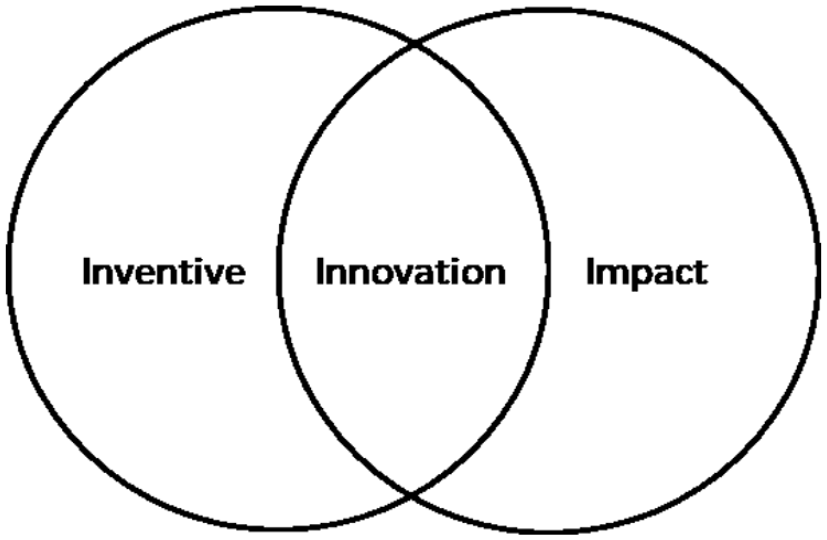
Innovation diagram.
On one hand, innovation has to be inventive. At any point in time, there are numerous novel ideas and potential solutions for policy problems in existence before they are materialized in actual governance acts (Kingdon, 2014). Policy innovation is not only coming up with a new policy idea or solution but also to put it into practice (Fagerberg, 2008). On the other hand, there should be some degree of impact; innovations must change the lives of the people targeted by a policy intervention (Polsby, 1984). In urban food policies, this impact can be related to issues such as reducing waste or shaping healthier diets.
Other scholars have also looked at the diffusion of innovation across contexts (e.g. Gray, 1973; Massey et al., 2014). However, because the focus of this article lies on the effect of governance tools on the actual adaptations of food system policy innovations, we will not investigate the origins and spread of innovations.
In line with the activities of the MUFPP and our understanding of innovation, we argue that cities are highly innovative with regard urban food system policies when they adopt, implement, or sponsor novel practices that effectively address multiple aspects of a food system (production, transformation, transportation, distribution, consumption and disposal), with the aim of having positive impact on urban food system sustainability. We shall also refer to this as high food policy innovativeness, vis-a-vis more limited food policy innovativeness when cities are only innovative in one aspect of the food system.
Cities and urban regions are regarded as a fertile ground for policy innovations. Decision-making at lower levels of government is associated with increasing policy innovativeness, as it is considered simpler to experiment and to design novel policy ideas in local settings (Strumpf, 2002). Moreover, lower-level polities, such as cities or metropolitan regions, are assumed to make it easier to involve stakeholders and to experiment and learn from experiences with existing practices (e.g. Ostrom, 2010). Although cities have a long history of food policies, urban food policies are closely associated with innovativeness. Urban food policies declined with the rise of nation states (Daviron et al., 2019), and it has been a relatively new development for modern cities to engage in the development of food system policies (Halliday, 2019).
Enabling urban food system innovativeness
In this contribution, we are particularly interested in how governance instruments affect variation in urban food policy innovativeness across cities, a link that has not explicitly been explored. Based on the monitoring framework of the MUFPP and Food and Agriculture Organization of the United Nations (FAO, 2019), we identify five governance tools that can be associated with high innovativeness in the development of urban food system policies: government integration, multi-stakeholder food policy and planning structure, integrated urban food policy strategies, mapping for policy development and monitoring. These five conditions may, in conjunction, contribute to explaining food system innovativeness, although each condition individually is not expected to be necessary or sufficient. Moreover, we address the potential effect of the absence of these conditions, and whether this may lead to less innovative policy interventions. In the upcoming section, we will theorize about how these governance instruments contribute to urban food system policy innovations.
Government integration
The presence of an active cross-sectoral and cross-jurisdictional government body for advisory and decision-making on food policies and programmes is expected to contribute to policy innovativeness. Policy integration scholarship argues that most of the contemporary policy challenges – including that of climate change, food security and sustainable development – are crosscutting the boundaries of established jurisdictions, governance levels and policy domains (Candel and Biesbroek, 2016). The complexity and multiple facets of urban food systems call for transboundary governance tools to foster multi-level and multi-sectoral policy-making (Barling et al., 2002; Righettini and Lizzi, 2020). In this view, municipal inter-departmental government bodies are expected to contribute to ensuring effective food policy coordination across dimensions of the food system, enabling integrated actions, especially when combined with a strategic overarching objective (Candel and Pereira, 2017: 90).
Adopting an overarching perspective to urban food systems calls for the city region as the most appropriate scale that enables the development and implementation of an integrated approach to plan urban food systems. Each city region has specific features and constraints and food policies and programmes need to reflect contextual specificities (Ilbery and Maye, 2016). By fostering cross-sectoral and cross-jurisdictional governance integration, cities are devising new approaches and mechanisms dealing with their specific context and enhancing further integration and innovativeness in the design and implementation of food policies. Thus, government integration, both across departments and across jurisdictions, creates opportunities for higher food system policy innovativeness. On the one hand, by creating awareness on cross-sectorial food-related issues, and by creating beneficial situations for effective policy coordination on the other. This implies that the absence of government integration may hamper broader urban food policy innovativeness because especially cross-sectorial innovations will be harder to coordinate when government integration is lacking (De Cunto et al., 2017).
Multi-stakeholder food policy and planning structure
Another way of creating awareness with policymakers on problems and solutions in the food domain is by involving stakeholders in the policy planning structure. The presence of an active multi-stakeholder food policy and planning structure that enhances transparency, collaboration and co-production among participants is the second governance condition we expect to contribute to high food policy innovativeness.
Collaboration with and between stakeholders is crucial in local policy development (Sibbing et al., 2021) and including relevant actors active in the food system, such as citizen associations, producers and private actors contributes to improving and connecting urban foodscapes and building capacity within and across actors and sectors (Sonnino and Beynon, 2015). Recent studies show that cities are very keen to enable strong participatory processes to co-create new food strategies. The involvement of civil society is crucial to identify emerging issues and response gaps and to enable the long-term viability of food policy and planning. This is why involvement of stakeholders in policy planning is positively associated with (incremental) policy innovations (Bason, 2013; Roberts and Bradley, 1991).
Moreover, involving multiple stakeholders also allow the involvement of policy entrepreneurs introducing new policy alternatives and ideas, which account for the positions of more stakeholders (e.g. Meijerink and Huitema, 2010). Accordingly, in line with the literature on stakeholder participation in policy-making, we expect that establishing mechanisms for engagement of different local actors, including civil society and cross-departmental working groups, will contribute to increased public-private collaboration and policy innovativeness (De Cunto et al., 2017). Conversely, the absence of multi-stakeholder involvement in policy planning is expected to hamper wider food system innovativeness. Not having stakeholders participate during policy development may lead to limited openness to new policy ideas and, in addition, can result in adopting policies that are not well received, or may have little impact on food-related practices (e.g. Stathopoulos et al., 2012).
Integrated urban food policy strategy
The third governance tool highlighted by the MUFPP is the presence of an integrated urban food policy strategy. Integrated urban food strategies are policy strategies connecting food to other urban policies in related sectors, such as nutrition, health, education, economy, social affairs or environmental policies at the city level (Doernberg et al., 2019).
De Cunto et al. (2017) associate the development of (integrated) urban food strategies as innovative per definition, as they often take a holistic approach, challenging conventional development practices and established planning models, with additional focus on participation, social inclusion and collaboration between stakeholders and citizens. While acknowledging that urban food strategies certainly play a role in policy innovativeness, these strategies are mostly innovations on paper, not yet in practice. Strategies formulate goals and commitments but are not directly policy instruments for implementation, which is an important analytical distinction. However, integrated strategies do include action points to achieve these goals, of which policy design is often an integral element.
The literature highlights the transformative potential of integrated food strategies, emphasizing the unique role cities can play in innovating the food system (Sonnino and Beynon, 2015). Urban food strategies can create or strengthen connections between governance levels, in the effort of integrating food with other sustainability goals. In this regard, the integration of policy strategies can play a significant role in transforming the urban development agenda and the integration of food policies across different sectors and governance levels, which is crucial for fostering sustainable innovation at the urban level (Marceau, 2008). Moreover, as urban food strategies span the boundaries of several policy domains, it may create spillover effects to coordinate the administrative and political responsibility for the strategy, establishing new institutional arrangements, such as a municipal department of food, or giving the planning department responsible for food or setting up a food policy council (Ilbery and Maye, 2016). Accordingly, integrated urban food policy strategies can trigger further food system policy innovations, especially when combined with an active integrated government body and an active multi-stakeholder structure. The absence of an (integrated) food strategy is expected to make it more difficult to develop innovative policies across the food system because a common touchstone is lacking.
Mapping for policy development
The presence of an inventory of local food initiatives and practices to guide development and expansion of municipal urban food policy is the fourth governance condition associated with urban food policy innovativeness. Understanding and fostering innovativeness in urban areas is crucial to attain sustainable development and the literature on social innovation emphasizes the importance of area-based local development strategies, bottom-up initiatives and local cooperation (Barling et al., 2002; Blay-Palmer et al., 2016; Marceau, 2008).
In this view, local bottom-up initiatives that recognize local strengths and opportunities are crucial to deliver innovative policy solutions. The literature on urban sustainability transitions emphasizes the need to better understand social practices, as they already exist at the local level, without the involvement of local government. The logic here is one of learning from experience. In this view, a practical approach based on the inventory of local initiatives and best practices is advocated, because it allows a more horizontal appreciation of existing innovation practices and helps policies to better reflect the social innovations that take place through food initiatives and related governance structures (Ilbery and Maye, 2016; Wiskerke, 2015). Conversely, when no mapping exercise is undertaken in food policy development, policymakers run the risk of missing opportunities to connect with and strengthen local initiatives, or re-inventing existing practices, with the risk of losing local support and stakeholder engagement. This may limit chances to be innovative, for example, by fostering connections between different initiatives across the food system, or by developing policies that allow existing initiatives to flourish.
Monitoring for policy development
Finally, we look at the presence of a mechanism for assembling and analysing urban food system data to monitor, evaluate and inform municipal policy-making on urban food policies as a condition to contribute to urban food policy innovations. Where mapping exercises can facilitate learning from current practices, timely monitoring can facilitate learning from policy experiences. The availability of data collection mechanisms and analytical tools to describe these systems enables understanding the objectives and impact of these policies and allows for timely adjustments. This is expected to increase in particular the effectiveness dimension of policy innovativeness, in addition to increased accountability (e.g. Hildén et al., 2014). Moreover, monitoring makes policies communicable, which can contribute to creating consensus and support among stakeholders. Not surprisingly, monitoring and assessment of the features of local food systems is often a crucial component of the development and implementation of integrated urban food strategies.
Monitoring and evaluation activities are inherent to the municipal policy-making process that is part of each policy sector. In the case of local food systems, monitoring is often complex because it is difficult to establish boundaries for the impact of food policies which touch upon multiple issues and domains. However, omitting monitoring and evaluation practices altogether would result in missed opportunities for further food policy innovations (Hildén et al., 2014).
Materials and methods
Case selection and scope conditions
To investigate the link between governance tools and urban food policy innovations we will look at European signatory cities of the MUFPP. However, not all signatory cities of MUFPP are actively pursuing urban food policy innovations. In many cases, signing the MUFPP may be mostly a symbolic gesture (Candel, 2020). Therefore, we only look at signatory cities that have been awarded for their innovations by receiving at least one MUFPP best practice award in 2019 and 2020 in one of the following categories: sustainable nutrition and diets, social and economic equity, food production, food supply and distribution or food waste. These awards are granted to cities that have submitted innovative practices and are judged by a committee on the basis of criteria for innovation, impact, inclusion and overcoming adversity. These criteria match our conceptualization of urban food policy innovativeness of inventiveness and impact. The highest-scoring policy practices, judged by an international committee of academic, UN agency, civil society and media experts, in each category are awarded, and receive recognition for innovative urban food policy practices (FAO, 2018: 5; MUFPP, 2022). This case selection approach led to an initial selection of 31 cities, which was later reduced to 26 due to data availability limitations. 2
We investigate whether and how (combinations of) specific governance tools drive cities that are committed to a sustainable urban food system are innovative in their food policy development across multiple dimensions of the food system, vis-a-vis more limited innovativeness. Therefore, we only include cities in our analysis that are recognized with a minimum of one MUFPP award, as an indicator of being actively engaged and committed to both this network and its goals. Moreover, the development of food policies in these cities can be expected to fit a joint agenda and notion of food policy innovations (Martín and De la Fuente, 2022). An advantage of this case selection strategy is that because these cities are more engaged there is better data availability and self-reporting on governance related to food. This makes the research more efficient and minimizes the risk of omitting governance instruments due to lack of reporting.
Materials
For our data collection, we identified the presence of the different governance instruments through an analysis of official municipal documents and webpages. We selected these documents by using the search query options on the websites of the selected cities where we looked for various search terms related to food policy and governance in both English and the local language. 3 Moreover, we have used Google and Duckduckgo to find additional documents by using the same search terms and looking through the first two result pages. The documents and websites retrieved through this search strategy were analysed to find information on the presence of the various governance instruments, and the extent to which they are active. A more detailed overview of the coding and sources used can be found in the Supplemental appendix.
Methods: qualitative comparative analysis
For our analysis, we apply QCA, a method based on Boolean logic. This methodology is suitable for modelling causal complexity and particularly gaining insights into causation, drawing on three main assumptions. First, conjunctional causation. This means that theoretically, we expect that different combinations of conditions will contribute to explain policy innovations. Second, equifinality. This means that multiple non-exclusive combinations of governance instruments may explain policy innovativeness. QCA offers the most systematic way of analysing these types of relations (Legewie, 2013; Schneider and Wagemann, 2012). Finally, asymmetric causation. In this background, the explanation for policy innovativeness (positive outcome) may be different from the explanation for limited innovation (negative outcome). For this purpose, we will run separate analyses for both high and low innovativeness. Moreover, QCA is frequently prescribed as a useful approach for comparing cases across medium-sized samples, ideally for 10–50 cases (Rihoux and Ragin, 2008; Schneider and Wagemann, 2012).
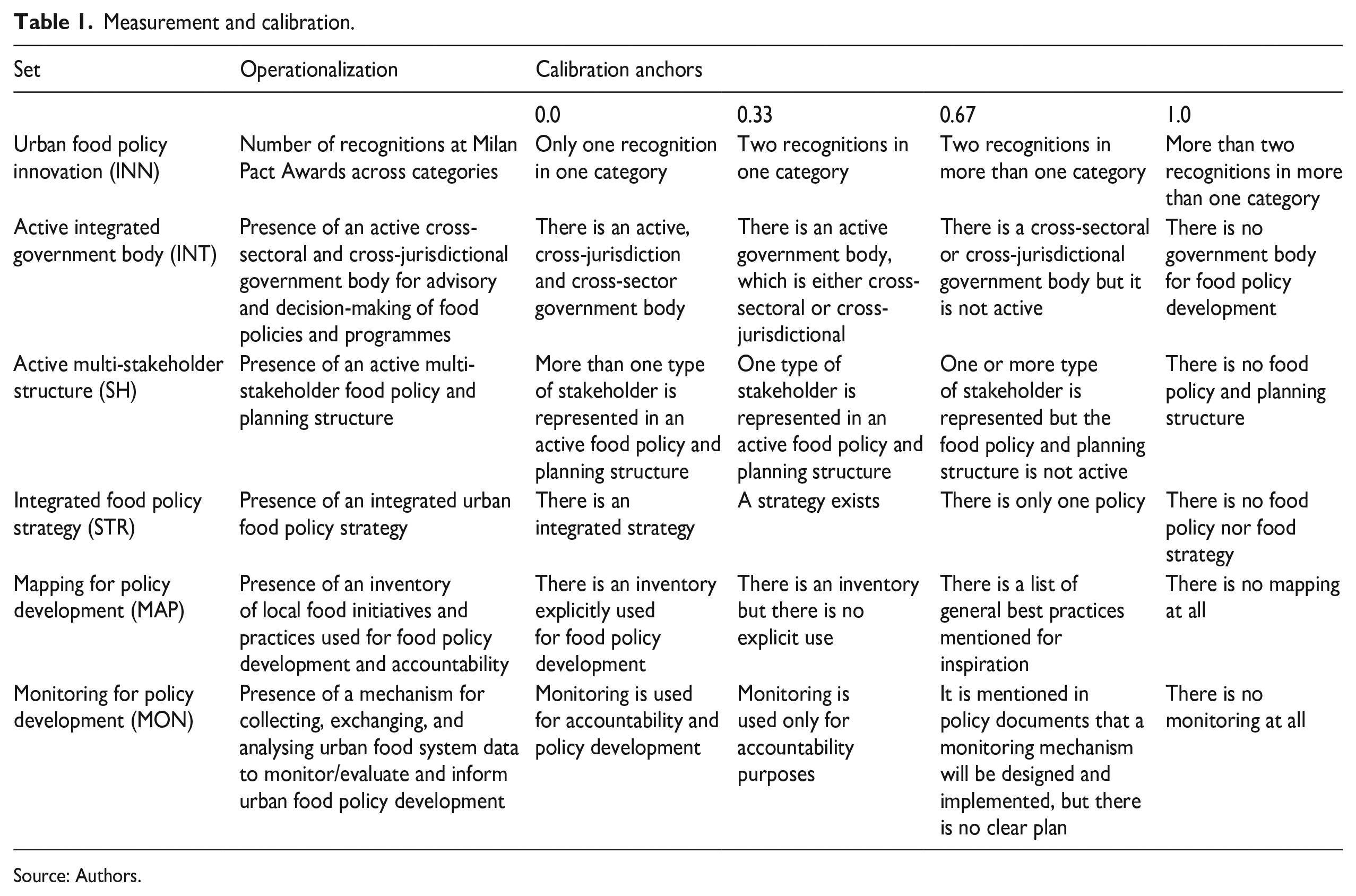
In the specific fuzzy-set approach to QCA we apply in this article, the different conditions are treated as sets of which cases have different degrees of membership. We have assigned set-membership scores on the basis of qualitative research using the criteria that can be found in Table 1, in which we explain how we measured the outcome and the five explanatory conditions, and how we determined the membership of cases in the sets. Qualitative anchors are set to determine whether the different cases are a full member of a set (1), a partial member (0.67), a partial non-member (0.33) or completely out of a set (0).
Measurement and calibration.
Source: Authors.
QCA uses truth table analysis to find necessary and sufficient conditions, or combinations thereof, for the explanation of a specific outcome (e.g. Legewie, 2013). As a first step, we will run an analysis of necessity to check whether there are necessary conditions present. In the second step, we run an analysis of sufficiency and interpret the so-called intermediate solution, in which assumptions about the unobserved truth table rows will be made in accordance with the direction of our theoretical expectations. 4
The outcome of the analysis will provide combinations of the presence or absence (indicated by the tilde, ~) of conditions which can be seen as sufficient for explaining the outcome, or its negation. The * sign signifies AND, indicating that several conditions occur in conjunction. These paths are combined with the logical OR (+ sign). The explanatory power and empirical relevance of the solutions are evaluated through measures of consistency (the extent to which a path or solution is sufficient) and coverage (the proportion of observed cases explained by a path or solution). For the analysis, we have used the software packages QCA and SetMethods in R (Duşa, 2007; Oana and Schneider, 2018).
Findings
To understand variation across cities that are active in the definition and implementation of innovative urban food policies for the management and governance of local food systems, we look for configurational explanations of both high and limited urban food policy innovativeness, providing empirical evidence from 26 European cities.
Analysis of necessity
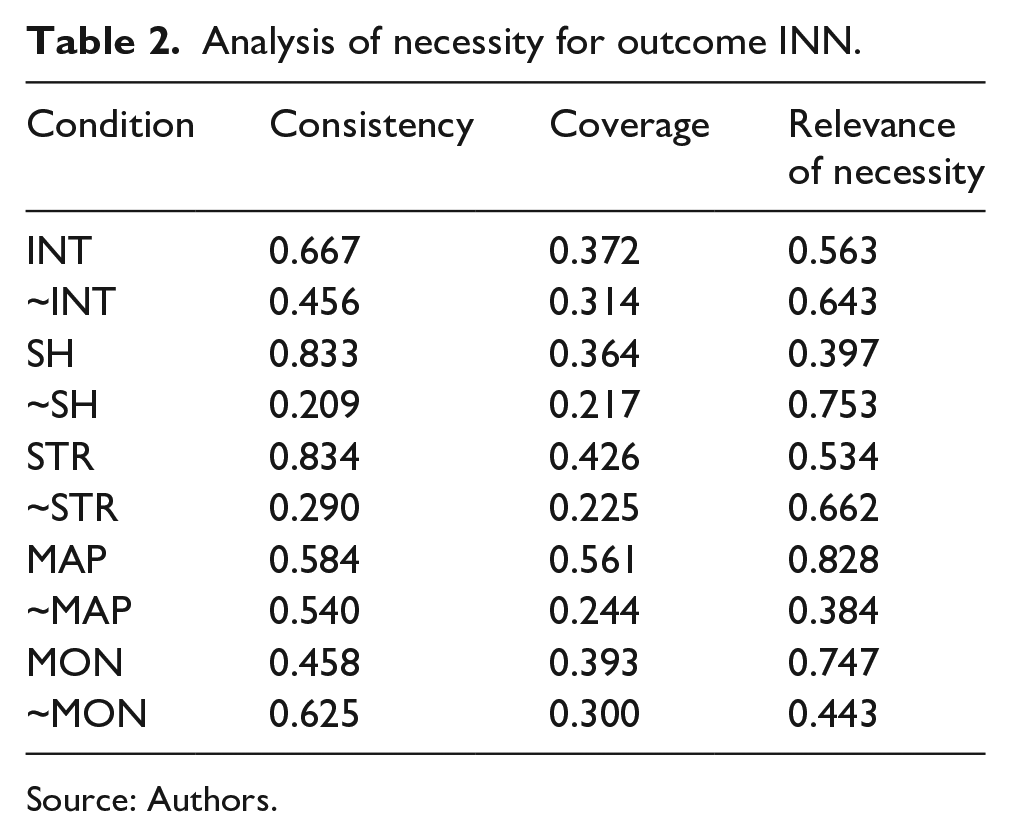
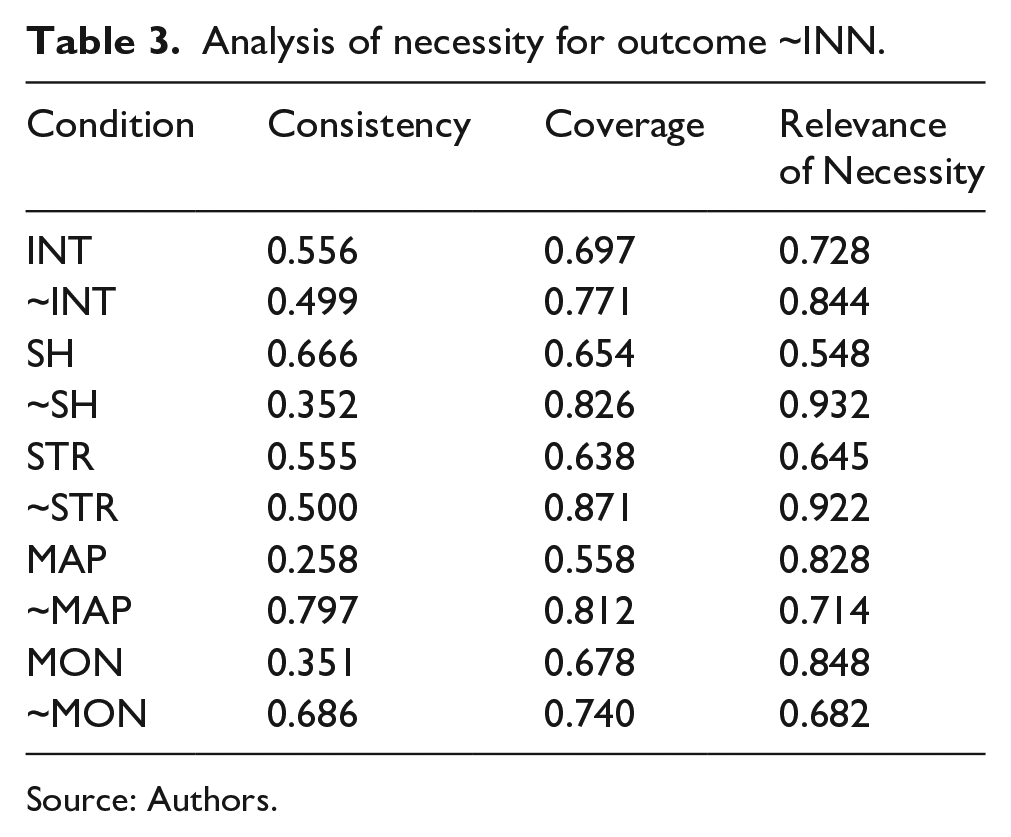
Tables 2 and 3 show the results of the analysis of necessity. Necessity is identified by two measures: consistency, which quantifies the strength of the relation, and coverage, which indicates the empirical relevance of the relationship to cases. A condition is regarded as necessary for explaining an outcome when the consistency of necessity is equal to or higher than 0.9 (Schneider and Wagemann, 2012: 143). For necessary conditions, the relevance of necessity (RoN) expresses the trivialness of the findings, where scores closer to 0 indicate higher trivialness, and scores higher than 1 indicate higher relevance.
Analysis of necessity for outcome INN.
Source: Authors.
Analysis of necessity for outcome ~INN.
Source: Authors.
The analysis of necessity reveals that none of the conditions is strictly necessary for the explanation of both high and limited urban food policy innovation.
Sufficient conditions for limited urban food policy innovation
As briefly introduced in the methodology section, we use consistency and coverage measures to evaluate the results of our analysis. The values of these measures can range from 0 (low) to 1 (high). Consistency is the extent to which the results are in line with the statements of sufficiency. For sufficient conditions, consistency is provided for single truth table rows (raw consistency), for single configurations or for the entire solution term. The proportional reduction in inconsistency (PRI) describes the degree to which a given configuration is (not) simultaneously sufficient for both the occurrence and the non-occurrence of the outcome. Coverage of sufficiency features how well the model explains the available empirical cases in an outcome set. Raw coverage describes the proportion of cases covered by a single configuration, and unique coverage indicates the proportion that is only covered by this specific configuration.
Setting a consistency threshold is decisive for determining which configurations of conditions are sufficient. Since consistency values strongly depend on the specific dataset, truth table and case distributions, there are no fixed anchors for setting these thresholds. In this study, to evaluate the accuracy of the explanatory models for high and low urban food policy innovativeness, we set the sufficiency threshold at 0.8 (Schneider and Wagemann, 2010; Schneider and Wagemann, 2012).
The analysis of sufficiency for high urban food policy innovativeness yields a surprising result: we find no sufficient configurations of governance instruments that allows explaining high urban food policy innovativeness. This means that in a set of innovative cities, our governance conditions cannot explain why some cities are highly innovative instead of limitedly innovative. This is somewhat puzzling, and we will get back to the theoretical implications of this finding in our discussion. When we take a closer look at the truth table (see Table A4 in the Supplemental appendix), we observe that in some of the highly innovative cases, such as Almere and Milano, all governance instruments are present. However, because many of these indicators are also present in other cases that are in the set of limited innovative cities, the consistency of these truth table rows is low.
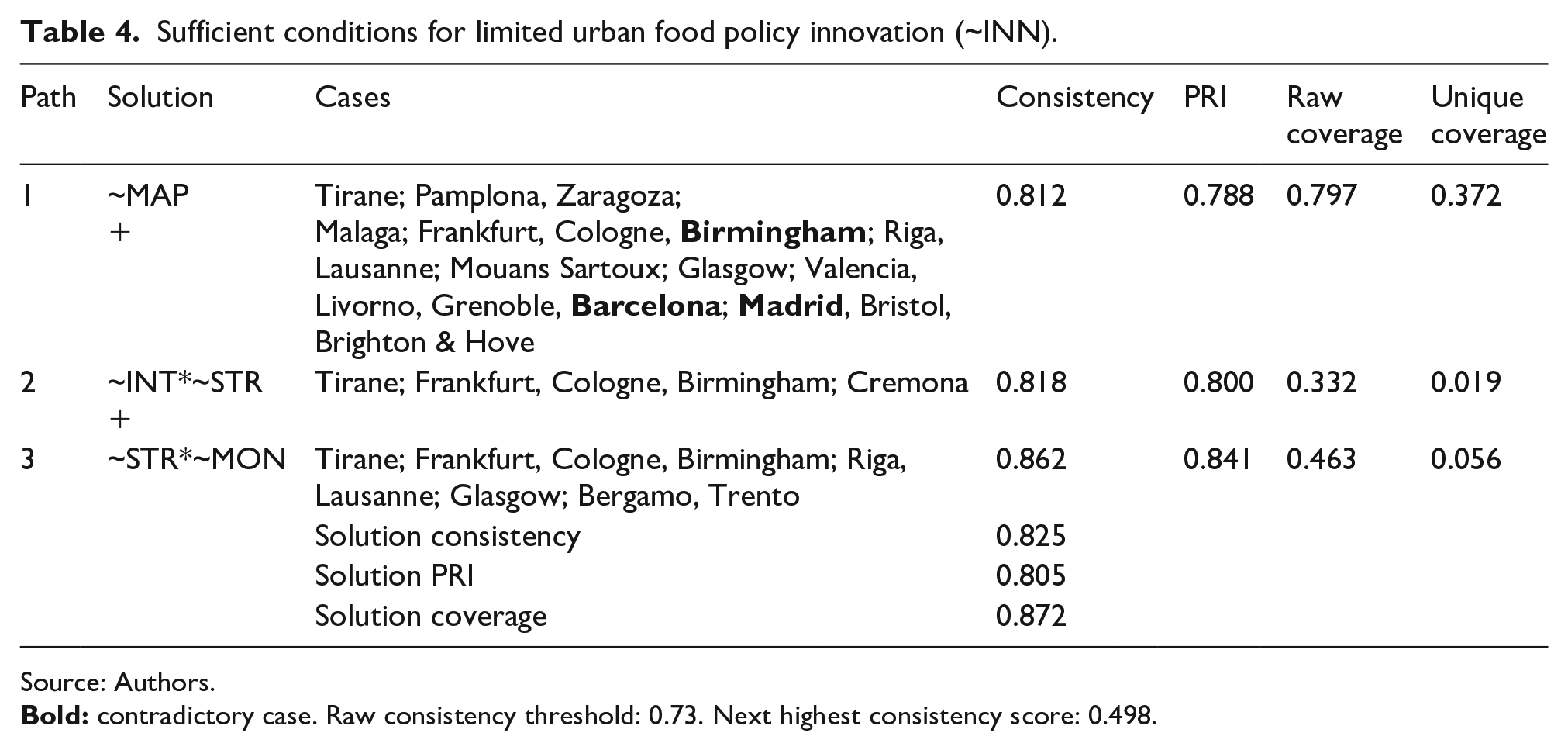
We do find three configurations of different governance tools, so-called paths, in our analysis, which are sufficient for explaining limited urban food policy innovativeness. These paths are presented in Table 4. The individual cases that are explained by each path, the consistency and coverage indicators for each individual path, and the overall solution are listed below. It is important to note that some cases can be explained by multiple sufficient paths (in line with the assumption of equifinality).
Sufficient conditions for limited urban food policy innovation (~INN).
Source: Authors.
In the first configuration, or path, the absence of an inventory of local food initiatives and practices for food policy development and accountability purposes is sufficient for explaining limited urban food policy innovation. In the second path, the absence of an active cross-sectoral and cross-jurisdictional government body for advisory and decision-making of food policies and programmes unfolds its effect in conjunction with the absence of an integrated urban food policy strategy. In the third path, the absence of an integrated urban food policy strategy in combination with the absence of a mechanism for collecting, exchanging and analysing urban food system data to monitor, evaluate and inform urban food policy development contributes to limited innovativeness. Both the individual paths and the complete solution have good consistency scores (>0.8), and the complete model has a high coverage (>0.85), indicating that these configurations are consistently sufficient, and explain a large proportion of the empirical cases with limited innovativeness.
As the final step of our analysis, we check how the cases in our analysis for limited innovation (~INN) are distributed in an XY plot (Schneider and Wagemann, 2010). The XY plot shows the distribution of cases by their fuzzy membership scores on the outcome against their membership in the solution (see Figure 2). The main diagonal, where X = Y, is where cases fall for which the presence of the solution X is together necessary and sufficient to the occurrence of the outcome Y. Below the diagonal, where Y < X, X is necessary to Y, and sufficient above, where Y > X. A good solution has to result in all the positive cases (Y > 0.5) also displaying the solution (X > 0.5) and lying above the diagonal (Y > X), and all the negative cases (Y < 0.5) not displaying the solution (X < 0.5). Cases situated above the diagonal are consistent. In the upper left quadrant are deviant cases for coverage, and in the lower right, quadrant are cases deviant in consistency and in kind (Schneider and Wagemann, 2012). The XY plot indicates that there are three deviant cases in consistency and in kind: Madrid, Barcelona and Birmingham, which is also indicated in Table 4. This means that in these cities, the conditions for limited innovation are present, but they belong to the set of cities with high innovation, rather than limited innovation. Such deviant cases in consistency are relevant to grasp the full extent of causal complexity. To this background, additional research will be needed, to establish the causal mechanism existing between the causal conditions and outcomes, and to advance the internal validity of our study.
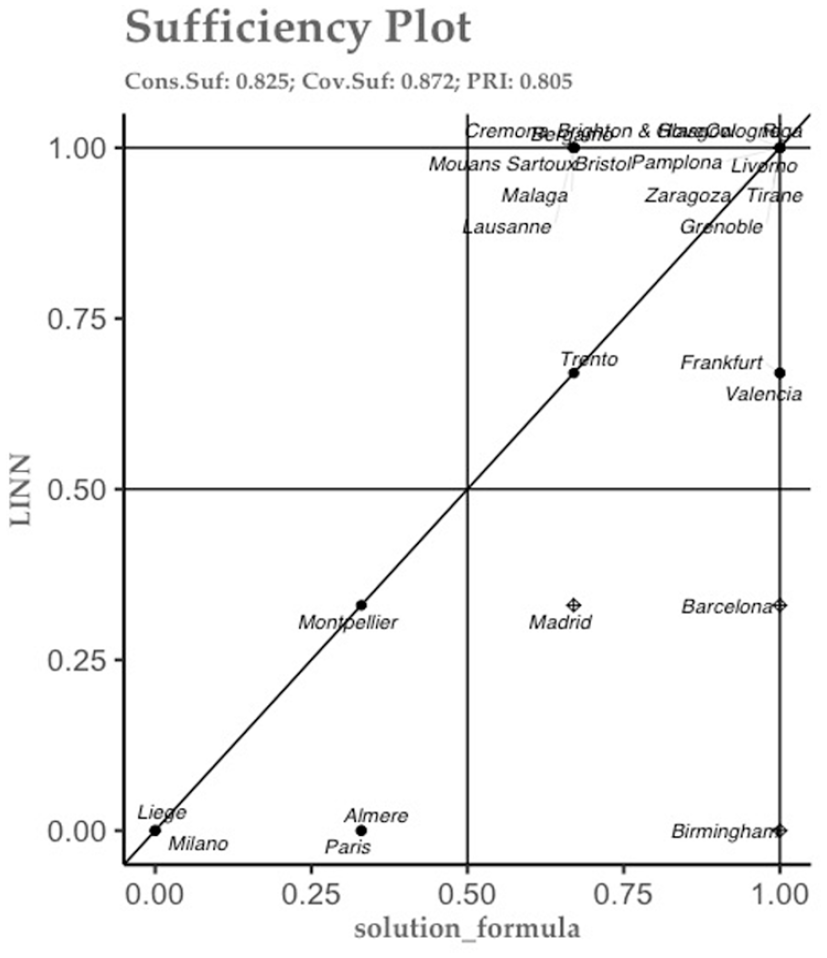
Sufficient conditions for limited urban food policy innovation.
Discussion and policy implications
The first key finding is that the observed governance tools could not provide sufficient explanations for high levels of urban food system policy innovativeness. Against the assumption of conjunctural causation, the presence of these governance tools is not necessary nor sufficient per se to foster innovation. Nevertheless, we contend that these governance instruments may still be regarded as relevant conditions for which the presence can contribute to food system policy innovativeness, albeit, in combination with other conditions, which we need to further explore. Moreover, we are hesitant to dismiss the potential effect of these governance tools altogether, because they do play a role in explaining why some cities are only limited innovative, as we will discuss next.
Second, we clearly find evidence that the absence of the governance conditions can explain limited innovativeness. Hence, the combined absence of these governance tools should be seen as hindering innovation. The implication of these findings is that if certain governance instruments are not present, this may prevent cities to develop policy innovations across the food system.
Food system innovations are gaining priority in the policy agenda of cities, but remain a challenge, as they require comprehensive strategies and adequate monitoring mechanisms. From the 26 European cities under scrutiny, we see that there are different patterns to explain limited urban food policy innovativeness. Because we only included cases in our analysis that are already considered to be somewhat innovative, our findings do not imply that removing these governance tools causally triggers non-innovativeness, but they offer an explanation of why these cities may be prevented from taking the next step to being highly innovative.
In this regard, we identify three paths for explaining limited innovativeness. First, we find the absence of mapping local food initiatives and practices as hindering factor for innovation (path 1), which is the most important condition in this regard, indicated by both high raw and unique coverage scores, in combination with a high level of consistency. In 16 cities out of 26 under scrutiny, the omission of this specific type of mechanism for learning from existing innovative food practices contributed to limited urban food policy innovations. Theoretically, this implies that promoting projects dedicated to exchange the best practices among stakeholders within and across food systems could play a role in fostering further innovativeness. As food system innovations are a relatively new area of policy development in many cities, there are valuable insights lot to be gained from mapping and exchanging good practices and lessons learned, and as our analysis shows: not doing so can limit the innovative capacity of cities.
Second, the analysis shows that not having an integrated urban food strategy plays a major role in hindering innovativeness, both in interplay with missing government integration across and between city departments, sectors and other jurisdictions (path 2), or with a lack of monitoring mechanisms and missing links between research, practice and policy (path 3).
Cities design and implement their food strategies differently: some develop comprehensive cross-sectoral and cross-jurisdictional strategies and long-term plans, while others still work on separate policy interventions, often led by different city departments. We find that this lack of institutional integration, combined with not developing an integrated strategy may hamper further policy innovativeness. As a policy implication, these findings suggest that not integrating different domains, either through institutional collaboration or the development of a shared strategy hampers further food system policy innovativeness across multiple dimensions of the food system.
Similarly, the combination of no institutional integration and the absence of monitoring for effectiveness and impact hampers further innovations, emphasizing the importance of monitoring tools. In addition, in some cities, multiple mechanisms apply. For example, in Tirane, Frankfurt and Cologne, multi-sector and multi-level mechanisms are lacking, as well as a mechanism for collecting, exchanging and analysing urban food system data to monitor, evaluate and inform urban food policy development.
Finally, neither the presence nor the absence of stakeholder involvement is found as a relevant condition. Theoretically, we expected that the presence of platforms for stakeholder involvement in food policy design would contribute to high innovativeness, and that the absence would have a hindering effect. One of the anticipated mechanisms here is that stakeholder involvement could open a window of opportunity for policy entrepreneurs to push for new innovations. Although, looking at formal structures for involving multiple stakeholders evidence in this direction is lacking. This may imply that successful stakeholder engagements can still occur through informal venues (see, for example, Polman and Alons, 2021). Moreover, stakeholder involvement may still play a role in enabling high innovativeness; however, our findings indicate that in combination with the investigated governance tools this cannot offer a sufficient explanation.
Although the governance innovations formulated by the MUFPP and the FAO, we included in our model do not contribute to explain why cities are highly innovative, the outcomes of the analysis allow us to highlight conditions that hamper limited innovative cities to take the next step in urban food policy innovativeness across dimensions of the food system.
Conclusion
In this article, we have looked at the extent to which configurations of specific governance tools can explain why some cities are more innovative across the food system in designing urban food policies than others. Our findings indicate that the government integration, stakeholder involvement, food strategy development, mapping and monitoring and evaluation cannot, either individually or in conjunction, explain why cities are highly innovative with regard to food system policies. However, we do find that (combinations of) the absence of these governance instruments can provide explanations for why some committed cities are limited in their innovativeness and are not yet making the next step to being highly innovative with regard to their food policies. In particular, these conditions are the absence of mapping of local food practices, and the absence of an integrated food strategy, either in combination with the lacking government integration or with the absence of a monitoring framework. As a policy implication, the outcome of this study suggests that not using these governance tools hampers further food system policy innovativeness across multiple dimensions of the food system.
Theoretically, for the understanding of urban food governance, our findings imply that these governance tools we have investigated are not sufficient for explaining governing for innovativeness across dimensions of the food system. Thus, other factors are required. Moreover, we add to our understanding of urban food system governance that lacking inspiration and insights on existing initiatives through mapping, or the absence of institutional integration in combination with either no strategy development or monitoring framework play a role in explaining why some committed cities are only limited in their food system policy innovativeness.
Our methodological choices entail some limitations with regard to the reliability and validity of the findings. Concerning reliability, our measurement and calibration depend on self-reporting of municipalities under scrutiny; therefore, information not published by the municipalities was not included, leading to a potential bias.
With regard to the (external) validity, we apply a modest view on generalization (Rihoux and Ragin, 2008; Thomann and Maggetti, 2020): whether the results can be applied to different cities remains to be tested. On the one hand, we have studied comparable cases for which we know that they engage in food policy innovations (Filippini et al., 2019). On the other hand, this case selection strategy may miss out on other types of innovations not recognized by the MUFPP.
The outcomes of our analysis also expose a new puzzle: why these governance indicators cannot explain high urban food system policy innovativeness? In this regard, we see a number of avenues for further research.
First, to fully assess if these governance instruments include necessary conditions or sufficient configurations for urban food system policy innovations, future research should also compare cases that are regarded as completely non-innovative with innovative cases, where different conditions are expected to play a role. Second, we have only looked at the presence and activity of the different governance instruments. However, many of the causal mechanisms behind the possible relationship between governance tools and innovation take place in the content and processes of the implementation of these tools. There is a qualitative difference between stakeholder participation processes in, for example, food councils or public consultations, and whether these are, for example, initiated top-down, or bottom-up. Third, further research can refine this governance model by adding or dropping conditions. For example, conditions of government integration and integrated strategy could be combined in one condition accounting for higher levels of policy integration. Similar steps could be applied to mapping and monitoring instruments, which may be condensed into one condition capturing learning capacity and activity. This would provide room for the inclusion of other procedural instruments, or political and institutional factors that may play a role in urban food policy innovations.
Finally, the assumption of asymmetrical causation enabled us to acknowledge the existence of a different explanation for limited innovativeness against high innovativeness, where the absence of some governance instruments proved to be sufficient for limited innovativeness. In this background, we may use these findings to further investigate the causal relation between these governance conditions hindering innovativeness and potential difference-makers towards improved innovativeness.
Supplemental Material
sj-docx-1-eur-10.1177_09697764231165203 – Supplemental material for Governance tools for urban food system policy innovations in the Milano Urban Food Policy Pact
Supplemental material, sj-docx-1-eur-10.1177_09697764231165203 for Governance tools for urban food system policy innovations in the Milano Urban Food Policy Pact by Daniel Polman and Giulia Bazzan in European Urban and Regional Studies
Footnotes
Authors’ Note
Giulia Bazzan is now affiliated Tilburg University, Department of Public Law and Governance, the Netherlands
Declaration of conflicting interests
The author(s) declared no potential conflicts of interest with respect to the research, authorship and/or publication of this article.
Funding
The author(s) received no financial support for the research, authorship and/or publication of this article.

Supplemental material
Supplemental material for this article is available online.
Notes
References
Supplementary Material
Please find the following supplemental material available below.
For Open Access articles published under a Creative Commons License, all supplemental material carries the same license as the article it is associated with.
For non-Open Access articles published, all supplemental material carries a non-exclusive license, and permission requests for re-use of supplemental material or any part of supplemental material shall be sent directly to the copyright owner as specified in the copyright notice associated with the article.
